In contrast to the classical gold standard (1873–1914), the interwar gold standard lasted a mere six years, before it collapsed in the early 1930s. A multitude of theories and hypotheses address the question of why the interwar gold exchange standard was so fragile. Economists have traditionally cited structural problems within the system such as the alignment of exchange rates, gold imbalances, the lack of an international hegemon, or persistent deflation as possible causes.Footnote 1 More recently, researchers have suggested that the changing social and political structures in the interwar years contributed to the economic difficulties, arguing that the reconstruction of the gold exchange standard in the years following World War I was incompatible with the rise of democracy.Footnote 2
The question of when and why countries choose to abandon fixed exchange rate regimes is one of the key questions in international macroeconomics. It is particularly interesting with respect to the relationship between exchange rate regime choice and the propagation of financial crises. The interwar gold exchange standard was characterized by Keynes as the “Golden Fetters” that had to be shed by Britain to avoid a prolonged crisis.Footnote 3 It thus provides an excellent example for deepening out understanding of the factors that contribute to instabilities in fixed exchange rate regimes. Here history allows us to study the stability of various fixed rate regimes under consideration of all determining factors.Footnote 4
Despite all the research on the gold standard, no one has yet weighed all the different economic, political, and social factors that contributed to its collapse. This article offers the first rigorous approach that simultaneously tests all the economic and political factors that influenced the disintegration of the interwar gold standard in a dynamic framework. The dynamic approach allows one to model when countries chose to leave the regime. It is implemented by applying a duration model to 24 countries. Moreover, the article explicitly models the changing survival probabilities of countries on the gold standard—the probability that a country would remain on gold given that it had not yet abandoned it. Countries left the gold standard with very different survival probabilities.
With respect to the results, high per capita income, international creditor status, and the prior experience of hyperinflation extended the time a country would remain on gold. In contrast, democracy, sterling bloc membership, high inflation rates, unemployment, and the experience of banking crises shortened the time a country would stay on the gold standard. Britain, it turns out, was something of a fair weather friend that left the gold standard when it had a 70 percent survival probability, whereas other key countries in the system remained on gold until survival probabilities had fallen below 20 percent.
THE INTERWAR GOLD EXCHANGE STANDARD: A BRIEF HISTORY
By the end of World War I most countries previously on the gold standard had abandoned their peg to gold.Footnote 5 Exchange rates were floating freely and extremely volatile. In search for a new monetary order, governments and central bankers demanded an international currency system with stable exchange rates. They longed for the prewar order of the classical gold standard, which had promoted trade, financial integration, and prosperity.Footnote 6 But officials hesitated to re-instate the prewar system, out of fear that it would induce a global shortage of gold. Because wartime inflation had shifted price levels, a return to gold at the prewar parity would have implied that many countries had overvalued their currencies. The pressure to return to prewar parities would induce deflation and thus delay reconstruction and the resumption of economic growth. A return at new exchange rates, in contrast, might have worsened a worldwide gold scramble and would have raised questions about the credibility of the new regime.Footnote 7
The establishment of an interwar monetary system was further complicated by a number of historical events, the most important of which was the problem of postwar reparation payments.Footnote 8 Although the peace treaties held Germany and its allies responsible for the war and burdened them with reparation payments, the actual amount of the payments was negotiated country by country throughout the early 1920s. The reparation demands of the war winners and the official judgment of what the losers would be able to pay differed widely. For Germany, the large reparation demands, as well as the French commitment to extract them by force, led to a devastating budget situation and accelerated the hyperinflation.Footnote 9 Moreover, the war-torn economies of Europe were in dire need of international support to finance reconstruction, but the war had left the major powers entangled in a web of accumulated debts. The United States had become Europe's major creditor and was the only country capable of granting financial assistance in the immediate postwar years.
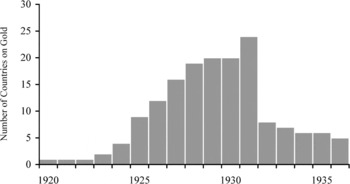
The emergence of the interwar gold standard was linked to Britain's decision to go back on gold in April 1925. By then, Britain felt pressured to return to gold, as other countries contemplated stabilizing their currencies. If it remained off gold while other countries adopted gold as their monetary anchor, then even more gold reserves and deposits would have shifted away from London and to New York. To halt the gold outflow, Britain returned to gold at the prewar parity, a choice that was regarded as a key signal of stability and credibility for the new system.Footnote 10 In fact, by the end of the year 1925, a number of countries had once again made gold their monetary anchor. Figure 1 shows the emergence of the gold standard during the late 1920s for the 24 countries used in this analysis.
NUMBER OF SAMPLE COUNTRIES ON THE GOLD EXCHANGE STANDARD

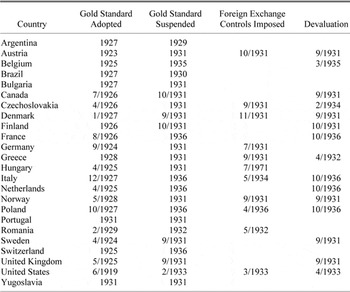
The system began to build slowly in the 1920s, spread more quickly after Britain's adoption of gold in 1925, and reached its height in the years 1927–1931. It then fell apart in the 1930s. The average time a country remained on gold was 6.75 years. Two countries in the sample, Portugal and Yugoslavia, both adopted the gold standard for only one year. The United States, the Netherlands, and Switzerland remained on gold the longest, 12 years each. Table 1 lists when the individual countries included in this analysis adopted and abandoned the gold exchange standard.
The interwar gold standard operated as an exchange standard system centered around key currencies. Adopting the gold standard brought stability to the international financial markets and introduced a brief period of economic growth. Nevertheless the system could not repeat the classical gold standard's success, and its problems soon became apparent. Relations between the United States and Britain were tainted by differing ideas on the merits of the gold exchange standard versus the pure gold standard and worsened after the governor of the New York Federal Reserve Bank, Benjamin Strong, died in 1928.Footnote 11 At the same time Britain and France continued to compete for financial dominance in Europe. These difficulties kept the monetary system from responding effectively to world-wide economic problems.
COUNTRIES ON THE GOLD EXCHANGE STANDARD, 1919–1938

Sources:
Bernanke and James, “Gold Standard”; and Eichengreen, Golden Fetters.
THE FRAGILITY OF THE INTERWAR SYSTEM
A variety of arguments have been used to explain the interwar system's fragility and its short life span. Most existing studies however, focus on the experience of individual countries or on specific economic and political criteria that made it difficult for countries to remain within the gold standard system. After summarizing these studies in a way that carefully distinguishes between economic factors on the one hand and political and institutional factors on the other, I integrate these arguments via a comprehensive empirical study.
Economic Arguments
Already in 1947 Robert Triffin pointed to the instabilities of the interwar system.Footnote 12 The exchange nature of the gold standard limited the overall gold needs of the system, but it also led to an inherent imbalance. The system placed pressure on the center countries to maintain their gold convertibility, but countries on the periphery, which held their reserves in the currencies of the center countries, possessed no enforcement mechanism over the center countries. As the world economy grew, and with it the demand for reserve currency, the center countries were tempted to increase their money stock. But increasing the liquidity of the reserve currency entailed the risk of a crisis of confidence for the entire system because it jeopardized the center currencies' link to gold.Footnote 13
Besides this inherent flaw in the system's design, the interwar system was also characterized by structural problems and persistent gold imbalances between the center countries.Footnote 14 France and the United States had policies to sterilize gold inflows, leading to the accumulation of gold reserves in both countries. Britain, in contrast, suffered from large gold outflows. Unfortunately, the adjustment mechanism of the gold standard did not succeed in eliminating these surpluses and deficits in the balance of payments.
Deficit countries were constrained by reserve losses and had to deflate in order to maintain fixed parities. Surplus countries, by contrast, allowed their foreign investments to increase without making an upward adjustment in their money supply or price levels.
This led to a steady decline in world prices contributing to the problem of widespread deflation.Footnote 15 According to Beth Simmons, growing central bank independence in the years following World War I exacerbated the problem of deflation.Footnote 16 Because independent central banks were virtually obsessed with inflation and price stability, they reinforced the deflation brought on by limited availability of gold.
The gold imbalances during the interwar years document the central banks' lack of cooperation. Whereas countries in financial difficulties could borrow from their neighbors during the classical gold standard years, this international support was no longer available in the years after the war.Footnote 17 A gold shortage in one country could therefore turn into a crisis of confidence for the entire system, rather than being solved cooperatively. This lack of leadership was aggravated by the shift of financial power from London to New York, which eliminated England's capacity to maintain global balance through movements of its discount rate.Footnote 18
More recently, Maurice Obstfeld, Jay Shambaugh, and Alan M. Taylor have characterized the difficulties of the interwar standard as a classical open economy trilemma, namely the inability of policy makers to simultaneously pursue a fixed exchange rate, open capital markets, and autonomous monetary policy.Footnote 19 Such an open economy imposes constraints on domestic policy makers that force them to decide between fixed exchange rates and an autonomous monetary policy.
Political Arguments
Political interpretations of the fragility of the gold standard regime include those of Barry Eichengreen, Simmons, and more recently Gabriel Tortella and Hans-Joachim Voth.Footnote 20 While Voth illustrates the importance of political events and their transmission to the stock markets, Eichengreen and Tortella both focus on the extension of the political franchise to the working class. This new political environment made governments reluctant to place external adjustment before domestic concerns over rising unemployment and economic inequality. Especially heavily indebted, small, open economies could only rely on expanded exports and limited imports to defend gold convertibility. But falling commodity prices in the late 1920s made this strategy difficult and forced countries to suspend external debt service or abandon the gold standard. If governments were willing to let the exchange rate depreciate, they would not be forced to pursue policies designed to compress domestic spending. On the other hand, convertibility served as a signal of confidence for domestic savers and international investors.Footnote 21Table 1 shows how countries actually chose different ways of leaving the regime. In particular, countries with large outstanding external debts, such as Austria and Germany, opted for exchange controls before official suspension in order not to increase their liabilities.
According to Simmons, democratic regimes and countries with a higher degree of openness were more likely to leave the gold standard.Footnote 22 In contrast, central bank independence, higher net national product, a greater net external investment position and a higher left-wing participation in government increased a country's probability of staying on gold.
The interpretation of political pressure and its effects on the stability of the regime can be related to the recent work on exchange rate regimes, currency crises, and the relationship between political institutions and economic outcomes.
There is a growing literature on the relationship between economic growth and democratic institutions.Footnote 23 With respect to the exchange rate regime, several researchers have pointed out that the decision to leave an exchange rate regime is not only an economic but also a political question.Footnote 24 Factors that matter for the willingness to defend or devalue a currency are electoral timing, constituent interests, and government partisanship. The desire to defend the existing regime often increases in the run-up to an election, but falls with the arrival of a new government or new political regime. Abandoning the peg often comes with voter disapproval and loss of pride.
Government partisanship relates to the idea that parties on the left place more emphasis on employment and income distribution while parties on the right are more concerned with fighting inflation and maintaining price stability.Footnote 25 Therefore left-of-center political parties might be more responsive to the demands of the domestic working class and place internal stimulation of the economy over external balance. Sometimes, however, a reverse effect can be observed, where left-of-center governments hold onto fixed exchange rate regimes as a signal of their commitment to external stability.Footnote 26 During the interwar years, many governments were bound by coalition agreements or were in a minority governing position, which restricted their policy choices and might have induced left-of-center governments to behave as centrists, or right-of-center governments to be socialist. Albrecht Ritschl, for example, describes the case of Germany following the September 1930 elections.Footnote 27 The centrist government led by Brüning was squeezed between the demands of the Social Democrats on the left and the advances of the NSDAP (National Socialist German Workers Party) on the right of the political spectrum. Similarly, Eichengreen outlines in detail the deadlock in the British Parliament on the decision to abandon the gold standard.Footnote 28 The Labor Government was incapable of remedying the budgetary problems and fell; it was replaced by a National Government, which then abandoned the gold standard regime.
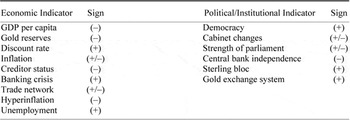
SUMMARY OF ARGUMENTS EXPLAINING THE COLLAPSE OF THE INTERWAR GOLD STANDARD

Source:
See the text.
Combining the Two
Table 2 summarizes all the arguments made about the collapse of the gold standard.
Rather than focusing on the individual factors that drove countries off gold in the 1930s, this article attempts to integrate these different arguments into a comprehensive empirical study. As of now these explanations for the collapse of the interwar system stand largely on their own. Though a vast array of research exists, there is no systematic study that evaluates, compares, or systematically analyzes these various explanations. Moreover, there are very few actual tests on the influence of politics and the pressures generated by rising democratization.
The study by Simmons is probably the closest example for the analysis carried out in this article, the main empirical difference being that her findings are based on a static probit model, rather than a dynamic framework as applied in this article.Footnote 29 Moreover, this analysis extends Simmons's work by including additional countries and a much wider range of economic and political control variables. The results confirm Simmons's basic findings with respect to democracy, national product, and the investment position, but the results differ with regard to the influence of trade, central bank independence, and left-wing participation. In addition, this analysis explicitly models the survival probabilities of key countries on the gold standard, an extension only possible in the dynamic framework. These survival probabilities further illuminate how the interplay of economics and politics affected the tradeoff between internal and external adjustment that countries faced at the time.
EMPIRICAL ANALYSIS
The empirical analysis in this study highlights the importance of democracy when analyzing the fragility of the interwar years. In the following, duration analysis is used to test for the effects of various political and economic indicators on the stability of the gold exchange system. Duration models estimate the association between explanatory variables and the time-conditional probability (hazard rate) of making a transition from one state to another. They use the cross-sectional and time series variation in the explanatory variables to identify the relationship between the covariates and the event of interest. Duration models therefore allow us to incorporate the dynamic nature of the problem when looking at the timing of devaluations. More specifically, the model estimates the probability that a country will leave the gold standard in a given year, taking into account that the country has not left the regime up to that point. It thus takes the recent history leading up to an event into account, information that is lost in the simple probit model.
Duration analysis is employed in labor economics to analyze employment spells but it has recently found applications in international economics, as well as in economic history.Footnote 30 Christopher Meissner analyzes the timing of adoption of the classical gold standard post-1870.Footnote 31 His findings conclude that trade networks and better access to capital markets determined a country's choice to join the gold standard and led to early adoption of the regime. Espen Bratberg, Lars E. Legernes, and Erling Vardal focus on the decline of fixed exchange rate regimes in the post-Bretton Woods period.Footnote 32 In their analysis a country's size, its inflation differential with the rest of the world, and its openness are the primary factors to explain the regime choice. Other examples of duration models in an international economics context include those of S. Sosvilla-Rivero and R. Maroto-Illera, and Joseph Joyce.Footnote 33
The present duration analysis focuses on the time conditional probability that a country leaves the gold standard at time t. For this sample of countries, all countries start in the fixed exchange rate regime and only transition once to a floating regime. The empirical analysis is therefore limited to a single event. Moreover, for the purpose of this analysis, leaving the gold standard regime is defined as either officially announcing the abandoning of gold as monetary anchor, imposing exchange controls, or suspending convertibility. Differentiating between these choices would have severely constrained the sample, but presents an interesting avenue for future research.
For a standard continuous time duration model, let T be a random variable with density function f(t) and distribution function F(t). Consider the conditional density of devaluation, i.e., abandoning the gold standard, given that devaluation has not yet occurred up to time t. The probability that devaluation has not occurred by time t is given by the survival function, which is

The conditional density of devaluation if there has been no devaluation so far is given by the hazard function:

For the interwar period, data limitations do not allow us to take into account the exact date on which a country abandoned the gold exchange standard. Thus the dependent variable is grouped in annual intervals. It is therefore necessary to work with discrete hazard rates. Stephen Jenkins illustrates how continuous time duration models can be transformed to discrete time.Footnote 34 Let the discrete hazard h t be the probability that a transition occurs in the interval (t, t + 1), conditional on no transition until time t. The discrete time hazard for each country i is then given by

where X it is a vector of covariates summarizing the observed differences between countries, b is a vector of parameters to be estimated, and θ(t) is a function describing the duration dependence in the hazard rate. The hazard function takes a complementary log log form and can be interpreted as the discrete time model to the underlying continuous time proportional hazards model.
Given the historical context of the timing of countries leaving the gold exchange standard (compare Figure 1), a Weibull parametrization of the hazard rate is adopted in the following analysis.Footnote 35 For the discrete approximation of the Weibull parametrization a variable log(time) is generated, which is a function of survival time t per country. A model with baseline hazard θ(t) = (q − 1)ln(t) can be estimated by including log(time) as regressor. Following Jenkins, this model is estimated by maximizing the following log-likelihood function

where h it is the discrete time hazard, y it = 1 if t = τ + s t and y it = 0 otherwise. Note that this log-likelihood function has the same form as the “standard” log-likelihood function for the regression analysis of a binary variable.
THE DATA
All of the following analysis begins with a set of 24 sample countries as defined in Table 1. The overall time period of estimation comprises the years 1928–1936, but for the individual countries only the years on the gold standard regime are taken into account. The dependent variable thus measures the time until departure after 1928. This generates a total number of 110 years at risk for the sample. The year 1928 was chosen to maximize the sample size for the regression. Because of this, three countries, Yugoslavia, Romania, and Portugal, had to be dropped from the final regression specification.
The analysis tests the various economic explanations of the gold standard's collapse, controlling for the level of GDP per capita, changes in gold, silver, and foreign asset reserves, trade relations, discount rate movements, and inflation rates. All variables are explained in the Appendix. Moreover, Table 3 summarizes all economic, political, and institutional explanatory variables and their hypothesized effects. GDP per capita, for example, captures a wealth effect that had already been observed by Meissner for the classical gold standard. Relatively wealthy countries were less exposed to domestic pressures and therefore found it easier to remain within the system. Also, for the interwar years, countries that were less affected by the Great Depression experienced smaller declines in per capita GDP and thus less pressure to leave the regime. Including gold reserves tests the hypothesis that imbalanced reserves contributed to the regime's fragility. High reserves should increase the probability that a country could remain on the regime. Countries that accumulated gold were able to sustain the system, whereas those losing gold were not.
SUMMARY OF HYPOTHESIZED EFFECTS

Notes:
(−) denotes that the variable is expected to reduce the hazard rate, thereby increasing the probability that a country remains on gold; (+) denotes that the variable is expected to increase the hazard rate, thereby reducing the probability that a country remains on gold; (+/−) denotes that the effect is indeterminate.
For this analysis, a trade network variable is included, measured as trade with countries on gold as percentage of total trade. Fixed exchange rate regimes promote trade flows by removing the exchange rate risk. The trade relations variable captures the idea that a country might have had a greater incentive to hold onto the regime to increase trade if the majority of the country's trading partners were also on the gold standard. One would therefore expect a higher percentage of trade with gold standard countries to increase the duration that a country would remain on gold.Footnote 36 On the other hand, for the interwar years many countries engaged in competitive devaluations.Footnote 37 Trade could therefore also be negatively related to gold adherence, reflecting that devaluing countries were trying to gain a competitive edge over trading partners that remained on gold. Moreover, by the early 1930s the importance of world trade for the international system had declined dramatically. Before opting for devaluation, many countries had tried to expand exports and limit imports to improve their foreign currency reserves. These import restrictions and prohibitive tariffs led to a world-wide decline in trade.Footnote 38
Including the average annual discount rate tests the question whether countries played by the “rules of the game” and adjusted interest rates to maintain external balance. Rates here are measured relative to the British rates. If countries played by the rules of the game, then countries that were leaving the regime should exhibit higher interest rates, meaning they exhausted the interest instrument while trying to defend the gold standard. Ragnar Nurkse and Eichengreen and Jeffrey Sachs suggest that this apparently was not the case.Footnote 39 The most famous example for this type of behavior is Britain, which left the gold standard in September of 1931 with a bank rate of 4.5 percent.Footnote 40 The inflation variable, measured as percentage deviation from average inflation, tests the arguments made by Ben Bernanke and Harold James and Simmons that deflation destabilized the regime.Footnote 41 Countries suffering from deflation might be induced to leave the regime.
Additional economic variables include a time-varying dummy for banking crises, a dummy variable indicating whether a country had experienced a hyperinflation in the immediate postwar period, a dummy variable indicating whether a country had been a net creditor throughout the interwar period, and the percentage of unemployed for some of the countries included. A higher incidence of banking crises, as well as higher unemployment rates, should increase the likelihood that a country would leave the regime. The example of Austria illustrates how domestic banking crises could drain a country of its reserves and then force it to abandon the monetary regime.Footnote 42 Likewise, higher unemployment increased the domestic pressures forcing a country to place internal over external adjustment. Moreover, the variables banking crisis and unemployment, together with the GDP per capita, control for the severity with which a country was hit by the Great Depression. Creditor status should decrease the probability that a country would leave the gold standard. The incidence of hyperinflation prior to the gold standard might induce countries to adhere to the regime in order to sustain credibility.
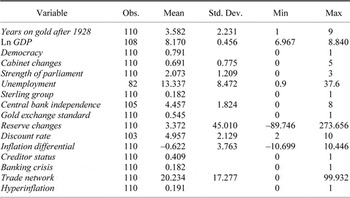
SUMMARY STATISTICS

Source:
Author's estimation.
Table 4 shows the summary statistics for the complete data set. The period of estimation is the country year. For the economic variables, the summary statistics confirm the prevalence of deflation and the high variance in countries' reserve stocks.
Moreover, the relatively high average unemployment of 13.3 percent stands out. The raw data suggest that multicollinearity is not a problem in this sample, but economic variables that might be highly correlated (such as GDP and inflation) were lagged or otherwise adjusted to avoid problems.
Institutional variables include a measure for central bank independence, a classification variable that accounts for the fact that at the time countries were grouped in currency blocs that might have influenced their decision making over gold standard adherence, and a gold exchange standard variable that indicates which countries held their reserves in the currencies of the center countries. Simmons suggests that the interwar regime was upheld by independent central banks committed to the regime.Footnote 43 In recent times, independent central banks are often associated with low inflation policies. This relationship cannot be confirmed for the interwar years.Footnote 44 Currency blocs are included through a dummy variable indicating membership in the Sterling bloc, as are countries on the gold exchange standard.
A regime classification of democracies versus nondemocracies is also captured through a dummy variable. The time-varying democracy dummy accounts for the fact that in democracies, domestic pressures to leave the gold standard in the face of an economic crisis should be higher than in authoritarian regimes. For this sample, about three-quarters of all observations are classified as democracies.
Additional political variables include a measure for the strength of Parliament and a variable capturing the number of cabinet changes in a given year. Countries with strong Parliamentary systems should display increased political stability, reducing the probability of a regime change. On the other hand they might be more domestically oriented, just choosing to leave the regime early. Frequent cabinet changes should create political instability and thus lead to early abandonment of the regime, but a country might also choose to remain on the gold standard to demonstrate commitment to specific economic policies despite political turmoil. The effect of these political variables on gold standard duration might therefore be ambiguous (compare Table 3).
RESULTS
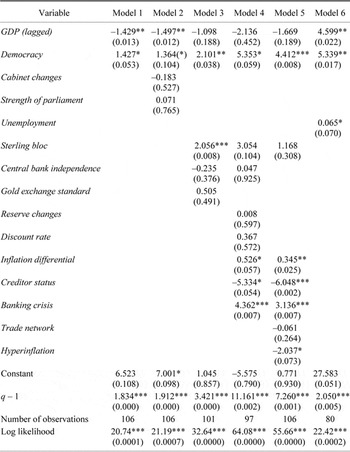
Table 5 shows the regression results for six different specifications of the duration regression. For all specifications the coefficient q − 1 on log(time) in the baseline hazard function is statistically significant and takes values greater than one. This confirms the increasing hazard assumption.
Specification 1 is the baseline regression, where the decision to leave is purely a function of the lagged value of log per capita GDP and a democracy dummy. This model captures the generic arguments. Higher GDP per capita in the previous period decreased the probability that a country would leave the gold standard in a given year. By contrast, democracy increased the probability. Both variables are statistically significant at 5 percent and 10 percent, respectively.
The result that democratic regimes were more likely to leave the system confirms the arguments made by Eichengreen, Simmons, and Tortella.Footnote 45 From the regression coefficients we can calculate the marginal effects on the odds of leaving the gold standard to simplify the interpretation of the results. Being a democracy boosted the likelihood of leaving the gold standard by exp(1.427) − 1 = 316.7 percent. A one unit change in log per capita GDP, in contrast, cut the probability of leaving the gold standard by 77 percent.
REGRESSION RESULTS, SURVIVAL REGRESSIONS WHERE THE DEPENDENT VARIABLE IS “LEAVING THE GOLD STANDARD”

*** indicates significance at 1 percent.
** indicates significance at 5 percent.
* indicates significance at 10 percent
Note:
p-values are in parentheses.
Source:
Author's estimation.
Specification 2 then extends the baseline model by including two additional political variables: the number of cabinet changes in a given year and a measure for the strength of parliament. Neither variable is statistically significant. Supplementary regressions (not reported here) added additional political indicators, such as a measure for a left-leaning government, the percentage of left in parliament, as well as the partisan veto player variable. These variables failed tests of statistical significance, but democracy remained significant in all of the regressions.Footnote 46 Again, the theory on how these political variables should behave is not clear. A further complication is that in many emerging democracies at the time governments were coalition governments, which makes it harder to measure their political orientation. So although not all political measures are significant, there was a sizable destabilizing effect from being a democratic regime.
Models 3–6 add more institutional and economic variables to capture arguments that have been made about the instability of the gold exchange standard. Model 3 includes institutional determinants of the gold standard, such as adherence to the sterling bloc, a measure for central bank independence, and a dummy variable indicating whether a country is on the gold exchange standard, meaning it held most of its reserves in a currency of one of the center countries. Sterling bloc adherence is significant in some of the model specifications, indicating that countries with close ties to Britain had an increased hazard of leaving the gold standard. The central bank independence measure and the indicator whether a country held currency rather than gold as reserves are unrelated to gold standard adherence.
Specifications 4 to 6 include the economic variables for reserve changes, discount rate adjustments, inflation differentials, creditor status, experience of banking crises, trade networks, hyperinflation, and unemployment. Reserve changes, discount rate adjustments, and the trade network variable did not have a statistically significant effect on the duration of the gold standard. The inflation differential, banking crises, and unemployment all raised the probability that a country would leave the regime. Creditor status and the prior experience of hyperinflation, however, lengthened the time that a country would remain on gold.
Higher inflation boosted the odds that a country would leave the gold standard. The result contradicts the hypothesis that deflation contributed to the failure of the regime. But looking at inflation rates over time, countries inflated as they left the regime. Because the analysis is based on annual data, it is possible that inflating after abandoning the regime is misinterpreted here as leading to the abandonment.Footnote 47 Also, the experience of banking crises and higher unemployment increased the probability that a country would leave the regime. Both variables underline that countries in more acute economic distress found it harder to remain within the system and were more likely to abandon the peg to gold.
Creditor status and the experience of hyperinflation made countries remain on the gold standard longer. The results for the creditor variable support those for gold reserves and reflect the interest that creditor countries had in fully recapturing their loans. The hyperinflation results suggest that countries with an experience of hyperinflation in the immediate postwar period clung to the regime to gain credibility. Austria and Germany, the two democratic countries that had experienced hyperinflation in the immediate postwar period were also among the first countries to adopt the interwar gold standard in the early 1920s, furthermore suggesting that they cared about the external validation that came with accepting the regime.
Given the insignificance of the discount variable, countries did not use the discount tool to fend off gold losses and remain within the regime. Also, the importance of trade was declining during the interwar years, and thus trade might not have mattered for a country's decision to stay on gold or leave the regime, possibly explaining why the trade network variable is not statistically significant. The insignificance of the reserves variable might seem surprising at first, but not all countries exhausted their reserves trying to defend the regime. The high variance in reserve changes (compare Table 4) in fact suggests that countries chose very different strategies for using their gold and currency reserves.
SURVIVAL PROBABILITIES
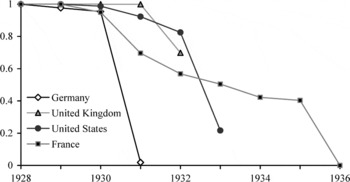
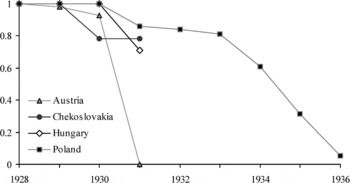
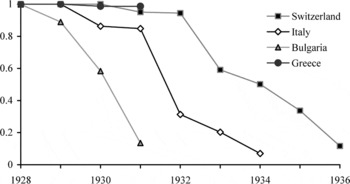
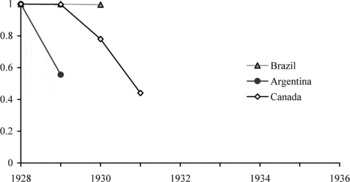
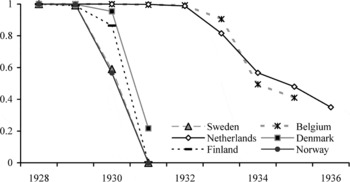
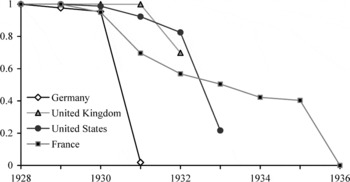
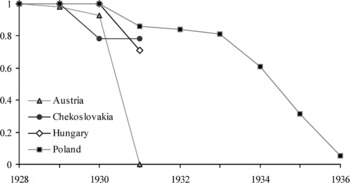
Because the model is dynamic, we can predict survival rates for individual countries in the sample. The survival rates, which are based on the coefficient estimates of Model 5 for the full sample, are set at 100 percent in 1928 for all countries and drop thereafter, as shown in Figures 2–6. For most countries, the survival rates fell drastically over the time the country was on the gold standard, and all countries left the regime when the survival rates were lowest, suggesting that these survival probabilities indeed describe the declining odds that the gold standard was maintained.
Although it is difficult to derive an exact benchmark of when countries should leave the regime, it seems reasonable to assume that it was probably advantageous for a country to abandon the gold standard once the survival rate dipped below 50 percent.
WAS BRITAIN A FAIR WEATHER FRIEND?
Figure 2 shows the survival probabilities for the core countries of the regime, Britain, France, and the United States, plus Germany. What is remarkable is that Britain left the regime when its survival rate was high—about 70 percent—whereas the other three countries left when their survival probabilities had fallen to 20 percent for the United States, or even close to zero percent in the case of France and Germany. The differences between the four selected countries are, therefore, striking and suggest that Britain abandoned the gold standard at a time when the economic conditions did not necessarily warrant such a move. These results for Britain confirm the claim by Paul Hallwood, Ronald MacDonald, and Ian Marsh that realignment expectations contributed to the exchange market pressure on the pound in 1931.Footnote 48 In contrast, the United States, Germany, and France likely held onto the gold standard too long.
A closer look at the politics of these four countries surrounding the decision to abandon the peg can help us explain their different responses. In Britain the suspension of convertibility on 19 September 1931 came in the midst of a government crisis. On 23 August the minority labor government under the leadership of Ramsay MacDonald fell when it could not adequately respond to rising reserve losses. It was replaced by a National Government, again under MacDonald's leadership, before a general election in October 1931 brought victory for the conservatives.Footnote 49
In the United States, on the other hand, the Hoover administration held onto the gold standard after Britain left in 1931, even though the predicted survival rates for the United States were lower than the British rates in 1931. Only after the government change in January 1933 did the new administration under the leadership of Franklin Roosevelt contemplated devaluation. Though Roosevelt had been purposefully vague about his dollar policies during the campaign, he was responsive to the rising inflationist sentiment in Congress, and convinced himself that raising prices above 1929 levels would be necessary for ending the depression. He thus devalued the dollar on 19 April 1933, in the midst of the preparations for the World Economic Conference.Footnote 50
Similarly, the French devaluation followed a government crisis and the rise of the Popular Front, which pursued inflationary policies under the leadership of Prime Minister Leon Blum. A Paris-based campaign to take France off the gold standard began to garner significant political support after Belgium left the gold bloc in 1935.Footnote 51 The campaign came after four years (1931–1935) of drastic deflationary measures, which concentrated on balancing the budget and defending the gold parity of the franc, and which led to continuously declining survival probabilities. France ended up as the country with the most severe crisis and the slowest recovery: it in fact did not regain 1929 output levels by the end of the decade.Footnote 52
The survival probabilities for Germany clearly reveal the severity of the country's economic problems. Germany was in fact the country with the most dramatic collapse in survival probabilities before it left the gold standard. The precipitous decline resulted from the German banking crisis in 1931, during which chancellor Brüning imposed exchange controls because of losses of reserves. Brüning's room for maneuver was compromised by his minority governing position. A similarly rapid collapse of survival probabilities struck Austria, again reflecting the impact of the domestic banking crisis.
Historians argue that Britain recovered rapidly because it cut its ties to the gold standard early on. The United States and France, by contrast, held onto gold far too long and suffered the economic consequences. The survival probabilities generated in this study suggest that Britain did indeed leave the gold standard early, while the other key countries adhered to gold even after survival probabilities had fallen below 20 percent. In all three countries the decisions about when to abandon gold were driven by political crises or by changes in the government or the administration. Domestic politics was equally important in Germany. Immediately preceding the departure from the interwar regime, Germany's chancellor Brüning had released a memorandum stating that Germany was no longer willing and able to make reparation payments to win domestic support for his policies. This memorandum sparked foreign withdrawals from Germany and weakened the country's financial position. It could only be halted with the Hoover moratorium proposed on 20 June 1931.Footnote 53
SURVIVAL RATES FOR THE CENTER COUNTRIES, BRITAIN, THE UNITED STATES, AND FRANCE, PLUS GERMANY
SURVIVAL RATES FOR CENTRAL AND EASTERN EUROPE
SURVIVAL RATES FOR SOUTHERN EUROPE

SURVIVAL RATES FOR THE AMERICAS

SURVIVAL RATES FOR SCANDINAVIA, THE NETHERLANDS AND BELGIUM

OTHER EXPERIENCES
Figures 2–5 illustrate the survival probabilities of other countries in the sample. The countries that were part of the gold bloc, France, Poland, Switzerland, Italy, Belgium, and the Netherlands all showed a significant decline in survival probabilities in 1932 or 1933. Except for France and Italy, the countries maintained relatively high survival rates until 1932, but the rates deteriorated drastically thereafter. If it makes sense to leave the gold standard when the survival rate falls to 50 percent, then no country should have stayed on it after 1934. Once again, political events played a key role when countries abandoned the regime. Belgium for example, experienced a banking crisis in 1934 and in November 1934 the government fell and was replaced by a more conservative cabinet, headed by Albert Theunis. Theunis imposed exchange controls in March of 1935, but was unable to control the crisis and had to resign. A new government of national union, headed by Paul von Zeeland, was formed, which devalued the Belgian franc by the end of the month.Footnote 54 Switzerland also delayed devaluation until 1936. Michael Bordo, Thomas Helbing, and Harold James discuss that this exchange rate policy reflected the difficulties of making exchange rate policy, given the peculiarities of the Swiss democratic system and the power of interest groups. The cost to the Swiss economy was huge: Switzerland's output level is 1935 would have been 18 percent higher if Switzerland had devalued the franc in 1931.Footnote 55
Survival probabilities in the Scandinavian countries all collapsed when Britain left the gold standard in 1931. As in Britain, they all recovered rapidly and returned to 1929 output levels by 1933 (Denmark) and 1934 (Norway and Sweden), respectively.Footnote 56
Several other countries also left the gold standard at comparatively high survival probabilities, including Czechoslovakia, Hungary, Greece, and Brazil. These countries on the periphery all left the interwar gold standard relatively early, in 1931. The Latin American countries in the sample, Brazil and Argentina, faced financial restrictions as a result of deteriorating terms of trade, an increased burden of foreign debt, and more stringent U.S. policies after 1929. Argentina's problems were aggravated by a rising trade deficit with the United States.Footnote 57
These examples provide additional evidence that the decision to leave the interwar gold standard was highly political. Although the empirical results of the article emphasize that democratic regimes were more likely to leave the gold standard early, the decision was often prompted by political crises, changes in government, and constituent interests.
CONCLUSION
Which factors contributed to the decline of the interwar gold standard, how can the timing of countries leaving the regime be explained, and how much weight can be attributed to institutional and political effects? The results of this study suggest that higher per capita GDP, creditor status, and the experience of hyperinflation increased the odds that a country adhered to the interwar gold exchange standard. Those elements highlight a wealth effect that had already been observed for the classical gold standard. It, moreover, stresses the importance of the gold standard to lend credibility. In contrast, a country's inflation rate, unemployment, adherence to the sterling bloc, and experience of banking crises, reduced the probability that a country remained on gold. Discount policy, reserve changes, trade relations, central bank independence, and whether a country held its reserves in foreign currency rather than gold, did not appear to matter for gold standard adherence—all evidence that countries did not adhere to the “rules of the game” during the interwar years. The standard explanation of the gold standard, that countries adjusted interest rates to maintain external balance and left the regime once this system could no longer be maintained, did not hold.
On the political side, the explanatory power of democracy for the instability of the regime is relatively strong. Survival rates for the core countries suggest that Britain could be characterized as a fair weather friend, leaving the gold standard even before predicted survival rates had fallen below 50 percent. The decision to abandon the regime was obviously forced by political turmoil. In contrast, the United States, France, and to some extent Germany held onto the regime far too long until survival rates had fallen below 20 percent. In these four countries, as in many others, a political change or crisis contributed to the decision to leave the gold exchange standard. The example of the interwar years thus shows how political and economic effects need to be considered jointly when investigating the decision of a country to maintain or abandon an exchange rate peg.
Appendix
COUNTRIES INCLUDED IN THE ANALYSIS
Argentina, Austria, Belgium, Brazil, Bulgaria, Canada, Czechoslovakia, Denmark, Finland, France, Germany, Greece, Hungary, Italy, Netherlands, Norway, Poland, Portugal, Romania, Sweden, Switzerland, the United Kingdom, the United States, and Yugoslavia.
DEPENDENT VARIABLE
Gold Standard
Dummy variable, taking the value of one for the year in which a country leaves the gold standard. Data are taken from Eichengreen, Golden Fetters; and Bernanke and James, “Gold Standard.” For the present analysis, there is no distinction between a de jure or a de facto adherence to the gold standard. Officially abandoning the regime, realigning the exchange rate, as well as imposing exchange controls are all counted as leaving the regime. Compare with Table 1 for exact dates on the individual countries.
INDEPENDENT VARIABLES
Banking Crisis
Time varying dummy variable, taking the value of one for any year in which a country experienced a banking crisis. Data are taken from Bernanke and James, “Gold Standard.”
Cabinet Change
Number of cabinet changes in a given year per country. Data are taken from Banks, Cross-Polity Time Series.
Central Bank Independence
Composed of an index for operational independence, ranging from one to four, with four being the most independent and an index for appointments, again ranging from one to four, with four being the most independent. The values are taken from Simmons, Who Adjusts; and extended by the author based on League of Nations, Central Bank and Monetary Laws, using Simmons's evaluation criteria.
Creditor Status
Dummy variable indicating whether a country was a net creditor or debtor throughout the gold standard period. Compare Eichengreen, Golden Fetters; and Simmons, Who Adjusts.
Democracy
Time varying dummy variable, taking the value of one for any year where a country could be classified as democratic, and the value zero for nondemocratic classification. Classifications are taken from Simmons, Who Adjusts; and Banks, Cross-Polity Time Series. For this analysis, countries counted as democracies include Austria, Argentina, Belgium, Bulgaria, Canada, Czechoslovakia, Denmark, Finland, France, Germany, Greece, The Netherlands, Norway, Sweden, Switzerland, the United Kingdom, and the United States. Nondemocratic regimes are Hungary, Poland, Portugal, Italy, Romania, Yugoslavia, and Brazil. None of the countries included in the analysis changed regimes while being on the gold standard. For example in Germany, democracy ended in 1933 with the coming to power of Hitler's National Socialist party, but by then the country had long abandoned the gold standard.
Discount Rate
Discount rates, taken from The Economist, are measured as differential to Britain.
Gold Exchange Standard
Dummy variable indicating which countries were on a gold exchange system, meaning they held their reserves in the currencies of the center countries.
Hyperinflation
A dummy variable taking the value of one for countries that experienced hyperinflation in the immediate postwar period. For this analysis only Austria, Poland, Germany, and Hungary are counted as having experienced a severe hyperinflation in the immediate postwar period. Classifications made by the author based on Eichengreen, Golden Fetters.
Inflation
Measured as the percentage deviation from average inflation of all countries included in the sample. Inflation rates are based on annual consumer price indices. Data are taken from Mitchell, European Historical Statistics.
Per Capita GDP
GDP data are taken from Maddison, World Economy. Data are missing for Portugal.
Reserves
Percentage change of gold, silver, and foreign currency reserves held by the government or the central bank. Data are taken from League of Nations, Statistical Yearbooks.
Sterling Bloc
The sterling bloc includes countries with close ties to Great Britain during the interwar years, often holding the majority of their reserves in British pounds. The classification of countries is taken from Ritschl and Wolf, “Endogeneity,” and includes Britain, Denmark, Finland, Norway, Portugal, and Sweden.
Strength of Parliament
Variable measures the effectiveness and accountability of the parliament. An irrelevant parliament, meaning the office of premier does not exist, is classified as zero. Absent effectiveness, meaning office of premier exists but there is no parliamentary responsibility, is classified as one. Incomplete effectiveness, the premier is to some extent constitutionally responsible to the legislature, is classified as two. And complete effectiveness, meaning the premier is constitutionally and effectively dependent upon a legislative majority, is classified as three.
Trade Network
Trade with gold standard countries (imports plus exports) measured as percentage of total trade. Data are taken from Mitchell, European Historical Statistics.
Unemployment Rate
Collected from League of Nations, Statistical Yearbooks.