Introduction
Poultry production under quality signs is specific to France. It was initiated in 1957 with the ‘poulet de Bresse’, which benefits from a protected origin (Appellation d’Origine Contrôlée) then by creating, in 1967, the ‘Label rouge’ (LR) with the aim to obtain products of higher sensorial qualities and by using genotypes and rearing conditions different from those currently used for standard production (Laszczyk-Legendre, Reference Laszczyk-Legendre1999). For genotype, the main difference concerns growth rate, a body weight of 2.5 kg being achieved at 35 or 81 days of age for standard and label genotypes, respectively. Old chicken breeds, like the ‘poulet de Bresse’ and the ‘Géline de Touraine’ (GT), are characterised by a very slow growth rate and need at least 120 days to reach a body weight of 2.5 kg.
The commercial interest for the GT was boosted in 1993 by the Agriculture Chamber of Indre-et-Loire (France), resulting in the creation of an inter-professional union (SIGT, Molard, Reference Molard2000). A selection programme is currently running at the selection centre of Bresse breed (CSVB, Béchane, France) in collaboration with the French union of poultry and fish breeders (SYSAAF, Nouzilly, France). It aims to improve laying performances, body weight at slaughter age and development of breast muscles of the GT breed.
Until now, the specific characteristics of carcass and meat from the GT have never been examined. The aim of our study was to analyse these characteristics by comparing the GT with an experimental crossbreed (EC) between two lines divergently selected on growth rate from the INRA Poultry Research Unit of Nouzilly (France, Ricard, Reference Ricard1975; Mignon-Grasteau, Reference Mignon-Grasteau1999) exhibiting the same growth rate as GT genotype, and with a LR genotype. Two slaughter ages, 84 days (males and females from the three genotypes) and 120 days (males and females from GT and EC genotypes), were examined in order to compare birds at the same age or at the respective slaughter age of each production. Slaughtering birds at ages close to sexual maturity can result in modifications of meat quality (Touraille and Ricard, Reference Touraille and Ricard1981; Ricard and Touraille, Reference Ricard and Touraille1988). Therefore, we estimated the sexual maturity of the birds by weighing the ovary and testis at slaughter ages.
Material and methods
Animals and experimental design
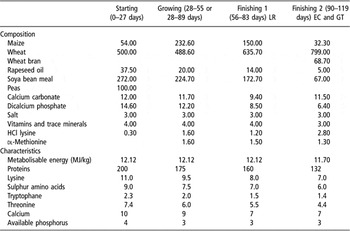
Male and female chickens from LR (JA 657; Boyé Accouvage, La Boissière en Gâtine, France), EC (PEAT, INRA Tours-Nouzilly, France) and GT (CSVB, Béchane, France) genotypes (250 per sex) were reared separately, at the experimental unit (PEAT) of INRA Nouzilly, in six poultry houses (10 birds/m2) with a frontal access to a pasture from 5 weeks of age. GT birds were characterised by a black plumage and a white skin, while LR and EC birds had a reddish-brown plumage and a white or yellow skin, respectively. All chickens were ad libitum-fed, first with a starting diet (0 to 28 days of age), then with a growing diet (28 to 56 days of age for LR genotype and 28 to 90 days of age for EC and GT genotypes), followed by a finishing diet (56 to 83 days of age for LR genotype and 90 to 119 days of age for EC and GT genotypes). The composition and main characteristics of diets are presented in Table 1. Wheat grains were also distributed to EC and GT genotypes from 28 to 90 days of age in compliance with the recommendations of the ‘Géline’ union.
Composition (g/kg) and main characteristics (g/kg) of diets

LR = ‘Label rouge’, EC = experimental crossbreeding, GT = ‘Géline de Touraine’.
All birds were individually weighed at 28, 56, 83, 90 and 119 days of age. Feed consumption was measured per genotype and per sex during these same periods. At 84 days of age, a sample of 80 birds per sex and per genotype was selected in order to represent the mean body weight ±2 s.d. of the group. Birds were submitted to a feed withdrawal of 8 h before slaughter at the experimental processing plant of INRA Nouzilly. Birds were electrically stunned in a water bath before bleeding by ventral neck cutting. After scalding (51°C, 3 min), plucking and manual gut removal, whole carcasses were air chilled in a cold room at 2°C for 24 h. At 120 days of age we repeated the same procedure but only for the EC and GT genotypes.
Measures on carcass and meat
At 24 h post mortem, the frequency of pecking and clawing injuries was noted on 50 carcasses per group selected at random, by considering three classes: 0 (absence), 1 (a few) and 2 (many). An overall score was calculated by adding each score weighted with its frequency. Skin colour was measured on the upper zone of the breast located under the wing with a spectrocolorimeter Miniscan TM (Hunterlab, Noisy le Grand, France) under the CIELAB system (L* = lightness, a* = redness, b* = yellowness). The thickness of wing membrane (as an indicator of subcutaneous fat) was measured with a micrometer (Ricard, Reference Ricard1972).
A sample of 30 carcasses per group was selected at random to evaluate the meat yield and carcass fatness. First, carcasses without blood, feathers and gut were weighed in order to determine the carcass yield in relation to body weight. Then, the breast muscles (Pectoralis major (PM) and Pectoralis minor) without skin, thighs + drumsticks with skin, abdominal fat and testis, ovary with or without follicles were removed and weighed. Yields were calculated in relation to body weight.
The day after slaughter, the ultimate pH (pHu) of meat was recorded by direct insertion of a xerolyte electrode in the right PM and in the Iliotibialis superficialis (IT, a thigh muscle) using a portable pH meter (Model 506; Crison Instruments S.A., Barcelona, Spain). Colour measurements were performed on the ventral side of the cranial, third part of the PM muscle and on the central part of the external face of the IT muscle using the same material and system as previously described for skin colour evaluation. All right PM muscles were then placed in polyethylene zip-locked bags and stored at 4°C for 2 days. At 72 h post mortem, the PM muscles were removed from the bags, wiped and weighed to evaluate drip loss expressed as percentage of the initial weight. Then PM muscles were vacuum packed in a plastic bag, stored for 3 more days at 4°C, cooked in a water bath at 85°C to reach an end-point of 75°C in the centre of each sample. PM muscles were then cooled for 15 min on ice, wiped and weighed again to evaluate cooking loss expressed as percentage of the PM weight before the cooking procedure (Honikel, Reference Honikel1998). Texture was determined objectively by using a single-blade (Warner–Bratzler) shear test performed with a universal testing machine (Instron 5543; Instron S.A., Guyancourt, France). Three adjacent strips (1.0 cm wide) per muscle were cut from the medial portion (parallel to the longitudinal axis of the muscle fibres), and sheared according to Honikel’s (Reference Honikel1998) method.
Statistical analysis
A one-way analysis of variance was used to test the effect of sex or genotype, at the same age (84 days) or at the respective slaughter age for each production (84 days for the LR group and 120 days for the EC and GT groups). Means were compared using a Newman–Keuls test (SAS, 1999). To analyse the frequency of injuries on the carcasses, we used a non-parametric Kruskall and Wallis test followed by a Man and Whitney test to compare means.
Results
Growth performances
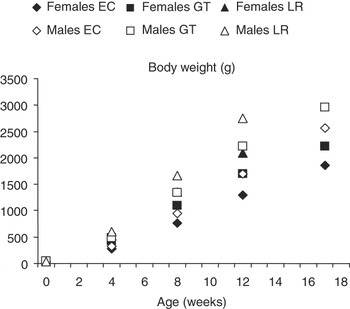
The females had a significantly (P < 0.01) lower body weight than the males from 28 days of age to the end of the experiment (Figure 1). The sexual dimorphism on body weight was more pronounced for the EC genotype compared with the other genotypes (P < 0.05). Actually, at their usual slaughter age, the ratio between body weight of females and body weight of males was 0.73b, 0.75a and 0.76a (P < 0.05) for EC, GT and LR genotypes, respectively. Except at 1-day old, the LR genotype exhibited the highest body weight until 84 days of age and the EC genotype the lowest (P < 0.01). Between 83 and 119 days of age, the body weight increase was 31% and 48% for GT and EC chickens, respectively. At their usual slaughter age, body weights (kg) were 2.44 ± 0.40b, 2.57 ± 0.46a and 2.20 ± 0.41c (P < 0.001) and feed conversion ratios (FCR) were 2.61, 3.42 and 3.54 for LR, GT and EC genotypes, respectively.
Body weight evolution from males and females of ‘Label rouge’ (LR), ‘Géline de Touraine’ (GT), and experimental crossbreeding (EC) chicken genotypes.

Carcass presentation
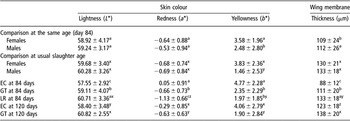
Whatever the slaughter age, lightness and redness of the carcass skin were not affected by sex (Table 2). Only the yellowness of the skin was higher in females than in males, the difference being more pronounced when compared at the usual slaughter age. The wing-membrane thickness was higher in males than in females but only at 84 days of age.
Effect of sex (n = 150) and genotype (n = 100) on skin colour of carcass and wing membrane thickness of chickens compared at the same age (day 84) or at their usual slaughter age (84 days for ‘Label rouge’ = LR and 120 days for ‘Géline de Touraine’ = GT and experimental crossbreeding = EC; means ± s.d.)

a,b,cSignificant differences between groups compared at 84 days of age with P < 0.05.
x,y,zSignificant differences between groups compared at usual slaughter age with P < 0.05.
At 84 days of age, the EC chickens exhibited the lowest values for lightness and the highest values for redness and yellowness of the skin, whereas the LR chickens exhibited the reverse (Table 2). The LR chickens had a significantly higher wing-membrane thickness than the other genotypes, particularly the EC chickens. When birds were compared at their usual slaughter age, the EC chickens still had lower values for L* and higher values for a* and b* than the other genotypes. The GT chickens had a significantly higher wing-membrane thickness than the other genotypes, particularly the EC chickens. The wing-membrane thickness was significantly and positively correlated (P < 0.05) with body weight (R 2 = 0.40) and abdominal fat weight (R 2 = 0.32).
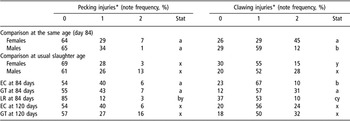
The occurrence of pecking injuries on carcasses was not affected by sex (Table 3). At 84 days of age, we observed a higher frequency of clawing injuries on female carcasses than on male carcasses. When birds were compared at their usual slaughter age, we observed the reverse situation.
Effect of sex (n = 150) and genotype (n = 100) on pecking and clawing injuries on carcasses of chickens compared at the same age (day 84) or at their usual slaughter age (84 days for ‘Label rouge’ = LR and 120 days for ‘Géline de Touraine’ = GT and experimental crossbreeding = EC)

*Defects were classified into three classes: 0 (absence), 1 (a few), 2 (many).
a,b,cSignificant differences between groups compared at 84 days of age with P < 0.05.
x,ySignificant differences between groups compared at usual slaughter age with P < 0.05.
Whatever the slaughter age comparison, the LR chickens always had less pecking and clawing injuries than the other genotypes (Table 3).
Carcass composition and sexual maturity
Whatever the slaughter age, the sex had no significant effect on carcass yield (data not shown).
When birds were compared at 84 days of age, we found a significantly (P < 0.001) higher carcass yield for LR chickens than the other genotypes (86.3%, 84.0% and 84.0% for LR, GT and EC groups, respectively). When birds were compared at their usual slaughter age, the EC chickens had a significantly (P < 0.01) lower carcass yield than the other genotypes (86.3%, 86.0% and 83.6% for LR, GT and EC groups, respectively).
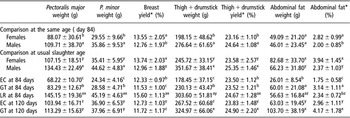
Whatever the slaughter age, the females exhibited a lower weight for the breast muscles and thigh + drumstick than the males (Table 4). The females exhibited a higher breast yield and a lower thigh + drumstick yield than the males. The weight of abdominal fat was similar for males and females when birds were compared at 84 days of age, but higher for the females when birds were compared at their usual slaughter age. The females always exhibited a higher percentage of abdominal fat than the males. The highest weight and the highest percentage of abdominal fat were recorded for the GT females slaughtered at 120 days of age (118.90 g and 5.31%, respectively).
Effect of sex (n = 90) and genotype (n = 60) on carcass composition of chickens compared at the same age (day 84) or at their usual slaughter age (84 days for ‘Label rouge’ = LR and 120 days for ‘Géline de Touraine’ = GT and experimental crossbreeding = EC; means ± s.d.)

a,b,cSignificant differences between groups compared at 84 days of age with P < 0.05.
x,y,zSignificant differences between groups compared at usual slaughter age with P < 0.05.
*Percentages were expressed relative to body weight.
Whatever the slaughter age, the LR chickens had a higher weight and a higher yield for PM and Pectoralis minor muscles than the other genotypes (Table 4). When birds were compared at 84 days of age, the LR chickens exhibited the highest weight and the highest yield of thigh + shank. When birds were compared at their usual slaughter age, the GT chickens exhibited the highest weight of thigh + shank and they had a yield of thigh + shank similar to that of LR chickens. When birds were compared at 84 days of age, the lowest weight and the lowest percentage of abdominal fat were recorded for the EC genotype, while, when birds were compared at their usual slaughter age, they were recorded for the LR genotype.
When male birds were compared at 84 days of age, the highest weight and percentage of testis were recorded for the EC genotype (Table 5) and when birds were compared at their usual slaughter age, they were recorded for the GT genotype. At 84 days of age, the LR females exhibited a higher weight of ovary than the other genotypes but the percentages were similar for all genotypes (Table 5). When females were compared at their usual slaughter age, the genotype had no significant effect on the weight or percentage of ovary. However, seven EC females among 30 and 15 GT females among 30 exhibited follicles. The diameter of the biggest follicle per bird was measured. The minimum diameters recorded were 0.14 and 2.87 mm, the maximum diameters recorded were 20.70 and 15.24 mm and the average diameters recorded were 4.44 and 6.52 mm for EC and GT females, respectively.
Effect of genotype (n = 30) on the weight and relative percentage to body weight of reproducing organs from chickens compared at the same age (day 84) or at their usual slaughter age (84 days for ‘Label rouge’ = LR and 120 days for ‘Géline de Touraine’ = GT and experimental crossbreeding = EC; means ± s.d.)

a,bSignificant differences between groups compared at 84 days of age with P < 0.05.
x,y,zSignificant differences between groups compared at usual slaughter age with P < 0.05.
Physico-chemical characteristics of meat
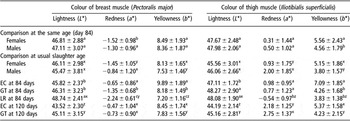
Whatever the slaughter age, the sex had no significant effect on the lightness of breast and thigh muscles (Table 6). When birds were compared at 84 days of age, the males had higher values for redness of breast muscle and lower values for yellowness of thigh muscle than the females. When birds were compared at their usual slaughter age, the males had higher values for redness and lower values for yellowness of breast and thigh muscles than the females.
Effect of sex (n = 90) and genotype (n = 60) on meat colour of chickens compared at the same age (day 84) or at their usual slaughter age (84 days for ‘Label rouge’ = LR and 120 days for ‘Géline de Touraine’ = GT and experimental crossbreeding = EC; means ± s.d.)

a,b,cSignificant differences between groups compared at 84 days of age with P < 0.05.
x,y,zSignificant differences between groups compared at usual slaughter age with P < 0.05.
Whatever the slaughter age, the LR chickens had the highest values for lightness, and the lowest values for redness and yellowness of breast and thigh muscles. On the contrary, the EC genotype exhibited the lowest values for lightness and the highest values for yellowness of breast and thigh muscles.
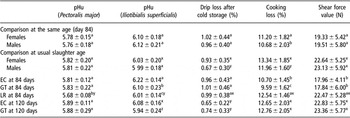
Whatever the slaughter age, we found no significant effect of sex either on the pHu of PM and IT muscles or on the shear force value of breast muscle (Table 7). The females exhibited higher values of cooking loss than the males and also higher values of juice loss after cold storage but only when birds were compared at usual slaughter age.
Effect of sex (n = 90) and genotype (n = 60) on ultimate pH (pHu) of breast and thigh muscles, drip loss after cold storage at +4°C or cooking at 85°C, and shear force value of cooked breast meat from chickens compared at the same age (day 84) or at their usual slaughter age (84 days for ‘Label rouge’ = LR and 120 days for ‘Géline de Touraine’ = GT and experimental crossbreeding = EC; means ± s.d.)

a,b,cSignificant differences between groups compared at 84 days of age with P < 0.05.
x,y,zSignificant differences between groups compared at usual slaughter age with P < 0.05.
Whatever the slaughter age, the LR chickens had lower values of pHu in PM muscle than the other genotypes. We observed the same in IT muscle when birds were compared at 84 days of age. When birds were compared at their usual slaughter age, the lowest pHu value in thigh muscle was observed in GT chickens. Drip loss of breast muscle after cold storage was only affected by genotype when birds were compared at their usual slaughter age, the LR chickens exhibiting the highest values. Cooking loss and shear force value of breast muscle were only affected by genotype when birds were compared at 84 days of age, the LR chickens exhibiting the highest values.
Discussion
Sex effect
Slow-growing chickens slaughtered at older ages than standard birds are also characterised by a high sexual dimorphism on body weight, as the difference between males and females increases with age (Mignon-Grasteau et al., Reference Mignon-Grasteau, Beaumont, Poivey and De Rochambeau1998). In the present study, the body weight of males at slaughter age was always higher than that of females but the carcass yield was similar for both sexes. The females had higher breast yield and carcass fatness, but lower thigh + drumstick yield than males. These observations have been reported and are related to the earlier development of females compared with males (Mignon-Grasteau and Beaumont, Reference Mignon-Grasteau and Beaumont2000). The sex also had a significant effect on the colour of the skin carcasses and the meat. The yellowness of skin carcasses and meat was higher for the females than for the males. This observation could be related to the highest fattiness of females because the carotenoid pigments, mainly responsible for the yellow colour, are located in the lipid depots (Fletcher, Reference Fletcher2002). The highest fattiness of females was not confirmed by the measurement of the wing-membrane thickness, probably because this criterion was more related to body weight (R 2 = 0.40) than to abdominal fat (R 2 = 0.32). The highest redness of meat from the males could be related to a higher content of haeminic pigments. The last significant effect of sex concerned the cooking loss of breast meat, which was higher for the females than for males. This observation could be related to differences in muscle structure and/or collagen content and characteristics. Actually, on this same study we measured the cross-sectional area of fibres in PM muscle and we found higher values for the females than for males, when birds were compared at their usual slaughter age (data not shown). The meat pH should not be responsible for this difference as males and females exhibited similar values for pHu.
Genotype effect
This study confirmed the difference in growth rate among genotypes resulting in later slaughter ages and also higher FCR for the EC and GT chickens than for LR chickens (Tixier-Boichard et al., Reference Tixier-Boichard, Audiot, Bernigaud, Rognon, Berthouly, Magdelaine, Coquerelle, Grinand, Boulay, Ramanantseheno, Amigues, Legros, Guintard, Lossouarn and Verrier2006).
According to observations during the rearing period, the EC and GT genotypes seemed to be more stressful than the LR chickens. Therefore, we decided to measure the wing-flapping duration and the number of straightening up attempts during the pre-slaughter shackling as Debut et al. (Reference Debut, Berri, Arnould, Guémené, Santé-Lhoutellier, Sellier, Baéza, Jehl, Jégo, Beaumont and Le Bihan-Duval2005) demonstrated a genotype effect on these behavioural responses with further consequences on meat quality. Unfortunately, we found a very few number of birds expressing such behavioural responses thus preventing the use of data. However, the highest scores for carcass defects, induced by clawing injuries, observed for EC and GT birds could be related to their higher susceptibility to stress. The pecking injuries could be related to aggressive behaviour as EC and GT birds are usually slaughtered at older ages. Moreover, the pHu of meat was also higher for these genotypes than for LR chickens, particularly in breast muscle characterised by a glycolytic energy metabolism. We can suggest that a higher susceptibility to stress, inducing a higher reactivity of birds during the catching before slaughter, could deplete more glycogen stored in muscles from EC and GT chickens, thus limiting the post mortem pH decrease. This effect on pHu had no consequences on either the cooking loss or shear force value of breast meat for birds compared at their usual slaughter age.
Because of their slow body development, only the GT chickens slaughtered at 120 days of age reached the carcass and the thigh + drumstick yields of LR chickens slaughtered at 84 days of age. However, the LR chickens, being selected for a few years on the breast yield, exhibited a much higher value for this parameter than the GT and EC genotypes. The breast yield of GT chickens was really low and did not increase between 84 and 120 days of age (P = 0.3366). The CSVB in collaboration with SYSAAF are actually trying to improve this character by selecting on higher breast angle value measured on live birds. Another specific characteristic of the GT chickens is the high carcass fattiness particularly for the females, which could confer a specific sensorial characteristic to this genotype as lipids are much implicated in determining the flavour, tenderness and juiciness of meat (Fernandez et al., Reference Fernandez, Monin, Talmant, Mourot and Lebret1999). Moreover, when birds were compared at their usual slaughter age, both GT males and females exhibited an earlier sexual maturity than the other genotypes and it is well known that birds slaughtered around their sexual maturity have a tougher and more flavoured meat than birds slaughtered at earlier ages (Touraille and Ricard, Reference Touraille and Ricard1981). The wing-membrane thickness was more related to body weight than to carcass fattiness.
The last significant effect of genotype concerned the colour of skin carcass and meat. In this case, we found a more coloured skin and meat for EC chickens, which could not be explained only by a higher fattiness as these birds had a lower percentage of abdominal fat than the other genotypes when birds were compared at 84 days of age, and an intermediate value to those of the other genotypes when birds were compared at their usual slaughter age. Whatever the slaughter age comparison, the EC chickens also had a lower wing-membrane thickness than the other genotypes. The EC chickens exhibited particularly high values for yellowness of skin and meat. This character could be under a genetic control as previously reported by Harms et al. (Reference Harms, Fry and Mac Pherson1977), Scholtyssek (Reference Scholtyssek1978) and Fletcher (Reference Fletcher2002) for the skin, and related to the ability to store carotenoid pigments. Le Bihan-Duval et al. (Reference Le Bihan-Duval, Berri, Baéza, Millet and Beaumont2001) obtained a heritability of 0.55 for b* parameter measured on the breast muscle of experimental chicken lines divergently selected on breast yield and abdominal fat percentage. More recently, Nadaf et al. (Reference Nadaf, Gilbert, Pitel, Berri, Feve, Beaumont, Duclos, Vignal, Porter, Simon, Aggrey, Cogburn and Le Bihan-Duval2007) identified, on the experimental breeds used to produce EC chickens, quantitative trait loci (QTLs) controlling redness and yellowness of breast meat. Further research is needed to identify the gene(s) underlying these QTLs.
In conclusion, the sexual dimorphism on body weight is more important for slow-growing lines slaughtered at older ages than standard birds. This could justify rearing and/or slaughtering these birds by separating sexes, particularly with the aim of further processing cut products requiring a low variability of carcass weight and meat yield. The EC and GT chickens seemed to be more stressful than LR chickens and should be provided with great attention during the rearing period and the pre-slaughter steps (catching, transport, shackling on the slaughter line) in order to reduce the occurrence of carcass defects. We also observed aggressive behaviours mainly among the males of LR and GT genotypes, which could reinforce the need to rear these birds by separating sexes. Both sex and genotype have a significant effect on skin and meat colour, which could be more related with the level of fat deposition for the first factor and the genetic control of carotenoid pigment deposition for the second one. The main characteristic of GT genotype is its great fattiness, particularly for the females, associated with a slaughter age close to the sexual maturity, which should confer it with typical sensorial attributes. This effect needs to be investigated.
Acknowledgements
This work was carried out with the financial support of the ‘ANR – Agence Nationale de la Recherche – The French National Research Agency’ under the programme ‘Agriculture et Développement Durable’, project ‘ANR-05-PADD-012, PRODDIG’, and the ‘Conseil Régional du Centre’. We thank the ‘Centre de Sélection de la Volaille de Bresse’ and the ‘Syndicat Interprofessionnel de la Géline de Touraine’ for the production and furnishing of eggs from ‘Géline de Touraine’, and the Experimental Station PEAT of Nouzilly for producing, rearing and slaughtering chickens. We are grateful to the technical staff of the Poultry Research Unit (URA) of Nouzilly and particularly Nicole Millet and Thierry Bordeau in charge of the experimental breeder selection and the practical realisation of the experiment, respectively.