




No CrossRef data available.
Article contents
Cognitive ability predicts degree of genetic abnormality in participants with 18q deletions
Published online by Cambridge University Press: 26 August 2005
Abstract
One of the most common chromosomal deletions is a loss of genetic material from the long arm of chromosome 18. Most individuals with this condition exhibit mental retardation (68%), yet previous attempts to link cognitive status to deletion size have not shown an association, possibly because cases with additional genetic abnormalities were included. We studied 46 participants ranging from 3 to 35 years of age who had a pure genetic abnormality by excluding those with mosaicism or complex genetic rearrangements. Our patients had terminal deletions ranging from a proximal breakpoint at 18q21.1 (greater genetic abnormality, larger deletion size) to a more distal breakpoint at 18q23 characterized with molecular genetic techniques. Cognitive ability, assessed with the age-appropriate measure (Bayley, 1993, Differential Ability Scale, Wechsler Scales), ranged from IQ = 49 to 113, with a predominance of mild and moderate mental retardation. Using multivariate regression, deletion size breakpoint rank order was predicted by cognitive ability, age, and adaptive behavior (Vineland Adaptive Behavior Scales), accounting for 36% of the variance in deletion size. However, lower cognitive ability (beta = .34, p = .032) and younger age (beta = .296, p = .024) predicted a larger deletion size, but adaptive behavior (beta = .225, p = .15) did not. An additional multivariate regression showed that cognitive ability and age together accounted for 33% of the variance in deletion size, whereas univariate regression showed that cognitive ability accounted for 26% of the variance and age accounted for 11% of the variance. These findings suggest that degree of cognitive impairment is associated with genetic abnormality when a large sample of individuals with “pure” deletions of genetic material from chromosome 18 is examined. (JINS, 2005, 11, 584–590.)
Information
- Type
- Research Article
- Information
- Journal of the International Neuropsychological Society , Volume 11 , Issue 5 , September 2005 , pp. 584 - 590
- Copyright
- © 2005 The International Neuropsychological Society
INTRODUCTION
18q-, one of the most common chromosome deletions, is caused by a loss of genetic material from the long arm of chromosome 18. The diagnosis is made cytogenetically by chromosome analysis. Clinical features vary widely in this disorder. Participants with this condition may exhibit short stature (77%), hearing impairment often associated with atretic ear canals (26%), and a variety of dysmorphic features (Cody et al., 1999; Strathdee et al., 1996). Growth hormone deficiency has been identified as a common cause of growth failure in affected children (Ghidoni et al., 1997; Hale et al., 2000), and incomplete cerebral myelination has been linked to the absence of the gene for myelin basic protein (Gay et al., 1997).
Although 68% to 93% of participants with 18q- deletion are reported to be mentally retarded (Cody et al., 1999; Strathdee et al., 1996), it is not clear whether deletion size is related to the degree of cognitive impairment. The understanding of the psychological functioning of children with 18q- is based mainly on case studies, which report cognitive abilities from severely impaired to below average (Schnizel, 1984). Although cognitive deficits found with 18q- have been assumed to be related to chromosomal deletion size (Mahr et al., 1996), no study has directly demonstrated this relationship (Kline et al., 1993; Mahr et al., 1996) for a variety of reasons.
Kline et al. (1993) studied seven individuals with 18q- and proposed that the size of the deletion may be related to the severity of the neurobehavioral phenotype, including brain abnormalities and cognitive deficit. However, the basis for concluding there was cognitive impairment was not clear because only one of the seven participants had formal cognitive evaluations and the sample size was small with no formal statistical analysis performed. Furthermore, it is not clear from the article whether participants were excluded for more complex genetic abnormalities.
More recently, Mahr et al. (1996) presented cognitive and behavioral data on 27 patients with 18q- ranging from 2 to 47 years of age. However, only 3 were 5 years old or younger and only 15 of the total sample had formal cognitive testing. These authors found no relationship between deletion size and cognitive or behavioral outcome. They also did not specify whether participants with additional genetic abnormalities were excluded, and their description of the genetic analysis does not include sufficient information to determine if such genetic abnormalities (e.g., interstitial deletions) could be identified. It is not clear in this article what differences, if any, there were between the participants who were cognitively tested and those who were not. Thus, it is not possible to separately evaluate the findings.
Although each of these studies has different limitations, the most obvious limitations are the likely inclusion of participants with additional genetic abnormalities, including mosaicism, which may mask a relationship between cognitive ability and genetic abnormality. The molecular analyses were not clearly delineated, and the breakpoint rank order points were limited, with 6 rank orders for Kline et al. (1993) and 16 for Mahr et al. (1996). Finally, the sample sizes were small and formal cognitive testing was limited. In addition, previous studies have not assessed the relationship between adaptive ability and deletion size, which is important because cognitive ability is only one measure of a child's ability to function.
Therefore, our study measured cognitive ability and adaptive function in participants with “pure” terminal 18q- deletion, with the goal of determining if cognitive ability as assessed by tests of psychometric intelligence, adaptive behavior as assessed by the Vineland Adaptive Behavior Scales, and age predicted deletion size. We hypothesized that the inclusion of individuals with pure deletions would provide a more powerful test of these relationships, while increasing the sample size would increase statistical power and potentially increase the range of breakpoint rank orders.
METHOD
Research Participants
Sixty-six individuals were available for this study from participation in a larger study of individuals with chromosome 18 abnormalities. Informed consent was obtained from each affected adult and from each child's parent prior to participation in the study. The study was approved by the Institutional Review Boards at The University of Texas Health Science Center and at the University of Texas at Austin. The participants were referred from the Chromosome 18 Registry and Research Society or by a physician. Our most successful participant recruitment has been through the lay advocacy group, which tends to be predominately Caucasian and middle class. Despite efforts to recruit participants through geneticists and other health professionals, we have received very few referrals in that manner. Although there is no reason to believe that there are any racial bases in the incidence of 18q-, there is an ascertainment bias in this sample, such that in the final sample of 46, 3 were Hispanic and 43 were non-Hispanic Caucasians.
Cytogenetic test reports were obtained from the clinical laboratory responsible for the initial diagnosis. Confirmation of the loss of material from the long arm of chromosome 18 was performed in our laboratory using molecular techniques as previously described (Cody et al., 1997). Deletions ranged from a proximal breakpoint at 18q21.1 to a more distal breakpoint at 18q23. The molecular techniques utilized in this study are similar to previous studies except that we emphasized the identification of mosaicism and/or interstitial deletions. Previous studies have not provided sufficient information regarding this issue.
We included only participants aged three years and older because estimates of cognitive ability below age three are not considered generally reliable (Bayley, 1993). To be included in our analysis, participants were required to have complete clinical, cognitive, and adaptive behavior data obtained by a member of our research team, and a blood sample to permit detailed genetic analysis. Participants who were unable to complete the cognitive measure appropriate for their age range were excluded from the study. These participants were multiply handicapped and were frequently unable to be tested because of severe problems with behavior or sensory handicaps (blind and deaf). There were 15 participants excluded for this reason. Sixty-six participants met these inclusion criteria.
Based on the molecular analysis, five participants exhibited mosaicism, six had more complicated genetic rearrangements, and five had interstitial deletions. Four had incomplete clinical data. These 20 participants were excluded from the study, resulting in a sample of 46, which ranged in age from 2 years 6 months to 35 years. There were 30 females and 16 males and 32 participants had hearing impairment sufficient to require hearing aids, which is common with 18q- deletions. No participant was included in this sample who was unable to speak or who communicated solely through the use of sign language.
Measures of cognitive ability
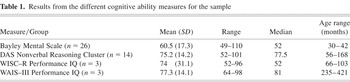
Evaluation of cognitive function and adaptive behavior was performed by a pediatric neuropsychologist or a doctoral student trained and supervised by the neuropsychologist. The age-appropriate ability measure [Bayley Scales of Infant Behavior–II (Bayley, 1993)]; Wechsler Intelligence Scale for Children–Revised [(WISC–R) Wechsler, 1981]; Wechsler Adult Intelligence Scale III [(WAIS III) Wechsler, 1997] or Differential Abilities Scale [(DAS) Elliott, 1990)] was administered as a measure of cognitive ability. Twenty-six children below age 42 months were given the Bayley, 14 children aged 42 months to 6 years were given the DAS, 3 between the age of 6 and 16 years of age were given the WISC–R because they were tested prior to 1991, and 3 above age 16 were given the WAIS–III. All of these measures yielded a measure of cognitive ability with a mean of 100 and a standard deviation of 15. The Performance IQ from the WISC–R and WAIS III and the Nonverbal Reasoning Cluster from the DAS were utilized to minimize the influence of hearing difficulties. The correlation between the Wechsler Performance IQ and the DAS Nonverbal Reasoning Ability score ranges from 0.72 to 0.75 (Elliott, 1990). In contrast to the other measures, the Bayley Scales of Infant Development 2nd Edition (Bayley, 1993) is not separated into a verbal and nonverbal section. This instrument provides measures of mental development (Mental Development Index) and motor skill development (Motor Development Index) for children from birth through 42 months of age. The Mental Development Scale includes items that cover a wide range of skill areas, including language, perception, social knowledge, and problem solving. The Mental Development Index was used in this analysis as an estimate of cognitive ability. For young children, the preponderance of items are nonverbal in nature, and the manual reports that items are selected that are similar in difficulty for each age, which would make the assessment of verbal skills across this age range difficult. Despite these differences between the Bayley and other tests used in this study, longitudinal studies on children with medical conditions have shown that Bayley scores at 12 months predict scores on the Wechsler Preschool and Primary Intelligence Scale at 4 1/2 years of age (Crowe et al., 1987), suggesting a reasonable degree of comparability between the Bayley and the Wechsler scales. Table 1 provides means, standard deviations, and ranges of the cognitive scores for each age group separately.
Results from the different cognitive ability measures for the sample

Adaptive skills
Adaptive skills for all participants were measured using the Vineland Adaptive Behavior Scales (VABS) Interview Edition (Sparrow et al., 1984), which assesses development of communication, daily living skills, socialization, and motor skills through an interview. For the children and adolescents, the main caretaker completed the interview, whereas the adult participants answered the questions themselves. The composite score was utilized with a mean of 100 and a standard deviation of 15, similar to cognitive ability measures. Individual domain scores were also analyzed.
Molecular genetic analysis
To estimate the size of the deletion for each patient, multiple methods of analysis were performed. Molecular analysis to confirm the loss of material from the long arm of chromosome 18 was performed on all patients using polymerase chain reaction (PCR)-based polymorphic markers. In this analysis, peripheral blood samples were used as the source of DNA. DNA samples were obtained from all patients and both parents, if available. A detailed description of this method has previously been published (Cody et al., 1997). In a few cases, somatic cell hybrids separating the abnormal chromosome 18 from the normal chromosome 18 were constructed using patient samples. These hybrids were used to further define the breakpoint when polymorphic markers were uninformative (Cody et al., 1997). When the most distal markers (D18S70 and D18S497) were not informative, fluorescence in situ hybridization (FISH) was used to distinguish between interstitial and terminal deletions. This method was described by Brkanac et al. (1998).
The breakpoint was rank-ordered from the most proximal (a rank of 1) to most distal breakpoint (a rank of 33), with the most proximal breakpoint reflecting the greatest amount of missing genetic material. In several instances, different individuals were assigned the same rank because their breakpoints were the same. Breakpoint rank order was utilized instead of the physical deletion size itself because the method used to determine the breakpoint is performed by progressively narrowing the region between markers, one that is present and one that is deleted. This procedure generates breakpoint regions and not nucleotide specific breakpoints. Since the genes are not evenly spaced along the chromosome, a physical distance does not correlate with the number of genes and therefore is not any more informative with regard to the number of genes deleted than rank order of breakpoint. While this procedure is similar to that utilized by Kline et al. (1993) and Mahr et al. (1996), our study differs from previous studies in that we excluded participants with interstitial deletions and mosaicism that were detected because of the higher resolution of our genetic analysis. In addition, our sample was larger and provided more rank order breakpoints [34 different breakpoint regions as opposed to 6 (Kline et al., 1993) and 16 (Mahr et al., 1996) in the previous studies].
RESULTS
Cognitive Ability
As can be seen in Tables 1 and 2, cognitive ability varied widely within and across the different age groups. Twenty-nine participants (63%) had cognitive scores between 49 and 69, 8 (17.4%) had scores between 70 and 84, and 9 (19.6%) had scores in the average range (89–98).
Demographic, cognitive, and adaptive behavior measures for the entire sample (N = 46)

The measures of cognitive ability were not significantly correlated with age (r = .139; p = .36) and were not significantly different between males and females (F(1,44) = 0.108, p = .74). However, the Bayley mental score was significantly lower than the DAS nonverbal reasoning score (F(1,39) = 6.93, p = .01). There were too few participants with WISC–R or WAIS III data for statistical comparison, but the means reported in Table 1 are similar.
Adaptive Skills
Adaptive skill development ranged from 19 to 86, indicative of severe delays compared to average levels of functioning. As seen in Table 2, the mean Adaptive Behavior Composite of 66.8 is similar to the mean cognitive ability, and the correlation between the two measures was significant (r = .61; p < .0001). There were no significant gender differences for the Adaptive Behavior Composite score or for any of the domain scores (p > .05).
Relationship of Cognitive Ability, Age, and Adaptive Behavior to the Deletion Size
A multivariate regression analysis was utilized to determine if the measures of cognitive ability, adaptive behavior, and age predicted the deletion size of the breakpoint rank order. This combination of predictors accounted for 36% of the variance in deletion size breakpoint rank order (F(3,42) = 11.57, p < .0001). In this multivariate analysis, lower cognitive ability (beta = .34, p = .032) and younger age (beta = .296, p = .024) were significant predictors of a larger deletion size, whereas the Adaptive Behavior Composite was not (beta = .225, p = .15). Poorer cognitive ability and younger age predicted greater genetic abnormality. Figure 1 illustrates the relationship between poorer cognitive ability and more proximal breakpoint (larger deletion size and greater genetic abnormality).

Regression plot of cognitive ability (IQ) versus breakpoint using Bayley, DAS, and Wechsler Scales as measures of cognitive ability.
A multivariate regression analysis was utilized to determine if the measures of cognitive ability and age together were predictive of breakpoint, and this combination of predictors accounted for 32.9% of the variance in deletion size breakpoint rank order (F(2,43) = 10.56, p = .0002). In this multivariate analysis, lower cognitive ability (beta = .47, p = .0006) and younger age (beta = .263, p = .043) were significant predictors of a larger deletion size. Univariate analyses indicated that the cognitive ability measure was a more significant predictor of breakpoint and accounted for 26% of the variance, whereas age accounted for only 11% of the variance. To more directly illustrate the relationship between age and breakpoint, we computed the median breakpoint (18.5), and found that the youngest group comprised 50% of those who were below the median breakpoint and 5% of those above the median breakpoint. The mean breakpoint for the youngest group was 13.87 (SD = 7.1) and for all other groups it was 19.3 (SD = 6.9). There was a significant difference between age and rank order, with the youngest showing a larger rank order breakpoint [F(1,44) = 103.4, p = <.0001]. Therefore, the youngest group had the greatest genetic abnormality.
Two exploratory univariate regression analyses were conducted to determine if the relationship between cognitive ability and breakpoint rank order was different when using the Bayley Index, which does not separate verbal and nonverbal abilities, than the DAS/Wechsler Scales, for which we used the nonverbal or Performance IQ rather than Verbal IQ. This reanalysis reduced the power significantly for the study and should be viewed as suggestive, especially because any differences in this relationship could be related to using two tests of cognitive ability or the fact that the two tests were administered to two different groups, one of which had greater genetic abnormality. Both the Bayley Mental Development Score [F(1,24) = 3.58, p = .07], and the DAS/Wechsler IQ scores [F(1,15) = 3.75, p = .07] marginally predicted breakpoint rank order.
Although the Bayley findings reported here suggest that the relationship between cognitive ability and genetic abnormality is not dependent on using strictly nonverbal measures (as was done for the DAS and Wechsler scales), we assessed the relationship between verbal cognitive ability and genetic abnormality. This was done by assessing the relationship between the verbal scales of the Wechsler/DAS and breakpoint rank order. Of the original sample, 20 participants had a verbal score that was considered clinically valid by their examiner, despite hearing impairment in 14. The age range for this group was between 4.7 and 35.1 years. Fifteen participants completed the DAS, two the WISC–R, and three the WAIS III. The mean IQ for the verbal subtests was 77.0 (SD = 20.7) and for the nonverbal subtests it was 74.5 (SD = 15.3). The univariate regression analysis showed that verbal ability predicted breakpoint rank order [F(1,18) = 6.12, p = .024], which is similar to the findings using nonverbal cognitive ability in the complete sample.
DISCUSSION
This is the first study to find that degree of cognitive impairment is related to the amount of missing genetic material in individuals with 18q- deletions. A broad range of cognitive ability and adaptive skills levels were present in this study. Measures of cognitive ability correlated significantly with breakpoint rank order but not with age or gender. Those participants with the most missing genetic material obtained the lowest cognitive ability scores compared to participants with less missing genetic material, and they also tended to be the youngest.
The relationship of breakpoint rank order to neuroantomical differences is just beginning to be explored in the 18q- deletion population. A high incidence (approximately 95%) of children with 18q- deletions have dysmyelination (Cody et al., 1999). Dysmyelination occurs when the myelin has never formed, in comparison to demyelination, in which the myelin was present and has deteriorated. Dysmyelination has been linked to mental retardation (Kline et al., 1993; Miller et al., 1990). A significant majority of children with 18q- have dysmyelination and also have a deletion of a specific 2-megabase region of 18q. This region has been found to contain the gene of myelin basic protein (MBP), which is hypothesized to be linked to dysmyelination (Gay et al., 1997). One of the first studies to evaluate the relationship between neuroanatomical differences and 18q- deletions was recently conducted by Kochunov et al. (2005). The corpus callosum in children with 18q- deletions, all with deletion of the MBP region, was analyzed and compared to age-matched typically developing children aged 4.5 years to 12. Findings indicated significant global and regional differences in the corpus callosum size with an overall smaller corpus callosum was found in children with 18q- even after correction for differences in brain size. The posterior portions of the corpus callosum were most significantly affected and were 25% smaller compared to the typically developing children. Although this study did not examine the relationship between these anatomical abnormalities and cognitive deficits, it suggests that our findings may be mediated by demyelination. Clearly, the underlying neural basis for this association requires direct study.
There are several possible explanations for our positive findings relative to other studies, including examining only participants with pure deletions, based on a high-resolution molecular technique that enabled us to detect mosaicism or complex genetic rearrangements. Our statistical power was also greater because we used a larger sample with 34 different breakpoints, compared to a significantly smaller number of breakpoint groups in previous studies by Kline et al. (1993; 6 groups) or Mahr et al. (1996; 16 groups). In addition, we formally assessed cognitive ability with valid and reliable tests that reflect a broader range of cognitive functioning, and we used a broader age range with heavy representation of individuals in the youngest age group (below age 6), who in our sample had the greatest evidence of genetic abnormality.
The finding that age was related to the deletion size of the breakpoint is intriguing. However, when age was covaried in the multivariate regression formula, cognitive ability remained significantly related to breakpoint rank order. Thus, the relationship of age to breakpoint is not the sole explanation for the prediction of breakpoint from cognitive ability. Children who were younger in this study also had the greatest amount of missing genetic material. This finding may be partially explained by the notion that the children who are more severely affected may be identified at an earlier age. In addition, our results may underestimate this effect, because individuals who were unable to complete the cognitive measures were excluded from the study, which restricted the range of cognitive ability assessed and potentially the range of the breakpoints. Fifteen were unable to be evaluated due to insufficient floor of the Bayley, Wechsler, or DAS tests, and more were excluded (N = 9) who were in the age range for the Bayley, than the DAS or Wechsler tests (N = 6). None of these tests allow for measures below 40 and thus those with severe or profound mental retardation were excluded. Our finding may have been more pronounced if these children had been included in the study. Future work will examine the distribution of breakpoints across the age range to determine if our finding of greater genetic abnormality in the younger participants is confirmed.
One weakness of the current study is that three different measures of cognitive ability were used. In part, this difficulty reflects the age range of our sample (3 to 35 years) and, in part, the range of developmental delay exhibited by the participants (from average cognitive ability to significant mental retardation). Given the age range of this sample, various measures of cognitive ability were necessary. The tests administered ranged from the Bayley Scales of Infant Development to the Wechsler Adult Intelligence Scale III. Similar to studies of low incidence disorders, problems with instrumentation cloud the interpretation of the findings. However, the Wechsler and DAS measures are highly correlated and some have argued that the variance introduced using these two different measures should not substantially alter these findings (Sattler, 2002). Moreover, exploratory analyses showed that there were trends (p = .07) supporting the initial finding of a relationship between breakpoint rank and mental scale separately for the children who were assessed either with the Bayley or the DAS. Further study is currently under way in our center to replicate these findings using a larger cohort.
As noted in the introduction, the ability of the Bayley to predict future scores on major intelligence tests is limited for typically developing children. However, our sample is comparable to children with medical conditions who show similar scores at 12 months using the Bayley and 4.5 years of age using the WPPSI (Crowe et al., 1987; Farrar & Harbor, 1989). Our finding that the relationship between cognitive ability and genetic abnormality was similar when the Bayley and the DAS/Wechsler scales were examined separately suggests that the findings were not specific to one cognitive instrument or one age group. Ideally, future research will examine these relationships using a single instrument if larger cohorts within a smaller age range can be obtained and studied longitudinally.
In summary, we found that cognitive ability and age predicted genetic abnormality in a group of individuals with terminal deletion of chromosome 18q, but cognitive ability was not related to age or gender. Studies are ongoing to identify specific genetic regions associated with the more significant mental retardation found in the participants with the most proximal deletions. The intriguing finding of the relationship between dysmyelination, deletion of the MBP region of the 18th chromosome, and possible links to cognitive ability, as found in our study, is an important linkage of these three aspects of this disorder that requires further study. Our findings also suggest that higher resolution analysis of genetic breakpoints can provide a more sensitive measure of the relationship between breakpoint and cognitive ability.
ACKNOWLEDGMENTS
We are appreciative of the support of the MacDonald family, Microsoft Corporation, the Chromosome 18 Registry and Research Society, and Genentech, Inc. in conducting this research. This work was also supported in part by the General Clinical Research Center, Audie L. Murphy Veterans Administration Hospital (NIH 2M01RR01346-18). We are grateful to the children and families who gave of their time and energy to participate in this study. We also acknowledge Dr. Timothy Keith and Jodene Fine, M.A., University of Texas at Austin, for assistance with the statistical analysis.
References
REFERENCES
Bayley, N.
(1993).
Bayley Scales of Infant Development 2nd Edition.
San Antonio, TX:
Psychological Corporation.
Brkanac, Z.,
Cody, J.D.,
Leach, R.J., &
DuPont, B.R.
(1998).
Identification of cryptic rearrangements in patients with the 18q-
deletion syndrome.
American Journal of Human Genetics,
62,
1500–1506.CrossRefGoogle Scholar
Cody, J.D.,
Brkanac, Z.,
Pierce, J.F.,
Plaetke, R.,
Ghidoni, P.D.,
Kaye, C.I., &
Leach, R.J.
(1997).
Preferential loss of the paternal alleles in the 18q-
syndrome.
American Journal of Medical Genetics,
69,
280–286.3.0.CO;2-N>CrossRefGoogle Scholar
Cody, J.D.,
Ghidoni, P.D.,
DuPont, B.R.,
Hale, D.E.,
Hilsenbeck, S.G.,
Stratton, R.F.,
Hoffman, D.S.,
Muller, S.,
Schaub, R.L.,
Leach, R.J., &
Kaye, C.I.
(1999).
Congenital anomalies and anthropometry of 42 individuals with
deletions of chromosome 18q.
American Journal of Medical Genetics,
85,
455–462.3.0.CO;2-Z>CrossRefGoogle Scholar
Crowe, T.K.,
Deitz, J.C., &
Bennett, F.C.
(1987).
The relationship between the Bayley Scales of Infant Development and
preschool gross motor and cognitive performance.
The American Journal of Occupational Therapy,
41,
374–378.CrossRefGoogle Scholar
Elliott, C.
(1990).
Differential Abilities Scale.
San Antonio, TX:
Psychological Corporation.
Farrar, D.C. &
Harbor, L.A.
(1989).
Responses to a learning task at 6 months and I.Q. test performance
during the preschool years.
International Journal of Behavioral Development,
12,
101–114.Google Scholar
Gay, C.T.,
Hardies, L.J.,
Rauch, R.A.,
Lancaster, J.L.,
Plaetke, R.,
DuPont, B.R.,
Cody, J.D.,
Cornell, J.E.,
Herndon, R.C.,
Ghidoni, P.D.,
Schiff, J.M.,
Kaye, C.I.,
Leach, R.J., &
Fox, P.T.
(1997).
Magnetic resonance imaging demonstrates incomplete myelination in
18q- syndrome: Evidence for myelin basic protein
haploinsufficiency.
American Journal of Medical Genetics,
74,
422–431.3.0.CO;2-K>CrossRefGoogle Scholar
Ghidoni, P.D.,
Hale, D.E.,
Cody, J.D.,
Gay, C.T.,
Thompson, N.M.,
McClure, E.B.,
Danney, M.M.,
Leach, R.J., &
Kaye, C.I.
(1997).
Growth hormone insufficiency associated in the 18q- deletion
syndrome.
American Journal of Medical Genetics,
69,
7–12.3.0.CO;2-P>CrossRefGoogle Scholar
Hale, D.E.,
Cody, J.D.,
Baillargeon, J.,
Schaub, R.,
Danney, M.M., &
Leach, R.J.
(2000).
The spectrum of growth abnormalities in children with 18q
deletions.
Journal of Clinical Endocrinology Metabolism,
85,
4450–4454.Google Scholar
Kline, A.D.,
White, M.E.,
Wapner, R.,
Rojas, K.,
Biesecker, L.G.,
Kamholz, J.,
Zackai, E.H.,
Muenke, M.,
Scott, C.I., Jr., &
Overhauser, J.
(1993).
Molecular analysis of the 18q- syndrome—and correlation with
phenotype.
American Journal of Human Genetics,
52,
895–906.Google Scholar
Kochunov, P.,
Lancaster, J.,
Hardies, J.,
Thompson, P.M.,
Woods, R.P.,
Cody, J.D.,
Hale, D.E.,
Laird, A., &
Fox, P.T.
(2005).
Mapping structural differences of the corpus callosum in individuals
with 18q deletions using targetless regional spatial normalization.
Human Brain Mapping,
24,
325–331.CrossRefGoogle Scholar
Mahr, R.N.,
Moberg, P.J.,
Overhauser, J.,
Strathdee, G.,
Kamholz, J.,
Loevner, L.A.,
Campbell, H.,
Zackai, E.H.,
Reber, M.E.,
Mozley, D.P.,
Brown, L.,
Turetsky, B.I., &
Shapiro, R.M.
(1996).
Neuropsychiatry of 18q- syndrome.
American Journal of Medical Genetics,
67,
172–178.3.0.CO;2-U>CrossRefGoogle Scholar
Miller, G.,
Mowrey, P.N.,
Hopper, K.D.,
Frankel, C.A., &
Ladda, R.L.
(1990).
Neurologic manifestations in 18q- syndrome.
American Journal of Human Genetics,
37,
128–132.CrossRefGoogle Scholar
Sattler, J.
(2002).
Assessment of children: Cognitive applications
(4th ed.).
San Diego, CA:
JM Sattler.
Schnizel, A.
(1984).
18q- syndrome. In
Catalogue of unbalanced chromosome aberrations in man (pp.
611–613).
New York:
Walter deGruyter.
Sparrow, S.S.,
Balla, D.A., &
Cicchetti, D.V.
(1984).
Vineland Adaptive Behavior Scales.
Circle Pines, MN:
American Guidance Service.
Strathdee, G.,
Zackai, E.H.,
Shapiro, R.,
Kamholz, J., &
Overhauser, J.
(1996).
Analysis of clinical variations seen in patients with 18q terminal
deletions.
American Journal of Medical Genetics,
59,
476–483.Google Scholar
Wechsler, D.
(1981).
Manual for the Wechsler Intelligence Scale for
Children–Revised.
San Antonio, TX:
Psychological Corporation.
Wechsler, D.
(1997).
Manual for the Wechsler Adult Intelligence Scale III.
San Antonio, TX:
Psychological Corporation.
Wechsler, D.
(2000).
Manual for the Wechsler Preschool and Primary Scales of Intelligence
III.
San Antonio, TX:
Psychological Corporation.
Results from the different cognitive ability measures for the sample

Demographic, cognitive, and adaptive behavior measures for the entire sample (N = 46)

Regression plot of cognitive ability (IQ) versus breakpoint using Bayley, DAS, and Wechsler Scales as measures of cognitive ability.
 You have
Access
- 6
- Cited by