

By 1908, the Ottoman Empire had witnessed not only many changes in terms of its economy, politics, and society, but also a change in its population structure. With the Second Constitution of 1908, liberty, equality, and justice had become a way of life among the Ottoman elite, but the Ottoman people in eastern Anatolia faced economic hardship. Not only were non-Muslim Ottomans, including Greeks and Armenians, having to grapple with these difficulties, Turks and Kurds too were living in miserable conditions. The only solution was to migrate, to Istanbul perhaps, or to the United States – to “Amrika” – as it was referred to during this period of so-called mass migration to the United States. Although Ottomans, mainly from Mamuret-ul Aziz (an Ottoman province in eastern Anatolia which, in the late nineteenth century, had included the sanjaks of Harput,Footnote 1 Malatya, and Dersim), had started migrating to this unknown land an unknown distance away as early as the 1860s, it was only after 1908 that their migration became an exodus.
As Talat S. Halman has noted, “The term Turk or Turkish designates a person born in the Ottoman Empire before 1923 or in the Turkish Republic after 1923, who is Muslim or whose family was Muslim, who was raised in a Turkish speaking household and who identifies as a Turk.”Footnote 2 The Turks who are the subject of this article are identified based on this definition. Assigned and asserted identities are also taken into consideration: those who asserted their identity as Turks and who were depicted as such by the newspapers of the time and by first-hand accounts of the residents of Peabody. Although the Ottoman immigrants had various ethnic backgrounds, on arrival in North America they all became known as “Turks”. This designation did not reflect a strictly ethnically defined group but rather continued the long-standing Western tradition of grouping Ottomans and Muslims together. Even the terms “Turkish Empire” or “Turkey” had been used long before the establishment of modern Turkey.
There were instances of Syrians in the United States also being called Turks, but in this specific case study of the Turkish leatherworkers of Peabody, a city where there were no Syrians, the term “Turk” essentially referred to the Turkish- and Kurdish-speaking Alevi and Sunni Muslim peoples from the province of Harput (in the Ottoman Empire this name was used interchangeably with Mamuret-ul Aziz), from which more than 90 per cent of them had emigrated. Although the Peabody census schedules of 1910 and 1920 show that there were Harput Armenians living in Peabody with the Turks and Kurds in the city’s boarding houses, their numbers were much fewer than those of the Turks working in the leather factories of Peabody.
The local newspapers and the census takers made no distinction between the Turks and Kurds, as their languages were registered as “Turkish”, although their descendants said they spoke Kurdish (as many of the Kurdish people of Dersim did), whereas Armenians registered as Armenian-speaking people. Also, while the local newspapers and the indigenous people of New England did not differentiate between Kurds and Turks and regarded the two group as Turks, they had discerned a distinction between the “Turks” and the other Ottoman groups such as the Armenians, Greeks, and Sephardic Jews, whose numbers were much smaller than that of the Turks. The other main immigrant group employed in the tanneries were Greeks from Greece, but they were lumped together with the Greeks from Turkey, many of whom came from Istanbul or Izmir.
A discussion of the historiography
Although there has been little secondary literature on the migration of Turks to the United States, interest in the subject has been growing. The foremost reason for its long-time neglect is the fact that approximately ninety per cent of the early Turkish immigrants returned to Turkey in the late 1920s or 1930s.Footnote 3 Only a few spent many years in the United States and established families there. A large number of Turkish immigrants, like immigrants of other nationalities, had always intended to return to their homeland after earning sufficient to secure themselves and their families enough to live comfortably in their old age. Therefore, with the greater optimism apparent among the Turkish community in the United States after the establishment of the Turkish republic, and in anticipation of obtaining land with the money accumulated during their years in the United States, the Turks, along with other non-Armenian Ottoman groups, began returning to their native soil.Footnote 4 In addition, although immigration from Turkey was never completely banned, the immigration restrictions of the 1920s and the national-origins quotas undercut the influx of people from eastern and southern Europe and Asia. This made family reunification in the United States almost impossible, if indeed immigrants had any intention along those lines.
While the study of Turkish/Ottoman migration to the US has advanced in the last five years, with a macro-history of the process under construction, important additional steps need to be taken. Much of the secondary literature published so far is based either solely on Ottoman sources or on individual accounts by immigrants. However, US sources, such as census schedules, military records, ships’ manifests, and city directories, provide valuable information on each Ottoman individual. Thus, more detailed case studies need to be undertaken. As Rudolph J. Vecoli noted almost three decades ago, “If we are to advance the study of immigration beyond the level of facile generalizations, we need a series of microstudies which trace particular contingents of immigrants from their specific origins to their specific destinations.”Footnote 5
Turks migrated from various parts of the Ottoman Empire, each of which had different politics, economics, cultural and ethnic compositions, and histories. Mirroring this diversity was the fact that the migrants settled in a number of regions in the United States, where each Ottoman group had different experiences, both socially and in the industrial workplaces where they found employment. As Vecoli emphasized, “we need to ask what bearing those specific origins and the characteristics associated with them had upon outcomes in terms of settlement, employment, politics, mobility, ethnicity and assimilation”. Therefore, approaching Turkish migration to the United States in general terms can be misleading. For example, considering the present case study, when Turks started migrating to the United States it was not Turkishness but being from Harput that bound them together.
Examining the militaryFootnote 6 and census records of Ottomans in New England’s industrial cities shows that nearly all the Turks and Kurds were registered as being from “Harpoot Turkey” and the Armenians from “Harpoot Armenia” (these are basically the same place). Many of the Turks found employment in the leather and leather-related industries, except for a few who ran their own businesses as grocery store, bakery, barber-shop, and coffee house proprietors. Reviewing the records, census officials would realize that Harpoot was not a country; sometimes “Harpoot” would be scratched out and replaced by “Turkey” or “Armenia”.Footnote 7
The existing literature fails to emphasize that this migration was labor migration and it should also be considered in terms of labor history. The present article, which is a product of research drawing on American governmental and non-governmental records, cemetery, local history, US labor and immigration records, and individual interviews, departs from the traditional approach to Turkish migration to the United States. US local and national newspapers, although colored by nativist sentiments, are very useful in tracing the history of the Turkish immigrants. For example, the Salem Evening News, which circulated widely in all eastern Massachusetts cities, had each day, from the 1910s to the 1930s, at least one article on the Turks of Peabody, mostly under the banner “Police Doings”. Beginning in the late nineteenth century, the New York Times and the Boston Globe were two national newspapers that also began circulating news on Turkish migration to the US. Unfortunately, records for Local No. 1 United Leather Workers of America, in which the Turks had a strong presence, no longer exist, and only a few pictures of union members can be found in the records of New England historical societies. However, the Salem Evening News was very useful in gaining information about the union.
Studying the early Turkish immigrants in their specific destinations will show that they were not helpless peasants who did not fit in with their community and simply returned to their homeland as soon as the Turkish republic was established. Although many Turkish immigrants were sojourners, they achieved considerable success in terms of the labor struggles in the industries in which they worked. Although the literature on Turkish migration to the United States in the 1960s focuses on specific migrant-sending regions in Turkey, such as the Black Sea, those studies were not based on a specific American industry, if there was any, in which Turks were prominent; their examples were based on Turks in various ill-paid temporary jobs such as janitoring or waitressing.Footnote 8
Recent studies assessing the identity of the Turkish immigrants of the period studied in this article fall into the common fallacy of claiming that the “first Turkish immigrants did not have a strong Turkish national identity because they considered themselves to be Ottomans or Muslims rather than Turks”.Footnote 9 This study shows that the basic ingredient in the identity of the early Turkish immigrant was his region – which in this case was “Harpoot” – rather than his country or religion. Considering these southern Anatolian peasants as “Ottomans”, as if Ottomans were a homogenous entity, is a generalization. As with the southern Italian immigrants who “knew nothing of patriotism for the Kingdom of Italy with other tillers of the soil”, their attachment to the soil stayed within the limits of their native town; that is why going through the census schedules one will find Armenians, Turks, and Kurds from Harput settled at the same boarding houses, as if they had reconstructed a microcosmic version of where they came from.Footnote 10 Similarly, on the ships’ manifests one will find Turks, Kurds, and Armenians from Harput sailing together to the United States.Footnote 11 Besides being a Harputian, being a leatherworker in the beam house, where many of the Turks were employed, is the second strongest ingredient in the identity of the early Turks in New England. Although almost all the Armenians of Peabody were from Harput, they tended not to be employed in the leather factories as much as the Turks did. Armenians running their own shops or working as retail merchants or salesmen were more common in Peabody.
Among the Turks who are the subject of this article there are also Kurds, as it is almost impossible to differentiate between the two in the census records as they are both Turkish-speaking peoples with typical Muslim names. Barbara Bilgé defines the population of Turkish and Kurdish immigrants in Metropolitan Detroit as “Turkish- and Kurdish-speaking Ottoman Sunni Muslim immigrants”Footnote 12 who came to the United States before World War I. It seems she was trying to inform Western readers that they were not Shiite Muslim immigrants. However, interviews with those immigrants’ children and grandchildren, who are still very much involved in eastern Anatolian affairs, show that a great many of them were Turkish- and Kurdish-speaking Alevi Muslim immigrants.Footnote 13
Migration begins
Harput American Board Mission and the Ottoman government’s response to migration
The Ottoman migration from (mostly) the eastern Anatolian provinces began as a result of information about life in the United States provided by Protestant missionaries. The first missionaries from the American Board of Commissioners for Foreign Missions (ABCFM) in Harput were George W. Dunmore and his wife, who had lived in Izmir until 1851, when they were sent to the Harput province. After the establishment of Fırat (Euphrates) College at the Harput mission in 1878, the number of emigrants rose significantly. Ottoman officials tried to restrict this uncontrolled migration, but failed. Armenians in particular received education at the mission’s schools, as Muslims refrained from Christian education, and those Armenians were the first group to make their way to the United States, as early as the 1860s. According to the American consul’s report, there were 16 American citizens in Mamuret-ul Aziz vilayet, and 260 Ottoman Armenians had recently become American citizens in the year that the American consulate at Harput opened. Year by year, the number of Armenians migrating to the United States rose. The number of immigrants from Harput to cities such as New York and Boston reached 3,000 per year.Footnote 14
With the organized efforts of both Fırat College and the Association of Protestant Armenian Churches, the number of people who migrated from Harput was the highest of all areas that sent immigrants to the United States.Footnote 15 Although it had never been the official policy of the missionaries to encourage emigration, they provided migrants with destinations, introductions, and sometimes educational opportunities. However, contact with the American missionaries, along with the reputation of the New World and high wages during a time of repressive political conditions and a depressed economy at home, were powerful motives to emigrate. The American consuls in Harput estimated that four-fifths of the Armenians who had immigrated to the United States came from Harput.Footnote 16 An Armenian from Worcester wrote a letter to the Turkish consulate in Washington, DC, stating that another Armenian, Gaspar Nahigyan from Harput’s Huseynik village, had opened agencies in both Istanbul and the United States to encourage Armenians to emigrate. He also mentioned that even Muslims, on the advice of the missionaries in Harput, were migrating to the United States.Footnote 17
Another Armenian immigrant, Tophaneliyan, wrote a letter in 1892 in which he mentioned the condition of those Muslims. He complained that American missionaries had deceived some Muslims in Anatolia by promising them jobs, encouraged them to emigrate, and then converted them to Christianity.Footnote 18 When this news reached the Ottoman government, an investigation was conducted in the United States. In 1892, the Ottoman delegation in Washington sent a report to the Ottoman Foreign Ministry (Hariciye Nezareti) stating that some 200 Muslims were still in the United States and noting that these people were poor and unskilled laborers who came with the purpose of earning a considerable amount of money.Footnote 19 The Ottoman government was taking note as early as 1893 because those of its Muslim citizens who had immigrated to the United States had not learned the customs and language of the host society and were therefore living in miserable conditions.Footnote 20 Although the migration of Muslims was prohibited, the US’s Contract Labor Law of 1885, which outlawed the practice of signing up foreign laborers to work in America, led to the Ottoman government’s ban on emigration for the other religious groups in the empire. However, clandestine migration continued, and it is impossible to talk of a consistent Ottoman policy towards emigration, as it was continually changing.
In addition to economic reasons, compulsory military service and political considerations also influenced Ottoman migration. Census records show a considerable increase in Ottoman migration to the United States just before and during the Balkan Wars. Traditionally, non-Muslims would not be conscripted into the army, and in return they would pay a tax, the cizye. However, on 7 August 1909, constitutional change ended this anomaly when it was decreed that all peoples of the empire were subject to conscription.Footnote 21 When soldiers were needed for the army during the Balkan Wars, some non-Muslims fled to the United States in order to escape military service.
Not only were non-Muslims reluctant to fight; Muslims, disappointed by the rule of the Young Turks, also made their way to the United States. As a Grecian merchant in Peabody noted, almost all Turkish people “come from Kharput [Harput], in Asiatic Turkey, and they came to this country because they were sick of the present government in Turkey and have no desire to fight”. He noted that “a great many of them left their homes to go to Constantinople, because it is hard to get a living in Kharput, and they have come to this country to escape compulsory military service”.Footnote 22 Both non-Muslims and Muslims from the Ottoman Empire travelled to America to escape military service and a life of abject poverty. The passenger manifests for ships arriving at US ports show that many Armenians, Turks, and Kurds from particular regions travelled together to the United States. Although there are misspellings of names and hometowns because of the manifest takers’ ignorance of Ottoman culture and names, ships’ manifests, particularly between the years 1911 and 1913, list many Armenian, Kurdish, and Turkish people who were making their way to the United States.
Peabody, MA – “the leather capital of the world”
The north-shore Massachusetts cities, including Lynn, Salem, and Peabody, began relying heavily on leather production towards the end of the nineteenth century. The large cities of New England’s Essex County, such as Haverhill, Woburn, Lynn, Salem, and Peabody, were interconnected through leather production and leather-related businesses. Lynn became the world center of manufacturing for women’s shoes, while Haverhill was known as the “Queen Slipper City”.Footnote 23 Peabody was recognized as the world’s largest producer of leather in 1919, with its 91 industrial establishments that employed 8,676 workers, with yearly wages of $10,233,573, and output valued at $52,906,722.Footnote 24 The figures below illustrate the rapid growth of Peabody’s leather industry.
Tanning in Salem and Peabody, chosen for the high quality of their water, necessary for turning animal skins into hides, started as early as the 1600s. From the 1860s to the 1880s, leather-related industries in Peabody experienced considerable growth, especially in the sheepskin business. By the turn of the twentieth century, there was a considerable rise in demand for unskilled labor in the tanneries and related businesses, and this demand was met by the Turks and Greeks (mostly from Greece) who began migrating to Peabody and Salem in search of work.Footnote 25 The largest tannery in Peabody was the A.C. Lawrence Leather Company, owned by the Swift Company, a huge meatpacking firm founded in Chicago, IL. In the 1910s, A.C. Lawrence operated three tanneries in Peabody and employed roughly 1,700 individuals, the majority of whom were Turkish and Greek immigrants.Footnote 26
Industrial statistics for Peabody, MA

Source: Wells, Peabody Story, p. 395.
Employment of Ottoman immigrants in the leather industry
Legend has it that a Peabody tannery entrepreneur brought 500 Turks to Peabody after hearing that the “Turks were the strongest and hardest working men in the world”.Footnote 27 Tannery work, in particular, was a “filthy and difficult” business, and native-born laborers were reluctant to take these jobs, especially at the “beam house”, where the leather was washed and shaved by using large amounts of chemicals. A beam-house job was the toughest work in that tough business, but it was the basis of leather production.Footnote 28 Thus, relying on immigrant labor was the only way to continue the tanning operations on which Peabody’s, Salem’s, and Lynn’s economies heavily depended. This “brawn drain” from Turkey would create an Ottoman microcosm in Peabody during the first few decades of the twentieth century. The beam-house job would also shape the life of Turks in Peabody and Salem, making them more and more dependent on kinship ties during their transformation into industrial workers. As Tamara Hareven notes,
The interdependence of kin in the factory was part of a larger role that kin fulfilled as the very source of security and assistance in all aspects of life. Within the family, relatives provided major support over the entire life course, both on a routine basis and in times of stress. Kin assistance was essential both in coping with the insecurities dictated by the industrial system, such as unemployment and strikes, and in coping with personal and family crises, especially childbirth, illness, and death.Footnote 29
Many of the Ottomans employed in Peabody’s tanneries were connected to each other by kinship ties or had been neighbors back in their homeland. Therefore, dependence on each other, especially between co-ethnics, was the essence of survival in the United States. The kinship ties and social networks along which job-related information was passed provided easier access to specific jobs in the tanneries.
For the New England Turks residing in Peabody or the surrounding cities, Peabody, located eighteen miles northeast of Boston, was the center of Turkish community life. Ahmed Emin Yalman estimated that 1,000 Turks lived in Peabody when he visited there in 1911.Footnote 30 In 1916, the Salem Evening News noted that 1,600 Turkish workers were employed in the beam and tan houses. Mehmed Fuad (Umay) gave the number of Turks as 600 in 1923.Footnote 31 A local historian of Peabody, John A. Wells, claims that the Turks at one time numbered over 2,000 in Peabody, Salem, and Lynn combined, while only 644 of them resided in Peabody itself. The Peabody decennial census of 1915 gives the number of people from Turkey (excluding Syria and “Armenia” – which means Armenians, whose number was given as 20 in the same census) as 561.Footnote 32 Although Peabody’s census records provide far lower numbers, such as 280 in 1920,Footnote 33 many Turks employed in Peabody’s tanneries resided also in Salem and Lynn. As Lynn and Salem were adjacent cities, it was not difficult to reach the tanneries of Peabody from there.
Boston Mat Leather Company’s beam house, located on Walnut Street, Peabody, MA, 1919. From the archives of Peabody Institute Library, Peabody, MA, reproduced with permission.

“Ottoman Street” and the coffee houses
Walnut Street in Peabody was the recreational center for Turkish and other Ottoman immigrants in Essex County. After the establishment of various Turkish and Greek coffee houses scattered along Walnut Street in the 1910s, the street came to be known as the Mecca for coffee houses and was called “Ottoman Street”. Another name for the street was “Peabody’s Barbary Coast”, as it was called by the residents of the city who witnessed many Turkish and Greek workers gambling in the coffee houses on Sundays, sometimes followed by fights over minor issues, mostly concerning the homeland. The coffee house was a safety valve in the adaptation of Turkish immigrants to the industrial system. As Herbert Gutman noted: “The American working class was continuously altered in its composition by infusions from within and without the nation, of peasants, farmers, skilled artisans, and casual day laborers who brought into industrial society ways of work and other habits and values not associated with industrial necessities and the industrial ethos.”Footnote 34
Coffee houses were also places to receive news from home. As Frank Ahmed notes, “the home scene truly concerned them since so many planned to return there some day”. It was a piece of home away from home. “With very few domestic responsibilities, a Turkish man could congregate with his friends and enjoy himself after 8–12 hours of hard labor in the tanneries.” The coffee house united newly arrived immigrants with former villagers: “this was a clearing house for coveted news from home”. In this way, the coffee house was indispensable to the Turkish immigrant’s survival in America. It provided the Turkish immigrant with a complete Turkish environment and might include a relative or a friend prepared to assure him work.Footnote 35 The coffee house and “Ottoman Street” was a response to the pressures of the industrial conditions that Turkish – as well as Greek – laborers, who were peasants and farmers in the old country, faced for the first time. In the coffee house, they were not helpless peasants but a group of people supporting each other in coping with the industrial system and in reconstructing a home that was thousands of miles away from where they had been raised.
An image from J.A. Lord Jr leather shop’s beam house in 1906. These three leatherworkers were identified in the original picture as Big Greek, Greek M., and Greek D. The hides were spread across a wooden beam and the hair or flesh, fat, and muscle were shaved off. The process is called de-hairing or de-fleshing. Information about the picture is provided in Ted Quinn, Peabody’s Leather Industry (Charleston, SC, 2008), p. 12. From the archives of Peabody Historical Society, Peabody, MA; reproduced with permission.

Many Turkish leatherworkers resided in boarding houses on Walnut Street or on other streets close to the tanneries. The more Peabody’s leather industry grew, the larger the labor force it needed. By 1910, Peabody’s population had reached 15,721, with the number of foreign-born inhabitants at 5,347.Footnote 36Table 2 above shows the breakdown of foreign-born inhabitants, with the greatest populations in Peabody.
Foreign-born population of Peabody, MA, by 1910
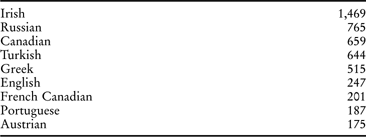
Source: Wells, Peabody Story, p. 386.
Most foreign laborers settled in boarding houses, which were a long-standing feature of the city, offering a bed, meals, and the lowest rents. When the Turks came to Peabody, they generally also lived in boarding houses, as “their bachelor dormitory-style living accommodations gave the Turks security”.Footnote 37 Wells notes that one boarding house on Lower Main Street was called “the house of the 101 Turks”. Boarding houses helped people to save their money by providing beds and food at low cost. And, sometimes, an enterprising immigrant would rent a house and arrange for his countrymen and, at times, other immigrants to live with him. A cook, who would also perhaps do the cleaning, was employed to provide culturally familiar food for meals at the boarding house and for breaks at the tanneries. Because of the heat in the leather factories, the men could easily warm their food and tea by placing them on one of the hot machines.
A Turkish grave in Cedar Grove Cemetery in Peabody, MA. The American headstone carvers were able to carve Ottoman script by imitating the handwriting of the Turks. The Ottoman script on the gravestone suggests that Halid Naman came from Diyarbakir vilayeti (Diyarbakir province). Picture taken by the author in 2007.

Although life in the boarding houses provided advantages, poor sanitary conditions in the tanneries and the boarding houses increased the risk of contracting contagious diseases, such as tuberculosis. These diseases resulted in death or, at best, an early return home. As Bill Toomey, who in the 1950s started working at A.C. Lawrence, where many of the Turks had worked and which had a reputation as a clean tannery, noted: “OSHA [the federal Occupational Health and Safety Administration] wouldn’t let you walk in there today.” He wondered “how anyone could sit down in there and eat their lunch. There was all blood and skin and stuff everywhere.”Footnote 38 The majority of the fifty-one Turks buried in Cedar Grove Cemetery in Peabody died from tuberculosis in the same year: 1917.Footnote 39 Cedar Grove Cemetery records show that those who lived until their forties and fifties developed cancers and heart diseases, probably because of the huge amount of chemicals they encountered every day, combined with their habit of smoking in the coffee houses.Footnote 40
“Men of Many Nations at Work in Peabody Tanneries”
Turks were a puzzle to the other residents of the city as well as to the tannery employers. With a different language and being the first and only Muslim community in Peabody, they were not always welcome among Anglo-Americans and European immigrants. An article in the Salem Evening News entitled “Men of Many Nations at Work in Peabody Tanneries: Difficulties of Handling Them” noted that Turks were puzzling to many employers, as their language and customs were so different from those of mainstream Americans. The article went on to say: “many of them appear to be Mohammedans”. According to the article, the Turks “hate the Greeks”. Because the Greeks and Turks would fight at the slightest provocation, “to put Greeks and Turks at work together would be almost as bad as mixing powder and matches”, and the two groups should work in different places or at different tasks.Footnote 41
Although the local and national newspapers portrayed Turks and Greeks as if they were the only groups that fought, quarrels among many ethnic groups in other industries was a part of industrial life in a multi-ethnic setting. Hareven notes:
Ethnic conflicts were the most divisive force among the workers. […] Discrimination or job segregation along ethnic lines as practiced by bosses and minor supervisors found its counterpart in ethnic conflicts among the workers. Jean Chagnon recalled breaking up frequent fights among members of different ethnic groups when he was second hand in the card room. “One Polish fellow, they used to call him Hot Dog, and a German fellow, they used to call him Kaiser – he had a big long mustache. I had to break up those fights. They were really swinging. Oh, I broke up a lot of fights.”Footnote 42
The physical proximity of the Turks and Greeks, not only in the tanneries but also in the streets where they resided, may have proved a negative factor, especially during the times of conflict in the homeland. For example, Ahmed notes that the closeness of the houses the Ottomans lived in would lead to some struggles among the two nationalities as “a careless word or threat, real or imaginary, particularly if it was directed at one’s family or national origin, could fill the street with fighting men”. If a Turk had been under attack, the other Turks would pour into street from their houses, “usually armed with a large piece of wood or any handy heavy object, prepared for battle.”Footnote 43
Adaptation of Turkish leatherworkers to a new culture
A great number of Turkish immigrants came from rural backgrounds and were farmer-peasants who became unskilled laborers in the United States, as was illustrated in the reports of the Dillingham Commission submitted in 1910. Those investigated included 438 Turkish households who worked in the tanneries and leather-finishing establishments of Wisconsin, Delaware, Pennsylvania, and Massachusetts.
As Table 3 overleaf indicates, among the groups illustrated in the report Turks comprised the highest percentage of those employees who had worked unwaged in their country of origin. Although nearly all the Turkish laborers self-identified as farm laborers or farmers, interviews with the descendants of the Turkish immigrants from Harput suggest that a few of them were employed in the tanneries of Harput province, which numbered sixty in 1907, including the sanjaks of Harput, Mezre, Malatya, and Egin.Footnote 44 Mehmed Ismail, who later took the surname “Sef” (“chief” in English), was employed at one of the tanneries in Harput and at the American mission. He served as a janitor at the mission, learned English, and was brought to the United States by the missionaries as early as 1901 He found a job in Peabody’s tanneries and perhaps acted as a trainer for the Turkish community.Footnote 45
Occupation before coming to the United States of foreign-born males who were 16 years of age or over at time of coming, by race of individual

N.B.: This table includes only races with 20 or more males reporting. The total, however, is for all foreign-born.
Source: Reports of the Immigration Commission, Immigrants in Industries (Washington DC, 1911), p. 36.
Many Turkish immigrants came to the United States about a decade after Ismail Sef, just before and during the Balkan Wars. An article based on an interview with a Turkish merchant published in the Salem Evening News in July 1912 portrays the Turkish leatherworkers in the tannery town as follows:
Turks in Peabody of whom there are now many seem about as foreign to the citizens of the town as if they were in their home land several thousand miles away. And they are in their home land, in their thoughts, according to a Turkish merchant of whom the inquiry was made the other day concerning the Turks in Peabody. These Turks of Tannery Town, according to the merchant, are low class men of Turkey. They are not educated. Indeed some of their views of life are centuries old. They have no intention of settling in this country. Their purpose is to earn and save as much money as they can in this country and then go back to their old homes.Footnote 46
Although the newspaper could have been colored by nativist sentiments and there might have been some exaggeration, Ahmet Emin Yalman (he would later become a famous Turkish journalist after his return to Turkey), who visited Peabody in 1911 while a student at Columbia University, pointed out similar issues regarding the Anatolian leatherworkers, whom he found living and working in miserable conditions. They were employed in the tanneries in the toughest jobs, which would not have been carried out by any of the American working class. For that work, they were paid no more than $5 or $6 a week, an amount similar to that which children employed in light jobs received. Labor statistics for Massachusetts confirm Yalman’s observation, as the lowest weekly wage of a leatherworker in Peabody’s close neighbor Woburn was $8 in 1910 and the highest was $16.Footnote 47 The Turkish leatherworkers had health problems because of the damp air and chemicals in the tanneries. Yalman was shocked by the ignorance of the Turks in Peabody, who were living and working in horrifying conditions and doing nothing to better them. He also criticized them for not trying to understand America and learn its language.
In fact, Turkish became the second language of the town; as Yalman noted when he got off of the train, he was surprised by signs written in English and Turkish. One Turkish worker told Yalman that none of them wanted to stay there. Their goal was to save some money, return to the homeland, and come together with their children. In order to prevent any thought of living there, they did not bring their families and did not try to learn English; indeed, they discouraged those who attempted to learn the language and tried to stop their efforts. The Turkish workers noted, “Our job is to work in tanneries. It is a filthy, difficult job. […] There is not much demand for this job.” They were well aware that their employers were trying to keep them, so they had “never been left hungry”. They cooked together and tried to save money to send it to the homeland.Footnote 48 Having something in their stomach and saving a little by not spending at all was enough for the Turkish laborers, who, at the time of Yalman’s visit, had probably been unaware that they could have demanded better wages and improved working conditions.
One of Peabody’s beam houses in 1920s. The people are identified as European immigrants. My belief is that many of them are either Turks or Greeks, who were heavily employed in the beam house. From Quinn, Peabody’s Leather Industry; reproduced with permission.

Lack of demand for better wages and terrible working conditions were not the only reasons why Turkish workers wanted to return home. Because of the ethnic divisions in the city of Peabody, where the Turks and Greeks, the Poles, and the Irish resided in different sections of the city, the Turks and other ethnic groups found it hard to organize strikes or form unions to lobby for better conditions. Although at the turn of the century leatherworkers in Peabody had become more union conscious and had started making gains in the workplace environment, including a nine-hour day, those gains proved transitory due to internal strife and conspiracies by manufacturers to limit unions.Footnote 49 Most Turkish (and other) workers did strike in early 1910s; however, those were minor strikes without any significant outcome, as the following extract from an article published in the Salem Evening News indicates:
The strikes among the Turks at the A. C. L. L. Co.’s [A.C. Lawrence] plant appear to be over, the places of the strikers having been filled. Many of the men have returned to work at the same wages […] but only the best men have been taken back. There was no further trouble among the strikers yesterday.Footnote 50
These were not union-led strikes, as labor unions such as the United Brotherhood of Leather Workers and the Amalgamated Leather Workers of America (which came into existence in 1905) did not survive long enough to continue their attempts at unionization. As Lynne Nelson Manion noted, “Manufacturers not only used the ethnic divisions among employees to thwart unionization attempts, they tried to keep new immigrants ignorant about organizing activity.” With the support of the federal government, one of the ways manufacturers controlled factory life was by objecting to unionization. The National Association of Manufacturers (NAM), formed in 1895, changed its goal from expanding “trade possibilities for its business members” to promoting “belligerent opposition to union organization”. Many leather manufacturers in Peabody adopted the NAM’s philosophy, which was opposed to collective bargaining.Footnote 51
The Balkan wars and world war I
Effects of the Balkan wars on Turkish leatherworkers
Despite the barriers to forming unions, there was a growing awareness concerning labor rights, which could be seen especially among Turkish workers in Peabody’s tanneries as a result of the Balkan wars. When Ahmet Emin Yalman visited Peabody for the second time, in 1913, he was surprised by the changes he witnessed. The men had subscribed to Istanbul newspapers to learn more about the Balkan wars, and they read these newspapers collectively, arguing about the condition of the homeland. Furthermore, lectures on workers’ rights given by a young Anatolian Greek excited interest among Turkish and Greek workers in labor rights. Yalman noted that the factory owners, who were troubled about losing such hard-working and enduring employees, increased their wages immediately.Footnote 52
Before coming to the United States, it is doubtful whether the Turkish leatherworkers had been introduced to the concept of strikes and labor unions. There were no clauses concerning the right to unionize and to strike in the Ottoman Constitution of 1876. However, when the strike wave of 1908 started in Istanbul and Izmir triggered by labor unrest in a number of industries, including tobacco (Régie), glass (Pasabahce), railways (Aksaray, Besiktas, Sisli), and bakeries in Istanbul, the Committee of Union and Progress (CUP) published an article stating that after a long time of oppression these strikes were not a surprise; the employers should not fear labor unions and should better the condition of the workers. With the intervention of CUP delegates and negotiations, almost all these strikes ended in gains for the workers: shorter working hours and better wages.Footnote 53
Year of arrival in US for Turks resident in Peabody, Massachusetts, 1920. See Işıl Acehan, “Outposts of an Empire: Early Turkish Migration to Peabody, Massachusetts, 1900–1930” (M.A., Bilkent University, 2005). US Federal Census Schedules (Microfilms), Peabody, MA, 1920.

The immigration of Turks to Peabody peaked between 1911 and 1914; it can be argued that these newcomers were among those who had migrated first to Istanbul, as the Grecian merchant mentioned earlier noted, and then immigrated to the United States to join the old home networks that had left from Harput previously. One could therefore speculate that the newcomers might have experienced the strikes in Istanbul, and that the Anatolian Greek mentioned by Yalman could have been one of the strike leaders. There is no solid evidence of this, however, as the manifests of ships arriving in US ports can be traced back only to the European ports of departure (which in many cases was Marseilles).
World War I and its outcomes
During the war in Europe, Turkish leatherworkers would become more ethnic and class-conscious. In 1916, the Salem Evening News reported the following:
There are in Peabody today about 1600 Turks. They are largely employed in the beam and tan houses where strength counts for everything. Without doubt, agitators have preached to these men and instilled into them the idea that they are indispensable to the leather business and that the positions they hold are theirs and others cannot take their places.Footnote 54
Turkish workers became visible in the labor troubles that many industries throughout the United States were experiencing in 1917. The most determinant factor in the strikes was economic, mainly demands for wage increases. As Bruce E. Kaufman notes, “periods of rapid inflation – such as during and following the First and Second World Wars, the Korean War and Vietnam War – resulted in large increases in strike activity precisely because they widened the distance separating the two sides as workers demanded larger-than-usual wage increases”.Footnote 55 A newspaper article, “250 Strike in Peabody Shops: The Foreigners Employed in Leather Factories Demand Increase in Wages”, chronicled an example of the troubles:
Extensive strikes among the Turks and for some other foreigners in the beam houses, soaks and in other storehouses at the A.C.L. Co’s and National Calfskin Co’s plants took place this morning and it was stated that all told some 250 men quit work. They want a raise from $18 to $22 per week in the beam houses and from $16 to $18 in the storehouses with extra pay for Saturday afternoon work.Footnote 56
It does not state whether the strike was ordered by the union, but many of the Turkish laborers were members of Local No. 1 United Leather Workers of America, and they also had a delegate, Allie Effendy, in 1919. One of the biggest meetings of the union was held in 1918, attended by more than 1,000 leatherworkers composed of Poles, Turks, Greeks, and Americans; Turks were the strongest group among them, as it is stated that the business representative Joseph Hayes, whom the Turks supported, would have “carried out the meeting had a vote been taken”.Footnote 57
Turkish workers also achieved a collective bargaining position with their strong presence in the leather business. While many of the previous strikes resulted in the places of the striking laborers being filled by others, this time the laborers achieved a raise in their wages and returned to work under an agreement arbitrated by the police chief Michael H. Grady, who played arbiter and counselor many times for the Turks, as the article “Strike Settled” illustrates:
The strike at the National Calfskin Co.’s plant, involving a large number of cellar men, beamsters, etc. chiefly Turks, was settled yesterday afternoon, Chief of Police Grady acting as intermediary between the strikers and Manager Charles P. Kelley of the plant. The Turks waited upon the chief, through a delegation of their number, and he got in touch with Manager Kelley and was closeted with the latter for about an hour, before he obtained an offer of compromise. The strikers wanted $25 per week. The manager had offered them $23 at the time they struck, but it had been refused. The settlement was made on a basis of $24 per week, the men to sign up for one year, agreeing not to strike for a higher wage in that time. These terms are agreed and the men returned to work today.Footnote 58
Labor statistics for Massachusetts for 1917 give the highest weekly wage for a leatherworker in Peabody’s neighbor, Lowell, as $22, while the lowest weekly wage was $11.55, and in another neighboring city, Salem, the highest weekly wage for a leatherworker in 1918 was $23.Footnote 59 As noted earlier, in 1911 Turkish laborers were earning at least $2 a week less than leatherworkers in other New England towns and cities. However, because of their collective efforts and strikes, by 1917 they were paid at least $2 more than the weekly wages of the highest-paid workers employed in the leather factories of the neighboring towns.
Despite these gains, the Great War would create a negative image of the Turkish leatherworkers; they became the target of criticism not only because of a rising nativism and hostility towards immigrant labor but also because Turkey’s entry into World War I on the side of Germany embittered anti-Turkish sentiments. By 1917, local newspapers, by emphasizing that Turks were enemy alien workers and were saving money to return home, had begun drawing a more negative image of the Turkish leatherworkers in Peabody’s tanneries. An article published by the Salem Evening News in 1918 was entitled “Turks Saving Their Money to Go Back Home: Earn Vast Sums Here While Brothers in the Old Country Fighting; Sidelight on Enemy Alien Workers.” The article emphasized the fact that the workers did not intend to remain in the United States and “when the war closes, they will have a fine bunch of money to take back to their native soil and this accumulated capital will make them big men in their community”. They were criticized for not spending money in the United States and instead investing it in their own countries.Footnote 60 Some Turks were refused coffee-house licenses on the ground that the Turks were pro-German and “most of the Turkish coffeehouses were hotbeds of sedition and treason”.Footnote 61
Conclusion
In addition to the effects of the Balkan Wars and World War I on the Turkish leatherworkers in making them more conscious of their rights as laborers, the local people’s reluctance to take beam-house jobs, the belief that Turkish people were tough enough to carry on the beam-house operations, and their strong position in Local No 1. gave Turkish leatherworkers a firm foothold in the leather factories. As one of the leatherworking veterans noted in 1918, “beam house work is hard, some of the young fellows complain”. He compared the old days, when they worked hard from sunrise to sunset in the beam houses, which are “rough, shabby places, with loose boards on the vats, a smell beyond description, cold as an iceberg in winter, and as hot as a Turkish bath in summer”, and the current (1918) “palaces of the beam houses”, where fresh air is blown every hour, workers have steel lockers and showers, and working hours are shorter, while the wage range is $20–$25 a week. He tried to persuade the young people of the town to stop grumbling about the beam house and take up the jobs that the foreigners had.Footnote 62 However, sanitary conditions in the beam houses were not as good as the veteran describes. Although the workers were provided rubber gloves and aprons, many of them, as stated earlier, suffered from tuberculosis between the mid-1910s and late 1920s and developed cancer in later years.
Local No. 1 of the United Leather Workers’ Union, which was formed in 1915 and represented many of the Turkish leatherworkers, was recognized by only two Peabody tanneries – Essex Tanning Company and Kirstein Leather Company. The other leather establishments, including A.C. Lawrence and the National Calfskin Co., where many Turks were employed, were reluctant to recognize the union, and this situation remained the same for several decades. In addition, labor unions in the United States were not very powerful before Franklin Delano Roosevelt signed the National Industrial Recovery Act (NIRA) into law on 16 June 1933. Section 7 (a) of the NIRA was designed to reduce and relieve unemployment and to improve standards of labor.
Thus, although the Turkish leatherworkers were active labor union members, their gains did not go beyond short-term economic achievements. By the 1920s, the labor movement and strikes both in Peabody and all American industrial cities experienced a decade-long drop due to the “sapping of worker militancy by the employers’ strategy of welfare capitalism, and the overall anti-union sentiment of the public fostered by the ‘Red Scare’ ”.Footnote 63 Finally, as the sharp decline in the number of Turks in the 1930 census of Peabody and as the Salem Evening News indicate, Turkish leatherworkers had begun returning to their homeland in the late 1920s – supposedly because of the decline in weekly earnings of ordinary male laborers in the leather industry beginning in 1922,Footnote 64 more widespread transportation networks, and the prospect of opportunities in the homeland. This migration led to a considerable decrease in the Turkish labor population in Peabody’s leather factories, and their unique place in the north-shore labor movement gradually faded away.
Although many of the Turkish leatherworkers did not learn English during their time in the United States, they were quick to respond to the new circumstances. The labor unions prior to 1933 “were worthless” and the leatherworkers “had nothing”, as Ed Hall, a former leatherworker, recalled. The tannery owners would “come in and they could lay you off anytime they want. Get rid of ya. Tell you, ‘All done’.”Footnote 65 However, despite the unfavorable conditions in the leather industry, by maintaining group solidarity through social and kinship ties Turkish leatherworkers secured a more favorable place in the tanning business than other nationalities did.



