Introduction
Since Happock's seminal work on the topic in 1935, job satisfaction has continued to generate interest across disciplines, from psychology (Argyle, Reference Argyle1989) and sociology (Kalleberg & Loscocco, Reference Kalleberg and Loscocco1983; Hodson, Reference Hodson2002), to economics (Freeman, Reference Freeman1978; Hamermesh, Reference Hamermesh2001), management sciences (Hunt & Saul, Reference Hunt and Saul1975), and public administration (Durst & DeSantis, Reference Durst and DeSantis1997; Wright & Kim, Reference Wright and Kim2004; Jung, Moon, & Hahm, Reference Jung, Moon and Hahm2007). The interest in job satisfaction, as much for researchers as for practitioners, is due to several reasons. Satisfied workers are more productive (Appelbaum & Kamal, Reference Appelbaum and Kamal2000), deliver higher quality of work (Tietjen & Myers, Reference Tietjen and Myers1998), and improve a firms competitiveness and success (Garrido, Perez, & Anton, Reference Garrido, Perez and Anton2005). Conversely, unsatisfied workers are more frequently late for work, absent from work, and motivated to leave the firm (Blau, Reference Blau1994; Lee, Reference Lee1998).
Additionally, many researchers have suggested an increasing importance in the role that our work plays in our everyday lives, with most able-body individuals spending at least one-half or more of their waking hours in the workplace (in one form or another), and with the landscape of work in the United States and across the world changing dramatically over the past 15–20 years in response to economic shifts, technological advances, and an increasingly global economy (e.g., Jamison, Jamison, & Wallace, Reference Jamison, Jamison and Wallace2004; Handel, Reference Handel2005). As work plays an increasingly significant role in our lives, and as different workplaces are unique – each with its own particular set of characteristics, it is important to understand what it is about the workplace that impacts our lives and how these characteristics impact a worker's overall job satisfaction.
The vast cross-disciplinary literature exploring work quality and job satisfaction has linked worker experiences to many individual, organizational, and social outcomes, yet this research has largely failed to shed much light on why cross-national differences in worker satisfaction and its determinants persist over time. An often accepted job satisfaction model, commonly considered to be widely generalizable across a wide variety of cross-cultural and cross-national contexts, actually appears to have a lack of applicability across countries (see Westover, Reference Westover2010a, Reference Westover2010b, Reference Westover2011; Westover & Taylor, Reference Westover and Taylor2010; Taylor & Westover, Reference Taylor and Westover2011).
The core questions driving this research are: (1) what are the empirical cross-national differences in job characteristics and job satisfaction, and (2) what are the causes behind these differences? Cross-cultural researchers would suggest that any such differences would all be due to cultural differences between countries. However, the limited research that explores work quality characteristics and job satisfaction from a cross-cultural perspective has largely failed to show how countries with similar cultural orientations still experience significant differences and how countries with different cultural orientations still experience similarities.
The question remains, what are the causes for these country differences. More specifically, what are the key country-level contextual and global-macro variables driving these country differences in job characteristics and perceived worker satisfaction (which is of increasing relevance in the age of an ever more globalized economy and hyper-competitive global marketplace)? Existing research cannot answer these and other related questions. Like many work attitudes, job satisfaction is a dynamic construct that changes in response to personal and environmental conditions. Monitoring job satisfaction over time and in different contexts will allow one to better examine and understand the salient factors that affect job satisfaction.
The overall purpose in conducting this research is to (1) empirically test (using various bivariate descriptive procedures and comparative OLS regression) significant, cross-national differences in job satisfaction and its determents and (2) explore the reasons for these cross-national differences, moving beyond the research of social psychologists and organizational behavior researchers, to also include import macro cross-national factors that directly influence these differences.
Literature review overview
The conceptualization of job satisfaction
Job satisfaction has been conceptualized in different ways. Some have simply regarded it as the degree to which people like their jobs (Spector, Reference Spector1997). Others see it as the degree of fit between the features of a job and workers’ expectations. Based on this approach, workers are relatively more satisfied with their jobs when their expectations are fulfilled or exceeded; otherwise, dissatisfaction would be the outcome of a work experience (Tutuncu & Kozak, Reference Tutuncu and Kozak2007). Job satisfaction is in fact commonly explained using the person–environment fit paradigm or needs-satisfaction model. The more a job fulfills the workers’ needs or values, the higher should be their job satisfaction levels (Kristof-Brown, Reference Kristof-Brown1996; Traut, Larsen, & Feimer, Reference Traut, Larsen and Feimer2000; Ellickson, Reference Ellickson2002). Rather than confine the definition of job satisfaction to job features, several researchers have incorporated the work environment. They see job satisfaction as a multidimensional attitude of workers toward their jobs and work places (Clark & Oswald, Reference Clark and Oswald1996; Davis & Newstrom, Reference Davis and Newstrom1999; Hamermesh, Reference Hamermesh2001). Additionally, theorists and researchers alike have often looked at job satisfaction in terms of nonmaterial (intrinsic) and nonmaterial (extrinsic) rewards (Kalleberg, Reference Kalleberg1977; Handel, Reference Handel2005).
Empirical studies looking at the impact of various antecedents of job satisfaction tend to be divided into three: (1) those that link satisfaction with the personal characteristics of employees, such as gender, and education (Oshagbemi, Reference Oshagbemi2000); (2) those that link satisfaction with elements of the work carried out by the employee, such as job characteristics, personal relations, and the work environment (Hackman & Oldham, Reference Hackman and Oldham1980); and (3) those that link this variable with the working conditions offered by the firm to the employee, such as compensation, promotion, and job security (Kotorov & Hsu, Reference Kotorov and Hsu2001; Darmon, Rigaux-Bricmont, & Balloffet, Reference Darmon, Rigaux-Bricmont and Balloffet2003). Accordingly, the three central accounts for workers’ satisfaction with their jobs are the characteristics of individuals, jobs, and organizations (Glisson & Durick, Reference Glisson and Durick1988; Judge & Church, Reference Judge and Church2000; Haley-Lock, Reference Haley-Lock2008).
Overview of the statist-job satisfaction link
There are various explanations for why and how job satisfaction and its work determinants can differ cross-nationally, based on national contextual factors. One theoretical perspective that can provide some explanations for why and how job satisfaction and its work determinants can differ cross-nationally is the statist perspective or international political economy perspective. While many theorists have argued for a global world system (e.g., Wallerstein, 1974, 2000), there is a growing body of scholarship that has shown a renewed interest in exploring the role of the state in the global economy (e.g., Hirschman, Reference Hirschman1945; Evans, Ruschemeyer, & Skocpol, Reference Evans, Ruschemeyer and Skocpol1985; Tilly, Reference Tilly1990; Mann, Reference Mann1993; Evans, Reference Evans1994, Reference Evans1995; Meyer, Boli, Francisco, Thomas, & Ramirez, Reference Meyer, Boli, Francisco, Thomas and Ramirez1997; Gilpin, Reference Gilpin2001; Kohli, Reference Kohli2004), while others argue that states are not the only actors in the international political economy, but they are the most important actors (e.g., Gilpin, Reference Gilpin2001).
There are many aspects of the state that prior cross-national research has take into account. In brief summary, these aspects include understanding state regime type and level of democratization (Polanyi, Reference Polanyi1944; Moore, Reference Moore1966; Evans, Reference Evans1994, Reference Evans1995; Kohli, Reference Kohli2004), understanding the effect of colonization on potential existing and future domestic economy (Kohli, Reference Kohli2004), issues surrounding the level of state political power and industrialization (Evans, Ruschemeyer, & Skocpol, Reference Evans, Ruschemeyer and Skocpol1985; Mann, Reference Mann1993), state military buildup and power (Evans, Ruschemeyer, & Skocpol, Reference Evans, Ruschemeyer and Skocpol1985; Tilly, Reference Tilly1990), the relative embeddedness and autonomy of the state with business interests (Evans, Ruschemeyer, & Skocpol, Reference Evans, Ruschemeyer and Skocpol1985; Evans, Reference Evans1995), the balance of state regulation with the sharing of state power with social groups (Polanyi, Reference Polanyi1944; Moore, Reference Moore1966), level state bureaucratic apparatus and decentralization (Evans, Ruschemeyer, & Skocpol, Reference Evans, Ruschemeyer and Skocpol1985), the state's role in the establishing, building, and sustaining of markets (Fligstein & Merand, Reference Fligstein and Merand2002; Kohli, Reference Kohli2004), and the relative level of welfare state work safety-net provision (Stephens, Reference Stephens1979a, Reference Stephens1979b; Korpi, Reference Korpi1983; Epsing-Andersen, Reference Epsing-Andersen1985; Hicks & Swank, Reference Hicks and Swank1992; Huber & Stephens, Reference Huber and Stephens2001).
Among the many statist researchers, Kohli (Reference Kohli2004) examined patterns of state construction and state intervention aimed at promoting industrialization and argues that the type of state involvement in society directly impacts development trajectory of that society, and thus the nature of working conditions within that society. Furthermore, Kohli developed a typology to examine the nature of different state regime ‘ideal types’ in this relationship, including: (1) neopatrimonial states, (2) cohesive-capitalist states, and (3) fragmented-multiclass states (neopatrimonial states and cohesive-capitalist states are on two ends of the state authority spectrum, with fragmented-multiclass states falling in the middle). Cohesive-capitalist states help to facilitate the availability of capital, labor, technology, and entrepreneurship, while also ‘enabling private investors to have a ready supply of cheap, ‘flexible,’ and disciplined labor’ (p. 13). In contrast, in ‘instead of strengthening the private sector, [neopatrimonial states] have appropriated scarce economic resources and diverted them everywhere but toward productive investment’ (p. 15). Additionally, cohesive-capitalist states have a lot more ‘power to define and pursue their goals than neopatrimonial states, with fragmented-multiclass states falling somewhere in between’ and the two key determinants of the variation in state power are ‘organizational characteristics of state institutions… and the manner in which states craft their relations with social classes, especially the producer classes’ (p. 21). In fragmented-multiclass states, power is not highly concentrated and leaders are generally committed to a broad set of goals and a variety of interest groups within the states make their demands known to the ruling elite. Kohli's typology will be useful in this research as it will allow me to connect variation in the nature of the state to variation in working conditions. Furthermore, his typology provides the means for making country comparisons in relation to other state-level political and economic conditions that in turn impact working conditions and the experience of workers in the workplace.
Kohli's typology of state directed development regime types is a county-level factor that shapes the broad domestic context for workplace conditions that can impact workers’ satisfaction levels and its determinants. Extrinsic rewards and working conditions have been reported to be worse in states Kohli (Reference Kohli2004) classifies as cohesive-capitalist and neopatrimonial in nature, as compared with those same conditions in fragmented multi-class states, while intrinsic workplace characteristics and workplace relations have been shown to be more salient toward worker satisfaction and work quality factors for countries with less oppressive fragmented multi-class regimes (Lee, Reference Lee1997; Benner, Reference Benner2002; Sweet & Munck, Reference Munck2002; Kohli, Reference Kohli2004; Mendenhall, Oddou, & Stahl, Reference Mendenhall, Oddou and Stahl2007; Perrucci & Perrucci, Reference Perrucci and Perrucci2007; Dowling & Welch, Reference Dowling and Welch2008; Meiksins, 2008). Additionally, workers in countries with a relatively greater level of welfare state safety net provisions experience less concern over extrinsic work rewards and conditions than those without such provisions (Epsing-Andersen, Reference Epsing-Andersen1985; Skocpol, Reference Skocpol1988; Weir, Orloff, & Skocpol, Reference Weir, Orloff and Skocpol1988; Pampel & Williamson, Reference Pampel and Williamson1989; Hall, Reference Hall1999; Hall & Soskice, Reference Hall and Soskice2001; Huber & Stephens, Reference Huber and Stephens2001; Scruggs & Allan, Reference Scruggs and Allan2006). For example, Kohli (Reference Kohli2004) found that coercive-capitalist states of South Korea repressed workers with a nearly warlike mobilization of labor to create a highly productive workforce (resulting in very poor working conditions related to workplace safety and health, wages, working hours, and areas of job enlargement and empowerment), whereas fragmented multi-class state of India encouraged a highly politicized labor force that never amounted to a cohesive capitalist force (resulting in greater workplace flexibility for workers, and better overall working conditions).
The statist perspective is important to the cross-national examination of job quality characteristics and job satisfaction because it provides an important alternative avenue to the cross-cultural explanation for understanding the reasons behind international differences in that impact job satisfaction and its determinants. Based on the different needs fulfillment models (that put first-level importance on basic ‘existence’ needs) of Maslow, Alderfer, and Herzberg (see Maslow, Reference Maslow1943; Herzberg, Mausner, & Snyderman, Reference Herzberg, Mausner and Snyderman1959; Alderfer, Reference Alderfer1972), this would lead to the logical conclusion that workers in cohesive-capitalist and neopatrimonial states with relatively worse working conditions would be more greatly motivated and satisfied by extrinsic workplace factors, while workers in fragmented multi-class states with better working conditions would be better able to move beyond the various extrinsic ‘existence’ needs and move toward the more ‘self-actualization’ and ‘personal fulfillment’ intrinsic needs. Thus, the statist perspective provides yet another important conceptual tool in the cross-national examination of job quality characteristics and job satisfaction.
Discussion of variables
Description of data
This research utilizes non-panel longitudinal data from the International Social Survey Program (1989, 1997, 2005 – various survey questions on job characteristics and job quality). The International Social Survey Program Work Orientations modules utilized a multistage stratified probability sample to collect the data for each of the various countries with a variety of eligible participants in each country's target populationFootnote 1. The Work Orientations module focuses on the areas of general attitudes toward work and leisure, work organization, and work contentFootnote 2. Variables of interest in the data collected by the International Social Survey Program are single-item indicators (i.e., with a single survey question for job satisfaction, interesting work, job autonomy, workplace relations, etc., on a Likert scale). For the purposes of this study, the units of analysis are individuals within the separate sovereign nations. In addition to examining one large sample including all respondents from all participating countries, a separate sample for each country is also examined to determine which job characteristics best predict job satisfaction in that particular country and then make cross-national comparisons (see also Westover, Reference Westover2008a, Reference Westover2008b, Reference Westover2010a, Reference Westover2010b, Reference Westover2011; Taylor & Westover, Reference Taylor and Westover2011).
Operationalization of variables
This research follows Westover's (Reference Westover2008a, Reference Westover2008b, Reference Westover2010a, Reference Westover2010b, Reference Westover2011) job satisfaction model (based on Kalleberg's, Reference Kalleberg1977 findings and Handel's, Reference Handel2005 study) for conducting a cross-national comparison of job satisfaction and the perceived importance of intrinsic and extrinsic job quality characteristic variations across countries (see also Spector, Reference Spector1997; Sousa-Poza & Sousa-Poza, Reference Sousa-Poza and Sousa-Poza2000; Muñoz de Bustillo Llorente & Macías, Reference Muñoz de Bustillo Llorente and Macías2005; Westover, Reference Westover2008a, Reference Westover2008b, Reference Westover2010a, Reference Westover2010b, Reference Westover2011). Handel (Reference Handel2005) characterized 12 variables from the General Social Survey into intrinsic and extrinsic job quality factors. Ten of the 12 variables used by Handel are available for all countries in each of the three waves of the International Social Survey data used for this study and are outlined below.
Key job quality characteristics related to job satisfaction
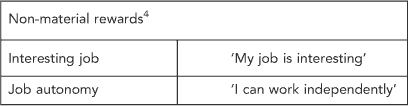
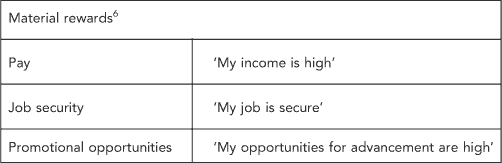
All variables are single-item measures based on the survey questions below (see also Westover, Reference Westover2008a, Reference Westover2008b, Reference Westover2010a, Reference Westover2010b, Reference Westover2011).
Dependent variable

Key independent variables (from the International Social Survey Program):
Intrinsic rewards

Extrinsic rewards
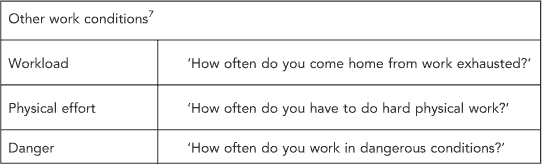
Individual control variables
Though the literature has identified many important individual control variables, due to limitations in data availability, control variables used were limited to the following, individual characteristics (see Westover, Reference Westover2008a, Reference Westover2008b, Reference Westover2010a, Reference Westover2010b, Reference Westover2011): full-time/part-time status, self-employment status, gender, age, marital status, and education (see Hammermesh, 1999; Sousa-Poza & Sousa-Poza, Reference Sousa-Poza and Sousa-Poza2000; Hodson, Reference Hodson2002; Carlson & Mellor, Reference Carlson and Mellor2004).
Country contextual variables
As country-contextual proxies for the statist perspective, a series of dummy variables were created for those country-level contextual variables related to these statist hypotheses, including: (1) high/low scores on the economic freedom index, (2) high/low scores on the rigidity of employment index, (3) high/low scores on the human development index, and (4) high/low scores on the democratization index (see Meyer et al., Reference Meyer, Boli, Francisco, Thomas and Ramirez1997; Gilpin, Reference Gilpin2001; Kohli, Reference Kohli2004 for further justification of these measures). Additionally, a dummy variable was created to designate whether a country was either a cohesive-capitalist or fragmented multi-class (categorization based on Kohli's, 2004 typology; see Appendix A for additional variable details).
Model
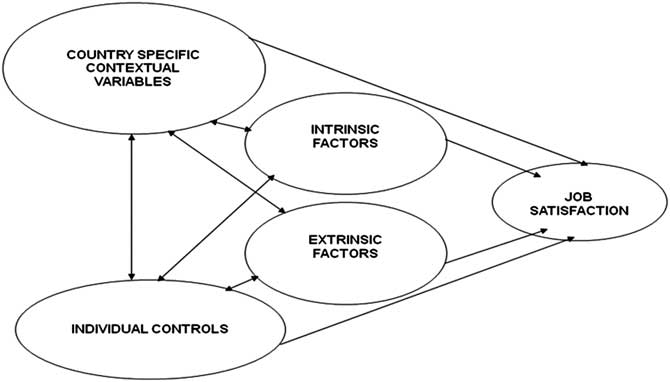
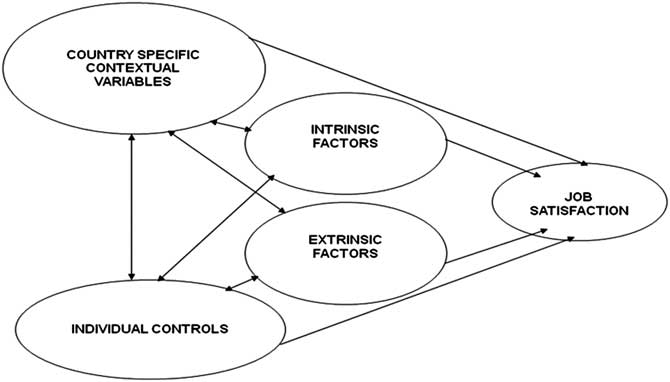
Figure 1 depicts the overall theoretical model of the influences on job quality and overall job satisfaction. In addition to the various intrinsic and extrinsic factors examined in most satisfaction research, this model also includes commonly omitted factors, including country-specific contextual variables, including national-level economic variables. I argue that each of these macro-level conditions set the stage for job quality conditions and worker satisfaction within a given nation. Furthermore, as a result of differing macro-level and differing job quality conditions, countries will have a difference in intrinsic and extrinsic work quality factors and their saliency to perceived satisfaction.
Factors impacting work characteristics and job satisfaction
Methodological description
Statistical methodology
First, this research uses data from the International Social Survey to perform a descriptive statistical analysis of work characteristics and job satisfaction for individual countries and across nations. These bivariate and multivariate analysis include trend analysis, correlations, ANOVA and ANCOVA procedures, cross-tabulations, as well as general descriptive statistics of job quality characteristics and job satisfaction in each country to provide descriptive comparative similarities and differences between countries. Additionally, both aggregate and country-specific OLS regression models of the impact of individual work characteristics on job satisfaction were generated to provide additional comparison between countriesFootnote 8.
Due to the ordinal nature of the dependant variable, it is most appropriate to use an ordered probit regression to look at the effect of different job characteristics on one's overall job satisfaction. However, many researchers have argued that using OLS regression is appropriate when looking at satisfaction variables on a Likert scale, where most respondents understand that the difference between responses of 1 and 2 is the same as the difference between responses of 2 and 3, and so on (see Handel, Reference Handel2005; Westover, Reference Westover2008a, Reference Westover2008b, Reference Westover2010a, Reference Westover2010b, Reference Westover2011). Additionally, using OLS regression results allows us to report an R 2 and adjusted R 2 value for the model and compare coefficients across models, which comparison is not appropriate in a probit model. Therefore, all regression results reported herein are OLS regression results. It is important to note that when the same OLS models where run in an ordered probit regression, the same significant results appeared for each of the independent and control variables across countries and waves (full ordered probit model results, are available upon request).
Limitations of data
One of the primary limitations of the available attitudinal data is that each question represents a subjective single item indicator. As Sousa-Poza and Sousa-Poza aptly point out, ‘[Subjective Well Being] scores depend on the type of scale used, the ordering of the items, the time-frame of the questions, the current mood at the time of measurement, and other situational factors’ (see also Diener, Diener, & Diener, Reference Diener, Diener and Diener1995; Sousa-Poza & Sousa-Poza, Reference Sousa-Poza and Sousa-Poza2000: 5; Westover, Reference Westover2008a, Reference Westover2008b, Reference Westover2010a, Reference Westover2010b, Reference Westover2011). They further point out that, as the International Social Survey Program data set only measures job satisfaction as a single-item indicator, variance due to the wording of the item cannot be averaged out and the single item further makes the evaluation of internal consistency problematic. Another problem is the non-panel longitudinal nature of the data. This research uses three waves of cross-sectional data and therefore one cannot specifically test the direction of causality among the variables examined as would be possible with panel longitudinal data. However, a conceptual framework is provided that hypothesizes the path of causality in addition to utilizing non-panel longitudinal data, which enables comparison of like variables over time (see also Westover, Reference Westover2008a, Reference Westover2008b, Reference Westover2010a, Reference Westover2010b, Reference Westover2011). Additionally, some variables of interest (i.e., work-related stress) and other important control variables (e.g., total hours worked per week, or whether or not an individual worked for the government or not) cannot be included in the analysis, as data are not available for each wave of data collection across all countries of interest.
Hypotheses
There are various explanations for why and how job satisfaction and its work determinants can differ cross-nationally, based on national contextual factors. One of these explanations is the role of state-directed development within a broader global economic and political context. In fact, recently increasingly numbers of scholars have shown a renewed interest in exploring the role of the state as an autonomous actor within a globalized economy, directly influencing country-level contextual business-related facets. Additionally, statist researchers have examined the level of state power and industrialization, the relative level of state embeddedness and autonomy with business interests, the level of bureaucratization, how states build and sustain markets, and state welfare provisions that impact the workplace (Meyer et al., Reference Meyer, Boli, Francisco, Thomas and Ramirez1997; Gilpin, Reference Gilpin2001; Kohli, Reference Kohli2004). These factors shape the broad domestic context for workplace conditions that can impact workers’ satisfaction levels and the determinants. Furthermore extrinsic rewards and working conditions have been reported to be worse in states Kohli (Reference Kohli2004) classifies as cohesive-capitalist and neopatrimonial in nature, as compared with those same conditions in fragmented multi-class states (Benner, Reference Benner2002; Munck, Reference Munck2002; Kohli, Reference Kohli2004; Perrucci & Perrucci, Reference Perrucci and Perrucci2007; Dowling & Welch, Reference Dowling and Welch2008; Sweet & Meiksins, Reference Sweet and Meiksins2008). As was the case with the world-systems argument above, based on the different needs fulfillment models of Maslow, Alderfer, and Herzberg (see Maslow, Reference Maslow1943; Herzberg, Mausner, & Snyderman, Reference Herzberg, Mausner and Snyderman1959; Alderfer, Reference Alderfer1972), this would lead to the logical conclusion that workers in cohesive-capitalist and neopatrimonial states with relatively worse working conditions would be more greatly motivated and satisfied by extrinsic workplace factors, while workers in fragmented multi-class states with better working conditions would be better able to move beyond the various extrinsic ‘existence’ needs and move toward the more ‘self-actualization’ and ‘personal fulfillment’ intrinsic needs. Thus, this framework leads to two hypotheses (specifically following Kohli's typology):
Hypothesis 1 : Workers in cohesive-capitalist states will experience worse overall job quality and perceived job satisfaction than workers in fragmented multi-class states.
Hypothesis 2a : Job satisfaction is more closely linked to extrinsic workplace rewards and other workplace conditions for workers in cohesive-capitalist states.
Hypothesis 2b : Job satisfaction is more closely linked to intrinsic workplace rewards and workplace relationships for workers in fragmented multi-class states.
Results
Descriptive statistics
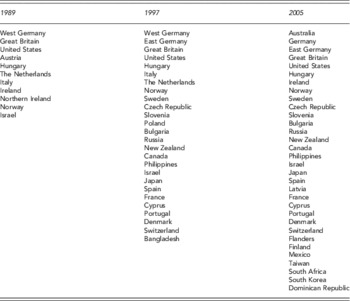
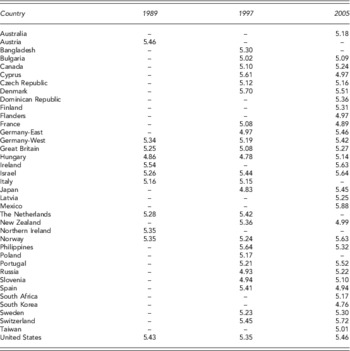
Table 1 shows mean changes in job satisfaction by country and wave. Specifically, for those six countries included in all three waves (West Germany, Great Britain, United States, Hungary, Norway, and Israel), all but Israel (which increased in each wave) saw a dip in mean job satisfactions scores from 1989 to 1997 and then a rebound from 1997 to 2005 with 2005 levels surpassing 1989 levels. Additionally, New Zealand, the Philippines, Spain, France, Cyprus, and Denmark were the only countries of the 22 countries included in both the 1997 and 2005 waves that saw a decline in mean job satisfaction from 1997 to 2005 (Table 2).
Study countries by year

Mean job satisfaction, by county and year (1989–2005)

Notes. Separate ANOVA and ANCOVA analysis show significant differences.
For job satisfaction across countries (at 0.05 or less level of significance).
Job Satisfaction is on a 1–7 scale (1 low, 7 high).
Intercorrelations among the main study variables
Job satisfaction was found to be significantly related to each of the main study variables in each wave of the study (International Social Survey Program 1989, 1997, and 2005)Footnote 9: management/employee relations, coworker relations, job autonomy, interesting work, job security, pay, promotional opportunities, workload, physical effort, and danger. The relationships of the study variables appear to be in the anticipated direction.
Regression results
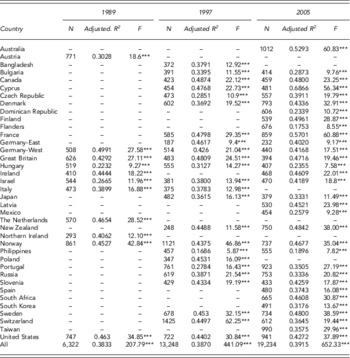
Table 3 below shows OLS regression model specifications for each country across the three waves of the study (complete regression results for each country across each wave are available upon request). It is interesting to note the difference in model predictability from country to country and from year to year. In 1989, West Germany has the highest adjusted R 2 (0.4991), while Hungary has the lowest (0.2232). Israel (0.2665) and Austria (0.3028) also each have relatively lower adjusted R 2 statistics, with the remainder of the countries falling somewhere from 0.38 to 0.46. In 1997, Canada (0.4874) and Great Britain (0.4809) have the highest adjusted R 2 values, while the Philippines has the lowest adjusted R 2 (0.1686). Portugal, the Czech Republic, Hungary, and Bulgaria, each have relatively lower adjusted R 2 values, ranging from 0.2784 to 0.3395, respectively. The remaining 19 countries have adjusted R 2 values ranging from 0.3615 to 0.4798. In 2005, Cyprus had far and away the highest (0.6866), followed by France (0.5701) and Australia (0.5293). Flanders (Belgium) and the Philippines each had by far the lowest adjusted R 2 values, at 0.1753 and 0.1896, respectively. The Dominican Republic (0.2339), Hungary (0.2355), and Mexico (0.2579) also had among the lowest adjusted R 2 values among the 32 countries. The remaining 26 countries have adjusted R 2 values somewhere between 0.2873 and 0.4961, with the vast majority at the higher end.
Summary of OLS model specifications, by country and year

Note. Level of significance: ***p < .001; – denotes data not available for given year.
Testing hypotheses
Among the various explanations for why and how job satisfaction and its work determinants can differ cross-nationally, one such possible explanation is embodied in the statist or international political economy perspective (exploring the role of the state as an autonomous actor within a globalized economy, directly influencing country-level contextual business-related facets conditions that can impact workers’ satisfaction levels and the determinants; see Meyer et al., Reference Meyer, Boli, Francisco, Thomas and Ramirez1997; Gilpin, Reference Gilpin2001; Kohli, Reference Kohli2004). As extrinsic rewards and working conditions have been reported to be worse in states Kohli (Reference Kohli2004) classifies as cohesive-capitalist, as compared with those same conditions in fragmented multi-class states, in order to examine whether the extent to which states control country-level contextual business-related facets would impact the relative saliency of either intrinsic or extrinsic work characteristics on worker satisfaction, country-level indicators were compiled for each of the 32 nations in wave 3. Dummy variables were created for those country-level contextual variables related to these statist hypotheses, including: (1) high/low scores on the economic freedom index, (2) high/low scores on the rigidity of employment index, (3) high/low scores on the human development index, and (4) high/low scores on the democratization index (see Meyer et al., Reference Meyer, Boli, Francisco, Thomas and Ramirez1997; Gilpin, Reference Gilpin2001; Kohli, Reference Kohli2004 for further justification of these measures; see Appendix A for additional variable details). Then mean scores for main study variables and OLS regression models were run for each sample to allow for comparison of intrinsic and extrinsic work characteristics and their ability to predict job satisfaction. These results are presented in Tables 4–8.
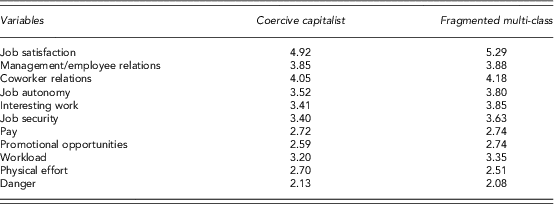
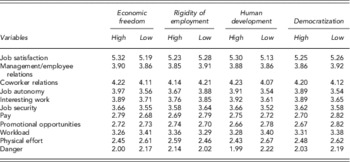
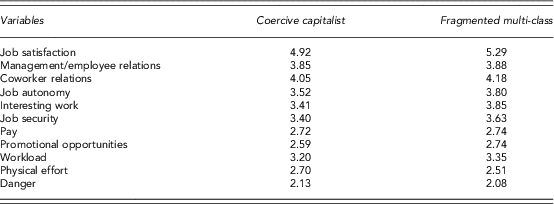
Tables 4 and 5 shows the comparative mean score of main study variables by the different statist-oriented country-level contextual variables and cohesive-capitalist state/fragmented multi-class state classifications. There is a significant difference in overall mean job satisfaction scores when comparing by high/low economic index scores, human development index scores, and cohesive-capitalist versus fragmented multi-class states classification, with countries with relatively higher levels of economic freedom and human development scores experiencing much higher job satisfaction scores than those countries with low scores on those two indices. There is little difference in job satisfaction when comparing by high/low levels of rigidity of employment index and democracy index scores. ‘Management/employee relations’ and ‘coworker relations’ mean scores varied little across the different dummy variable comparisons. However, ‘job autonomy’ mean scores were significantly level in cohesive-capitalist states and in countries with low economic freedom, greater rigidity of employment, low human development, and low levels of democratization. Mean scores for ‘interesting work’ were very similar across economic freedom, rigidity of employment levels, but were significantly lower for cohesive-capitalist states and those countries with lower levels of human development and democratization. ‘Job security’ mean scores are lower in countries with lower levels of economic freedom, greater levels employment rigidity, lower levels of human development and democratization, and cohesive-capitalist states, while there is no such consistent pattern for ‘pay’ or ‘promotional opportunities.’ However, perceived ‘workload,’ ‘physical effort,’ and ‘danger’ is higher in countries with lower levels of economic freedom, greater levels employment rigidity, and lower levels of human development and democratization.
Comparative mean scores of main study variables, by coercive-capitalist/fragmented multi-class classification
Comparative mean scores of main study variables, by dummy indices

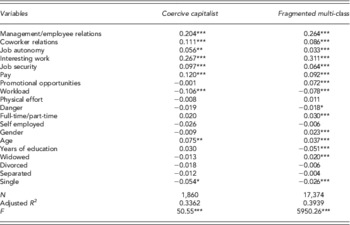
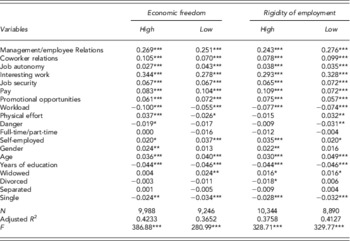
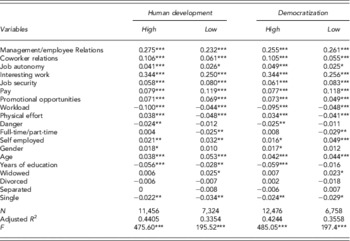
Furthermore, Tables 6–8 show OLS regression results by relative high/low levels of economic freedom, rigidity of employment, human development, democratization, and cohesive-capitalist state/fragmented multi-class state classifications. It is noteworthy that overall model fit and predictability of job satisfaction levels is much higher in ‘fragmented multi-class’ countries with higher levels of economic freedom, lower levels employment rigidity, and higher levels of human development and democratization. It is also noteworthy that each of the intrinsic factors (‘management/employee relations,’ ‘coworker relations,’ ‘job autonomy,’ and ‘interesting work’) have stronger standardized β coefficients (with a couple of minor exceptions) in countries with higher levels of economic freedom, lower levels employment rigidity, and higher levels of human development and democratization. Though there is no clear consistent pattern in the standardized β coefficient strength across all of the extrinsic factors (‘job security,’ ‘pay,’ ‘promotionally opportunities,’ ‘workload,’ ‘physical effort,’ and ‘danger’) across the different statist-related country-level factors, generally speaking, there are stronger standardized β coefficients for the extrinsic job characteristics in countries with lower levels of economic freedom, greater levels employment rigidity, and lower levels of human development and democratizationFootnote 10.
OLS regression results of study variables, by coercive-capitalist/fragmented multi-class classification
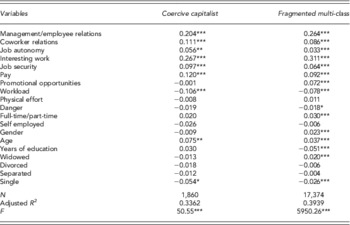
Note. Level of significance: *p < .05; **p < .01; ***p < .001; β values.
OLS regression results of study variables on job satisfaction, by economic freedom and rigidity of employment indices

Note. Level of significance: *p < .05; **p < .01; ***p < .001; β values.
OLS regression results of study variables on job satisfaction, by human development and democratization indices

Note. Level of significance: *p < .05; **p < .01; ***p < .001; β values.
Thus, based on comparative OLS regression results of job satisfaction and its determinants by cohesive-capitalist/fragmented multi-class state classification and other country-level variables related to the state, there is fairly strong support for H1, H2a, and H2b. In relation to H1 specifically, countries with lower levels of economic freedom, greater levels employment rigidity, lower levels of human development and democratization, and those classified as cohesive-capitalist states have significantly lower job satisfaction levels than those countries with higher levels of economic freedom, lower levels of employment rigidity, higher levels of human development and democratization, and those classified as fragmented multi-class states. Additionally, there are significant differences between the mean scores of other intrinsic and extrinsic job characteristics, depending on country classification and levels of economic freedom, rigidity of employment, human development, and level of democratization.
In relation to H2a and H2b specifically, based on comparative OLS regression results of job satisfaction and its determinants by country-level variables related to the state, in countries with higher levels of economic freedom, lower levels employment rigidity, and higher levels of human development and democratization, intrinsic work characteristics do provide greater overall predictability in overall perceived job satisfaction and have greater standardized β coefficients than their extrinsic counterparts. Once more, in countries with lower levels of economic freedom, greater levels employment rigidity, and lower levels of human development and democratization, extrinsic work characteristics generally have equal or greater standardized β coefficients than the extrinsic coefficients in the countries with higher levels of economic freedom, lower levels employment rigidity, and higher levels of human development and democratization. However, the results clearly show that in each case (regardless of country classification), intrinsic work characteristics add the most overall predictability to perceived job satisfaction of workers within those countries. To get a clearer picture as to the full impact that state-directed country-level contextual business related facets have on workers’ job characteristics and perceived satisfaction levels, future research needs to examine a greater number and wider variety of countries, while exploring other theoretically relevant country-level variables that may help to explore country level differences from a statist perspective.
Conclusions
Discussion
While no previous research has been done to show the link between statist-oriented country-level contextual business-related facets and perceived worker satisfaction, findings from this study have demonstrated such a connection, with fragmented multi-class states experiencing better perceived working conditions and job satisfaction than workers in cohesive-capitalist states. Additionally, as was reported earlier OLS regression results of job satisfaction by country showed that intrinsic workplace factors have a stronger impact on worker satisfaction in fragmented multi-class states, while extrinsic conditions have a stronger impact on worker satisfaction in cohesive-capitalist states. Furthermore, these findings support the crux of needs fulfillment job satisfaction models, that individuals first need to adequately address their extrinsic ‘existence/survival’ needs before focusing on the higher level intrinsic ‘actualization’ needs (see Maslow, Reference Maslow1943; Herzberg, Mausner, & Snyderman, Reference Herzberg, Mausner and Snyderman1959; Alderfer, Reference Alderfer1972).
However, the results clearly show that in each case (regardless of country classification), intrinsic work characteristics add the most overall predictability to perceived job satisfaction of workers within the 32 participating countries. While at first look, this result may seem at odds with the statist theory and its corresponding hypotheses, I believe it actually provides greater support for the statist perspective, as the 32 participating countries in 2005 were predominantly fragmented multi-class states and a handful of cohesive-capitalist states (no clear neopatrimonial states participated). Future research examining a greater number and broader variety of countries (particularly including neopatrimonial states) would be able to shed additional light on the relevance of the statist perspectives in understanding cross-national differences in work characteristics and perceived worker satisfaction.
A generalizable cross-national model of job satisfaction?
Ever since Smith, Kendall, and Hulin's (1969) job descriptive index and Hackman and Oldham's (Reference Hackman and Oldham1980) job characteristics model of job satisfaction, researchers have made modest variations to this earlier foundational work to develop a variety of job satisfaction models. Among those job satisfaction models still used today, arguably none are as commonly used as the one developed by Kalleberg (Reference Kalleberg1977) and used by Handel (Reference Handel2005) and countless others. In each case, this commonly accepted model has been considered to be widely generalizable across a wide variety of cross-cultural and cross-national contexts. However, as I demonstrated through Table 4 previously, Kalleberg (Reference Kalleberg1977) and Handel's (Reference Handel2005) generally accepted job satisfaction model is not simply generalizable across countries around the world. Rather, what is generally considered a widely generalizable job satisfaction model actual holds up very differently in countries around the world within varying country-level contexts, with overall predictability and job satisfaction determinants’ significance levels varying widely from country to country. This means that researchers should take great caution in comparing results from different job satisfaction studies performed around the world. Rather, a new and expanded model of job satisfaction, one that takes into account country-contextual differences, is vitally needed.
Practical implications
Results show that both intrinsic and extrinsic work characteristics strongly impact worker job satisfaction. Therefore, it is important for any work organization (such as multinational corporations, global NGO's, local and national governments, and labor unions) to understand that individual workers in different countries face unique country-contextual conditions that impact their experience in the workplace (above and beyond commonly understood cross-cultural differences).
For worker organizations, such as labor unions, findings suggest that a worker's satisfaction with their employment experience will differ greatly depending on the country-contextual economic conditions and the level of state-directed development within a given country. Results suggest that intrinsic workplace factors (such as job autonomy, interesting work, and workplace relationships) have a stronger impact on worker satisfaction in ‘fragmented multi-class’ countries, while extrinsic conditions (such as such as higher pay, opportunity for advancement, and manageable workload) have a stronger impact on worker satisfaction in ‘cohesive-capitalist’ countries. For union strategies and goals, this means that unions need to be aware of these fundamental differences in worker preferences and develop long-term union goals/strategies to help enhance the workers’ experience on the job.
Due to the fact the worker job satisfaction impacts firm performance and various measures of worker well-being, firms operating in countries with different levels of state-directed development need to be cognizant of these differences and unique challenges and work to tailor management philosophy and policy to create a unique work atmosphere that will benefit the interests of both the employer and the employee, as well as society at large.
Appendix A
Country contextual variables
• Economic freedom index: Index ranges from 0 to 100, with higher values indicating less government influence and lower values indicating more repressive political regimes. The index relies on the following sources for data on banking and finance, in order of priority: Economist Intelligence Unit, Country Commerce, Country Finance, Country Profile, and Country Report, 2007–2009; International Monetary Fund, Staff Country Report, ‘Selected Issues and Statistical Appendix,’ and Staff Country Report, ‘Article IV Consultation,’ 2007–2009; Organization for Economic Co-Operation and Development, Economic Survey; official government publications of each country; US Department of Commerce, Country Commercial Guide, 2007–2009; Office of the US Trade Representative, 2009 National Trade Estimate Report on Foreign Trade Barriers; US Department of State, Investment Climate Statements 2009; World Bank, World Development Indicators 2009; and various news and magazine articles on banking and finance (see http://www.heritage.org/index/Financial-Freedom.aspx).
• Economic freedom index high/low: Whether a country had high (>2.65) or low (<2.65) economic freedom index score.
• Rigidity of employment index: Measures the regulation of employment, specifically the hiring and firing of workers and the rigidity of working hours. This index is the average of three sub-indexes: a difficulty of hiring index, a rigidity of hours index, and a difficulty of firing index. The index ranges from 0 to 100, with higher values indicating more rigid regulations (World Development Indicators Database).
• Rigidity of employment high/low: Whether a country had high (>35) or low (<35) rigidity of employment index scores.
• Human development index: The human development index combines three dimensions: (1) life expectancy at birth, as an index of population health and longevity, (2) knowledge and education, as measured by the adult literacy rate (with two-thirds weighting) and the combined primary, secondary, and tertiary gross enrollment ratio (with one-third weighting), and (3) standard of living, as measured by the natural logarithm of gross domestic product per capita at purchasing power parity (UNDP – Human Development Report).
• Human development index high/low: Whether a country had high (>90) or low (<90) human development index score.
• Democracy index: Index compiled by The Economist examining the state of democracy in 167 countries, attempting to quantify this with an Economist Intelligence Unit Index of Democracy which focused on five general categories: electoral process and pluralism, civil liberties, functioning of government, political participation and political culture. The democracy index is a kind of weighted average based on the answers of 60 questions, each one with either two or three permitted alternative answers. The democracy index, rounded to one decimal, decides the classification of the country, as quoted: (1) full democracies – scores of 8–10, (2) flawed democracies – scores of 6–7.9, (3) hybrid regimes – scores of 4–5.9, and (4) authoritarian regimes – scores below 4 (The Economist Intelligence Unit's index of democracy 2006).
• Democracy index high/low: Whether a country had high (>8) or low (<8) democracy index score.
• Cohesive-capitalist versus fragmented multi-class dummy variable (see Kohli, Reference Kohli2004).