1 INTRODUCTION
1.1 Language and the Internet
New ways of using information and communication technologies have changed—and continue to change—the way we view writing and publishing in the 21st century (Baron, Reference Baron2008; Crystal, Reference Crystal2001, Reference Crystal2006; Curzan, Reference Curzan2000). Various forms of computer-mediated communication (CMC), such as weblogs (blogs), discussion fora, and real-time chat, enable everyday Internet users, or ‘netizens,’ to publish their texts immediately in digital format. These new outlets for linguistic expression are generally free from the traditional gatekeepers of print publications (e.g., editors) who check for the accuracy of grammar, spelling, and style. Thus, online publishing has led to a certain democratization of information sharing, text dissemination, and authorship (Warschauer and Grimes, Reference Warschauer and Grimes2008).
With greater freedom to disseminate and to access information freely and widely via Internet-mediated communication technologies, new varieties of language have begun to emerge. Crystal (Reference Crystal2001: 28; Reference Crystal2006: 31) refers to online language as ‘Netspeak,’ a variety—or an umbrella term for several varieties (2006: 271)—distinct from both speech and writing, yet a hybrid at the same time. New forms of written/typed discourse, influenced by both technological and social factors (Herring, Reference Herring, Schiffrin, Tannen and Hamilton2001, Reference Herring2002, Reference Herring2007), have thus led at least some Internet users and communities to establish their own norms for orthography. As Crystal (Reference Crystal2006: 175) points out, orthographic variation (i.e. deviations from the accepted, standard, written norm) is widespread in many forms of CMC, because ‘when the social advantages are so great, people make enormous semantic allowances’.
The study reported in the present article explores one specific type of orthographic variation in one form of computer-mediated French: the variable use of accents and diacritics in online personal advertisements posted by women and men from Quebec. Anis (Reference Anis and Anis1999: 86; see also Anis, Reference Anis, Danet and Herring2007) notes that accent deletion (i.e., the absence of accents and diacritics) is one characteristic feature of computer-mediated French discourse, because in most cases the absence of accents and diacritics does not lead to linguistic ambiguity thus making them semantically irrelevant. In addition, the non-use of accents and diacritics may be motivated by the need for economy and efficiency in technology-mediated communication, wherein the use of accents may not be convenient, or because the technology used does not support accents and diacriticsFootnote 1 (Liénard, Reference Liénard and Gerbault2007; Pierozak, Reference Pierozak2003: vol. 1, part 2, chap. 1). To date, however, most research on variable accent and diacritic use has been limited to synchronous (i.e., real-time) environments and mobile telephony, two contexts in which rapidity of communication and economy are of the utmost importance. Asynchronous (relatively stable, static) contexts have received less attention (cf., however, van Compernolle and Williams, in press). This article aims to expand the range of social contexts in which orthographic variation has been examined, and to explore the distribution of French accents and diacritics according to the age and gender of Internet dating site members.
1.2 Age and gender as sociolinguistic variables
Milroy and Milroy (Reference Milroy, Milroy and Coulmas1997: 53) contend that most primary social categories (e.g., social class, age, and gender) are intended to be exploratory social variables; they do not in and of themselves provide explanatory power in a variationist analysis. Instead, primary social variables are often used as a means of driving the quantitative treatment of linguistic variation in order to hypothesize about the nature of language change. It is in this exploratory vein that the variables of age and gender have been considered in the present study.
In both apparent and real time studies of linguistic variation, age is generally considered in order to explore a potential change in progress (Labov, Reference Labov1963, Reference Labov1966; see Bailey, Reference Bailey, Chambers, Trudgill and Shilling-Estes2002 for an overview). In other words, given constant social and stylistic factors, differences in patterns of language use across age groups can provide evidence of the trajectory of linguistic change. Typically, it is assumed that younger speakers are the ‘linguistic innovators’ of a given speech community, inasmuch as incoming variants surface more frequently in their speech than in that of their older counterparts.
Gender is also a classic social variable considered in variationist studies. It, like other primary social categories, ‘is a purposefully broad, unrefined social variable that can be easily taken into account at the data-collection stage of research’ (Cheshire, Reference Cheshire, Chambers, Trudgill and Shilling-Estes2002: 424). Nonetheless, interesting findings have been reported in studies of language change. As Labov (Reference Labov1990) notes, men use non-standard forms more frequently than do women in cases of stable sociolinguistic variation (210), while women tend to favor incoming prestige forms more than men when the change comes from above (213). At the same time, women are often the innovators in terms of linguistic change in progress than men in cases of a change from below (215). Although gender is admittedly often treated as a straightforward binary social variable, Labov's principles of linguistic change offer some insight into the interpretation of the results of studies of language change.
The primary objective of the present article is to determine whether, and to what extent, accent/diacritic use is subject to social variation. As such, the following exploratory research questions will be addressed:
1. How, if at all, do age and gender correlate with the use of accents and diacritics?
2. What differences, if any, are there in the distribution of the various accents and diacritics?
3. Is there any evidence of a potential change in progress, implying the loss of accents and diacritics in computer-mediated French?
2 ACCENTS AND DIACRITICS IN FRENCH
Throughout the history of the French language, accents and diacritics have witnessed a certain degree of instability. Prior to the 16th century, for example, many scribes, authors, and printers did not use accents or diacritics. In the early 1500s, the printer Robert Estienne first introduced the acute accent for word-final masculine [e], and Geoffroy Tory started using the cedilla to signal the pronunciation of [s] with orthographic c (Rickard, Reference Rickard1993: 93). Within a few years, the acute accent, the cedilla, and the apostrophe ‘were being advocated by Montflory . . ., [and] by 1540, some or all of these signs were being widely, though not universally or consistently, used by French printers’ (Rickard, Reference Rickard1993: 94; Ayres-Bennett, Reference Ayres-Bennett1994: 168, 174, 186).
Accent and diacritic use did not, however, become (relatively) standardized until the middle of the 18th century, with the intervention of the Académie française (Pellat and Andrieux-Reix, Reference Pellat and Andrieux-Reix2006). Even recently (i.e., 19th and 20th centuries), there have been a number of proposals for reforming, or at least expanding, acceptable orthographic forms in French (Watts, Reference Watts1991). On December 6, 1990, for instance, the Académie française published in the Journal officiel a number of rectifications de l'orthographe (‘orthographic rectifications’), which address, among other things, the now-optional use of those accents and diacritics no longer serving to mark a pronunciation change or to distinguish (in writing) two homonyms.
Orthographic variation in computer-mediated French has received attention from several scholars (Anis, Reference Anis and Anis1999, Reference Anis, Danet and Herring2007; Liénard, Reference Liénard and Gerbault2007; Pierozak, Reference Pierozak2003; van Compernolle and Williams, 2007, in press). In many cases, orthographic simplification, such as truncation, abbreviation, and accent deletion, may be motivated by the need to balance semantic expression with efficiency, since standard (or traditional) written forms are not always convenient to produce in electronic environments. As such, accent/diacritic deletion is widespread, because the absence of an accent or diacritic may not always lead to linguistic ambiguity or a misinterpretation when the word appears in context and because it may be more convenient to produce a letter without an accent.
In the only previous statistical analysis of variable diacritic use in computer-mediated French, van Compernolle and Williams (in press) explored the use of the acute accent in synchronous online chat and asynchronous discussion fora. They report acute accent use in synchronous chat at 58.1%, while asynchronous fora participants used the accent in 91.7% of variable contexts. The stark difference between acute accent presence in chat and fora is most likely related to the synchronicity of message transmission. In synchronous chat, expedience of communication takes precedence over traditional conventions of written language, whereas in fora, participants have the time to compose and revise their contributions. van Compernolle and Williams also found that the acute accent was most likely to appear word-finally, where it often serves to distinguish, for example, personal verb forms from past participles (e.g., mang-e ‘eat’ vs. mang-é ‘eaten’).
3 ONLINE DATING
3.1 Motivations
Motivations for using online dating sites are considerably diverse, and they are necessarily qualitatively different from one individual to another. Nonetheless, it is clear that online dating and computer-mediated matchmaking have moved from targeting niche audiences to become part of mainstream social practice (Ellison, Gibbs, and Heino, Reference Ellison, Heino and Gibbs2006: 416). This is certainly due—at least in part—to the fact that information and communication technologies more generally have become central, even mundane, components of everyday social and professional interaction (Herring, Reference Herring2004).
The proliferation of information and communication technologies is not, however, the sole reason for the rapid growth of online dating. Online dating sites respond to a number of social needs of their users. For instance, they provide an alternative to meeting singles in bars and clubs, or at work and school (Whitty and Carr, Reference Whitty and Carr2006: 125). Online dating can also provide an environment less susceptible to personal embarrassment and social awkwardness (Hardey, Reference Hardey2004; Yurchisin, Watchcravesringkan, and McCabe, Reference Yurchisin, Watchravesringkan and McCabe2005). In addition, online dating sites enable communication between members to take place relatively quickly, if not synchronously, which can help to foster emotions relatively quickly (Ben-Ze'ev, Reference Ben-Ze'ev2004: 7). Finally, online dating sites provide members with an expanded network of potential social contacts that is not limited to their personal social networks in offline contexts (Hardey, Reference Hardey2004; Ellison et al., Reference Ellison, Heino and Gibbs2006; Whitty and Carr, Reference Whitty and Carr2006).
3.2 Self-presentation and impression-formation
Self-presentation and impression-formation in online environments has received much attention in CMC scholarship (e.g., Bargh, McKenna, and Fitzsimons, Reference Bargh, McKenna and Fitzsimons2002; McLaughlin, Osbourne, and Ellison, Reference McLaughlin, Osbourne, Ellison and Jones1997; Parks and Floyd, Reference Parks and Floyd1996; Roberts and Parks, Reference Roberts and Parks1999; Utz, Reference Utz2000). According to this research, the lack of non-verbal information makes linguistic information all the more important for managing impressions of others in online contexts. This has had important implications for researchers interested in online dating.
Ellison et al. (Reference Ellison, Heino and Gibbs2006), for instance, found that (English-speaking American) online dating site members took advantage of the online environment in order to present their ‘ideal self’ (see Goffman, Reference Goffman1959). In anticipation of offline, face-to-face interaction, however, members attempted ‘to balance their desire for self-promotion with their need for accurate self-presentation’ (p. 430). At the same time, Ellison et al.'s informants reported developing various techniques for evaluating the credibility of other members’ profiles in recognition of the potential for inaccurate self-presentation in online dating contexts. In turn, then, these same techniques enabled them to develop ‘various strategies to demonstrate the credibility of their [own] identity claims, recursively applying the same techniques they employed to uncover representational ruses in others’ (pp. 430–431). Some of these techniques were discursive, for example, providing narrative accounts of personality traits ‘rather than including a “laundry list” of attributes’ (p. 429).
3.3 Discourse and language variation
A few recent studies of online dating sites have explored discursive and linguistic features of dating site members’ profiles. Groom and Pennebaker (Reference Groom and Pennebaker2005), for example, compared women's and men's personal narratives along a rather gender-stereotyped dimension. They report men focusing more on physical traits of themselves and desired partners, money and other possessions, and professional and personal success. Women, on the other hand, centered their ads around personality traits and their desire to construct more intimate interpersonal relationships. van Compernolle (Reference van Compernolle and Koop2008a) found that French-speaking women and men from Quebec engaged in different types of communication styles. Citing Tannen's (Reference Tannen1990) concepts of report and rapport communication styles, this author concludes that women shape their personal narrative in order to build rapport with their reader, while men tend to report their status and goals. Important age differences were also found, in that younger advertisers tend to treat the online personal as a form of interpersonal communication by, for example, including greetings more often than do older advertisers. In addition, van Compernolle found that older advertisers justify their participation in online dating more often than do younger ones.
Linguistic variation has been explored in two previous studies of online personal ads from Quebec. van Compernolle (Reference van Compernolle2008b) investigated the variable use of ne in verbal negation. He reports ne deletion (i.e., absence or omission of ne) at a rate of 22.4%, a surprisingly high frequency given the fact that the personal narrative is a rather static electronic text that can be revised and edited. A VARBRUL analysis revealed age to be a significant independent variable, in that younger advertisers (18–25 years) retained ne less frequently than did advertisers aged 26–35 years and 36–45 years. In addition, those advertisers who used a second-person address form in the ads deleted ne more often than did those who employed only first- and third-person reference. van Compernolle (Reference van Compernolle2008b) speculates that ‘informal linguistic forms are used as a means of creating intimacy between the advertiser and his or her interlocutor,’ arguing that the ‘use of standard written forms could actually seem sociopragmatically inappropriate, since it is unlikely that (hyper)formal linguistic variants (e.g., ne presence) would be used in face-to-face or live voice communication, at least within certain demographic groups’ (‘Conclusion,’ para. 5).
van Compernolle (Reference van Compernolle2008c) analyzed second-person pronoun use and address strategies in the same corpus of online personals from Quebec. His analysis reveals that most online dating site members address their reader with familiar tu; however, young men tend to use vous-plural to address all potential readers. Despite this difference, van Compernolle concludes that second-person address, especially tu, personalizes the narrative. He speculates that this is motivated by a desire to avoid undue formality and instead to create intimacy between an advertiser and his or her reader in anticipation of an offline, face-to-face meeting (2073–2074).
4 DATA AND METHOD
4.1 Overview of Netclub.com
Netclub.com is a multinational, multilingual online dating site owned by Trader Classified Media serving over 4,500,000 people in North America and Europe (Netclub, 2008a). Members of the Quebec site, which is based in Montreal, are typically between the ages of 25 and 44, and live in urban areas, such as Montreal and Quebec City (Netclub, 2008b). The site encourages long-term, serious relationships, as opposed to brief sexual affaires. According to the membership agreement, inappropriate behavior (e.g., looking for sexual partners) may be sanctioned by the site administrators.
Netclub.com provides its members with a number of services. An online profile is first created as a way of advertising members seeking a relationship. Such information as age, gender, occupation, favorite hobbies, and so forth are entered into a searchable database. In addition, members are encouraged to provide more details by writing a personal narrative up to 2,000 characters (~300 words) in length. Members are also allowed to upload up to five digital photographs to their profile (pending content approval from site administrators).
Two levels of membership are available on Netclub.com. A VIP membership is available for a nominal fee, depending on the length of subscription (e.g., one month, six months, or one year). VIP members have full access to all of the site's communication tools (e.g., intranetwork email and real-time chat), and they can contact any member they wish. Alternatively, a basic (i.e., free) membership is available. Non-paying members are entitled to create a profile and search for potential partners, but they can only contact VIP members who have full access to the site's resources. In other words, no two people with a basic, free membership can contact each other.
4.2 Data collection
Data were collected from the Netclub.com Quebec site during late Fall 2006 over a period of one week. In order to access members’ profiles, the author created two basic membership accounts (i.e., by providing a valid email address): one as a man seeking a women and the other as a women seeking a man. The author never published a profile,Footnote 2 nor did he contact any members. All data were collected from members’ public profiles (i.e., profiles that were accessible to anyone having provided a valid email address). As such, no data were obtained through deceptive means, such as contacting a member and pretending to be interested in arranging a date.
Profiles were found using the site's searchable database. For each gender, profiles of members in two age groups were sought: 18–25 years and 36–45 years.Footnote 3 These age groups were chosen as the specific focus of this study because they represent two distinct generations who have had different histories of access to computer-mediated communication technologies. The 18–25 year-olds, for instance, are the so-called ‘digital natives’ (Prensky, Reference Prensky2001) of the ‘Net Generation’ (Tapscott, Reference Tapscott1999), who have nearly always had access to computers and Internet technology. By contrast, many of those members in the 36–45 year-old age group could be considered ‘digital immigrants’ (Prensky, Reference Prensky2001), because they have not always lived in a world where access to information and communication technologies was widespread.
Since the focus of this study is on the variable use of diacritics in dating site members’ writing, only those ads that included a written narrative were included. Those members’ profiles that did not have a personal narrative were simply discarded. Profiles were searched until 50 personal narratives from each demographic category (i.e., age and gender) were obtained. In total, then, 200 narratives—equally distributed across social categories—were retained for analysis. The narratives were copied and saved as text files for further review. No personally identifiable data (e.g., photographs, pseudonyms, date of birth) were copied in order to protect the privacy of Netclub.com members. Each narrative was simply coded for gender and age group.
4.3 Circumscribing the variable context
In accordance with the principle of accountability, each potential variable context (i.e., a letter that should—in the formal, standard, written language—or did have an accent or diacritic) was identified using a concordancing software package. In total, over 5,000 potential variable contexts were extracted from the corpus. Each token, then, was reviewed in order to determine whether or not it represented a true variable context. The following exclusions were made:
– Capitalized letters (e.g., Écris-moi vs. Ecris-moi ‘write to me’), where accent/diacritic use is optional even in the standard written language
– Misplaced or incorrectly inserted accents/diacritics (e.g., plûtot vs. plutôt ‘rather’, ce né pas vs. ce n’est pas ‘it is not’)
– Environments in which another orthographic form replaced an accent or diacritic (e.g., j'ai parler vs. j'ai parlé ‘I spoke’, sa vs. ça ‘that’, c t vs. c’était ‘it was’)
– Proper nouns (e.g., Montréal)
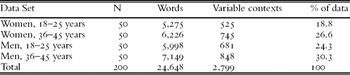
After exclusions, a total of 2,799 tokens were retained for analysis. Each token thus represents a context in which an accent or diacritic would be expected (or required) in the standard written language. Table 1 displays information about the present corpus, including the number of personals, words, and variable contexts found in each of the four data sets.
Corpus information.

5 PATTERNS OF VARIATION IN THE CORPUS
5.1 Overall distribution of diacritics
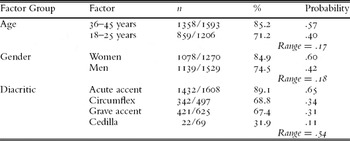
The first level of analysis aims to determine the rate of accent and diacritic use in the online personal ads and to uncover any patterns that emerge from the data. Each token of a variable context was coded for VARBRUL analysis using the latest instantiation of the variable rule program—Goldvarb X (Sankoff, Tagliamonte, and Smith, Reference Sankoff, Tagliamonte and Smith2005). Three independent variables were considered: age, gender, and diacritic type. Table 2 provides observed frequencies (n), relative frequencies (%), and the VARBRUL probability score for accent/diacritic presence in the corpus. A VARBRUL probability score of .50 or higher indicates that accent/diacritic presence is favored in a given context.
VARBRUL analysis of diacritic variation.α

α Total n = 2217/2799 (79.2%); Corrected mean (Input) = .826; Total chi-square = 47.45; Chi-square/cell = 2.97; Log likelihood = –1248.919; p = 0.000
Perhaps unsurprisingly, age was found to be a statistically significant factor. Older advertisers are more likely to use accents and diacritics than are younger ones. This finding supports the well known and often-stated tenet of variationist sociolinguistics that younger speakers typically produce innovative or non-standard variants more frequently than do older speakers. Despite this difference, however, older advertisers demonstrate productive variation in the use of accents and diacritics, in that the expected accent/diacritic was absent from nearly 15% of all variable contexts. Gender, too, was selected as a statistically significant independent variable. As a group, women are favored to use accents and diacritics when compared to men. In terms of Labov's (1990) general principles of language change, this result suggests either stable variation (i.e., no change in progress) (Principle I; p. 210) or the emergence of accent/diacritic use as a ‘prestige variant’ (Principle Ia; p. 213). Finally, diacritic type was found to contribute to the variation as well. The acute accent is the most likely one to be present, with a relative frequency of 89.1%. In contrast, the circumflex and the grave accent occur in approximately two thirds of variable contexts, and the cedilla is present in less than one third of variable contexts.
A comparison of ranges (i.e., the difference between the lowest and highest probability score within a given factor group) shows that diacritic type (range = .54) is the most influential of the three independent variables. Gender (range = .18) and age (range = .17) are approximately equally weighted in terms of contribution to the variation. In order to unpack these findings somewhat, a series of partitioned VARBRUL analyses was performed. A partition analysis helps to provide a more nuanced interpretation of results of a VARBRUL analysis by treating each factor group (i.e., independent variable) as an independent data set (Paolillo, Reference Paolillo2002: 89–93).
5.2 Interactions between age and gender
The results of the first level of analysis show both age and gender to be contributing factors in the variable use of accents and diacritics among Quebecker online dating site members. However, a VARBRUL analysis considering only main effects ‘may fail to capture a large part of the variation’ (Sigley, Reference Sigley2003: 250). Testing for interaction effects via cross-tabulation and recoding can help to elucidate some of the underlying sources of variation not immediately perceptible in a main effects analysis.Footnote 4
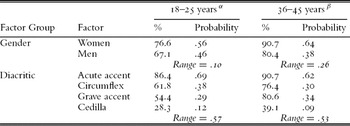
In the present data, the test statistics (see fn. α of Table 2) indicate that the first level of analysis may not represent the best fit to the theoretical model.Footnote 5 For instance, the total chi-square is relatively high for a statistical model with only five degrees of freedom, which is indicative of a number of higher-than-ideal error scores for certain cells. In addition, the scattergram produced by Goldvarb X showed some spread among the data points, suggesting that the original coding was not the best fit to the model. Table 3 displays the results of a partition analysis treating each age group as an independent data set. The test statistics (fn. α and β of Table 3) indicate a better fit to the model when compared to the first level of analysis.
Partitioned VARBRUL analysis of age groups.

α Total n = 859/1206 (71.2%); Corrected mean (Input) = .743; Total chi-square = 4.52; Chi-square/cell = 0.57; Log likelihood = –636.548; p = 0.007
β Total n = 1358/1593 (85.2%); Corrected mean (Input) = .877; Total chi-square = 25.84; Chi-square/cell = 3.23; Log likelihood = –603.151; p = 0.000
In both age groups, women retain accents and diacritics more often than do men, thereby corroborating the main effect results presented in Table 2. However, the data clearly show that gender is more influential among advertisers in the 36–45 year-old age group (range = .26) than among those in the 18–25 year-old age group (range = .10). Put another way, while gender is significant in both data sets, the difference between women and men is more pronounced among the older advertisers.
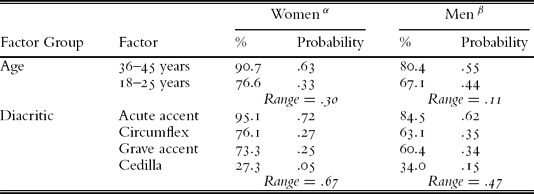
Another way to interpret the data is to explore women and men as separate data sets. These results are provided in Table 4. For both women and men, age was selected as a significant factor in accent/diacritic use. It is clear, however, that age has a much greater influence among women (range = .30) than among men (range = .11). Incidentally, the women/men partition analysis shown in Table 4 produced the best fit to the model (fn. α and β of Table 4), suggesting that this is perhaps the most appropriate way to interpret the data.
Partitioned VARBRUL analysis of genders.
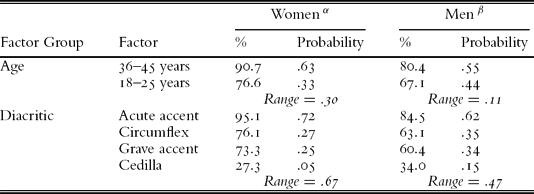
α Total n = 1078/1270 (84.9%); Corrected mean (Input) = .900; Total chi-square = 4.7; Chi-square/cell = .59; Log likelihood = –438.153; p = 0.000
β Total n = 1139/1529 (74.5%); Corrected mean (Input) = .765; Total chi-square = 15.63; Chi = square/cell = 1.95; Log likelihood = –795.632; p = 0.000
5.3 Differences among the diacritics
The first level of analysis (Table 2) revealed diacritic type to be the most influential factor in determining the presence versus absence of an accent or diacritic. Such was also true in each of the partition analyses presented above (Table 3 and Table 4). The acute accent context—regardless of its presence or absence—is the most widely distributed, and it is also the most frequently realized one (presence = 89.1%). The circumflex and the grave accent are rather similarly distributed, occurring in 68.8 and 67.4% of variable contexts, respectively. The cedilla, however, is a relatively low frequency diacritic, accounting for only 2.5% of all variable contexts (n = 69), with a mere 31.2% rate of realization.
One reason for the acute accent being realized at significantly higher rates relative to the other diacritics is that its presence or absence often distinguishes between two words by marking a phonological difference (e.g., parl-e [ə] or Ø ‘speak’ vs. parl-é [ɛ] or [e] ‘spoken’). Notwithstanding, it was deleted at a rate of 10.9% (n = 176). This is only marginally higher than the rate of acute accent deletion in asynchronous discussion fora (7.3%) reported by van Compernolle and Williams (in press). Given the similarity between discussion fora and online dating ads in terms of synchronicity (i.e., asynchronous message transmission) and the ability to revise and edit one's text, it is not surprising that the acute accent should occur at relatively high rates in both contexts. van Compernolle and Williams also report that the acute accent is least likely to be deleted in word-final position, because this is the context in which there exists the greatest potential for ambiguity or misinterpretation. Such is also true in the present data, inasmuch as the acute accent was nearly categorically retained in word-final position. The only context in which it was deleted in this particular environment was in the case of feminine gender agreement wherein an additional orthographic (but unpronounced) e is added to the ending of an adjective or past participle.Footnote 6 One such example is provided in (1), an excerpt taken from a young woman's personal narrative.
(1) Je suis une fille tres connectee a la vie, aux sensations et aux emotions!!
‘I'm a girl really connected to life, to feelings and to emotions!!’
In (1), the absence of the acute accent poses no interpretive-semantic problems for the reader of the ad: first, because the syntactic environment itself leaves little doubt as to whether connectee should be read as an adjective (i.e., ‘connected’) or the third-person singular verb form (i.e., ‘connect’); and, second, because the morphological marker of feminine gender agreement (i.e., orthographic e) provides the reader with an additional clue as to the intended meaning of the word. Incidentally, excerpt (1) provides two examples of grave accent deletion (i.e., tres ‘very’ and a ‘to’), as well as an additional example of acute accent absence in the word emotions.
In contrast to the acute accent, the circumflex and the grave accent were less widely distributed but were subject to rather more variation. While the acute accent can serve to distinguish between two words on the phonological level, the circumflex and the grave accent have no such function. Instead, their presence versus absence, in many cases, does not result in any linguistic ambiguity (e.g., très vs. tres ‘very’, être vs. etre ‘to be’). A limited number of homonyms, however, are distinguished in writing through the use of the circumflex or the grave accent, such as the feminine article or pronoun la ‘it/her’ and the adverb là ‘there’, or the preposition sur ‘on’ and the adjective sûr(e) ‘sure/safe’. In isolation, the absence of the circumflex or grave accent in such words could lead to a misinterpretation, but, given that their syntactic and discursive distributions are decidedly different, it is difficult to imagine the absence of these diacritics causing a communicative problem in context.
The cedilla, finally, was least often used. This is because it is rather limited in its potential distribution inasmuch as it can only be used with the consonant c to signal a phonological change (i.e., c [k] vs. ç [s]). In the present corpus, nearly all tokens of potential cedilla use were the demonstrative pronoun ça/ca ‘that’ (n = 60/69). The remaining tokens included garçon/garcon ‘boy’, façon/facon ‘fashion/way’, and français/francais ‘French’. Thus the results for the cedilla are in fact more indicative of its presence versus absence in ça/ca. As for most tokens of the circumflex and the grave accent, the absence of the cedilla in ça is unlikely to lead to any ambiguity.
6 A CHANGE IN PROGRESS?
The patterns of variation observed in the corpus suggest that accent/diacritic use in not only a linguistic variable (van Compernolle and Williams, in press) but a sociolinguistic variable as well, inasmuch as the distribution of accents and diacritics is unbalanced along the dimensions of age and gender. Yet the question remains: Is there a change in progress, implying the eventual loss of accents and diacritics in computer-mediated French? If so, what type of change is occurring?
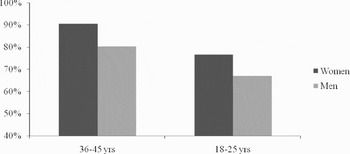
A rather commonsensical point of view might interpret the findings of this study as a positive indication of a change in progress, whereby accents and diacritics are being progressively lost, if only in computer-mediated French. The strongest evidence for this is the lower rates of accent and diacritic use among dating site members age 18–25 when compared to those age 36–45. As Figure 1 shows, despite the fact that women used accents and diacritics more often than men in both age groups, the difference between the age groups remains constant.
Overall frequencies of diacritic use in the corpus.

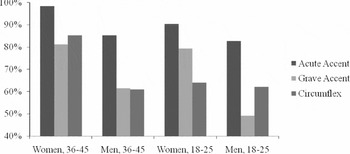
Factoring in the influence of the type of accent/diacritic, the same general pattern emerges. Figure 2 displays rates of use of the acute accent, grave accent, and circumflexFootnote 7 for the four demographic groups. Generally speaking, women use accents and diacritics more often than men, as do older advertisers relative to younger ones. The one exception here is that younger men used the circumflex slightly more often than did older men, although this difference is negligible. At the same time, the acute accent appears to be the most resistant to change, as discussed above, and this is true across social groups.
Intersection of age, gender, and diacritic type.

Yet the implication that accents and diacritics are being lost in (computer-mediated) French meets some resistance when the patterns regarding gender are taken into account. If it were a case of a straightforward loss of accents and diacritics, one might expect women to be at the forefront of this change (Labov, Reference Labov1990: 215). The analysis presented above does not, however, support this view, inasmuch as women in both age groups use accents and diacritics at higher frequencies than do men. Two plausible alternatives remain, however.
The first supposes that the variation is stable, a situation in which one would expect women to tend towards the more conservative end of the spectrum (Labov, Reference Labov1990: 210). In other words, accents and diacritics, while subject to variability, are not disappearing from computer-mediated French at all. Instead, the difference between age groups may be due to other social factors. For instance, younger dating site members, so-called ‘digital natives’ (Prensky, Reference Prensky2001), are simply used to excluding accents and diacritics in text-based electronic communication. The ‘digital immigrants’, on the other hand, approximate the linguistic practices of the natives as a means of integrating into digital culture without completely converging with it. Seen from this perspective, then, ‘age’ is not so much a reflection of date of birth, nor is it associated with a ‘variant on the rise’, as it is an indication of one's place in today's online digital society.
The second alternative interpretation suggests that there is in fact a change in progress. However, contrary to the rather popular and often-stated belief that online written language is increasingly diverging from standard norms (Crystal, Reference Crystal2001, Reference Crystal2006), the presence of an accent or diacritic may be interpreted as a prestige variant in computer-mediated contexts via its association with the standard written language. The use of accents and diacritics, then, might signal the desire to dissociate oneself from a perceived ‘subordinate’ variety of (online) language, characterized by non-standard, abbreviated writing. In this type of situation, women often demonstrate higher rates of ‘prestige form’ use (Labov, Reference Labov1990: 213), which would align with the distributional analysis presented above.
7 CONCLUSION
The study reported above has provided some insight into the variable use of accents and diacritics in one form of computer-mediated French (online dating personals), thereby complementing van Compernolle and Williams’ (in press) study of acute accent use in non-moderated chat and discussion fora. The analysis revealed important differences between the discourse of ‘digital natives’ and that of ‘digital immigrants’, as well as between women and men. The results do not, however, point straightforwardly to a change in progress, whereby accents and diacritics are being progressively lost in computer-mediated French. Instead, given the interactions between age and gender shown to be operable in the present study, what seems more probable is that either the situation is stable or accents and diacritic presence is becoming a prestige variant in at least this type of computer-mediated communication. Ultimately, however, answering these questions is well beyond the scope of this article. Like any apparent time study of language variation, hypothesizing about potential language change can be only speculative due to the absence of comparable diachronic data. A real time approach, perhaps in five or ten years, is needed in order to confirm or disconfirm the speculations discussed above.
This research also has important implications for written French more generally. If accents and diacritics are, in fact, being lost in computer-mediated contexts, how might this affect non-electronic writing? As CMC becomes increasingly embedded in everyday social practice, will non-standard orthographic norms, including accent deletion, make their way into the formal, standard written language? A world in which all genres of writing reflect presently non-standard electronic forms is, of course, hard to imagine today. Indeed, as long as there are editors, teachers, and other people of authority acting as gatekeepers to the written language, it is unlikely that such variation will be transmitted to formal written genres. As such, future research might well prefer to investigate other (non-electronic) forms of unedited writing in order to determine the extent to which non-standard electronic varieties of language are influencing relatively unguarded, spontaneous, unedited, and unrevised varieties of written language.