Introduction
The voluminous literature on clientelism offers valuable insights about why and how politicians trade selective benefits for political support. The concept of clientelism serves as a corrective to the “responsible parties” theory, which holds that candidates promise policies in line with voters’ preferences and make good on those promises once in office to avoid punishment in subsequent elections. Empirical research shows that politicians in new democracies do not necessarily advance broad agendas that most citizens prefer; they instead cater to the interests of citizens whom they “know to be highly responsive to such side-payments and willing to surrender their vote for the right price” (Kitschelt & Wilkinson Reference Kitschelt, Wilkinson, Kitschelt and Wilkinson2007:2). Understanding clientelism is important because the particularized (versus programmatic) distribution of goods and services may, depending on the context in which it occurs, undermine democratic accountability (Lindberg Reference Lindberg2010), retard income growth (Krieckhaus Reference Krieckhaus2006), facilitate income growth (Khan & Sundaram Reference Khan and Sundaram2000), or thwart international financial organizations’ efforts to liberalize economies (Kitschelt & Wilkinson Reference Kitschelt, Wilkinson, Kitschelt and Wilkinson2007).
The meaning of clientelism is vague, despite the concept’s central importance in political science. Scholars inconsistently refer to clientelism as a principal-agent problem (Kitschelt & Wilkinson Reference Kitschelt, Wilkinson, Kitschelt and Wilkinson2007), a political monopoly (Medina & Stokes Reference Medina, Stokes, Kitschelt and Wilkinson2007), or machine politics (Ganse-Morse, Mazzuca & Nichter Reference Ganse-Morse, Mazzuca and Nichter2014). A popular definition of clientelism is “nonprogrammatic distribution combined with conditionality” (Stokes et al. Reference Stokes, Dunning, Nazareno and Brusco2013:13), where nonprogrammatic distribution means the absence of public criteria for distributing either collective or individual benefits (Stokes et al. Reference Stokes, Dunning, Nazareno and Brusco2013:10). The two main components of this definition are, first, the way in which benefits are distributed and, second, the quid pro quo arrangement between patron and client. Scholars of African politics emphasize a third component: the type of benefit, namely whether or not it is excludable. Clientelism in Africa involves “the distribution of personal favors to selected members of the electorate in exchange for ongoing political support” and therefore occurs “at the expense of the provision of public goods” (Wantchekon Reference Wantchekon2003:399–401). Writing about clientelism in the African context, Erdmann and Engel (Reference Erdmann and Engel2007:107) focus on the transfer of benefits that are “individual (land, office, services)” as opposed to “collective benefits (roads, schools).” The premise is that African voters have a stronger preference for private goods such as cash than for public goods such as health care reform. One common denominator across Africanist and non-Africanist understandings of clientelism is the idea that citizens pledge votes in return for patronage. Indeed, it is not unusual for scholars to discuss clientelism and vote buying interchangeably (Magaloni Reference Magaloni2006:123), even though patronage can also buy turnout, abstention, and ideological affinity (Nichter Reference Nichter2012). The concept of clientelism has been “stretched” (Collier & Mahon Reference Collier and Mahon1993) to describe cases where its exact meaning is unclear.
The purpose of this article is to clarify what clientelism is and to document its extent in a region that political scientists and development personnel consider especially clientelistic: sub-Saharan Africa. A careful reading of the literature suggests personal contact as a fundamental aspect of clien- telism. Bargains between patrons and clients occur both between and during election cycles through face-to-face conversations, phone calls, and handshakes (Paller Reference Paller2014). Thinking about clientelism in this more concrete way brings to light contradictory assumptions that scholars make regarding the nature of contact between politicians and citizens in different settings.
Scholars who study African countries and young democracies often view all personal contact as clientelistic and hence bad for governance and economic development (Bénit-Gbaffou Reference Bénit-Gbaffou2011; Keefer Reference Keefer2007; van de Walle Reference van de Walle2001; Young Reference Young2009; Joseph Reference Joseph and Lewis1998; Jackson & Rosberg Reference Jackson and Rosberg1982; Lindberg Reference Lindberg2010; Vicente & Wantchekon Reference Vicente and Wantchekon2000). The canonical term for describing African politics is “neopatrimonial,” referring to a system in which “a veneer of rational-legal authority has been imposed by colonialism, yet a personalistic or ‘patrimonial’ logic characterized by patronage, clientelism, and corruption is said to prevail” (Pitcher et al. Reference Pitcher, Moran and Johnston2009:130). Although the definition of neopatrimonialism and its relationship with clientelism are hotly debated (Whitfield Reference Whitfield and Mette Kjaer2015; Charrad Reference Charrad2011; Pitcher et al. Reference Pitcher, Moran and Johnston2009; Erdmann & Engel Reference Erdmann and Engel2007), some authors propose that the term was invented to describe particularly virulent, characteristically African forms of clientelism in which personal (“traditional,” “tribal,” “kin-based”) relationships facilitate non-programmatic distribution (Mkandawire Reference Mkandawire2015; Varraich 2014). In contrast, political scientists who study rich democracies usually assume that personal contact allows ordinary citizens to voice preferences, air grievances, and hold their representatives accountable for distributing resources equitably (Adams Reference Adams2007; Stotsky Reference Stotsky1987; Eisinger Reference Eisinger and Hahn1972; Verba & Nie Reference Verba and Nie1972). Prior to the Trump presidency, an intricate analysis of handshakes between an American Congress member and constituents would strike many readers as bizarre, but paragraphs detailing the handshakes between a Fulani leader and his supporters supposedly reveal the preponderance of clientelism in Cameroon (Hansen Reference Hansen2003). I entertain the possibility that Africa seems more clientelistic than other regions because African politics scholars tend to equate personal contact with clientelism. Eschewing that proclivity, I interpret personal contact as clientelistic only when citizens request particularistic favors rather than policies that benefit larger groups.
Estimating the degree of clientelism in personal encounters between citizens and politicians can resolve contradictions that play out in policy circles. On the one hand, many monitoring agencies and non-governmental organizations view personal contact with suspicion (Torsello Reference Torsello and Heywood2015). They typically direct their suspicion to the presumed vote sellers as opposed to the vote buyers, devising “sensitization” programs to help citizens resist temptation and vote their conscience when candidates extend a quid pro quo (Hicken et al. Reference Hicken, Leider, Ravanilla and Yang2014; Vicente Reference Vicente2013). On the other hand, a growing number of aid-funded initiatives aim to foster communication between politicians and citizens as a way to enhance government performance. For example, the World Bank touts the “short route of accountability,” which creates “opportunities for more meaningful and more effective contact between public official[s] and citizens and thus strengthens citizen influence over public management” (Helling et al. Reference Helling, Serrano and Warren2004:21). If clientelism is as pervasive in developing areas as some political scientists suggest, then shortening the route of accountability may do more harm than good by bringing patrons and clients into closer contact.
To discern the “good” kind of personal politics from the “bad,” this study returns to the classic notion of clientelism-as-personal-politics advanced by Pitt-Rivers (Reference Pitt-Rivers1954), Médard (Reference Médard1976), and others, defining clientelism as contact between citizens and politicians where citizens request private goods in exchange for political loyalty. Analyzing Afrobarometer surveys from twenty-seven African countries and original survey data from Niger, I find that personal contact in Africa is widespread, and that citizens reach out to politicians for diverse reasons, most of which are not clientelistic. And a supplemental survey reveals that although Nigeriens frequently meet with elected officials and party leaders in person or over the phone, most of these highly personalized interactions do not involve requests for targeted favors, as scholars suspect. Respondents’ answers to open-ended questions illuminate a general preference for receiving public, not private, goods from the politicians they contact. These findings indicate that contact between elected officials and their constituents constitutes a healthy democratic process in countries such as Niger, which are often perceived as clientelistic and hence undemocratic (International Crisis Group 2013; Hamani 2011).Footnote 1
In the next section, personal contact is defined as distinct from personal rule; competing theories about personal contact view it either as a source of clientelism or conversely as a source of government accountability. In the third section, rates of contact between citizens and politicians are compared at multiple levels of analysis: across African countries, across African and non-African countries, across categories of politicians, and across time. In the fourth section, survey data is used to interpret and explain personal contact: Do citizens contact politicians to request private goods or to hold leaders accountable for serving the public good? What are the characteristics of contactors versus non-contactors? How do citizens reach politicians? The final section concludes with a summary of findings and implications for theory and policy.
Personal Contact in Comparative Perspective
Practically all clientelism involves personal contact, but not all personal contact is clientelistic. People may contact politicians to request special favors in the form of jobs, food, or money. They may also contact politicians to request policies that affect larger groups, such as public education spending, equal rights for women, or campaign finance reform. It can be argued that the failure to distinguish between these forms of contact leads scholars to overestimate the extent of clientelism in societies where personal contact is very common.
Personal contact in its political applications involves behaviors such as visiting a lawmaker’s office, writing a letter to a mayor, or attending a town hall meeting. Its defining characteristic is the ease with which politicians can identify citizens. Citizens who initiate personal contact sometimes volunteer their identifying information in the hope that a politician will remember them when making policy or distributive decisions. This is not the case with impersonal forms of contact such as voting or protesting, where participants usually expect to remain anonymous. Political scientists consider breeches of ballot secrecy to be clientelistic precisely because an electoral process that is meant to be impersonal becomes personal. Patron-client ties consist of “a fight against anonymity (especially in the urban setting) and a seeking out of primary personal relationships” (Kenny Reference Kenny1962:136).
In this study, emphasizing citizen-initiated contact with lower-level politicians, personal contact is differentiated from personal rule, an elitist political system in which “the rivalries and struggles of powerful and willful men, rather than impersonal institutions [. . . ] are fundamental in shaping political life” and in which the masses “are usually unmobilized, unorganized, and therefore relatively powerless to command the attention and action of government” (Jackson & Rosberg Reference Jackson and Rosberg1984:421). Focusing on sensational examples of personal rule such as Jomo Kenyatta of Kenya or Sékou Touré of Guinea leads scholars to narrow the scope of African politics to “grand patrons” (Sandbrook Reference Sandbrook1972:117) and “palace politics” (Jackson & Rosberf Reference Jackson and Rosberg1984:425), even though contact between rulers and the ruled occurs on a daily basis at many levels of society.Footnote 2 Personal contact draws less scholarly notice than personal rule, even though it realistically affects more people’s lives. When it does receive attention in the African politics literature, it is in two different contexts: as a source of clientelism or as a source of accountability.
Personal Contact as a Source of Clientelism
Clientelism in Africa is not limited to vote buying, which is a high-cost and low-reward political strategy: Many party leaders cannot afford to staff brokers, bosses, or polling station monitors due to capital constraints (Arriola Reference Arriola2013), and an uneven electoral playing field often advantages the ruling party more than the opposition’s vote buying can offset (Kelly Reference Kelly2014). Instead, clientelism functions as a way for citizens to directly seek assistance from power holders and for politicians to cultivate support in between election cycles on a one-on-one basis. Politicians act as mediators who perform small favors to meet citizens’ needs for protection, dispute resolution, and subsistence in the absence of state-provided public goods (Weingrod Reference Weingrod1968:383). In return, the cash-strapped mediators win approval on the cheap. African clientelism is what Mavrogordatos (Reference Mavrogordatos1997) terms “traditional clientelism,” describing a personal relationship between a patron and a client. This relationship has three characteristics: It involves people of unequal status, wealth, or influence; it depends on the reciprocal exchange of goods, with the patron offering economic benefits and the client offering political loyalty; and it is close, involving face-to-face or voice-to-voice contact (Weingrod Reference Weingrod1968). The unequal status between actors does not mean that the relationship is necessarily antagonistic or exploitative. It can be symbiotic or even affectionate (Hilgers Reference Hilgers and Hilgers2012:11).
Historically, clientelism in Africa is intertwined with personal contact. It is best conceived as a “lopsided friendship” (Pitt-Rivers Reference Pitt-Rivers1954) rather than a feature of the party system.Footnote 3 In many cases, no broker stands between patron and client, who interact directly (Bénit-Gbaffou Reference Bénit-Gbaffou2011; Médard Reference Médard1976). The “reciprocal support of one’s own” (Güneş-Ayata Reference Güneş-Ayata, Roniger and Güneş-Ayata1994:22) can become so strong as to resemble kinship. Family metaphors are ubiquitous in African politics, and scholars frequently evoke them as evidence of clientelism. Schatzberg (Reference Schatzberg2001) notes the custom of African rulers portraying themselves as fathers of their nations: Mobutu Sese Seko of Zaïre embraced the nickname “bon père de famille” or “good father and family man”; Félix Houphouët-Boigy of Côte d’Ivoire greeted visitors to his home as “my dear sons, my dear grandsons.”Footnote 4 Lower-level government officials and chiefs exhibit similar paternalism by “feeding” their “children,” which can entail handing out money as well as food (Schatzberg Reference Schatzberg2001:149). Seitel (1980:12) alludes to the quid pro quo dimension of clientelism by quoting a proverb from the Haya people of Tanzania: “Akulisa niwe akutwala,” which translates to, “The one who feeds you is the one who rules you.”
The conventional wisdom among scholars of African politics is that this personalized type of clientelism is pervasive (van de Walle Reference van de Walle2001; José Alvarez Rivadulla 2012; Jennings 1997). Van de Walle (Reference van de Walle2001:51) posits that “political authority in Africa is based on the giving and granting of favors, in an endless series of dyadic exchanges that go from the village level to the highest reaches of the central state.” Interviewing Ghanaian members of parliament, Lindberg (2003:124) cites numerous clientelistic exchanges that include “attending to individuals’ schools fees, electricity and water bills, funeral and wedding expenses; or distributing cutlasses and other tools for agriculture, or even handing out ‘chop-money’ (small cash sums) to constituents.” A field experiment in Benin further supports the assumption “that African voters invariably have a much stronger preference for private transfers than for public goods or projects of national interest” (Wantchekon Reference Wantchekon2003:399). Wantchekon randomized candidates’ campaign promises and found that promises of targeted benefits garnered more votes than promises of public goods. Robinson and Verdier (2013:264) reiterate as a matter of fact that “the politics of developing countries, particularly in Africa, seem to be particularly clientelistic.”
Yet, other evidence suggests that politics in Africa is not as clientelistic as people imagine. Five years after publishing his initial observations of extensive clientelism in Ghana, Lindberg reported with a co-author the results from another survey showing that Ghanaian voters were fairly unconcerned about receiving patronage from local parliamentarians. In a sample of 690 voters in Ghana’s 1996 and 2000 elections, “only five percent of respondents suggested that gifts, assistance, or promises thereof from candidates determined their voting choice” (Lindberg & Morrison Reference Lindberg and Morrison2008:117). The vast majority of respondents cared more about choosing a competent national executive and behaved as “mature” democratic citizens. This study builds on Lindberg and Morrison’s work by gauging the pervasiveness of clientelism beyond Ghana and during periods in between elections.
Personal Contact as a Source of Accountability
A contrasting literature depicts personal contact as a source of government accountability as opposed to a source of clientelism. The idea that personal contact with citizens could make leaders more accountable became popular in the United States with the passage of President Lyndon B. Johnson’s Great Society reforms of the 1960s. At the time, maximizing citizen participation in governance seemed like a promising way to make anti-poverty campaigns more effective: By writing letters and attending town hall meetings, the recipients of public assistance could directly communicate their needs and provide feedback to policy makers (Thomas Reference Thomas2013). This “new era of citizen participation” in the War on Poverty (Moynihan Reference Moynihan1969) upended a belief that had prevailed in the United States since the founding of the country, which held that elected officials should not bend to the public will but instead rely on their own wisdom and expertise to govern in citizens’ best interest. Personal contact is suspect (i.e., presumably clientelistic) under a trusteeship model of representative democracy where citizens have no legitimate reason to contact politicians; but under the newer accountability model of representative democracy, personal contact is essential for guiding nearly every policy decision.
Interest in personal-contact-as-accountability outlived the Great Society. Later studies underscored the democratic value of “citizen lobbyists” (Adams Reference Adams2007), e-governance (Gibson & Cantijoch Reference Gibson and Cantijoch2013), and contacting as a “linkage path” between citizens and politicians (Vedlitz Reference Vedlitz1980). In practical applications of personal-contact-as-accountability, town hall meetings remain a popular way for American politicians to “scale” democracy to the local level (Lukensmeyer & Brigham Reference Lukensmeyer and Brigham2002). President Barack Obama’s Organizing for Action campaign espoused a mission “to ensure the voices of ordinary Americans are heard in Washington.”Footnote 5
There are growing efforts to transport this decentralized form of government to developing regions and particularly to sub-Saharan Africa, where the concentration of executive power has enabled rulers to ignore citizen demands, capture development funds, and resist liberal democratic reforms (Blair Reference Blair2000). Accountability is a priority among aid-granting agencies interested in promoting democracy and good governance (Bardhan & Mookherjee Reference Bardhan and Mookherjee2006), with the preferred route to accountability being direct links between citizens and politicians (World Bank 2004; Helling et al. Reference Helling, Serrano and Warren2004). For example, the U.S. Agency for International Development (USAID) has an objective “to improve the relationship between civilians and state actors by directly linking those who are governed with those who are democratically elected to govern.”Footnote 6 The affiliated “Making All Voices Count” consortium aims to “repair the broken links between governments and citizens,” as with its program in Ghana that helps citizens give feedback on government services through a telephone hotline.Footnote 7 The assumption underlying these initiatives is that politicians will not meet citizens’ demands through electoral pressures alone, but will be accountable only if citizens can personally reach them at any time. Referring to Botswana and Tanzania, Ringo and Lekorwe (2013:199) explain: “Contacting enhances education of the leaders [and] makes it possible for members of parliament (MPs) to get information about the constituency, which can be taken back to the legislature to educate other MPs about the province, resulting in more informed policy decision-making. MPs also facilitate the flow of information and services back to the constituency, making government more concrete and accessible, improving delivery and empowering citizens to participate in developing their communities.”
Not all political scientists share policy makers’ confidence in personal contact as a source of accountability. Some scholars of African politics are wary of contacts between citizens and politicians, which they associate with a long list of negative phenomena: clientelism (van de Walle Reference van de Walle2001), corruption (Ekeh Reference Ekeh1975), prebendalism (Joseph Reference Joseph1987), neopatrimonialism (Bratton & van de Walle Reference Bratton and de Walle1994), “big man syndrome” (Jackson & Rosberg Reference Jackson and Rosberg1982), and “the politics of the belly” (Bayart Reference Bayart1989). As Cornwall (Reference Cornwall2008) points out, typologies of political contacting are implicitly normative: In some contexts (international development programs and U.S. politics) contacting is good; in other contexts (African politics) it is bad. The remainder of this article considers whether this normative sorting of personal contact is justified, addressing the question, “Just how clientelistic is African politics?”
The Extent of Personal Contact in Africa
This section documents the extent to which citizens in Africa directly contact politicians. The focus is on citizen-initiated contacts, even though politicians sometimes initiate contacts. There are three reasons for this approach. First, most programs for reducing vote buying or increasing civic engagement target the behavior of citizens and not of the politicians (Torsello Reference Torsello and Heywood2015; Hicken et al. Reference Hicken, Leider, Ravanilla and Yang2014; Vicente Reference Vicente2013). Second, there is a need to expand the small literature on the “demand side” of clientelism (Calvo & Murillo Reference Calvo and Murillo2004). An extensive literature on personal rule and vote buying in Africa (Jackson & Rosberg Reference Jackson and Rosberg1984; Kramon Reference Kramon2009) and on politicians’ use of constituency service to garner “the personal vote” (Cain et al. Reference Cain, Ferejohn and Fiorina1987) already exists. Much less is known about contacting from the bottom up. Finally, there is a wealth of existing data on citizen-initiated contacts that has not been thoroughly analyzed.
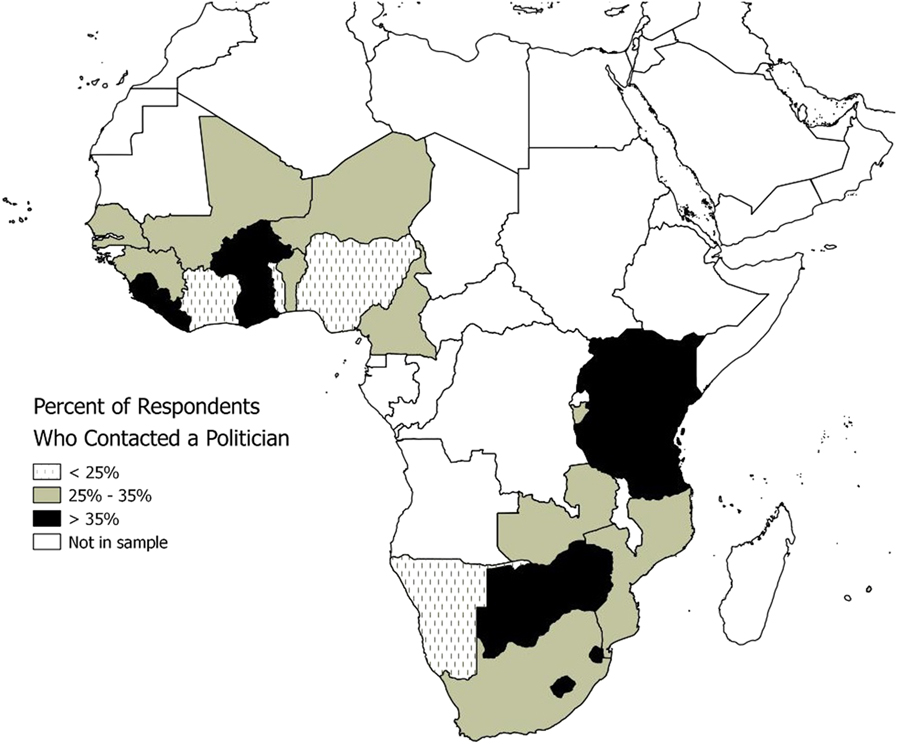
Afrobarometer surveys ask whether people have contacted a politician “for help to solve a problem or to give them your views.” These surveys are nationally representative, covering thirty-six countries across five rounds from 1999 to 2014 (although not all countries are included in each round). The sample size per survey is approximately one thousand respondents. In Round 5, 40 percent of nearly fifty thousand respondents said they had contacted a politician during the past year. Disaggregating to the country level provides a fuller picture of personal contacting on the African continent. The map in Figure 1 displays the percent of respondents who contacted at least one politician during the past year in the twenty-seven countries that have available Round 5 data, with darker shades denoting higher contacting rates. Contact rates range from 16 percent in Togo to 57 percent in Sierra Leone, with an average of 33 percent.
Cross-National Variation in Rates of Contact with Politicians. Data are from Afrobarometer Round 5 (2011–2013). The average rate of contact across all twenty-seven countries in the sample was 33 percent.

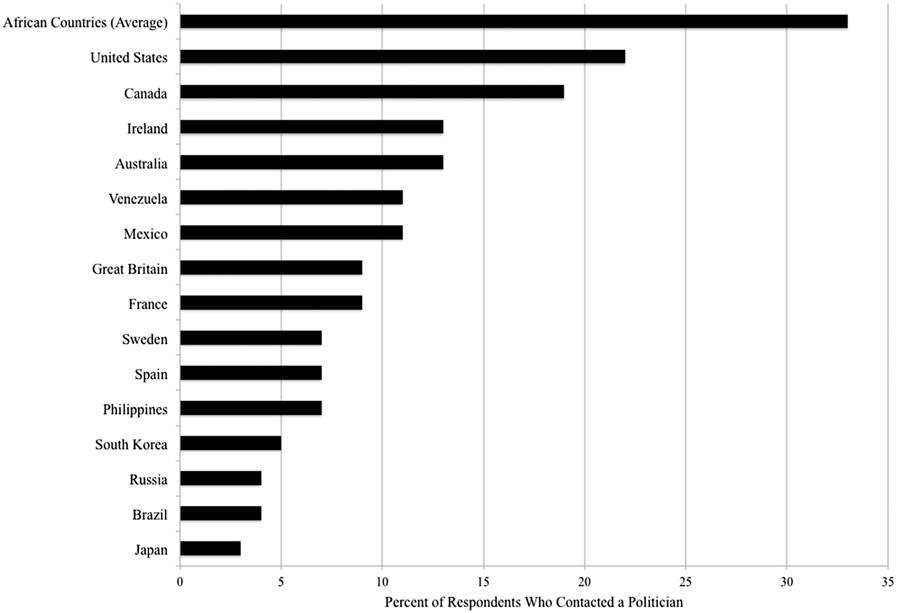
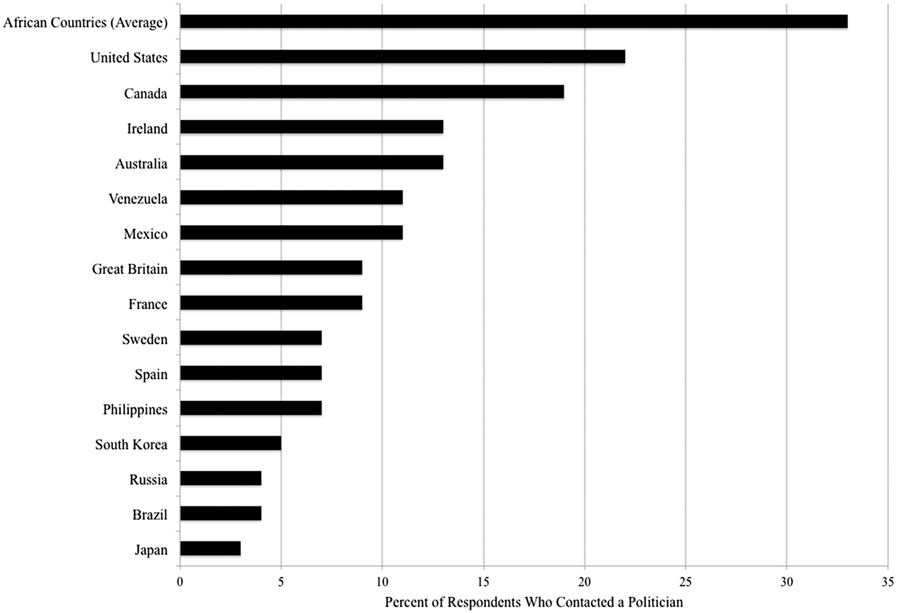
What constitutes a high level of contact with politicians? Comparing African survey data with non-African survey data puts the information in Figure 1 into perspective. Figure 2 lists the percent of respondents who contacted a politician during the past year in sixteen diverse countries outside of Africa. The data are from the International Social Survey Programme (2004). Although contacting rates range from only 2 percent in Hungary to 22 percent in the United States, no rate approaches the 33 percent average among African countries. One might wonder whether the availability of traditional leaders such as chiefs and marabouts inflates African contacting rates. Restricting Afrobarometer survey responses to contacts with only non-traditional politicians (MPs, local government councilors, officials of government ministries, and officials of political parties) shrinks the average African contacting rate to 23 percent, but this still exceeds the rates in all non-African countries. Overall, data are consistent with the conventional wisdom that politics in Africa is far more personal and participatory than politics in other parts of the world.
Rates of Contact with Politicians in African and Non-African Countries. African data are from Afrobarometer (2011–2013, twenty-seven countries). Non-African data are from the International Social Survey Programme (2004). Numbers indicate the percent of respondents in each country who said they had contacted or attempted to contact a politician or a civil servant to express their views in the past year. Sample size is roughly 1,000 for each country.
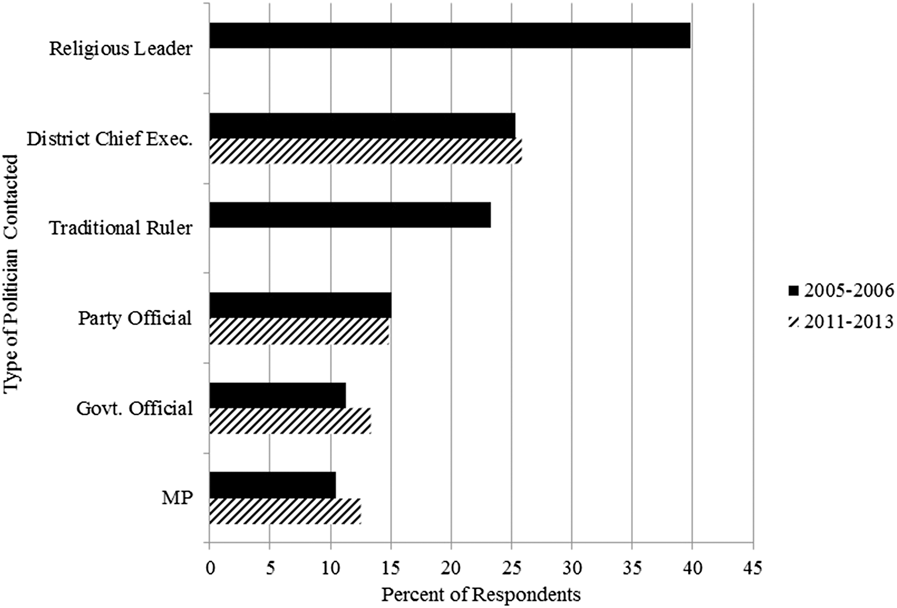
Contacting politicians is common in Africa, but contacting rates vary across categories of politicians. In Round 3 of the Afrobarometer surveys (2005–2006), enumerators asked whether respondents had contacted the following types of politicians during the past year: a member of parliament, a government official, a party official, a district chief executive, a traditional ruler, or a religious leader.Footnote 8 The black bars in Figure 3 summarize the distribution of contacts across those categories. Respondents were most likely to approach religious leaders, who received contacts from almost 40 percent of approximately 25,000 respondents. Respondents’ next most popular choice was district chief executives, followed by traditional rulers. National-level politicians, including party officials, government officials, and members of parliament, received relatively few contacts, likely because most citizens live far from the seat of national government. Respondents’ strong preference for local problem-solvers suggests that focusing on grand patrons and palace politics tells an incomplete story about politics in Africa. The importance of traditional rulers also supports Englebert’s claim that precolonial institutions maintain political influence even as “modern” state institutions consolidate (Englebert Reference Englebert2002a). Figure 3 reveals little variation in patterns of contacting over time. Bars with hash marks summarize data from Round 5 (2011–2013) alongside the black bars summarizing data from Round 3 (2005–2006). The Round 5 questionnaire did not include all of the same categories of politicians as the Round 3 questionnaire, but there is enough overlap for comparison. Rates of contact across categories of politicians vary hardly at all in the two time periods, indicating that citizens have stable preferences for seeking help from local authorities.
Rates of Contact with Categories of Politicians. Data are averages from Afrobarometer Round 3 (17 countries, 2005–2006) and Round 5 (28 countries, 2011–2013). In Round 5, question wording changed to ask about contact with a “municipal councilor” rather than a “district chief executive.” Although these types of politicians are not equivalent, I group them together because both are sub-national government officials.

Client or Constituent? Interpreting Citizen-Politician Contact
Do people who contact local authorities and other politicians seek patronage (e.g., jobs, cash, personal protection), or do they seek public goods (e.g., civil liberties, paved highways, public welfare programs)? What are the characteristics of contactors versus non-contactors? How do citizens reach politicians? This section of the study addresses those questions with two sets of evidence: Afrobarometer survey data from seventeen countries and original survey data and interviews from Niger. The interviews from Niger are used to interpret contact with politicians from the citizens’ point of view, yielding a more complex view of “clientelistic” behaviors.
Regional Patterns
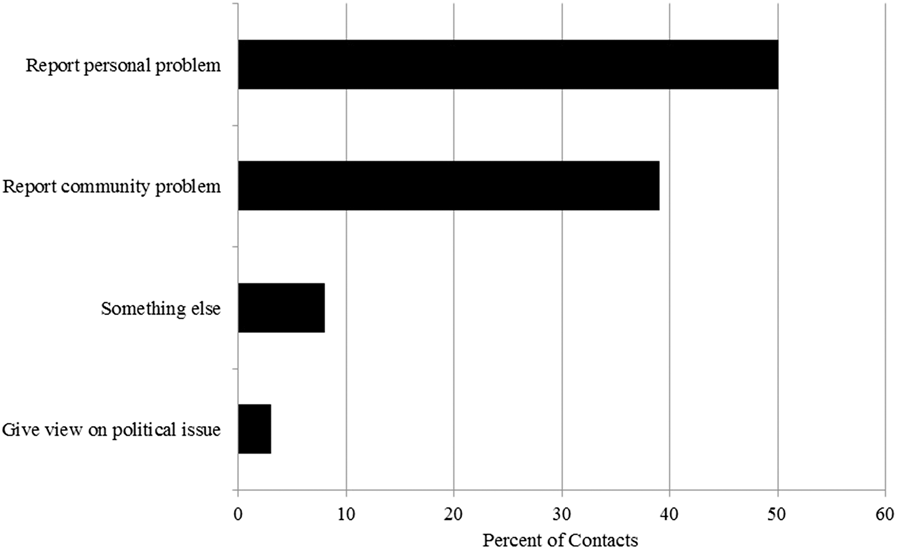
Round 3 of the Afrobarometer surveys included a follow-up question asking the people who contacted politicians why they did so: to report a personal problem, to report a community problem, to give their views on a political issue, or something else. In the past, scholars have used reporting a personal problem as a proxy for engaging in clientelism (Young Reference Young2009:4). The summary of responses in Figure 4 suggests that personal contacting in Africa is often but not always clientelistic. About half of all respondent-initiated contacts were about personal problems, but almost 40 percent were programmatic, relating to problems that affect a respondent’s broader community. It bears noting that scholars are unclear about whether requests for community goods can be clientelistic if goods accrue mainly to certain ethnic or geographic groups. Some consider clientelism to include ethnic favoritism and pork-barrel politics (Stokes et al. Reference Stokes, Dunning, Nazareno and Brusco2013), whereas others concentrate on goods that politicians target to individuals, such as campaign hand-outs and jobs (Schneider Reference Schneider2015). I contend that the degree of selectivity matters on both technical and normative levels. A citizen’s request for a clinic is technically different from a request for an envelope of cash because the relative non-excludability of the former weakens the quid pro quo mechanism: Many people can use the clinic no matter whom they support politically. Moreover, there is a questionable bias in the clientelism literature toward defining political community on the national rather than the local level, such that the provision of national health care is supposedly programmatic but the construction of a regional clinic is supposedly clientelistic (Wantchekon Reference Wantchekon2003). Alternative, traditional ideas of community emphasize the local—the village, the small town, the extended family (Omoto & Malsch Reference Omoto, Malsch and Omoto2012:84). This is especially true in former colonies where state and nation are foreign constructs; the colonially-imposed “civic public” exists alongside the “primordial public,” which is a sub-national and often ethnically-based community that is public nonethelesss (Ekeh Reference Ekeh1975). I code requests for local public goods as programmatic based on this context-specific reference point for “the broader community.” In sum, the evidence in Figure 4 is split in support of two empirical claims—one stating that personal contacting is a source of clientelism and the other stating that it is a source of government accountability.
Reasons for Contacting Politicians. Data are from Afrobarometer Round 3 (2005–2006). Percentages are calculated from 13,933 instances of citizen-initiated contact in a sample of 25,397 survey respondents from 17 countries. Categories are answers to the question, “Think of the last time you contacted any of the above leaders. Was the main reason to: tell them about personal problems; tell them about a community problem; give your view on political issue; something else?”

Personal Contact in Niger
There are three disadvantages of Afrobarometer data that could lead to invalid inferences about the nature of political contacting. First, Afrobarometer surveys include only four general response options for the question about why a respondent contacted a politician: “to tell them about a personal problem,” “to tell them about a community problem,” “to give a view on a political issue,” or “something else.” This exemplifies a common but serious error in survey research, which is to impose general outside categories that may not reflect local meanings—in this case, meanings of what constitutes a personal or a community problem (Crotty Reference Crotty1998; Williams Reference Williams2000). As Auyero (1999:305) points out in an ethnographic study of Argentina, “from the outside, what appears as an exchange of votes for favors is seen from the inside in many different (and, sometimes, antagonistic) ways: manipulation versus caring, interested action (politics, calculative exchange) versus disinterested actions (friendship).” Second, coding clientelism from short, predetermined response options is problematic for cognitive reasons: Thinking takes time and effort, so respondents tend to give the most accessible answer rather than searching their memory for the most reasoned one (Lieberman et al. Reference Lieberman, Schreiber and Ochsner2003:684). Third, the Afrobarometer surveys do not include information on modes of contact, so it is impossible to know just how personal citizen-politician linkages are. Does contacting a politician involve face-to-face interaction, writing a letter, making a phone call, emailing, submitting a question via a web-based portal, or communicating through intermediaries? Different modes of political contact can be more effective than others (Gerber & Green Reference Gerber and Green2000), so failing to record and differentiate between them is a potential source of bias.
In light of these shortcomings, the preceding analysis of Afrobarometer data is supplemented with an analysis of original survey data and interviews that were collected in Niger in December 2014. One purpose of conducting my own surveys was to add questions on modes of contacting. Another was to reformat the key question on why citizens contact politicians. Instead of prescribing a few reasons for initiating contacts, the question was left open-ended, and enumerators were asked to record each respondent’s exact answer. These reasons were later interpreted as clientelistic or not, depending on whether a respondent requested an excludable good. This approach is unusual: Interpretive research usually takes an ethnographic form, involving the “thick” study of a handful of subjects or “informants” (Emerson et al. Reference Emerson, Fretz and Shaw2011). Surveys, in contrast, are usually designed in a quantitative framework to maximize sample size; prescribed response options save enumerators’ time but impede close interpretation. This study borrows advantages from both approaches, combining some of the detail of ethnography with some of the generalizability of survey research.
Niger was an appropriate site for the surveys because politicians there have an international reputation for being clientelistic (Hahonou Reference Hahonou, Olivier de Sardan and Alou2009; International Crisis Group 2013). This reputation also exists within Niger. Nigerien social anthropologist Hamani Oumarou characterizes civil ser- vants in the following way: “In a context of various structural weaknesses of the state, we observe among public officials the privatization of service in the form of corruption, predation, ‘everyone-for-himself-ism,’ and clientelism” (Hamani Reference Hamani2011:1). The perception of Niger as clientelistic is longstanding. One of the most influential scholars in the country, Jean-Pierre Olivier de Sardan, lamented during the first decade of statehood about “a personal and non-anonymous relation founded on social proximity but also on an inequality” between citizens and politicians (Olivier de Sardan Reference Olivier de Sardan1969:182).
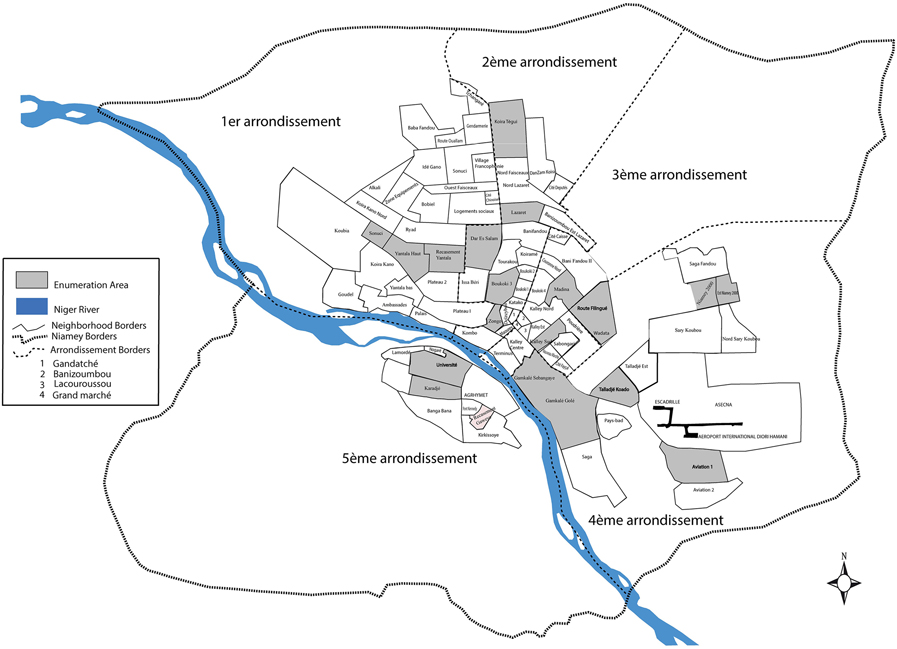
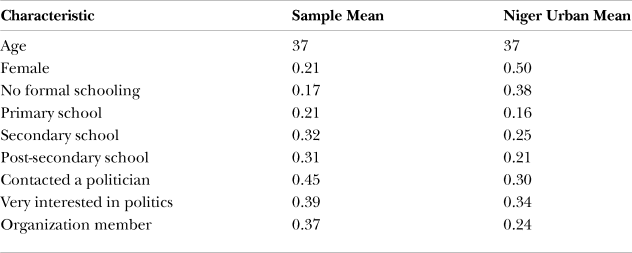
180 people were surveyed in the capital city of Niamey, stratifying by neighborhoods that local research assistants helped to identify as politically active. The sample encompassed eighteen neighborhoods in all, shown on the map in Figure 5. Niamey sits on the Niger River with businesses, government buildings, and political activity concentrated on the east bank. In neighborhoods such as Zongo near the National Assembly, striking workers sporadically halt traffic, and monuments are plastered with campaign posters during election years. Student neighborhoods on the west bank are also politically active, so they were surveyed as well. The goal in stratifying was to over-sample people who had contacted politicians in order to ask why and how contact had occurred. Working only in the capital city was therefore part of the stratification strategy. Three enumerators from the Univeristé Abdou Moumouni de Niamey administered questionnaires to ten respondents per neighborhood whom they selected quasi-randomly, at varied times of day and in dispersed areas within each neighborhood.Footnote 9 The resulting sample is similar to the urban sub-sample of the nationally representative Afrobarometer survey (Table 1), except that the respondents in this sample are more politically active on average, indicating that stratification was effective.Footnote 10 Women are under-represented, because in Niger women are overwhelmingly less politically active than men—a vestige of the French colonial policy of ruling through patriarchal customary laws (Kang Reference Kang2015).
Enumeration Area

Sample Characteristics

Sample means calculated from 180 Niamey respondents in 2014. Niger urban means calculated from 263 urban Afrobarometer respondents in 2013.
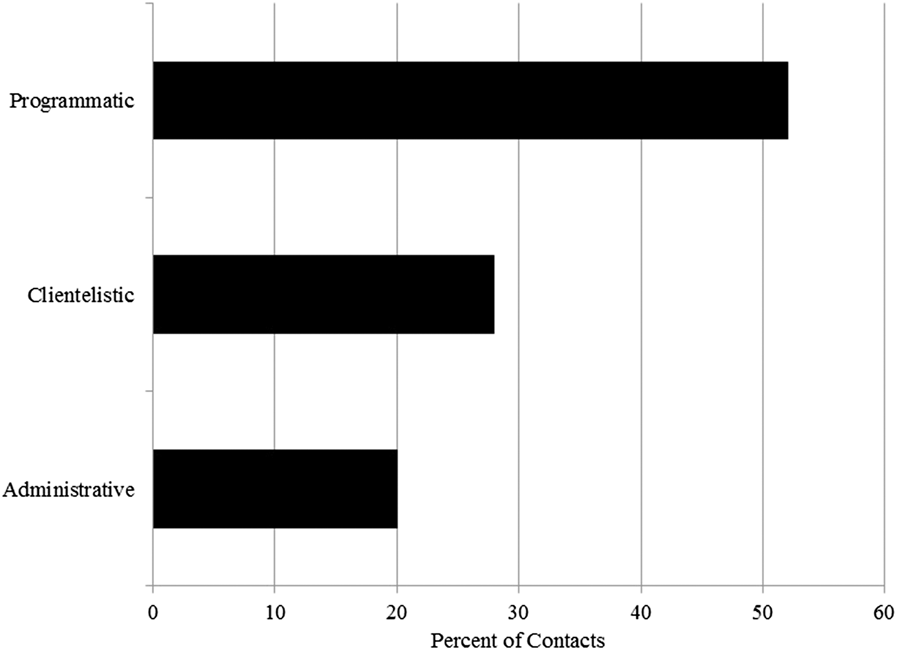
Reasons for contacting politicians varied considerably among respondents who said they had contacted a politician. When asked the follow-up question, “Why did you contact this person?” many people named community-oriented reasons, for instance: to advocate for the women of Niamey, to repave a damaged road, to alleviate traffic congestion, and to discuss general problems in the neighborhood, commune, or country. In contrast, some people cited requests for private goods. Nearly every request in this category was for a job. Other personal requests were for money to pay for a child’s baptism and for help with a parent’s illness. A third group of reasons related to administrative issues. People in this category initiated contacts in order to join a political party, organize a meeting, follow up on paperwork, and so on.
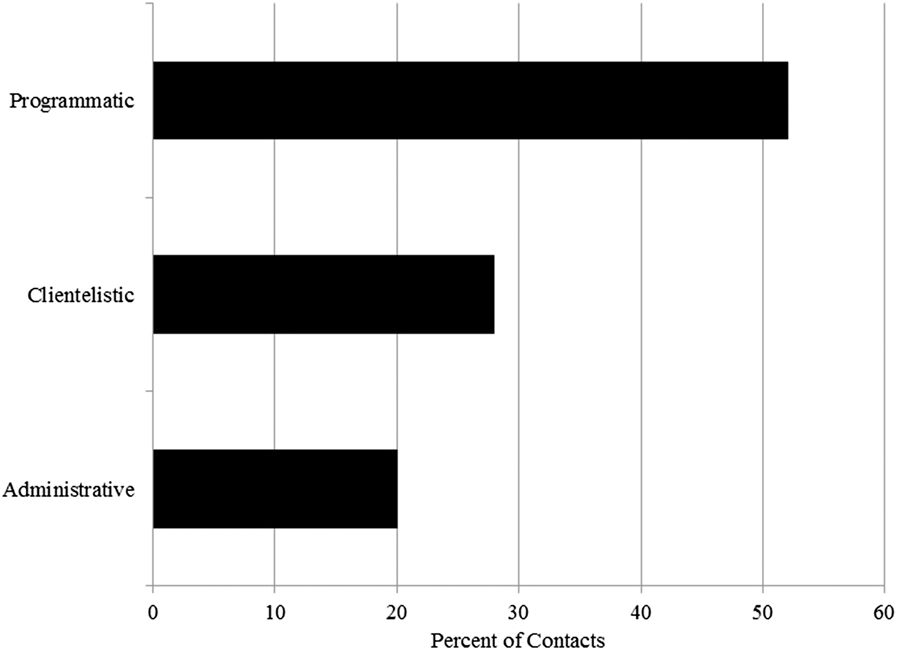
These responses were coded into three categories: programmatic, clientelistic, and administrative. The distribution of responses appears in Figure 6. The frequencies of programmatic and clientelistic contacts are the reverse of the pattern in the Afrobarometer data (Figure 4). In the Niger sample, more than half of all contacts were programmatic while 28 percent were clientelistic, whereas in the Afrobarometer sample, half of all contacts were clientelistic while approximately 40 percent were programmatic. The Afrobarometer survey may have overstated the rate of clientelism by grouping requests for private patronage with requests for administrative assistance in the same response category. This problem was avoided in the Niger sample by asking an open-ended question about reasons for contacting and then interpreting and coding the responses post hoc.
Categories of Citizen Requests in Niger. Percentages are calculated from 82 instances of citizen-initiated contact in a sample of 180 survey respondents. Responses are coded into categories from answers to the question, “Why did you contact this person?”
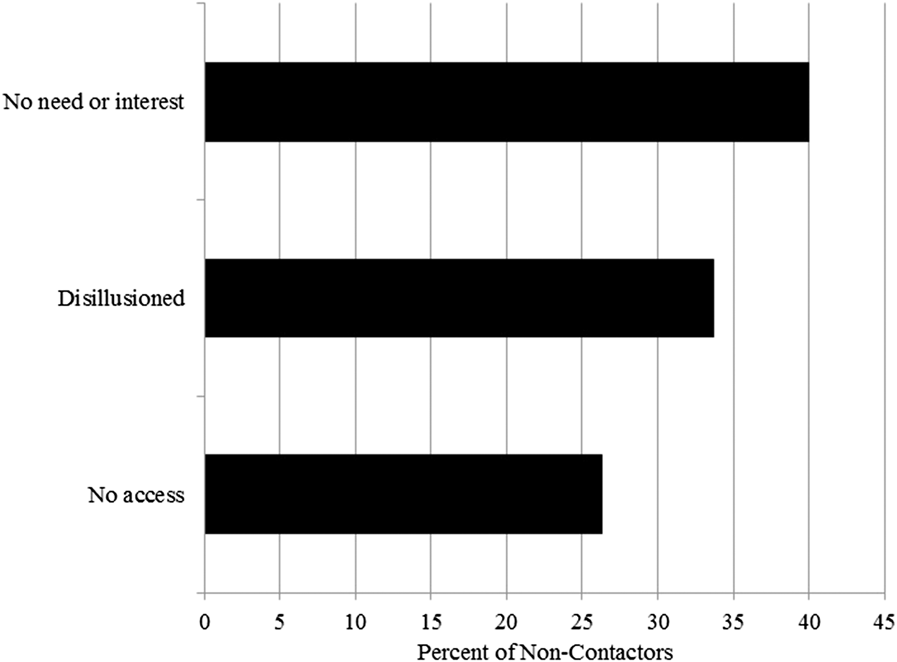
The survey also examined people’s reasons for deciding not to contact a politician. Open-ended responses ranged from a lack of need or interest (“I had no need to.”; “I’m not interested in politics.”), to the inability to access politicians (“I couldn’t reach him.”; “I didn’t have a chance.”), to disillusionment with the representative process (“Politicians are selfish and dishonest.”; “They would never receive an unemployed person like me. They stigmatize people who lack education and employment.”). These responses were coded into three categories: no need or interest, no access, and disillusioned. The graph in Figure 7 suggests that apathy and disillusionment are to blame for political disengagement and the fact that the rate of contacting politicians is lower in Niger than in other African countries (16 percent in Niger versus 33 percent on average among all twenty-seven countries in the Round 5 Afrobarometer surveys). These findings reflect what Nigerien journalists call the crise de confiance, or crisis of confidence, among citizens regarding the state of democracy (Amadou Reference Amadou2014). Since national independence in 1960, Niger has had seven constitutions and four coups d’état, alternating between multiparty and military rule. Successive leaders, both elected and unelected, have failed to substantially improve material conditions in a country that remains one of the poorest in the world. In a climate marked by weak rule of law and low government accountability, it is perhaps not surprising that many survey respondents feel it is futile to contact politicians with their grievances. A quarter of Nigeriens are either unsatisfied with democracy or do not think their country is a democracy at all (Mueller & Matthews Reference Mueller and Matthews2016).
Nigeriens’ Reasons for Not Contacting Politicians. Percentages are calculated from 95 instances of decisions not to contact politicians in a sample of 180 survey respondents. Responses are coded into categories from answers to the question, “Why did you not contact one of these people?”

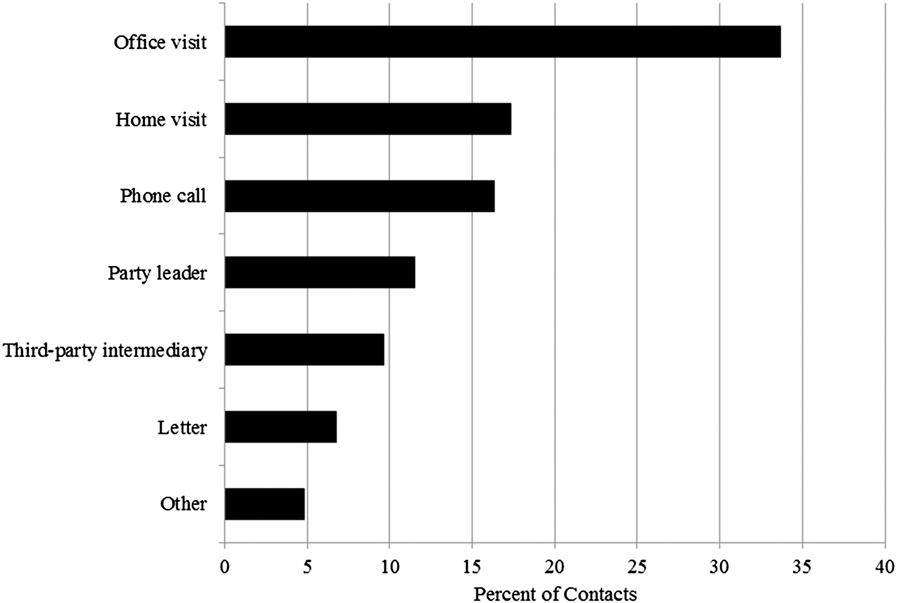
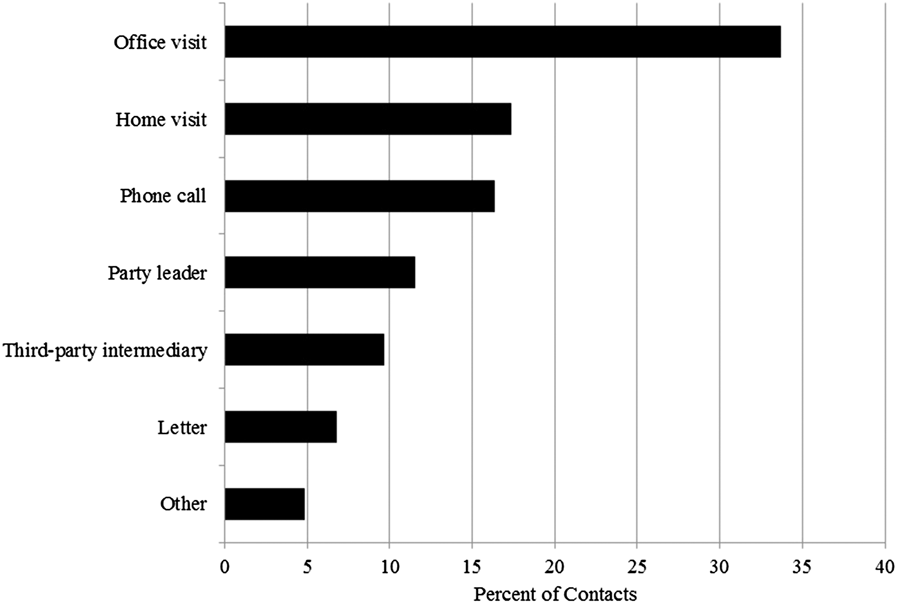
To measure the extent of personal politics, enumerators asked a follow-up to the question of whether respondents had contacted a politician in the past year: “How did you contact this person?” They then read a set of response options that were chosen by consulting local social scientists on norms of contacting in Niger: “by visiting the politician’s office,” “by making a phone call,” “by writing a letter,” “through a party leader,” or “through a third-party intermediary.” Respondents were also offered the open-ended option of “other (please specify).” Figure 8 shows a summary of responses. Seventeen percent of respondents chose “other” and stated that they had contacted a politician by visiting that person’s home. This was the second most common response after making an office visit. There were enough people who cited home visits that I coded their responses into a separate category. The responses remaining in the “other” category were mixed. Some mentioned meeting politicians at fadas, conversation groups of mostly young men that pop up around Niamey at night in makeshift spaces. Fada is a Hausa word that originally referred to gatherings of chiefs in rural Niger. It gained a different, urban connotation after the National Conference of 1992 ended single-party rule and allowed for public organizing and expression (Boyer Reference Boyer2014). Today, fadas are primarily social groups for playing cards and sharing tea, but members’ conversations sometimes turn political (Masquelier Reference Masquelier2013). Other venues for contacting politicians were less specific to the Nigerien context. Phone calls were common, and were often made to a politician’s private cell phone.Footnote 11 Predictably, few respondents said they had written a letter (Niger’s adult literacy rate of 15 percent is the world’s lowest by World Bank estimates). No respondent mentioned online communication, which is also to be expected in a country where only 1.4 percent of the population used the Internet as of 2013 (International Telecommunications Union 2013). The prevalence of face-to-face interaction and informality is consistent with the assumption that politics in Africa remains very personal, even if the requests that citizens make of politicians are usually about public goods.
Modes of Contacting Politicians in Niger. Percentages are calculated from 104 responses to the question, “How did you contact this person?” (asked as a follow-up to respondents who had contacted a politician)
Personal contact in Niger is best understood not as clientelism, but rather as an adaptation to institutional and economic limits on impersonal communication. The economics literature provides a helpful framework for understanding this phenomenon. People do business with strangers only when obtaining goods is not too onerous and when institutions like property rights, contracts, and law enforcement insure against cheating. Absent such institutions and easy access to goods, people tend to trade only with members of their immediate social networks (Fafchamps & Minten Reference Fafchamps and Minten2001). Personalized and informal relationships are rational behaviors despite limiting the size of markets and retarding economic development (Kranton Reference Kranton1996). Market exchange flourishes when contracts “permit cooperation to take place among persons who otherwise would not interact for lack of trust” (Kapstein Reference Kapstein2004:6). Weber introduced a similar logic to the political science literature when he described Western democratic institutions as an impersonal source of social bonds, compared with the fusion of public and private in “pre-modern,” non-Western societies (Laruelle Reference Laruelle2012:301).
Institutions such as elections and constitutions must be widely trusted in order for citizens to cast ballots with confidence that their votes will hold leaders accountable. When most citizens are literate and can contact public officials with the click of a mouse, letter writing is a viable way to express grievances and demands. Niger struggles on both fronts. Its institutions for enforcing social contracts are notoriously weak, as contemporary events illustrate. President Mamadou Tandja dissolved the Constitutional Court in 2009 after judges ruled against his proposed referendum to replace the semi-presidential system of government with a presidential one. In 2016, lawyers went on strike to protest government arrests that they perceived as politically motivated. That same year, citizens accused the National Independent Electoral Commission of violating its promise to oversee free and fair elections by allowing people to cast ballots without voter identification cards. When rule of law fails, neither economic nor social contracts are credible at arm’s length (Kapstein Reference Kapstein2004). Instead, “the credibility of political promises depends on a history of personal exchange and interaction between the promisor and the promisee” (Keefer Reference Keefer2004:3). The highly personal nature of politics in Niger is compatible with this theory.
Citizens revert to home visits and phone calls when democratic institutions are weak but also when communication technologies are inaccessible thanks to cost or illiteracy.Footnote 12 This is well documented in the clientelism literature. Stokes et al. (Reference Stokes, Dunning, Nazareno and Brusco2013) show that improvements in education and newspaper circulation in Britain and the United States during the late nineteenth century allowed politicians to campaign directly to the entire electorate; personal contacting became obsolete and clientelism declined. However, earlier studies overlook innocuous forms of personal contact that exist alongside or even outnumber clientelistic ones in societies where most people still cannot read newspapers. The evidence in this article suggests that chummy relations between citizens and politicians in Niger, which foreign observers attribute to a clientelist culture, is actually an equilibrium of reciprocal exchange comparable to the practice of sealing a business deal with a handshake. This system seems to be working for Nigeriens: Survey respondents who said they had contacted a politician received a response almost three quarters of the time; 18 percent heard back in a day or less. In unstructured interviews, some citizens confessed that they would not even try to initiate formal processes like applying for land titles, filing law suits, or requesting public services; it is much easier to pay a personal call to local leaders who sometimes have open-door policies at all hours of the day.
Conclusion
This study lays the foundation for reconceptualizing personal contacting in Africa as a source of accountability and not just as a source of clientelism. It specifically addresses whether it is true, as often believed, that citizen outreach to politicians can be generalized as requests for patronage. I conclude that the evidence does not definitively support this conventional wisdom. African politics remains very personal, judging by high rates of direct contact between rulers and the ruled and citizens’ self-reported tendency to visit politicians at home or call politicians’ private cell phones. At the same time, these one-on-one interactions do not disproportionately center on particularized transfers of benefits. Nigerien citizens’ own accounts of relations with politicians imply that the bulk of citizen requests are programmatic, relating to needs of the broader community. Personal contact is hence a weak proxy for clientelism. This becomes evident only through an interpretivist methodology that employs open-ended survey questions instead of imposed response options as in the popular Afrobarometer surveys. Original survey data presented in this article thus advance our knowledge about citizen engagement and government accountability in a country, Niger, that earlier data portrayed as undemocratic. Although the findings are based on a limited sample, they may encourage scholars to interpret personal politics with more ambivalence. In practice, this could mean not assuming that personal politics is inherently clientelistic in some contexts and inherently democratic in others, or studying interactions between citizens and politicians using more immersive methods. This article can guide research beyond Niger, as political contacting has been equated with clientelism in other African countries (e.g., Willott Reference Willott2011) as well as in Central Asia (e.g., Laruelle Reference Laruelle2012).
Rather than clientelism, the more plausible explanation for the pervasiveness of personal contact is restricted impersonal communication. Contacting government officials is a struggle even in rich democracies with elaborate systems for connecting citizens with leaders (Eisinger Reference Eisinger and Hahn1972:44), but it is especially daunting in poor transitional regimes that lack infrastructure of many kinds. Impersonal contact in the form of letter writing or emailing is impractical in societies where a large portion of the population cannot read or access the Internet. Furthermore, personal relationships are historically important in much of Africa owing to the illegitimacy of both colonial and post-colonial states (Englebert Reference Englebert2002b) and flaws in the democratic process (van de Walle Reference van de Walle2002). Citizens who do not trust that a vote for a candidate or a letter to a bureaucrat will translate into concrete improvements in their wellbeing may instead be inclined to make face-to-face requests for help with basic needs—unless they become so disillusioned with politics that they disengage altogether. The widespread preference for contacting traditional rulers rather than national-level politicians attests to the value that citizens place on social familiarity. In sum, people in Africa seem to have acknowledged long ago what policy makers have asserted more recently: Given imperfect representative institutions, the short route to accountability is better than the long one.