Introduction
Studies on the parasites of reptiles may provide insightful information about the ecological and evolutionary relationships between helminths and their hosts (Aho, Reference Aho, Esch, Bush and Aho1990). Helminthological studies also contribute to our understanding of the hosts’ biology and conservation, such as indicators of environmental stress, food-web structure and ecosystem biodiversity (Marcogliese, Reference Luque, Pereira, Alves, Oliva and Timi2004).
However, even with the increase of these studies, especially in the last two decades, data on the helminth richness and complexity of the parasite–host relationship is still scant, especially in lizards (Kamiya et al., Reference Kamiya, O'Dwyer, Nakagawa and Poulin2014; Campião et al., Reference Campião, Aquino Ribas, Morais, Silva and Tavares2015; Silva Neta & Ávila, Reference Roca and Hornero2018). Scarcity of data on their parasitic community and their ecological parameters is even greater in the Brazilian semi-arid (Anjos et al., Reference Anjos, Bezerra, Passos, Zanchi and Galdino2011; Ávila et al., Reference Ávila, Anjos, Ribeiro, Morais, Silva and Almeida2012; Araujo Filho et al., Reference Araujo Filho, Ribeiro, Brito, Teles, Sousa, Ávila and Almeida2014), especially in isolated humid forest enclaves (locally known as Brejos de Altitude – highland marshes) (Ribeiro et al., Reference Preston and Johnson2012; Amorim & Ávila, Reference Amorim and Ávila2019; Silva et al., Reference Ribeiro-Junior2019).
Parasitism can alter the structure of wild communities (Fournié et al., Reference Fournié, Goodman and Cruz2015) due to changes in the behaviour and aptitude of the hosts (Adelman & Martin, Reference Adelman and Martin2009; Preston & Johnson, 2012). The increase in parasitic load can be related to the larger body size of the hosts (Poulin, Reference Pianka and Vitt2004; Kamiya et al., Reference Kamiya, O'Dwyer, Nakagawa and Poulin2014; Teixeira et al., Reference Souza, Ribeiro, Antonucci, Ueda, Carniel, Karling and Pavanelli2018), and can interfere with their levels of infection (Anjos et al., Reference Anjos, Rocha, Vrcibradic and Vicente2005; Barreto Lima et al., Reference Barreto-Lima, Toledo and Anjos2011; Bezerra et al., Reference Bezerra, Pinheiro, Melo, Braga, Anjos and Borges-Nojosa2020). However, efforts to document parasites are insufficient (Jorge & Poulin, 2018), limiting the understanding of determining factors of this structuring (Ibrahim & Soliman, 2005). Thus, the association of morphological approaches with ecological data can promote effective estimates of species diversity and distribution (Luque et al., Reference Loebmann and Haddad2016).
Norops fuscoauratus (D'Orbigny in Duméril & Bibron, 1837), a small-bodied lizard of the family Dactyloidae, has a disjunct geographic distribution in the Amazon and the Atlantic Forest, with populations in highland marshes in the Brazilian state of Ceará (Avila-Pires, Reference Avila-Pires1995; Loebmann & Haddad, Reference Kuzmin2010; Ribeiro-Junior, 2015). Biological aspects of N. fuscoauratus have been published, such as diet and microhabitat use (Vitt et al., Reference Teixeira, Silva, Brito, Teles, Araujo-Filho, Franzini and Mesquita2003, Reference Vicente, Rodrigues, Gomes and Pinto2008), whereas parasitological studies are more scarce and restricted to Amazonian populations (Ávila & Silva, Reference Ávila and Silva2010, Reference Ávila and Silva2013). Herein, we present the parasitological descriptors of helminths associated with N. fuscoauratus from highland marshes of the Brazilian semi-arid, testing the influence of host body size on parasitism.
Material and methods
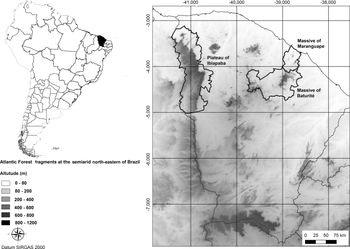
Fieldwork took place in highland marshes characterized by semi-decidual or montane evergreen forest (Pagano & Araújo, Reference Oliveira, Teixeira, Queiroz, Araujo-Filho, Teles, Brito and Mesquita2010) in three conservation units: Serra de Maranguape Environmental Protection Area (3°54′38.6″S, 38°43′12.5″W); Serra de Baturité Environmental Protection Area (4°16′04.7″S, 38°54′54.4″W), both crystalline massifs; and Ubajara National Park (3°43′29.3″S, 40°55′43.0″W), a sedimentary plateau (fig. 1). Sample areas have a mean altitude of 877 m, a tropical hot and humid climate, a mean temperature ranging from 24 to 28°C and a mean rainfall of 1532.9 mm, with the wet season concentrated in the first three months of the year (Ipece, Reference Ibrahim and Soliman2018a, b, c).
Schematic map with location of the three sampled highland marshes in the Brazilian semi-arid.

Lizard specimens were collected by hand through visual searches from January to March 2019, with the according permit issued by the Instituto Chico Mendes de Conservação da Biodiversidade (SISBIO 72.384) and authorized by the ethics committee of the Universidade Regional do Cariri (CEUA/URCA process number 00026/2015.2). Specimens were euthanized with a lethal injection of sodium thiopental, their mass weighed with a Pesola® spring scale (0.1 g precision) (Schindellegi, (Schwyz), Suiça) and the snout-vent length (SVL) measured with a digital caliper (0.01 mm precision). Posteriorly, individuals were fixed with 10% formalin, preserved in 70% ethanol and deposited at Coleção Herpetológica da Universidade Regional do Cariri. Twenty-five individuals were necropsied with a midventral incision and all organs and coelomic cavity were searched for helminths. Parasites found were preserved in 70% ethanol, mounted in temporary slides, nematodes were cleared in lactophenol and acanthocephalans and trematodes were dehydrated in an increasing series of alcohol, stained with the hydrochloric carmine technique and diaphanized in eugenol. Slides were analysed under a microscope with a computerized image analysis system (Carl Zeiss Microimaging GmbH, Gottingen, Germany). Helminth identification was based on Yamaguti (Reference Vitt, Avila-Pires, Zani, Sartorius and Espósito1961, Reference Vitt, Magnusson, Avila-Pires and Lima1963), Vicente et al. (Reference Teixeira, Brito, Teles, Ribeiro, Araujo-Filho, Lima and Almeida1991), Anderson et al. (Reference Anderson, Chabaud and Willmott2009) and Gibbons (Reference Gibbons2010). Voucher helminths were deposited at Coleção Parasitológica da Universidade Regional do Cariri. Parasitological descriptors (prevalence, mean intensity of infection and abundance) were calculated according to the specifications of Bush et al. (Reference Bush, Lafferty, Lotz and Shostak1997). Throughout the text, means are presented with ± standard error.
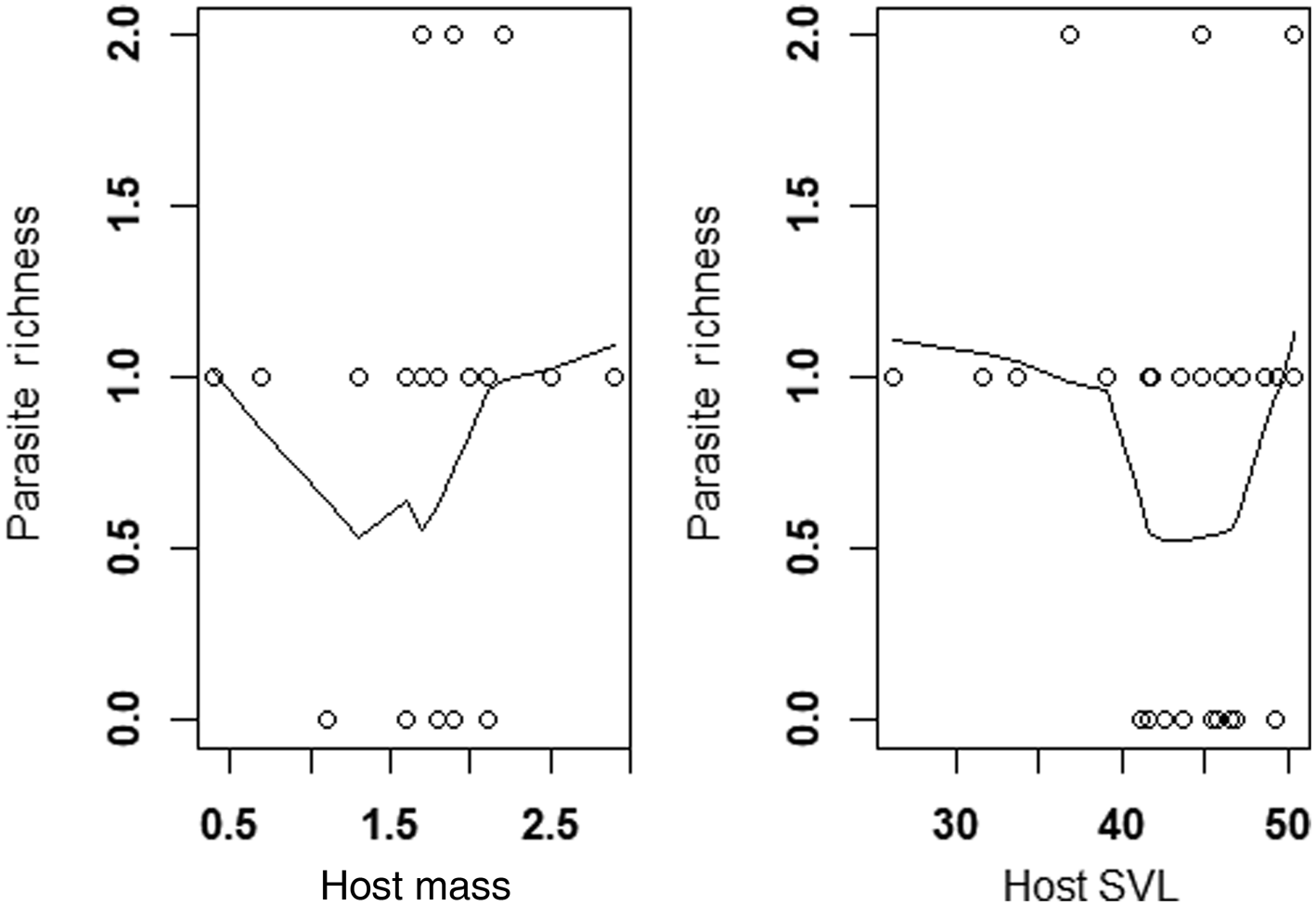
To test the relationship between host body size and mass with richness of parasites, we performed a linear regression in R platform version 3.4.1 (R Foundation, Reference Poulin and George-Nascimento2018).
Results
Of the 25 lizards examined, 16 were adult females, one juvenile (mean SVL 44.01 ± 1.5, range 26.2–50.4) and eight adult males (mean SVL 41.3 ± 1.86, range 31.6–49.3). Sixteen were infected by a total of 69 parasites, an overall prevalence of 64%. Mean richness was 0.76 ± 0.13, mean abundance 2.76 ± 1.13 (0–24); mean intensity of infection was 4.31 ± 1.66 (1–25).
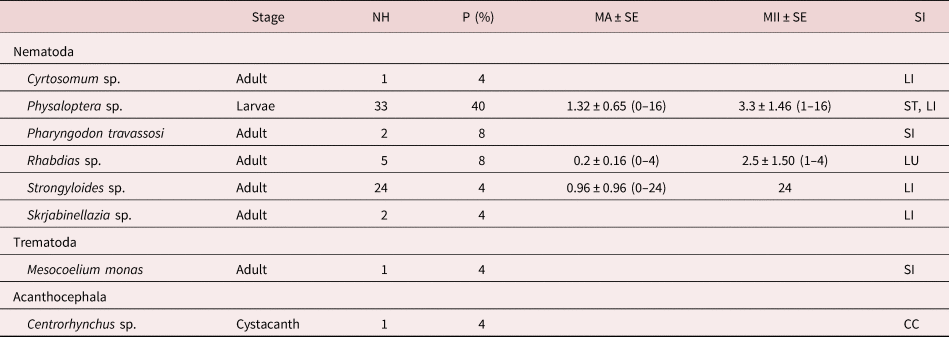
Eight taxa of helminths were found associated with N. fuscoauratus (table 1), belonging to Nematoda (six taxa), Trematoda and Acanthocephala (both with one taxa). Physaloptera sp. and Strongyloides sp. present higher abundances, whereas Mesocoelium monas, Cyrtosomum sp. and Centrorhynchus sp. showed lower abundance. There is no relationship of host body size (P = 0.79) and mass (P = 0.50) with parasite richness (fig. 2).
Linear regression in Norops fuscoauratus between: (a) host mass and parasitic richness; (b) host snout-vent length and parasitic richness.

Number of helminths (NH), prevalence (P), mean abundance (MA) and mean intensity of infection (MII) with standard error (SE), range in parentheses and site of infection (SI) of helminths associated with Norops fuscoauratus (n = 25) in highland marshes of the Brazilian semi-arid.

ST, stomach; SI, small intestine; LI, large intestine; CC, coelomic cavity; LU, lung.
Discussion
Helminth richness found here in N. fuscoauratus is higher than that reported in previous studies (Bursey et al., Reference Bursey, Goldberg and Parmelee2005; Goldberg et al., Reference Goldberg, Bursey and Vitt2006a; Albuquerque et al., Reference Albuquerque, Ávila and Bernarde2012; Ávila & Silva, Reference Ávila and Silva2013). The similarity in helminth composition in the present study with other studied populations can be noted by the common presence of M. monas and the genera Physaloptera, Rhabdias and Skrjabinellazia, which could be due to phylogenetic constraints (Pianka & Vitt, Reference Pagano, Araújo and Degenovine2003; Ávila & Silva, Reference Ávila and Silva2013) or ecological adjustments (Brooks et al., Reference Brooks, León-Règagnon, McLennan and Zelmer2006; Goldberg et al., Reference Goldberg, Bursey and Vitt2010; Cabrera-Guzmán & Garrido-Olvera, Reference Cabrera-Guzmán and Garrido-Olvera2014).
Nematoda was the most abundant and rich group of parasite species in our sample, as reported elsewhere for amphibians and reptiles from South America (Ávila & Silva, Reference Ávila and Silva2010; Campião et al., Reference Campião, Morais, Dias, Aguiar, Toledo, Tavares and Silva2014), including N. fuscoauratus (Goldberg et al., Reference Goldberg, Bursey and Vitt2006a; Albuquerque et al., Reference Albuquerque, Ávila and Bernarde2012) and other members of the Dactyloidae family (Cabrera-Guzmán & Garrido-Olvera, Reference Cabrera-Guzmán and Garrido-Olvera2014; Araujo Filho et al., Reference Araujo Filho, Brito, Lima, Pereira, Mesquita, Albuquerque and Almeida2016; Cabral et al., Reference Cabral, Teles, Brito, Oliveira Almeida, Anjos, Guarnieri and Ribeiro2018; Amorim & Ávila, Reference Amorim and Ávila2019). Higher infection of nematodes can be related to host habitat use and diet, which facilitate transmission (Aho, Reference Aho, Esch, Bush and Aho1990; Poulin, Reference Poulin2005; Teixeira et al., Reference Silva Neta and Ávila2017).
Among the helminths found, we could not identify Centrorhynchus sp. and Physaloptera sp. due to their immature stage; nor could we identify Skrjabinellazia sp. and Cyrtosomum sp. because we found only adult females – male characters, such as spicule size and arrangement of caudal papillae, are necessary for accurate identification (Vicente et al., Reference Teixeira, Brito, Teles, Ribeiro, Araujo-Filho, Lima and Almeida1991). Both Rhabdias and Strongyloides have an alternation of free-living (both males and females) and parasitic (females) cycles, which makes accurate identification difficult. However, the species of Rhabdias found in the present work may be an undescribed species. Müller et al. (Reference Mihalca, Micl˘uş and Lefkaditis2018) pointed out that Rhabdias parasitizing Norops brasiliensis in Ceará state is probably a new species, but molecular studies will help to elucidate the identity of specimens found here.
Physaloptera sp. was the most prevalent and abundant (40%). Since all specimens were larvae, N. fuscoauratus may act as a paratenic hosts for Physaloptera sp. Larvae may be acquired by ingestion of infected arthropods by N. fuscoauratus (Anderson, Reference Anderson2000; Vitt et al., Reference Vitt, Avila-Pires, Zani, Sartorius and Espósito2003). Species of the genus Physaloptera are common parasites of vertebrates, which act as both paratenic and definitive hosts (Anderson, Reference Anderson2000), usually found infecting the stomach and intestine of lizards (Ávila & Silva, Reference Ávila and Silva2010; Teixeira et al., Reference Silva Neta and Ávila2017). Physaloptera spp. have been reported to infect N. trachyderma and N. brasiliensis (Albuquerque et al., Reference Albuquerque, Ávila and Bernarde2012; Amorim & Ávila, Reference Amorim and Ávila2019), and Physaloptera retusa were already reported in N. fuscoauratus (Goldberg et al., Reference Goldberg, Bursey and Vitt2006a; Albuquerque et al., Reference Albuquerque, Ávila and Bernarde2012; Ávila & Silva, Reference Ávila and Silva2013).
Strongyloides sp. also presents a higher abundance. This nematode genus is known to infect amphibians, reptiles and mammals (Roca & Hornero, Reference Ribeiro, Ferreira, Brito, Teles, Ávila, Almeida and Guarnieri1992). Although several animals have been reported as hosts for Strongyloides (Souza et al., Reference Silva, Manoel, Uieda, Ávila and Silva2015; Cardia et al., Reference Cardia, Camossi, Fornazari, Babboni, Teixeira and Bresciani2016; Carvalho-Pereira et al., Reference Carvalho-Pereira, Souza, Santos, Walker, Pertile, Oliveira and Reis2018), there are few records of infection in lizards (Ávila & Silva, Reference Ávila and Silva2010; Mati et al., Reference Martin, Llorente, Roca, Carretero, Montori, Santos and Romeu2013). Therefore, N. fuscoauratus is a new host record for Strongyloides spp.
The Trematoda M. monas (Rudolphi, 1819), the Acanthocephala Centrorhynchus sp. and the Nematoda Cyrtosomum sp. showed lower prevalence and intensity of infection. It is possible that cystacanths of Centrorhynchus sp. were acquired through prey consumption and N. fuscoauratus may act as a paratenic host (Martin et al., Reference Marcogliese2005; Cabrera-Guzmán & Garrido-Olvera, Reference Cabrera-Guzmán and Garrido-Olvera2014). Mesocoelium monas have been reported in the intestine of several amphibians and reptiles (Goldberg & Bursey, Reference Goldberg and Bursey2008; Ávila & Silva, Reference Ávila and Silva2010; Bursey et al., Reference Bursey, Goldberg, Telford and Vitt2012), including N. brasiliensis in humid forests in Ceará state (Amorim & Ávila, Reference Amorim and Ávila2019) and N. fuscoauratus from the Amazon (Ávila & Silva, Reference Ávila and Silva2013). Cyrtosomum sp. was also reported in lizards from the family Dactyloidae, such as Cyrtosomum longicaudatum in Dactyloa punctata and Dactyloa transversalis (Goldberg et al., Reference Goldberg, Bursey and Vitt2006b), but this is the first record of Centrorhynchus spp. in the lizard genus Norops.
Both Pharyngodon travassosi (Pereira, 1935) and Skrjabinellazia sp. present low prevalence and mean intensity of infection in our study. While Pharyngodon spp. are frequently reported infecting lizards from the family Teiidae (Ávila et al., Reference Ávila, Cardoso, Oda and Silva2011; Brito et al., Reference Brito, Ferreira, Ribeiro, Anjos, Almeida, Mesquita and Vasconcellos2014a), with no records for Norops spp., Skrjabinellazia were already reported in Norops spp., with Skrjabinellazia sp. in N. brasiliensis and Skrjabinellazia galliardi for N. fuscoauratus (Ávila & Silva, Reference Ávila and Silva2013; Amorim & Ávila, Reference Amorim and Ávila2019).
Rhabdias are nematodes commonly found infecting the lungs of amphibians and reptiles (Anderson, Reference Anderson2000; Aguiar et al., Reference Aguiar, Toledo, Anjos and Silva2015). They have a direct life cycle that includes both parasitic and free-living stages (Anderson, Reference Anderson2000; Kuzmin, Reference Koprivnikar, Marcogliese, Rohr, Orlofske, Raffel and Johnson2013). Some species are known to influence the performance of hosts, restricting their growth and limiting locomotion (Kelehear et al., Reference Jorge and Poulin2019) or causing lung lesions (Mihalca et al., Reference Mati, Pinto and Melo2010). Rhabdias spp. are well documented infecting lizards of the family Dactyloidae (Dobson et al., Reference Dobson, Pacala, Roughgarden, Carper and Harris1992; Bursey et al., Reference Bursey, Goldberg and Telford2003, Reference Bursey, Goldberg and Miller2004), including Norops punctatus (Goldberg et al., Reference Goldberg, Bursey and Vitt2006b), N. brasiliensis (Ribeiro et al., Reference Preston and Johnson2012; Amorim & Ávila, Reference Amorim and Ávila2019) and N. fuscoauratus (Goldberg et al., Reference Goldberg, Bursey and Vitt2006a). Goldberg et al. (Reference Goldberg, Bursey and Vitt2006b) suggested that humid microhabitats might favour the infection by Rhabdias, which may corroborate the findings of the present study.
Although larger hosts generally have higher parasitic loads (Poulin & George-Nascimento, Reference Poulin and Rohde2007; Araujo Filho et al., Reference Araujo Filho, Ribeiro, Brito, Teles, Sousa, Ávila and Almeida2014), and the intensity of infection increases with body size and mass (Barreto-Lima et al., Reference Barreto-Lima, Toledo and Anjos2011; Oitaven et al., Reference Müller, Morais, Costa-Silva, Aguiar, Ávila and Silva2019), this relationship was not found in the present study. There are other reasons for variations in parasite richness, such as ecological characteristics (Brito et al., Reference Brito, Ferreira, Ribeiro, Anjos, Almeida, Mesquita and Vasconcellos2014a), intersexual differences (Galdino et al., Reference Galdino, Ávila, Bezerra, Passos, Melo and Zanchi-Silva2014), host immunity (Koprivnikar et al. Reference Kelehear, Saltonstall and Torchin2012), seasonal variation (Brito et al., Reference Brito, Corso, Almeida, Ferreira, Almeida, Anjos and Vasconcellos2014b) or a combination of these factors (Araujo Filho et al., Reference Araujo Filho, Brito, Lima, Pereira, Mesquita, Albuquerque and Almeida2016; Oliveira et al., Reference Oitaven, Silva Ribeiro, Moura and Oliveira2017).
Despite the small sample size, we report four new helminth records for N. fuscoauratus. This reinforces the need for sampling new areas and hosts so that the helminth diversity of the Neotropical region can be known. Thus, our findings represent a new record of helminth fauna for N. fuscoauratus in highland marshes of the Brazilian semi-arid. In addition, the present study contributes to the knowledge of the parasitic fauna of the Neotropical region.
Acknowledgements
We thank Daniel Cassiano Lima, Drausio Honorio Morais and Waldir Mantovani for their contributions to improving the work. Our thanks also to the entire team of the Herpetology Laboratory at the Regional University of Cariri (URCA), for their assistance in collections and in the laboratory.
Financial support
The authors thank the Conselho Nacional de Desenvolvimento Científico e Tecnológico (CNPq) for providing a research fellowship (R.W.A., 303622/2015-6; 305988/2018-2), thank the Coordenação de Aperfeiçoamento de Pessoal de Nível Superior (CAPES), Brazil (J.M.S.M., process number 88882.454282/2019-01; S.S.O., process number 88882.454285/2019-01) for the providing a Master's scholarship (finance code 001) and, Fundação Cearense de Apoio Científico e Tecnológico (FUNCAP) and CNPq/Instituto Chico Mendes de Conservação da Biodiversidade (ICMBio) for the partial financial support (CNPq/ICMBIO/FAPs number 18/2017 – Caatinga process number 421350/2017-2).
Conflicts of interest
None.
Ethical standards
The authors assert that all procedures contributing to this work comply with the ethical standards of the relevant national and institutional committees on human experimentation and with the Helsinki Declaration of 1975, as revised in 2008. Lizards were collected according to the permits issued by ICMBio (SISBIO 61823-1, 29613) and by the ethics committee of the Universidade Regional do Cariri (CEUA/URCA process number 00026/2015.2). The authors assert that all procedures contributing to this work comply with the ethical standards of the relevant national and institutional guides on the care and use of laboratory animals.