Introduction
The role that stray and owned dogs play in the transmission of parasitic diseases to humans, especially homeless people, via environmental factors such as soil contamination of gardens and public grounds, is a major problem (Habluetzel et al., Reference Habluetzel, Traldi, Ruggeri, Attili, Scuppa, Marchetti and Menghini2003; Brouqui & Raoult, Reference Brouqui and Raoult2006; Martínez-Moreno et al., Reference Martínez-Moreno, Hernandez, Lopez Cobos, Becerra, Acosta and Martinez Moreno2007). Helminth zoonoses transmitted from domestic animals, especially dogs, in urban areas are considered of importance in industrialized countries, while in developing countries, they probably do not receive the attention they deserve, especially with regard to infection in young children (Marx, 1991; MacDonald et al., Reference MacDonald, Araojo and Pearce2002). The species of parasites present in dogs and their geographical distribution depend on constant changes in climatic conditions; therefore, surveillance of parasites and parasitic diseases should be a constant task in order to develop control strategies to prevent their role as vectors for a variety of human and animal pathogens (Martinez-Carrasco et al., Reference Martinez-Carrasco, Berriatua, Garijo, Martinez, Alonso and Ruiz de Ibáñez2007). There is limited information at present about dog helminths in central Mexico; Fernández & Cantó (Reference Fernández and Cantó2002) reported on intestinal parasites in 201 dogs during a 5-month period. Thus, the aim of the present study was to determine species, prevalence, abundance and mean intensity of infection of helminths present in stray dogs located in an urban area, by age, sex and season.
Materials and methods
The study was performed in the city of Queretaro in central Mexico located 220 km north of Mexico City, with an annual mean temperature of 18°C and pluvial precipitation of 555 mm. A total of 378 stray dogs, which are defined in this study as dogs living close to humans, dependent upon human refuse or handouts for food but not owned, or as owned dogs living with humans, but allowed to be free ranging (Stafford, Reference Stafford and Stafford2006), were captured from January to December 2008.
Collection and examination of dogs for parasites
The subjects, of varying age and sex, were brought to the Animal Control Center Unit (ACCU) in Queretaro, Mexico, and housed for 48–72 h before being euthanized in accordance with protocol NOM-033-200-1995 of the Ministry of Health (Sacrificio humanitario de los animales domésticos y silvestres). All were strays and had originated from the state capital, which is divided into seven districts. The ACCU's protocol for capturing freely roaming dogs is to service each district one day a week, or to respond to complaints by citizens from a particular area.
The complete digestive tract, trachea, lungs and heart were separated, maintained at 4°C and transported to the Veterinary School at the Autonomous University of Queretaro. Each sample was opened longitudinally and examined for the presence of helminths. Parasites were preserved in 70% ethanol until their identification, which was made as described by Taylor et al. (Reference Taylor, Coop and Wall2007). Among the 378 dogs sampled, there were 194 (51.3%) males and 184 (48.7%) females. Age was determined as described by Eldredge et al. (Reference Eldredge, Carlson, Carlson and Giffin2007); 150 (39.7%) were between 1 and 12 months old (young) and 228 (60.3%) were older than a year (adult).
Infection levels were obtained relative to host age, sex and time of year, and the terminology used for prevalence, abundance and mean intensity of infection was based on Bush et al. (Reference Bush, Lafferty, Lotz and Shostak1997).
Data analysis
Prevalence was calculated by dividing the number of animals presenting a helminth by the total number of examined dogs. To determine differences among prevalences, χ2 was utilized; when prevalences were below 10, Fisher's exact test was used. To compare the effect of age, sex and season on the abundance and mean intensity of infection, t-tests and analyses of variance (ANOVA) were performed. All tests were performed with a 95% confidence level.
Results
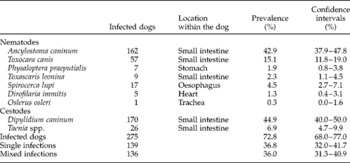
We recovered nine helminth species. Prevalences of different nematodes and cestodes are shown in table 1. The study revealed a prevalence of 72.8% infected dogs. Out of the 378 subjects that were examined, 55.2% (208) presented nematodes and 48.1% (182) cestodes. Single infections were observed in 50.5% (139) of infected animals while 49.5% (136) harboured mixed infections. Ancylostoma caninum and Dipylidium caninum were the most common helminths recovered, with prevalences of 42.9% and 44.9%, respectively. The next highest prevalences in descending order were: Toxocara canis with 15.1%; Taenia spp. with 6.9%; Spirocerca lupi with 4.5%; Toxascaris leonina with 2.3%; Physaloptera praeputialis with 1.9%; Dirofilaria immitis with 1.3%; Oslerus osleri with 0.3% (table 1).
The prevalence (%) of helminth species and their location within stray dogs from the city of Queretaro.

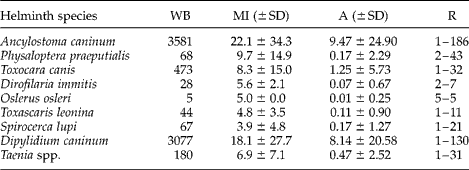
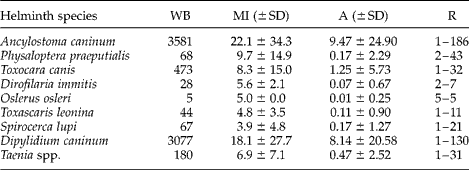
A total of 7523 worms were recovered. Ancylostoma caninum presented the highest mean intensity of infection, with 22.1 parasites, followed by D. caninum with 18.1 parasites, and P. praeputialis and T. canis with 9.7 and 8.3 specimens, respectively. The remaining parasites presented lower mean intensities of infection and varied from 6.9 to 3.9. The abundance of infection showed A. caninum as the parasite with the highest abundance with 9.5 parasites, followed by D. caninum with 8.1 and T. canis with 1.25 parasites. The rest of the parasite species presented an abundance of infection below 1 (table 2).
The mean intensity (MI) and abundance (A) of helminth species in stray dogs in the city of Queretaro; total worm burden (WB) and range (R).
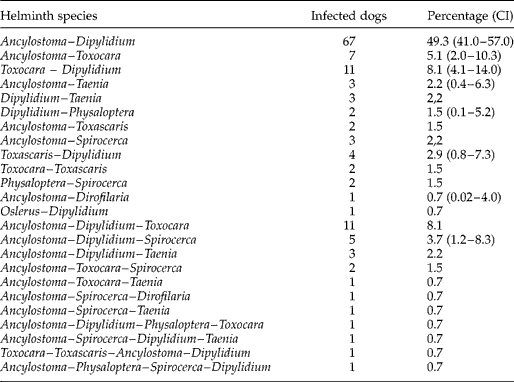
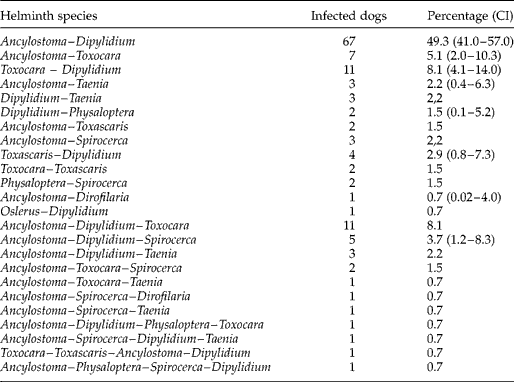
The relationship between infection type (mixed/single) and presence of parasites (infected/not infected) was tested through the  test. No statistical difference was observed ( = 0.051). Mixed infections of nematode and cestode worms were seen in 29.1% (110) of the subjects. Nematode mixed infections were observed in 39 (10.3%) animals; 14 (3.7%) had mixed cestode infections. A detailed breakdown of co-infections showed that 108 (79.4%) of the mixed infections were produced by two parasite species, 24 (17.6%) by three and four (2.9%) by four different species (table 3).
The occurrence of mixed helminth infections in stray dogs in the city of Queretaro.
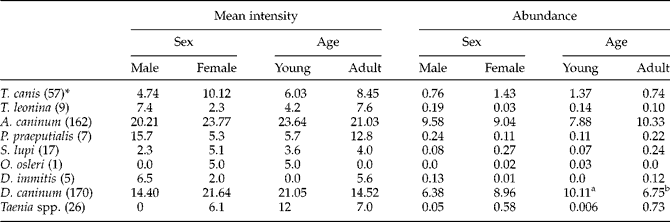
Prevalences of helminth infections were analysed by age and sex. Results showed no significant differences between infected young (70%) and adult (74%) animals ( = 545, P = 0.46); however, statistical differences were observed in T. canis, where 37 of 57 infected dogs were young and only 20 were adult ( = 10.14, P = 0.002). Statistical differences were also observed in A. caninum, where 53 young and 117 adults were infected ( = 48.18, P = 0.0001). No differences were seen when we compared prevalences of infected female (68%) and male (76%) animals ( = 3.30). The mean intensity of infection and the abundance of infection by age and sex were obtained and are shown in table 4. Ancylostoma caninum, D. caninum and T. canis presented the highest mean intensity of infection and abundance. We performed t-tests for the most prevalent parasites, i.e. T. canis, A. caninum and D. caninum; a statistical difference was observed in D. caninum when young and adult animals were compared (P = 0.03). No statistical differences in the mean intensity of infection or abundance were observed in the rest of the parasites (P>0.05).
The mean intensity and abundance of helminth species in stray dogs from the city of Queretaro, relative to host age and sex.
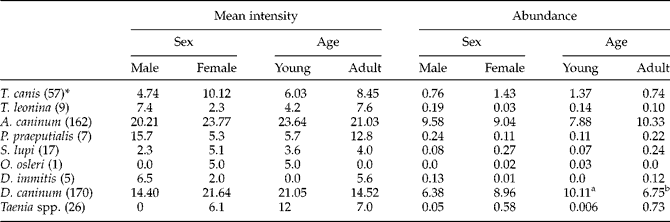
abDifferences among different superscript letters in the same line (P < 0.05).
* Number of parasitized dogs in parentheses.
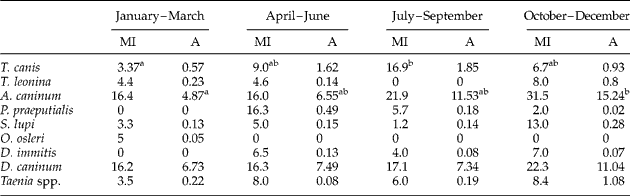
The mean intensity of infection and abundance were also analysed by season. Dogs were analysed by season; from January to March (winter), April to June (spring), July to September (summer) and October to December (autumn), and the mean intensity of infection and abundance obtained (table 5). The highest mean intensity of infection and abundance were observed between October and December for A. caninum, with 31.5 and 15.2 parasites, respectively. Mean intensities of infection and abundance of infection in each season for A. caninum, T. canis and D. caninum were compared statistically using ANOVA. No differences were observed in the ANOVA test for the mean intensity of infection for any of the parasites (P>0.05); however, in the post hoc Tukey test, differences were observed for T. canis between winter and spring. Analysis of the abundance of infection showed no differences with regards to T. canis and D. caninum. Statistical differences were observed for A. caninum (P = 0.01); however, Tukey test analysis determined that the winter, spring and summer groups, and spring, summer and autumn groups were not statistically different (P>0.05). The abundance of winter and autumn groups was statistically different (P < 0.05).
The mean intensity (MI) and abundance (A) of helminth species in stray dogs from the city of Queretaro, relative to season.
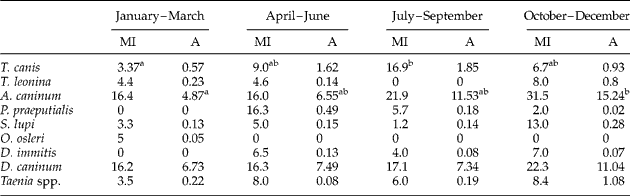
abDifferences among different superscript letters in the same line (P < 0.05).
The number of dogs euthanized and the prevalence of animals infected with helminths by district showed that two districts, located at the periphery of the city, had the highest prevalences (81.5% and 87.0%) and were statistically different from the city centre (62.0%) ( = 4.90, P = 0.03, Fisher's P = 0.005).
Discussion
The advantage of determining the parasite species and their frequency after post-mortem examination rather than after faecal examination is that all worms can be observed regardless of intensity of infection (Overgaauw, Reference Overgaauw1997). Lillis (Reference Lillis1967) and Vanparijs et al. (Reference Vanparijs, Hermans and van der Flaes1973) showed a significantly higher prevalence of helminths after post-mortem examination than after faecal examination. In the present study, post-mortem examinations of 378 stray dogs showed a high level of infection. Of the euthanized dogs, 72.8% harboured at least one helminth; these results are similar to the 71.3% found in stray dogs in Cordoba, Spain (Martínez-Moreno et al., Reference Martínez-Moreno, Hernandez, Lopez Cobos, Becerra, Acosta and Martinez Moreno2007), the 76.0% observed in stray dogs in the Free State, South Africa (Minnaar et al., Reference Minnaar, Kroceck and Fourie2002) and the 70.9% found in Granada, Spain (Illescas-Gómez et al., Reference Illescas-Gómez, Rodriguez-Osorio, Granados-Tejero, Fernández-Valdivia and Gómez-Morales1989). The high prevalence that was found indicates a contaminated environment in which animals live and the absence of anthelmintic treatment programmes for stray dogs.
Ancylostoma caninum and T. canis, both recognized as zoonotic agents, were the most commonly encountered nematodes. This agrees with research findings in other parts of the world (Ramírez-Barrios et al., Reference Ramírez-Barrios, Barboza-Mena, Muñoz, Angulo-Cubillan, Hernández, González and Escalona2004; Sowemimo & Asaolu, Reference Sowemimo and Asaolu2008). Ancylostoma caninum was found in 162 of the infected dogs and presented the highest mean intensity of infection and abundance of all parasites encountered. Eguía-Aguilar et al. (Reference Eguía-Aguilar, Cruz-Reyes and Martínez-Maya2005) in Mexico City determined a prevalence of 60% of A. caninum in stray dogs and a mean intensity of infection of 33.1 worms. Ancylostoma caninum has been known to cause cutaneous larva migrans or creeping eruption in humans exposed to infective larvae, mainly in resource-poor communities in developing countries (Heukelbach & Feldmeier, Reference Heukelbach and Feldmeier2008) and has also been named as a leading cause of human eosinophilic enteritis in Australia and the USA (Croese et al., Reference Croese, Loukas, Opdebeeck and Fairley1994; Khoshoo et al., Reference Khoshoo, Schantz, Craver and Stern1994; Prociv & Croese, Reference Prociv and Croese1996). As a result of the widespread distribution and high prevalence of A. caninum in dogs, especially in urban areas in developing countries, zoonotic infection, probably acquired by oral infection through soil, contaminated food or water (Landmann & Prociv, Reference Landmann and Prociv2003), may be relatively common but unrecognized (Khoshoo et al., Reference Khoshoo, Schantz, Craver and Stern1994).
Toxocara canis was the second most frequently found nematode in the study; 57 animals presented. As expected, and due to the worm transmission pattern, T. canis was found mainly in young animals. Toxocariasis is also a public health problem in socio-economically poor communities; its prevalence is proportional to infection rates in dogs and cats with free access to public parks and playgrounds where young children congregate and are, thus, at higher risk (Nathwani et al., Reference Nathwani, Laing and Currie1992). A study performed by Katagiri & Oliveira-Sequeira (Reference Katagiri and Oliveira-Sequeira2008) in Sao Paulo State, Brazil, showed a high correspondence with the present work; the authors reported an overall prevalence of 13.9% in stray dogs, detecting the highest prevalence in young animals. Eguía-Aguilar et al. (Reference Eguía-Aguilar, Cruz-Reyes and Martínez-Maya2005) in Mexico City showed a prevalence of 13.3% in dog intestines, while Martínez-Barbabosa et al. (Reference Martínez-Barbabosa, Gutiérrez-Quiroz, Ruiz-González, Gutiérrez-Cárdenas, Sosa-Edubiel, Valencia-Juárez and Gaona2008), also in Mexico City, observed a prevalence of 66.7% in a serological study with the indirect haemagglutination test; this last result could probably indicate the permanence of larval stages in different tissues of the infected dog after worms have been eliminated from the small intestine.
Spirocerca lupi, a parasite found primarily in regions with temperatures in excess of 15°C, was found with a prevalence of 4.7%; this prevalence is similar to that found by Yacob et al. (Reference Yacob, Ayele, Fikru and Basu2007) in Ethiopia, higher with regards to reports of Haralabidis et al. (Reference Haralabidis, Papazachariadou, Koutinas and Rallis1988) in Greece, Oliveira-Sequeira et al. (Reference Oliveira-Sequeira, Amarante, Ferrari and Nunes2002) in Brazil and Dubná et al. (Reference Dubná, Langrová, Nápravnik, Jankovská, Vadlejch, Pekár and Fechtner2007) in the Czech Republic, and lower than that reported by Borthakur et al. (Reference Borthakur, Rajkhowa, Sarmah and Das2006) in India and by Oryan et al. (Reference Oryan, Sadjjadi, Mehrabani and Kargar2008) in Iran. The higher prevalence of S. lupi observed in older dogs (83%) can be explained by a prepatent period of about 6 months (Taylor et al., Reference Taylor, Coop and Wall2007) and agrees with results obtained by Yacob et al. (Reference Yacob, Ayele, Fikru and Basu2007). Spirocerca lupi has been associated with oesophageal sarcoma by several authors (Seibold et al., Reference Seibold, Bailey, Hoerlein, Jordan and Schwabe1955; Bailey, Reference Bailey1963, Reference Bailey1972; Ranen et al., Reference Ranen, Lavy, Aizenberg, Perl and Harrus2004), although this type of tumour is not common in dogs (Ridgway & Suter, Reference Ridgway and Suter1979). Other nematode species found in the study, i.e. T. leonina, P. praeputialis, D. immitis and O. osleri presented frequencies below 5%. To the best of our knowledge, this is the first time that P. praeputialis and D. immitis have been reported in Queretaro. Dirofilaria immitis was found in five dogs, with a mean intensity of infection of 5.6 adult worms. This result could have been due to the increased movement of people and their pets, as the population growth rate in the city has been 2.4% annually for the past 4 years (Instituto Nacional de Estadística Geografía e informática, 2010), which may indicate for the near future a risk of exotic parasite introduction to areas newly suitable, as a result of climate change (Wall & Morgan, Reference Wall and Morgan2009). Dirofilaria immitis is not considered to be of great public health significance, although the infection, usually produced by a single worm confined in lung tissue, must be differentiated from malignant lung tumours (Rena et al., Reference Rena, Leutner and Casadio2002).
Dipylidium caninum was the most common parasite in the study found in 170 dogs, with a mean intensity of infection of 18.1 and an abundance of 8.14 worms. The cestode was more prevalent in adult than in young dogs; this could indicate a lack of post-infection protection. Stallbumer (Reference Stallbumer1987) points out that although cestodes induce a good immune response, antibodies formed are not effective against the parasite. Human infection with D. caninum requires accidental ingestion of the intermediate host, the dog or cat flea that contains the cysticercoids. Although the risk of human infection is low and often asymptomatic, it is most likely to affect small children because of frequent contact with canine pets in public parks and open areas.
Single and multiple infections were found at the same prevalence; 139 presented with a single infection and 136 had multiple infections. Dai et al. (Reference Dai, Li, Liu, Liu, Liu, He, Tan, Lin, Liu and Zhu2009) in China found, in a study with 438 adult dogs slaughtered in local abattoirs, that 100% were infected by more than one helminth species. These results differ from the findings of other authors in which single worm species were encountered more frequently (Ramírez-Barrios et al., Reference Ramírez-Barrios, Barboza-Mena, Muñoz, Angulo-Cubillan, Hernández, González and Escalona2004; Fontanarrosa et al., Reference Fontanarrosa, Vezzani, Basabe and Eiras2006; Sowemimo & Asaolu, Reference Sowemimo and Asaolu2008). Probably our results are due to a complete absence of medical care for stray dogs or to the fact that a high percentage of these 136 mixed infections was produced by the combined presence of A. caninum and D. caninum.
The study showed no significant difference (P>0.05) in the prevalence of helminths as to sex, results that are consistent with previous work (Haralabidis et al., Reference Haralabidis, Papazachariadou, Koutinas and Rallis1988; Eguía-Aguilar et al., Reference Eguía-Aguilar, Cruz-Reyes and Martínez-Maya2005; Fontanarrosa et al., Reference Fontanarrosa, Vezzani, Basabe and Eiras2006; Yacob et al., Reference Yacob, Ayele, Fikru and Basu2007). The analysis of the mean intensity of infection and abundance did not show differences in respect of age or sex.
Statistical analyses of seasonally grouped mean intensities and abundances of infection of A. caninum, T. canis and D. caninum were performed. Statistical differences were observed only when the mean intensities of infection of T. canis were compared and also when the abundance of infection of A. caninum was analysed. The fact that differences were observed only in two cases was probably due to a very short rainy season and an 8°C difference between the hottest and coldest months observed in the city during 2008. A previous study by Fernández & Cantó (Reference Fernández and Cantó2002) looking for intestinal worms in dogs in Queretaro, Mexico, during a 5-month period, showed higher helminth prevalences than those obtained in the present study regarding A. caninum, T. canis, T. leonina and D. caninum. The results of the present study could have been influenced by the difficult climatic conditions for the parasites' free-living stages, as the amount of rainfall dropped by 232 mm during the same period in the present study.
The higher prevalence of infected dogs in two districts was probably due to their location at the periphery of the capital city, as some areas can be considered semi-rural. Similar results were observed by Martínez-Moreno et al. (Reference Martínez-Moreno, Hernandez, Lopez Cobos, Becerra, Acosta and Martinez Moreno2007) in Cordoba, Spain.
The overall frequency of helminths found in the study, as well as the presence of mixed helminth species in a single host, may indicate an elevated environmental contamination with parasite eggs, mainly in public parks and open gardens, creating a high risk of infection for pet dogs and humans, especially small children. In addition, the presence of four zoonotic parasites underlines the importance of controlling helminthiasis in stray dogs and stresses the need to establish a state control programme for parasitic diseases.