Pride is an emotion which arises as the result of a positive assessment of one’s own action (Lewis, Reference Lewis, Lewis and Haviland-Jones2000). Although it is sometimes discussed as a moral emotion, it is habitually analyzed in relation to personal achievement in different fields (academic, professional, sporting, etc.). However, people also sometimes feel proud of their moral actions: helping someone, fighting against injustice, etc. In this study, we focus specifically on the pride that someone may feel when s/he does something s/he believes to be morally good, namely, moral pride.
Research into pride has gained impetus over recent years (Tracy, Robins, & Tangney, Reference Tracy, Robins and Tangney2007). However, little attention has yet been paid to moral pride. Nevertheless, this is a theme which is well worth pursuing since, as studies on the motivational role of pride in other areas suggest (Williams & DeSteno, Reference Williams and DeSteno2008), and as certain authors have pointed out (Tangney, Stuewig, & Mashek, Reference Tangney, Stuewig, Mashek, Tracy, Robins and Tangney2007), moral pride may fulfill an important motivational function within the moral field.
Indeed, the few empirical studies carried out on moral pride to date have focused precisely on its motivational effects. These studies show that moral pride may in fact serve as an intrinsic reinforcement of moral behavior (Etxebarria, Ortiz, Apodaca, Conejero, & Pascual, 2013; Hart & Matsuba, Reference Hart, Matsuba, Tracy, Robins and Tangney2007).
Although much more research is still required in this respect, this study aims to go one step further in the analysis of this emotion. Thus, the aim of the study was to answer a question which had not hitherto been the object of any empirical analysis, that is, if some specific type of actions generate a greater degree of moral pride.
The study was carried out with adolescents. The reason for this is that one of the types of action we particularly wished to study was that which involved going against the group majority. Since adolescents are especially sensitive to peer acceptance and peer pressure (Allen, Porter, McFarland, Marsh, & McElhaney, Reference Allen, Porter, McFarland, Marsh and McElhaney2005), we believe this age group is ideal for analyzing the effect of this type of action on moral pride. Adolescence is also a suitable age for analyzing other types of actions that we were interested in studying, namely: actions which involve a personal cost of a different kind (e.g. frustration of personal plans, dedication of time or effort, etc.) and actions which are the result of a prior intention (or alternatively, are simply a spontaneous response to the immediate demands of the situation).
Type of Actions which Generate a Greater Degree of Moral Pride
Our starting point was the idea that the higher the price exacted by the moral behavior, the more moral pride would be felt.
This idea was based on studies such as that conducted by Lewis, Alessandri, and Sullivan (Reference Lewis, Alessandri and Sullivan1992), who found that as early as the age of 3, children expressed significantly more pride when they managed to complete a difficult task than when they completed an easy one. It was also based on the analysis of moral functioning in humans. Most people are well aware of how they should behave in a wide range of different situations. If they do not behave in this way, it is generally not because they lack values or are disoriented in relation to how they should act. The problem is quite different: moral behavior often involves paying a price - a price that is sometimes quite high. It may involve going against the group majority, feeling isolated, compromising one’s own position or status, postponing or frustrating one’s own desires or making an effort one is not, in principle, prepared to make. These factors often result in a gap between behavior and the dictates of moral reason; a lack of consistency between cognition and moral action (Etxebarria & De la Caba, Reference Etxebarria and De la Caba1998). However, at the same time, these same factors mean that when indeed the moral action takes place, it is considered more meritorious, and therefore more likely to generate a greater degree of moral pride.
Demonstrating that moral pride is indeed greater when the moral behavior involved exacts a higher price is of great interest, since this would mean that moral pride not only strengthens moral behavior, but also that it strengthens those particular moral behaviors which most need reinforcement. This in turn would provide an additional reason for sustaining that this emotion plays a key role in the moral field.
Based on this general approach, in this study we assumed specifically that the intensity of the pride felt as the result of a positive moral action would be greater when the action in question involved going against the group majority (something which generally, and especially during adolescence, exacts a particularly high price) and when it involved a personal cost of a different kind, such as an unwanted effort or the frustration of personal plans, etc. Previous studies with adolescents have found that prosocial behavior decreases when the action in question involves going against the group majority (Etxebarria & De la Caba, Reference Etxebarria and De la Caba1998; Staub, Reference Staub1989) or when it involves a personal cost of a different kind, such as possible punishment or frustration of one’s personal plans, etc. (Eisenberg et al., Reference Eisenberg, Fabes, Miller, Fultz, Shell, Mathy and Reno1989; Etxebarria & De la Caba, Reference Etxebarria and De la Caba1998). Bearing this in mind, it is logical to assume that both positive actions which involve going against the group majority and those which involve a personal cost of a different kind would be considered more meritorious and would therefore generate a greater degree of moral pride than those actions not involving these aspects.
However, theoretical arguments and empirical data exist which call into question the assumption that pride is more intense when the action involves going against the group majority. As Ben-Ze'ev (Reference Ben-Ze’ev2000) points out, although pride is related to self-assessment, here (as with shame), the opinion of others is crucial. In accordance with this assertion, an experiment conducted with university students found that others' praise increased the experience of pride (Webster, Duvall, Gaines, & Smith, Reference Webster, Duvall, Gaines and Smith2003). Bearing this in mind, it may be that the positive effect on pride of the fact that the action involves going against the group majority is cancelled out by the risk of criticism and rejection by the group that this type of action poses. In other words, this factor may have contradictory effects: in principle it may foster pride, since it renders the action more meritorious, yet at the same time it works against pride, since it involves a critical assessment by others. Consequently, it was not easy to put forward a specific hypothesis regarding the final effect of such an action on moral pride. However, this is precisely the reason why an analysis of this effect is so interesting. In this study, the decision was finally taken to analyze the effect of this factor without formulating any prior hypothesis.
Data also exist which call into question the assumption that pride is more intense when the action in question involves a personal cost of a different kind, such as unwanted effort and the frustration of one's own plans, etc. Thus, in a study which examined the attribution of pride to the agent of diverse prosocial actions in children aged 7, 9 and 11, participants attributed less pride to the agent in situations which involved a personal cost than in those which did not (Kornilaki & Chlouverakis, Reference Kornilaki and Chlouverakis2004). However, this finding was more evident in the younger members of the sample group. One might expect the influence of interest in personal gain on moral judgment and subsequent emotions to have been overcome by the time individuals reach adolescence, and one might expect adolescents to consider prosocial behaviors which involve a personal cost to be more praiseworthy, both in themselves and in others. Based on these considerations, in this study we hypothesized that adolescents would feel a greater degree of moral pride when the moral actions in question involved a higher personal cost.
Furthermore, the study also aimed to test the hypothesis that the intensity of pride experienced as the result of a positive moral action would be greater when said action involved complying with a prior intention than when it was a mere spontaneous reaction to the demands of the immediate situation. This hypothesis was based on the observation that individuals often establish as objectives those things they tend not to do spontaneously and which involve some kind of effort; in other words, actions which are in some sense costly. However, this hypothesis was very tentative, since it was not based on any empirical evidence.
In short, the aim of this study was to analyze if some specific types of action generate a greater degree of moral pride. In this sense, the first aspect analyzed, with no specific hypothesis being established, was the effect of the action in question involving going against the group majority. Secondly, we also aimed to test two hypotheses: (a) that moral pride is greater when the moral actions in question involve a personal cost different from the one stated above (dedication of time or personal effort, etc.) than when they do not; and (b) that the intensity of pride resulting from a moral action is greater when the action in question is the result of a prior intention than when it is merely a spontaneous reaction to the immediate demands of the situation.
Method
Participants
Participants were 160 adolescents aged between 14 and 16 (M = 14.83, SD = 0.70) from three secondary schools. Of these, 59.6% were girls and 40.4% boys.
Design and Measures
During the design of the study, when selecting the moral behaviors in relation to which we were going to analyze levels of pride in accordance with the variables going against the majority, other personal costs and prior intention, the decision was taken to choose only prosocial behaviors. The reason for this was that, although moral values and moral assessment of behaviors may differ substantially from one person to the next, in general everyone assesses this type of behavior as morally positive.
16 scenarios were designed which required a prosocial action to be taken, two different scenarios for each of the combinations of the three variables being analyzed: going against the group majority or not, other personal costs or not and prior intention vs spontaneous reaction. Using these 16 scenarios, two versions of the Questionnaire (A and B) were developed, each with 8 different scenarios, one for each of the combinations of the three factors mentioned above. Thus, the general design of the study contains the three within-subjects factors mentioned (2 x 2 x 2) and one between-subjects factor (x 2), which is the version of the questionnaire.
An example of a scenario involving a situation requiring prosocial behavior that goes against the group majority, involves a personal cost of another kind (in this case a punishment) and does not involve complying with a prior intention but is rather the result of a spontaneous reaction to an immediate situation is: “The other day a group of friends (including you) broke a computer while you were playing football in an off-limits area. Your teacher had seen Pello and Ane (two classmates who are regular troublemakers) hanging around that particular area. He suspected it had been them and so accused them of breaking the computer. The truth was that it hadn’t actually been them, but you don't really like them (in fact, no one in your class likes them very much) and if you tell your teacher the truth you’ll be punished and what’s more, your friends will be annoyed with you because it’s likely that your teacher will figure out that they were with you too.”
As stated above, one questionnaire was drafted with 8 scenarios (Version A), one for each of the combinations of the three variables being studied, and another questionnaire was designed with the other 8 (Version B). In both versions, in those scenarios in which it was an adolescent that needed help, girls were told that it was a girl, while in the boys' version it was a boy. Also, in both versions the order in which the scenarios were described was randomized. Participants were randomly assigned to two groups, and half were given version A of the questionnaire while the other half were given version B. The Appendix contains all the scenarios used (Versions A and B, both for girls).
In each of the scenarios, before asking the participants whether or not they would feel proud if they carried out the action required by the situation, respondents were asked: “In a situation such as this, what do you or would you really do?” This open-ended question, which aims to assess whether or not respondents would engage in the Prosocial Behavior in question, was added in order to enable us to distinguish (during the subsequent analysis stage) between pride resulting from actions respondents said they would carry out, and pride linked to behaviors they said they would not engage in.
Next, participants were asked about their feelings of Pride. For example, in the scenario outlined above, the specific question was as follows: “Whatever your previous answer, imagine that in the end you decide to own up. How would you feel afterwards? If you think you would feel proud of what you’ve done (satisfied with yourself), please indicate the intensity of this feeling on the scale below.” The intensity of the feeling of pride was assessed on a 7-point scale (1 = not at all proud; 7 = very proud).
Reliability Tests
As stated earlier, the variable prosocial behavior was measured using one open-ended question. This required the responses given by participants to be classified by our research team.
Responses to the question: “In a situation such as this, what do you or would you really do?” were divided into three categories: “would help”, “would not help” and “unclassifiable”.
To analyze the reliability of this variable, two collaborators independently coded the responses given by 37 participants. The inter-rater agreement kappa indexes in the different situations oscillated between .73 and 1. According to Landis and Koch (Reference Landis and Koch1977), the lowest of these indexes can be considered good, while the rest can be considered very good.
Procedure
Adolescents responded to the questionnaire in their own classrooms. Before being given the corresponding version, they were informed of the nature of the test, and special emphasis was placed on the fact that participation in the study was voluntary and anonymous, and that all responses provided would be strictly confidential. All signed an informed consent sheet. None of the adolescents in the sample group refused to participate.
Results
Manipulation Check: Effect of the Variables Going Against the Majority, Other Personal Costs and Prior Intention on Prosocial Behavior
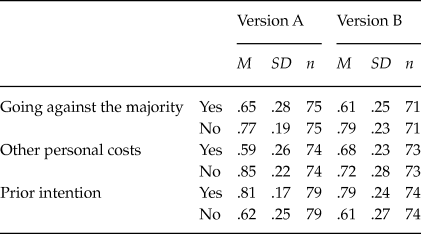
In order to determine whether or not the experimental manipulation had worked as expected, the effect of the variables going against the majority, other personal costs and prior intention on prosocial behavior was analyzed. To this end, we compared the proportion of “would help” responses (a) in situations in which helping involved going against the group majority and in those in which it did not, (b) in situations which involved a personal cost of some other kind and in those which did not, and finally, (c) in situations in which the behavior was the result of a prior intention and in those in which it was not. Thus, three analyses of variance were conducted, each one to analyze the effect of one of the within-subjects factors manipulated (going against the majority, other personal costs and prior intention), as well as the between-subjects variable version of the test (A or B). The results are presented in Table 1.
Means and Standard Deviations in the Proportion of Prosocial Behavior by the variables Going Against the Group Majority, Other Personal Costs and Prior Intention

As expected, in the first ANOVA, the main effect of the factor going against the group majority was significant, F(1, 144) = 37.97, p < .001, η2 = .209; the main effect of the factor version of the test was not, F(1, 144) = .30, p = .585, η2 = .002, and nor was the interaction effect, F(1, 144) = 1.65, p = .202, η2 = .011. When helping involved going against the group majority, the proportion of “would help” responses was significantly lower. In the second ANOVA, the main effect of the factor other personal costs was also significant, F(1, 145) = 33.55, p < .001, η2 = .188; the factor version, however, was not, F(1, 145) = .42, p = .518, η2 = .003. The interaction effect was significant, F(1, 145) = 16.62, p < .001, η2 = .103. In both versions, when helping involved a personal cost, the proportion of “would help” responses was lower than when it did not. Nevertheless, and given that the interaction effect was statistically significant, it is worth mentioning that while this difference was fairly large in version A, it was smaller in version B.
These results are interesting in themselves, since in accordance with prior studies, they show that prosocial behavior decreases when the action in question involves going against the group majority (Etxebarria & De la Caba, Reference Etxebarria and De la Caba1998; Staub, Reference Staub1989) or when it exacts some other kind of price (Eisenberg et al., Reference Eisenberg, Fabes, Miller, Fultz, Shell, Mathy and Reno1989; Etxebarria & De la Caba, Reference Etxebarria and De la Caba1998). However, they also indicate an effective manipulation of these two variables in the study.
Finally, in the third ANOVA, the main effect of the factor prior intention was also significant, F(1, 151) = 57.81, p < .001, η2 = .277; the main effect of the factor version was not, F(1, 151) = .52, p = .472, η2 = .003, and nor was the interaction effect, F(1, 151) = .02, p = .893, η2 = .001. When helping involved a prior intention, the proportion of “would help” responses was significantly higher than when it was not.
Effect of the Variables Going Against the Majority, Other Personal Costs and Prior Intention on Moral Pride
As stated above, the aim of our study was to analyze whether moral pride differs in accordance with whether or not the action in question involves going against the group majority, a personal cost of another kind or a prior intention. To this end, an analysis of variance was conducted to determine the effect of these three within-subjects factors, along with the between-subjects variable version of the test, on moral pride.
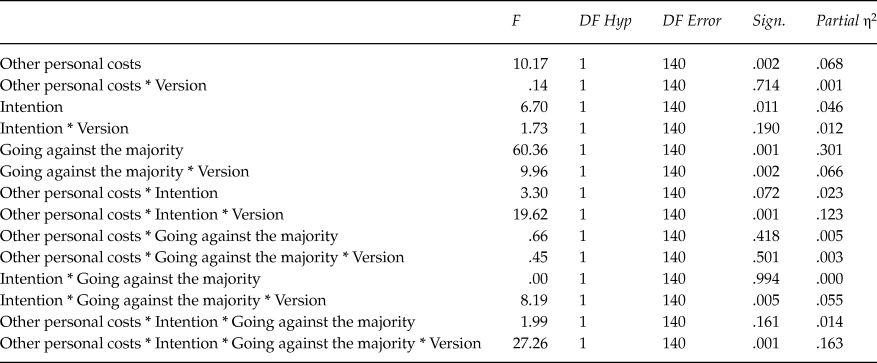
The main effect of the between-subjects factor version of the test was not found to be statistically significant, F(1, 140) = .05, p = .825; its effect size was η2 = .001. We cannot, therefore, talk about general differences between version A and version B of the test. We can conclude that in general, both versions are equivalent as regards the pride they generate, although in one or various situations differences may appear between the moral pride generated by the specific scenario described in the different versions (A and B).
Table 2 shows the main effects of the within-subjects factors going against the majority, other personal costs and prior intention, as well as the interactions between them and with the between-subjects factor version of the test. As shown in the table, only interactions (be they first, second or third level) which include the factor version of the test are statistically significant (although not all interactions involving this factor are). None of the interactions which do not include the factor version of the test are statistically significant. This contrast, along with the fact that the main effect of the factor version of the test was neither statistically significant nor substantial, leads us to conclude that those interactions which include the factor version of the test are explained by the instability which is necessarily introduced by the specific content of each scenario. All scenarios which aim to be true to life inevitably reflect or evoke more factors than those contemplated in the design of any study.
Main Effects on Moral Pride of the Within-subjects Factors Going Against the Majority, Other Personal Costs and Prior Intention, and Interactions between them and the Between-Subjects Factor Version of the Test

The effects of those interactions which include the factor version of the test indicate inter-scenario instability which, once controlled, enables a better assessment of the main within-subjects effects and their possible interactions. We shall now examine these effects in more detail.
As shown in Table 2, the main effect of the factor other personal costs was statistically significant, with a considerable effect size (η2 = .068), that was higher than that found in meta-analytical studies on related themes (Richard, Bond, & Stokes-Zoota, Reference Richard, Bond and Stokes-Zoota2003). Therefore, regardless of the specific nature of each scenario, statistically significant differences were observed between the moral pride generated by actions which involved some kind of personal cost (frustration of plans, dedication of time or effort, etc.) and that generated by those which did not. Curiously enough, as opposed to that predicted by our hypothesis, when helping involved a personal cost of some kind, the moral pride generated was found to be lower (M = 5.07, SD = 1.03) than when it did not (M = 5.32, SD = 1.03). However, the most striking and powerful effect was found in the factor going against the group majority (η2 = .301). Consistent with the previous result, when helping involved going against the group majority, the moral pride generated was found to be lower (M = 4.90, SD = 1.04) than when it did not (M = 5.49, SD = .99).
Finally, the main effect of the prior intention factor was also found to be statistically significant, although of a more moderate size than in the case of the two previous factors (η2 = .046). The “would help” responses that involved a prior intention generated more pride (M = 5.30, SD = .99) than those that were the result of a mere spontaneous reaction to the immediate situation (M = 5.09, SD = 1.06).
Nevertheless, in the analysis described above, all moral pride responses were taken into consideration, i.e. both those in which the subject had previously stated that they would in fact help (pride resulting from the action one believes one would take) and those in which the subject had previously stated that they would not help (pride resulting from carrying out an action which in reality, one is unlikely to take). In both cases, the responses given were in relation to hypothetical situations, but even so, it seems worthwhile to distinguish between them.
In this study, our main interest was in analyzing the first type of pride. Thus, a more specific analysis was carried out to determine whether the pride felt as the result of an action taken (or to be more exact, as the result of an action one believes one would take) differs in accordance with the factors going against the group majority, other personal costs and prior intention. To conduct this analysis, we first created the following within-subjects variables: Pride resulting from actions involving going against the majority, Pride resulting from actions not involving going against the majority, Pride resulting from actions involving a personal cost of another kind, Pride resulting from actions not involving a personal cost of another kind, Pride resulting from actions prompted by a prior intention and Pride resulting from actions not prompted by a prior intention. Each of these variables was the mean of the scores for pride in the corresponding situations in which the subject had previously stated that they would in fact help, providing always that the respondent stated they would help in at least 2 of the 4 possible situations given. Once this set of variables had been created, three ANOVAs were conducted, each one to analyze the effect of one of the within-subjects factors (alternatively going against the group majority, other personal costs and prior intention), as well as the between-subjects factor version of the test.
In the first ANOVA, the main effect of the factor going against the group majority was significant, F(1, 109) = 11.28, p = .001, η2 = .094; the main effect of the factor version of the test was not, F(1, 109) = .001, p = .948, η2 = .001, and nor was the interaction effect F(1, 109) = 1.14, p = .287, η2 = .010. The level of moral pride resulting from the action the respondent believed they would take was lower when the action in question involved going against the majority (M = 5.46, SD = 1.02) than when it did not (M = 5.70, SD = .99). In the second ANOVA, the main effect of the factor other personal costs was not significant, F(1, 116) = .01, p = .910, η2 = .001; nor were the main effect of the factor version of the test, F(1, 116) = .17, p = .681, η2 = .001, or the interaction effect, F(1, 116) = .11, p = .739, η2 = .001. Similarly, in the third ANOVA, the main effect of the factor prior intention was not found to be significant F(1, 117) = .12, p = .733, η2 = .001; nor were the main effect of the factor version of the test F(1, 117) = .33, p = .568, η2 = .003, or the interaction effect, F(1, 117) = 1.85, p = .177, η2 = .016. Therefore, in the case of pride resulting from positive actions which the subject believes they would in fact take, the only factor found to be significant was going against the group majority. The effect size in this case was lower than in the previous analysis, although still notable.
Although it was not strictly the initial aim of the study, we nevertheless decided it would be interesting to explore which of the two types of pride described earlier (pride resulting from the action one believes one would take, and pride resulting from an action that, in principle, one would probably not be prepared to take) was more intense.
As seen earlier, a significantly higher proportion of adolescents said that they would not help when helping involved going against the group majority or when it involved a personal cost of another kind. Bearing this in mind, it would be logical to assume that although they would not be prepared to take certain action due to the problems and personal costs involved, they nevertheless believe that if they did, they would experience a particularly intense feeling of pride, precisely because said action was more costly and less common. But is this really the case?
To answer this question, an ANOVA was conducted to analyze the within-subjects differences between pride resulting from situations in which the respondent said they would help and pride resulting from situations in which they said they would not help. The ANOVA also included the between-subjects variable version of the test. This analysis revealed a significant main effect of the within-subjects factor, F(1, 101) = 87.33, p < .001, η2 = .464; the main effect of the between-subjects factor version of the test was not found to be significant, F(1, 101) = .04, p = .842, η2 = .001; nor was the interaction effect F(1, 101) = .58, p = .449, η2 = .006. Pride in situations in which respondents said they would help (M = 5.45, SD = .88) was significantly higher than the pride they said they would feel if they helped in those situations in which they had previously stated that they would not help (M = 4.36, SD = 1.23).
Discussion
The aim of this study was to analyze which types of action generate a greater degree of moral pride. Specifically, three factors were analyzed: whether or not the action involved going against the group majority, whether or not it involved a personal cost of a different kind, and whether or not it was the result of a prior intention. The analyses carried out provided fairly surprising results.
Our initial assumption was not borne out by the results. Indeed, the results obtained seem to suggest that the opposite is true. Thus, it was observed that, rather than generating more moral pride, hypothetical prosocial behaviors that involved going against the group majority or a personal cost of a different kind led to lower levels of anticipated moral pride. Although it seems logical to assume that these behaviors (which are harder by definition and therefore less frequent, as the data indeed confirmed) would be considered more meritorious and would result in a greater degree of pride, in fact, our results indicate just the opposite. How should we interprete these results?
The fact that behaviors which involve going against the group majority fail to generate more pride, although at first seemingly illogical, was not, to a certain degree, entirely unexpected. As stated in the introduction, pride depends greatly on other people’s judgment (Ben-Ze’ev, Reference Ben-Ze’ev2000; Webster et al., Reference Webster, Duvall, Gaines and Smith2003). Bearing this in mind, it may be that the positive effect on moral pride of the fact that the prosocial behavior involves going against the group majority (thereby rendering the action more meritorious) is cancelled out by a fear of being criticized and rejected by the group. However, what we see here is that an expectation of outside criticism can totally reverse the relationship which one might expect to find between the prosocial action which involves going against the group majority and moral pride. Therefore, our data suggest that the importance of external judgment in moral pride is much greater than has habitually been supposed.
Any interpretation of these results, however, should take into consideration the characteristics of the developmental stage being studied. From an adaptive perspective, integration into the peer group is adolescents' principal task; it is an investment for the future, since once outside their family, young people’s main relationships are established with others of the same or similar age. Consequently, interest in peer acceptance and approval is more intense during adolescence than in any other stage of life. Another factor which contributes to this is the changes which take place in the social-emotional system of the adolescent brain, in which a significant increase of oxytocin receptors occurs. Oxytocin increases trust-related behaviors towards members of the social group (Kosfeld, Heinrichs, Zak, Fischbacher, & Fehr, Reference Kosfeld, Heinrichs, Zak, Fischbacher and Fehr2005), activity in the lateral and dorsal regions of the amygdale following exposure to positive social cues (Gamer, Zurowski, & Büchel, Reference Gamer, Zurowski and Büchel2010) and the salience of social information of close or reliable others (Bartz, Zaki, Bolger, & Ochner, Reference Bartz, Zaki, Bolger and Ochsner2011). Oxytocin is a key hormone for social bonding, which increases peer attraction and the gratifying power of social recompense within the peer group (Steinberg, Reference Steinberg2008). However, the price of peer group approval and acceptance is conformity with its values, interests and behaviors (Allen et al., Reference Allen, Porter, McFarland, Marsh and McElhaney2005). This would explain not only the lower frequency of prosocial behavior if said behavior went against the group, but also the lower levels of pride generated as a result since, as stated above, in pride the opinion and assessment of the audience (be it real or imaginary) is essential. However, during the course of adolescence, as the connections between cortical and sub-cortical areas improve, there is a considerable increase in resistance to peer influence. It would be interesting to analyze the effect of the variable going against the majority on moral pride in an older age group.
Even more surprising than the previous finding were the results obtained for the variable other personal costs. This result (less pride generated by prosocial behavior which involves a personal cost) is consistent with that found in the study by Kornilaki and Chlouverakis (Reference Kornilaki and Chlouverakis2004). As stated in the introduction, these authors found that children attributed less pride to the main character of a series of situations in those situations which involved a personal cost than in those which did not. However, it is important to remember that the aforementioned study focused on a sample group of 7-to-11 year olds. We assumed that, once individuals had reached adolescence, the strong influence of interest in personal benefit on moral judgment and subsequent emotions would have lessened somewhat and subjects would hold more costly prosocial behavior to be more meritorious, and therefore more likely to generate a greater degree of pride. The result obtained, which contradicted this hypothesis, may be explained by the fact that the majority of the adolescents in the sample group were still at stage 2 of moral judgment (Kohlberg, Reference Kohlberg1984), in which moral judgment is strongly influenced by concern over one’s own interests and the consequences of one’s behavior for oneself. However, other interpretations are also possible. Thus, it may be that, in general, for the majority of individuals (not just for those at stage 2), the fact that the behavior in question involves a personal cost is a negative, frustrating element which undermines the positive feelings (due to the positive action) which are a key part of the experience of pride. Alternatively, it may also be that this phenomenon is related to the characteristics of Western culture, a culture which is increasingly hedonistic and which values effort (an aspect which, at least in Spain, was of major importance until just a couple of decades ago, and which was often considered a value in itself) less and less highly (Inglehart & Welzel, Reference Inglehart and Welzel2005; Verdú, Reference Verdú2005). These interpretations, which are not necessarily mutually exclusive, open up interesting areas of exploration for future research.
Finally, as regards the type of variables which generate a greater degree of pride, the results revealed that prosocial behaviors which are a response to a prior intention generate more pride than those which are mere spontaneous reactions to the demands of the immediate situation. Unlike the previous results, this finding coincided with our expectations. However, bearing in mind that, according to our analyses, prosocial behaviors with no prior intention are less frequent, this result is also consistent with the results obtained for the previous two variables. The same pattern of response can be observed in all three cases: in general, adolescents feel less moral pride in connection with actions which are less common amongst them. This conclusion, which emerges quite clearly, is paradoxical. In principle, the most likely explanation lies with the special influence of the peer group during this developmental stage. However, it may be that the same phenomenon also occurs (to a certain extent at least) in later stages also. This is another question which deserves further analysis in the future.
Whatever the case, what is clear is that our data fail to support the central assumption of the study, i.e. that moral pride is greater when the moral actions in question are more costly, thus helping to bolster specifically those behaviors most in need of support and reinforcement. This claim does not hold true, or at least not in relation to the immediate reaction of pride. Might it be that a greater degree of pride is felt in response to more costly behaviors after a certain time has transpired, once the individuals are no longer in the situation and when both external criticism and the frustrating element involved in other personal costs have disappeared? Experience indicates that this is probably the case, although again, this is a question which requires further empirical research.
The results discussed so far refer to experiences of pride in general, i.e. both pride resulting from an action one would take and pride resulting from an action one would not, in principle, be prepared to carry out. However, we are particularly interested in the first of these here. In the analyses of this first type of pride, only the factor going against the group majority was found to have a significant effect. The size of this effect was smaller than in the previous analyses, although still notable. This result is particularly interesting, since here we were comparing the means for the pride felt after doing something which meant going against the majority and the pride felt after doing something which did not, among participants who had previously stated that they would help in at least 2 out of the 4 cases which involved going against the group majority (i.e. respondents whose answers reflected a fairly high moral level).
Therefore, this factor is vital to understanding the experience of moral pride, at least during adolescence. It seems that, when prosocial behavior involves going against the majority, another psychological element emerges (namely the critical opinion of others) which acts in the opposite way to pride and often tends to generate feelings of shame (Pascual, Etxebarria, & Pérez, Reference Pascual, Etxebarria and Pérez2007; Smith, Webster, Parrott, & Eyre, Reference Smith, Webster, Parrott and Eyre2002).
Although it was not one of the initial aims of the study, we decided it would be interesting to determine which of the two types of pride described above was more intense. In this respect, one might expect the pride felt in the event of doing something one would not, in principle, be prepared to do (probably due to the problems or personal costs involved) to be more intense. However, the results indicate just the opposite: the pride generated by those behaviors which participants said they would be willing to engage in was significantly more intense than that they said they would feel in the event of doing something they felt they would be unlikely to do.
This result, which is clearly consistent with the previous ones, deserves special attention. It suggests that, at least for the majority of adolescents, the motivational element represented by the anticipation of moral pride linked to especially difficult actions is relatively weak. It is doubtful that this anticipated moral pride would have a motivational force comparable to that of anticipated guilt, not only due to its non-aversive nature, but also as a result of its weakness. Nevertheless, this is a question that requires empirical analysis.
This study has certain limitations which should not be overlooked. The first lies in the self-report nature of the data. In future studies, it would be interesting to use autobiographical recall techniques or, better yet, to measure emotional reactions to actual moral action. In relation to the method used here, although every effort was made to control the effect of the specific contents of the situations by having 2 scenarios for each of the combinations of the three variables studied, it would have been better to have had an even greater number of scenarios for each combination. Also, as stated earlier, it would have been a good idea to determine the moral judgment stage of the adolescent respondents. Finally, and again as stated earlier, since the study focused only on adolescents, there is no way of knowing whether the results found are specific to adolescence or general to all age groups, at least in our culture.
Nevertheless, in relation to the possibility of generalizing the results obtained, it is important to bear one aspect in mind. Although older age groups have not been analyzed, it would not be that surprising if the negative effect on moral pride of both factors going against the group majority and other personal costs (although particularly the effect of the first one, which was found to be especially strong) was observed to persist in many adults. However, given that concern over peer acceptance is not as strong as in adolescence (Allen et al., Reference Allen, Porter, McFarland, Marsh and McElhaney2005), it would also be logical to assume that this effect would be weaker in older age groups. This is a hypothesis which deserves to be explored in more detail in the future.
Whatever the case, our results highlight the need to focus on these factors in children’s education. It is important for children to understand that moral action often involves a price, and that one must be prepared to pay that price. They should also understand that moral action sometimes involves separating oneself from, or even going against the group, and that doing this should not generate shame, but should rather be a source of pride. Because pride does not only stem from academic or sporting achievements; it also stems from moral action.
This research project was supported by a grant from the Spanish Ministerio de Ciencia e Innovación (project code: PSI2009–11600).
Scenarios Used
Version A
1. Intention Footnote 1 /against/other cost. The school janitor has been the butt of dirty tricks and practical jokes since the start of the school year. You have joined in too, but one day, as you watch him search nervously and frantically for the keys he accidentally left lying around and which you and your friends hid, you realize that he is really suffering. You could tell him where they are, but you know that he might report you to the principal (for having participated in the “joke”), and what's more, your classmates would be angry with you.
2. Intention/not against/other cost. You're free this weekend and feel like doing something different. One of your friends has been a bit stressed lately and her parents have suggested she go away for the weekend. She probably won’t go though, because the young children she coaches usually have a match at the weekend. You could go and coach them for her. You’d be doing her a real favor and going away would do her good, but it would mean getting up really early at the weekend and having less time for your own plans.
3. Reaction/against/other cost. It’s 8.00 in the morning and you have just caught the bus, along with your classmates, to go to school. In two hours’ time you have a test and you are just having a last look at your notes. An elderly person gets on the bus and starts asking your classmates to let them have their seat, but none of your classmates gives up their seat, and some even start making derisive comments. You know that if you give up your seat, you won’t be able to use the bus journey to study.
4. Reaction/not against/other cost. You want to go and spend the afternoon in San Sebastián and are running to catch the train. It’s raining, and if you don’t make it to the station in time, there won’t be another train for half an hour. On the way you come across an old lady who’s also heading for the station, but she has no umbrella and is getting soaked. If you help her you’ll miss the first train and might not have enough time to do everything you had planned for the afternoon.
5. Intention/against/no other cost. Some months ago a group of immigrants moved into your neighborhood. Among them was a girl who then joined your class half way through the school year. She doesn’t speak your language very well and has definitely not managed to settle down and fit in with her new class. In general, your classmates tend to ignore her (sometimes quite rudely) and no one wants to hang out with her. In your opinion, she is a nice girl who simply hasn't been given a chance.
6. Intention/not against/no other cost. This week you are free in the mornings and could go round to see your grandmother who has been a bit under the weather lately. You are organizing your plans for the week and you know it would make her really happy if you dropped by for a visit.
7. Reaction/against/no other cost. Alejandra is different from the other girls in your class. She is very quiet and tends to get cold-shouldered. When the class splits into working groups, no one tends to choose her, even though she’s not a bad student. One day, you are asked to pick the members of your working group.
8. Reaction/not against/no other cost. You have gone out with your friends and suddenly see a boy who is crying. It looks like he has fallen off his bike and the chain has come off. You’re not in a hurry and could suggest to your friends that you all go and help him.
Version B
1. Intention/against/other cost. There is a new girl in your class, Jaione, who seems a bit odd and spends all day off by herself. Even though they hardly know her, your friends don’t like her and although she might be a bit boring, you think that it might be possible to integrate her little by little into the group.
2. Intention/not against/other cost. You have a friend in your class who is really bad at a subject and this week needs help in the afternoons in order not to fail a re-sit. You always pass this subject and could perhaps give her a hand.
3. Reaction/against/other cost. The other day a group of friends (including you) broke a computer while you were playing football in an off-limits area. Your teacher had seen Pello and Ane (two classmates who often get into trouble) hanging around that particular area. He suspected it had been them and so accused them of breaking the computer. The truth was that it hadn’t actually been them, but you don't really like them (in fact, no one in your class likes them very much) and if you tell your teacher the truth you’ll be punished and what’s more, your friends will be annoyed with you because it’s likely that your teacher will figure out that they were with you too.
4. Reaction/not against/other cost. You see an elderly person who needs help lifting some large suitcases down from the train. You are already late for an important meeting, but you don’t see anyone else on the platform who could help.
5. Intention/against/no other cost. Maider is a girl who has a lot of problems both at home and at school. She has trouble passing exams and finds it hard to make friends in class because her classmates don't like her. You, however, think she is OK. You are planning your birthday party and are thinking about who to invite.
6. Intention/not against/no other cost. You have this afternoon off and your mother has asked you to help her run an errand.
7. Reaction/against/no other cost. Itxaso is a very popular girl in your class. Maialen, on the other hand, has always been a bit isolated. One day, in the school yard, Itxaso, for no apparent reason, starts teasing Maialen and humiliating her in front of everyone. All the other onlookers seem to be backing Itxaso.
8. Reaction/not against/no other cost. You have the morning off and have gone out for a walk. As you walk along the street, you see a girl with crutches and her leg in a plaster cast, carrying a heavy bag. She is having trouble getting around some roadworks. She needs someone to help her carry her bag for a few meters until she can get past the roadworks.