Looking back to his childhood in the 1870s, Harry Menzies nostalgically recounted his participation in events at Exeter Hall in London. Exeter Hall was the focal point for the great English evangelical gatherings of the nineteenth century. For youngsters, it was particularly remembered for the annual juvenile Protestant missionary rallies, begun as early as 1842 and soon replicated throughout Britain in other main centres.Footnote 1 There children were lauded as missionary supporters and exhorted to ever higher levels of commitment to the cause. Harry, however, remembered these meetings in a different light:
Pleasanter in every way were the annual bus-rides … to Exeter Hall, where we invariably arrived early and occupied the front seat of the gallery. What if we didn't listen much to the speeches; what if now and then the loud popping of the cork of a ginger beer bottle interrupted the proceedings and drew shocked glances from our neighbours? [We were] no different from other children in their likes and dislikes, and authorities were tolerant, even though we made the annual meeting one long pic-nic.Footnote 2
The intensity of these meetings notwithstanding, accounts of juvenile missionary support from across British worldFootnote 3 settings highlight children's missionary support as a simultaneous site of philanthropic endeavour, intensive recruitment of hearts, minds and bodies for the missionary cause, socialization and great fun. The enduring image is that children primarily collected and gave money. Yet, as Francis Prochaska notes, Exeter Hall meetings were also a reminder that ‘raising money and saving heathens was only one side of the children's missionary movement’. Equally important was the focus on the ‘minds of the young’ wherein ‘“training” became the watchword’.Footnote 4 A Baptist writer captured this dual philanthropic and pedagogical imperative when he argued that ‘the passing of the missionary box must never be a mere formality. It should always be the occasion of some little word that shall increase knowledge, create enthusiasm, renew devotion, and stimulate generosity.’Footnote 5 Across the nineteenth and twentieth centuries, philanthropic ventures and movements were ubiquitous and complex sites of children's and young people's religious identity formation, as recent scholarship attests.Footnote 6 As Brian Stanley notes, however, over the longer term ‘the allure of children's money-raising power’ proved too powerful.Footnote 7 Consequently, both in historical and historiographical terms, the financial aspect has taken centre stage.
This article draws more explicit attention to the broader significance of children's missionary support, by focusing primarily on the ways that the relationship between children and young people,Footnote 8 pedagogy and missions emerged in Protestant rhetoric. It argues that the children's missionary movement was educational at heart, and that in it philanthropy and pedagogy went hand in hand. In particular, over the long nineteenth century all the players consistently emphasized the importance of nurturing a ‘missionary spirit’, a notion that was primarily religious in its intent but which in practice moved from pragmatic philanthropy to a more formalized emphasis on education and identity formation. The article introduces representative ways by which this was articulated, drawing on examples from a range of British world contexts in which Protestant children (white or settler and indigenous) were engaged educationally and philanthropically in very similar ways. It acknowledges that for these settings scholarship to date has tended to evaluate educational impact in terms of philanthropy, socialization, social class relations and the formation of racial or imperial attitudes.Footnote 9 By way of conclusion it also suggests that, looked at from a more specifically educational angle, children's missionary support fitted into particular national or denominational agendas, conflated civic and religious identity (especially in the context of empire and colonialism), and set children in imperial or quasi-global networks of information exchange.
Education and Children's Missionary Support: An Evolving Relationship
Children had been actively recruited as home-base supporters within the British missionary movement from the first decade of the nineteenth century, but especially from the 1840s onwards, with more systematic organization and the emergence of monthly periodicals. On the surface the financial element certainly dominated representations of the movement. In 1917 Constance Padwick,Footnote 10 a Church Missionary Society (CMS) missionary, writer and editor, noted in a historical review of British children and missions that this emphasis possibly dated back to the 1830s, which she labelled the ‘decade of the discovery of children's halfpence’. She suggested that an ‘examination of the story of the missionary societies during the [eighteen-] thirties leads to the conviction that missionary committees had discovered not children but a copper-mine’.Footnote 11 This motif has cast a long historical shadow, bolstered in part by extant financial statistics that indicate the relative importance of juvenile giving for English Protestant denominations in general, and missionary societies in particular.Footnote 12 Yet there was another dynamic at work. By the time of the 1910 World Missionary Conference, missionary and denominational thinkers had felt the need to re-emphasize the ‘imperative importance of interesting the boyhood and girlhood of the churches in the work of foreign missions’, lamenting that the ‘present inability and ineffectiveness of the Church, in view of her great opportunities, is directly traceable to the lack of any policy of missionary education of her children in the past’. Therefore attention needed to be given to ‘the study of the child and the laws of education’.Footnote 13
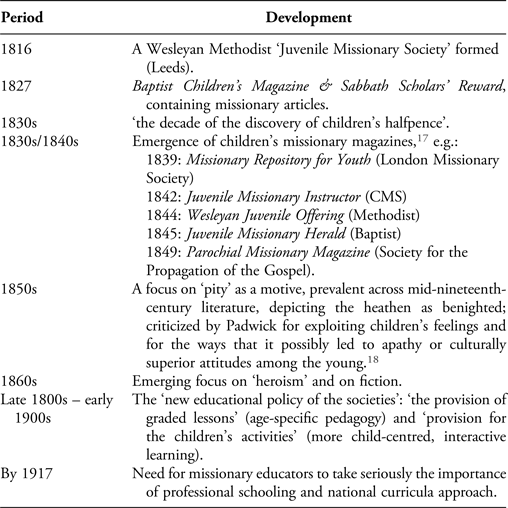
Padwick was the first to stand back and assess the British movement over a longer historical trajectory. Her genealogy of juvenile support is instructive for this article in terms of the ways that educational elements were implicitly, explicitly and continuously present (Table 1). Furthermore, educational and religious developments from the late eighteenth century onwards together acted as important precursors for the juvenile moment of the 1830s and 1840s. In particular, Padwick referenced new educational philosophy and practice, represented by the early Madras and Lancasterian schooling systems, by Rousseau and by Pestalozzi, as well as contemporary evangelical revivalism's emphasis on childhood as the key developmental stage for taking ‘increased responsibility … for [the] personal use of privileges’.Footnote 14 She finished with a pointed observation, reflecting the same concerns expressed by the report of Edinburgh's Commission VI on the ‘Home Base of Missions’:
So we stand in 1917, heirs of the past with its triumphs and its mistakes, and we look for the next step in the way of God. … And we missionary folk stand convinced that Christianity, as taught to the children and as practised in the nation, has been robbed of force and motive power by the strangely general omission of its missionary bearing, its missionary ideals and its missionary demands.Footnote 15
Genealogy of British Children's Missionary Support to 1917

Source: Padwick, ‘Children and Missionary Societies in Great Britain’.
In Padwick's estimation, education was central for the relationship between children and missions. Beyond her analysis, a longer and wider reading of the movement reveals that this was in fact acknowledged throughout the nineteenth century. In the first instance the responsibility for this was often more located in the Christian home, where parents, not clergy or teachers, were expected to take primary responsibility. North American Baptist Revd Dr Smyth argued vociferously in 1846 that the ‘missionary spirit of a family, and through it of the church, (which is composed of families,) is the greatest moral agent, under God, by which the Gospel is to be diffused’. Parents should be exemplars to their children in both what they believed about and what they did for missions, especially through their ‘example, reading, conversation, prayers, and conduct’.Footnote 16 This was a long-lived sentiment, which constituted an ongoing point of tension between those who saw the home as the centre of informal education and those who emphasized an institutional approach. As the century progressed however, this latter conviction prevailed, as church-based education for the young became formalized and professionalized through the Sunday school movement in particular.Footnote 19 By the first decade of the twentieth century, in many Protestant contexts the Sunday school and the youth-orientated Bible class had become the expected institutional homes for missionary support. Edinburgh's Commission VI, referring to various North American settings, noted that the Sunday school movement offered a ‘unique opportunity’ in terms both of ‘what it can do for missions’ and of ‘the effect of this work of education on the Church of the future’.Footnote 20 Moreover, by the early 1900s Anglo-American Sunday schools were well established as ‘primary sites for missionary propaganda’ and as ‘an important source of missionary funding’. Indeed, across nineteenth-century British world settings they had become the ‘single largest source of information about what foreign people were like’.Footnote 21 As such, they were important sites of attitudinal formation with respect to the wider world, albeit increasingly supplanted by state-run schools in this respect from the early 1900s, with the implementation of compulsory education and its attendant pedagogical paraphernalia.Footnote 22
Fostering a ‘Missionary Spirit’
A long-running historical and pedagogical motif was that of fostering a ‘missionary spirit’ among children and young people. Although Padwick did not explicitly use this phrase, she alluded to it, suggesting that early nineteenth-century writers had missed a vital connection: ‘what is absent to an astonishing degree is the connexion between the child's gift and the Lord. The giving of the missionary penny seems hardly ever treated as an act of worship, a personal transaction between the little child and God.’ She went on to suggest that this had changed: ‘we to-day must be grateful to the Sunday school reform movement for making the child's offertory a great moment with its song and prayer’.Footnote 23 The notion of fostering a missionary spirit was in essence an educational ideal, indicating that missionary support was primarily a spiritual act, but one that needed adult intervention and support. Three examples drawn chronologically from the period are indicative of how this idea became wedded to institutional expressions of religious childhood, and more specifically to children's education and the formation of juvenile identity.
In the first instance, missionary spirit was a concept applied equally to Protestants of all ages, as made abundantly clear by Revd T. B. Whiting (CMS) at the 1860 Liverpool Missionary Conference.Footnote 24 He held that having a missionary spirit transcended ‘that cold acknowledgment of the duty which unlocks the purse at stated intervals’; rather, it marked out individuals who took ‘such an interest in the cause as will ensure self-denial in its behalf’.Footnote 25 This could only be the profound product of ‘divine grace’. As such, the existence of a missionary spirit depended upon ‘the number of truly converted hearts’ and therefore upon the degree to which ‘true religion’ (that is ‘all that tends to excite and maintain a spirit of vital godliness and living faith’) gripped those in the churches.Footnote 26 One state of being could not exist without the other. At the same time, as with ‘every other Christian grace’, he also argued that the missionary spirit needed ‘to be fostered in the hearts of God's people’.Footnote 27 To achieve this, he presented a twenty-point strategy, which included gaining information; subscribing to and studying newspapers, periodicals, books and pictures; attending meetings and lectures; and belonging to organized groups.Footnote 28 Whiting noted briefly that ‘Juvenile Associations are especially important, not only on account of the large sums they produce, but also because they early enlist the sympathies of the heart.’Footnote 29 In these terms, while there was in the 1860s a clear association between children's support and institutional organization, more important was the conviction that genuine juvenile engagement should be predicated on an internal dynamic that was both intellectual and emotional. Reference to the ‘sympathies of the heart’ presumed a prior reorientation of that ‘heart’ away from self and towards a higher set of priorities, nurtured through organizational involvement, among other things.
While Sunday schools were not specifically referenced in this rhetoric, by the 1880s they were clearly on the agenda (reflecting their increasingly important presence across British world settings), and their role in nurturing a changed juvenile ‘heart’ was more clearly delineated. This is evident in the second example, drawn from an address by the Northern Irish Presbyterian minister Rutherford Waddell to southern New Zealand Sunday school teachers in 1883.Footnote 30 Talking on ‘The Sabbath-School and Missions’, he laid out a strong case for the Sunday school as a prime site of missionary spirit formation. By this stage, across the British world, Sunday schools were a well-established component of colonial Protestant religion, drawing on increasing numbers of settler children across the denominations as well as being a key tool in missions among indigenous children.Footnote 31 Yet Waddell suggested that missions were not yet seriously on Sunday school agendas, a situation he viewed critically, making clear that this had to change. Reflecting a commonly held view, he argued that Sunday school children were the church of the future; they would ‘take our place and carry on Christ's work when we are gone’, including the primary task of missions which lay at the heart of the church's identity and purpose.Footnote 32 Therefore shaping young minds and lives was a foundational task. Like Whiting, Waddell perceived that a ‘missionary spirit’ could not be imposed but instead emanated from a more profound formation of Christian character, best done during childhood. He remonstrated that:
We know the truth of this in regard to everything else – in regard to conversion, to virtue, &c. We know the value of teaching youth to be truthful, honest, pure. We know that if childhood is allowed to pass without its being taught these cardinal virtues, it is vain to begin it when character is formed. And so of the missionary spirit. Do we believe that a missionary spirit is an essential element of Christian character? Then the time, and I would say the only time, to create such a spirit is in youth. It is perfectly futile to expect a missionary spirit in the Church, if the seeds of it have not been sown in the Sabbath-schools, which are the nurseries of the Church. Hence the duty and responsibility of giving missions a prominent place in Sabbath-school teaching.Footnote 33
Waddell did not presume to delineate or impose a curriculum. However, he strongly suggested that for a missionary spirit to be awakened, there were some key provisos. Firstly, teachers themselves needed to be thoroughly ‘possessed’ with this same missionary spirit, so that children would imbibe their teachers’ ‘enthusiasm’ for missions.Footnote 34 Secondly, financial considerations must be secondary at best. Through their own enthusiasm teachers should focus on ‘filling the child's soul with the Spirit of Christ. If you can do that, then the rest will follow as certainly as the waters pour out when you lift the sluice; but if you do not do that … you degrade the great principle of Christian liberality.’ Finally, teachers should do two things: ‘teach the children to have wide sympathies’ and ‘teach them the joy and heroism of doing good’.Footnote 35 Sunday schools were free to implement all manner of strategies, projects and plans, but needed to be shaped by, or based upon, a more profound rationale.
Waddell's speech was made in the context of a missionary movement full of late nineteenth-century bravado, yet to sense any crisis looming on the horizon, and it was directed at a burgeoning children's religious movement still edging its way towards organizational sophistication. The third and final example, drawn from the early twentieth century writing of American missionary statesman John R. Mott, indicates that by then the connection between missions and Sunday schools had become much more finely drawn. Writing in 1904, foreshadowing issues to be raised again at the 1910 conference, Mott sketched out programmatically a systematic educational schema for fostering a juvenile missionary spirit.Footnote 36
Like Waddell, Mott understood the imperative importance of engaging childhood and youth as key stages of faith and character formation, arguing that if ‘for twenty or even fifteen years the young people of Christendom could be interested and properly instructed in missions the whole Church would be filled with the missionary spirit’.Footnote 37 Sunday schools were pivotal sites from which this ‘spirit’ could have an increasingly pervasive influence, both on other church-centred juvenile or youth organizations and on individuals as they developed in their faith. Drawing on contemporary Canadian and American examples, Mott focused pragmatically on appointing Sunday school missionary ‘officers’, systematic planning, structured programmes with children and young people's different developmental stages in mind, regularly timetabled missions-focused slots, manuals and training for teachers and collections of missionary-focused books in Sunday school libraries.Footnote 38 At the same time these elements could not be separated from the wider life of the church. Clergy should play a pedagogical role by emphasizing two things. Firstly, preparing children and young people for communicant membership (a ‘serious and impressive occasion’) was strategically significant, for during this preparation the minister could exert ‘a deep missionary influence on young people’, complementing what had been learnt and imbibed through both their formal and informal education.Footnote 39 Secondly, Mott suggested that the minister should also ‘seek to influence parents … to be willing to facilitate their children devoting themselves to the service of Christ either at home or abroad’. In particular, ‘the spirituality of the home’ remained central to the ‘development of missionary spirit and purpose in children’.Footnote 40 In both cases Mott drew upon his broad reading of missionary and other Christian exemplary biographies. Overall, he saw home and Sunday schools together as critical for forming young Christians characterized by ‘right habits of giving to missions, praying for missions, and working for missions’.Footnote 41
From the 1900s onwards, although the home remained important, missions were systematically and more comprehensively built into Sunday school and Bible class syllabi and programmes. Informed missionary support (financial and emotional) effectively became institutionalized across a broad range of British world and American settings. National denominational and international transdenominational teaching materials included a regular and carefully thought out regime of mission-oriented lessons, ideas and resources. Denominational magazines likewise carried regular missionary-focused materials and reports, supported in most cases by dedicated missionary magazines for the young, published by missionary or women's committees, which often acted as proxy curriculum resources, drawn upon by Sunday school teachers and missionary group leaders alike. These were not one-offs; rather, as for example in the case of the late 1920s American Southern Baptist magazine World Comrades, they provided week-by-week programmes of teaching and learning that potentially eased the load of teachers.Footnote 42 While the focus was on offering systematic pedagogical materials, the underlying concern of fostering a missionary spirit remained central. As Southern Baptist children were reminded at Christmas 1927:
China is but one of the nations of the world and there are millions of people who cannot keep Christmas because they have not heard the announcement of the angels. … Let us be so full of Christ in our hearts at Christmas that we will care about all the others in the world and will love them and pray for them. CHRIST-MAS – cherish the day, Comrades, slip away from the tissue paper and tinsel, the new toys and the frolic and tell Jesus you are grateful for Christmas, pledge him all the room in your heart that he wants and needs.Footnote 43
Historicizing Children's Religion
The relationship between children and religion is currently opening up as an important area of scholarly interest and public debate, with dual attention given to constructions or representations of childhood and to children as religious actors or agents.Footnote 44 The historical question of children's religion is a complex subject in which we find ‘complex counterpoints of ecclesiastical prescription and practice, of parental love and fear, and … on the part of children themselves, of passivity and active appropriation’.Footnote 45 For the nineteenth and twentieth centuries, education and philanthropy were key sites wherein Protestant children imbibed, responded to and acted out religious beliefs and ideals, and children as ‘missionary supporters’ were an important expression of this. As has been seen here, moreover, the result was more than the finances raised. As previewed in Prochaska's writing during the 1970s and 1980s,Footnote 46 educational intent is an important lens through which to achieve a more nuanced understanding of juvenile religious philanthropy. Missionary philanthropy was certainly a prominent extrinsic activity that highlights the progressive ways in which the churches’ young were increasingly seen as strategic religious and public actors. Philanthropy was therefore significant for juvenile religious and identity formation and helped in their integration into emotional-theological communities that valued participation and service,Footnote 47 albeit for reasons that varied across time and place. At the same time, as exemplified in the example of Rutherford Waddell, these communities emphasized broader notions of children as pre-adults; missionary support helped to orient their thinking towards the kinds of citizens they might be as adults and, specifically, encouraged them to think about future missionary service as a vocation and career.
This focus on the centrality and intentionality of the educational factor therefore helps to take us beyond mere pounds, shillings and pence (as important as these were), to tease out the wider significance of the children's missionary support movement across Protestant settings. To date, perhaps, this has been best done for English contexts. Prochaska, for example, helpfully suggests that the nineteenth-century children's missionary movement opens up the opportunity to think further about changing conceptions of childhood, the nature of children's recreation and ‘the power of the missionary societies to form racial and cultural attitudes in the young’.Footnote 48 Likewise, we now have a very clear sense of the ways in which Sunday schools and missionary education were important for working-class religion and imperial engagement.Footnote 49 However, these remain somewhat speculative or are limited to particular denominations, leaving room for more finely grained and comparative research. Moreover, they are English- or British-centred and thus reflect specificities of time and place that may or may not pertain more broadly.
By way of conclusion, when the wider British world is considered from an educational angle, at least two further observations can be made that indicate fruitful avenues for further thinking. Firstly, this approach provides an interesting opportunity to consider the connections between children as missionary supporters and as consumers of material culture. Across the spectrum of national contexts, children, through the missionary movement and Sunday schools, interacted with a range of material culture in a way that was broadly educative and significant up to the late nineteenth century, when compulsory schooling was introduced more comprehensively. Periodical literature emerges as a significant element in this process and was, by the early 1900s, a well-entrenched element of children's missionary support. This too can be approached from two angles. On the one hand missionary magazines for children can be considered as part of a wider global or imperial circulation of goods, ideas and information, through which children were informed and developed ideas about the wider world from shared texts.Footnote 50 On the other hand this literature gave power to children's agency as interactive readers and missionary participants.Footnote 51 Periodicals called for a response from juvenile readers, provided a vehicle for them to participate in missionary support, gave them a public voice, helped to develop the emotional-theological communities noted above and possibly bolstered hierarchical views of their relationship to other children (especially in non-European or non-Christian settings).
Secondly, an educational focus highlights how the children's missionary movement was constitutive of juvenile citizenship, variously defined as religious, civic and imperial. This, while focused on the ‘religious’, often in reality led to the conflation of imperial and religious identity for children and young people, possibly reinforcing identities predicated on dualistic notions of ‘them’ and ‘us’ in terms of attitudes toward non-Western children. Heavenly citizenship was a consistent thread across the decades under study, but how that was conflated with other civic notions changed noticeably. In essence children might be seen as ‘global citizens’, but what that meant changed over time. Up to and including the First World War, such notions were demonstrably connected to imperial citizenship and varying notions of the ‘nation’, although this connection was accentuated more in some settings (Canada and Scotland) than in others (New Zealand). Missionary rhetoric and pedagogy also helped to cement stronger and more cohesive denominational identities and loyalties. In the inter-war decades, however, that began to change. Imperial and wartime language was co-opted within the religious discourse of a ‘higher imperium’ involving a primary allegiance to God. Furthermore, citizenship was reconstructed in the light of peace movements and the League of Nations, with a more pronounced emphasis on the ‘brotherhood of man’. In the longer term, in the years immediately following the Second World War, upholding democracy became an important motif, as missions began to be constructed more in terms of partnership than of paternalism. Thus the missionary movement that embraced and activated large numbers of British world children and young people contributed to collective and individual identities as much as it became a treasure trove of the church. Character and identity formation, spirituality, finance and citizenship emerge as significant outcomes of an enduring feature of juvenile Protestant religion spanning the late nineteenth and early twentieth centuries.