I. SETTING THE SCENE
Nero was at Naples, happily engrossed in his vocal exercises, when he learned of the revolt of Julius Vindex, the governor of Gallia Lugdunensis, in March a.d. 68.Footnote 1 At first, Suetonius reports, the emperor remained ostensibly unmoved by the news, uninterested even; indeed, for eight whole days, he simply ignored the crisis, secluding himself in the local gymnasium. But his demeanour changed drastically when he received a proclamation from Vindex heaping scorn on his family name and disparaging his ability as a lyre-player.Footnote 2 This was, for Nero, an insult too grievous to bear. He hurried back to Rome in a fit of frenzy and summoned a meeting of the imperial council in his newly built palace, the Domus Aurea.Footnote 3 The councillors nervously assembled in anticipation of a formal briefing. But, as it turned out, the emperor was in no mood to talk politics (Suet. Ner. 41.2):
ac ne tunc quidem aut senatu aut populo coram appellato quosdam e primoribus uiris domum euocauit transactaque raptim consultatione reliquam diei partem per organa hydraulica noui et ignoti generis circumduxit,Footnote 4 ostendensque singula, de ratione et difficultate cuiusque disserens, iam se etiam prolaturum omnia in theatrum affirmauit, si per Vindicem liceat.
Not even then did he convene a public meeting of the Senate or the people, but called a few of the leading men to his palace and, after holding a brief conference, spent the rest of the day guiding them through some water-organs, of a new and unknown kind, showing them off one by one and lecturing on the workings and difficulty of each; he even promised that he would exhibit them all in the theatre—with Vindex's permission.
The epitomator of Cassius Dio preserves a different account of the same episode (Cass. Dio 63.26.4–5):
νύκτωρ ποτὲ τοὺς πρώτους τῶν βουλευτῶν καὶ τῶν ἱππέων ἐξαπίνης σπουδῇ, ὡς καὶ περὶ τῶν παρόντων τι κοινώσων σφίσι, μεταπέμψας “ἐξεύρηκα” ἔφη “πῶς ἡ ὕδραυλις” (αὐτὸ γὰρ τὸ ῥηθὲν γραφήσεται) “καὶ μεῖζον καὶ ἐμμελέστερον φθέγξεται.” τοιαῦτα μὲν καὶ τότε ἔπαιζεν.
One night he suddenly summoned the foremost senators and equestrians as a matter of urgency, as if to make some communication to them regarding the present situation, and then said to them (I quote his exact words): ‘I have discovered a way by which the water-organ will produce louder and more tuneful music.’ Such were the games he played even at that time.
As the days and weeks wore on, Nero's obsession with the organ showed little sign of wavering. It would be only a matter of time, Nero thought, until the renegade Vindex and his Gallic insurgents would be forced into submission. A great celebration was called for, and who better to preside over the festivities than the emperor himself?
sub exitu quidem uitae palam uouerat, si sibi incolumis status permansisset, proditurum se partae uictoriae ludis etiam hydraulam et choraulam et utricularium ac nouissimo die histrionem saltaturumque Vergili Turnum. (Suet. Ner. 54)
Near the end of his life, indeed, he had publicly made a vow that, if his power remained intact, he would perform at his victory games as an organist, a pipe-player and a bagpipe-player, and that on the last day he would appear as an actor and dance ‘Virgil's Turnus’.
Much to Suetonius’ relief, Nero's victory games proved to be nothing more than a flight of fancy. Within a few months of Vindex's revolt, the emperor was dead, and his memory consigned to infamy by the Senate.
Such, in short, is the surviving ancient testimony for Nero's association with the water-organ: two brief accounts of a curious incident in the Domus Aurea and an allusion to victory games which never took place. Whether Tacitus made mention of Nero's organ-playing in the relevant section of his Annals we do not know, since the extant narrative breaks off in the middle of a.d. 66. Here, as ever, the loss of a potentially corroborating source is regrettable. Dio's account is preserved only in the Byzantine epitome of Xiphilinus, compiled during the eleventh century. Although Xiphilinus is generally considered a reliable transmitter of Dio's text, we cannot discount the possibility that he condensed or reworked his source material in some way.Footnote 5 More importantly, there is considerable doubt surrounding the historicity of the ancient narratives. As scholars have noted, Nero's demonstration of the organa hydraulica bears an uncanny resemblance to an episode from the reign of Caligula, in which the crazed emperor summons an audience of consular advisers to his palace in the middle of the night, appears unannounced adorned in full actor's costume, and performs a lively musical number before disappearing again.Footnote 6 There are obvious problems, therefore, in taking the story of the water-organ at face value. Indeed, according to Keith Bradley, the story is ‘no more than a literary representation’ of Nero's mania for the performing arts, with little basis in historical reality.Footnote 7 It is telling that, in the copious modern scholarship on the Neronian Principate, the emperor's association with the organ has received only passing comment.Footnote 8
Yet the evidence is worth a closer look. Even if we reject the idea that Nero's organa hydraulica were a mindless distraction from civil war, and even if we refuse to believe that he contemplated games to celebrate Vindex's defeat, it would be naive to regard his cultivation of the organ (and of other wind instruments) as a malicious fiction devised ex nihilo by his detractors in the wake of his ignominious demise. Significantly, the Suetonian depiction of Nero as an avid lover of the pipes is corroborated by the Greek orator Dio Chrysostom, whose teenage years coincided with the turbulent final period of Nero's reign. In his discourse On the Philosopher, delivered in the aftermath of Nero's death, Dio makes a negative example of the deceased princeps (τῶν νῦν βασιλέων τις ‘a certain monarch of recent times’) by criticizing his insatiable appetite for artistic and athletic pursuits (Dio Chrys. Or. 71.9):
… κηρύττειν καὶ ᾄδειν πρὸς κιθάραν καὶ τραγῳδεῖν καὶ παλαίειν καὶ παγκρατιάζειν. φασὶ δὲ καὶ γράφειν καὶ πλάττειν ἱκανὸν αὐτὸν εἶναι καὶ αὐλεῖν τῷ τε στόματι καὶ ταῖς μασχάλαις ἀσκὸν ὑποβάλλοντα, ὅπως διαπεφευγὼς ᾖ τὸ αἰσχρὸν τὸ τῆς Ἀθηνᾶς. οὔκουν ὑπῆρχε σοφός;
… he acted as herald, sang songs to the lyre, performed tragedies, wrestled and participated in the pancration. What's more, they say that he could paint, sculpt, and play the pipes, both with his mouth [that is, in conventional fashion] and by tucking a bag beneath his armpits with a view to avoiding the reproach of Athena. Was he not, then, a wise man?Footnote 9
Although Dio purports to be basing this characterization on rumour rather than on fact, we have reason to believe that he was drawing on a set of beliefs about Nero that were prevalent during the emperor's own lifetime. As Suetonius points out, Nero had taken steps ‘towards the end of his life’ (sub exitu … uitae) to ensure that his ambitions as a pipe-player were common knowledge; indeed, he had vowed ‘publicly’ (palam) to perform on a variety of wind instruments, including the double-pipes (choraulam), the bagpipes (utricularium) and the water-organ (hydraulam). Of course, I do not mean to suggest therefore that the ancient sources are free from distortion or bias. But the possibility that Nero's interest in wind instruments was grounded in historical reality, and not simply a product of literary representation, is one which ought to be taken seriously.
This article examines Nero's association with the water-organ from two perspectives. The first section seeks to explain the role of the water-organ episode in the deconstruction of Nero's memory. My concern here will be in exploring how Suetonius and Cassius Dio use the organ to encapsulate a set of negative Neronian traits—in particular, his excessive devotion to leisure (otium), his simultaneous pursuit of multiple artes, his immaturity and his lack of political insight. Crucial to the interpretation of this episode, I will argue, is the fact that the hydraulis was not simply a musical instrument but also a marvel of technological engineering, invented by a man with strong ties to the intellectual milieu of Hellenistic Alexandria. By casting Nero as a kind of technical expert, endowed with an intimate knowledge of the mechanics of organs, Suetonius and Dio further undermine his credibility as a ruler. In the second part of the article, I shift the focus away from later accounts of Nero to reconstructing Nero's own self-representation. The promotion of the water-organ, I argue, constituted a serious intellectual and cultural move, which aimed to resonate with a broad cross-section of Roman society. More than just a performance artist, Nero imagined himself as an artifex in the fullest sense—a champion of paideia in all its forms—and, in doing so, he sought to appeal to the scientific and technological inclinations of contemporary Roman elites, as well as to the musical proclivities of Roman spectators who delighted in the organ's booming and mellifluous tones. In the end, his reign came to a premature end, and his experiments with the water-organ were cleverly trivialized by a hostile tradition which framed the whole enterprise as a lesson in (inadvertent) Neronian self-abasement.
II. DECONSTRUCTING NERO'S ORGANS: HISTORY, TRADITION AND REPRESENTATION
The invention of the water-organ was attributed in antiquity to an engineer named Ctesibius, a barber's son from Alexandria who lived during the mid third century b.c.Footnote 10 Ctesibius achieved lasting fame as a pioneer in the field of hydraulics. He was credited with the discovery of the piston-pump and the water-clock, among various other hydraulicae machinae.Footnote 11 But the organ was arguably his most enduring creation of all, starting a trend in the manufacture of keyboard instruments that would shape the history of western music for over two millennia.Footnote 12 The product of human ingenuity rather than divine intervention, the water-organ was clearly distinguished from the lyre (cithara) and the double-pipes (Gk. auloi, Lat. tibiae), the instruments which underpinned the Graeco-Roman musical experience, in that it lacked a foundation in the mythological tradition. Its cultural cachet derived principally from the fact that it was a man-made invention, designed to astonish as well as to entertain.
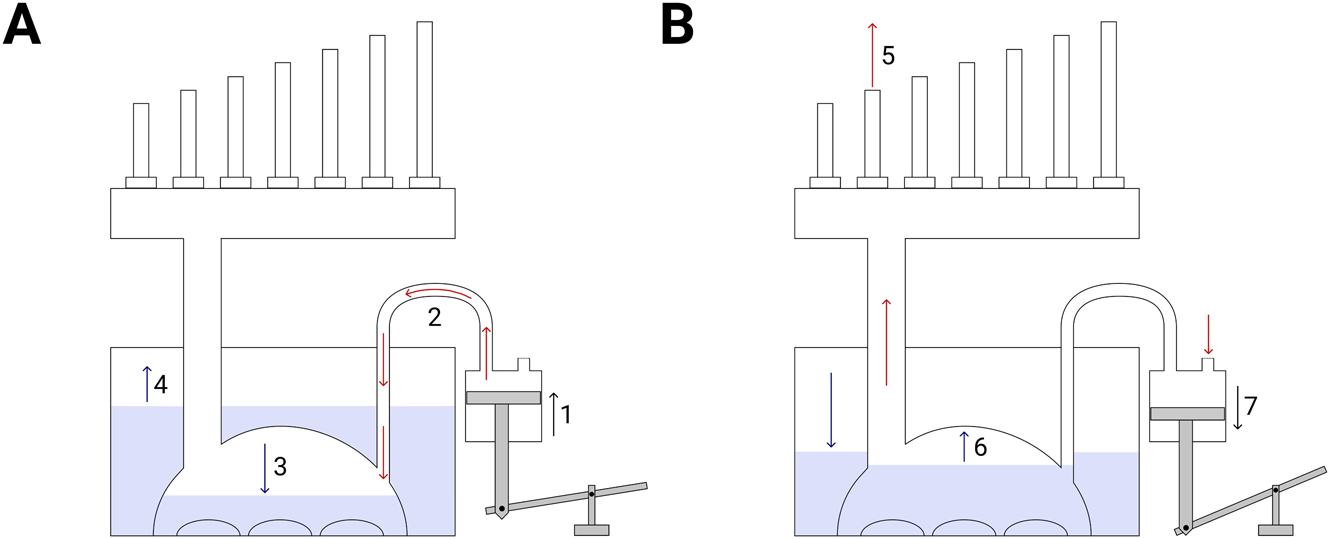
The hydraulis worked by harnessing the compressed air inside a cistern filled partially with water (Fig. 1).Footnote 13 Two cylindrical pistons on either side, worked by levers, pumped air into a hollow chamber inside the cistern, called a pnigeus (A1–2). The incoming air displaced water into the cistern through apertures at the base of the pnigeus (A3), driving the water level in the cistern upwards and thereby maintaining the high air pressure within the chamber (A4). When a key was depressed, a spring mechanism allowed the compressed air from the pnigeus to escape freely through the pipe, producing a musical sound (B5). As air escaped the pipe, the pressure in the pnigeus dropped, allowing water to re-enter (B6). The constant operation of the pistons was therefore necessary to ensure that the organ was primed for playing (B7).
Diagram illustrating the mechanism of the hydraulis (source: author)

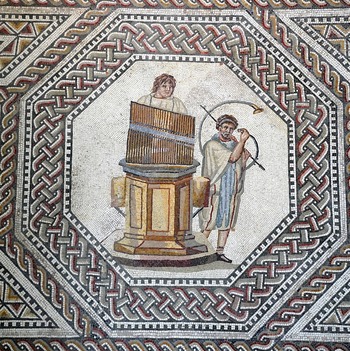
Little is known about the early history of the hydraulis. The instrument is first attested in an honorific decree from Delphi, dating from around 90 b.c. The inscription records the achievements of a Cretan organ-player (ὕδραυλος) named Antipatros, who had been invited specially by the Delphic archons to participate in a two-day festival and was subsequently rewarded for his performance with various honours, including a bronze statue.Footnote 14 We do not know how or when the Romans first encountered Ctesibius’ invention. They certainly knew of the existence of the hydraulis by the middle of the first century b.c., since Cicero alludes to the instrument in his Tusculan Disputations (as discussed below).Footnote 15 By the time of Nero, at any rate, the organ was familiar to audiences in Rome for its role in accompanying public spectacles of various kinds. In a scene from Petronius’ so-called Cena Trimalchionis, the sight of a slave carving meat is likened to ‘a gladiator in a chariot fighting to the accompaniment of a water-organ’ (essedarium hydraule cantante pugnare), while in the anonymous poem Aetna, usually dated to the 60s or 70s a.d., the hydraulis is described as a ‘vessel’ which ‘with its water-worked song makes music in large theatres’ (carmineque irriguo magnis cortina theatris … canit).Footnote 16 It is also around the middle of the first century a.d. that the hydraulis begins to appear in Roman art. Of the forty or so artistic representations of the instrument which survive, the majority are associated either with gladiatorial spectacles or with performances in the theatre or the circus. In several cases, the hydraulis is represented as part of a larger instrumental ensemble, including brass-players (tubicines/cornicines) and pipe-players (tibicines).Footnote 17
Medallion depicting an organist and a trumpet-player (cornicen) on an amphitheatre mosaic from the Roman villa at Nennig, Germany; third century a.d. (photo: Wikimedia Commons)

What was it about Nero's affinity with the organ that so scandalized the likes of Suetonius and Cassius Dio? Certainly, as Bradley notes, the theme of ‘Kunstlermanie’ figures prominently in both narratives. One cannot read the passages without being reminded of Nero's notorious exploits on the stage, first as citharoedus and later as tragoedus—from his public debut at Naples in a.d. 64 to his star turn at the Neronia of 65 to his prize-winning tour of Greece in 66–7. Suetonius makes the theatrical connection explicit by listing the hydraulis among the various instruments which Nero vowed to play at his ludi uictoriae in 68. Here, as elsewhere, the implication is that the emperor was devoting his time to frivolous pleasures when he should have been attending to important matters of state, not the least of which was how to deal with the mounting political opposition to his rule. Both Suetonius and Dio take pains to stress the severity of the situation in which Nero found himself at this critical point in his reign (ac ne tunc quidem; καὶ τότε). Suetonius portrays Nero in typically cavalier fashion, hastily concluding his official business (transactaque raptim consultatione) in order to spend the remainder of the day waxing lyrical about his new organs (reliquam diei partem … circumduxit). Dio, by contrast, sets the whole scene at night-time (νύκτωρ). Without warning (ἐξαπίνης), the leading members of the imperial council receive an urgent message summoning them to a crisis meeting in the palace. Nero begins speaking, the first word of his speech, ἐξεύρηκα (‘I have discovered’), promising the revelation of newly acquired intelligence about Vindex's conspiracy. Yet, in an instant, the tension turns to bathos: there is no mention of Vindex at all; only the revelation of a new and improved hydraulis. Dio's narrative plays out as a kind of surreal nightmare, the nocturnal ambience creating the illusion of a topsy-turvy world—a distinctly Neronian world—in which business is conducted under cover of darkness, and work serves merely as a pretext for leisure.
Modern commentators have tended not to detect signs of radical intent in Nero's decision to take up the organ. For example, Edward Champlin, noting the ‘progression’ of Nero's performances ‘from private and amateur to public and professional’, claims that ‘the step from citharody to tragedy was a natural one’; it was natural, too, that ‘a tyrant of artistic bent’ should develop an interest in wind instruments later on in life.Footnote 18 There are, to be sure, many musicians today who are lauded for their ability to perform proficiently on more than one instrument. This was not the case in antiquity, however. For a performer to apply himself to several different musical pursuits at the same time was highly unusual. Indeed, it flew in the face of the established convention that musicians should specialize in one instrument, and one instrument alone.Footnote 19 It was certainly not unheard of for citharodes to switch to accompanying the pipes, but this was apparently taken as an admission of failure, since the cithara was deemed the more difficult instrument (Cic. Mur. 29): ‘they say of Greek musicians that aulodes are those who are incapable of becoming citharodes’ (aiunt in Graecis artificibus eos auloedos esse qui citharoedi fieri non potuerint).Footnote 20 Nero's brand of multi-instrumentalism was, as far as we can tell, the first of its kind, and in the eyes of conservative elites it represented a radical departure from the cultural norm.Footnote 21 Revealingly, Martial thought it degrading for an esteemed tibicen such as Canus to desire to play the bagpipes, presumably on the grounds that such a lowly instrument was unbecoming for a serious concert musician (et concupiscat esse Canus ascaules?).Footnote 22 What, then, could be less worthy of an aspiring artifex than to proclaim himself publicly as an expert citharode, piper, bagpiper and organist all at the same time, not to mention the many other activities which he was supposed to have engaged in?
By seeking to subvert the normal rules of artistic performance, Nero displayed in the eyes of his critics not only a lack of dignity and political prudence but also a lack of maturity. An education in the different artes could be considered an appropriate grounding for a young princeps, but only in so far as it equipped him with skills that would enable him to exercise good judgement as a mature ruler.Footnote 23 Nero's problem was that he failed to outgrow his juvenile pursuits. On the contrary, he made them increasingly the focus of his energies. It is notable in this regard that Dio presents the water-organ episode as a particularly egregious example of Nero's taste for jokes, allowing this one example to speak for the rest (συχνὰ δὲ δὴ καὶ ἤθυρεν, ὧν ἐγὼ τὰ μὲν ἄλλα παραλείψω, ἓν δὲ εἴπω).Footnote 24 He then goes on to describe Nero's behaviour as a kind of παιδιά, ‘childish play or amusement’ (τοιαῦτα μὲν καὶ τότε ἔπαιζεν).Footnote 25 The implication is clear: Nero was more interested in playing around with his musical instruments than in the serious business of running the empire. Nor was he the only youthful emperor to display such a fault: Caligula, Commodus, Elagabalus and Severus Alexander are all censured for their devotion to music (Elagabalus and Severus are even supposed to have played the organum, perhaps in imitation of Nero himself).Footnote 26
In many ways, therefore, the water-organ episode reinforces the standard depiction of Nero in the literary sources as an obsessive, transgressive and immature narcissist who preferred the escapist world of show business to the grim reality of imperial politics. The realization that Nero the organist shares similar traits with Nero the citharode and Nero the actor should come as no great surprise of course. But there is, I think, a deeper meaning to be gleaned from this particular episode. After all, Suetonius and Dio could have presented the encounter in the Domus Aurea as yet another of Nero's interminable recitals, a sequel to the concert series in Greece. And yet, in neither version of the story is it stated simply that he wished to play the organ. The attraction of the instrument for Nero had as much to do with its practical mechanics as with its aesthetic qualities. Suetonius’ Nero expends considerable energy on explaining the inner workings of the organa hydraulica, their ratio and difficultas, making a complex machine intelligible and accessible to its audience on an intellectual level: he ‘describes’ (disserens) as well as ‘shows’ (ostendensque). Dio, similarly, has Nero deliver a direct speech in which he claims personal responsibility for improving the mechanical capabilities of the hydraulis. Indeed, Dio makes a point of telling the reader that he is quoting Nero verbatim: “ἐξεύρηκα” ἔφη “πῶς ἡ ὕδραυλις” (αὐτὸ γὰρ τὸ ῥηθὲν γραφήσεται) “καὶ μεῖζον καὶ ἐμμελέστερον φθέγξεται.” It is this ‘eureka’ moment, so to speak, which forms the crux of the narrative.Footnote 27 To invent an organ that was ‘louder and more musical’ certainly required a level of artistic cultivation; but, no less importantly, it also demanded a specialized knowledge that could only be gained by mastering the principles of Ctesibian hydraulics. As recent scholarship has underlined, scientific discourse in Graeco-Roman antiquity was characterized by a strongly competitive ethos. Consequently, ‘ancient experts … tended to reach for self-assertive and ostentatiously innovative first-person personas’ which bolstered their claims to intellectual authority.Footnote 28 Seen in this light, Nero's desire to reinvent the organ (ἐξεύρηκα) looks very much like a typical assertion of technical expertise, perhaps even evoking the memory of Archimedes, whose ‘eureka’ moment served as a paradigmatic model for scientific thinkers in the Roman empire.Footnote 29
In fact, it could be argued that, in depicting Nero as a knowledgeable authority on water-organs, Suetonius and Dio were mining a vein of conservative elite disdain towards professional ‘inventors’ or ‘builders’ of machines (variously identified in Latin as mechanici, machinatores, or simply artifices). In his Life of Demetrius, Plutarch criticizes kings who ‘applied their love of technē to things that would afford useless pleasure or diversion’ (οὐδ᾿ εἰς διαγωγὰς ἀχρήστους ἔτρεψε τὸ φιλότεχνον), such as ‘playing the pipes, painting and metal-working’ (αὐλοῦντες καὶ ζωγραφοῦντες καὶ τορεύοντες).Footnote 30 An example of one such king can be found in Polybius’ Histories. In a passage discussing the behaviour of the Seleucid king Antiochus IV Epiphanes, Polybius states that Antiochus ‘would often be seen wandering about in all parts of the city with two or three companions’ and ‘was especially to be found at the silversmiths’ and goldsmiths’ workshops, holding forth at length (εὑρησιλογῶν) and discussing technical matters (φιλοτεχνῶν) with the moulders and other craftsmen’.Footnote 31 The criticism of technophile rulers such as Antiochus IV is suggestive of a broader elite prejudice against vulgar or ‘banausic’ occupations. In one of his Moral Epistles, Seneca dismisses technological invention as the product not of ‘wisdom’ (sapientia) but of ‘ingenuity’ (sagacitas), a lower form of knowledge.Footnote 32 Even the great Archimedes is said by Plutarch to have regarded his own mechanical inventions as ‘ignoble and vulgar’ (ἀγεννῆ καὶ βάναυσον).Footnote 33 Such passages may give us an insight into why Suetonius and Dio represent Nero in the manner that they do. To portray the emperor in the act of playing the organ would have been shocking enough. But to cast him in the guise of a humble artifex, guiding his audience through the intricacies of his craft, was something altogether more distinctive, and thus all the more powerful as an indictment of Nero's vices.Footnote 34
III. TECHNOLOGY, INNOVATION AND PAIDEIA IN NERONIAN ROME
The surge of scholarly interest in theatre and spectacle which occurred around the turn of the millennium (sometimes referred to as the ‘performative turn’) has revolutionized modern conceptions of the Neronian Principate.Footnote 35 The watershed moment came in 1994 with the publication of the volume Reflections of Nero: Culture, History and Representation, edited by Jaś Elsner and Jamie Masters. In her important contribution to that volume, Catharine Edwards transformed Nero from a mindless, stage-obsessed fanatic into a highly self-conscious political actor. By subordinating the role of emperor to that of theatrical artiste, Edwards argues, Nero effectively turned the notoriety of public performance on its head, distorting the boundary between appearance and reality and so ‘show[ing] he could transcend the rules that ordered the rest of society’. In this way, Nero was able to harness the transgressive power of theatricality in order to ‘find new discursive strategies for representing imperial power’.Footnote 36 Edwards's emphasis on the representational aspects of Neronian stagecraft (and statecraft) laid the groundwork for Champlin's provocatively revisionist monograph, published in 2003. Far from being a maniacal monster, Champlin's Nero comes across as a consummate showman, a ‘very serious’ performer endowed with a ‘ferocious energy’, ‘passionate determination’ and a ‘fecund imagination’.Footnote 37 Above all, the young emperor is portrayed as an expert manipulator of his own self-image, successfully turning popular opinion in his favour by incorporating the language of mythology into his theatrical role-playing.
The modern rehabilitation of Nero has undoubtedly succeeded in facilitating a more nuanced understanding of the emperor and his era. Scholars have become increasingly sensitive to the distorting lens of the historical sources. Contemporary attitudes to Nero were by no means universally negative, and many of Nero's seemingly irrational or trivial actions can be better explained by paying closer attention to the audience(s) at whom such actions might have been targeted. For example, in his book The Culture of Kitharôidia (2010), Timothy Power demonstrates how Nero rendered ‘the Hellenic language of kitharoidia legible and lovable to Romans’ by translating a quintessentially Greek art form for a Roman setting.Footnote 38 Tacitus’ derogatory assessment of Nero's supporters at the beginning of the Histories—‘the plebs accustomed to the theatre and the circus’ (plebs circo ac theatris sueta)—certainly provides some indication of his popularity as performer.Footnote 39 Other sources reinforce this impression.Footnote 40
Equally, we should not assume that all members of the elite were opposed to Nero's artistic pursuits. Columella, writing in the middle of the first century a.d., takes for granted the demand among members of his own class for high-quality teachers who specialized in music and dance.Footnote 41 The young man praised for his skill at playing the lyre in the anonymous panegyric known as the Laus Pisonis is probably the same Piso who conspired against Nero in a.d. 65.Footnote 42 Even allowing for poetic licence, the idealization of a Roman nobilis as an accomplished citharode speaks to a society which valued the acquisition of musical skills as part of a well-rounded aristocratic education. At the Ludi Maximi of a.d. 59, according to Cassius Dio, senators and equestrians performed in a variety of productions, including some who played the pipes and sang to the lyre (ηὔλησάν τινες αὐτῶν … καὶ ἐκιθαρῴδησαν), just as Nero himself would do.Footnote 43 They could not have taken part in such performances without the appropriate training; and, as Champlin points out, ‘there was no overt coercion of the upper classes to participate’.Footnote 44
The idea that Nero actively sought to elevate the status of the water-organ in the latter part of his reign therefore need not be dismissed as fictitious or far-fetched. The hydraulis was, after all, a highly popular instrument associated with mass public spectacles. It is surely no coincidence that Suetonius refers to Nero's intention to appear in public as an organist in a section of the Life dealing with the emperor's popularitas, his courting of popular approval.Footnote 45 Judging from Cicero's remarks in the Tusculan Disputations, the organ was also an instrument which appealed to the rarefied tastes of Roman elites. Cicero finds fault with those of an Epicurean disposition who, in seeking to mitigate feelings of pain or suffering, preferred to listen to the sound of a hydraulis than to a dialogue of Plato.Footnote 46 The pleasure derived from listening to the water-organ, Cicero implies, was similar to that derived from eating a fine fish (accipenserem), looking at a diverse array of flowers (florida et uaria), or smelling a fragrant bouquet (fasciculum). In each case, it seems, sensory overload was the desired aim. Perhaps, then, by presenting himself as an ardent supporter of the hydraulis, Nero was seeking to capitalize on the instrument's mass appeal in the face of the mounting political opposition to his rule. For an emperor who styled himself as both a supreme aesthete and a patron of the plebs, the hydraulis represented a potentially useful means of bridging the gap between private (elite) luxury and public (popular) leisure.Footnote 47
There is also the question of technological innovation to consider. If the organ was already popular with audiences in Rome, why introduce a new type (or types)? Why fixate on the organ's ratio and difficultas? The relationship between emperors and technology is a topic that remains to be fully explored by historians of imperial Rome. It goes without saying, of course, that technology played a vital role in enabling the construction of roads, bridges, aqueducts, canals and other engineering projects undertaken at the behest of, and with the resources of, the emperor. In most cases, this role is simply taken for granted by our sources: technology was a necessary means to an end but seldom the focus of direct imperial oversight. Technical treatises are frequently addressed to emperors, in the expectation (or hope) that the recipient would be willing and able to engage seriously with their contents.Footnote 48 Trajan, in Book 10 of Pliny's Letters, evinces a concern for the progress of ongoing construction projects in the province of Bithynia-Pontus.Footnote 49 Only rarely, however, does the evidence afford specific insights into the attitude of individual emperors towards technological innovation.
Two notable exceptions are worth singling out. First, Suetonius tells the story of an unnamed mechanicus who approached Emperor Vespasian with an invention that allowed heavy columns to be transported up the Capitoline hill at low cost. Although the engineer was rewarded handsomely for his invention, Vespasian refused to make use of it, ‘declaring that he must be allowed to feed the common people’ (praefatus sineret se plebiculam pascere).Footnote 50 The second example relates to the supposed discovery of ‘unbreakable’ glass. The craftsman responsible was granted an audience with the emperor (identified in some sources as Tiberius). However, instead of rewarding the craftsman for his ingenuity, the emperor had him beheaded, out of fear that the discovery, if made public, would drive down the cost of gold and other precious metals.Footnote 51 For Moses Finley, these anecdotes bore witness to the ancients’ antipathy towards technological innovation, which resulted in its long-term stagnation.Footnote 52 More likely, the stories are apocryphal; as Kevin Greene explains, they illustrate the particular character traits of the two emperors concerned: Vespasianic prudentia, in the case of the column transportation system, and Tiberian saeuitia, in the case of the ‘unbreakable’ glass.Footnote 53 Nevertheless, it remains the case that in both passages the emergence of novel technologies is presented in strikingly cynical terms. Far from promoting the technologies as a boon to society, the emperors in question suppress them out of a desire not to disrupt the status quo.
Nero's attitude to the water-organ could not be more different. His eagerness to exhibit the hydraulis in public, to lay bare its complex machinery and fine-tune its design (at least in Dio's version), speaks to an enthusiasm for technological innovation that finds few parallels, if any, in the tradition of Roman imperial biography.Footnote 54 In fact, the organ episode can be compared with a number of other literary anecdotes attesting to Nero's scientific curiosity more broadly: for example, his novel method of watching gladiatorial fights through the reflection of an emerald;Footnote 55 or his expedition to discover the source of the Nile, documented by Seneca, Pliny and Cassius Dio;Footnote 56 or his (albeit unsuccessful) attempt to measure the depth of the Alcyonian Lake, by which route Dionysus had descended into the underworld;Footnote 57 or his plan to dig a canal through the isthmus at Corinth (also unsuccessful);Footnote 58 or the so-called decoctio Neronis, Nero's trademark drink made by boiling water and then rapidly cooling it in ice.Footnote 59 Collectively, these examples highlight a peculiarly Neronian fascination with artificial technologies and construction projects which appear to defy the laws of nature. In my view, a strong case could be made for adding the water-organ to this list of nature-defying creations. Seneca, Nero's tutor and long-time confidant, alludes to the hydraulis in his Natural Questions as an instrument which ‘by water pressure emits a sound louder than that which can be produced by the human voice’ (aquarum pressura maiorem sonitum formant quam qui ore reddi potest), likening it on this basis to the horn (cornu) and the trumpet (tuba).Footnote 60 Dio's suggestion that Nero attempted to make the organ ‘louder and more musical’ (μεῖζον καὶ ἐμμελέστερον) thus accords well with its reputation as a device with supernaturally loud properties, especially when one considers the unnatural lengths Nero went to in order to enhance the sonority of his own voice.Footnote 61
Again, in assessing Nero's technophilia, we should be wary of placing too much confidence in the anti-Neronian sources. Attitudes towards technology expressed within the moralizing genres of historiography and biography are not necessarily representative of the attitudes of Roman society as a whole. As modern scholarship has emphasized, the existence of competing ethical discourses among the Roman aristocracy allowed for the articulation of conflicting value judgements about technology and technical knowledge more broadly.Footnote 62 Seneca, for all his aversion to technological innovation, still deemed the water-organ sufficiently noteworthy to warrant mention in a discussion of the effects of air pressure. Pliny the Elder, meanwhile, goes so far as to place the invention of organa hydraulica by Ctesibius on a par with the laying out of the city of Alexandria by the architect Dinochares.Footnote 63 Most significantly, the mechanical workings of the hydraulis piqued the interest of two prominent technical writers of the first century, Vitruvius and Hero of Alexandria. Vitruvius singles out the organ's ‘sophisticated design’ (exquisita ratio) and ingenious ‘complexity’ (subtilitatis; subtiliter); it was, for this reason, an obscura res, something difficult for the layperson to understand.Footnote 64 Similarly, Hero of Alexandria, writing in the time of Nero, provides a close examination of the hydraulis in his treatise Pneumatika, presenting it as an example of a mechanical device which created a ‘wondrous effect’ (ἐκπληκτικόν τινα θαυμασμὸν) by harnessing the power of the elements.Footnote 65 Paul Keyser has suggested that Hero's hydraulis may have served as the model or prototype for Nero's organa hydraulica, on the grounds that Hero likely had contacts with high-profile intellectuals in Rome.Footnote 66 Though this idea remains purely speculative, the evidence clearly confirms the existence of a circle of educated elites in first-century Rome who sought to acquire and disseminate technical knowledge of Ctesibius’ invention.Footnote 67 By presenting himself as a well-informed and highly engaged connoisseur of water-organs, endowed with the expert knowledge of a Vitruvius or a Hero, Nero demonstrated that he possessed a superior paideia, a kind of technocratic authority, which his subjects ought to emulate.
Moreover, Nero's efforts to promote technological innovation, and the model of paideia it represented, could be seen as a deliberate attempt to rival the achievements of the Hellenistic kings in this area. It is surely no coincidence that Nero chose to exhibit his new organs in the opulent surroundings of the Domus Aurea, a complex which was almost certainly inspired by the Ptolemaic royal palace at Alexandria.Footnote 68 The traits of polymathia and philotechnia were associated particularly with members of the Ptolemaic dynasty. The invention of the hydraulis by Ctesibius would not have been possible were it not for the patronage of the early rulers of this dynasty, who provided the scholars of the Alexandrian Museum with much-needed resources and publicity.Footnote 69 Philo of Byzantium, a Greek writer on mechanics who was active in Alexandria a few decades after Ctesibius, observed that the technitai in that city benefitted greatly from the endorsement of kings who were ‘ambitious and lovers of technē’ (ϕιλοδόξων καὶ φιλοτέχνων).Footnote 70 Even the tyrannical Ptolemy VIII Euergetes (182–116 b.c.), who reportedly did so much to undermine the reputation of the Museum, was said to have ‘filled the islands and cities with grammarians, philosophers, mathematicians, musicians, painters, athletic trainers and numerous other technitai’, thereby sparking ‘a fresh revival of all types of paideia’ (ἀνανέωσις πάλιν παιδείας ἁπάσης).Footnote 71 This emphasis on a holistic conception of paideia is indicative of the ‘totalizing tendency’ of Hellenistic scholarship more broadly, and represents a striking departure from earlier Athenian notions of paideia, which stressed the importance of specialization (Plato, revealingly, criticizes polymathia as being ‘a danger to children’).Footnote 72 For Suetonius and Dio, schooled in the Platonic tradition, it was easy to cast Nero's intellectual pursuits in a negative light; indeed, Dio takes pains to present Nero as the antithesis of a pepaideumenos, turning his back on the traditional paideia that had been instilled in him as a young boy by his mother Agrippina and his pedagogue Seneca.Footnote 73 But there seems little doubt that the spirit of Hellenistic philotechnia was alive and well in Neronian Rome.
A closer look at the water-organ episode can therefore shed new light on the role of technology, and of paideia more broadly, in the cultural politics of the Neronian Principate. As serious as Nero's theatrical and athletic ambitions undoubtedly were, it is important to recognize that the range of artes with which he was associated went far beyond the stage or the circus. Through his various technological and scientific endeavours, Nero made paideia a central pillar of his Principate. He sought to create a new monopoly of knowledge, founded upon the institutions and aspirations of the Ptolemaic dynasty but focussed through the prism of Roman imperial power. The organ contributed to this project in more ways than one. With its complex hydraulic mechanism, it represented the epitome of technological refinement. More than just a musical instrument, the hydraulis was a marvel of human engineering, whose secrets could only be disclosed by a select group of learned scholars (of whom Nero claimed to be one). Reinvention turned the hydraulis into a miraculum, something noui et ignoti generis, a collectible, a symbol of the emperor's control over both the epistemic and the physical resources of Rome's empire. The hydraulis was also accessible to the populus Romanus at large. As contemporary evidence makes clear, audiences at the games relished its distinctly resonant and tuneful sound—qualities which Nero evidently wished to enhance. Inevitably, however, Nero did not manage to persuade everyone. To those of a more conservative disposition, the emperor's philotechnia looked like an assault on the very foundations of Roman culture. It was this conservative view that won out after Nero's death and posthumous damnation. Disavowed by surviving elites and redeployed as a moral paradigm, the organ came to symbolize the worst excesses of the Neronian regime.
IV. CONCLUSIONS
The water-organ features prominently in the story of Nero's final days in power as narrated by Suetonius and Cassius Dio. For these writers, the showcasing of the hydraulis in the Domus Aurea, which coincided with a period of mounting political tension in Rome, presented a stark illustration of the emperor's moral vices, his pretensions and his delusions, his tyrannical whims and desires. On the one hand, the episode bears witness to Nero's fanatical obsession with all things musical. Blurring the boundaries between reality and fantasy, tension and bathos, it strikes a chord with many other ancient depictions of Neronian theatricality. By branding himself as an aficionado of the organ—and, by extension, as an aspiring multi-instrumentalist—Nero showed that he was willing to transgress the normal rules of musicianship. In doing so, he appeared to demonstrate a shocking disregard for the duties of the imperial office, born out of an inane and selfish devotion to otium. On the other hand, we can see in the image of the emperor-organist the channelling of negative Roman attitudes towards technology. For Nero's detractors, it was bad enough that the emperor saw fit to put the organs on display in the first place; worse still was the fact that he was able to talk about them in such elaborate detail, thereby placing himself on a par with the class of professional artifices who traded in precisely this kind of technical expertise.
Ultimately, the historicity of the water-organ episode must remain controversial. And yet, with closer scrutiny of the evidence, it is possible to reconstruct a plausible picture of why the ‘historical’ Nero might have cultivated an image of himself as a collector and connoisseur of water-organs. Recent scholarship on the Neronian Principate has focussed on recovering the subtle and complex ways in which the emperor represented himself as ‘artist’, ‘musician’ and ‘performer’. The problem with this (otherwise valuable) approach, however, is that it presupposes an artificial divide between the ‘arts’ and the ‘sciences’ that is fundamentally anachronistic in an ancient context. The Greek word τέχνη, and its Roman equivalent ars, encompassed an extremely wide range of intellectual and practical disciplines, including not only music, dance and poetry but also philosophy, mathematics, rhetoric, painting, sculpting and much more.Footnote 74 Likewise, the term artifex (τεχνίτης in Greek), though often associated with musical or theatrical performers, referred strictly to anyone who practised a skilled craft, including mechanici and machinatores.Footnote 75 In this sense, ‘music’ and ‘technology’ were not regarded as discrete branches of learning but rather as part of the broad spectrum of artes (or disciplinae) which collectively comprised the epistemic system of paideia. The origins of this intellectual worldview were Hellenistic—or, more specifically, Alexandrian. But it was a worldview shared by many elites in Rome, as demonstrated by writers such as Vitruvius and Seneca, whose works are imbued with a deep knowledge of technical subjects (including both hydraulic engineering and music theory). Crucially, in the case of the water-organ, the elite appetite for technological ingenuity went hand in hand with a popular appetite for novel types of public entertainment. These twin factors made the hydraulis a potentially effective means of configuring and consolidating imperial power.
Sadly, for Nero, the end came too soon. Vindex's rebellion was eventually thwarted (that satisfaction at least was afforded to the emperor), but the unrest in Gaul set in motion a chain of events that, within the space of just a few months, would bring about the total annihilation of the Julio-Claudian dynasty. Nero never had the opportunity to perform on the organ in public, as he so desperately desired.