“Lyndon B. Johnson is the head of the Democratic Party. If he's for civil rights, let him go into the Senate next week and declare himself…. Let him go in there right now and take a moral stand—right now, not later. Tell him, don't wait until election time.”
Malcolm X (reprinted in Kramnick and Lowi Reference Kramnick and Lowi2008, 1328)In 1964, Malcolm X gave a speech to Cleveland's Cory Methodist Church in which he made a politically sophisticated argument regarding coalitions and the illusion of captured votes. He claimed that it was the black man's vote that put President Johnson in the oval office, and it was the black man's vote that could take him out. According to Malcolm X, the Democratic Party had assumed African American loyalty and, for that reason, was emboldened to drag its feet on civil rights issues. Although the struggles and history are different, gay, lesbian, and bisexual (GLB) voters find themselves in a similar situation of assumed capture and Democratic leaders' benign indifference. In this article, we argue that the Democratic Party—specifically the presidential candidate—should pay more attention to gay civil rights and the gay vote, as its 2012 electoral fortunes may depend on it.
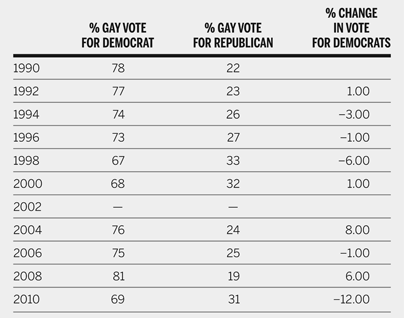
The general assumption is that, with the exception of a small group of Log Cabin Republicans, the Democratic Party owns the gay vote. There is good reason for this viewpoint given the general hostility of the Republican Party toward gay rights, leading one scholar to characterize the Democratic Party as standing “by in mute defense while the Republican Party demonizes gay and lesbian Americans.” (Smith Reference Smith2007, 117). However, GLB voters are far from a captured group for the Democratic Party. On November 6, 2010, the New York Times published a “Portrait of the Electorate” using exit poll data from 2008 congressional races that provided detailed voter demographic categories (New York Times 2010). This portrait included information on GLB voters for election years 1990–2000 and 2004–2010 (see table 1). The percentage breakdown between those voting for the Democrat and Republican parties respectively was fairly consistent during 1990–96. The first notable increase in the percentage of the GLB vote for the Republican Party occurs in 1998, when the Republicans garnered 33% of the GLB vote in 1998 and then 32% in 2000. The Democratic/Republican percentages returned to pre-1998 levels in 2004 and 2006, with a significant leap in 2008 for the Democrats. In that year, during candidate Obama's promises of inclusion and civil rights for all, the largest percentage of GLB voters sided with the Democrats, with the Republican Party able to capture only 19% of these voters in 2008. However, in 2010, we see a repeat of the later Clinton years with a significant swing of the GLB vote back to the Republican Party, with the Republicans receiving one-third of the GLB vote. Such large percentages belie the conventional wisdom that the Democratic Party has captured the GLB vote and can, therefore, ignore that constituency.
Percentage of Gay Vote by Party

Source: “Portrait of the Electorate: Table of Detailed Results,” The New York Times, November 6, 2010. Accessed March 19, 2011. http://www.nytimes.com/interactive/2010/11/07/weekinreview/20101107-detailed-exitpolls.html.
Getting accurate data on GLB voters is difficult because it depends on self-identification, specifically the disclosure of personal information to an exit pollster that may lead to discomfort, if not potential hostility. Underreporting issues may result, in general, but it is also problematic in national data as states vary widely in their levels of gay tolerance. Not only does San Francisco have a larger gay population than other cities, but it is also more tolerant. For example, GLB voters in San Francisco might feel more comfortable providing information to the exit pollster than GLB voters in Mississippi. Estimating state, and even district, level percentages of the GLB vote has been difficult.Footnote 1 However, these best-guess estimates are based on allocating national percentages. We used national figures across all states with the acknowledgment that the actual GLB vote may vary based on region.
Data from the National Exit Poll indicate that the GLB vote was 4% of the 2008 national electorate (Center for Information & Research on Civic Learning and Engagement 2008). Hence, even a 10-percentage point switch to the Republican Party within this relatively small GLB vote nationally will not cause the collapse of the Democratic Party. However, small declines in the GLB vote for Democrats in key battleground states in 2012 could cost President Obama the electoral votes from those states. To that end, we looked at the effect of the GLB vote in key states during the 2008 presidential election, with possible ramifications for the 2012 presidential election.
THE 2008 GLB VOTE IN KEY STATES
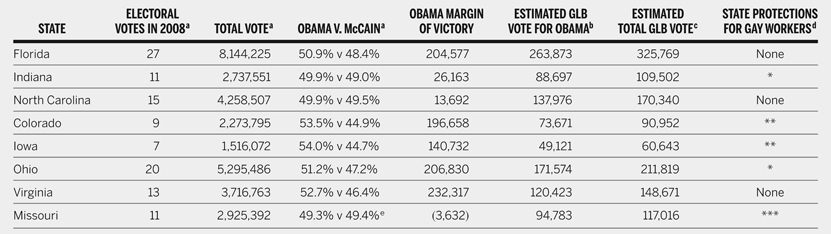
In the 2008 presidential election, Florida, Indiana, and North Carolina, with 53 electoral votes, were all extremely close races (see table 2). Not only were President Obama's margins of victory small in these states, but were less than his estimated GLB vote. For example, table 2 shows that President Obama carried North Carolina by 13,692 votes, while he received the votes of almost 138,000 GLB North Carolinians. In fact, a significant shift of the GLB vote to the Republican nominee could have meant the loss of any of these three states by candidate Obama in the 2008 election. In addition, the 2008 GLB vote provided a sizeable proportion of candidate Obama's margin of victory in Ohio (83% of the victory margin), Virginia (52% of the victory margin), Colorado (37% of the victory margin), and Iowa (35% of the victory margin). If political support for President Obama declines among independent voters in the 2012 presidential election because of any continued economic distress, then the GLB vote in Ohio, Virginia, Colorado, and Iowa (with a total of 49 electoral votes in 2008) could provide the margin of victory for the president in these states.
The Gay Vote and Obama Victory Margins in Key 2008 Battleground States

a Election Results 2008. New York Times, December 9, 2008. Available at: http://elections.nytimes.com/2008/results/president/votes.html. Accessed March 19, 2011.
b “Portrait of the Electorate: Table of Detailed Results.” New York Times, November 6, 2010. Available at: http://www.nytimes.com/interactive/2010/11/07/weekinreview/20101107-detailed-exitpolls.html. Accessed March 19, 2011. The table shows Democrats received 81% of the GLB vote in 2008, which we used in our calculation of the estimated GLB vote for Obama in 2008.
c Center for Information & Research on Civic Learning & Engagement (2008). “CIRCLE Fact Sheet. Young Voters in the 2008 Presidential Election.” Accessed March 19, 2011. http://www.civicyouth.org/PopUps/FactSheets/FS_08_exit_polls.pdf. This fact sheet provides data from the National Exit Poll indicating that the GLB vote was 4% of the 2008 national electorate, which we used in our calculation of the estimated total GLB vote in 2008.
d Human Rights Campaign, Statewide Employment Laws and Policies. Updated March 8, 2011. Available at: http://www.hrc.org/documents/Employment_Laws_and_Policies.pdf. Accessed March 19, 2011.
e Senator McCain won Missouri.
* Executive order, administrative order, or personnel regulation prohibiting discrimination against public employees based on sexual orientation or gender identity.
** State law prohibits discrimination by public and private employers based on sexual orientation and gender identity.
*** Prohibits discrimination against public employees in the executive branch based on sexual orientation.
THE 2012 ELECTION AND GAY ISSUES
The 2012 election is gearing up to be a close race, especially in the Electoral College. The slim margins of victory during 2008 in the battleground states (with more than 100 combined electoral votes) presented in table 2 demonstrate that the GLB vote will matter in 2012. A bloc of GLB voters has the potential to swing the election and, as such, these voters are poised to make demands on the Democratic Party. In fact, if the elections in these battleground states during 2012 are as close as they were in the 2008 election, the GLB bloc will not have to cross over to the Republican Party for President Obama to lose reelection. If GLB voters stay home in sufficient numbers, withholding their votes from the Democratic coalition, then President Obama could lose reelection. Given this power position, it would behoove the Democratic Party to assess its past performance on the issue of gay rights and strongly push for passage of the Employment Non-Discrimination Act (ENDA) into federal law, which arguably would have greater positive—and measurable—impact on more people in the gay community than repeal of Don't Ask, Don't Tell (DADT) or the Defense of Marriage Act (DOMA).Footnote 2
Gay rights advocates have had many disappointments under the Obama administration. After much pageantry and promise of a united America, President Obama fell back into the role of previous presidents, dodging the same-gender marriage issue and abdicating any role in the DADT debate for most of his first two years in office. DADT was finally repealed two years into the Obama Administration by a lame duck session of Congress. In a move recognized as having political implications for the 2012 presidential election, in February 2011, the Obama administration announced it will no longer defend the DOMA before any federal appellate court because the president and Attorney General Holder concluded the law is unconstitutional (Shear Reference Shear2011). One of the most damaging disappointments in the gay community, however, has been the lack of support and presidential leadership for passage of ENDA. Although reliant on congressional action, the president as leader of the party and single executive officer plays a crucial role. If nothing else, presidential support can go a long way to publicize the need for protection against workplace discrimination for gay, lesbian, and bisexual Americans.
THE EMPLOYMENT NON-DISCRIMINATION ACT (ENDA)
ENDA was first introduced into Congress in 1994 to provide basic protection against workplace discrimination on the basis of sexual orientation. A federal solution is necessary because inconsistent and insufficient protections remain at the state level. Only 12 states and the District of Columbia have laws prohibiting discrimination by public and private employers based on sexual orientation and gender identity, whereas another nine states prohibit discrimination based on sexual orientation (Human Rights Campaign 2011). In addition, nine states have an executive order, administrative order, or personnel regulations that prohibit discrimination against public employees based on sexual orientation and gender identity. Another three states ban discrimination against public employees based only on sexual orientation. The order in Missouri covers only employees in the executive branch of state government. These prohibitions preventing discrimination against public employees based on sexual orientation do not protect gay workers in the private sector. Passage of ENDA would extend protection from employment discrimination based on sexual orientation to gay workers in the private sector in all states.
As table 2 shows, only two of the battleground states (Colorado and Iowa) have laws prohibiting employment discrimination by public and private employers based on sexual orientation and gender identity. Three of the battleground states (Florida, North Carolina, and Virginia) have no state laws prohibiting employment discrimination by public or private employers against GLB employees based on sexual orientation. Indiana, Missouri, and Ohio have limited policies banning discrimination against public employees based on sexual orientation. Strong advocacy for passage of ENDA by President Obama could especially motivate GLB voters to turn out in 2012 in those states with limited or no employment protections for GLB workers. ENDA may have the greatest electoral impact in Florida, the key battleground state (27 electoral votes in 2008 and 29 electoral votes in 2012), where the Republican governor Rick Scott in an executive order he signed in early January 2011 refused to extend nondiscrimination protections in pay and employment to GLB state workers (Wing Reference Wing2011).
Not only has fighting workplace discrimination based on sexual orientation been an uphill battle, but nondiscrimination policy has lost ground at the state level. On February 5, 2010, in Virginia Republican governor Bob McDonnell signed an executive order overturning existing state law prohibiting discrimination in the public workforce based on sexual orientation (Helderman Reference Helderman2010a). Also in 2010 Virginia's attorney general urged public colleges and universities in that state to rescind policies banning discrimination on the basis of sexual orientation (Helderman Reference Helderman2010b). These actions by elected Republican officials in Virginia may make GLB voters in that state the most sensitive and receptive to strong advocacy by President Obama for passage of ENDA in the 2012 presidential election.
In the 1960s federal action was needed to guarantee the attainment of civil rights for African Americans; today, federal action is essential to assure the attainment of civil rights for all gay, lesbian, and bisexual Americans. The actions of the governor and attorney general in Virginia during 2010 drive home this point. ENDA is closely modeled on Title VII of the Civil Rights Act of 1964, extending the protections to sexual orientation. It is far from extreme—explicitly prohibiting quotas or preferential treatment of any kind, and exempting small businesses and religious organizations. ENDA would prohibit public and private employers from making employment decisions (i.e., hiring, firing, promotions, and compensation) based on sexual orientation. The first time the Act passed either chamber of Congress was in 2007 when it passed the House of Representatives (after removing gender identity from the protected class). However, ENDA did not pass in the Senate; it continues to be introduced into every Congress with similar results.
Prohibiting employment discrimination based on sexual orientation has support from both the general public and industry. According to the Human Rights Campaign Foundation (2009), by 2008, 88% of Fortune 500 companies and 94% of Fortune 100 companies implemented policies that prohibit discrimination based on sexual orientation. Similarly, public opinion consistently supports nondiscriminatory legislation. Gallup has asked the question “In general, do you think homosexuals should or should not have equal rights in terms of opportunities?” in eight polls spanning from 1977 to 2001 (Newport Reference Newport2001). In 1977, the first time the question was asked, 56% of respondents agreed with the statement. Over the years, support increased reaching 84% of support in 1996 where it has remained since. Since 1996, other public opinion polls (e.g., Newsweek and Associated Press) have asked whether respondents support equal protections specifically in employment for gays and lesbians. The level of support has consistently measured between 84% and 86% of respondents (PollingReport.com 2011). An Associated Press poll in 1996 asked if the respondents favored federal legislation to give equal protection in employment to gays and lesbians, with 85% of respondents supporting federal involvement (PollingReport.com 2011).
Support for employment opportunities sharply contrasts with support for same-gender marriage. In 1996, ICR Survey Research Group found that only 30% of respondents were in favor of same-gender marriage, yet 85% favored equal job opportunities for gays and lesbians (PollingReport.com 2011). Lax and Phillips (Reference Lax and Phillips2009) provide similar findings at the state level where there is consistently greater support for housing and job protection than policies such as same-gender marriage or adoption. Gary Mucciaroni (Reference Mucciaroni2008) suggests that employment discrimination is not perceived as a threat to the public in the same way marriage is perceived to be, and therefore it garners greater public support (Mucciaroni Reference Mucciaroni2008, 18–9). Whatever the reason, legislation involving job discrimination is more widely supported by Americans than other policies protecting or extending gay rights. Given the high levels of both public and business support, a pro-ENDA position would require less political courage than support for same-gender marriage. Strong support for ENDA would allow President Obama to avoid questions of religion and morality that envelop the same-gender marriage debate and focus only on equality of opportunity for gays and lesbians—something deemed central to the American creed. Strongly pushing ENDA is not meant to undercut the significance of equal access to marriage. In many ways, however, ENDA may have greater actual value to more gays and lesbians in terms of people's daily lives and financial futures than the ability to marry legally.
Potential electoral trade-offs could occur as a result of this strategy. Obama's support of ENDA may result in backlash at the state and local level, the mobilization of evangelical voters for the Republican candidate, or the loss of Democratic voters who oppose the extension of gay rights. The backlash thesis is most often applied to judiciary intervention (e.g., see, Klarman Reference Klarman2005 and Rosenberg Reference Rosenberg1991). The premise is that when minority groups advocate for their rights through the courts, political backlash results in the form of local and state legislation. This thesis has been used to explain the increase in state laws banning same-gender marriage after court decisions extended or upheld the right. What some scholars have argued, however, is that court cases mobilize both sides, resulting in gains as well as reversals. Thomas Keck (Reference Keck2009) shows that while bans by the states on same-gender marriage have increased from 1993 to 2008, so have antidiscrimination statutes in the states. Daniel Pinello concludes that although the court decisions may have led to some political backlash, they also succeeded in “inspiring political elites elsewhere in the country to follow suit, and in mobilizing grass-roots supporters to entrench their legal victory politically” (Pinello Reference Pinello2006, 193).
The underlying mechanism of the backlash thesis helped craft the narrative surrounding the 2004 presidential election in which moral issues purportedly helped President Bush to win a second term. One of Bush's strategies, often attributed to Karl Rove, was to use the fear of gay marriage to mobilize evangelical voters. This was deemed especially effective in those states, such as Ohio, where the issue of same-gender marriage was on the ballot. Exploring this further, research shows that while gay marriage was important to voters, it was not as important and did not influence voter choice as much as the Iraq war, terrorism, or the economy (Hillygus and Shields Reference Hillygus and Shields2005; Lewis Reference Lewis2005). As one article concluded, “It appears that values-based appeals only served to reinforce Bush's support among those already planning to vote for him, but failed to persuade new voters. In other words, the moral issues of gay marriage and abortion matter most where the campaign mattered least” (Hillygus and Shields Reference Hillygus and Shields2005, 207). Campbell and Monson (Reference Campbell and Monson2008) argue that Bush's campaign resulted in backlash among secularists, a trend ignored by the dominant narrative. They argue that as tolerance toward homosexuality grows, especially with generational replacement, opposition to the expansion of gay rights will “become a much riskier political strategy, potentially engendering an even wider counter-reaction” (Campbell and Monson Reference Campbell and Monson2008, 415). As we discussed previously, antidiscrimination statutes engender much less opposition than same-gender marriage, leading to even less of a chance of backlash and mobilization following the passage of ENDA than has occurred with other gay rights policies.
Another potential electoral cost is the possibility that President Obama could drive away part of the Democratic base—specifically African Americans or older Americans, or both—by supporting protections for the GLB community. The passage of California's Proposition 8 banning same-gender marriage, an example of this potential trade-off, is highlighted by Obama's campaign that mobilized African American voters, who also happened to largely oppose same-gender marriage. Although an unintended consequence of Obama's campaign, the African American vote is credited with giving Proposition 8 the necessary edge to pass. Although polling data shows that African Americans tend not to support same-gender marriage, African Americans strongly support laws protecting gays and lesbians from job discrimination. In 2005, Princeton Survey Research Associates International conducted a national survey with an oversampling of African American, Hispanic American, and Asian American respondents. African Americans were least supportive of full marriage rights for gay and lesbian couples with only 16.4% supporting (in contrast to 23.1% of whites, 23.8% of Hispanic Americans, and 30.5% of Asian Americans). Yet, African Americans were the group most supportive of laws protecting gays and lesbians from prejudice and discrimination in job opportunities, with 70.5% of African Americans responding that such laws should be passed (Princeton Survey Research Associates International 2005).
Older Americans are least supportive of public policies protecting the GLB community than other age groups. For example, 73% of Americans between 18 and 25 years of age think laws should protect gays and lesbians from employment discrimination compared with only 56% of Americans who are over the age of 70 (Princeton Survey Research Associates International 2005). Less than 30% of 18 to 25 year-old Americans oppose marriage or civil unions for gays and lesbians compared with 50% of Americans over 70 who oppose these relationship rights (Princeton Survey Research Associates International 2005). Stronger support by President Obama for the rights of GLB Americans could reduce his electoral appeal to older voters in 2012. However, in five of the six last presidential elections older voters were more likely than voters of other ages to identify health care as the most important or among the top two most important issues deciding their vote (Blendon et al. Reference Blendon, Altman and Benson2008), with Medicare especially important (Campbell Reference Campbell2003). Various polls show that from 51% to 68% (mean, 59%) of retirees or near retirees oppose the Republican plan formulated by representative Paul Ryan to change the Medicare program that passed the House of Representatives in April 2011, with 58% of older Americans concluding that they would be worse off under this Republican (Ryan) Medicare plan (Blendon and Benson Reference Blendon and Benson2011).Footnote 3 Medicare reform, not ENDA, is more likely to be the key issue affecting the vote of a large majority of older Americans in the 2012 elections.
On the other side of the electoral equation, not all Republican candidates are the same. A Republican candidate might appeal to members of the GLB community, earning its vote regardless of President Obama's actions. Neither Republican politicians nor GLB voters are monolithic categories. Republican candidates have different stances on gay rights issues just as GLB voters have varying political beliefs. Members of the GLB community are “normally distributed throughout the population” with differing demographics that can lead to disparate interests along the political spectrum (Smith Reference Smith2011, 36). A gay business owner may be more interested in Republican economic policy and tax structures than in the passage of a civil rights bill. Sexual orientation is only one aspect of anyone's identity. However, it is the characteristic that leads to discrimination against the GLB community, thus setting apart these Americans from other single-issue voting blocs. For this reason, we believe that if President Obama supported the passage of ENDA, any Republican candidate would need to advocate a similar policy position to win over a significant portion of these GLB voters.
The position of President Obama's Republican opponent on the range of GLB issues will affect the GLB vote in 2012. A national Quinnipiac University Poll (2011) was conducted in July 2011, surveying Republicans and people leaning Republican to ask how they would vote if the Republican primary were held that day. Potential Republican nominees for president receiving the greatest support in this poll were former governor Mitt Romney (25%), representative Michelle Bachmann (14%), former governor Sarah Palin (12%), and governor Rick Perry (10%), with no other candidate exceeding 6%. As of mid-July 2011, only Mitt Romney and Michelle Bachmann among these top four had announced their candidacies for the Republican presidential nomination. During a 2007 television appearance on Meet the Press Mitt Romney expressed support for ENDA at the state level but not at the federal level (Meet the Press 2007). Representative Bachmann voted against ENDA in the House of Representatives in November 2007 (Employment Non-Discrimination Act (ENDA): Roll Vote No. 1057 2007). Both former Governor Romney and Representative Bachmann stated during a June 2011 Republican presidential debate in New Hampshire that they support a constitutional amendment banning same-gender marriage (Politisite.com 2011). In that same debate Representative Bachmann said she would keep the “don't ask/don't tell” policy on gays and lesbians serving in the military, while former Governor Romney said that policy “should have been kept in place until conflict was over” (Politisite.com 2011).
In addition, future nominations to the federal judiciary by the president could become a salient issue for GLB voters in 2012, especially if the US Supreme Court upholds California's Proposition 8 banning same-gender marriage or hands down adverse rulings on same-gender marriage in general or other gay rights issues before the 2012 election. Three current justices on the US Supreme Court will be 76 years of age or older by 2012, with four justices reaching at least 78 years of age by 2016 (Supreme Court of the United States 2011). The advancing ages of nearly half the justices on the Supreme Court indicate possible openings on the Court by 2016, with opportunities for new nominations for the presidential candidate elected in 2012. Any adverse rulings on gay rights issues (or even five to four rulings protecting gay rights) by the US Supreme Court before the 2012 election will highlight the importance of the federal judiciary to securing equality for GLB Americans. As a result, some GLB voters may favor the reelection of President Obama to ensure that a Democratic president fills potential openings on the US Supreme Court during the 2012–2016 term.
LIMITATIONS
Data from the National Exit Poll indicate that the GLB vote was 4% of the 2008 national electorate (Center for Information & Research on Civic Learning and Engagement 2008). We used this percentage to estimate the GLB vote in each state that was included in our analyses. The percentage of GLB voters may vary from this 4% in each state. For example, intuitively the percent of GLB voters in New York, California, or Florida probably exceeds the percentage of GLB voters in Montana or Mississippi. Gates estimated that, based on American Community Survey data, only 2.6% of Montana residents are GLB compared to 5.7% of Washington State residents (Gates Reference Gates2006, 7). In addition, we assumed that candidate Obama received 81% of the GLB vote in each state during the 2008 election. The actual percentage most likely varied from state to state. However, clearly, the GLB vote provided the margins of victory in 2008 for President Obama in Florida, North Carolina, and Indiana (with a total of 53 electoral votes), and made substantial contributions to his margins of victory in Ohio, Virginia, Colorado, and Iowa (with a total of 49 electoral votes). The popular vote, and especially the electoral vote, will likely be considerably closer in the 2012 presidential election than they were in 2008, which highlights the importance of the GLB vote to President Obama's reelection. Our analyses, with limitations acknowledged, provide insights into the role of the GLB vote in key battleground states.
CONCLUSIONS
Holding the 2012 Democratic National Convention in North Carolina is seen by many political analysts as an attempt to repeat the 2008 presidential victory in that state. Although a politically savvy move, it signals the Democratic Party's concern about maintaining the diverse coalition of voters that led to the victory in North Carolina. The Democratic Party is in for a tough fight in 2012. President Obama's electoral fortunes in 2012 are more explicitly tied to the nation's economy and may be beyond saving even with a strong GLB vote. We believe he will fail without it. Given the large and conservative Republican majority in the House of Representatives, it is unlikely President Obama can provide sufficient leadership to help pass ENDA before the next presidential election.Footnote 4 This drives home the missed opportunity to achieve this civil rights milestone in the previous Congress, especially during the lame duck session. President Obama needs to incorporate strong support for ENDA into his reelection platform and to issue an executive order that restricts federal contracts to those companies that prohibit discrimination based on sexual orientation. Then, the Democratic Party has the chance to recapture the GLB votes it lost in 2010 with a publicly supported policy that will not scare away moderate voters and potentially help secure reelection. This situation is especially true in those battleground states where the GLB vote can deliver a substantial number of electoral votes. To echo the advice of Malcolm X, tell President Obama not to wait until election time. By then, it will be too late.