Introduction
One of the most obvious and often cited explanations for the difference between invariably successful first language (L1) acquisition and the variable results of second language acquisition (L2) is the fact that L2 learners have already mastered one language. Few L2 researchers (or L2 speakers) would probably deny that L1 grammar is the source of some of the errors observed in an L2. But what exactly is transferred from the L1 into the grammar of subsequently acquired languages? Providing a straightforward answer to this question remains the topic of numerous studies in the field of L2 acquisition. A recently proposed account, the Feature Reassembly Hypothesis (Lardiere, Reference Lardiere2009) (FRH), suggests that L2 learners initially transfer the lexical encoding of the L1 morphosyntactic and semantic features.
Following in the steps of the Full Transfer Full Access hypothesis (FTFA, Schwartz & Sprouse, Reference Schwartz, Sprouse, Hoekstra and Schwartz1994, Reference Schwartz and Sprouse1996), the FRH assumes that adult learners bring a system of formal features, already assembled into native lexical items, to the L2 acquisition task. This view relies on the assumption that syntactic features are morphosyntactic primitives (Chomsky, Reference Chomsky1995) and that the lexicon of these features determines the ‘parametric profile’ of a particular language (Borer, Reference Borer1984). Cross-linguistic variation is understood as differences in which features are lexically encoded and how they are ‘bundled’ into lexical items (Giorgi & Pianesi, Reference Giorgi and Pianesi1997). The FRH refines the FTFA proposal by insisting that successful L2 acquisition ultimately depends on reconfiguring the feature bundles of L1 lexical items into those of the L2, in cases where differences exist. If linguistic features are assumed to be reflections of universal cognitive categories, we can assume that ‘new’ features, not encoded in L1, will be acquirable in the L2 as long as they are detectable in the input. At the outset of interlanguage development, however, specific L1 feature combinations are associated with what are perceived as their closest L2 lexical equivalents. This phase is known as the mapping stage. As learners get more exposure to the L2, it becomes possible to add new features not instantiated in their L1, eschew L1 features not encoded in the L2 and reassemble native features that do not coincide within the same lexical items in the L2, during the reassembly stage.
Most of the studies testing the FRH have addressed the question of featural representations and their effect on L2 comprehension off-line. For instance, the hypothesis has been applied to the study of L2 acquisition of number in L2 English and L2 Korean (Lardiere, Reference Lardiere2009; Hwang & Lardiere, Reference Hwang and Lardiere2013), of existential quantifiers in L2 Korean, Chinese and English (Gil & Marsden, Reference Gil and Marsden2013), and of expressions of definiteness and specificity in L2 Russian (Cho & Slabakova, Reference Cho and Slabakova2014). The existing studies have largely confirmed the predictions of the hypothesis with respect to L1 transfer at the initial stages of L2 acquisition, i.e., the mapping stage. For instance, beginning L2 learners of Mandarin Chinese and Korean (L1s English & Japanese) map L2 wh-expressions solely to interrogatives, as in their L1s, and do not show evidence of interpreting L2 wh-expressions as wh-existentials, a possibility available in the L2 (Gil & Marsden, Reference Gil and Marsden2013).
The present cross-sectional study pursued two main goals. First, we set out to test the predictions of the FRH beyond the initial mapping stage. We focused on the acquisition of French object pronouns by native speakers of English since pronominal paradigms in English and French lexically encode a different set of features. Our goal was not only to establish the initial mappings but also to understand how L1 bundles are gradually reassembled to match L2 features. To achieve this goal, we investigated how cross-linguistic differences in features encoded by pronouns affect learners’ interpretations of L2 (French) object clitics (le and la) at different proficiency stages.
Second, we sought to explore how L1-L2 (mis)matches in lexical encoding of formal features affect on-line language processing, thereby extending the application of the FRH beyond the acquisition of grammatical representations. L1 transfer has been proposed as one of the explanations contributing to the differences observed between L1 and L2 processing profiles (Clahsen & Felser, Reference Clahsen and Felser2006; Hopp, Reference Hopp2010). The research available today seems to converge on the idea that at the representational level advanced L2 learners can ultimately reassemble features from their original L1 bundles (Choi & Lardiere, Reference Choi, Lardiere, Belletti, Bennati, Chesi, DiDomenico and Ferrari2006; Cho & Slabakova, Reference Cho and Slabakova2014). What remains to be seen is whether L2 processing routines are automatically adjusted to process lexical items available in L2 once the corresponding feature bundles have been established in the grammar. Assuming L1 featural representations are eventually reassembled into new L2 bundles, does completion of this reassembly process automatically alter L1 processing routines? Or does it take L2 learners additional time to adjust on-line computations based on the new L2 representations?
French and English object pronouns
In spite of the close typological relationship between English and French, the pronominal paradigms differ in some important respects. First, French, unlike English, has both strong and weak/clitic object pronouns in its paradigm (Riemsdijk, Reference Riemsdijk and van Riemsdijk1999; Zwicky, Reference Zwicky1977). Acquisition of clitic object pronouns has been extensively studied in Romance languages (mainly Spanish and French). It is now well established that different populations of learners experience difficulties with this grammatical category, namely normally developing monolingual and bilingual children, children with SLI, adult L2 learners and heritage speakers (Bruhn-Garavito & Montrul, Reference Bruhn-Garavito, Montrul, Stringfellow, Cahana-Amitay, Hughes and Zukowski1996; Duffield, White, Bruhn de Garavito, Montrul & Prévost, Reference Duffield, White, Bruhn De Garavito, Montrul and Prévost2002; Grüter, Reference Grüter2005; Jakubowicz, Nash, Rigaut & Gérard, Reference Jakubowicz, Nash, Rigaut and Gérard1998; Montrul, Reference Montrul2010; Paradis, Crago, Genesee & Rice, Reference Paradis, Crago, Genesee and Rice2003; White, Reference White1996; Zesiger, Zesiger, Arabatzi, Baranzini, Cronel-Ohayon, Franck, Frauenfelder, Hamann & Rizzi, Reference Zesiger, Zesiger, Arabatzi, Baranzini, Cronel-Ohayon, Franck, Frauenfelder, Hamann and Rizzi2010). This difficulty has been attributed to phonological properties of clitic pronouns, their non-canonical merging site, their special functional category status, or the complex nature of the clitic-argument dependency. Most of the L2 studies focused on object clitic production (French: Adiv, Reference Adiv and Anderson1984; Granfeld & Schlyter, Reference Granfeldt, Schlyter, Prévost and Paradis2004; Hawkins, Reference Hawkins2001; Herschensohn, Reference Herschensohn, Prévost and Paradis2004; Schlyter, Reference Schlyter and Martinot1997; Selinker, Swain & Dumas, Reference Selinker, Swain and Dumas1975; Towell & Hawkins, Reference Towell and Hawkins1994; Véronique, Reference Véronique1989; Spanish: Liceras, Reference Liceras1985; Liceras, Maxwell, Laguardia, Fernández, Fernández & Díaz, Reference Liceras, Maxwell, Laguardia, Fernández, Fernández and Díaz1997; Montrul, Reference Montrul2010) and on testing the knowledge of clitic placement (French: Bruhn-Garavito & Montrul, Reference Bruhn-Garavito, Montrul, Stringfellow, Cahana-Amitay, Hughes and Zukowski1996; Duffield et al., Reference Duffield, White, Bruhn De Garavito, Montrul and Prévost2002; Hoover & Dwivedi, Reference Hoover and Dwivedi1998; Spanish: Duffield et al., Reference Duffield, White, Bruhn De Garavito, Montrul and Prévost2002; Duffield & White, Reference Duffield and White1999; Montrul, Reference Montrul2010). This research demonstrates that in spite of initial difficulties associated with the non-canonical position of object clitics in Romance, L2 learners are able to master rules of clitic placement, even if their L1 does not have pronominal clitics (Duffield & White, Reference Duffield and White1999; Montrul, Reference Montrul2010).
Building on these studies, we aimed at exploring how L1-L2 featural (mis)matches affect pronoun comprehension and on-line processing.Footnote 1 In spite of their special syntactic status, French pronominal clitics are referential pronouns (as opposed to anaphors and R-expressions) and function similarly to English object pronouns in terms of establishing referential relations with antecedents in the preceding discourse. In production, the choice between a pronoun and an R-expression could depend on several factors, such as discourse structure (e.g., topic/focus distinction), syntactic function (e.g., subject/object distinction), linear distance between the antecedent and the pronoun as argued by Accessibility Theory (Ariel, Reference Ariel1990, Reference Ariel1994). In comprehension resolving a clitic pronoun reference, just like resolving any pronoun reference, relies on feature matching as well as on the knowledge of binding syntactic restrictions (Chomsky, Reference Chomsky1981) and discourse principles. The evidence available today suggests that both types of information (grammatical and discourse information) are utilized in on-line resolution of pronouns (Grodzinsky & Reinhart, Reference Grodzinsky and Reinhart1993). For example, Arnold, Eisenband, Brown-Schmidt and Trueswell (Reference Arnold, Eisenband, Brown-Schmidt and Trueswell2000) found that native speakers of English simultaneously access (natural) gender information and linear distance/order of mentioning information in resolving English subject pronouns. Rigalleau, Caplan and Baudiffier (Reference Rigalleau, Caplan and Baudiffier2004) further confirmed that native speakers of French are sensitive to (natural) gender disagreement when processing pronouns that refer to a discourse focus.
Extending our comparison of French and English pronouns beyond the presence/absence of clitics, we will now focus on lexically encoded feature combinations essential for feature matching operation during pronoun resolution. Both languages lexically encode a three-way person distinction: first person (English: me/us, French: me/nous), second person (English: you, French: te/vous) and third person (English: him/her/it/them, French: le/la/lui/les/leur).Footnote 2 As is clear from these examples, both languages also encode number in a similar way.
While both English and French third person forms encode person and number features, they encode natural and grammatical gender information differently. French has grammatical gender, which means that its nouns are grouped into “noun classes” (feminine and masculine) based on “formal assignment rules” (Corbett, Reference Corbett1991). Moreover, elements that syntactically depend on a noun (adjectives, determiners, participles) carry either masculine or feminine morphological agreement markers. Just like nouns and their dependent elements, French clitic object pronouns le and la, the focus of the current study, also encode the masculine and feminine gender of their antecedents. In the case of accusative clitics, French does not make any lexical distinctions between [±Human] referents, which forces us to conclude that French does not lexically encode the [±Human] feature.
English differs from French in two respects. First, English uses different pronominal forms to refer to [+Human] and [–Human] referents (him or her vs. it). Second, English categorizes some nouns as masculine and feminine based on their meaning (natural gender): male humans are classified as masculine (e.g., him), females as feminine (e.g., her) and all other nouns as neuter (e.g., it). Furthermore, English has a “pronominal gender system” (Corbett, Reference Corbett1991, p. 12), meaning that natural gender of an antecedent is lexically encoded only by personal, possessive and reflexive pronouns. English adjectives, determiners, and participles are not morphologically marked for gender.
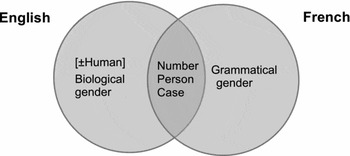
Figure 1 visually presents the similarities and the differences in feature specifications of (accusative) object pronouns in English and French. To summarize the differences crucial for the present study, English object pronouns lexically encode the [±Human] feature and natural gender of their referents, while French accusative clitics lexically encode grammatical gender but do not lexically encode the [±Human] feature. These cross-linguistic differences in lexically encoded feature bundles can be problematic for L2 pronoun resolution. To give readers an example of potential difficulties, let us consider the mini-dialogue in (1) and the possible interpretations of the object pronoun in the last sentence (it/la).
Lexically encoded feature combinations of French and English object pronouns.

-
(1)
A: Je n'aime pas quand mon frère entre dans mon bureau. Il range mes bouquins et mes papiers et après je ne peux plus rien trouver! Hier il a passé 5 minutes dans mon bureau et aujourd'hui je ne trouve ni mon dictionnaire, ni ma rédaction pour la classe d'espagnol.
B: Mais non! C'est pas de sa faute! Tu la cherches déjà depuis trois jours! Footnote 3
A: I don't like it when my brother enters my home office. He rearranges my books and my papers and then I cannot find anything anymore! Yesterday he spent 5 minutes in my home office and today I can find neither my dictionary, nor my composition for the Spanish class!
B: No! It's not his fault! You've been looking for it for three days already!
The English sentence does not provide grammatical means to unambiguously identify the referent of the object pronoun it, since it could refer to either the dictionary or the composition. A speaker might, of course, try to use discourse principles (e.g., recency of mentioning) to resolve the pronoun reference. Lexical encoding of gender in French allows unambiguous pronoun resolution, since la can only refer to the composition (feminine noun in French) and not to the dictionary (masculine noun in French). An L2 learner of French needs to realize that French pronouns lexically encode grammatical gender, which means that, if necessary, gender information can be used to identify not only human antecedents but also disambiguate between inanimate antecedents, as demonstrated in (1). The goal of the current study was to test whether L2 learners initially transfer feature specifications associated with L1 pronouns into their L2 grammar, hindering their accuracy of pronoun reference resolution, and whether subsequent reassembly is possible to achieve target-like interpretations.
Acquisition and on-line processing of gender
Before we discuss relevant L2 research on gender processing, we would like to briefly review some L1 findings in the domain of gender acquisition. It is important to establish how natural and grammatical genders are acquired and processed by native speakers to be able to compare L1 and L2 patterns. Children acquiring languages with grammatical gender initially rely on morphophonological (e.g., gender suffixes) and syntactic (e.g., gender agreement) cues to assign gender to nouns rather than on extra-linguistic cues, such as natural gender of human referents (Karmiloff-Smith, Reference Karmiloff-Smith1979; Pérez-Pereira, Reference Pérez-Pereira1991). As for L1 processing of gender agreement, adult speakers process it at a syntactic level (Friederici, Reference Friederici2002; Gunter, Friederici & Schriefers, Reference Gunter, Friederici and Schriefers2000; Hagoort & Brown, Reference Hagoort and Brown1999; Sabourin, Reference Sabourin, Foster-Cohen and Nizegorodcew2001) with gender congruent markers producing a robust facilitation effect on language processing (Bates, Devescovi, Hernandez & Pizzamiglio, Reference Bates, Devescovi, Hernandez and Pizzamiglio1996; Franceschina, Reference Franceschina2005; Grosjean, Dommergues, Cornu & Guillelmon, Reference Grosjean, Dommergues, Cornu and Guillelmon1994; Guillelmon & Grosjean, Reference Guillelmon and Grosjean2001).
Research on L1 processing of agreement in general suggests that different morphological features might have “different degrees of cognitive salience” (Carminati, Reference Carminati2005, p. 273, but see Silva-Pereyra & Carreiras, Reference Silva-Pereyra and Carreiras2007, for an opposing view). French and English differ in their criteria for gender assignment (formal gender assignment in French and semantic gender assignment in English), which could possibly lead to different processing profiles for grammatical and natural gender. Data from gender agreement errors (Spanish and French) showed that sentential subjects that encoded natural gender triggered fewer gender agreement errors on predicative adjectives than sentential subjects that encoded grammatical gender (Vigliocco & Franck, Reference Vigliocco and Franck2001). These findings suggest that in language production, grammatical gender might indeed have a different status than natural gender. However, these findings are not necessarily directly applicable to the interpretation of pronouns. Indeed, in a series of three experiments with native speakers of Spanish and French, Garnham, Oakhill, Ehrlich and Carreiras (Reference Garnham, Oakhill, Ehrlich and Carreiras1995) found strong facilitation effects with both grammatical and natural gender of object pronouns. The researchers analyzed clausal reading times, question-answering times and question-answering accuracy and found facilitation effects in contexts where gender provided cues for interpreting object pronouns that referred to inanimate things as well as those that referred to people.
Compared to early and relatively error-free L1 acquisition of gender classification and gender agreement, the end-result of L2 acquisition in this domain is much more variable. It has been observed, for example, that L2 learners make more gender errors with certain grammatical categories than others (e.g., more errors with adjectives than with determiners) (Liceras, Díaz & Mongeon, Reference Liceras, Díaz, Mongeon, Leow and Sanz2000; Foucart & Frenck-Mestre, Reference Foucart and Frenck-Mestre2011) and that native speakers of grammatical gender languages achieve better results than those whose L1 does not have grammatical gender (Foucart & Frenck-Mestre, Reference Foucart and Frenck-Mestre2011; Franceschina, Reference Franceschina2005; Sabourin, Reference Sabourin, Foster-Cohen and Nizegorodcew2001; Sabourin & Stowe, Reference Sabourin and Stowe2008).
The existing research provides conflicting evidence with respect to ultimate acquirability of gender agreement by L2 learners. Studies that tested off-line and on-line gender comprehension found very accurate performance of L2 learners (Bruhn de Garavito & White, Reference Bruhn de Garavito, White, Pérez-Leroux and Liceras2003; Foucart & Frenck-Mestre, Reference Foucart and Frenck-Mestre2011; Gabriele, Fiorentino & Alemán Bañón, Reference Gabriele, Fiorentino and Alemán Bañón2013; Gillon Dowens, Vergara, Barber & Carreiras, Reference Gillon Dowens, Vergara, Barber and Carreiras2010; Grüter, Lew-Williams & Fernald, Reference Grüter, Lew-Williams and Fernald2012; Montrul, Foote & Perpiñán, Reference Montrul, Foote and Perpiñán2008; Tokowicz & MacWhinney, Reference Tokowicz and MacWhinney2005; White, Valenzuela, Kozlowska-MacGregor & Leung, Reference White, Valenzuela, Kozlowska-MacGregor and Leung2004). However, learners’ difficulties in producing correct morphological realizations of gender agreement are largely documented in the L2 literature (Franceschina, Reference Franceschina2005; Grüter et al., Reference Grüter, Lew-Williams and Fernald2012). These conflicting findings are suggestive of a possible divide between a syntactic computation of gender agreement and lexical knowledge of gender. In other words, it is possible that gender agreement becomes unproblematic once L2 learners are able to correctly assign nouns to their target gender classes. For instance, Hopp (Reference Hopp2013) found that those learners of German who possessed stable lexical knowledge of gender were able to use it as a predictive cue demonstrating that agreement mechanisms rely on lexical knowledge.
There is evidence to suggest that the distinction between natural and grammatical gender affects L2 learners’ performance. However, research on the impact of the semantic feature [±Human] on on-line processing of gender agreement has so far produced contradictory results. These differences in the experimental findings might be explained by the part of speech participating in the agreement relationship, the specific language combination and experimental design. In the domain of adjectival agreement, gender agreement violations triggered longer reading times with animate nouns than with inanimate nouns in the data of monolingual and intermediate-proficiency L2 speakers of Spanish (Sagarra & Herschensohn, Reference Sagarra and Herschensohn2010), leading the researchers to conclude that “the processing of agreement with animate nouns is cognitively more demanding than with inanimate nouns.” (p. 106). Contrary to these findings, Irmen and Knoll (Reference Irmen and Knoll1999) found that for native speakers of German, gender cues facilitated processing of pronouns that referred to people as well as objects. In the same experiment, gender cues facilitated sentence interpretation only when pronouns referred to people for Finnish L2 learners of German. Several considerations warrant further investigation of the impact of L1 encoding of natural and grammatical gender on L2 development. First, gender agreement might affect processing of different parts of speech differently, e.g., the difference between adjective-noun gender agreement and antecedent's gender encoded by a pronoun. Secondly, the language combination studied by Irmen and Knoll (L1 Finnish–L2 German) is not optimal for investigating the role of L1 feature transfer, since Finnish encodes neither grammatical, nor natural gender in the pronominal paradigm. Finally, the experimental design of Irmen and Knoll did not focus on incremental processing of gender, nor did it investigate how L2 knowledge of gender develops across different proficiency levels.
Motivation and research questions
Deprived of proper lexical meaning, pronouns encode semantic and morphosyntactic features that facilitate the task of establishing a referential link between pronouns and their discourse antecedents or real-world referents. The features that contrast pronominal forms within the paradigm are, however, language specific. While object pronouns in both French and English encode person and number, the languages differ in lexical encoding of the semantic feature [±Human] and the morphosyntactic feature of grammatical gender. The differences between the paradigms make any initial mappings highly problematic and potentially misleading. Following the predictions of the FRH, we assume that L2 learners initially transfer lexically encoded L1 feature bundles and map them to their closest L2 equivalents. In the case at hand Anglophone learners of French will need to map three L1 forms onto the two forms available in L2, as it is depicted in Figure 2 below:
Problem space for L1-L2 mapping of English object pronouns and French accusative clitics.

In its current formulation, the FRH does not allow specific predictions with respect to the mapping that L2 learners might attempt in a situation such as the one we are considering here. However, it predicts that learners will initially map L1 feature bundles even if they do not coincide with feature specifications of the L2 items. Thus, we can expect learners to be more accurate when pronominal reference is determined by semantic gender than when it is determined by grammatical gender. Alternatively, if L1 lexical encoding of features does not affect L2 error patterns, we would expect learners to make interpretation errors with le and la referring to people and non-humans to an equal or comparable degree.
The study was designed to answer three research questions about the two proposed stages of feature reassembly.
During the initial mapping stage:
-
1) Do L2 learners interpret French object clitics more/less accurately depending on whether they refer to people or to inanimate objects?
During the subsequent reassembly stage:
-
2) Do L2 learners of an L1 that lexically encodes only natural gender use grammatical gender information to interpret L2 pronouns off-line?
-
3) Do L2 learners of an L1 that lexically encodes only natural gender use grammatical gender information to interpret L2 pronouns on-line?
Method
Participants
A group of native speakers of French (n = 43) and a group of L2 learners of French (L1 English) (n = 87) participated in the experiment. Native speakers of French were tested in France and recruited among students at two major universities in Paris (Mean age = 21.6). All French native speakers reported some knowledge of English: 56% reported advanced and 42% intermediate proficiency in English. Thus the native speakers were essentially bilingual, which makes them comparable in this respect to our learner group. Second language learners of French were tested in the U.S. and were either enrolled in college-level French courses at a large Midwestern university or worked as French instructors at the same institution (Mean age = 21.7). All participants received financial compensation for their participation.
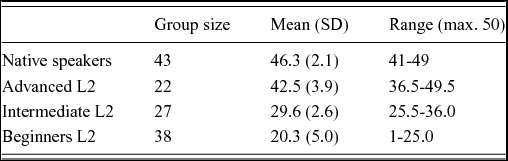
All participants completed a C-test assessing their proficiency in French (Renaud, Reference Renaud2010). The C-test consisted of two short texts, each containing 25 blanks. The first sentence of each text was left intact. In the remainder of the text every other word contained a blank. Participants were asked to fill in the second half of the words that contained blanks. Each correctly completed item was given a point; partially correct completions received the score of .5. Items left blank, meaning-incompatible answers or answers with more than 2 spelling errors were scored as 0. For more details on the format of the test and the scoring criteria the reader is referred to Renaud (Reference Renaud2010). Based on the results of the C-test, we divided the L2 learners into three proficiency groups, see Table 1.
Accuracy scores (1-50) on the proficiency task (C-test).

Procedure
All participants were tested individually in a quiet environment on one of the university campuses. The four experimental tasks and the background questionnaire were presented on a computer in the following order: the self-paced reading task, the background questionnaire, the grammaticality judgment task, the picture selection task, and the C-test. Here we present the results of the self-paced reading and the picture selection tasks. Participants met with the researcher, who was available during the testing session to answer clarification and/or vocabulary questions about the experimental tasks. Participants completed all the tasks in one session that usually lasted for an hour and a half (range from one hour to two hours) and were allowed to take breaks as necessary.
Materials
Picture selection task
The French system of gender assignment is quite opaque, with some morphological and phonological generalizations (Corbett, Reference Corbett1991). However, neither the picture selection task, nor the self-paced reading task tested learners’ lexical knowledge of gender. The picture selection task was specifically designed to determine whether the type of antecedent available in the context affected the accuracy of the participants’ interpretations of French accusative clitics le and la. Here we report the results of two experimental conditions of the picture selection task. Both conditions tested the influence of gender on pronoun resolution of le and la. In the [+Human] condition we tested the use of gender in contexts where le and la referred to a human, while in the [–Human] condition we tested the use of gender in contexts where the clitics referred to an inanimate object. The picture selection task contained 66 experimental items presented in a pseudo-randomized order. Each test item consisted of:
-
(1) a short context introducing two potential referents (#1 & #2);
-
(2) the test sentence reintroducing one of these referents with a clitic (marked for gender);
-
(3) four types of responses presenting four referential possibilities:
-
a) referent #1,
-
b) referent #2,
-
c) both referents are possible,
-
d) a gender-matched distractor thematically compatible with the context, but not mentioned previously.
-
All the contexts were presented in French. Each condition contained 6 items, each presented twice, once with the masculine and once with the feminine clitic in the test sentence. The same six verbs were used to construct test items in both [+Human] and [–Human] conditions: voir ‘see’, chercher ‘look for’, comprendre ‘understand’, (re)trouver ‘see again/find’, choisir ‘choose’, connaitre ‘know’. Thus, the two conditions discussed here differed only with respect to the type of antecedent available in the context: human beings in the [+Human] condition and inanimate objects in the [–Human] condition.
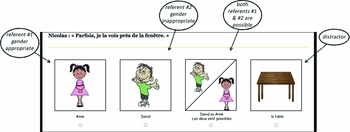
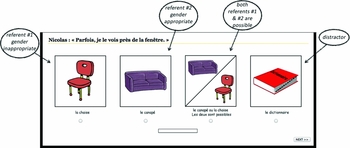
In the sample test item illustrated in Figure 3, ([+Human] condition), Anne (referent #1) and David (referent #2) are introduced as potential antecedents in the short context: Tuesday evening, Nicolas goes to the library to meet Anne or David. The test sentence contains the feminine clitic la and, thus, can only be interpreted as referring to Anne. Figure 4 illustrates an experimental item from the [–Human] condition: both potential referents are inanimate objects, in this case a couch (masc) and chair (fem): When Nicolas needs to work at the library, he prefers his comfortable chair or his relaxing couch. The test sentence contains the masculine clitic le that can only refer to the couch.
Sample test item condition [–Human] of the picture selection task (Nicolas: “Sometimes I her (fem) see near the window”).

Sample test item condition [–Human] of the picture selection task (Nicolas: “Sometimes I it (masc) see near the window”).

Self-paced reading task
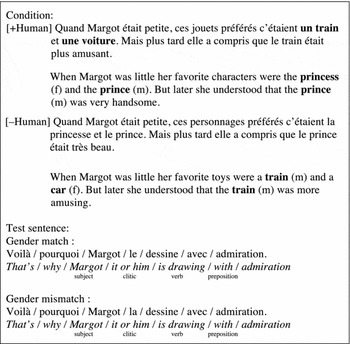
The self-paced reading task was designed to test whether native speakers and L2 learners were sensitive to gender mismatches with [–Human] as well as [+Human] antecedents. The test contained 24 experimental items and 56 distractors that followed the same format as the test items. In the [+Human] condition the experimental items tested participants’ sensitivity to gender mismatches with humans as potential antecedents. In the [–Human] condition the experimental items tested gender mismatches with inanimate objects as potential antecedents.
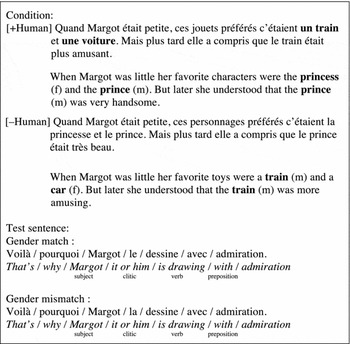
To reiterate, the task did not test participants’ lexical knowledge of gender since gender was always unambiguously marked on the determiner. Each test sentence was presented in a non-cumulative moving window format (Just, Carpenter & Woolley, Reference Just, Carpenter and Woolley1982) and was preceded by a short context presented in French (Figure 5). The context introduced a main character and two other potential referents of different gender. In the [+Human] condition, these two potential referents were a human male and a human female, e.g., prince & princess in the [+Human] condition in Figure 5. In [–Human] condition these two referents were inanimate common nouns of different (grammatical) gender, e.g., train & car. Items in both conditions were designed so that only one of the potential referents was discourse-prominent, therefore creating a gender expectation for the clitic in the test sentence. Each test sentence was followed by a yes-no comprehension question. The number of yes and no answers was balanced for each participant within the entire task. The pronoun in the test sentence either matched or mismatched the gender of the discourse-prominent referentFootnote 4 (e.g., prince in the [+Human] condition and train in the [–Human] condition).
Sample test item of the self-paced reading task.
Results
Off-line task: Picture selection
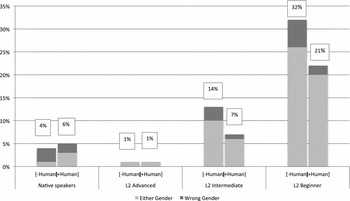
As a reminder, here we analyze two conditions of the picture selection task: [+Human] and [–Human] conditions. As expected, native speakers and advanced learners performed very accurately on both conditions – accuracy rate of 94% and above.Footnote 5 Since the distractor picture always matched the clitic's gender, errors in computations of gender were the most revealing when participants chose ‘gender inappropriate’ and ‘both referents are possible’ pictures. Furthermore, since the number of ‘gender inappropriate’ responses was extremely low across groups and conditions (no more than 6%), we combined ‘gender inappropriate’ and ‘both referents are possible’ responses into one response category: ‘gender error’. Figure 6 visually presents these results as a proportion of gender errors for each group and each condition.Footnote 6
Proportion of gender errors per group per condition (%).

We analyzed gender errors using a 2 × 4 repeated-measures ANOVA with condition as a within-subjects factor and group as a between-subjects factor. The test revealed a statistically significant interaction between condition and group (Condition×Group) in the by-participant and the by-item analysis (F1(3,126) = 3.58, p = .02; F2(3,20) = 3.71, p = .03). The Bonferroni post-hoc tests analyzed by participant revealed that intermediate and beginning learners made more ‘gender errors’ in the [–Human] condition than in the [+Human] condition (p = .02 and p < .001 respectively). The differences in gender errors between [–Human] and [+Human] conditions for advanced learners and native speakers were not statistically significant (p = .9 and p = .35 respectively).
On-line Task: Self-paced Reading
The self-paced reading task presented a higher level of difficulty to our participants. Unlike the picture selection task, where the contexts were short and mostly contained vocabulary introduced in the first year of college French, the contexts in the self-paced reading task tended to be longer and included more advanced vocabulary (e.g., la bonne ‘the maid’ or le jardinier ‘the gardener’). Moreover, while pictures possibly alleviated some processing pressure in the picture-selection task, in the self-paced reading task L2 learners had to solely rely on verbal processing, which is harder at lower levels of proficiency. Therefore, it was important to make sure that the L2 learners were able to accurately perform the task and used gender information to correctly interpret the test sentences.
In order to determine whether the participants actually processed the sentences for information and extracted target-like meaning we calculated two types of comprehension accuracy scores: percentage of correct answers for the entire task and percentage of correct answers for the clitic sentences/test items. If the participants answered the yes-no questions at chance, we would expect an accuracy rate of 50%. For the overall task, beginners answered 61% of comprehension questions accurately, intermediate – 65%, advanced learners – 82%, native speakers – 87%. However, for the test items, only native speakers and advanced L2ers correctly identified clitics’ referents at an above chance rate: 84% and 76% respectively. Beginning L2 learners answered 52% of questions correctly and intermediate 54%. This analysis led us to believe that the task was overly complex for beginning and intermediate L2 learners. Therefore, reading time results of the beginning and intermediate groups were not included in the analysis we present hereFootnote 7 .
We analyzed test sentence reading times per segment, excluding the first two segments that were repeated in each sentence throughout the experiment (Voilà pourquoi. . . ‘That's why. . .’). We further excluded extreme reading times from the analysis. In the native group, we removed all values that exceeded 2000 milliseconds. Since reading times of L2 learners are generally longer than those of native speakers, it did not seem appropriate to determine outliers using the same cutoff point for L2 learners and native speakers. Therefore, for the advanced L2 group we removed all values exceeding 2 SDs from the mean calculated per segment. This affected 1% of native speakers’ data and 4% of the advanced learners’ data.
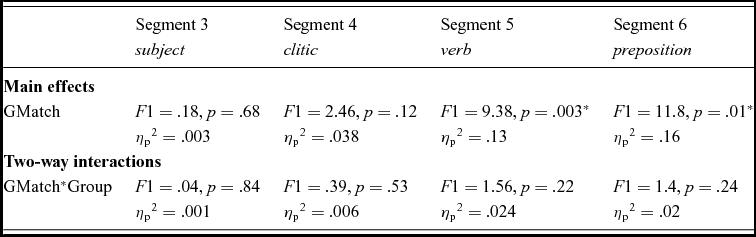
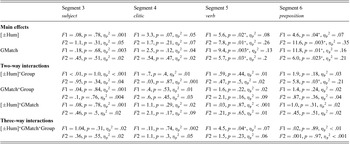
We remind the reader that the experimental design had two (within-subjects) independent variables. The first variable was gender match/mismatch between the clitic and the discourse-prominent antecedent, and the second variable was the [±Human] condition. Before analyzing the results by condition, we compared reading times of gender matching and gender mismatching sentences. We performed a 2 × 2 repeated-measures ANOVA test for the reading times for each of the five sentence segments: the subjectFootnote 8 , the clitic, the verb, and the penultimate sentence segment, the preposition. We found no statistically significant main effect or interaction on the subject nor on the clitic. We found a statistically significant main effect of gender match/mismatch for the verb and the preposition. These results are reported in Table 2.
Main effects and interactions in 2 × 2 repeated-measures ANOVA for reading times of each sentence segment.

* statistically significant p values at .05
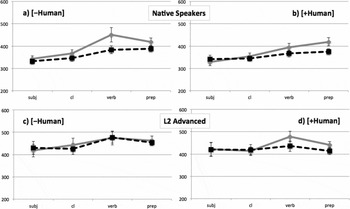
To determine whether the differences in reading times of sentences with gender matching and mismatching clitics were statistically significant in [–Human] as well as in [+Human] condition, we analyzed reading times for each segment by condition. These word-by-word reading times are graphically presented in Figure 7. We performed a 2 × 2 × 2 repeated-measures ANOVA test. Our within-subjects variables were [±Human] condition and Gender (Mis)match and the between-subjects variable was Group (natives and advanced). Main effects, two- and three-way interactions for each analyzed segment are presented in Table 3. Finally, in analyzing the results we were primarily interested in whether native speakers and advanced L2 learners were sensitive to gender mismatches. Therefore we focused on these contrasts leaving aside the general differences between reading times in [+Human] vs. [–Human] conditions. If detected, such contrasts could be the artifact of the experimental design since it was impossible to control for the impact of the differences in [±Human] contexts on the processing of the test sentences.
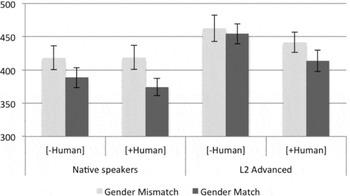
Reading times (ms) per segment: . . . Margotsubj lecl dessineverb avecprep admiration.

Main effects and interactions in 2 × 2 × 2 repeated-measures ANOVA for reading times of each sentence segment.

* statistically significant p values at .05
a approaching statistical significance
The differences between gender matched and gender mismatched sentence reading times on the subject (segment 3) and the clitic (segment 4) were minimal and did not produce any statistically significant results. The ANOVA on the reading time of the verb (segment 5), the segment immediately following the clitic, revealed a three-way interaction of Condition × Gender (Mis)Match × Group in the by-subject analysis (F1 (1,63) = 4.5, p = .04) and a main effect of condition in the by-item analysis (F2 (1,22) = 7.8, p = .01). The post-hoc Bonferroni test of the data grouped by subject showed that while Native speakers took longer to read verbs that followed clitics of mismatched gender in both [+Human] (p = .03) and [–Human] conditions (p = .002), advanced L2 learners were only sensitive to gender mismatches in the [+Human] condition (p = .02), but not in the [–Human] condition (advanced: p = .93).
In both by-participant and by-item analyses, both groups were sensitive to gender mismatches on the preposition following the verb (avec ‘with’ in the example given in Figure 5). The ANOVA revealed a main effect of Gender (Mis)Match (F1 (1,63) = 4.6, p = .04; F2 (1,22) = 11.6, p = .003). We also detected a main effect of Condition in the by-participant analysis and a two-way interaction between Condition × Gender (Mis)Match in the by-item analysis (see Table 3 for the results). The last two results address differences between [±Human] conditions and not between gender (mis)matches. As discussed above, such differences between conditions were hard to avoid in designing the experiment and are not directly relevant to the research questions pursued here.
Going back to the differences between gender matched and gender mismatched sentences, the contrasts in reading times detected at the preposition (6th segment) are visually presented in Figure 8. Even though the difference between gender matching and gender mismatching sentences in the [–Human] condition in the advanced L2 group was small, it was in the predicted direction and statistically significant. Therefore, it is important to point out that native speakers and, crucially, advanced L2 learners were sensitive to gender incongruity in both conditions.
Reading times (ms) of segment 6.

Discussion
In order to understand how L1 lexical combinations of morphosyntactic and semantic features affect L2 knowledge of French pronouns and how this knowledge develops over time, we conducted two experiments with native speakers and L2 learners of French of different proficiency. Since we were primarily interested in which features of pronouns were easier to access and process, we used a picture selection task and a self-paced reading task. The two tasks differed dramatically in their level of difficulty. The picture selection task was less demanding than the self-paced reading task, as evidenced by ceiling performance on the former by the native speakers and the advanced L2 learners. The self-paced reading task, on the other hand, proved overly complex for beginning and intermediate learners, whose results were excluded from further analysis of this task. This difference in the level of difficulty of the tasks allowed us to venture extrapolations about interlanguage development at different proficiency levels.
We focused on a language combination (L1 English – L2 French) where significant feature reassembly was required. First, L2 French lacks the [±Human] feature available in L1 grammar. Second, unlike English, L2 French lexically encodes grammatical gender. Hence, while the L1 has natural gender, the L2 grammatical gender feature is new to the learners and they need to add it into pronoun feature bundles at the same time as they delete the native [±Human] feature. The experimental tasks were designed to relieve processing pressure by consistently providing grammatical gender information through the determiner.
The participants in the current experiment were instructed learners of French. This means that they most likely received explicit metalinguistic explanations and in-class practice using object pronouns. Therefore, the interpretation errors we uncovered in our study provide further evidence for the sequential nature of second language acquisition, where target-like representations and target-like language use can be facilitated by instruction but also require extensive linguistic input and practice. On the one hand, we uncovered clear developmental patterns with respected to the tested property. On the other hand, since the participants were receiving instruction, even the beginners performed fairly well on the easier task that tested pronoun interpretation.
More specifically, in the picture selection task the beginner group demonstrated some ability to use grammatical gender to interpret L2 pronouns. However, lexical encoding of natural gender in the L1 pronominal paradigm (he vs. she) influenced beginner and intermediate L2 learners’ off-line interpretations of le and la. L2 learners in these two groups interpreted French object clitics more accurately when they referred to people than when they referred to inanimate objects. Namely, the learners initially made fewer ‘gender errors’ interpreting natural gender in the [+Human] condition than interpreting grammatical gender in the [–Human] condition. These results reflect the learners’ relative difficulty in using grammatical gender as compared to natural gender to interpret French accusative clitics.
The advanced L2 learners, however, performed very accurately interpreting L2 pronouns in the picture selection task. Their accuracy rate was equally high in both [+Human] and [–Human] conditions (99%). This fact suggests that, at high proficiency levels, L2 learners used grammatical as well as natural gender to interpret pronouns. Thus, the accuracy of the advanced group on the picture selection task indicates that an eventual successful reassembly of morphosyntactic features is possible. grammatical gender has become part of the feature specifications of the L2 clitic pronouns in the grammar of these learners, even though this feature is not lexically encoded in L1 pronouns.
Turning to on-line processing of the gender feature, we can see that the specific feature encoding in the L1 affected how gender mismatched pronouns were comprehended in real time. However, these differences between L1 and L2 processing of gender mainly had to do with the timing of the effects triggered by feature mismatches. Based on our results, we can conclude that advanced L2 learners used grammatical gender information to interpret L2 pronouns on-line. We observed similar effects in the native and the advanced L2 group, even though these effects appeared somewhat later in the case of L2 learners. Simply put, native speakers demonstrated sensitivity to gender violation in processing verbs immediately following the clitic, while advanced L2 learners demonstrated comparable sensitivity one segment later. This is not an unusual finding in L2 processing research (e.g., Hahne, Reference Hahne2001; Coughlin & Tremblay, Reference Coughlin, Tremblay and Armstrong2011).
Let us first discuss the reading time patterns detected on the segment immediately following the clitic pronoun – the verb. Native speakers of French took longer to read verbs that followed gender mismatched pronouns that referred to [+Human] as well as [–Human] antecedents. When reading the verb, the advanced learners were only sensitive to gender mismatches in the [+Human] condition, not to gender mismatches in the [–Human] condition. Recall that in the off-line task the same advanced group used grammatical gender to the same degree as they used natural gender and made virtually no errors in interpreting L2 pronouns (1% error). This discrepancy between the off-line and the on-line impact of gender on pronoun processing could indicate a lingering transfer effect on L2 processing from the native language that has natural gender, but not grammatical gender in its inventory. The difference in the L2 performance with grammatical and natural gender uncovered in the self-paced reading task went undetected in the off-line performance.
Now, let us turn to the reading time patterns observed two segments after the clitic was encountered. Importantly, the advanced L2 learners took longer to read this segment in sentences where the clitic did not match the gender of the discourse prominent antecedent. These differences were detectable in both [+Human] and [–Human] conditions. These results suggest that advanced L2 learners can detect grammatical gender violations as well as natural gender violations, even though these processing reflexes are detectable (one segment) later in L2 reading time data than in native speakers’ data.
Based on these off-line and on-line findings, we would argue that ultimately successful feature reassembly is possible and it is evident in on-line processing as well as in off-line interpretations of L2 pronouns. However, the influence of lexical encoding of L1 morphosyntactic features is detectable in on-line language processing for much longer (even at advanced proficiency levels) than in the off-line performance. It manifests itself in three ways. First, advanced L2 learners detected gender violations at the same processing moment as native speakers in the [+Human] condition, but not in the [–Human] condition. Second, the asymmetry between gender matching and gender mismatching sentences in the [–Human] condition became detectable later in the reading times of the advanced L2 learners. Lastly, the distinctions between the reading times in gender match and gender mismatch sentences were not as sharp in [–Human] condition as in [+Human] condition for the advanced L2 learners, another possible consequence of L1 transfer. In other words, gender mismatch based on the feature that exists in L1 (i.e., natural gender) was more prominent for the advanced learners than the feature mismatch that does not exist in the L1 (i.e., purely grammatical gender of [–Human] referents). Provided these distinctions between off-line and on-line performance of the advanced L2 learners, we can assume that a certain delay could exist between acquiring a representation and being able to utilize it automatically on-line.
In this respect, our findings are in accord with accounts that postulate that variability in L2 functional morphology may be due to lexical access difficulty (e.g., the Missing Surface Inflection Hypothesis, Prévost & White, Reference Prévost and White2000). According to these accounts, language has an underlying and a surface representation. L2 learners are able to successfully acquire abstract functional features, but may continue using forms that are underspecified for the said features. Our results also square with usage-based accounts, e.g., L2 learners create weaker lexical representations than native speakers because they use the L2 considerably less (Gollan, Montoya & Werner, Reference Gollan, Montoya and Werner2002). Finally, the findings are also compatible with capacity accounts, which argue that problems with functional morphology are due to the lower processing capacity of L2 learners, which prevents them from consistently accessing and computing inflection and function words in real time (Hopp, Reference Hopp2010; McDonald, Reference McDonald2006). According to these accounts, computational difficulties stem from paucity of memory resources, slower decoding and, in general, slower processing. Our results also demonstrate that speaking of L1 influence on L2 development (as in the Full Transfer Full Access Hypothesis, Schwartz & Sprouse, Reference Schwartz and Sprouse1996) is no longer precise enough. L1 influence is stronger in cases when feature reassembly is needed. Conceptualizing transfer in terms of feature reassembly (e.g., adding new features, getting rid of L1 features, reassembling features from L1 lexical bundles) allows us to better predict L1 transfer in general and specific errors and developmental trajectories in particular.
The reading times pattern uncovered in our experiment could alternatively be explained by the differences in “cognitive strength” (Carminati, Reference Carminati2005, p. 259) of natural and grammatical gender in L2 processing. It is conceivable that natural gender is generally easier to process than grammatical gender. For example, Carminati discovered processing differences for pro resolution. In her experiment number mismatches were processed faster than gender mismatches. The current experiment did not reveal such an asymmetry in the processing of grammatical and natural gender by native speakers of French, a finding that echoes the results obtained by Garnham et al. (Reference Garnham, Oakhill, Ehrlich and Carreiras1995). It is still conceivable that natural gender mismatches are more salient than grammatical gender mismatches for L2 learners who have not achieved near-native proficiency in an L2. In order to explore this possibility, further research is necessary into how grammatical and natural gender mismatches are processed by L2 learners – especially speakers of L1s that lexically encode both grammatical and natural gender.
Here we mainly focused on two types of gender, grammatical and natural gender, and how L2 speakers, who do not have grammatical gender in their L1, acquire this new feature. However, as discussed at the beginning of the article, the mismatch between French and English also involves how the [±Human] feature is lexically encoded in the two languages. We are leaving a more detailed investigation of this featural mismatch to further research. Future research on the topic could also benefit from considering statistical properties of the linguistic input potentially available to L2 learners. Earlier sensitivity to natural gender mismatches could be the result of differences in the statistical distribution of human and non-human referents of le and la in the input.
The FRH tested here has important pedagogical implications, encouraging L2 educators to be mindful of L1-L2 differences. Teaching French object clitics pronouns to native speakers of English is a good case in point. Even though the current study used a cross-sectional design and did not look at the effects of instruction on acquisition, it still has implications for L2 pedagogy. When it comes to teaching French pronouns to Anglophones at college level, a cursory examination of some textbooks as well the first author's personal experience reveal that most pedagogical interventions are focused on training students in clitic production. Additional evidence from Bruhn de Garavito's work on Spanish pedagogy of pronominal clitics suggests a similar picture for teaching Spanish clitics. Namely, the forms are presented along with some grammatical rules, followed by fill-in-the-blank practice activities, question-and-answer activities prompting learners to use clitics in a sentence, and open-ended communicative activities (Bruhn de Garavito, Reference Bruhn de Garavito2013).
Applied linguists, who conducted research on L2 acquisition of Romance clitics, have called for a more careful attention to the input characteristics in teaching the topic (Bruhn de Garavito, Reference Bruhn de Garavito2013; Erlam, Reference Erlam2003; Wust, Reference Wust2010). Classroom-based intervention studies found that form-focused instruction is beneficial to L2 acquisition, including form-focused instruction of French object pronouns (Erlam, Reference Erlam2003). However, several potentially important variables were conflated in Erlam's study, for example the [±Human] distinction of pronominal antecedents. Based on her cross-sectional study of L2 acquisition of French object clitics, Wust (Reference Wust2010) recommended providing students with ample possibilities in clitic detection and interpretation. This approach to teaching French clitics goes in line with the tenets of Processing Instruction (VanPatten, Reference VanPatten and VanPatten2004, Reference VanPatten, Gass and Mackey2012), where foreign language teachers are encouraged to provide a variety of comprehension exercises to help learners pay attention and, ultimately, master L2 morphology.
Based on our results, we would like to join Wust and the proponents of Processing Instruction in encouraging French instructors to provide students with more comprehension activities, especially at the initial stages of instruction. Our findings lead us to believe that activities targeting native-like interpretation of object clitics should be part of the curriculum along with production exercises, especially in the case of Anglophone learners, where no one-to-one mapping can initially be established between L1 and L2 forms. Learners should be trained to resolve pronoun reference using lexically encoded information in a target-like way. Our results also reinforce the voices in the field that call for practicing processing morphosyntactic and semantic distinctions that might be problematic to L2 leaners (Lardiere, Reference Lardiere, Gass and Mackey2013; Slabakova & García Mayo, Reference Slabakova, García Mayo, Whong, Gil and Marsden2013).
Conclusion
In this experimental study, we heed Clahsen et al.’s (Clahsen, Felser, Sato & Silva, Reference Clahsen, Felser, Sato and Silva2010) directive that “more fine-grained linguistic distinctions are required to understand the nature of L2 morphological processing, beyond the basic procedural versus declarative difference.” (Clahsen et al., Reference Clahsen, Felser, Sato and Silva2010, p. 39) The combined picture that emerges from the results of two tasks suggests that the way the native language bundles morphosyntactic and semantic features into various lexical items affects L2 development. These results by and large support the predictions of the FRH and provide further motivation for conceptualizing L1 transfer in terms of mapping and reassembly of morphosyntactic and semantic features in L2 lexical items. Changes in the interlanguage at different proficiency levels were detected not only in the task that directly tested comprehension but also in the on-line task. However, ultimately successful feature reassembly is possible, as revealed by learners’ off-line and, importantly, on-line performance. An area that still deserves further investigation is the relationship between the ability to map/reassemble features as part of linguistic representations and the ability to efficiently recruit these representations during language processing. This, indeed, was one of the questions we asked in the introduction of the paper. Based on our results, we propose that target-like on-line use of correct feature bundles could constitute a third stage of interlanguage development that follows the mapping and the reassembly stages. This last stage would most likely consist of strengthening links between lexical nodes and corresponding gender classes (Hopp, Reference Hopp2013), and automatizing procedural knowledge of gender agreement (Segalowitz, Reference Segalowitz2010; DeKeyser, Reference DeKeyser, VanPatten and Williams2015). It remains to be seen how such a view fares with an opposing view such as Parsing to Learn, where on-line sensitivity precedes target-like interpretations (Dekydtspotter & Renaud, 2014). The proposal based on the current findings would need further empirical verification with other properties, other language combinations, and longitudinal data on feature reassembly.
Appendix 1 Test items of the picture selection task
[+Human] condition
-
1. Mardi soir Nicolas vient à la bibliothèque pour rencontrer Anne et David. Nicolas : « Parfois, je la/le vois près de la fenêtre. »
-
A. Anne
-
B. David
-
C. Anne ou David: les deux sont possibles
-
D. La table/le dictionnaire
-
-
2. Le mercredi Nicolas va au parc avec Claire et Luc. Nicolas : « Le soir je le/la cherche partout. »
-
A. Claire
-
B. Luc
-
C. Luc ou Claire: les deux sont possibles
-
D. Le banc/la fleur
-
-
3. Paul et Nathalie font leurs études à Londres cette année et parlent anglais tout le temps. Nicolas : « Maintenant, je le/la comprends difficilement. »
-
A. Nathalie
-
B. Paul
-
C. Nathalie ou Paul : les deux sont possibles
-
D. Le livre/la brochure
-
-
4. Vendredi Marie et Pierre ont été malades et ne sont pas venus à l’école. Nicolas : « Heureusement, lundi je la/le retrouve en classe. »
-
A. Marie
-
B. Pierre
-
C. Marie ou Pierre: les deux sont possibles
-
D. La feuille de papier/le cahier
-
-
5. Jeudi les étudiants préparent des projets en groupes. Sabrina et Marc veulent travailler avec Nicolas. Nicolas : « Parfois je le/la choisis pour faire le travail. »
-
A. Sabrina
-
B. Marc
-
C. Sabrina ou Marc : les deux sont possibles
-
D. Le projecteur/la tablette
-
-
6. Philippe, Louisette et Nicolas font beaucoup d'activités: du judo, de la natation et du cheval. Ils passent beaucoup de temps ensemble. Nicolas: « Par conséquent, je la/le connais bien. »
-
A. Louisette
-
B. Philippe
-
C. Louisette ou Philippe : les deux sont possibles
-
D. La bibliothécaire/Le bibliothécaire
-
[–Human] condition
-
1. Quand Nicolas doit travailler à la bibliothèque, il préfère sa chaise confortable et son canapé relaxant. Nicolas : « Parfois, je la/le vois près de la fenêtre. »
-
A. la chaise
-
B. le canapé
-
C. la chaise ou le canapé : les deux sont possibles
-
D. la tablette/le dictionnaire
-
-
2. Quand il joue dans le parc, Nicolas cours vers la fontaine ou vers le banc. Nicolas : « Dans le parc, je le/la cherche chaque dimanche. »
-
A. la fontaine
-
B. le banc
-
C. le banc ou la fontaine : les deux sont possibles
-
D. le terrain de football/la fleur
-
-
3. Les devoirs à l’école sont très difficiles. Nicolas doit lire plusieurs fois le journal et la brochure distribués en classe. Nicolas : « Maintenant, je le/la comprends bien. »
-
A. la brochure
-
B. le journal
-
C. la brochure ou le journal : les deux sont possibles
-
D. le dictionnaire/la lettre
-
-
4. Le weekend Nicolas ne peut pas trouver son sac à dos et sa clé USB. Nicolas : « Heureusement, lundi je la/le trouve à l’école. »
-
A. la clé USB
-
B. le sac a dos
-
C. la clé USB ou le sac a dos : les deux sont possibles
-
D. la ceinture/le baladeur MP3
-
-
5. Nicolas adore les fruits. Ses fruits préférés sont la pomme et le pamplemousse. Nicolas : « Parfois je le/la choisis pour mon goûter. »
-
A. la pomme
-
B. le pamplemousse
-
C. le pamplemousse ou la pomme : les deux sont possibles
-
D. le kiwi/la banane
-
-
6. Nicolas passe beaucoup de temps dans le parc et à la ferme. Nicolas: « Par conséquent, je le/la connais bien. »
-
A. la ferme
-
B. le parc
-
C. le parc ou la ferme : les deux sont possibles
-
D. le muse/la librairie
-