


1 Introduction
The etymologies of two common Germanic words, English blood and bone, are marked by their obscurity. Although their cognates are well represented within the Germanic family, both lack clear cognates in other Indo-European languages. Various explanations for their origins have been put forward, including the claim that neither is Indo-European (Hawkins Reference Hawkins and Comrie1987).
Figure 1 shows the prominent proposed etymologies of blood, plus some of its cognates, which are found in all three branches (Eastern, Northern and Western) of Germanic.
Blood's etymology
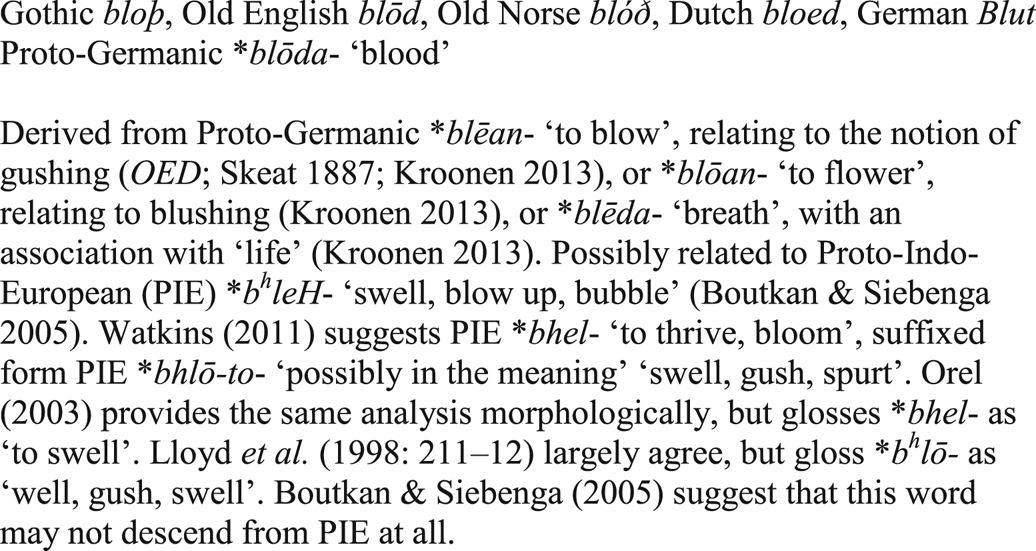
As an anatomical term, bone refers to elements of the skeleton, but its cognates are polysemous: in Dutch and the Scandinavian languages, it may mean ‘bone’ or ‘leg’, while in German, it predominantly means the latter. (Knochen is the regular German word for ‘bone’.) No cognate is found in Gothic. Figure 2 shows its widespread etymologies and some of its cognates.
Bone's etymology
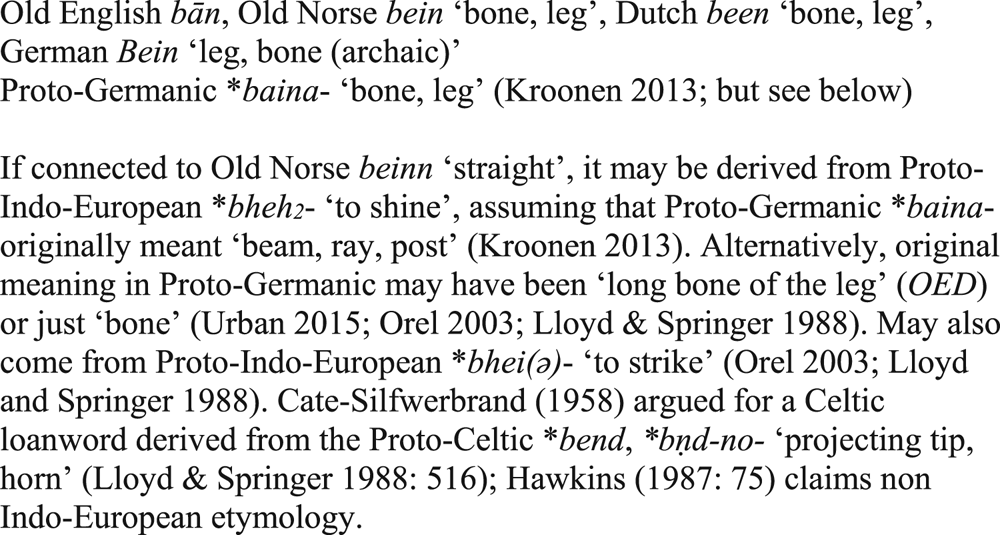
The association in Old Norse between beinn ‘straight’ and bein ‘bone, leg’ is dubious; the Oxford English Dictionary Online (hereafter OED) describes it as possible but unsubstantiated, and calls into question the origin of the Old Norse adjective itself; Orel (Reference Orel2003: 32) and Kroonen (Reference Kroonen2013) call for considerable semantic elasticity to account for the name of a basic body part, and neither seems especially confident in their disparate accounts.
Both blood and bone (and their cognates) share an initial b- with many other body-related words throughout Germanic (e.g. beard, brain, breast). These words constitute what Dwight Bolinger (Reference Bolinger1940: 65) dubbed a ‘word constellation’: a group of words sharing similar semantics and a certain phonetic characteristic – in this case, an initial /b/. I suggest that the association of sound and meaning played a critical role in the lexicogenesis of blood and bone, formed by blending the initial b-, suggestive of the group of body-related words, with two pre-existing lexemes: Proto-Germanic *flōda- ‘something that flows’ and *staina- ‘stone’, both of which are uncontroversially derived from Proto-Indo European (hereafter PIE) (Boutkan & Siebenga Reference Boutkan and Siebenga2005; Watkins Reference Watkins2011: 87; Kroonen Reference Kroonen2013).
In section 2, I provide an overview of phonesthesia, with a particular focus on the role of phonesthemes in word formation. In this section, I describe the b- ‘body-related’ phonesthetic group. In section 3, I discuss Germanic vocabulary, with consideration given to the Germanic Substrate Hypothesis and the word-formation process of blending. In section 4, I discuss my proposed etymologies for blood and bone, outlined above, addressing some potential problems with these etymologies. I conclude in section 5 by considering the significance of these suggestions for the consideration of phonesthemes in linguistics more generally.
2 Phonesthesia
Phonesthemes (sometimes phonaesthemes) are ‘frequently recurring sound-meaning pairings that are not clearly contrastive morphemes’ (Bergen Reference Bergen2004: 290). The term was coined by Firth in 1930, but the phenomenon it applies to has been described in English since as far back as 1653, when John Wallis included a list of evocative sound clusters in his Grammatica Linguae Anglicanae. Some examples on Wallis’ list were wr-, showing ‘obliquity or twisting’, as in wry, wrong, wreck and wrist, and br-, evoking a ‘violent and generally loud splitting apart’, as in break, breach and brook (Magnus Reference Magnus and Allen2013: 198). Wallis argued, as Bolinger (Reference Bolinger1940) would three centuries later, that the meanings of some words could be ascertained through the sound clusters of which they are composed; in sparkle, for instance, the sp- ‘indicates dispersion’, -ar- evokes ‘high-pitched crackling’, -k- indicates ‘sudden interruption’ and -l ‘frequent repetition’, as in wiggle, wobble and twiddle (Magnus Reference Magnus and Allen2013: 199). Most phonesthemes in English are onsets or initial consonants, but rimes and codas may be phonesthetic as well (Firth Reference Firth and Strevens1930: 185; Lawler Reference Lawler2006: 1–2). Phonesthemes can occur in any lexical category (Kwon & Round Reference Kwon and Round2015: 14).
The question of where phonesthemes originate remains unanswered. Benczes (Reference Benczes2019: 74–83) provides a good overview of the topic. Boussidan et al. (Reference Boussidan, Sagi and Ploux2009: 36) suggest that they may have begun as morphemes in a proto-language, which ‘may have survived through generations’. Watkins (Reference Watkins2011) lists several Indo-European roots as the progenitors of some Germanic phonesthemes (see section 2.1, below). Blust (Reference Blust2003: 199–200) thoughtfully considers this topic, but concludes that ‘the origin of phonesthemes remains enigmatic’.
There is considerable debate over whether phonesthemes are morphemic (Benczes Reference Benczes2019: 84). Blust (Reference Blust2011: 407) characterizes phonesthemes as ‘submorphemes’, because they ‘can be identified by recurrence, but not by contrast’. Kwon & Round (Reference Kwon and Round2015: 24) review this issue, and find that phonesthemes behave like morphemes in most ways, other than the fact that they often appear in ‘lexical stems which are composed of a recurring sound-meaning pairing plus a non-recurrent residue’. Ultimately, they assert that ‘it is imperative that phonaesthemes be accorded a coherent place in morphological theory’. It is sufficient for my purposes here to state that a phonestheme expresses a ‘recognizable semantic association’ without necessarily being classified as a morpheme.
Phonesthemes are often thought of within the domain of sound symbolism, a broad field that also encompasses onomatopoeia and ideophones, defined by the hypothesis that ‘the meaning of a word is partially affected by its sound (or articulation)’ (Magnus Reference Magnus and Allen2013: 192). To some extent, sound symbolism is at odds with the notion that the relation between the signifier and the signified is arbitrary, but Blust (Reference Blust2003: 201) sets phonesthemes apart from onomatopoeia, from which they ‘appear to be entirely independent’. Instead, their form is arbitrary: their semantic associations arise from their ‘use and application to new words in the lexicon’, and not some inherent psychological association of sound and meaning (Williams Reference Williams2013: 597). Firth (Reference Firth1957: 198) railed against associating phonesthemes with ‘the fallacy of sound symbolism’, positing only that ‘a definite correlation can be felt and observed between the use and occurrence of certain sounds and sound-patterns … and certain characteristic common features of the contexts of experience and situation in which they function’ (1957: 45). There is no empirical evidence that phonesthemes tend to occur in any particular semantic domains (Blust Reference Blust2003: 201), which further distinguishes them from onomatopoeia, which is relegated to imitative sounds. Nonetheless, many researchers still associate phonesthemes with sound symbolism, going to far as to identify the phonestheme as ‘a type of sound symbolic entity’ (Abelin Reference Abelin2015: 20). Drawing a firm distinction between phonesthemes and sound symbolism is troublesome because sound symbolism is inconsistently defined (Elsen Reference Elsen2017: 491–2).
In order for a phonestheme to exist, there must be a set of words that share similar semantics and a similar phonological form. Bolinger (Reference Bolinger1940: 65) refers to these groups as ‘word constellations’; the term used in this paper is ‘phonesthetic group’. A phonesthetic group exists regardless of its composite words’ ‘etymology and language of origin’ (Wright Reference Wright2012: 5), and may contain words belonging to different lexical categories. The number of words necessary to constitute a phonesthetic group is not defined, but the larger the group, the more canonical it is understood to be (Kwon & Round Reference Kwon and Round2015: 13). A phonestheme's location within a word is important: a given phoneme must appear in a particular position in a series of words with a shared semantic domain, such as the onset of the first syllable or coda of the final syllable, for it to become associated with said domain. In Germanic languages, most phonesthemes occupy the beginnings of words.
Bolinger (Reference Bolinger1975: 219) writes that the strength of a phonesthetic group can influence the meaning of a word that originally shared with the group a formal, but not semantic, feature. For example, twiddle, first attested in 1547, originally meant ‘to be busy with trifles’. However, it acquired the sense of ‘rotate or turn’ around 1676, due to its formal similarities with words like twist and twirl (Smith Reference Smith2014: 25). The OED is unclear on twiddle's etymology, and suggests that it is actually a blend of twist or twirl with fiddle or piddle – however, the fact that it showed no apparent semantic connection to twisting until over a century after its first attestation might call this account into question.
It has also been argued that phonesthesia can be a deciding factor in which words are borrowed. Firth (Reference Firth and Strevens1930: 191) opined that ‘the importance of “phonaesthemes” in permanently naturalized borrowed words has not been properly recognized’. Carling & Johansson (Reference Carling and Johansson2014: 211) write that ‘a number of words in sound symbolic [i.e. phonesthetic] networks are loan words’, noting that many cases are inter-Germanic, such as Swedish glas ‘glass’ from Middle Low German glas ‘glass’ from Old Norse gler, all in the gl- ‘light-related’ phonesthetic group. Others are from outside of Germanic, like English glair ‘white of an egg’ and glairy ‘wisced, slimy’, from Old French glaire ‘egg white’ (ibid.).
2.1 Phonesthemes in English and their role in word formation
Three well-attested English phonesthemes are gl-, sn- and gr-. gl- suggests luminousness; it appears in words such as glisten, glow, gleam, gloss, glimmer and glitter. Bolinger (Reference Bolinger1965: 221–2) estimated that half of the common English words beginning with this cluster had to do with ‘light/vision’. Bergen (Reference Bergen2004: 293) consulted an online version of Webster's 7th Collegiate Dictionary and found that 39 percent of word types and 60 percent of word tokens beginning with gl- related to ‘light’ or ‘vision’, and that 28 percent of word types and 19 percent of word tokens beginning with sn- had definitions relating to ‘nose’ or ‘mouth’. This was described as an ‘overwhelming statistical pairing’. Working with the Middle English Dictionary (hereafter MED), Williams (Reference Williams2013: 599) found most gl- words in Middle English to fall within five main semantic fields: ‘light/vision’ (glisnen, glou), ‘joy/gladness’ (gladful, glē), ‘vitreousness/viscosity’ (glas, gleu); ‘quick/smooth movement’ (glīden, glent); and deceptiveness (glōse, glāberer). Tabulating all Middle English gl- words in the MED, he found the ratio of phonesthetic to questionably/non-phonesthetic words to be 151:84 (i.e. nearly 2:1). Williams also identified certain words as bridging these semantic categories. For example, glem connoted both brightness and deception; while it literally meant ‘a beam or radiance of emitted light’, it also indicated ‘a type of what is evanescent or fleeting’, as in the phrase maken a glem, ‘to make a deceptive show’ (Williams Reference Williams2013: 603). Williams found that these polysemous linking words were employed at key points in the Middle English Pearl (late fourteenth century) to heighten the poem's effect.
Sn- suggests an association with the nose, as in snot, snort, snout, snore and sniffle. According to Philps (Reference Philps2011: 1123), approximately a third of all lexical stems beginning with sn- in the New Short Oxford English Dictionary have to do with nasality. Francis & Kucera (Reference Francis and Kucera1982) found 28 percent of word types and 19 percent of word tokens beginning with sn- in the Brown corpus to have meanings related to ‘nose’ or ‘mouth’, a percentage far above chance (Bergen Reference Bergen2004: 293). The association of sn- with the nose may account for the modern form of sneeze: this word is a cognate of the Dutch fniezen, Danish fnyse and Swedish fnysa, ‘to snort’. In Middle English, the word was fnese, from the Old English fnēsan, ‘to sneeze, puff, snort’; it's not attested as sneeze until 1493. The transformation of Middle English /f/ to English /s/ is not the result of a regular process of sound change; it is accounted for by the semantic pull of other nose-related sn- words, like snore, snoke ‘to snuff or smell’, and snite ‘to clean or wipe the nose’ (Burridge & Stebbins Reference Burridge and Stebbins2015: 136).
Gr- suggests ‘grasping’, appearing in such words as grasp, grip, grab, grapple, and grope (Kwon & Round Reference Kwon and Round2015: 16). Piotr Sadowski (Reference Sadowski2001) studied gr- in Middle English alliterative verse, identifying six main clusters of meaning: hand-object contact (graspen, gropen), ‘the processes of natural life occurring above the ground’ (gras, ground), words pertaining to ‘the inside of the earth and things underground’ (grave, gravel), agriculture words (grist, grain), words involving negative emotions relating to fear (grendel, grim), and words involving negative emotions relating to sadness (greven, gronen). Like Williams, Sadowski found these groups connected by linking words. He also determined that the majority of phonesthetic gr- words were of native Anglo-Saxon origin.
Because these three phonesthemes appear in several other Germanic languages (Blust Reference Blust2003: 188; Abelin Reference Abelin1999: 135; Firth Reference Firth1957: 45), it is suggested that their phonesthesia dates back to Proto-Germanic (Carling & Johansson Reference Carling and Johansson2014: 206). Watkins (Reference Watkins2011: 29, 84) suggests that gl- and sn- be traced back to PIE, reconstructing their etyma as *ghel- ‘to shine’ and *snu- ‘imitative beginning of Germanic words connected to the nose’.
2.1.1 -g ‘animal name’
One of the more interesting English phonesthemes is the final -g in the names of several animals: dog, frog, pig, stag, earwig, teg (‘a sheep in its second year’), hog (and its compounds, like warthog), bug and slug. This phonesthetic group is presented in table 1, divided into five subgroups. The first two contain names that have been in the group continuously since Old English. Subgroup 3 contains more recent additions. The fourth contains sucga, a group-member in Old English without a descendant in the language today. The final subgroup contains bagga, a group member in Old English whose modern form, badger, does not end in -g, and which is therefore not a member of this phonesthetic group any longer. Some of the Old English forms, marked with an asterisk, have been reconstructed from placenames (Hogg Reference Hogg and Anderson1982: 195).
The -g animal names

2.1.2 Old English -cga, -gga ‘hypocoristic animal name’
According to the OED, the words in subgroup 1 form a set ‘of uncertain or phonologically problematic etymology’ dating back to Old English, where each of them contained the medial [gg] geminate, written as -cg- or -gg-. Hogg (Reference Hogg and Anderson1982: 195) highlights this geminate's rarity: including actual samples plus those reconstructed from place names, it appeared in only 21 Old English words. The majority of geminates in Old English are attributed to West Germanic doubling of a consonant before *j; however, a [gg] cluster in this environment would have subsequently been palatalized early on in the development of Old English. The fact that these words contain [gg], as opposed to [ʤ], indicates that they cannot have resulted from West Germanic gemination, meaning that their development was the result of an innovative process taking place within Old English itself.
A significant portion of all Old English [gg] words are animal names that take the form of masculine weak nouns, including the etyma of the words listed above: docga, frogga, *picga, *stacga, (ēar-)wicga and *tacga ~ *tecga, as well as sucga ‘hedge sparrow’.Footnote 2 Gąsiorowski (Reference Gąsiorowski2006: 279) suggests that bagga ‘badger’ be added to this list, and the OED would add hogga ‘hog’, a strong masculine that may originally have been weak. Most of these words have etymologically transparent, ‘more important’ synonyms in Old English: hund, frosc (‘the normal form in the Germanic languages’) or frox, swīn, heorot ‘male deer’, ceafer ‘beetle, locust, caterpillar, or other pest’, scēap or ēowu and spearwe ‘sparrow’, which they only came to replace gradually (Hogg Reference Hogg and Anderson1982: 196). As a result, there is general consensus that the [gg] animal names were originally hypocoristic forms (Gąsiorowski Reference Gąsiorowski2006: 280; Hogg Reference Hogg and Anderson1982: 196; OED). It is worth mentioning here that the medial [gg] is not apparently imitative in any way. Rather, it may be understood as a phonestheme, one of several ‘frequent pairings of phonemes and aspects of meanings’ (Elsen Reference Elsen2017: 492), in this case expressing the fact that a given animal name is hypocoristic.
2.1.3 Development of the phonesthetic group
Slug has perhaps the simplest etymology, and appeared the latest. From the Middle English adjective slugge ‘to be lazy, slow, or inert’, a likely Scandinavian borrowing, it is not attested as an animal name until 1703 (OED). Although its derivation has nothing to do with its phonesthetic quality, this is a member of the group today due to its shared semantic and phonological affinities.
While hog is generally considered a Celtic borrowing (see Welsh hwch, Cornish hogh), it is suggested by both Hogg (Reference Hogg and Anderson1982: 197) and the OED that it ‘may have been partially assimilated to the group of which *picga is a member, on purely semantic grounds’. This semantic pull may also be responsible for frogga, derived by replacing the final consonants of the original frosc~frox ‘frog’ with the -gga phonestheme (OED; Gąsiorowski Reference Gąsiorowski2006: 280). Bug ‘insect’, first attested in 1622, was influenced by this process as well. The OED describes its etymology as ‘origin unknown’, and notes:
Perhaps a transferred sense of bug [‘an imaginary evil spirit or creature’], insects being taken to resemble typical representations of monsters or the monstrous, although early examples show no clear evidence of such association. Sense 1 [‘any small insect or larva that is considered to be a pest’] also appears to show either connection or confusion with earlier budde and boud, which occur in similar senses: beside sharn-bug compare earlier sharnbud.
Just as frosc~frox became frogga within Old English, earlier bud became English bug – and both transformations were apparently motivated by the words’ semantic connections with the same phonesthetic group.
Brian D. Joseph (Reference Joseph1997: 12) calls this phenomenon ‘phonesthematic attraction’, applicable when ‘sound symbolic clusters of words … draw other words into their “orbit”, so that these other words change their form in the direction of the sound symbol’. More poetically, Bolinger (Reference Bolinger1953: 328) describes this as ‘a change of form to make the word seem to mean what it really means’.
Using the analogical transformation of frosc~frox to frogga as a starting point, Gąsiorowski (Reference Gąsiorowski2006: 281–2) suggests that docga is derived from dox~dohx ‘yellowish-brown’, an appropriate source given the fawn or brindle color of the mastiff. The usage of color words for hypocoristics is well attested in Old, Middle and Modern English: Gąsiorowski (Reference Gąsiorowski2006: 280) mentions Blæcca, from blæc, an Old English nickname for someone with black hair; Bruin ‘bear’, printed by Caxton in Reynard the Fox (1481), relates to brown; and Red, Blondie and Blackie are commonly used to refer to people or animals with hair of those colors today.
Under Gąsiorowski's analysis, the lexeme dox ‘yellowish-brown’ was taken as the base for the creation of a new term for an animal of that color. The new lexeme was intended to fit into a group of other animal names, all of which ended in -cga or -gga. Its final consonant sounds were replaced with -cga, thereby making it conform to the rest of the series (Reference Gąsiorowski2006: 281–2). Gąsiorowski analyses this derivation as a strengthening of the final obstruent in dox, /ɣ/ or /x/, arising from a hypocoristic truncation of the underlying word. While this strengthening can account for the forms of docga and frocga, this does not explain the many other animal names in this phonesthetic group. I suggest instead that the base was blended with the -cga phonestheme (see figure 3).
Dog

This process is similar to that by which frosc yielded frogga, and by which fnese became sneeze, but differs in a very important way. Frosc always meant ‘frog’ and fnese always meant ‘sneeze’ – their phonological forms were changed in order to fit them into phonesthetic groups, but their meanings remained the same. But with docga, the resulting word's meaning, ‘dog’, is completely different from that of dox ‘yellow-brown’. Although basically synonymous with the pre-existing hund, it constitutes an entirely new word, given its completely distinct phonological form and its difference in register.Footnote 3
2.2 Analogical emergence
Phonesthemes may also be used in the creation of new words through the process of analogical emergence. Carling & Johansson (Reference Carling and Johansson2014: 210) named this method, wherein ‘words are created by means of an association to other sound symbolic words within the language, formally and semantically’. In practice, a speaker incorporates a phonestheme in the creation of a new word. The inclusion of the phonestheme helps to express something of the word's intended meaning, provided that the listener is familiar with the corresponding phonesthetic group.
Åsa Abelin (Reference Abelin1999: 232–7) has conducted experiments wherein subjects were tasked with coining nonce words carrying a particular meaning. Semantically appropriate phonesthemes were usually incorporated into the subjects’ creations. In other words, phonesthetic patterns are accessible to speakers, and are used productively in word formation, even though speakers might not be consciously aware of their existence. Later, Abelin (Reference Abelin2015: 24–7) conducted an experiment wherein ten Swedish-speaking subjects were tasked with pairing nonce words with pictures. The pictures were each chosen to reflect a trait associated with a given phonestheme; this phonestheme was present in one of the two nonce words made available for each picture. Subjects usually matched the images with the words that contained the semantically appropriate phonestheme – for example, when presented with an image of a knotty lump of wood, eight of the ten participants chose the word skrob over blik, in correspondence with the Swedish skr- ‘rough surface’ phonestheme (Abelin Reference Abelin2015: 27).
Because they grant listeners an immediate understanding of a previously unknown word, phonesthemes are popular among professionals who create names for products and companies. Abelin (Reference Abelin2015: 26–7) conducted studies using the corpora of the Swedish Patent and Registration Office and the Swedish registry of medicines, with the database of written Swedish (KORP) used to establish a baseline. It was found that pejorative phonesthemes are almost uniformly avoided in Swedish brand names, and that semantically appropriate phonesthemes were overrepresented in certain fields: for example, fl- ‘speed-related,’ appeared often in names for medications in Sweden.
But incorporating phonesthemes in the formation of new words is not limited to nonce words and brand names, as the English -ash ‘forceful strike’ phonesthetic group illustrates.
The words in this robust group were introduced chiefly in Middle and Early Modern English. Words include bash, clash, crash, dash, gnash, hash, lash, mash, pash, slash, smash and swash. Some of these are only dialectal today, while others are rather high-frequency words. It seems that only mash originated in Old English. Hash is a borrowing of French hacher ‘to cut into small pieces’. Two, lash and slash, may have been borrowed from Old French (lascher ‘to loose, let go’ and esclachier ‘to break’ respectively). Others may have Scandinavian origins: the OED compares bash to Swedish basa ‘baste, whip’ and Danish baske ‘beat, strike’; dash to Swedish daska ‘drub’ and Danish daske ‘to beat’; and gnash is derived from the older English gnast, a borrowing derived from Old Norse *gneista ‘gnash teeth’. But the OED cautions that these cross-linguistic similarities may simply be a case of ‘analogous formations’, noting that English crash is similar, but probably not actually related to, Swedish krasa, Danish krase ‘to crackle’.
The etymologies for most of these words – even those described as possible borrowings – are chiefly characterized by the OED as ‘onomatopoeic’. For some of these words, this seems appropriate: pash and smash are ‘probably imitative’, and swash is ‘echoic’ – onomatopoeic in the true sense of the word. But many of these words are not actually imitative, and, bearing in mind that many of these etymologies were written before Firth coined the word ‘phonestheme’, I suggest a change in terminology: rather than onomatopoeia, several of these words were formed through phonesthesia.
For instance, the OED suggests that clash was formed ‘from instinctive association with classes of pre-existing echoic words. The initial element is that of clap, clack, etc.; the final that of dash, splash, smash, swash, etc., or perhaps a direct imitation of the element of sound common to these.’ These ‘classes of pre-existing echoic words’ might otherwise be called phonesthetic groups. This etymology suggests a compounding of the cl- ‘noisy collision’ phonestheme with the -ash phonestheme. Similarly, crash is etymologized as ‘having the same relation to crack that clash has to clack and clap’, in other words taking the cr- ‘noisy impact’ phonestheme identified by Bloomfield (Reference Bloomfield1933: 245) as its first element. Bash is described as combining ‘the b of beat, bang, and the termination of dash, gash, gnash, hash, lash, pash, smash, etc.’. In these three examples, phonesthemes are taken as bases for the formation of entirely new words.
2.3 b- ‘body-related’
I suggest that b- is a phonestheme in English, indicating ‘part of the body, body-related’. Magnus (Reference Magnus1998) proposed the phonesthetic group of b- ‘body parts’, and calculated the words in this group as constituting 5.31 percent of the 583 English words with an initial b-.Footnote 4 Notably, she populated this phonesthetic group with fewer words than I do. Several of these words can be seen illustrated in figure 4.
This illustration of the bearded woman of Limerick, from a manuscript containing Gerald of Wales’ Topographia Hiberniae (c. 1196–1223), displays numerous body-related b- words, including bare, body, brow, beard, breasts, belly and buttocks. (British Library MS Royal 13 B VIII, f. 19r. British Library Catalogue of Illuminated Manuscripts www.bl.uk/catalogues/illuminatedmanuscripts/welcome.htm. Image is in the public domain.)

The words that I have placed in the b- phonesthetic group, listed in table 2, all feature an initial b- and are spread across four primary semantic subdomains relating to the body: external body-parts, internal body-parts (including fluids and gases), bodily injuries or malformations and bodily verbs, as well as body itself. A few are body-related adjectives. I also included two words which survive only in dialectal English: bree ‘the eyelid’, described in the OED as obsolete except in northern dialects, and bouk ‘the trunk of the body’, now ‘Scottish and dialectal’. It is also noteworthy that a number of words existed in Old English which no longer make up part of Modern English vocabulary, and are thus absent from table 2. These include kennings like bānhūs ‘body [bone-house]’, Latin glosses like burse ‘scrotum’, and everyday words like bæcþearmas ‘intestines’ and bearm ‘bosom, lap’ (Cameron et al. Reference Cameron, Amos and Healey2018; Hough & Kay Reference Hough and Kay2017).
Body-related b-words in English

The first column lists basic words, while the second lists relevant derivatives, e.g. dialectal variants, clippings, or compounds. The third column provides a brief etymology of each word. For development from Old English, my sources were Hall's (Reference Hall1960) Concise Anglo-Saxon Dictionary, Skeat's (Reference Skeat and Walter1887) Principles of English Etymology, vol. I, and the OED. Proto-Germanic reconstructions are from Kroonen's (Reference Kroonen2013) Etymological Dictionary of Proto-Germanic. Where Kroonen provided no etymology, I used Orel's (Reference Orel2003) Handbook of Germanic Etymology; where Orel was lacking, I turned to Fick et al’.s (1909) Wortschatz der Germanischen Spracheinheit (cited as ‘Fick’ in table 2). Although Kroonen's reconstructions take primacy, I consulted all three of these dictionaries for background information and alternative analyses. PIE reconstructions are from Watkins’ (Reference Watkins2011) American Heritage Dictionary of Indo-European Roots, with Fortson's (Reference Fortson2010) Indo-European Language and Culture consulted as well.
Notes on the reliability of the Proto-Germanic and PIE roots are informed by the sources listed above plus Boutkan & Siebenga's (Reference Boutkan and Siebenga2005) Old Frisian Etymological Dictionary (cited in table 2 as ‘Boutkan’) and Liberman's (Reference Liberman2008) Analytical Dictionary of English Etymology.
Language abbreviations include, in order of appearance, OE (Old English), PGmc. (Proto-Germanic), PIE (Proto-Indo-European), ME (Middle English) and IE (Indo-European).
Nearly all of the words date back to Proto-Germanic, suggesting that this phonesthetic group existed in that language as well. This is somewhat supported by the phonesthetic group's presence in other modern Germanic languages. For example, German includes many cognates of English, such as Bälle ‘balls’, Bart ‘beard’ and Busen ‘bosom’, but also Beule ‘bump’ and Bauch ‘stomach’. English does have more words in the b- ‘body-related’ phonesthetic group than does German, but this is not exceptional. A comparison can be made to the sn- ‘nasal/oral area’ phonesthetic group, which Blust (Reference Blust2003: 188) reckons as containing 19 words in English, 11 in German and 12 in Dutch.
It has been argued that poetry, both alliterative and rhyming, may serve to teach and reinforce phonesthetic associations (Benczes Reference Benczes2019: 76–7). Alliteration is the major characteristic of the oldest surviving Germanic poetry (Lehmann Reference Lehmann1971: 4; Fortson Reference Fortson2010: 350). It is attested in Old High German, Old Icelandic, Old Saxon and Old English (Lehmann Reference Lehmann1971: 23). Alliteration is found in several of the oldest runic inscriptions, such as that on the fifth-century Gallehus horn: Ek HlewagastiR HoltijaR horna tawidō ‘I Hlegestr of Holt made the horn’ (Lehmann Reference Lehmann1971: 28). The Ström whetstone from Norway, carved in the early seventh century, includes the inscription wate hali hino horna hahaska þi haþu ligi ‘Let the horn moisten this hanging stone, so that the grass may lie’ (Owen Reference Owen1928: 3). These runes are believed to be the closest surviving approximants of Proto-Germanic (Lehmann Reference Lehmann1971: 77). Early runic inscriptions like these date to ‘some stage of development between a relatively homogenous [North-West Germanic]’ and the earliest manuscripts in the differentiated Germanic languages (Findell Reference Findell2012: 3).
Many b- ‘body-related’ words appear together in verse. This is demonstrated in the Old English poem St Guthlac A (late tenth century). When demons attack Guthlac, an angel commands them not to harm him: Ne sy him banes bryce, ne blodig wund ‘let there be in him no break of a bone, nor bloody wound’ (Gollancz Reference Gollancz1895: 147).
The common alliterative grouping of words from this phonesthetic group may have contributed to the coining or borrowing of some b-initial body-related words. The OED cites the Cursor Mundi (c.1325) as the first attestation of blester ‘blister’ in Middle English, where it appears alongside bile ‘boil’ and bolnand ‘swelling (up)’ in a passage about the plagues of Egypt affecting the bodis of the pharaoh's people: Bile and blester, bolnand sare ‘boil and blister, swelling sore’.
In England, rhyming largely replaced alliteration after the Norman conquest, although it survived in the north and the west. There was something of an alliteration revival from the thirteenth through sixteenth centuries, perhaps suggesting a continued tradition or Scandinavian influence (Lehmann Reference Lehmann1971: 23–4).
3 Germanic vocabulary
From the inception of Indo-European philology, Germanic has been regarded as something of an outsider. Sir William Jones (Reference Jones1798: 423) described ‘the Gothick’ and Celtic languages as ‘blended with a very different idiom’. One of the hallmarks of its apparent otherness is its vocabulary: it is estimated by some scholars that up to a full third of the Germanic lexicon is of non-Indo-European origin (Feist Reference Feist1914: 88; Hawkins Reference Hawkins and Comrie1987: 71; Kroonen Reference Kroonen2011: 126). Hawkins (Reference Hawkins and Comrie1987: 74) asserts that these words ‘belong to the very core of the basic vocabulary of Common Germanic’. Others have arrived at far more conservative estimates, including Prokosch (Reference Prokosch1939: 23), who posits ‘a negligible quantity’ of substratum words, and Kroonen (Reference Kroonen2013), who cites 15 percent as ‘etymologically unclear’ and only 4-5 percent as explicitly non-Indo-European.
3.1 Germanic Substrate Hypothesis
The Germanic Substrate Hypothesis is a popular but controversial theory that addresses the origins of these etymologically difficult words. It posits that they are the remnants of an extinct substrate language spoken by the natives of northern Europe (Sǒrgo Reference Sǒrgo2015: 13). The Germanic languages, it is argued, retained a large share of words from this substrate, but relics may be found in the Celtic, Slavic, Italic and Baltic families as well (Boutkan Reference Boutkan1998: 102). The hypothesis is that ‘the Germanic family emerged from a contact language spoken by both the Indo-European newcomers and indigenous inhabitants’ (Pereltsvaig & Lewis Reference Pereltsvaig and Lewis2015: 138).Footnote 5
Many have argued that this explanation has been grossly over-applied (Roberge Reference Roberge and Hickey2010; Kroonen Reference Kroonen2011: 126–32; 2013; Pereltsvaig & Lewis Reference Pereltsvaig and Lewis2015: 138). Kroonen (Reference Kroonen, Grünthal and Kallio2012: 255) supports a conservative version, wherein the Indo-Europeans borrowed agricultural terms from the Neolithic Europeans among whom they settled. Others contend that the theory has essentially no merit at all (Schuhmann Reference Schuhmann2012).Footnote 6
3.2 Germanic word formation
If a given word has unclear origins, advocates of the Germanic Substrate Hypothesis often suggest that it is a relic of the Pre-Germanic substrate. This does not take into account the fact that new words are frequently coined in living languages, often without recoverable etymologies. In his review of Boutkan & Siebenga (Reference Boutkan and Siebenga2005), Anatoly Liberman (Reference Liberman2006: 4) takes issue with the over-attribution of difficult words to a substrate origin, writing:
In American slang, a state of nervous excitement can be called tizzy, dither, and swivet. Their phonetic shape is somewhat unusual, their related forms have not been found, and their origin, except possibly for tizzy, is ‘unknown’. To complicate matters, tizzy, recorded only in the 19th century, first surfaced in texts with the meaning ‘sixpence’ (the same word?). Tizzy, dither, and swivet are not substrate words, are they?
Throughout the Germanic languages, the primary methods of lexicogenesis are compounding, derivation (the application of affixes to roots) and borrowing. Affixes may have their origins as independent roots, such as the -hood of childhood, from Old English hād ‘person, personality, sex, condition, quality, rank’ – as a result, synchronic derived forms may have been compounds when they were first created. New words may also be introduced by several relatively minor processes; relevant to this article are blending and phonesthesia.
3.2.1 Blending and phonesthesia
Blending is an inexact process whereby at least two elements are combined to create a single, new lexeme, known as either a ‘blend’ or ‘portmanteau’ (Bauer Reference Bauer, Aarts and McMahon2006: 502). Bat-El (Reference Bat-El and Khan2013: 371) notes that ‘blends are somewhat like compounds, but with fewer restrictions’. Blending is found in many languages, including English, Russian, Icelandic, German and Hebrew (Tappenden Reference Tappenden2009; Pereltsvaig Reference Pereltsvaig2010; Bat-El Reference Bat-El and Khan2013).
Most blends use two separate lexemes as their elements. Typically, these elements are clipped word-internally at the blend's ‘switchpoint’, usually a place of phonetic or graphemic overlap (Gries Reference Gries2004: 645). For example, the switchpoint of spork is o, found in both elements, spoon and fork. Blends, especially those without overlapping segments, usually bear the prosody of the longer of the two elements. If a polysyllabic blend's first element is monosyllabic, it will not usually be clipped (e.g. foolosopher). If its first element is polysyllabic, but can be fit into the prosodic structure of the blend's second element, it usually won't be clipped either (e.g. dramedy). Blends are frequently used in the media, as product names, and as scientific and technical terms (Szymanek Reference Szymanek, Štekauer and Lieber2005: 434).
Chris Smith (Reference Smith2014) explored the role of phonesthesia in blends, and found that 55 percent of blends coined between 1200 and 1900 fit within phonesthetic groups. For example, eight blends fit within the fl- ‘motion, repeated or fluid’ phonesthetic group: flaunt, flounder v., flurry, flush, flare, flustrate, fluff and flimmer. This is unsurprising: if the first element contains an initial phonestheme, or if the second element contains a final phonestheme, then the resulting blend should contain that phonestheme too. More interesting is Smith's finding that blends are often reanalyzed to fit into phonesthetic groups that their elements might not have belonged to, especially when the blend's form is opaque enough that its elements are hard to recognize. In other words, phonesthematic attraction commonly asserts itself on blends. Another interesting finding is that only 1.5 percent of the 202 blends coined after 1900 seemed to be phonesthetic. This is attributed to the more recent blends tending to be more transparent, and thus less likely to be reanalyzed (Smith Reference Smith2014: 29). It is also possible that blends belonging to phonesthetic groups tend to be longer lasting, perhaps owing to their phonesthesia. Smith uses the OED as the source for pre-1900 blends, but contemporary research for those coined after 1900. As a result, there is an imbalance in the blends studied: prejudice in favor of well-attested, long-lasting pre-1900 words is mixed with a laissez faire acceptance of more recent neologisms, regardless of their popularity and longevity.
As discussed in section 2.1.3, blends may be composed of a phonestheme and a lexeme from the outset. Several words from Lewis Carroll's ‘Jabberwocky’ are blends that depend in part upon phonesthesia to be understood, including slithy (lithe x slimy), with the pejorative sl- phonestheme (sludge, slop), and mimsy (miserable x flimsy), evocative of whimsy and clumsy as well as flimsy (Firth Reference Firth1957: 194). Firth (Reference Firth and Strevens1930: 186) suggests that many words formally identified as blends of two lexemes are really blends of phonesthetic groups. He takes issue with Jespersen's accounting of twirl as a blend of twist and whirl, suggesting that ‘we cannot limit the habit background of twirl to those two words. This background probably includes the tw- and -irl/-url phonaesthemes’. It is likely that the whole tw- phonesthetic group is represented in this blend, including twist, twitch, twinge and others – selecting only one as the definitive initial element of this blend is ‘not … a satisfactory basis’ (ibid.). Algeo (Reference Algeo1977: 60) also noted that blending may take place between ‘classes of words’, citing glop, ‘a liquid or viscous substance or mixture; spec. inferior or unappetising food’ (OED), which ‘might be explained simply as a blend of glob and slop’, but is more likely a blend of the gl-, found in gloom, glug, and glum, with the -op in slop, drop and flop. As discussed in section 2.2, the OED etymologizes clash, crash and bash in much the same way.
4 Blood and bone
Supporters of the Germanic Substrate Hypothesis often mention blood and bone as words with possible non-IE origins (Hawkins Reference Hawkins and Comrie1987; Boutkan & Siebenga Reference Boutkan and Siebenga2005). Neither has clear non-Germanic cognates or widely accepted origins, and their proposed etymologies are semantically problematic. I suggest that the role of phonesthesia in lexical development has been overlooked, and that applying its principles to these words may be fruitful. Based on the attraction of the b- ‘body-related’ phonestheme, I suggest that blood and bone were formed as phonesthetic blends, along the same lines as Old English docga ‘dog’, as discussed in section 2.1.3.
4.1 Blood
Figure 1 lists some of blood's cognates and provides an overview of its proposed etymologies. It is reproduced as figure 5.
Blood's etymology

None of these etymologies seems definitive. The only two things that all of the sources I've consulted agree on is that the word existed in Proto-Germanic as an a-stem noun, and that it is a derived form of some kind. All require some imagination, most lack an explicit explanation of how the word arrived at its Proto-Germanic form, and none is reported with particular confidence: Kroonen (Reference Kroonen2013) lists three suggestions without any mention of which one is most plausible; Watkins carefully qualifies his etymology; Boutkan doubts the PIE in his own entry; and all provide different definitions of the PIE root.
A thoughtful analysis is provided by Lloyd et al. (Reference Lloyd, Lühr and Springer1998: 211–12). They note that the abundance of words for ‘blood’ in the Indo-European languages is ‘usually explained by the replacement of taboo words with euphemisms’. Noting the abundant discord over blood's etymology, they argue that the most likely analysis is that the Germanic etymon of blood (*ƀlōđa- or *ƀlōþa-) is one such euphemism, probably originating as the ‘perfect participle -to- added to the Indo-European *bhlō- “pour, well, gush, swell”’. *ƀlōđa- would thus mean something like ‘that which gushed’. This analysis is morphologically reasonable and semantically quite transparent. It also largely accords with those provided by Orel (Reference Orel2003: 50) and Watkins (Reference Watkins2011: 10).
Setting aside slight differences in their reconstructed forms, all three derive the Germanic word for ‘blood’ from the PIE *bhlō, an o-grade ablaut of *bhel(ǝ). The significant point of departure involves the meaning of the Indo-European stem *bhlō-.
Lloyd et al. gloss *bhlō as ‘quellen’, translated to English as ‘pour, well, gush, swell’ (Messinger, Türck & Willmann Reference Messinger, Türck and Willmann1993: 463). Fick et al. (1909: 146) earlier provided the same definition, but noted their uncertainty by appending a question mark to their gloss: ‘quellen?’
Watkins, on the other hand, provides no explicit definition for *bhlō-, leaving it to inherit its definition from its basic, e-grade form, *bhel-‘to thrive, bloom’. Interestingly, none of the words that Watkins derives from *bhlō (e.g. blow, bloom, blossom, and, via Latin, flower) points to any connection with gushing, welling or pouring apart from the Germanic blood-related words. Watkins suggests that the ‘suffixed form *bhlō-to-’, the etymon of these (and only these) Germanic blood-related words, may have the meaning ‘swell, gush, spurt’ – meaning that he holds, contrary to Lloyd et al., that *bhlō- alone does not have this meaning.
Orel (Reference Orel2003: 50) likewise does not identify the PIE as having anything to do with pouring or gushing. Rather, he notes only that it is ‘further connected with [Germanic] *ƀlōanan’, i.e. ‘to blow, to bloom, to blossom’.
It should be noted that, although they doubt the word's Indo-European origins, Boutkan & Siebenga (Reference Boutkan and Siebenga2005) do refer to a PIE ‘*bhleH- ‘swell, blow up, bubble’’. ‘Bubble’ is similar to ‘gush, soak’ in that both denote the presence of a liquid. But since the only words derived from PIE *bhel- that explicitly have to do with liquids are those found in Germanic, and since none of them involves any liquid other than blood, it seems to me that Watkins’ more conservative definition of PIE *bhel- ‘thrive, bloom’ is more warranted than Lloyd et al.'s.
Thus, while Lloyd et al.'s analysis is attractive and well reasoned, there is still an unfortunate degree of uncertainty in the meaning of the PIE stem. If indeed it indicated gushing liquids, then an analysis of *ƀlōđa as ‘that which gushed’ is plausible. But it is problematic that the only indication that *bhlō had this meaning is a single word controversially derived from it.
With apologies, I add to the discord. I propose that the etymon of blood, reconstructed by Kroonen (Reference Kroonen2013) as PGmc. *blōda-, was formed by blending the b- ‘body-related’ phonestheme with the Proto-Germanic etymon of flood. Figure 6 lists some of flood's cognates and provides a brief sketch of its etymology.
Flood's etymology
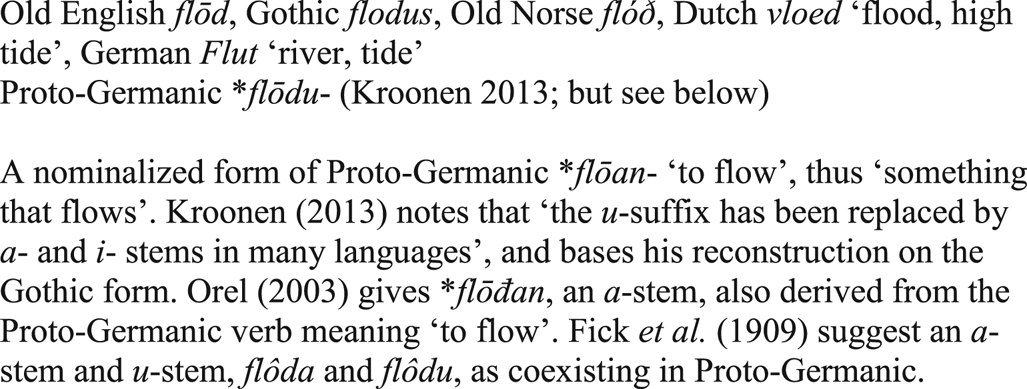
Note that flood's meaning has changed substantially through the centuries. As stated above, PGmc. *flōdu- is simply a nominalization of the verb meaning ‘to flow’; it could refer to a flood in the modern sense of the word, but also to any body of flowing water. This was still the case for Old English flōd. According to the Dictionary of Old English: A to I Online (Cameron et al. Reference Cameron, Amos and Healey2018, hereafter DOE), flōd could variously mean ‘flowing (in) of the tide’, ‘body of (flowing) waters’, ‘river, stream’, ‘sea, ocean’, ‘water (as opposed to other elements)’, ‘deluge, inundation’ and the ‘Deluge recorded in the book of Genesis’, along with figurative meanings, like ‘copious flow/stream (of blood/tears)’ and ‘a stream of words’. That Old English blōd is recorded as also meaning ‘vein’ is intriguing, since flōd could refer to water as well as the channel that carried it (Hall Reference Hall1960: 52).
In combining b- ‘part of the body’ with *flōdu- ‘something that flows’, one constructs a word that denotes the substance that flows through the body. I suggest that the semantics of this etymology are clearer than many of those previously cited, and largely identical with the semantics in Lloyd et al.'s analysis: blood is the (most salient) fluid that flows through the body. This concept surfaces even today: when we speak of the bloodstream, we relate blood with flowing water, and when we say bloodflow, we connect blood with a cognate of flood.
4.1.1 The stem problem
For the etymon of blood, Kroonen (Reference Kroonen2013) reconstructs PGmc. *blōda- as an a-stem, yet reconstructs the etymon of flood as PGmc. *flōdu-, a u-stem. This presents a problem for my analysis: if *blōda- is a blend of an initial b- with *flōdu-, why should the stem of the noun have changed in the process?
The explanation may be found in the way that Kroonen reconstructs *flōdu-. He notes that Gothic flodus provides the basis of his reconstruction, writing that many Germanic languages have ‘replaced’ the apparently original u-suffix – but offers no explanation for this development, nor of why one should favor the Gothic over the Old English or Old Norse. Stem discrepancies themselves are not strange. For example, Old English gāt ‘goat’ and Gothic gaits are inconsistent: the Gothic word suggests a PGmc. i-stem, reconstructed as *gaitiz, but this would have produced Old English gǣt and English [git]; the stem-type of the Proto-Germanic form is necessarily ambiguous (Peeters Reference Peeters1977: 167). In the case of flood, however, the cross-linguistic discrepancies are numerous. It seems likely that the variation existed in Proto-Germanic. If the Proto-Germanic form was grammatically unstable, this would explain the great variation in its child forms.
Kroonen is apparently alone in his reconstruction; I have found no independent sources that cite flood's Proto-Germanic origin exclusively as a u-stem. Orel (Reference Orel2003) reconstructs *flōðan, and Fick et al. (Reference Fick, Falk and Torp1909) reconstruct *flôda and *flôdu as coexisting in PIE. As shown in table 3, the stem for the etyma of flood and blood is identical in these two sources.
Flood and blood reconstructions

If the attested Germanic cognates of flood and blood in table 4 are compared, it becomes immediately apparent that, apart from the initial b-, and aside from Gothic, they are identical.
Flood and blood by language

The Gothic divergence is accounted for easily enough taking as a starting point Fick et al.'s (1909) analysis that *flōdu-, a u-stem version of flood's etymon, coexisted in Proto-Germanic with *flōda-, an a-stem version of this same word. In Proto-Germanic, it was *flōda- that was blended with b- to yield *blōda-, which became Gothic bloþ. Meanwhile, it was *flōdu- that became Gothic flodus. *flōdu- and *flōda-, which coexisted in Proto-Germanic, competed for survival in the Germanic languages, leading to a noteworthy degree of variation.
4.1.2 Blood as a phonesthetic blend
In light of the above, I suggest the blending process in figure 7 as responsible for blood and its cognates:
Blood

In this sort of blend, there is a motivation to preserve as much of the second element as phonologically possible. As the initial bl- cluster is permissible in Proto-Germanic, the b- phonestheme only replaces the initial f- of *flōda-, and not the entire onset.
4.2 Bone
Figure 2, reproduced as figure 8, lists some of bone's cognates and summarizes its proposed etymologies.
Bone's etymology
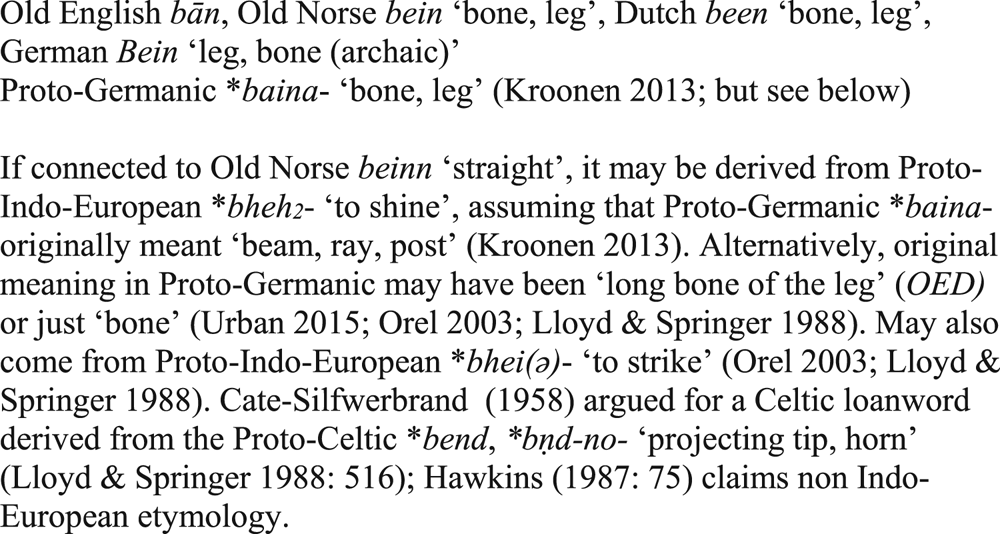
As is the case with blood, there is little consensus regarding the development of bone. It has been characterized as ‘quite isolated in Indo-European and without etymology’ (Lloyd & Springer Reference Lloyd and Springer1988: 515). A connection to Icelandic and Old Norse beinn ‘straight’ is usually mentioned, but often doubtfully (Lloyd & Springer Reference Lloyd and Springer1988: 515). This is anecdotally supported by the fact that some south German dialects use Bein to refer to long, straight bones, as opposed to rounded joints. However, this etymology is significantly problematized by the fact that the adjective beinn is ‘exclusive to northern Germanic’, while correspondences to bone are found ‘in all Germanic languages except for Gothic’. Lloyd & Springer (Reference Lloyd and Springer1988: 515–16) find this reconstruction to be ‘etymologically opaque’. The OED similarly notes that the connection to beinn ‘cannot be either substantiated or disproved, as that word is itself of uncertain origin and without parallels in West Germanic’. Even if the words shared a Proto-Germanic root, there is no compelling reason to suggest that the word for ‘bone’ is derived from the word for ‘straight’ in Proto-Germanic.
The connection to ‘to strike’ is unclear as well: words derived from PIE *bhei- ‘to strike’ include Old Irish benim ‘strike, cut’, Russian bilo ‘stick, hammer’, Armenian bir ‘big stick, club’ and English bill (of a bird) (Lloyd & Springer Reference Lloyd and Springer1988: 516; Watkins Reference Watkins2011: 9). There seems to be a suggestion that bones are shaped like clubs, or got their name from having been used as a beating implement. This is possible, but not widely supported, and seems semantically uncertain.
Lloyd & Springer (Reference Lloyd and Springer1988: 515–16) briefly discuss several other, less popular etymological proposals as well, all of which they characterize as unconvincing: connections to Latin femur ‘thigh’, Norwegian buna ‘bone tube' and Middle Low German bunk are rejected because these vowel forms would not have arisen from the diphthong in Proto-Germanic *baina-, and Cate-Silfwerbrand (Reference Cate-Silfwerbrand1958) calls upon an otherwise undocumented Celtic loanword with i-epenthesis, relating to Proto-Celtic (possibly PIE) *bend-, *bṇd-no- ‘projecting tip, horn’, rejected as unclear.
In summary, there have been many proposed etymologies for *baina-. None is generally accepted, and all are recognized as troublesome, on either formal or semantic grounds.
4.2.1 Bone's polysemy
Because of its polysemy in the Germanic languages, Kroonen (Reference Kroonen2013) reconstructs the meaning of *baina- as ‘bone, leg’. This is at odds with general consensus: Lloyd & Springer (Reference Lloyd and Springer1988: 515–16), Seebold (Reference Seebold2001), Orel (Reference Orel2003) and Urban (Reference Urban, Bowern and Evans2015: 385) reconstruct the original meaning as ‘bone’, while the OED notes that it may have ‘denoted a long bone of the leg’. There is considerable evidence that Proto-Germanic *baina- meant ‘bone’, and that ‘leg’ was a later development. Urban (Reference Urban, Bowern and Evans2015) bases this on many factors, including extensive internal evidence in the development of German, the surviving textual evidence, and the meaning of bone's cognates in most compounds and derived forms that include it.
Old Norse, Old English and Old High German are the earliest languages with a written cognate of bone. No Gothic words for ‘bone’ or ‘leg’ have survived; the passages in the Bible that would have contained word for ‘bone’ are missing from Ulfila's translation (Cleasby & Vigfusson Reference Cleasby and Vigfusson1874: 55). In Old Norse, bein primarily meant ‘bone’, but a meaning of ‘leg’, specifically from the knee to the foot, is attested in later sources (Cleasby & Vigfusson Reference Cleasby and Vigfusson1874: 55). The usual word for ‘leg’ in Old Norse was leggr (Arthur Reference Arthur2002: 85). Old English bān chiefly meant ‘bone’, but it seems to have meant ‘leg’ in certain compounds, discussed below. However, the OED notes that ‘the sense ‘leg’ is not unambiguously attested for the simplex in Old English’, and in any case sceanca – today's shank – was the usual word for ‘leg’.
In none of these languages did the cognates of bone refer exclusively to the bones of the leg, and numerous compounds containing bone-cognates point to its general meaning. Consider the Old Norse viðbeina ‘collar-bone’ and höfuðbein ‘head-bones’, Old High German brustbein ‘breast bone’ and Old English cinbān ‘jawbone, jaw, chin’.
The hints at polysemy in Old English are found in some compounds, including bānece ‘pain in the thigh (-bone), sciatica’ and bānrift ‘leg armour, greave(s), literally “bone-covering” or “leg-covering”’’, which was used to gloss the Latin tibialis (DOE). Like the situation in Old Norse, the Old High German bein originally meant ‘bone’, but later came to mean ‘leg’ as well (Urban Reference Urban, Bowern and Evans2015: 374). Urban explains the semantic broadening of *baina- as an example of metonymy, ‘based on spatial contiguity’ (2015: 375). The bones of the leg may have been the most salient, being the largest in the body.
4.2.2 Bone as a phonesthetic blend
Accepting the original Proto-Germanic meaning as ‘bone’, I suggest that *baina- is a blend of the b- ‘body-related’ phonestheme with Proto-Germanic *staina- ‘stone’. Figure 9 provides some of stone's cognates and an overview of its etymology.
Stone's etymology
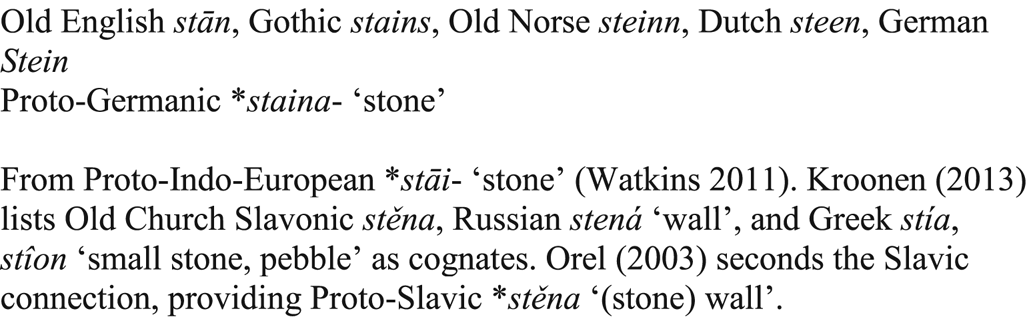
Table 5 compares bone and stone and their cognates across several Germanic languages. Gothic is absent because no cognate of bone is attested in that language.
Bone and stone by language

The Germanic peoples were intimately familiar with both bones and stones, and runic inscriptions are found carved in both materials. Stones are the hard mineral objects abundant in the natural world, and bones are the hard, seemingly mineral objects in the body. Thinking of a ‘bone’ as a ‘body-stone’ is semantically transparent – the only other real contender for this meaning would have been ‘teeth’.
I suggest the blending process in figure 10 as responsible for bone and its cognates. As with blood, as much of the second element was preserved as phonologically possible. Because an initial bt- cluster is illegal in Proto-Germanic, the b- phonestheme replaces the whole onset of the syllable.
Bone

5 Conclusion
Because of a paucity of data from outside Germanic, it is impossible to know the origins of words like blood and bone with certainty. As shown above, there is very little concord on their origins. The Germanic Substrate Hypothesis has accounted for many difficult words by calling upon a hypothetical substrate language. While this method may be valid, it is also fruitful to appeal to productive processes of word development. By applying the principles of phonesthetics to the problem of blood and bone, new avenues of etymology may have been opened. I suspect that this sort of analysis may be useful in tackling other Germanic words with problematic etymologies; building on the work of Gąsiorowski (Reference Gąsiorowski2006), it can explain the origin of dog, and Bolinger and Firth have used it to account for many other lower-frequency words.
In addition to providing new etymologies for blood and bone, this proposal also incorporates phonesthemes into etymological work in a new way. As shown in prior sections, English words like twiddle, sneeze, crash, clash, bash, frog, bug, twirl and glop have been described by earlier researchers as owing their forms or meanings to phonesthesia. For many of these words, the effect of phonesthesia has been relatively small – the modification of a consonant in a pre-existing word, as with sneeze and bug, or a shift of meaning, as with twiddle.
In this proposal, meanwhile, phonesthemes are recognized not merely as strings which might prompt the modification of an existing word, but as word-formation elements in their own right. This itself is not entirely new: some words, like clash and twirl, have been etymologized as blends or compounds of phonesthemes before, and, as shown in section 2.1.3, dog may also be analyzed as the blending of a word (dox ‘yellow-brown’) with a phonestheme (-gga ‘hypocoristic animal name’). As Kwon & Round (Reference Kwon and Round2015: 24) highlight, most phonesthemes diverge from traditional morphemes in that they often appear in ‘lexical stems which are composed of a recurring, sound-meaning pairing [i.e. the phonestheme itself] plus a non-recurrent residue’. It follows that phonesthemes should have played a role in the development of these stems, and therefore in the creation of wholly new words. What is new in this proposal, however, is the suggestion that phonesthemes may have been essential to the composition of high-frequency words.
The present sense generally seems to be that phonesthesia, where recognized, is a marginal phenomenon, and thus must appear only in novel, low-frequency words. However, this attitude is not universal. Joseph (Reference Joseph1997: 15) wrote of the importance of ‘marginal’ linguistic phenomena to a systematic understanding of grammar, noting that, for the speaker, ‘all linguistic knowledge starts out as marginal’, and that ‘generalizations’ emerge as we learn more and fit these ‘marginal’ scraps of linguistic information into a system. He goes on to note that ‘the smaller, more local, generalizations are what speakers exploit dynamically, as the case of phonesthematic attraction shows’.
Joseph presaged a trend of interest in ‘marginal’ linguistic phenomena, and his paper has been cited in over a dozen articles on topics such as ideophones, sound symbolism and phonesthesia.Footnote 7 In her monograph Rhyme over Reason, Réka Benczes (Reference Benczes2019: 18) takes note of the ‘growing body of research into atypical patterns in English word-formation’, and contributes by exploring words formed through phonological motivation. This includes phonesthematic (‘sound-symbolic’) words such as ‘glimmer and glisten’ and blends, along with words formed through wordplay and alliterative compounding. Benczes maintains that words formed through phonological motivation are ‘part and parcel of everyday language use’. Even if phonesthesia is a less frequently employed method of word formation, there is no reason to suppose that the words it is used to coin must always remain low-frequency, novelty words. For example, the OED places clash, crash and frog as ‘occur[ing] between 1 and 10 times per million words in typical modern English usage’, on par with words like surveillance, tumult and paraphrase.
It is well established that innovative words have historically replaced more staid synonyms. Perhaps the most popular example is that of the Germanic words for ‘bear’. Owing to a taboo on saying the animal's name, there is no Germanic animal word derived from the PIE *̥rtko- ‘bear’. Instead, Proto-Germanic *beran- ‘bear’ was derived from the PIE *bher- ‘bright, brown’, allusively referring to the animal as something like ‘the brown one’ (Watkins Reference Watkins2011: 74). Another case is that described in section 2.1.3, where the hypocoristic OE frogga came to replace frosc/frox. Like these words, blood and bone must each have coexisted with earlier words for the concepts that they refer to. PIE roots with these meanings have been reconstructed and, with some variation in specifics, are widely accepted. No words derived from PIE *ost- ‘bone’ are found in Proto-Germanic (Orel Reference Orel2003; Watkins Reference Watkins2011: 63; Kroonen Reference Kroonen2013), but PIE *kreuǝ- ‘blood’ gave rise to Proto-Germanic *hrawa- ‘raw’ and *hraiwa- ‘dead body, death’ (Kroonen Reference Kroonen2013). Words derived from these roots survived in the modern Germanic languages, including, for example, English raw from the former and Dutch reeuw ‘foam or sweat of a dying person’ from the latter (Kroonen Reference Kroonen2013). But over time, these newer phonesthetic formations – *blōda and *baina – came to be favored, and replaced the pre-existing words for ‘blood’ and ‘bone’.



