INTRODUCTION
Chemosynthetic ecosystems were discovered in 1985 on the Mid-Atlantic Ridge (MAR) (Rona et al., Reference Rona, Klinkhammer, Nelsen, Trefry and Elderfield1986). Their main features are their linear distribution along the ridge, short life and restricted extension linked to the carbon source they depend on. These ecosystems are separated by several hundred kilometres, though two distant sites can support very closely related communities and share common species. Approximately 600 species from hydrothermal areas around the world have been described and many of the invertebrates among them host chemoautotrophic bacteria as epi- or endosymbionts and are endemic to the vents (Desbruyères et al., Reference Desbruyères, Segonzac and Bright2006). However, little is known about the distribution of endemic species from one site to another along the axial valley. The discovery of a new hydrothermal ecosystem and the description of its species composition enrich existing knowledge of the species distribution along the ridge.
Nine hydrothermal vent ecosystems are known on the Northern MAR (NMAR). Ashadze-1, the southernmost NMAR vent field, is the only such system that has not been described until now. It is the deepest ocean vent field (4080 m) and is located on a rocky mantel of serpentinized peridotites modified by seawater, very common in the axial valley of this oceanic segment. After its discovery in 2003, Ashadze-1 was revisited in 2005 (Beltenev et al., Reference Beltenev, Neschertov, Shilov, Ivanov, Shagin, Stepanova, Cherkashev, Batuev, Samovarov, Rozhdestvenskaya, Andreeva, Fedorov, Davydov, Romanova, Rumyantsev, Zaharov, Luneva and Artem'eva2003, Reference Beltenev, Ivanov, Shagin, Segeyev, Rozhdestvenskaya, Shilov, Debretzova, Cherkashev, Samovarov and Poroshina2005). A TV-towing system revealed the presence of sea-anemones and chaetopterid polychaetes. During the Serpentine cruise in 2007, this site was studied by using new techniques available on the Ifremer Victor Remote Operated Vehicle (ROV) (Fouquet et al., Reference Fouquet, Cherkashov, Charlou, Ondréas, Birot, Cannat, Bortnikov, Silantyev, Sudarikov, Cambon-Bonnavita, Desbruyères, Fabri, Querellou, Hourdez, Gebruk, Sokolova, Hoise, Mercier, Kohn, Donval, Etoubleau, Normand, Stephan, Briand, Crozon, Fernagu and Buffier2008). The temperature of the hydrothermal end-member fluid was high (374°C), and contained high hydrogen (19 mM) and iron (9.3 mM), whereas the hydrogen sulphide concentration (1 mM) was low (Charlou et al., in press).
Fine scale bathymetry was obtained directly on board and allowed us to approach the site to acquire high resolution photographs to compose a mosaic of images from which geographical data were extracted to produce maps. Biological samples allowed us to describe the faunal composition of this ecosystem and confirm the trophic position of certain species.
Four objectives were pursued to describe the Ashadze-1 vent field: (1) mapping of sulphide structures, substrata and the spatial distribution of the dominant species visible on the images—the sea-anemone Maractis rimicarivora Fautin & Barber, Reference Fautin and Barber1999; (2) the description of benthic communities; (3) determining stable isotopic ratios measured in dominant species in order to understand the trophic positions of these consumers at Ashadze-1; and (4) the comparison of the Ashadze-1 faunal composition to the other NMAR vent communities.
MATERIALS AND METHODS
Study site and material
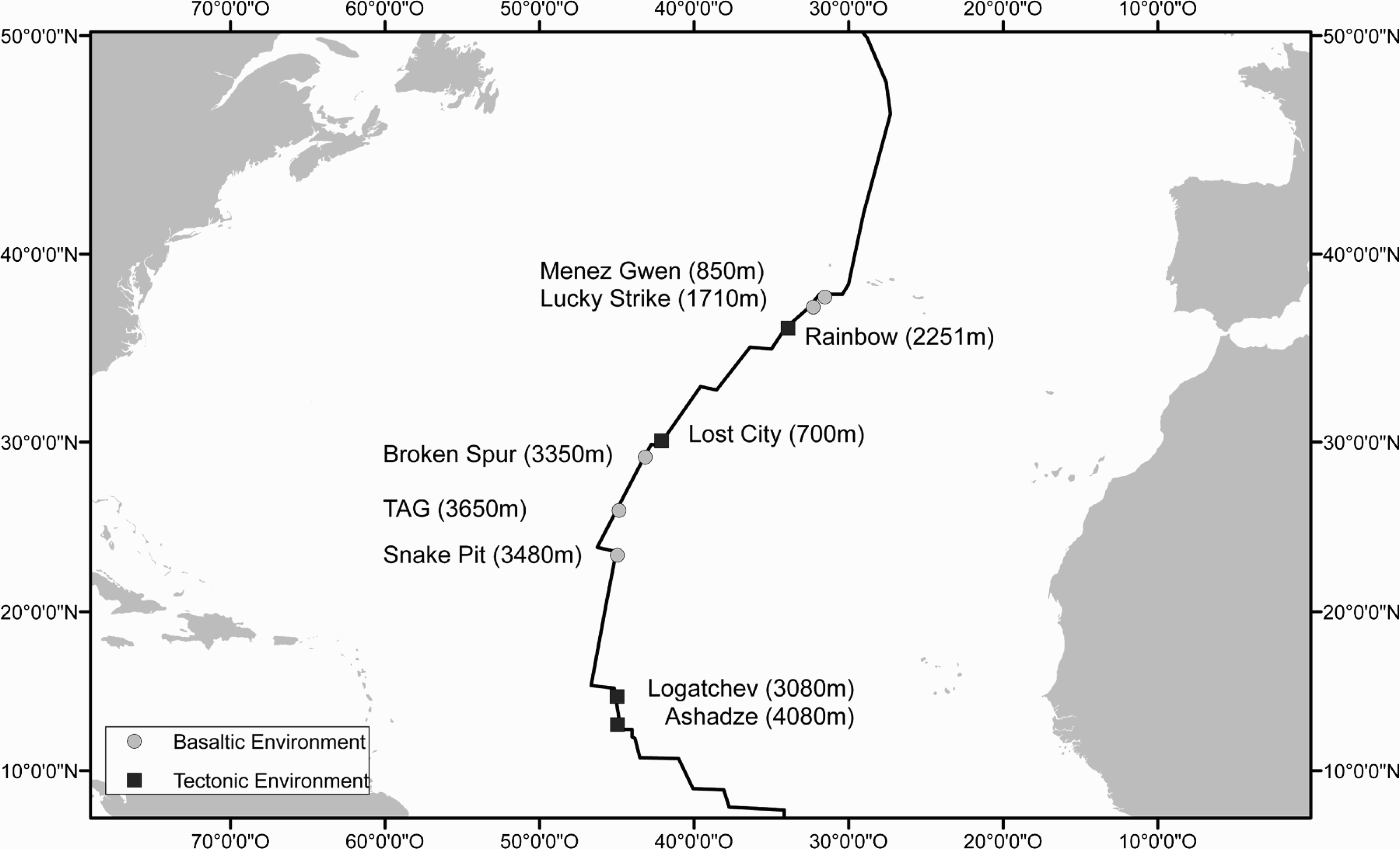
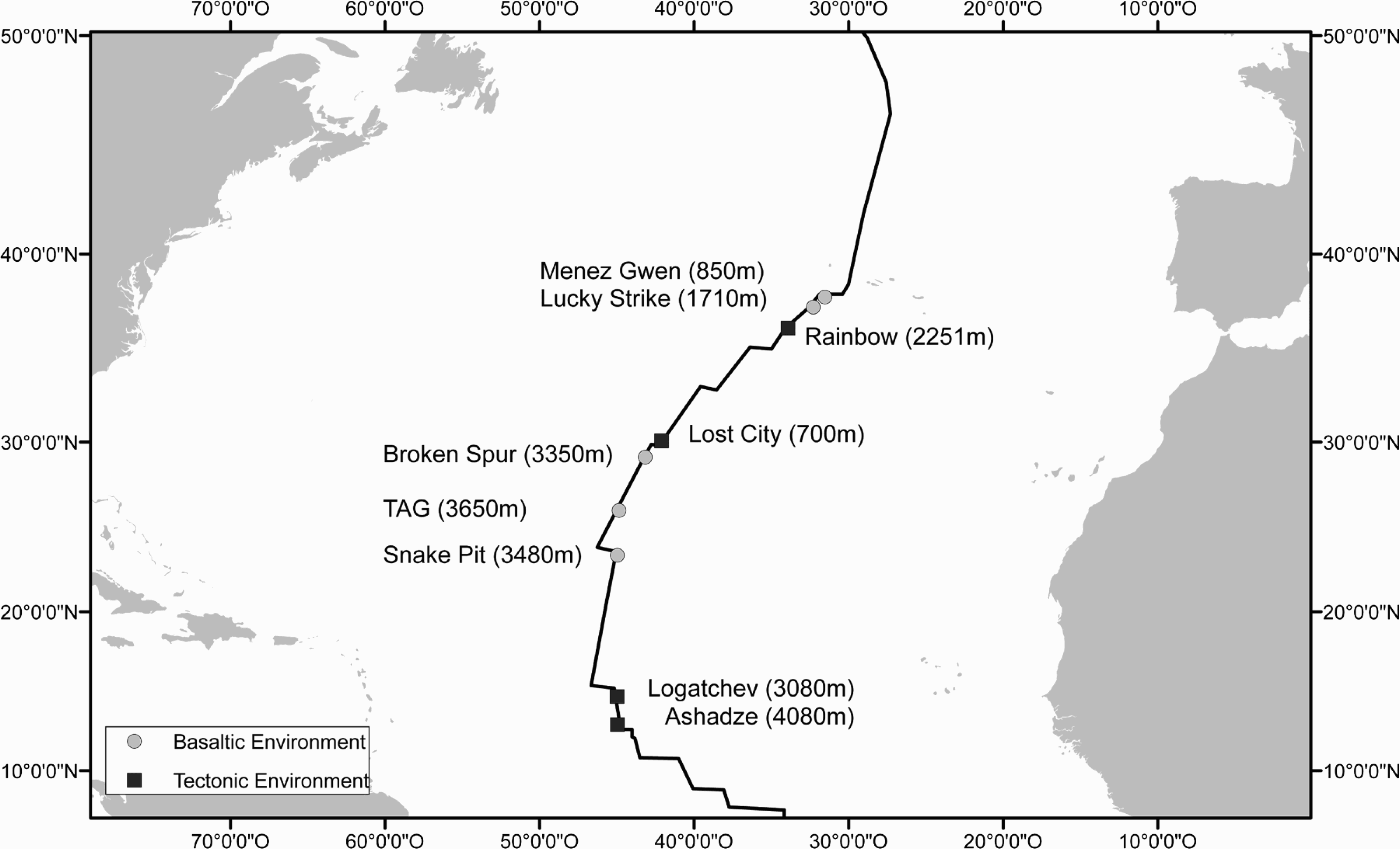
The study was performed at the Ashadze-1 hydrothermal vent field (12°58′N 44°51′W, 4080 m) on the Mid-Atlantic Ridge during the Ifremer Serpentine French–Russian cruise (Fouquet et al., Reference Fouquet, Cherkashov, Charlou, Ondréas, Birot, Cannat, Bortnikov, Silantyev, Sudarikov, Cambon-Bonnavita, Desbruyères, Fabri, Querellou, Hourdez, Gebruk, Sokolova, Hoise, Mercier, Kohn, Donval, Etoubleau, Normand, Stephan, Briand, Crozon, Fernagu and Buffier2008) (Figure 1). Four dives were performed with the remote operated vehicle (ROV) ‘Victor 6000’ (dives 310-01, 311-02, 312-03 and 313-04). The ROV ‘Victor 6000’ can use two separate modules for two different objectives: surveying and sampling. The ‘Victor’ survey module, known as the ‘Module de Mesure en Route’ (MMR), was deployed during the first dive (Simeoni et al., Reference Simeoni, Sarrazin, Nouze, Sarradin, Ondréas, Scalabrin and Sinquin2007). The first survey was performed at 50 m above the bottom and covered a surface area 1000 m × 3000 m to gather bathymetric data; the second survey was performed 10 m above the bottom and covered an area of 200 m × 140 m to gather micro-bathymetric data (precise to within 20 cm) and long range black and white optical images (OTUS camera) (Fouquet et al., Reference Fouquet, Cherkashov, Charlou, Ondréas, Birot, Cannat, Bortnikov, Silantyev, Sudarikov, Cambon-Bonnavita, Desbruyères, Fabri, Querellou, Hourdez, Gebruk, Sokolova, Hoise, Mercier, Kohn, Donval, Etoubleau, Normand, Stephan, Briand, Crozon, Fernagu and Buffier2008). The ‘Victor’ sampling module was deployed during the three other dives to explore the site and collect water, rock and faunal samples as well as colour video images.
Locations of the nine known hydrothermal vent ecosystems on the northern Mid-Atlantic Ridge (NMAR). Ashadze-1 is the southernmost vent site of the NMAR and the deepest ocean vent field.
OTUS photo mapping survey and GIS
The ROV navigated at 8 m above the bottom during OTUS acquisition at Ashadze-1, and 1200 OTUS images were taken every 10 seconds for two and a half hours. Consequently, each image covered a surface equivalent to 8 by 8 m, for a total surface area of 200 by 140 m. The images were geo-referenced and oriented to conform to the direction of the submersible by using a dedicated Ifremer tool, ‘Adelie OTUS’, developed for the ArcGIS software suite (ESRI) and OTUS images. The speed of the ROV and image acquisition frequency led to an overlap in image acquisition. A 70% overlap was chosen to reduce the asymmetrical lighting effect. A total of 1000 images were used in order to compose a mosaic, the final objective. The geodesic system used was WGS84, with Mercator projection with standard parallel N15.
Sulphide structure and marker distribution
The exploratory dives were performed by the ROV with three video cameras. One was fixed to a pan-and-tilt mount used by the ‘Victor’ pilots. A fixed camera was also mounted on the back rail to provide a vertical view and another video camera was fixed on the left side of the vehicle. The three video images were simultaneously recorded on DVD for subsequent analysis. A total of 80 hours of video were recorded. Every video included time, immersion, and camera panoramic and tilt angle data. This information was used to compare the positions of sulphide structures to those extracted from the OTUS black and white image analysis. During the exploration dives, plastic plates were deployed to mark every noteworthy structure to assist navigation and future explorations. Colour video analysis enabled the mapping of sulphide structures and markers.
Substrata classification and mapping
Nine substrata classes were defined: pelagic sediments, fault areas, solid angular blocks, strongly oxidized sulphide minerals, oxidized sulphide minerals, moderately oxidized sulphide minerals, recently oxidized sulphide minerals, fresh sulphide minerals, and hydrothermal sediments. The contours of these different substrata were digitized by GIS following the pattern on OTUS images.
Maractis rimicarivora spatial distribution
Maractis rimicarivora was conspicuously abundant on OTUS images that were manually digitized and integrated in the GIS for spatial analysis. Sea-anemone densities were calculated using the Spatial Analyst tool of the ArcGIS ESRI suite. A simple density calculation was applied with a 4 m diameter circle for the neighbourhood. The resulting map was generated with a pixel size of 0.3 m. These parameters allowed a consistently smooth density estimation of the sea-anemone population in the overall area, including that in parts in which organisms could not be digitized, i.e. plumes or non-overlapping parts of OTUS images.
Megafauna benthic communities
Species identification was achieved from recovered specimens as well as those analysed from the colour video records. Biological samples were collected during ROV exploration dives 311-02, 312-03 and 313-04 using a suction sampler and the submersible grab. Organisms were washed on deck with filtered seawater after which the latter was passed through 500µm sieves. The organisms collected were fixed in 4% formalin in seawater for 24 hours and stored in 70% ethanol. Back on land, the samples were sorted under a binocular microscope. Individuals were identified to the lowest possible taxonomic level. A. Waren (Swedish Museum of Natural History) and A. Sysoev (Zoological Museum, Moscow State University) assisted with gastropod identification; N. Sanamyan (Kamchatka Branch of the Pacific Institute of Geography) assisted with actiniarian identification; E.P. Turpaeva (Shirshov Institute of Oceanography, Moscow) assisted with pycnogonid identification; I. Bartsch (Forschungsinstitut Senckenberg, Hamburg) assisted with acarina identification and A. Martynov (Zoological Museum, Moscow State University) assisted with ophiurid identification; and D. Desbruyères, M. Morineaux (Ifremer Brest, France) and S. Hourdez (CNRS Roscoff, France) assisted with polychaete identification.
Sample preparation and stable isotope analyses
Tissue samples were collected from four dominant species: Phymorhynchus moskalevi Sysoev & Kantor, 1995 gastropods, Maractis rimicarivora sea-anemone, Mirocaris fortunata Martin & Christiansen, 1995 shrimps and Phyllochaetopterus sp. nov. polychaete. Samples were prepared from alcohol-preserved specimens except for chaetopterids, which were prepared from formalin-preserved specimens. As the effects of these two kinds of preservation have been reported to be negligible in previous studies, no specific comparison was performed (Bergquist et al., Reference Bergquist, Eckner, Urcuyo, Cordes, Hourdez, Macko and Fisher2007; De Busserolles et al., Reference De Busserolles, Sarrazin, Gauthier, Gélinas, Fabri, Sarradin and Desbruyères2009). Gastropods, shrimps and cnidarian muscle and soft tissue were removed from the specimens and used for stable isotope analyses. For the chaetopterids, whole intact individuals separated from their tubes were analysed. Shrimp and chaetopterid animals had to be pooled to obtain enough material to analyse. No acid was applied to the samples since the tissues did not contain any carbonate.
Stable isotope measurements were performed on homogenized material obtained after drying samples by lyophilization for 24 hours. All the dried samples were analysed in an elemental analyser coupled with an isotope ratio mass spectrometer (EA-IRMS Europa Scientific, Iso-Analytical, Crewe, UK) to determine carbon, nitrogen and sulphur isotopes. The values are expressed in δ (delta) notation using as standards Pee Dee Belemnite for carbon, atmospheric N2 for nitrogen and Canyon Diablo Troilite for sulphur. Trophic shifts of +1‰ for δ13C (Conway et al., Reference Conway, Kennicutt, Van Dover, Lajtha and Michener1994) and +3.4‰ for δ15N (Minegawa & Wada, Reference Minegawa and Wada1984) were considered, whereas no significant shift of δ34S was assumed (McCutchan et al., Reference McCutchan, Lewis, Kendall and McGrath2003).
Ordination of NMAR vent sites
Lists of species present on each of the nine hydrothermal vents known on the NMAR (Menez Gwen, Lucky Strike Rainbow, Lost City, Broken Spur, TAG, Snake Pit, Logatchev and Ashadze-1) were drawn up by using two main sources: the Handbook of deep-sea hydrothermal vent fauna (Desbruyères et al., Reference Desbruyères, Segonzac and Bright2006) and the Biocean database (Fabri et al., Reference Fabri, Galeron, Larour and Maudire2006). For the analyses we kept the vent community species, though neglected the ‘penetrating’ species which are also found in the abyssal oceanic domain and may have been observed at the shallowest vent fields (Desbruyères et al., Reference Desbruyères, Almeida, Biscoito, Comtet, Khripounoff, Le Bris, Sarradin and Segonzac2000; Colaço et al., Reference Colaço, Dehairs and Desbruyères2002). The working matrix was composed of the presence or absence of each species at each vent site. A dendrogram for the hierarchical clustering of all the sites, using group-average linking based on the Bray–Curtis similarity matrix, was established with PRIMER (Plymouth Routines in Multivariate Ecological Research, Version 5 (Clarke & Warwick, Reference Clarke and Warwick2001)). In parallel a dendrogram was also established for data previously transformed according to Hellinger, giving the same grouping (Legendre & Gallagher, Reference Legendre and Gallagher2001).
Long term data archive and availability
Observations, sampling, video recording, digital images and temperature measurements were performed during dives 311-02, 312-03 and 313-04. All the data and metadata were stored in the Biocean database (Fabri et al., Reference Fabri, Galeron, Larour and Maudire2006) and metadata are available on the website http://www.ifremer.fr/biocean. Species level taxonomic identifications and metadata will be available on the Ocean Biogeographic Information System portal (http://www.iobis.org) of the Census of Marine Life Programme (http://www.coml.org/).
RESULTS
Ashadze-1 photo mosaic
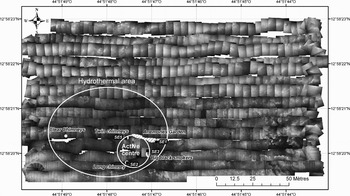
The photo survey of Ashadze-1 was organized in a GIS and gave a precise overview of the hydrothermal vent site (Figure 2). The images recorded covered an area of 110 × 200 m and show the active site, located in the south-western part of the mosaic.
The OTUS photo survey mosaic of Ashadze-1. The darker area in the southern part contains fluid emissions and sulphide structures, while the grey uniform area in the north mostly contains pelagic sediment. Three black smokers (Long chimney, Big black smokers and Twin chimneys) are grouped in an area 20 × 20 m, and 5 small thin ‘Clear chimneys’ are located 40 m away in the western part. A group of small diffusing oxidized chimneys called the ‘Anemone garden’ is located in the northern part of the active centre. Markers SE1, SE2, SE3 and SE5 were deployed to mark the edifices.

Sulphide structure and marker distribution
The Ashadze-1 hydrothermal vent site is organized around a group of three very active black vents (Figure 2). The 2-m high ‘Long chimney’ is located at the top of a small mound, marked with a plastic plate labelled SE2. The plume of this chimney was so intense that it was detected 50 m above the bottom during the bathymetric survey and it masked part of the hydrothermal area on the OTUS images. The ‘Long chimney’ was broken for fluid sampling during dive 312-03. The maximum fluid temperature was 352°C. The ‘Big Black smokers’ are five big apertures that expel black fluid at 353°C and located on a small crest marked with a plastic plate labelled SE3. The ‘Twin chimneys’ are two thin black smokers 50 cm high, located on a steep slope marked with a plastic plate labelled SE5. Fluid sampling was performed during dive 313-04 in the smaller one and the temperature measured was 347°C.
West of the central part, the ‘Clear chimneys’ expel a translucent concentrated jet of fluid less loaded with sulphide compounds than that of the fluid expelled from the black smokers. No temperature measurement was performed at this site. The ‘Anemone garden’ lies to the north of the active centre and is a group of small chimneys that expels a fluid reaching a temperature of 112°C. These structures are black and orange due to a mix of fresh and oxidized sulphide minerals, and they are covered by sea-anemones Ma. rimicarivora. This complex is marked with a plastic plate labelled SE1 on the eastern border.
Substrata distribution
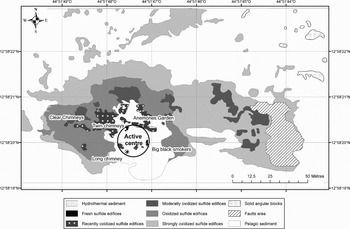
The interpretation of each OTUS image resulted in the substrata map showing a large area covered by hydrothermal sediments produced by a complex of three active chimneys (fresh sulphide edifices on Figure 3). Sulphide edifices were more oxidized northward from the active central part. No gradation was observed southward. In the eastern part of the field no fresh sulphide edifices were noticed but moderately oxidized sulphide edifices and chaotic were present.
Ashadze-1 substrata are divided into nine classes visible on the OTUS images. The active centre is located in the south-western part, where the fresh sulphide edifices are in the middle of hydrothermal sediment area. The dark grey to light grey areas represent sulphide edifices ranging from fresh to oxidized stages. In the eastern part several faults and angular blocks are present, with no specific hydrothermal activity.

Maractis rimicarivora spatial distribution
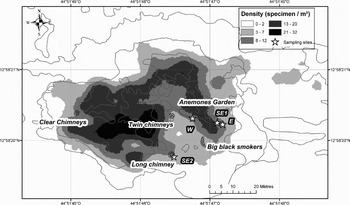
Thirty-four thousand three hundred and twenty-nine sea-anemones Ma. rimicarivora were digitized from the OTUS images. The sea-anemone population was mainly located in the vicinity of the active centre (Figure 4). High densities (32 ind.m−2) were found in the eastern part of the active centre at only 5 m from two groups of black smokers: ‘Twin chimneys’ and ‘Long chimney’. The density of Ma. rimicarivora decreased gradually with distance from the active centre, dropping to 2 ind.m−2 at a distance of 25 m. Sea-anemones live on hard substrata. They have been observed on sulphide structures as well as on small blocks of old sulphide chimneys very close to fluid venting from hydrothermal sediment.
The spatial distribution of Ma. rimicarivora decreasing gradually with distance and concentrically around a high density centre (32 sea-anemones.m−2) located between the ‘Twin chimneys’ and the ‘Clear chimneys’. Two sampling sites, W and SE1, were located on a ring around the ‘Anemone garden’, E was in the sediment, and SE2 was at the bottom of ‘Long Chimney’.

Benthic communities
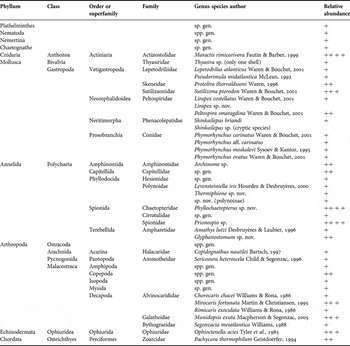
The inventory of all the benthic fauna found in the community is presented in Table 1. It is composed of 10 phyla, 32 families and 43 species among which at least 7 species are new to science. In the Mollusca phyla, no bivalves were found except 1 Thyasira sp. shell, whereas at least 12 species of gastropods were present including 2 new species. In the Annelida phyla, only the polychaete class was sampled with 11 species of which at least 3 were new. Most of the arthropods were not identified to species level although several species were found in each of the 8 orders. The five decapod species were those commonly found on MAR hydrothermal vents.
Composition of benthic species at Adhadze-1 identified from recovered specimens and from video records. Relative abundances are classified: +, rare; ++ , common; ++ + , abundant; ++ + +, dominant

The benthic-megafauna community observed is dominated by two species, namely the sea-anemone Ma. rimicarivora and the chaetopterid Phyllochaetopterus sp. nov. These species form large populations on different substrata, such as the walls of active and old chimneys and on old pieces of fallen chimneys and for the most part covered by hydrothermal sediments.
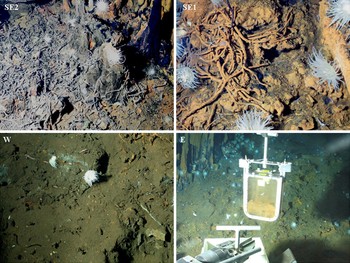
Specimens were sampled at 4 sites: on the eastern part (SE1) and on the western part (W) of the ‘Anemone garden’, at the base of the ‘Long chimney’ (SE2) and in the sediment 2 m east (E) of the ‘Anemone garden’ (Figure 4). These four sites can be distinguished on the videos (Figures 4 & 5): the first (SE1) was at the base of active and fresh sulphide chimneys; the second (W) was also very similar but covered by grey hydrothermal sediment, probably stemming from the three black smokers; the third (SE2) was characterized by very black hydrothermal sediment covering pieces of hard substratum, and the last (E) was composed of two layers, a top layer 8-cm thick composed of orange-brown oxidized sediment and an underlying grey one.
Digital photographs of Ashadze-1 sampling sites. Site W is covered with a thin layer of grey particles. Site SE1 appears to be very clean and orange. Site E is located in the sediment 2 m from SE1. Site SE2 is completely covered by sediment at the bottom of the ‘Long chimney’.

The polychaete chaetopterid was observed in dense mats at the base of the chimneys. This polychaete, Phyllochaetopterus sp. nov., can be recognized easily by its long tube from which two long white palps sometimes protrude. Video films and sampled specimens showed that chaetopterids conformed to a pattern with regard to sediment coverage. At SE1 they seemed to be clean, fat and healthy, and the tube annelations were clearly observed; however, on the western part of the ‘Anemone garden’ (W) the chaetopterids were also fat and healthy but specimens and tubes were incrusted by hydrothermal sediment and covered with a white bacterial mat; at SE2 the chaetopterids were very thin and completely incrusted by hydrothermal sediment; and finally, in the eastern part of the ‘Anemone garden’ (E), only transparent empty chaetopterid tubes were sampled.
Entire sampled polychaete populations were identified at the four sites described previously. The highest diversity was found at SE1 (8 families) where Phyllochaetopterus sp. nov. was the dominant polychaete with amphinomid and capitellid families. At W Phyllochaetopterus sp. nov. were the only dominant species. However, Phyllochaetopterus sp. nov. were almost absent or dead at SE2 and in the hydrothermal sediment on the eastern part of the Anemone garden (E). In addition, it is noteworthy that: (1) a group of scavenger Archinome sp. was seen on the video at the bottom of site SE1 where a hundred Archinome sp. were sampled; and (2) that two Ampharetids, Amathys lutzi and Glyphanostomum sp. nov., and Spionid Prionospio sp. were particularly abundant at SE2. The latter species was also sampled in relatively high abundance in blade cores in the sediment at SE2 and E where the only other polychaete family found was Ampharetidae.
Three species of alvinocaridid shrimps were found in order of decreasing abundance on the walls of active or fresh sulphide chimneys: Mirocaris fortunata, Chorocaris chacei (identified onboard from videos), and very few Rimicaris exoculata. Only isolated individuals of the latter species were observed, with only seven specimens being collected at SE1. Conversely, Mi. fortunata was observed in a ring around the ‘Anemone garden’ whose chimneys are composed of black and fresh sulphurs. They were present at the two sampled sites, SE1 and W, located close to this ring. Mirocaris fortunata were seen swimming between chaetopterid tubes at SE1 while they were neither seen nor sampled at SE2 and E.
Gastropods were sampled everywhere at Ashadze-1. Similar diversity was found at SE1 on the hard substratum and at the base of the ‘Long chimney’ (SE2), characterized by very black hydrothermal sediment covering pieces of old chimneys. Quite high numbers of dead gastropods were found at these two sites. At SE2 no gastropod was visible on the video films due to the thick layer of particles, even after zooming in. However, 2/3 of gastropod specimens were sampled at SE2, with Sutilizona pterodon making up more than half of them. This species, as well as Lepetodrilus atlanticus, Lirapex costellatus and Lirapex sp. were not sampled at any other site. Protolira thorvaldssoni was also sampled in notably high quantities at SE2. Only four species were sampled throughout the three sites W, SE1 and SE2: Peltospira smaragdina, P. thorvaldssoni, Shinkailepas briandi and Pseudorimula midatlantica in decreasing order of abundance. Four different species of scavenger or predator gastropod Phymorhynchus spp. were present at SE1, whereas only one or two were sampled at SE2 and W.
At the base of the ‘Anemone garden’ in a temperature zone around 3.5°C, the ophiuroid Ophioctenella acies and the scavenger pycnogonid Sericosura heteroscela were common among chaetopterid polychaetes. Occurrences of the galatheid Munidopsis exuta were plotted from our black and white images. These galatheids were most common at the periphery of the active centre, especially on very oxidized-sulphide structures. Predators included the crab Segonzacia mesatlantica and the zoarcid fish Pachycara thermophilum.
In brief, we found that benthic communities were most diverse and abundant at the ‘Anemone garden’ in the eastern part (SE1) as well as in the western part (W). At W a bacterial mat covered faunal populations and diversity seemed to be lower than at SE1. In the sediment (E) further away from the low fluid venting of the ‘Anemone garden’, no specimens were collected apart from empty chaetopterid tubes and one polychaete family. Conversely, many specimens were collected from the sediment at the bottom of the strong fluid venting of the ‘Long chimney’ (SE2).
Trophic position of consumers
The mean isotopic ratios of animal tissues ranged from −20.07 to −11.9‰ for δ13C, from 5.5 to 8.0‰ for δ15N and from 6.87 to 10.17‰ for δ34S (Table 2).
δ13C, δ15N and δ34S values for the species collected at Ashadze-1 vent field.

Min, minimum; Max, maximum.
Maractis rimicarivora has the lowest range of mean δ13C values, around −14.69‰, and the highest range of δ34S, from 8.44‰ to 11.02‰. Its δ15N isotopic signature is the highest with a mean value of 10.43‰.
Mirocaris fortunata has a δ13C value of −12.88‰, the lowest range of δ15N values, around 8.52‰, and the lowest range of δ34S values, around 10.15‰.
Phyllochaetopterus sp. nov. have the lowest δ13C mean isotopic signature with the highest range of values from −25.38‰ to −15.61‰. It also has the highest range of δ15N, from 9.88‰ to 8.22‰, and the lowest δ34S isotopic signature with a mean value of 6.87‰.
Phymorhynchus moskalevi has the highest δ13C and δ34S isotopic signatures with mean values of −11.47‰ and 11.9‰ respectively while it has the lowest δ15N isotopic signature with a mean value of 8.12‰.
Ordination of the NMAR vent ecosystems
A total of 88 species from NMAR hydrothermal vent communities were considered in the matrix. The three following taxa represented 84% of the total species number: Arthopoda, including 15 species of copepods, 9 amphipods, 6 acari, 5 caridea, 1 brachyura, 1 galatheide and 1 pycnogonid; Mollusca, including 23 species of gastropods and only 2 bivalves; and Annelida with 11 species of polychaetes. The remaining 16% were represented by Chordata—6 species of fish, Cnidaria—4 species including one Anthozoa Ma. rimicarivora, Echinodermata—2 species of ophiuroids and 1 species of Chaetognatha. The number of species per area from north to south was the following: Menez Gwen—34 species, Lucky Strike—48, Rainbow—40, Lost City—7, Broken Spur—15, TAG—19, Snake Pit—32, Logatchev-1—24 and Ashadze-1—29.
The fauna at Lost City was represented by only 8% of the total species matrix, therefore it was not considered in the following analyses. Moreover, the chemical features of the emitting fluids are very different to those found in the other hydrothermal fields, having a high pH value of 9 and low temperature, leading the alkaline fluid to precipitate carbonates and hydroxides below the sea floor and upon mixing with seawater (Kelley et al., Reference Kelley, Karson, Blackman, Früh-Green, Butterfield, Lilley, Olson, Schrenk, Roe, Lebon, Rivizzigno and Party2001).
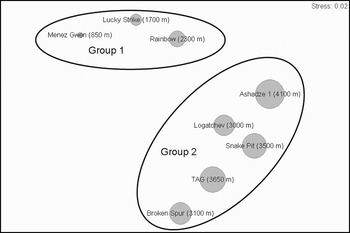
The aim of the ordination was to display the biological relationships among the hydrothermal vent ecosystems known on the NMAR. The ordination provides a 2 dimensional view of the sites whose placement reflects the similarities of their biological communities. A non-metric, multidimensional scaling (MDS) plot was produced by PRIMER (Figure 6). A stress value of 0.02 was derived by statistical processing. As it is close to 0.01 it gives a good two-dimensional representation with no possibility of misleading interpretation. A cross-check with the results of the hierarchical classification was performed by superimposing the two groups formed with 50% similarity: the ‘Northern-shallow NMAR’ and the ‘Central-deep NMAR’. The latter included Ashadze-1. As the ‘penetrating’ species were not included in our analyses, this ordination does not reflect the proportion of these species resulting from considerable depth.
Multidimensional scaling (MDS) ordination of the known Northern Mid-Atlantic Ridge hydrothermal vent ecosystems. Bray–Curtis similarity coefficients of species presence or absence were used for the ordination. Depths represented by circles of different sizes and the two clusters formed at 50% similarity levels were superimposed on the MDS plot.

DISCUSSION
Ashadze-1 benthic communities
Deep-sea hydrothermal communities are usually distributed in concentric rings around vent openings: bacterial feeders on chimney walls, symbiotic species in the intermediate area of diffuse venting and filter feeding organisms on the external rings (Colaço et al., Reference Colaço, Dehairs and Desbruyères2002). This scheme did not appear to be reproduced in the Ashadze-1 vent field as the diffuse venting area was not colonized by organisms living in symbiotic association with primary producers.
The striking difference between Ashadze-1 and other hydrothermal macrofaunal communities on the NMAR is the sharp numerical dominance of the sea-anemone Ma. rimicarivora, reaching densities of 32 ind.m−2. This species was especially abundant on chimney walls near the shimmering fluid. Sea-anemones are usually considered as peripheral species at hydrothermal vents occupying the zone of oxidized sulphides (Copley et al., Reference Copley, Tyler, Van Dover, Schultz, Dickson, Singh and Sulanowska1999). At TAG Ma. rimicarivora occurred in a concentric pattern at a distance from 15 to 60 m around the central chimney complex and reached the highest density of 20 ind.m-2 at 30–40 m from the centre of a black smoker zone. Maractis rimicarivora is known to be a typical cnidarian, depending on prey for energy and nutrients, with no evidence of bacterial symbiosis (Van Dover et al., Reference Van Dover, Polz, Robinson, Cavanaugh, Kadko and Hickey1997; Fautin & Barber, Reference Fautin and Barber1999). It is a suspension feeder and predator, feeding on small zooplankton and particulate organic material. At TAG it has also been seen preying on the shrimp R. exoculata (Van Dover et al., Reference Van Dover, Polz, Robinson, Cavanaugh, Kadko and Hickey1997). The effect of temperature on the distribution of sea-anemones was investigated at TAG. The negative correlation between the abundance of anemones and the mean temperature recorded over a one year period suggest that the distribution of sea-anemones may be ultimately constrained by a maximum thermal tolerance of 25°C. However, in the absence of physiological investigations, ecological interactions such as shrimp aggregations in higher-temperature areas preventing the settlement of sea-anemones were suggested (Copley et al., Reference Copley, Jorgensen and Sohn2007). At the Ashadze-1 vent field, Ma. rimicarivora indeed occurred on oxidized chimney walls where swarms of R. exoculata were expected. We measured a temperature of 3°C at the surface of Ma. rimicarivora at SE1 in the ‘Anemone garden’.
The quasi-absence of the shrimp R. exoculata at Ashadze-1 may be a consequence of the low temperature on chimney walls, ranging from 3 to 10°C. The optimal thermal habitat of R. exoculata would be around 20°C taking into account its physiological thermal tolerance and the chemosynthetic activity of shrimp epibionts (Ravaux et al., Reference Ravaux, Gaill, Le Bris, Sarradin, Jollivet and Shillito2003; Schmidt et al., Reference Schmidt, Le Bris and Gaill2008a). At TAG and Rainbow, temperature measurements ranged from 3 to 18°C in shrimp swarms (Schmidt et al., Reference Schmidt, Vuillemin, Le Gall, Gaill and Le Bris2008b). Juveniles were observed to colonize the colder zones further away from black smoke emissions (Gebruk et al., Reference Gebruk, Southward, Kennedy and Southward2000). At Ashadze-1 only very few R. exoculata could be observed and sampled. They were restricted to the site labelled SE1 in the ‘Anemone garden’ situated in the non-oxidized part of the chimney. The absence of dense shrimp aggregations at Ashadze-1 could also be the result of a recent environmental change, in terms of months or years, caused by a shift in the pattern of hydrothermal activity. This has already been suggested to explain the absence of dense shrimp aggregations at Broken Spur (Murton & Van Dover, Reference Murton and Van Dover1993). Rimicaris exoculata can disappear very quickly as has been seen at 5°S on SMAR, where a large platform was densely populated by shrimps in 2005, but hardly any shrimps were observed on the same structure in 2006 (Haase et al., Reference Haase, Petersen, Koschinsky, Seifert, Devey, Keir, Lackschewitz, Melchert, Perner, Schmale, Süling, Dubilier, Zielinski, Fretzdorff, Garbe-Schönberg, Westernströer, German, Shank, Yoerger, Giere, Kuever, Marbler, Mawick, Mertens, Stöber, Walter, Ostertag-Henning, Paulick, Peters, Straus, Sander, Stecher, Warmuth and Weber2007).
Another symbiotic species missing at Ashadze-1 was the mussel Bathymodiolus sp.: neither live bivalves nor shells were found on this vent field. This absence can be explained by two hypotheses: (1) very high production of suspended mineral particles at this vent field could negatively affect the filtering activity of bivalves and result in their absence, as was described for Rainbow (Desbruyères et al., Reference Desbruyères, Biscoito, Caprais, Colaço, Comtet, Crassous, Fouquet, Khripounoff, Le Bris, Olu, Riso, Sarradin, Segonzac and Vangriesheim2001); and (2) although great precautions were taken to ensure the complete coverage of the area, we did not have enough time to survey a sector south of the active field. It is possible that we missed a population of bathymodiolid mussels in the area, as was the case at Lost City where an enormous field of sub-fossil mussel shells was found on the slope of the Atlantis massif near the active field three years after its discovery (Sagalevitch et al., Reference Sagalevitch, Bogdanov, Bortnikov, Silantyev, Galkin and Lein2005).
Phyllochaetopterus sp. nov. were found in very high densities, essentially on hard substratum. Sampled specimens were particularly healthy in areas where few hydrothermal sediments had accumulated, i.e. on the ‘Anemone garden’. However, chaeropterid species are generally reported in high densities in mud and sandy bottoms in intertidal areas (Nishi, Reference Nishi2008). Until today, only a few species have been observed in hydrothermal deep seawater and at very low densities on the MAR. During the French EXOMAR cruise in 2005, another genus, Spiochaetopterus sp., was seen in low densities at TAG in a similar habitat: on blocs buried under hydrothermal oxidized particles with several Ma. rimicarivora scattered around (Fabri, personal observation). Chaetopterid tube worms have never been reported on the East-Pacific Rise but were observed in high densities in the vicinity of an active vent on the Pacific–Antarctic Ridge near the Foundation Seamount Chain (Stecher et al., Reference Stecher, Turkay and Borowski2002). Like all chaetopterid polychaetes, Phyllochaetopterus sp. nov. are a tubicolous species. The branches of the tube are probably used to modify the movement of water passing through it, carrying food particles. These particles are then trapped by mucus bags secreted by the polychaete. Both palps, seen outside the tube in videos, are also used but to a lesser extent, to seize the food in the environment (Barnes, 1965). The weak hydrothermal activity and high particle flow characterizing Ashadze-1 seems to be favourable to the development of this polychaete family.
Four species of the predatory gastropod Phymorhynchus spp. were present, among which one new species was discovered. These gastropods are often observed at the periphery of dying vents and are known to feed on mussels, shrimp remains, other gastropods and polychaetes (Desbruyères et al., Reference Desbruyères, Segonzac and Bright2006; A. Waren, personal communication). The gastropod Peltospira smaragdina was sampled all over Ashadze-1, but the ones taken from SE1 were all dead. They contained dust-like rust-coloured sediment and had evidently been buried for some time. It appeared as though they had suffocated (A. Waren, personal communication). On the contrary L. atlanticus was not as dirty and rusty as most of the specimens from SE1. It was in very good condition, although the soft parts were missing. The presence of a single L. atlanticus shell is the first specimen seen between Snake Pit and the newly discovered vent field at 5°S on the MAR (Haase et al., Reference Haase, Petersen, Koschinsky, Seifert, Devey, Keir, Lackschewitz, Melchert, Perner, Schmale, Süling, Dubilier, Zielinski, Fretzdorff, Garbe-Schönberg, Westernströer, German, Shank, Yoerger, Giere, Kuever, Marbler, Mawick, Mertens, Stöber, Walter, Ostertag-Henning, Paulick, Peters, Straus, Sander, Stecher, Warmuth and Weber2007). Lepetodrilids have long been considered vent-endemic animals but they have recently been found at seeps and on sunken wood (Johnson et al., Reference Johnson, Waren and Vrijenhoek2008). These tiny gastropods are usually sampled as by-catches with the larger vent taxa, especially bivalve molluscs in the Atlantic Ocean, on which these limpets reside. At Ashadze-1 L. atlanticus was sampled with a piece of chimney by the grabbing arm of the submersible. Usually, the shells disappear quite rapidly in vents, in contrast to seeps and regular deep sea beds, so it is possible that an event occurred at Ashadze-1 relatively recently (A. Waren, personal communication).
Most species of Galatheid are scavengers not restricted to hydrothermal vents. They usually occur in low densities and their abundance in vent environments probably reflects the benefit derived from the organic matter produced by the chemosynthetic community inhabiting these zones. In general, their abundance increases in the vicinity of active hydrothermal sites and decreases in the centre of hydrothermal activity, which is what we found at Ashadze-1.
To sum up, the hydrothermal community at Ashadze-1 lacks symbiotic species (except for single R. exoculata) that are characteristic of the deep-sea hydrothermal fields on the Mid-Atlantic Ridge. This absence is partially counterbalanced by unusually rich development in the active zone of peripheral species such as Phyllochaetopterus sp. nov. and Ma. rimicarivora. Moreover many scavengers such as Phymorhynchus spp., Ophioctenella acies and Munidopsis exuta colonize substrates in the active zone. Previous work focused on the life-cycle of a hydrothermal vent ecosystem from its initial colonization, growth and development of the community, followed by its demise (Van Dover, Reference Van Dover2003). Knowing the characteristics of a waning stage ecosystem, i.e. gathering of scavengers and invasion by non-vent deep-sea taxa, we believe that Ashadze-1 is such an ecosystem. High faunal diversity at the Ashadze-1 vent field emphasizes the fact that diversity is similar at declining and at active vent fields, and is maintained by non-chemosynthetic taxa invading the field owing to the low level of toxic sulphides (Van Dover, Reference Van Dover2002).
With regard to the fact that deep-sea hydrothermal vents are patchy and ephemeral environments, with individual vents lasting only a few years or decades (Micheli, 2002), and taking into account the faunal characteristics of this ecosystem and the accumulation of particles at the base of ‘Long chimney’ we assume that the formation of the latter occurred rapidly due to the sudden intensification of the fluid flow that led to the burial of the ecosystem developing around it. This assumption is supported by the fact that although fauna were not visible at the surface of the sediment, apart for a few emerging sea-anemones, specimens were found when sampling the layer of hydrothermal particles. Both live and dead gastropods were found in this thick layer of particles at the bottom of the ‘Long chimney’, whereas they usually live on hard substrata; also chaetopterids were very thin and completely black. Conversely, polychaetes were healthier at SE1, which is 15 m from ‘Long chimney’, and is probably a more favourable environment for their development with lower particle accumulation. Health appeared to decrease as the thickness of particles lessened, going from ‘Long chimney’ to W, the western part of the ‘Anemone garden’, and finally to SE1, the more remote eastern part. Site W was covered by a thin layer of particles, possibly originating from the ‘Long chimney’ and the first impact of its growth. The higher the chimney, the larger the area covered by particles. Moreover, only one bivalve shell was found in the sediment two meters from ‘Long chimney’. This may indicate that bivalves were present but buried due to the possible rapid growth of the chimney. As they are filter-feeders they may not have been able to survive with the massive sudden input of particles.
Trophic position of consumers
Chemosynthetic-based ecosystem primary producers are known to be either sulphur-oxidizing chemosynthetic bacteria, methanotrophic bacteria and/or bacteria utilizing other reduced chemicals such as hydrogen or iron (Schmidt et al., Reference Schmidt, Vuillemin, Le Gall, Gaill and Le Bris2008b). Invertebrates acting as primary consumers are capable of exploiting these bacteria either through the ingestion of free-living chemoautotrophic bacteria, or via nutritional exchange with endosymbiotic chemoautotrophic-bacteria (Colaço et al., Reference Colaço, Dehairs and Desbruyères2002; Bergquist et al., Reference Bergquist, Eckner, Urcuyo, Cordes, Hourdez, Macko and Fisher2007).
Natural variations in stable isotopes have been widely used in marine ecology over the past twenty years to investigate the food web (Peterson & Fry, Reference Peterson and Fry1987; Conway et al., Reference Conway, Kennicutt, Van Dover, Lajtha and Michener1994). Stable carbon, nitrogen and sulphate isotopic ratios are commonly measured in order to evaluate the source of dietary carbon, trophic position and sulphate origin respectively (McCutchan et al., Reference McCutchan, Lewis, Kendall and McGrath2003).
In our study stable isotope ratios were measured on very few species, all of them being heterotrophic. Therefore, we did not try to construct the food web structure at Ashadze-1. However, we focused on the trophic position of these species through their isotopic ratios in order to support our hypotheses on the waning stage of this ecosystem. The tissue isotopic mean values of the four species at Ashadze-1 are compared to values measured for the same species at other vent fields on the NMAR (Colaço et al., Reference Colaço, Dehairs and Desbruyères2002, De Busserolles et al., Reference De Busserolles, Sarrazin, Gauthier, Gélinas, Fabri, Sarradin and Desbruyères2009). Although carbon isotopic values fall into the range described for these species, nitrogen isotopic values are always higher at Ashadze-1 than at other vent fields.
Maractis rimicarivora and Phymohynchus moskalevi at Ashadze-1 have similar isotopic values to that measured for the same species at TAG. δ13C isotopic mean values are the same and δ15N isotopic values are 2‰ higher at Ashadze-1. These values were already observed to be higher at TAG than at the other vent fields for these species (Colaço et al., Reference Colaço, Dehairs and Desbruyères2002). Actinarians usually collected at the periphery of vent fields have a very positive δ15N signature, indicating that they occupy a high trophic level. They are believed to profit occasionally from the vent communities, but not exclusively. Phymorhynchus sp. are scavengers or predators, usually feeding on mussels at different vent fields, except at TAG where no mussels were found. Phymorhynchus sp. was then assumed to adapt and feed on dead shrimps, but is also known to feed on gastropods and polychaetes (A. Waren, personal communication).
Mirocaris fortunata has similar isotopic values at Ashadze-1 and at the Rainbow vent fields (Colaço et al., Reference Colaço, Dehairs and Desbruyères2002). The δ13C isotopic values are the same and δ15N isotopic values are 2‰ higher at Ashadze-1. The δ13C isotopic values in this species have a very wide range—from −10.46 to 22.06—suggesting an opportunistic feeding strategy (Gebruk et al., Reference Gebruk, Southward, Kennedy and Southward2000). Mirocaris fortunata were described as predators and scavengers or detritus feeders on the strength of what was found in their stomachs (Colaço et al., Reference Colaço, Dehairs and Desbruyères2002). They are assumed to prey on individuals that feed on free-living bacteria (De Busserolles et al., Reference De Busserolles, Sarrazin, Gauthier, Gélinas, Fabri, Sarradin and Desbruyères2009). They are also assumed to graze directly on free-living bacteria, as indicated by stable isotope signatures that can be around –10 to –11 (Gebruk et al., Reference Gebruk, Southward, Kennedy and Southward2000).
Phyllochaetopterus sp. nov. has a similar δ13C minimum value and a δ15N value higher by 3.89‰ than that measured for chaetopterids at Logatchev (Colaço et al., Reference Colaço, Dehairs and Desbruyères2002). The wide range of δ13C measured for these polychaetes may be due to the fact that either whole individuals were kept for analyses (thus their gut content was not removed) or that their diet was composed of very diverse particulate organic matter (POM). POM at hydrothermal vents can be composed of body parts of invertebrates, faunal or microbial mucous secretions, microbial cell debris and photosynthetically derived material (Levesque & Juniper, Reference Levesque and Juniper2002). The increased contribution of large and heterogeneous POM has been shown to significantly contribute to the diet of organisms in areas of low fluid discharge or as a vent site ages (Limén et al., Reference Limén, Levesque and Juniper2007).
Carbon isotopic ratios are assumed to allow determining the source of dietary carbon for an organism (Conway et al., Reference Conway, Kennicutt, Van Dover, Lajtha and Michener1994). As the δ13C values are in the same range at Ashadze-1 and at other vent fields on the NMAR, we can state that the four species for which isotopic ratios were measured at Ashadze-1 have the same food diet as that sampled at other NMAR fields. The generally very high δ15N values for the Ashadze-1 species suggest that their nitrogen source does not stem directly from local origin, but rather from recycled organic matter. Hence we can consider that these species play the same secondary consumer role in the ecosystems. The sulphur isotopic ratios of vent species are assumed to reflect their source isotopic values because isotope fractionation associated with the assimilation of sulphur compounds is thought to be small (Conway et al., Reference Conway, Kennicutt, Van Dover, Lajtha and Michener1994). The food web based on photosynthetically derived POM has sulphur isotopic values ranging from +10 to +20‰ while the sulphur isotopic values of the food web based on locally produced organic matter, vent sulphides, pore-water sulphides and thiosulphate, range from −11.5 to +13.4‰ (Brooks et al., Reference Brooks, Kennicutt, Fisher, Macko, Cole, Childress, Bidigare and Vetter1987). The mean δ34S isotopic ratios measured from animal tissues at Ashadze-1 ranged from +6.87 to +10.17‰, falling within the range of the δ34S ratios found for vent species.
The high trophic level of dominant species and the sulphur isotopic ratios reflecting vent sulphide origins support the hypothesis of a chemosynthetic ecosystem present at Ashadze-1, although no symbiotic species were seen during the Serpentine cruise. Two hypotheses can be put forward: (1) symbiotic species existed but were buried or consumed by detritus-feeder species like Ma. rimicarivora, Phyllochaetopterus sp. nov., Phymorhynchus sp. and Mi. fortunata, all of which were abundant; or (2) symbiotic species did not exist, perhaps owing to great depth, as free-living bacteria are the only component at primary producer level that constitute the food source of primary consumers. However, this trophic level was not very well represented as we could not find enough small crustaceans to feed this high proportion of secondary consumers, unless sea-anemones and shrimps are the primary consumers. Our opinion is that the first hypothesis better reflects the transfer of organic matter along the food chain.
Comparison with the Mid-Atlantic Ridge hydrothermal vent ecosystems
Species richness (S) on the NMAR vent fields is based on Desbruyères et al. (Reference Desbruyères, Segonzac and Bright2006). Minimum species richnesses on Lucky Strike (S = 28) Snake Pit (S = 27) and Logatchev (S = 24) have been described and compared previously, but they were lower than that presented in this study (respectively 48, 32 and 24) (Van Dover & Doerries, Reference Van Dover and Doerries2005). One of the reasons explaining this difference is that the previous study analysed only mussel bed communities. However, at Lucky Strike, which can be considered as a giant mussel bed, we found 7 additional species of gastropods and 8 other species of annelids. An alternative explanation for the increased species number at the current stage might be the international sampling perfomed on some of the NMAR vent fields that has led to better knowledge of these vent communities. The low species richness at Broken Spur (S = 15) might result from the low number of samples taken by the international scientific community. However, some vent fields have been visited hundreds of times but nonetheless exhibited very low species richness, such as TAG (S = 19).
Ashadze-1 is grouped with the deepest and southernmost NMAR vent fields, though these results do not allow determining whether latitude or depth is the major factor influencing geographical distribution. Previous studies have highlighted the same division between the NMAR vent fields, invoking bathymetry as the major geographical barrier to species dispersion (Van Dover et al., Reference Van Dover, German, Speer, Parson and Vrijenhoek2002). This division is emphasized by the two mussel species B. azoricus and B. puteoserpensis, found in the northern and southern parts respectively. However, a recent study also based on the presence or absence of species, but using other statistical methods, has shown that the Azores fields cannot be considered separately from the other northern Atlantic fields when comparing the NMAR vent fields to other ocean vent fields (Bachraty et al., Reference Bachraty, Legendre and Desbruyères2009). This was also shown by Gebruk & Mironov (Reference Gebruk, Mironov, Vinogradov and Vereshchaka2006), based on the distribution of common species and pairs of closely related species along the NMAR.
Vent sites recently discovered on the southern MAR (SMAR) will provide new information on species distribution (Koschinsky et al., Reference Koschinsky, Billings, Devey, Dubilier, Duester, Edge, Garbe-Schönberg, German, Giere, Keir, Lackschewitz, Mai, Marbler, Mawick, Melchert, Mertens, Peters, Sander, Schmale, Schimdt, Seifert, Seiter, Stöber, Suck, Walter, Weber, Yoerger, Zarrouk and Zielinski2006). The shrimp R. exoculata, the gastropod L. atlanticus and the mussel B. puteoserpentis were found at 5°S at a depth of 3050 m (Haase et al., Reference Haase, Petersen, Koschinsky, Seifert, Devey, Keir, Lackschewitz, Melchert, Perner, Schmale, Süling, Dubilier, Zielinski, Fretzdorff, Garbe-Schönberg, Westernströer, German, Shank, Yoerger, Giere, Kuever, Marbler, Mawick, Mertens, Stöber, Walter, Ostertag-Henning, Paulick, Peters, Straus, Sander, Stecher, Warmuth and Weber2007). The few specimens of R. exoculata and L. atlanticus found at Ashadze-1 support the theory that no geographical barrier exists between NMAR and SMAR. This leads to the hypothesis that Ashadze-1 could be one of the stepping stones in species dispersal along the MAR between Logatchev and the vent fields at 5°S.
AKNOWLEDGEMENTS
We thank M. Segonzac for helping with the species lists for the NMAR vents and O. Gauthier for validating the statistical methods. We are also grateful to the captain and crew of RV ‘Pourquoi Pas?’, the pilots and crew of the ROV ‘Victor 6000’ and the shipboard scientific party, especially A. Normand for the microbathymetric map. We are also grateful for the assistance of the following taxonomic specialists: A. Sysoev, N. Sanamyan, E.P. Turpaeva, A. Martynov, I. Bartsch and S. Hourdez, and especially to A. Waren for his taxonomic identifications and very helpful comments. Furthermore, we are indebted to Keith Hodson (www.accent-europe.fr) for correcting the English. This work was funded by the European Union MARBEF project (FP6-GOCE-CT-2003- 505446) and ANR DeepOases (ANR06BDV005).