Introduction
The prevalence of cigarette smoking in the United States (US; 15.1%) has declined significantly from the first US Surgeon General's (1964) report (42%). However, there are still approximately 36.5 million adult smokers in the US, resulting in more than 480,000 tobacco-related deaths each year (Jamal et al., Reference Jamal, King, Neff, Whitmill, Babb and Graffunder2016). Within US military Veterans enrolled in the Veterans Health Administration or Veterans Administration (VA), the overall prevalence of smoking is approximately 15% (Huang et al., Reference Huang, Kim, Gasper, Xu, Bosworth and May2017), similar to that of the general population. However, this figure obscures high rates of smoking among subgroups that are high utilizers of healthcare services (Huang et al., Reference Huang, Kim, Gasper, Xu, Bosworth and May2017). For example, Veterans who are diagnosed with mental health or substance use disorders (SUD), HIV, and younger Veterans recently returning from deployments have rates of smoking ranging from 30% to 80% (Huang et al., Reference Huang, Kim, Gasper, Xu, Bosworth and May2017).
A combination of behavioural counselling and medication is consistently found to yield the best outcomes for smoking cessation (Fiore et al., Reference Fiore, Jaén, Baker, Bailey, Benowitz and Curry2008), including among military Veteran samples (Stead & Lancaster, Reference Stead and Lancaster2012). However, the majority of adult smokers who make a quit attempt do so without aid or support, likely contributing to less than 10% of quit attempts resulting in abstinence (Abrams, Graham, Levy, Mabry, & Orleans, Reference Abrams, Graham, Levy, Mabry and Orleans2010; Shiffman, Brockwell, Pillitteri, & Gitchell, Reference Shiffman, Brockwell, Pillitteri and Gitchell2008a). Currently, it is estimated that approximately 6% of smokers use a combination of behavioural counselling and medications to assist in a quit attempt simultaneously (Kotz, Fidler, & West, Reference Kotz, Fidler and West2009; Shiffman et al., Reference Shiffman, Brockwell, Pillitteri and Gitchell2008a). In contrast, a substantially greater proportion report using pharmacotherapy, estimates ranging from 32% to 48% (Kotz et al., Reference Kotz, Fidler and West2009; Shiffman et al., Reference Shiffman, Brockwell, Pillitteri and Gitchell2008a). Yet among Veterans receiving treatment in VA diagnosed with a tobacco use disorder, a recent study suggested that less than 4% utilize tobacco cessation counselling services (Kelly, Sido, & Rosenheck, Reference Kelly, Sido and Rosenheck2016). Considering the efficacy of combined counselling and pharmacotherapy, and the ready availability of smoking cessation medications for VA patients (Hamlett-Berry et al., Reference Hamlett-Berry, Davison, Kivlahan, Matthews, Hendrickson and Almenoff2009), enhancing engagement into counselling is a critical step in preventing tobacco-related morbidity and mortality for Veterans.
Behaviours and characteristics, such as greater heaviness of smoking (a measure of nicotine dependence reflecting smoking quantity and time to first cigarette; Heatherton et al., Reference Heatherton, Kozlowski, Frecker, Rickert and Robinson1989) and lower self-efficacy to quit, have been found to predict the utilization of assistance when making a quit attempt (Myers, Strong, Linke, Hofstetter, & Al-Delaimy, Reference Myers, Strong, Linke, Hofstetter and Al-Delaimy2015). In addition, previous studies have consistently identified female sex, higher nicotine dependence, and greater age as associated with treatment utilization (Kotz et al., Reference Kotz, Fidler and West2009; Shiffman et al., Reference Shiffman, Brockwell, Pillitteri and Gitchell2008b; Zhu et al., Reference Zhu, Melcer, Sun, Rosbrook and Pierce2000). Among Veterans, factors such as age, gender, and psychiatric diagnosis impact not only the use of assistance, but also preference for cessation assistance (e.g., medication only vs. clinic referral) (Myers, Chen, & Schweizer, Reference Myers, Chen and Schweizer2016). For example, female Veterans were more likely to accept a clinic referral than were males and those with a psychiatric diagnosis more likely than those without. Beyond factors that influence accepting an initial referral, further exploration of variables that predict treatment utilization after a referral among Veterans is needed.
Interventions focused on engaging smokers and increasing the use of evidence-based treatment are imperative (Abrams et al., Reference Abrams, Graham, Levy, Mabry and Orleans2010), particularly among Veteran sub-populations who have a higher prevalence of smoking. A recent trial (Fu et al., Reference Fu, van Ryn, Burgess, Nelson, Clothier and Thomas2014) comparing a proactive outreach telephone session offering a choice of treatment options with usual care found that nearly 30% of participating Veterans who received the proactive intervention (n = 1556) expressed an interest in receiving smoking cessation treatment. At one year follow-up, proactive care participants reported significantly higher engagement in telephone counselling, use of pharmacotherapy, and combined pharmacotherapy and counselling than those in the usual care group. Abstinence rates at six months were significantly higher among those in the proactive condition and related to use of telephone counselling. This study provides evidence that efforts to enhance treatment engagement among Veteran smokers can yield improved cessation outcomes.
To date, additional studies have focused on other factors, including motivation, stage of change (SOC), and mental health diagnoses, related to engagement into treatment or failure to utilize treatment. For example, Japuntich and colleagues (Reference Japuntich, Sherman, Joseph, Clothier, Noorbaloochi and Danan2017) found that proactive care resulted in a smaller effect on prolonged abstinence rates for those with than without a mental health diagnosis. Within this same trial, there were differences by readiness to change and treatment condition such that participants in the contemplation and preparation stages of change who received the proactive intervention had better abstinence outcomes than those in usual care (Danan et al., Reference Danan, Joseph, Sherman, Burgess, Noorbaloochi and Clothier2016). These findings support encouraging treatment utilization regardless of current SOC. Collectively, these studies demonstrate the promise of outreach efforts to engage smokers in treatment and identify factors that may influence treatment utilization.
To further our understanding of the treatment engagement process, the present study examined variables associated with treatment participation following a telephone contact designed to enhance treatment utilization for smokers with mental health diagnoses enrolled in a VA medical centre. Individual characteristics and smoking-related variables previously found to be associated with treatment utilization were examined, including demographic variables, smoking cessation related cognitions, and tobacco dependence (Kotz et al., Reference Kotz, Fidler and West2009; Myers et al., Reference Myers, Strong, Linke, Hofstetter and Al-Delaimy2015 , Reference Myers, Chen and Schweizer2016; Shiffman et al., Reference Shiffman, Brockwell, Pillitteri and Gitchell2008b). For the current study, we anticipated that treatment engagement (defined as attending a treatment session within 30 days of the telephone contact) would be predicted by female sex, greater age, more readiness for change, higher importance of quitting, lower confidence in quitting, and greater cigarette consumption. In addition, we explored whether psychiatric diagnosis would be related to treatment engagement.
Methods
Design
The present longitudinal study utilized data gathered through a retrospective review of patient's electronic medical records (EMRs) and progress notes.
Participants
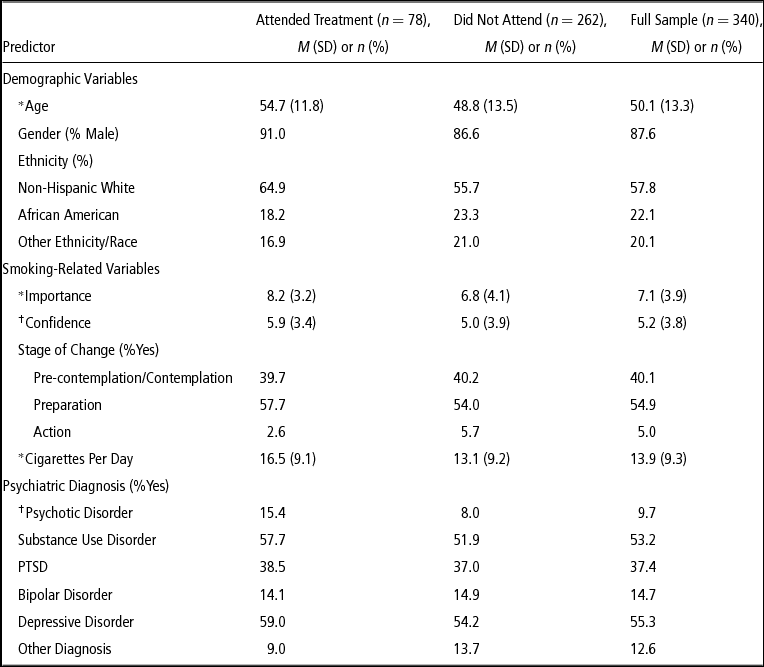
Data for this naturalistic study were extracted from EMRs and progress notes from September 2013 to September 2014 for 394 Veterans with psychiatric diagnoses who were referred to a tobacco cessation consultation clinic and completed a brief telephone session that included evaluation and treatment engagement efforts. Of these, 340 cigarette smoking Veterans (86% of completed referrals) were retained for study analyses. The tobacco cessation clinic provides treatment for all types of tobacco; however only cigarette smokers were included because (a) the existing literature focuses on smoking cessation treatment utilization specifically (e.g., Fu, van Ryn, Burgess et al., Reference Fu, van Ryn, Burgess, Nelson, Clothier and Thomas2014; Fu, van Ryn, Sherman et al., Reference Fu, van Ryn, Sherman, Burgess, Noorbaloochi and Clothier2014) and (b) the level of cigarette consumption provides an indicator of nicotine dependence, a consistent predictor of treatment utilization (Shiffman et al., Reference Shiffman, Brockwell, Pillitteri and Gitchell2008b). Participants were on average 50.1 years of age (SD = 13.3), predominantly male (88%), and included 58% non-Hispanic white, 22% African American, 6% Asian, 6% Hispanic, and 7% of other racial/ethnic origins. Demographics, smoking variables, and psychiatric diagnoses are shown in Table 1.
Univariate comparisons of those engaging versus not engaging in treatment within 30 days by demographics, smoking variables, and psychiatric diagnosis

Note: *p < .05; †p < .10.
Telephone Contact Procedure
Consultation requests were sent from providers to the smoking cessation clinic by EMR, indicating the Veteran had expressed an interest in cessation and consented to being contacted by phone. Clinic procedure was to attempt at least two telephone calls to contact each referred smoker. Calls were made by the smoking cessation psychologist or a psychology trainee. The evaluation portion of the call consisted of an assessment of current smoking, past quit efforts, intentions to quit, and current importance and confidence in quitting. Following assessment, Veterans were provided with information regarding available smoking cessation programs, procedures for enrolling in treatment, and proactive efforts to encourage treatment utilization (e.g., identifying accessible quit smoking group times and locations, referral to in-house proactive telephone clinic). All Veterans participating in smoking cessation groups or telephone counselling were offered pharmacotherapy.
Measures
Demographic characteristics
Variables extracted from the EMR included age, gender, and race/ethnicity.
Smoking and quitting behaviour
Smoking behaviour was assessed as cigarettes per day (CPD). For quitting, participants were asked whether they had made a serious quit attempt (at least 24 hours) within the past 12 months (yes or no).
Smoking cessation cognitions
Standard items were employed to assess intentions to quit and importance of and confidence in quitting. Intentions to quit were assessed as plans to quit within 30 days or 6 months (Al Delaimy et al., Reference Al Delaimy, Leas, Myers, Strong, Hofstetter and Linke2014). Importance and confidence for quitting were each assessed on an 11-point Likert scale (ranging from 0 = not important to 10 = very important, and 0 = not confident at all to 10 = very confident, respectively) (e.g., Boudreaux et al., Reference Boudreaux, Sullivan, Abar, Bernstein, Ginde and Camargo2012).
Stage of change (SOC)
Participants were classified into stages of change using the SOC algorithm (Stage of Change Algorithm (SCA) Smoking; Velicer et al., Reference Velicer, Fava, Prochaska, Abrams, Emmons and Pierce1995), using intentions to quit, past year quit attempt, and current smoking as follows: pre-contemplation = no plans to quit in next 6 months; contemplation = plans to quit in next 6 months or 30 days, but no past year quit attempt; preparation = plans to quit in next 30 days and made quit attempt in past year; action = recently quit).
Psychiatric diagnosis
Psychiatric diagnoses were obtained from EMR problem lists. Diagnoses were categorized as psychotic disorders, non-tobacco SUD, post-traumatic stress disorder (PTSD), bipolar disorder, depressive disorders, or other. Psychotic disorders included diagnoses of schizophrenia and other psychotic disorders. Mood disorders included major depression and dysthymia. Diagnoses may have been entered at any time since Veteran enrolment in the system, and thus may not reflect currently active disorders.
Treatment engagement
Treatment engagement was defined as participating in a smoking cessation treatment session within 30 days of completing the telephone call. The 30-day period was selected so as to increase likelihood of a relationship between the variables assessed at the time of the phone call and treatment participation given that cessation-related cognitions are temporally variable (e.g., Collins & Graham, Reference Collins and Graham2002). Session attendance was established by extracting from the EMR a smoking cessation treatment specific clinic code attached to all smoking cessation clinics in this facility, along with the date of the encounter.
Analytic Plan
Initial bivariate analyses were conducted to assess relations between individual predictors and outcomes. Predictors were examined in relation to treatment engagement (attendance within 30 days of the telephone call) for all participants. Predictors were then explored in relation to stated intention to attend treatment. Subsequently, a hierarchical logistic regression analysis was conducted to examine predictor relations for the outcome of interest, engaging in at least one smoking cessation treatment session within 30 days of call participation (yes or no). The first step of the regression included demographics and smoking-related variables (CPD, SOC, and importance and confidence in quitting) that have previously been found related with treatment utilization (Danan et al., Reference Danan, Joseph, Sherman, Burgess, Noorbaloochi and Clothier2016; Fu et al., Reference Fu, van Ryn, Sherman, Burgess, Noorbaloochi and Clothier2014; Myers et al., Reference Myers, Strong, Linke, Hofstetter and Al-Delaimy2015 , Reference Myers, Chen and Schweizer2016). Demographic variables are presented by frequencies and percentages for categorical variables and means (deviation [SD]) for continuous variables. The SOC variable was originally coded for four levels (pre-contemplation – contemplation – preparation – action); however, none of the participants who attended treatment were in pre-contemplation. To avoid empty cells for the logistic models, we combined pre-contemplation and contemplation into a single level for analysis. Because we had no a priori hypotheses for their influence, psychiatric diagnoses were entered separately on a second step. No assumptions or imputations were made for missing data. Analyses were conducted using IBM SPSS Statistics version 24 for Mac.
Results
Of the Veteran cigarette smokers who completed the brief evaluation and referral telephone call (N = 340), 22.9% (n = 78) individuals completed at least one session of treatment (either telephone or group) within 30 days. Univariate comparisons (see Table 1) found that age was the only demographic variable that differed by treatment attendance, with those attending being significantly older than those not attending treatment (mean = 54.7, SD = 11.8 vs. mean = 48.8, SD = 13.5, p = 0.001). Of the smoking-related variables, differences emerged whereby those attending treatment reported smoking more CPD (mean = 16.6, SD = 9.1 vs. mean = 13.1, SD = 9.2, p = 0.004), and higher perceived importance of quitting (mean = 8.2, SD = 3.2 vs. mean = 6.8, SD = 4.1, p = 0.005) than those not attending treatment. No significant differences emerged by SOC, and smokers from contemplation as well as preparation and action stages engaged in treatment. None of the univariate comparisons of attendance by psychiatric disorder reached statistical significance.
Prior to conducting logistic regression, zero-order correlations among the predictor variables were assessed to examine for multicollinearity. The only correlation to exceed r = 0.30 was that between importance and confidence in quitting (r = 0.627). In order to assess for multicollinearity, we conducted two regressions, regressing the remaining independent variables on importance and confidence, respectively. Examination of tolerance and variance inflation factor (VIF) values did not exceed recommended cut-offs for establishing the presence of multicollinearity (tolerance > 0.20 and VIF < 4) (Menard, Reference Menard1995; Pan & Jackson, Reference Pan and Jackson2008, respectively).
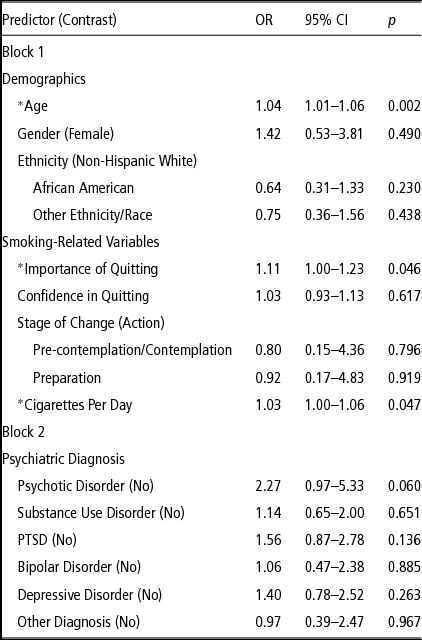
As shown in Table 2, the logistic regression analysis included two hierarchical blocks of variables: (1) demographics and smoking-related variables, and (2) mental health diagnoses. There were significant effects of age and smoking rate, such that the odds of engaging in treatment increased by 4% (odds ratio [OR] = 1.04, 95% CI 1.01–1.06, p = 0.002) for each additional year of age. Likewise, the probability of attending treatment increased by 3% (OR = 1.03, 95% CI 1.00–1.06, p = 0.049) for each additional cigarette consumed per day. Finally, each one-point increase in self-reported importance of quitting was associated with 11% greater odds of attending treatment within 30 days (OR = 1.11, 95% CI 1.00–1.23, p = 0.043). No other variables significantly predicted treatment engagement.
Logistic regression predicting treatment attendance within 30 days

Note: *p < 0.05; Overall model: χ 2 (15) = 35.38, p = 0.002; Block 1: χ 2 (9) = 29.05, p < 0.001; Block 2: χ 2 (6) = 6.32, p = 0.388.
Discussion
Relatively little is known regarding factors that influence whether smokers will engage in treatment and utilize assistance when attempting to quit. Much of the available information is drawn from population surveys with retrospective reports of type of assistance used in past cessation attempts (Hung, Dunlop, Perez, & Cotter, Reference Hung, Dunlop, Perez and Cotter2011; Kotz et al., Reference Kotz, Fidler and West2009; Shiffman, Brockwell, Pillitteri, & Gitchell, Reference Shiffman, Brockwell, Pillitteri and Gitchell2008a; Shiffman et al., Reference Shiffman, Brockwell, Pillitteri and Gitchell2008b). The present study examined smoking cessation treatment utilization prospectively among Veterans with psychiatric disorders who were referred to a cessation clinic. Consistent with some previous studies, age, cigarettes smoked per day, and importance of quitting all were significant predictors of attending treatment (Myers et al., Reference Myers, Chen and Schweizer2016; Myers et al., Reference Myers, Strong, Linke, Hofstetter and Al-Delaimy2015). Within this sample, type of psychiatric diagnosis did not contribute to treatment engagement. Few, if any, prior studies have examined whether particular psychiatric diagnoses influence smoking cessation treatment engagement. However, a study of engagement among smokers with serious mental illness found that those with more severe symptoms were less likely to attend treatment (Travaglini, Li, Brown, Bennett, Reference Travaglini, Li, Brown and Bennett2017).
Findings from this study offer additional insight regarding influences on the treatment engagement process among Veterans who are currently smoking. Although the smokers in this sample either accepted or requested a referral for smoking cessation treatment, only 22.9% attended at least a single treatment session within a month of telephone contact. While this rate is substantially higher than reported in population samples, the observed level of utilization is disappointingly low in a population with interest in and ready access to treatment. While access to care and affordability may impact treatment utilization (Twyman, Bonevski, Paul, & Bryant, Reference Twyman, Bonevski, Paul and Bryant2014), VA patients are provided smoking cessation medication upon request and have access to behavioural counselling at no cost, either through local programs or by referral to telephone counselling quit lines (Hamlett-Berry et al., Reference Hamlett-Berry, Davison, Kivlahan, Matthews, Hendrickson and Almenoff2009). This finding highlights the importance of identifying novel approaches for enhancing treatment utilization.
Of the variables examined, treatment engagement was more likely for older smokers, those with greater cigarette consumption, and those who perceived quitting as more important. This constellation of predictors is consistent with prior findings suggesting that smokers most likely to utilize assistance are those who are the most dependent and have failed in the past (Myers et al., Reference Myers, Strong, Linke, Hofstetter and Al-Delaimy2015). Older smokers may also have experienced more health-related and other consequences from their smoking, and thus assessed quitting as more important. Perceived importance of quitting is a potentially malleable factor, suggesting the utility of motivational techniques for enhancing treatment engagement. Unlike our prior study (Myers et al., Reference Myers, Strong, Linke, Hofstetter and Al-Delaimy2015), lower confidence in quitting was not associated with employing assistance. It may be that smokers more confident in quitting declined referral and reduced the range of this variable compared with the population-based sample examined previously. Alternately, this discrepancy may reflect varying approaches to measuring confidence in quitting.
Previous studies have found women more likely to utilize treatment than men (Kotz et al., Reference Kotz, Fidler and West2009; Myers et al., Reference Myers, Strong, Linke, Hofstetter and Al-Delaimy2015), a finding that was not replicated in the present analyses. This may reflect the preponderance of males in this Veteran sample, or that gender plays a lesser role among smokers who accept treatment referrals. Our prior examination of Veteran smokers indicated that those with psychiatric diagnoses were more likely to accept referrals to a smoking cessation clinic. Within this sample of smokers with mental illness, type of diagnosis did not relate with treatment engagement, adding to the growing evidence that all smokers with mental illness should be encouraged to quit smoking and utilize treatment resources. Finally, SOC, or level of readiness to stop smoking, was not associated with treatment engagement, and in fact smokers from various stages engaged in treatment. This is consistent with findings of other recent studies (Japuntich et al., Reference Japuntich, Sherman, Joseph, Clothier, Noorbaloochi and Danan2017) and highlights the value of encouraging all smokers across stages of change to utilize smoking cessation treatment.
There are several limitations to consider when interpreting study findings. The present investigation addressed only a portion of the process by which smokers engage in smoking cessation treatment, the final link between having accepted a referral and attending a treatment session. Conceptually, this study also focused on examining initial engagement into treatment, defined as participating in a single session. This approach precluded examining whether these same variables predict the extent to which treatment is employed and whether both behavioural assistance and pharmacological aides were used. These remain important outcomes for future studies. In addition, the range of variables examined is limited and does not fully characterize the engagement process, which is likely influenced by additional cognitive, attitudinal, and environmental factors. Finally, this sample of military Veterans was predominantly male and included only smokers with psychiatric diagnosis, limiting generalizability of the findings.
In sum, this study is one of the first prospective examinations examining treatment engagement, defined here as participating in treatment within a month of completing a brief referral telephone contact. As with prior studies, indicators of higher dependence and age predict treatment engagement. Perceived importance of quitting was also a significant predictor of treatment attendance. Future research may focus on identifying barriers following an initial referral contact that impedes engaging, especially among Veterans who are younger and smoke fewer CPD. Moreover, interventions that explore beliefs about smoking and aim to enhance the perceived importance of utilizing assistance when quitting smoking may serve to increase engagement.
Acknowledgements
None.
Financial Support
Preparation of this manuscript was supported with funds from the Tobacco Related Disease Research Program (TRDRP) 23XT-0004 (Myers).
Conflict of Interest
None.
Ethical Standards
Use of these data was approved by the Human Research Protection Program and Institutional Review Board of the VA San Diego Healthcare System.