Introduction
Obesity has long-term, remarkable medical and public health implications.Reference Ogden, Carroll, Kit and Flegal 1 Obese women are more likely to deliver macrosomic infants. 2 , Reference Ovesen, Rasmussen and Kesmodel 3 Excessive weight gain in pregnancy also increases the risk for birth weight greater than the 90th percentile.Reference Johnson, Clifton and Roberts 4 Higher birth weights are associated with increased risk of adolescent obesity.Reference Salsberry and Reagan 5 An intergenerational risk of obesity and diabetes has been described, whereby maternal obesity is an independent risk factor for offspring obesity, separate from that of diabetes.Reference Crume, Ogden and West 6 – Reference Sewell, Huston-Presley, Super and Catalano 9 The influences of fetal programming imposed by maternal obesity and diabetes may not be immediately evident at birth or early childhood, but may emerge later.Reference Dabelea, Hanson and Lindsay 10
The model of fetal programming outlined by David Barker classically describes the risk of disease among growth restricted infants during pregnancy.Reference Barker, Hales and Fall 11 This hypothesis suggests fetal programming occurs based on maternal exposures that alters development and influences risk of future disease.Reference Barker, Hales and Fall 11 An abnormal metabolic environment imposed by obesity or excess weight gain in pregnancy leads to fetal and neonatal overgrowth, childhood obesity and decreased insulin sensitivity.Reference Guo, Liu, Ye, Zhuang and Ren 12 , Reference Marchi, Berg, Dencker, Olander and Begley 13 These sequelae can lead to early onset of adult disease such as type 2 diabetes and metabolic syndrome. The cycle may continue when these women become pregnant.Reference Catalano 14 Several studies indicate that metabolic changes can be passed to subsequent generations. Responsible molecular mechanisms that contribute to offspring programming of obesity and type 2 diabetes include: hyperglycemia, impaired insulin signaling, increased circulation of adipocyte and inflammation signaling markers, abnormal adipose differentiation and metabolism, excessive placental hormone production, and alterations in the adipo-insular axis.Reference Garcia-Valdes, Campoy and Hayes 15 – Reference Carty, Akehurst and Savage 17 Numerous studies have identified correlations between maternal factors and biochemical evidence of abnormal placental and fetal metabolism.Reference Catalano, Presley, Minium and Hauguel-de Mouzon 18 – Reference Verhaeghe, Van Bree and Van Herck 22 In addition, animal models have tested the effects of under and over-nutrition in pregnancy and its effects on offspring.Reference Ainge, Thompson, Ozanne and Rooney 23 , Reference Tamashiro, Terrillion, Hyun, Koenig and Moran 24
We proposed to utilize neonatal foreskin to evaluate the effects of infant birth weight on fetal programming. Neonatal foreskin is a tissue that is readily available where circumcisions are performed and has previously been utilized to assess different cellular processes including wound healing and developmental abnormalities such as hypospadias.Reference De Corte, Verween and Verbeken 25 – Reference Vottero, Minari and Viani 28 Importantly, the foreskin represents a terminal neonatal tissue which can be utilized in the study of developmental programming.Reference Reynolds, Dickens, Green, Marsit and Pearson 29 We postulated that changes in gene expression involved in glucose metabolism, insulin signaling, inflammation, and oxidative stress in neonatal foreskin are associated with infant birth weight.
Materials and methods
Subjects
This was a birth cohort study of male neonates from 55 mother–baby couplets that was approved by the University of Kentucky Institutional Review Board. Subjects were born at the University of Kentucky from June 2012 to March 2013. Inclusion criteria were English-speaking mothers, ⩾18 years old, and term delivery (⩾37 weeks) of a non-anomalous, singleton male infant. Neonates admitted to the neonatal intensive-care unit were excluded. Mothers who had already consented to have a circumcision performed were approached for study enrollment. Foreskin samples were collected by study personnel after routine circumcisions were performed by the obstetric team on duty each day. The hypodermis (dartos) layer was immediately, grossly dissected from the dermis/epidermis. Samples were frozen in liquid nitrogen and stored at −80°C until processing. Eight samples were excluded because the RNA was degraded (n=2) or they were not processed because they were twins (n=4) or preterm (n=2).
Data collection
Maternal demographic and clinical factors [pre-pregnancy body mass index (BMI), gestational weight gain, co-morbidities and delivery data] and infant birth weight and anthropomorphic measurements (body length and head circumference) were recorded. Maternal ethnicity and smoking status were self-reported.
Sample processing
mRNA Isolation
Approximately 40 mg of tissue was placed in 1 ml Qiazol and homogenized using a Geno/Grinder 2010 (SPEX SamplePrep). RNA was extracted from hypodermis samples using the Qiagen RNeasy Lipid Tissue Mini Kit (Cat. No. 74804, Qiagen).Reference Berglund, Schwietert and Jones 30 RNA was eluted from column using 30 μl of nuclease free water. RNA integrity number (RIN) was measured using an Agilent 2100 BioAnalyzer (Agilent) and samples with RIN values lower than 6.8 were omitted (two samples). The average RIN for the remaining 47 hypodermis samples was 8.3. complementary DNA (cDNA) was reverse transcribed using C1000 Thermal Cycler (Bio-Rad Laboratories Inc.) and qScript cDNA SuperMix (Quanta Biosciences) for quantitative real-time polymerase chain reaction (qPCR).
NanoString CodeSet
We pre-selected a panel of 120 genes involved in glucose metabolism, insulin signaling, inflammation and oxidative stress. RNA of 100 ng was loaded per sample for each NanoString run. NanoString results were normalized by creating scaling factors for positive controls (sum of positive controls) and pre-selected housekeeping genes (the geometric mean was calculated for 13 housekeeping genes for each sample) according to manufacturer’s suggestions. After normalization, all 13 housekeeping genes had a false discovery rate (FDR)-adjusted P-values above 0.10 in comparing the seven largest babies to the other 40.Reference Benjamini and Hochberg 31 , Reference Rosner 32 The FDR was defined with respect to these 13 genes. There were 17 (non-housekeeping) genes whose average corrected NanoString counts were below 15; these were excluded from the analyses described subsequently. A comprehensive list of analyzed genes is included (Supplementary Material Table). The NanoString nCounter system is highly reproducible and provides similar expression patterns to qPCR.Reference Geiss, Bumgarner and Birditt 33
qPCR
Real-time qPCR was performed using a Step One Plus Real-Time PCR System (Applied Biosystems, Life Technologies); 20 ng cDNA/reaction was used in conjunction with TaqMan probes (Applied Biosystems, Life Technologies) developed using gene accession numbers associated with NanoString CodeSet above. Tubulin, beta class I (TUBB, Cat. # Hs00742828_s1) was selected as an endogenous control for normalization due to its expression levels being comparable for the two groups of babies. The top three genes from Table 2, plasminogen activator inhibitor 1 (PAI-1, Hs01126606_m1), glucose transporter type 4 (GLUT4, Hs00168966_m1), leptin receptor (LEPR, HS00174497_m1) were validated with qPCR for a subset of the samples. A subset of the control samples (n=7) were tissues collected from babies directly before or after the increased birth weight babies (n=7). Genes of interest were run in duplicate and TUBB was run in triplicate. Replicates were then averaged, and mRNA expression levels are presented as
 $${\rm 2}^{{\Delta \Delta C_{t} }} $$
.Reference Schmittgen and Livak
34
Statistical analysis
Statistical analyses were done using Sigma Plot 12.0 (Jandel Scientific, Chicago, IL, USA), SAS 9.3 (SAS Institute Inc, Cary, NC, USA) and Microsoft Excel 2013 (Microsoft Corp., Redmond, WA, USA). As this was a pilot and exploratory study, an a priori power analysis was not conducted. We targeted a sample size of 50. Greater birth weight was defined as the top 15% of the cohort (seven babies), and the control group consisted of the remainder of the samples (40 babies). In bivariate analysis (Table 1), we compared the two groups on continuous clinical factors via t-tests and on categorical clinical factors via Fisher’s exact tests. NanoString gene expression was analyzed via t-test according to birth weight stratum. If expression departed substantially from normality, a log transformation was performed before t-test; this happened once (nicotinamide phosphoribosyltransferase). If even log-transformed expression departed substantially from normality, a nonparametric rank sum test was performed in lieu of t-test; this happened once (superoxide dismutase 1). Group variances were treated as equal in the t-test unless a companion f-test yielded a contrary result (with P<0.01), which happened three times [histone deacetylase 1 (HDAC1), low density lipoprotein receptor-related protein 1 (LRP1), and thioredoxin (TXN)]. The 90 resulting P-values [120 minus 13 (housekeeping) minus 17 (low counts)] were adjusted by FDR.Reference Benjamini and Hochberg 31 , Reference Rosner 32 The 10 genes with FDR-adjusted P<0.05 were ranked by fold change (mean increased birth weight group/mean control). In multivariate analysis on the 10 genes for which FDR-adjusted P-values were <0.05, the Schwarz Bayesian CriterionReference Schwarz 35 was used to select a multiple linear regression model predicting expression for each gene based on group membership (increased birth weight v. not) and a subset of variables chosen from the following list: ethnicity of the mother (Caucasian v. not), gestational weight gain category (over recommended v. not), mode of delivery (cesarean v. not), smoking during pregnancy (yes v. no), insurance status (private v. not), employment (full-time v. not), education (affirmed college degree or better v. not), feeding (complete or partial use of bottle v. not), third trimester glucose tolerance test, ponderal index, age at delivery, gravida, parity, pre-pregnancy weight, pre-pregnancy BMI, gestational weight gain, gestational age, day of life for circumcision, birth weight, birth length and head circumference. A total of 10 records (out of 47) had missing values on glucose tolerance test or ponderal index, which were imputed by mean value within birth weight group. Ordinary least squares was used for model fitting, unless birth weight group variances were substantially different (as judged by the aforementioned f-test), in which case weighted least squares was employed. qPCR gene expression was compared between birth weight groups by t-test and natural log transformation performed preceding t-test when normality failed (PAI-1 and GLUT4). Continuous data are summarized as mean±SEM and categorical data by counts.
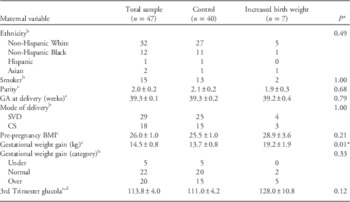
Maternal demographics of study sample

GA, gestational age; SVD, spontaneous vaginal delivery; CS, cesarean section; BMI, body mass index.
a Continuous variables were compared with the use of Student t-test while categorical variables were compared by Fisher’s exact test.
b Data given as count.
c Data are given as mean±SEM.
d Glucose tolerance test (Glucola).
*P<0.05.
Results
Maternal: Table 1 outlines the demographics and obstetrical characteristics of our study sample. The mean maternal age was 27.6 years (range 20–38). A total of 32% of women smoked before pregnancy (15/47); no mother’s smoking status changed during pregnancy. The mean parity was 2.0 (range 1–5). The mean gestational age at delivery was 39.3 weeks (range from 37.2 to 41.3). In all, 62% of the study patients delivered vaginally. The mean pre-pregnancy BMI in our study cohort was 26.0 kg/m2 (range 17.5–41.4); 27% of women were categorized as obese with BMI >30 and mean gestational weight gain was 14.5 kg (range 3.2–26.3). A total of 43% (20/47) of women gained excess weight during pregnancy, 47% (22/47) gained within the recommendations and 11% (5/47) gained less than recommended.Reference Rasmussen, Catalano and Yaktine 36 Overall, gestational weight gain was similar between obese and non-obese women (P=0.77). The mean 3rd trimester 50 g glucose challenge was 113.8 mg/dl (range 64–179) and was not significantly correlated with continuous birth weight in this cohort (P=0.74). In all, 10 women underwent 3 h glucose challenge for screening values >130 mg/dl and one was diagnosed with gestational diabetes; six women were diagnosed with gestational hypertension, and three developed pre-eclampsia.
Offspring: Foreskin samples from 47 neonates were used for NanoString analysis. About half of the samples were taken on day 1 of life (51%, range 0–3). The mean birth weight of the control babies was 3324±60 g compared with 4115±87 g for the top 15% of babies in the cohort (P<0.0001).
The control and increased birth weight samples did not differ significantly according to maternal age (P=0.84), ethnicity (P=0.49), parity (P=0.68), smoking (P=1.00), or mode of delivery (P=1.00). In this cohort, pre-pregnancy BMI was not significantly correlated with continuous birth weight overall (P=0.36), and birth weights were not significantly different between non-obese and obese mothers (3411±80 v. 3521±120 g, P=0.47). Gestational weight gain was significantly correlated with continuous birth weight (Pearson’s r=0.43; P=0.002) and women that gave birth to increased birth weight babies also had higher gestational weight gain (P=0.01; Table 1).
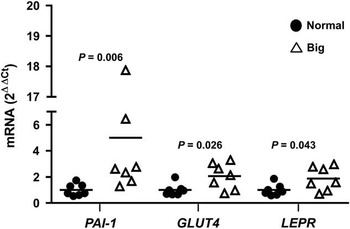
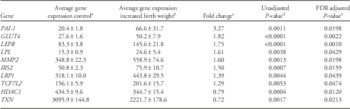
Gene expression was measured in the hypodermis of 47 neonates and expression levels of the highest 15% of birth weight babies (n=7) were compared with those of the remaining babies (n=40). Table 2 shows the 10 genes with an FDR adjusted P<0.05. Both HDAC1 and TXN were significantly downregulated in the hypodermal layer in higher birth weight newborns compared with the remainder of the cohort. Eight genes were significantly upregulated with a fold change >1.25 in the larger babies. These genes were PAI-1, GLUT4, LEPR, lipoprotein lipase (LPL), matrix metalloproteinase 2 (MMP2), insulin receptor substrate 2 (IRS2), LRP1, and transcription factor 7-like 2 (TCF7L2). We validated three genes with the greatest (and significantly different) fold change in mRNA differences in the NanoString CodeSet with real-time PCR (PAI-1, GLUT4 and LEPR). We found significant increases in PAI-1 (P=0.006), GLUT4 (P=0.026) and LEPR (P=0.043) in babies with the 15% highest birth weights compared with a subset (n=7) of the normal weight babies (Fig. 1).
Quantitative polymerase chain reaction (qPCR) validation of three genes with the highest (and significant) fold change in messenger RNA (mRNA) differences in the NanoString CodeSet. Horizontal line depicts the mean expression for each gene.

Comparison of gene expression in hypodermis in the subsample with higher birth weight v. control

a Data are given as mean±SEM.
b Increased birth weight group is the top 15% from the study (n=7) compared with the rest (n=40).
c Fold change in mean gene expression of increased birth weight divided by control.
d Unadjusted P-values from t-tests are shown.
e False discovery rate-adjusted P-values are displayed; as this table includes only genes with FDR-adjusted P-values below 0.05, the interpretation is that we expect nine or 10 of these discoveries to be true.
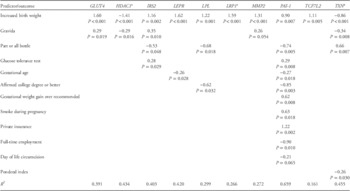
Multivariate analysis results are summarized in Table 3. Each column represents a different regression model, corresponding to one of the 10 genes for which the FDR-adjusted P-value was <0.05 in comparing birth weight groups. Eight of the 10 models contain, in addition to group, one or more maternal or infant characteristics which portend gene expression. As an example, controlling for gestational age, LEPR expression is predicted to increase by more than one-and-a-half of its standard deviations when birth weight crosses from normal to elevated; and, controlling for birth weight, each increase in gestational age by one of its standard deviations decreases predicted LEPR expression by approximately one-quarter of its standard deviation. The latter result makes sense intuitively; for instance, if a 37-week gestational age baby and a 41-week gestational age baby have the same birth weight, then the 37-week baby is larger relative to his age and would be anticipated to have greater LEPR expression consistent with being of larger size. With two exceptions, one on the high end (PAI-1, 65.9%) and one on the low end (TCF7L2, 16.1%) between 25 and 50% of each gene’s variation in expression level was accounted for by birth weight group and other maternal or infant characteristics. Besides birth weight, the predictor most often appearing in multivariate analysis was gravida, which was selected for five out of the 10 regression models. The direction of the relationship between gravida and gene expression in these five models was the same as that between birth weight and gene expression; when increased birth weight corresponded to greater gene expression, so did increased gravida and vice versa. In addition, part or all bottle fed appeared in four out of the 10 regression models with the direction of the relationship being opposite to that of birth weight and gene expression. No other predictor was selected for more than two of the regression models, though, interestingly, the model for PAI-1 contained 10 predictors; no other model contained as many as five.
Multivariate analysis of gene expression levels

Each column represents a separate regression model. Variables actually selected for each model are those whose cell entries are filled in. Each regression coefficient is the estimated number of standard deviations by which the outcome is expected to increase when the predictor goes from no to yes (if the predictor is binary) or when the predictor increases by one standard deviation (if the predictor is continuous), while adjusting for all other predictors in the same model. These regression coefficients turned out to be >0.50 in absolute value for all binary predictors and <0.50 in absolute value for all continuous predictors. Accompanying each regression coefficient is a P-value. The final row contains R 2, the proportion of (weighted) variation in gene expression explained by the variables used to predict it.
a Weighted least squares analysis.
Discussion
We used human foreskin tissue to assess changes in gene expression of neonates related to obesity, weight gain in pregnancy and birth weight. Our main finding was that birth weight was associated with the expression of genes related to metabolism and inflammation in neonatal tissue. We confirmed what others have shownReference Butte, Ellis, Wong, Hopkinson and Smith 37 in that birth weight was positively correlated with gestational weight gain. Understanding weight induced alterations in gene expression may be important in establishing potential mechanisms responsible for the detrimental effects of small or large birth weight and increased maternal weight gain on offspring risk of developing obesity and type 2 diabetes. While we do not anticipate that gene expression changes in the foreskin are driving whole body changes in appetite and energy balance, hyperglycemia and inflammation, we suspect that these changes are representative of the types of alterations that are seen in other tissues. Results from this study point to the foreskin as a useful model to study developmental programming using a tissue that comes directly from the infant after birth and may not include maternal contributions like placentaReference In ‘t Anker, Scherjon and Kleijburg-van der Keur 38 and cord blood.Reference Hall, Lingenfelter and Adams 39 However, given that others have shown that elevated baby birth weight impacts a number of markers related to glycemic control,Reference Kainulainen, Jarvinen and Heinonen 40 appetite/energy balance,Reference Mazaki-Tovi, Kanety and Pariente 41 , Reference Wiznitzer, Furman and Zuili 42 obesityReference Wang, Shang and Dong 43 and inflammation in placenta or cord blood,Reference Catalano, Presley, Minium and Hauguel-de Mouzon 18 we assessed similar markers in the neonatal foreskin.
Upregulation of gene expression in foreskin tissue related to appetite and energy balance, hyperglycemia and inflammation were found in babies with increased birth weight. These data support human epidemiological evidence demonstrating that high birth weight babies are at an increased risk for developing obesityReference Curhan, Chertow and Willett 44 , Reference Curhan, Willett and Rimm 45 and type 2 diabetes later in life.Reference Wei, Sung and Li 46 These data further our knowledge by providing mechanisms of dysfunction that may be predisposing high birth weight babies to an obese, insulin resistant phenotype at increased risk of developing cardiovascular disease in adulthood.Reference Rich-Edwards, Stampfer and Manson 47 Several markers of obesity, insulin resistance, and cardiovascular disease had the greatest fold change in gene expression with higher birth weight (Table 2). While some markers have been measured in animal models of developmental programming or in human placenta/cord blood, this is the first study to examine them in neonatal foreskin. The skin is readily available following circumcision at birth and can be obtained later in life through skin biopsies. These repeated measures are a necessary next step in determining if the observed gene expression changes in the current study extend beyond infancy.
Results from the present study suggest that high birth weight babies have increased expression of obesity related genes (LPL and LEPR). Studies in rodents have shown that leptin treatment in offspring late in development slows neonatal weight gain and reverses prenatal adaptations resulting from stimuli that promote adulthood obesity.Reference Vickers, Gluckman and Coveny 48 LEPR expression is increased in response to leptin insensitivity as a compensatory mechanism to defend against obesity. However, in later stages of LEPR insensitivity, there is a loss of weight homeostasis and obesity ensues.Reference Lin, Storlien and Huang 49 This provides exciting evidence of particular markers that may be targeted for therapeutic interventions in high birth weight babies to prevent adulthood obesity. Future studies in our lab will begin to investigate these mechanisms in humans.
Chronic obesity leads to whole body and skeletal muscle insulin resistance.Reference Kahn and Flier 50 A number of proteins are involved in regulating cellular insulin sensitivity. GLUT4 mRNA is increased acutely in response to hyperinsulinemia;Reference Sano, Kane and Sano 51 however, as insulin resistance develops and progresses to type 2 diabetes, translocation of GLUT4 to the cell membrane in response to insulin is reduced.Reference Garvey, Maianu and Zhu 52 While infants in the present study were not obese per se, we did find that the highest 15% body weight babies had significantly elevated mRNA expression of GLUT4 and IRS2, proteins stimulated by insulin which are, in part, responsible for glucose uptake into cells. Though, it is important to note that we did not directly measure differences in protein or phosphorylation levels as part of this study.
In the area of developmental programming, elevated levels of PAI-1, an inhibitor of fibrinolysis, were found in the white adipose tissue of male rat offspring born to obese dams fed a high-fat diet during pregnancy.Reference Pisani, Oller do Nascimento and Bueno 53 This is a phenotype that is common in obesity and is related to increased risk of developing cardiovascular disease.Reference Juhan-Vague and Alessi 54 In the heart, elevated PAI-1 plays a role in the development of fibrosis.Reference Takeshita, Hayashi and Iino 55 In the present study, PAI-1 was increased in the hypodermal layer of the foreskin in the 15% highest birth weight babies; however, whether or not this also translates into increased PAI-1 expression in the hearts of these babies which might be predisposing them to greater risk of developing cardiovascular disease is not known. Huang et al. demonstrated that fetal hearts of sheep from obese mothers had increased cardiac fibrosis,Reference Huang, Yan and Zhao 56 thus, this may be a mechanism of increased cardiovascular disease risk in babies born to obese mothers (and thus, predisposed to elevated birth weight).Reference Reynolds, Allan and Raja 57 Interestingly, TXN, an antioxidant,Reference Yoshida, Nakamura, Masutani and Yodoi 58 was reduced in the 15% highest birth weight babies, thus providing further evidence for a phenotype which may be more predisposed to increased oxidative stress and developing cardiovascular disease later in life. In fact, previous animal studies have demonstrated that offspring born to obese dams tend to have higher rates of oxidative stress,Reference Bruce, Cagampang and Argenton 59 potentially due to downregulation of TXN.
Although not a specific aim of the paper, it is of interest that gravida, or number of pregnancies a woman has had, appeared as a predictor in five of the regression models (Table 3), second in frequency to increased birth weight. Increased parity, or number of live births a female has had (which would also increase gravida), has been associated with weight gain and obesity in humansReference Ness, Harris and Cobb 60 and mice.Reference Rebholz, Jones and Burke 61 Given that obese mothers tend to have bigger babies,Reference Whitelaw 62 the fact that all of the genes whose expression levels were altered with gravida (adjusted for other variables) are also associated in the same direction with increased birth weight, is not a surprise.
There were several limitations to this study. The top 15% birth weight babies were grouped together, as opposed to using a more standard definition of macrosomia, due to our limited sample size. Further, the relatively low number of samples did not allow for analysis of gestational diabetes or hypertension as confounding factors on gene expression. While gene expression was altered in the top 15% birth weight babies compared with controls, it is significant to note that mRNA levels do not strongly correlate with protein expression.Reference Vogel and Marcotte 63 Finally, neonatal tissue can only be collected in males following circumcision; thus, female neonates were not included in this study and we cannot comment on a potential sex bias at this time. Despite these limitations, we have demonstrated the neonatal foreskin as a useful tissue to study developmental programming.
We found that gene expression related to glycemic control, appetite/energy balance, obesity and inflammation was altered in tissue from babies with elevated birth weight. These genes point to potential mechanisms regarding fetal programming in macrosomic babies. Importantly, this model can be expanded in future studies to include collection of placenta, cord blood and maternal serum for comparative analyses.
Acknowledgments
The authors would like to acknowledge Lawrence P. Reagan from the University of South Carolina School of Medicine for his insightful discussions about GLUT4 and Wendy F. Hansen for her thoughtful comments on the manuscript.
Financial Support
The authors’ views are not necessarily those of the funding agencies that supported their efforts. Funding for the study was generously provided by the Graduate Center for Nutritional Sciences at the University of Kentucky. A.J.S and S.S. were supported by the National Institutes of Health (NIH) (5P20GM103436-15). In addition, A.J.S. was supported by NIH CTSA Award (UL1TR000117). R.J.C. was supported, in part, by the NIH (P20GM103527-08). L.J.R. was supported by an American Heart Association Post-Doctoral Fellowship (15POST25110002). C.S.R. was supported by NIH training grants (T32DK07778 and 5T32HD060556).
Conflicts of Interest
None.
Ethical Standards
The authors assert that all procedures contributing to this work comply with the Belmont Report and with the Helsinki Declaration of 1975, as revised in 2008, and has been approved by the University of Kentucky Medical Institutional Review Board.
Supplementary material
To view supplementary material for this article, please visit https://doi.org/10.1017/S2040174417000290