INTRODUCTION
Echinoderms are exclusively marine invertebrates which have more than 6500 extant species distributed in six classes (Hendler et al., Reference Hendler, Miller, Pawson and Kier1995). Previously, 108 shallow water echinoderms were listed in Puerto Rico, 15 of them echinoids (Benavides-Serrato, Reference Benavides-Serrato2006). The listed species of the class Echinoidea increased recently with the addition of Cassidulus caribaearum and Echinoneus cyclostomus (Rodríguez-Barreras et al., Reference Rodríguez-Barreras, Sabat, Benavides-Serrato and Bontemps2012a, Reference Rodríguez-Barreras, Calzada-Marrero and Sabatb). Puerto Rico is part of the distributional range of many other sea urchins. The lack of continuous systematic field surveys in Puerto Rico and the burrowing behaviour of many irregular echinoids has contributed to underestimate the real biodiversity of this group.
The flattened sea urchin Clypeaster subdepressus (Gray, 1825) is one of the most common echinoids of the genus Clypeaster in the Caribbean shallow waters. The distribution range of the species extends from North Carolina in the United States to Rio de Janeiro in Brazil (Serafy, Reference Serafy1979). In the Caribbean, the species was reported for Mexico (Quintana Roo), Belize, Cuba, and Panama (Bravo-Tzompantzi et al., Reference Bravo-Tzompantzi, Solís-Marín, Laguarda-Figueras, Abreu-Pérez and Durán-González1999; Del Valle-García et al., Reference Del Valle, Solís-Marín, Abreu Pérez, Laguarda Figueras and Durán González2005; Laguarda-Figueras et al., Reference Laguarda-Figueras, Solís-Marín, Durán-González, Ahearn, Buitrón-Sánchez and Torres-Vega2005; Alvarado et al., Reference Alvarado, Solís-Marín and Ahearn2008). Furthermore, the Smithsonian National Museum of Natural History (SNMNH) contains collections of individuals from the Bahamas, Colombia, Costa Rica, Cuba, Dominica, Grenada, Jamaica, St Lucia, Suriname, and the south-east coast of the United States. However, the species has not yet been reported for Puerto Rico. The burrowing behaviour of the species could be a potential factor that has delayed its finding despite the great size of C. subdepressus with a diameter up to 300 mm (Hendler et al., Reference Hendler, Miller, Pawson and Kier1995).
The species Paraster floridiensis is a small sea urchin which burrows up to 250 mm and usually its presence could be detected mainly by the presence of dead tests on the surface of sediments (Chesher, Reference Chesher1966). Its distribution range extends from the Bahamas, Belize, Dominica, the Florida Keys, Honduras and Panama (Chesher, Reference Chesher1966; Kier, Reference Kier1975; Hendler et al., Reference Hendler, Miller, Pawson and Kier1995; Alvarado et al., Reference Alvarado, Solís-Marín and Ahearn2008). There are specimens deposited in the SNMNH of the species of all these localities, including Bermuda and Suriname. However, C. subdepressus and P. floridiensis have not yet been reported for Puerto Rico. With this new information, we added up to 19 species to the list of shallow water echinoids for Puerto Rico.
RESULTS
SYSTEMATICS
The new list of shallow water echinoids of Puerto Rico has 19 added species distributed in 8 orders, 10 families, and 18 genera.
Phylum ECHINODERMATA Klein, 1754
Class ECHINOIDEA Leske, 1778
Order CIDAROIDEA Claus, 1880
Family CIDARIDAE Gray, 1825
Eucidaris tribuloides tribuloides (Lamarck, 1816)
Order DIADEMATOIDA Duncan, 1889
Family DIADEMATIDAE Gray, 1855
Diadema antillarum (Philippi, 1845)
Astropyga magnifica A.H. Clark, 1934
Order TEMNOPLAUROIDA Mortensen, 1942
Family TOXOPNEUSTIDAE Troshel, 1872
Lytechinus variegatus variegatus (Lamarck, 1816)
Tripneustes ventricosus (Lamarck, 1816)
Order ECHINOIDEA Claus, 1876
Family ECHINOMETRIDAE Gray, 1825
Echinometra lucunter lucunter (Agassiz, 1863)
Echinometra viridis Agassiz, 1863
Order HOLECTYPOIDA Duncan, 1889
Family ECHINONEIDAE Wright, 1857
Echinoneus cyclostomus Leske, 1778
Order CASSIDULOIDA Clauss, 1880
Family CASSIDULIDAE Agassiz y Desor, 1846
Cassidulus caribaearum Lamarck, 1801
Order CLYPEASTEROIDA A. Agassiz, 1872
Family CLYPEASTERIDAE L. Agassiz, 1835
Clypeaster rosaceus (Linné, 1758)
Clypeaster subdepressus Gray, 1825
Family MELLITIDAE Stefanini, 1911
Leodia sexiesperforata (Leske, 1778)
Mellita quinquiesperforata Leske, 1778
Order SPATANGOIDA Claus, 1876
Family BRISSIDAE Gray, 1855
Brissus unicolor (Leske, 1778)
Brissopsis elongata elongata Mortensen, 1907
Meoma ventricosa ventricosa (Lamarck, 1816)
Plagiobrissus grandis (Gmelin, 1788)
Family SCHIZASTERIDAE Lambert, 1905
Moira atropos (Lamarck, 1816)
Paraster floridiensis (Kier & Grant, 1965)
MATERIAL EXAMINED
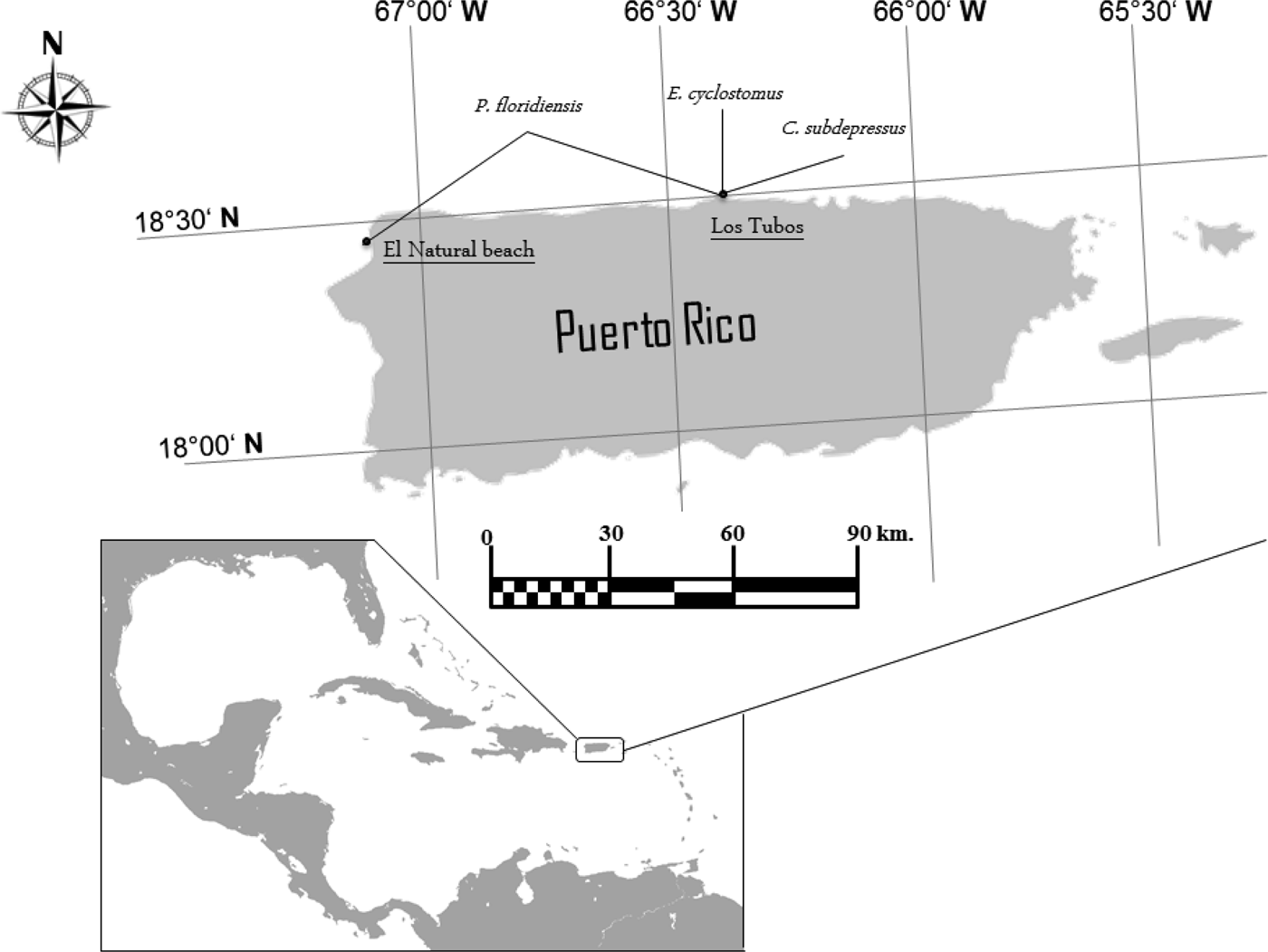
One test of Paraster floridiensis was collected at the ‘El Natural' dive site, Aguadilla municipality (18°27′47.17″N 67°10′10.45″W) at 20 m depth. The other test was found in Los Tubos, Manatí municipality (18°28′21.65″N 66°27′3.46″W) at 10 m depth (Figure 1). Both samples were collected in October 2012 and deposited in the collection of the Zoology Museum of the University of Puerto Rico, Río Piedras campus with the codes EEPF-001 and EEPF-002. Tests were small, fragile, approximately spherical, heart-shaped and the anterior petals are much longer than the posterior petals. Hence, the anterior gonopores were smaller than the posterior gonopores.
Map showing the localities of the two new records for Clypeaster subdepressus and Paraster floridiensis, and the new locality for Echinoneus cyclostomus in Puerto Rico.

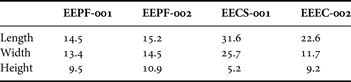
The test of the Clypeaster subdepressus was collected in October 2012, in Los Tubos, Manatí municipality (18°28′21.65″N 66°27′3.46″W), on the north coast of Puerto Rico (Figure 1) at 8 m depth. The species was found in a sand plain of a fringing reef, which is considered its typical habitat (Hendler et al., Reference Hendler, Miller, Pawson and Kier1995). The EECS-001 belongs to a juvenile and it has a relative higher test, thicker edge and smaller petals than the adults (Serafy, Reference Serafy1970). The test is white in colour, circular in shape, relatively flat and without spines. The sample was submitted to the same collection under the code EECS-001. Measurements of all samples are shown in Table 1. With this new information we update the list of shallow water echinoids for the Puerto Rico coast with the addition of two new records. Moreover, the finding of an entire test of Echinoneus cyclostomus (EEEC-002) in the same locality has increased its local distributional range.
Measures of the three tests collected of Paraster floridiensis (EEPF), Cypleaster subdepressus (EECS) and Echinoneus cyclostomus (EEEC). All units are in millimetres; caliper error ± 0.05 mm.

CONCLUSION
This work reviews the echinoid fauna and updates the current information available for Puerto Rico. Furthermore, we reported the exact locality of the two new records and the collection reference codes where they have been deposited in order to facilitate future taxonomic works. Most of the previous studies have been conducted mainly on the south coast and this has created a knowledge gap for the north coast. The recent two new additions (Rodríguez-Barreras et al. Reference Rodríguez-Barreras, Sabat, Benavides-Serrato and Bontemps2012a, Reference Rodríguez-Barreras, Calzada-Marrero and Sabatb) together with these new records suggest further field surveys are required. The Caribbean is the habitat of many other echinoids that have not yet been reported for Puerto Rico.
ACKNOWLEDGEMENTS
We thank the Sea Grant College Program (PD-295 & R92-110) and the Center for Applied Tropical Ecology and Conservation (C.A.T.E.C.), Neptune's Divers, and NewGen Divers for their logistic support. We specially thank Paul Bayman, PhD for his critical review of early versions of this manuscript.