Potential applications of oxide nanofibers are being widely exploited because of these fibers’ advantages of large surface area and low-cost production.Reference Yury1–Reference Huang and Choi3 These are valuable characteristics for sensor and catalyst applications in which surface-controlled reactions are critical.Reference Rodríguez and Marcos4–Reference Sawicka and Gouma6 Such nanofibers were first synthesized a few decades ago and, since then, nanofibers of various metal oxide materials have been prepared and characterized, and their potential applications in many areas have been demonstrated.Reference Asokan, Park, Choi, Chang and Kim7–Reference Ramakrishna, Fujihara, Teo, Lim and Ma9
Very recently, the growth behavior of nanograins in ZnO nanofibers synthesized by electrospinning has been investigated by the current authors.Reference Park and Kim10 According to the results, individual nanofibers consist of nanograins. The nanograins coalesce and grow under higher calcination temperatures and longer calcination times. The size of the nanograins is likely to determine all of the physical and chemical properties of the nanofibers.
One of the important applications of oxide nanofibers is as gas sensors. Therefore, it is interesting to study how the size of nanograins influences the gas sensing properties. In this study, the effects of the size of nanograins in ZnO nanofibers on gas sensing properties for CO were investigated. We found that ZnO nanofibers with large nanograins show sensing properties superior to nanofibers with small nanograins.
ZnO nanofibers were synthesized by the electrospinning method. The synthesis procedure and nanofiber microstructures are described in detail in the previous work.Reference Park and Kim10 Two different nanofibers that were calcined for 6 and 24 h, which had nanograin diameters of 48 and 85 nm, respectively, were selected to investigate the influence of the size of nanograins on the sensing properties.
For the sensing measurements, Ni (∼200 nm in thickness) and Au (∼50 nm) double-layer electrodes were sequentially deposited via sputtering on the specimens using an interdigital electrode mask. The process of fabricating the nanofiber sensors is described in detail in our previous reports.Reference Park, Choi, Lee, Lee and Kim11, Reference Choi, Park and Kim12 The response of the ZnO nanofiber sensors to CO was measured at 300 °C using a homemade gas dilution and sensing system. The sensitivity (S) was estimated according to the following formula, S = R a/R g, where R a is the initial resistance in the absence of CO and R g is the resistance measured in the presence of CO.
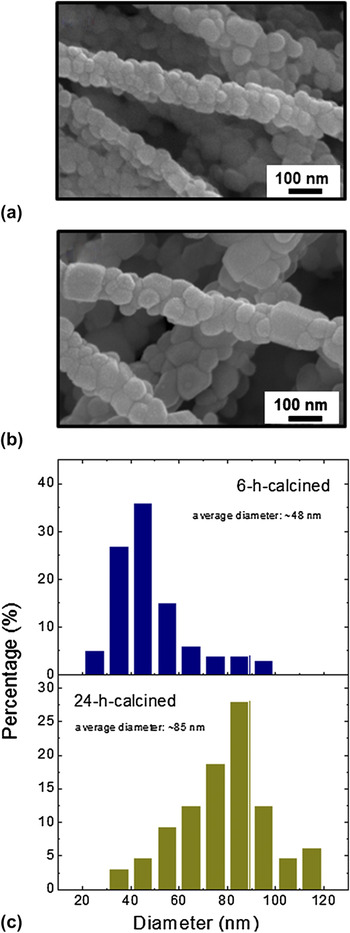
For the purpose of investigating the effects of the size of nanograins on the sensing properties for CO, the responses of the sensors fabricated from the two different ZnO nanofibers, which had been calcined for 6 and 24 h, were investigated in a comparative way. Figure 1 shows the microstructures of the two selected ZnO nanofibers. The ZnO nanofibers calcined for 6 h consist of nanograins of ∼48 nm in diameter. The 24-h-calcined ZnO nanofibers show much larger nanograins of ∼85 nm. Figure 1(c) shows the histograms of the grain diameters measured for the 6- and the 24-h-calcined ZnO nanofibers. As is evident, though there is some portion of overlap, the majority of grains in the 24-h-calcined nanofibers are larger than those in the 6-h-calcined nanofibers. Using the two different types of ZnO nanofibers, gas sensors were fabricated.
Microstructures of (a) 6-h-calcined and (b) 24-h-calcined ZnO nanofibers. (c) Histograms of the grain diameters.

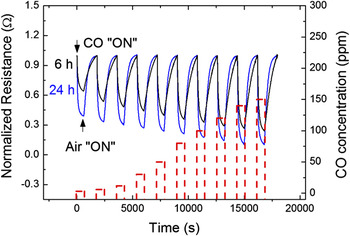
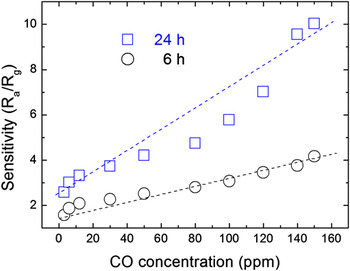
Figure 2 shows the resistance change with time according to the change of CO concentration. Note that the dotted lines (red) indicate the CO concentrations used in each sensing measurement. The responses of the sensors clearly track the change of the CO environment. The resistances of the sensors decrease upon exposure to CO, whereas they increase upon exposure to air gas. This sensing behavior of the ZnO nanofibers for CO can be explained in the framework of a normal n-type semiconductor sensor. As usual, CO reacts with the chemisorbed surface oxygen as CO + O2− → CO2 + 2e−. In this way, the liberated electrons decrease the resistance of the ZnO nanofibers. Importantly, the sensor fabricated with the ZnO nanofibers calcined for 24 h shows a much better response than that of the sensor fabricated with 6-h-calcined ZnO nanofibers. Figure 3 summarizes the sensitivities for the sensors. At 150 ppm CO, the sensitivity of the sensor fabricated with the 24-h-calcined ZnO nanofibers is better by a factor of ∼5 than that of the sensor fabricated with the 6-h-calcined nanofibers.
Dynamic responses to CO of the sensors fabricated with ZnO nanofibers that were calcined for 6 and 24 h. The dotted red lines indicate the concentrations of CO.

Comparison of sensitivity of gas sensors fabricated with 6-h- and 24-h-calcined ZnO nanofibers.

The reason why the sensor fabricated with nanofibers of large nanograins exhibits a superior sensitivity can be speculated as follows. Gas molecules such as CO adsorbed on the surface of each nanofiber migrate into the grain boundaries and then fully occupy the grain boundaries of all the nanograins. This produces electron-depleted layers at the interfaces of the two adjacent nanograins, eventually building up a potential barrier for electrons to flow across. The potential barrier plays the role of a resistor, which is connected in series with the potential barriers built up at other grain boundaries. The change in resistance during the adsorption of gas molecules, originating from such a process, creates the gas sensing process in nanofibers. Based on this depletion layer-based mechanism, which is generally accepted in the literature,Reference Aswal and Gupta13 one would expect a higher sensitivity for the 6-h-calcined nanofibers because they consist of smaller grains, providing more area of grain boundaries. However, the results in Figs. 2 and 3 show that a considerably enhanced response to CO was observed rather in the large-grained nanofibers. This inevitably indicates that the change results not from the grain size but from another critical material property associated with the gas sensing mechanism according to the different calcination times. Taking into account the general phenomena during the calcination treatment, a change in either the calcination time or the temperature greatly influences not only the grain size but also the crystallinity. The crystallinity of a material can be fundamentally understood as the degree of order on the atomic scale. A longer calcination time or a higher calcination temperature usually results in a better crystallinity via recrystallization or densifying process. This increased crystallinity gives us enhanced capabilities to detect chemical species. In our results, by eliminating the effect of grain size as the reason for the enhanced sensitivity in the 24-h-calcined ZnO nanofibers, the improvement of crystallinity after the prolonged calcination time is more likely to be responsible for the enhancement. According to a survey of the literature, crystallinity is an important material property that influences the gas sensing mechanism in TiO2 filmsReference Seeley, Bandyopadhyay and Bose14 and SnO2 films.Reference Ahn, Kim, Park and Huh15
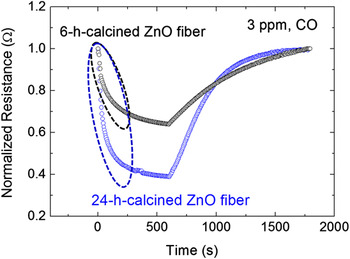
In addition, large-grained ZnO nanofibers showed shorter response and recovery times. This is because gas molecules are likely to diffuse more slowly into nanofibers that are made up of small nanograins, as compared with the case of nanofibers of large nanograins. Therefore, a longer time is needed for gas molecules to completely occupy the grain boundaries in an individual nanofiber and to form potential barriers in nanofibers of small nanograins. Therefore, sensors fabricated with nanofibers of smaller nanograins show relatively slower response and recovery times than do sensors fabricated with nanofibers of large nanograins. Figure 4 shows the enlarged part of the response data shown in Fig. 2 for 3 ppm CO. As is evident, the resistance of the sensor fabricated with nanofibers of large nanograins more quickly decreases (increases) during the absorption (desorption) process of CO. This strongly supports our explanation.
Enlarged part of the response results shown in Fig. 2 for 3 ppm CO.

This work demonstrated that the size of nanograins in individual ZnO nanofibers greatly influences nanofiber sensing properties for the CO. Sensors fabricated with nanofibers of large nanograins showed superior sensitivity, and shorter response and recovery times, compared to those qualities of sensors fabricated with nanofibers consisting of small nanograins. A mechanism was proposed to explain the experimental results. The improved crystallinity due to the longer calcination time appeared responsible for the superior sensitivity. On the other hand, the faster occupancy and removal of gas molecules to grain boundaries in the large-grained nanofibers was the most probable cause for their shorter response and recovery times for detecting CO. This work suggests that in the application of oxide nanofibers to gas sensors, not only the size of the nanograins existing in individual nanofibers but also the crystallinity of the grains need to be optimized to obtain the best sensing properties.
ACKNOWLEDGMENT
This work was supported by Nuclear R&D program through the National Research Foundation of Korea.