Introduction
The proportion of adults reaching old age has been increasing worldwide. Although most developed countries define “elderly” as being 65 years of age and over, in Malaysia the elderly are defined as those aged 60 years and more (Malaysia, 2010; WHO, 2011). It is predicted that the proportion of the population that can be defined as elderly will increase from 5.9% in 1991 to 9.9% by 2020 (Selvaratnam and Tin, Reference Selvaratnam and Tin2007). As this proportion increases, the prevalence of diseases associated with old age will increase as well – including dementia. Although the World Health Organization reports that 7% of elderly people suffer from dementia (WHO, 2008), a recent study reported the prevalence among elderly Malaysians to be 14% (Hamid et al., Reference Hamid, Krishnaswamy, Abdullah and Momtaz2011).
There is only a limited range of care management options. These include assisted-living facilities, nursing homes, residential care, day care center or home care. The literature suggests that most elderly people prefer living in their own homes (Iwarsson et al., Reference Iwarsson2007), and most caregivers prefer to provide care at home (Suh et al., Reference Suh, Kil Yeon, Shah and Lee2005). There are also cultural traditions favoring home care, with care for older adults viewed as the children's responsibility. In Malaysia, placing relatives with dementia in residential or nursing home care is perceived as abandonment and against religious obligations (MacKenzie, Reference MacKenzie2006). However, caring for family members with dementia is a source of burden and distress (Burns and Rabins, Reference Burns and Rabins2000; Chene, Reference Chene2006). Usually transfer to nursing homes and/or residential care takes place only when caregivers are no longer able to cope with the condition of the dementia patient (Rigaud et al., Reference Rigaud, Fagnani, Bayle, Latour, Traykov and Forette2003; Moyle et al., Reference Moyle, McAllister, Venturato and Adams2007).
Nevertheless, it is not an easy choice, and the decision is even harder when negative sentiments are attached to nursing homes. In a study of the public perceptions on the quality of nursing homes it was reported that 52% of respondents viewed quality as fair or poor (Hogan and Mickus, Reference Hogan, Mickus and Baumer2002). Additionally, several studies have reported negative consequences following institutionalization, including depression, increased sense of loneliness, alienation and a decrease in functional competence (Aneshensel et al., Reference Aneshensel, Pearlin, Levy-Storms and Schuler2000; Ball et al., Reference Ball2000; Scocco et al., Reference Scocco, Rapattoni and Fantoni2006).
Although health-related quality of life (HRQoL; i.e. those aspects of QoL that are affected by health) has been examined in residential homes (Sloane et al., Reference Sloane, Zimmerman, Williams, Reed, Gill and Preisser2005; Hoe et al., Reference Hoe, Hancock, Livingston and Orrell2006) and nursing homes (Zimmerman et al., Reference Zimmerman2005; Scocco et al., Reference Scocco, Rapattoni and Fantoni2006; Gerritsen et al., Reference Gerritsen, Steverink, Ooms, De Vet and Ribbe2007), to date no study appears to have reported a comparison of the HRQoL of dementia patients in nursing homes and home care. As such, it remains unclear whether placement of the dementia patient in a nursing home will make a difference to their HRQoL (Moyle et al., Reference Moyle, McAllister, Venturato and Adams2007). This paper describes the research protocol for such a study.
Aims and hypothesis
This cross-sectional study aims to investigate the effect of living arrangement (nursing homes versus home care) on the HRQoL of dementia patients. The study hypothesis is that dementia patients who receive home care have a better HRQoL when compared to those living in nursing homes.
There are four studies aims:
(a) to provide a profile of HRQoL among dementia patients in the nursing home and in home care;
(b) to compare the HRQoL of dementia patients in the nursing home and in home care. The study hypothesis that home care provides better HRQoL than institutional care was operationalized as a difference of 2 points on the WHO-8 scale, which is half a standard deviation (for justifications, see below);
(c) to identify factors that differentiate the HRQoL of dementia patients in these two settings (if any); and
(d) to identify the needs of individuals with dementia in the nursing home and in home care.
Methods
Study design and procedures
In order to obtain an understanding of HRQoL and the needs of dementia patients in nursing homes, it is important to compare the nursing home group with a community sample of people receiving care at home. As respondents cannot be randomly assigned, the most appropriate research approach is to use a quasi-experimental cross-sectional design where patients will be stratified by age and cognitive severity.
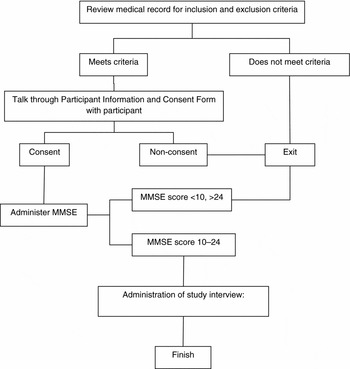
Based on this design, respondents will be sampled from two different settings: nursing homes (dementia patients residing in government nursing homes) and community home care (dementia patients who live with a carer and get services from the memory clinic in government hospitals). The procedures for recruiting respondents from nursing homes and home care are presented in Figure 1.
Study recruitment pathways and the overall study design.

Eligible respondents will be assessed in two parts. The first part will be administered by the researcher through an interview using a formal interview protocol, hereafter termed the Professional Questionnaire. Measures include the Mini-Mental State Examination (MMSE; Folstein et al., Reference Folstein, Folstein and McHugh1975), Camberwell Assessment of Need for the Elderly – Short version (CANE-S; Reynolds et al., Reference Reynolds2000), Cornell Scale for Depression in Dementia (CSDD; Alexopoulos et al., Reference Alexopoulos, Abrams, Young and Shamoian1988) and Barthel Index (BI; Mahoney and Barthel, Reference Mahoney and Barthel1965). The second part involves a participant-reported outcome (PRO) questionnaire (Respondent Questionnaire), which includes sociodemographic information, the EUROHIS-QOL (WHO-8; Power, Reference Power, Nosikov and Gudex2003), Assessment of Quality of Life (AQoL-8; Hawthorne, Reference Hawthorne2009), Geriatric Depression Scale – 15 items (GDS-15; Brink et al., Reference Brink, Yesavage, Lum, Heersema, Adey and Rose1982) and the Friendship Scale (FS) for assessing social isolation (Hawthorne, Reference Hawthorne2006).
These questionnaires will be translated into Malay language using forward and backwards translation and reconciliation done by the National Translation Institute of Malaysia prior to administration. Based on the average item response time from a previous study, it is anticipated that it will take an average of 52 minutes to complete the interview. To minimize respondent fatigue, participants will be offered a break during interviews. The administration of scales will be terminated when a respondent proves to be unwilling or is unable to respond to the questions that were asked (e.g. suffers excessive tiredness).
Respondents and sample size
Respondents will be recruited from government nursing homes (inpatients) and government hospitals (outpatients with home care). Two nursing homes and three hospitals will be from Selangor and Kuala Lumpur, Malaysia. These facilities were chosen because these localities have the highest population density in Malaysia. Inclusion criteria for the study are that participants must:
a) be aged between 60 and 89 years old – this age range reflects the average life span in Malaysia (74 years) and the Malaysian definition of “elderly” (Malaysia, 2010), with those aged over 89 being excluded to avoid skew in the study population;
b) have sufficient command of Malay or English and have sufficient insight to be able to complete an interview and questionnaire;
c) score between 10 and 24 on the MMSE – these scores are below the cutpoint for dementia (24) and are consistent with previous research and recommendations into assessing cognitive impairment among those with dementia (Sansoni et al., Reference Sansoni2007; Ibrahim et al., Reference Ibrahim2009); and
d) be able to provide informed consent.
The recruitment pathway based on these inclusion criteria is shown in Figure 1. As shown, where possible, inclusion criteria data will be extracted from the medical record. This has two advantages: it enables the researchers to stratify recruitment to meet the necessary sample requirements described below, and it minimizes the response burden on putative participants.
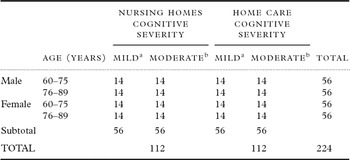
As the WHO-8 is the main study PRO instrument and was derived from the original WHOQOL-100 and the WHOQOL-BREF (Power, Reference Power, Nosikov and Gudex2003, Schmidt et al., Reference Schmidt, Muhlan and Power2006), the sample size was calculated based on re-analysis of data from the Australian data of the WHOQOL-OLD study collected by one of the authors (GH). This suggested an expected mean and standard deviation of 21.22 ± 4.64 for nursing home residents and 23.29 ± 4.56 for the home care group. The number needed for each group was determined after Davison et al. (Reference Davison, Fayers, Nunn, Venables and Taylor1986). Where the test size is 0.05 and power 0.80, a minimum of 105 respondents are required for each group (nursing home and home care) in order to have sufficient power to detect statistically significant differences in HRQoL between the settings, defined as a difference of 2 points, which is half a standard deviation on the WHO-8. As respondents will be stratified according to gender and cognitive severity to minimize selection bias in the study, the number of respondents needed in the study is shown in Table 1.
Stratified sample size calculation

Cognitive severity measured by Mini-Mental State Examination (MMSE).
a = MMSE 21–24.
b = MMSE 10–20.
Measures
Sociodemographic data
Respondents will be asked to complete a short sociodemographic questionnaire. This will cover respondents’ age, gender, ethnic origin, number of children, education, self-reported health conditions, marital status, utilization of health services, symptoms and perceived severity of impairment. In addition, respondents from the nursing homes will be asked about the duration and reason for admittance to the nursing home.
Health information
Health information will be extracted from the medical record, after consent is given. This will include principal diagnosis, type of dementia listed in the medical record, duration, comorbidities, prescribed medications and drug history.
Mini-Mental State Examination (MMSE)
The MMSE (Folstein et al., Reference Folstein, Folstein and McHugh1975) is a brief cognitive screening tool which has been widely used to screen for cognitive disorders in various clinical settings, community surveys, institutionalization and epidemiologic studies (Folstein et al., Reference Folstein, Folstein and McHugh1975; Tombaugh et al., Reference Tombaugh, Mcdowell, Kristjansson and Hubley1996; Scocco et al., Reference Scocco, Rapattoni and Fantoni2006; Whelan et al., Reference Whelan, Oleszek, Macdonald and Gaughran2009). It consists of 11 items which focus on orientation, memory and attention, naming objects, performing written and verbal tasks, writing a sentence, and drawing a complex figure. This assessment takes about 5 to 10 minutes to complete (Tombaugh et al., Reference Tombaugh, Mcdowell, Kristjansson and Hubley1996). MMSE scores range from 0 (severely impaired) to 30 (intact), with the cut-off score of 24 giving good sensitivity and specificity in detecting dementia (Folstein et al., Reference Folstein, Folstein and McHugh1975). The level of cognitive impairment on the MMSE is categorized according to the score obtained, with a score of 0–10 being severe, 11–24 mild or moderate and 25–30 no cognitive impairment (Schultz-Larsen et al., Reference Schultz-Larsen, Kreiner and Lomholt2007). The MMSE has been previously validated for use in Malaysia (Ibrahim et al., Reference Ibrahim2009).
EUROPE Health Interview Survey-Quality of Life (EUROHIS-QoL; hereafter WHO-8)
The WHO-8 is a short HRQoL measure that was derived from the original WHOQOL-100 and the WHOQOL-BREF (Power, Reference Power, Nosikov and Gudex2003; Schmidt et al., Reference Schmidt, Muhlan and Power2006). It consists of eight items, two from each of the psychological, physical, social and environmental domains of the WHOQOL-BREF (Power, Reference Power, Nosikov and Gudex2003). Each item is rated using a 5-point response format, ranging from “0 = not at all/very poor” to “5 = completely/very good”. The overall HRQoL score is computed by summing all eight items, with higher scores indicating better HRQoL (Power, Reference Power, Nosikov and Gudex2003). The scale showed a good internal consistency with α ranging from 0.80 to 0.83 and low to moderate floor and ceiling effects (Schmidt et al., Reference Schmidt, Muhlan and Power2006).
Assessment of Quality of Life (AQoL-8)
The AQoL-8 (Hawthorne, Reference Hawthorne2009) is a short HRQoL measure that was derived from the original AQoL. It consists of eight items representative of two items from each of the independent living, social relationship, physical senses and psychological well-being domains of the AQoL. Each item is rated on four levels of responses from a normal health state to a very poor health state. Responses are replaced with community preference values which were obtained from a stratified sample of the general Australian community using time trade-off. Total scores are presented as utility scores on a life-death scale which ranges from -0.04 (worse than death), 0.00 (death) to 1.00 (best HRQoL) (Hawthorne, Reference Hawthorne2009).
Camberwell Assessment of Need for the Elderly - Short Version (CANE)
The CANE assesses the needs of older people with mental health problems (Reynolds et al., Reference Reynolds2000). It was derived from the earlier Camberwell Assessment of Need (CAN) designed for mental health patients (Orrell and Hancock, Reference Orrell and Hancock2004). The CANE-S is a structured interview that assesses met and unmet care needs and care use in 24 areas (social, medical, and psychological needs, and needs regarding the living environment) (Hancock et al., Reference Hancock, Reynolds, Woods, Thornicroft and Orrell2003). Respondents are asked about any difficulties or problems with performing activities in each of the areas. Needs are rated as 0 = no need (no problem), 1 = met need, 2 = unmet need, or 9 = unknown. Needs are met when a difficulty in a particular area is being provided for, in such a way that the person no longer feels its negative impact on his or her overall QoL. Unmet needs are experienced when a person is not supported for a problem that occurs in a particular area, or receives insufficient or inadequate support (Orrell and Hancock, Reference Orrell and Hancock2004). Total scores for met needs and unmet needs are calculated separately by counting the number of 1 (met needs) and 2 (unmet needs) in all the 24 items. These two scores can be added to derive total score for needs.
The Cornell Scale of Depression in Dementia (CSDD)
The Cornell Scale of Depression in Dementia (CSDD; Alexopoulos et al., Reference Alexopoulos, Abrams, Young and Shamoian1988) is an assessment specifically designed to screen depression in an elderly population with dementia (Alexopoulos et al., Reference Alexopoulos, Abrams, Young and Shamoian1988, Debruyne et al., Reference Debruyne2009). It is a clinician interviewer administered scale which relies on information from patients or from caregiver's observations of the patient's behavior during the week prior to the interview. The CSDD consists of 19 items concerning physical well-being, sleep, appetite and other vegetative symptoms (Alexopoulos et al., Reference Alexopoulos, Abrams, Young and Shamoian1988, Korner et al., Reference Korner2006). Each of the items are rated as a (unable to evaluate), 0 (absent), 1 (mild or moderate) and 2 (severe). The scores of the individual items are summed and a cut-off of 8 indicates mild depression and 12 major depression (Alexopoulos et al., Reference Alexopoulos, Abrams, Young and Shamoian1988). However, a study by Vida et al. (Reference Vida, Des Rosiers, Carrier and Gauthier1994) found a cut-off of 7 ideal for the CSDD in Alzheimer's patients with a sensitivity of 90% and specificity of 75%.
Geriatric Depression Scale-15 (GDS-15)
The Geriatric Depression Scale (GDS) is a self-rating scale developed to screen depression in an elderly population (Brink et al., Reference Brink, Yesavage, Lum, Heersema, Adey and Rose1982). The original version of GDS consists of 30 items (GDS-30), while a short version of the GDS contains 15 items (GDS-15). These items seek information concerning lowered affect, decreased activity levels, irritability, withdrawal, distressing thoughts, and negative judgments about the past, present and future. It is presented in a yes/no response format with one point being assigned to each answer. Items are summed and higher scores indicate higher depression level. Total scores for GDS-15 range from 0 to 15 (Sheikh and Yesavage, Reference Sheikh and Yesavage1986).
This scale has been widely translated and validated across different clinical settings, cultures and countries. The Malaysian population validation study (Teh and Hasanah, Reference Teh and Hasanah2004) revealed good psychometric properties for GDS-15 (Cronbach's α coefficient = 0.84 and test-retest reliability = 0.84). The optimum cut-off point (Malay version of GDS (M-GDS) was 7/8 with 100% sensitivity and 92.0% specificity.
Barthel Index (BI)
The Barthel Index (BI; Mahoney and Barthel, Reference Mahoney and Barthel1965) was the first functional measure developed to assess the rehabilitation process in patients with a neuromuscular or musculoskeletal disorder. It consists of ten items: feeding, moving from wheelchair to bed and return, getting on and off toilet, bathing self, walking on level surface, ascending and descending stairs, dressing, and controlling bowels and bladder. Each item is scored on a 3-point scale, with 0 = totally dependent. 1 = some help needed and 2 = totally independent. Items are weighted and summed to give a score ranging from 0 to 100 (Giles et al., Reference Giles, Hawthorne and Crotty2009). A score of 100 indicates total independence; 91–99 slight dependence; 61–90 moderate dependence; 21–60 severe dependence and 0–20 total dependence (Lin et al., Reference Lin, Wu, Kao, Tzeng, Watson and Tang2009). It takes between 5 and 15 minutes to complete, depending on the respondent's responses.
Friendship Scale (FS)
The FS (Hawthorne, Reference Hawthorne2006) assesses aspects of both perceived social isolation and loneliness. It consists of six items with three covering feelings of loneliness and three the importance of actual social contacts. Responses are categorized into five levels of perceived social isolation (almost always/most of the time/about half the time/occasionally/not at all). Total scores are derived from the summation of item responses after reversals. A score of “0” indicates complete social isolation and a score of “24” indicates high social connectedness. The suggested cut points are as follows: very isolated 0–11, isolated 12–15, some isolation 16–18, socially connected 19–21 and very connected 22–24 (Hawthorne, Reference Hawthorne2006).
Data analysis
Prior to analysis, all variables will be examined for accuracy of data entry, missing values, pattern of distributions and assumptions of multivariate analysis. Missing values will be treated by using mean substitution, hot-deck imputation or regression imputation depending upon variable type (Hawthorne and Elliott, Reference Hawthorne and Elliott2005). Data normality will be assessed and transformed prior to data analysis where necessary (Tabachnick and Fidell, Reference Tabachnick and Fidell2001). Descriptive statistics and categorical variables will be examined and presented as counts, proportions or percentages. Categorical data will be analyzed using χ2; where the distributional assumptions of χ2 are violated the data will be analyzed with the Fisher Exact test (e.g. the relationship between sociodemographics and perceived needs, thereby identifying the needs of those with dementia (study hypothesis (d)).
Scales will be scored using the instrument developers’ recommended methods and algorithms. In the interests of readability and comparability with other studies, the original scale scores will be presented as means (standard deviations, SDs). Inferential statistical analyses will be carried out on the original score data where this is normally distributed; where it is non-normally distributed and has been successfully transformed, the analysis will be on the transformed data; should transformation fail non-parametric inferential tests will be used (in this case, medians and inter-quartile ranges will be reported). Subject to successful transformation, for univariate analyses mean scores will be analyzed using the independent samples t-test. If transformation fails, the Mann-Whitney U-test will be used instead. Where there are multiple levels to be examined, analysis of variance (ANOVA) will be used, or the Kruskall-Wallis H test (e.g. providing profiles of HRQoL or comparing between nursing home and home care (study hypotheses (a) and (b)).
Multivariate analyses using multiple linear regression will be used to test models of relationships between outcomes and various predictors (in the sense of variables logically associated with outcomes of interest, i.e. study hypothesis (c)). The purpose of this modeling is to identify important predictors since it is these that are potentially amenable to health care interventions aimed at providing better health care for those with dementia and so subsequently improving patients’ HRQoL.
Study results will be presented as both significance testing results and as effect sizes using Cohen's d (Cohen, Reference Cohen1988) in order to gauge the size of differences as well as their statistical significance. All data will be entered and analyzed using SPSS version 16.0.
Time line
The study will take three years to complete. The first ten months will cover the development of the conceptual framework of the study, followed by confirmation and ethics approvals. Questionnaires will be translated into Malay and will be field tested. This will take about four months and these data used to adjust the questionnaires (if needed). The next ten months will be dedicated to data collection. The remaining 12 months will be used for data analysis, and to report the findings in both a report and through academic articles.
Discussion
As the population of Malaysia ages, there will be increasing numbers of older people, a proportion of whom will have dementia. Regardless of the type of dementia, this raises various social and economic concerns for families, the government and broader society – concerns which have yet to be fully addressed and for which there is a very limited research evidence base to guide decision-makers on the best way forward. Since there is currently no cure for people with dementia, the focus to date has been on providing the best possible care for dementia patients. Increasingly, it is recognized that this care should include attention to the patient's HRQoL. Although there are theoretical and research grounds for the quality of various services for elderly people, rigorous evidence is lacking to show how beneficial the services are in promoting or maintaining HRQoL. In particular, it is unknown whether those with mild dementia experience a higher HRQoL in institutional or family care.
The main study limitation is that it is cross-sectional. The implication is that the predictive relationships described by the study's statistical analyses are, strictly, associations rather than causations. The interpretation of these relationships, however, will be based on logical criteria (e.g. it is reasonable to argue that dementia severity may cause a family to place their loved one in institutional care, whereas it is unreasonable to argue that institutional care has caused dementia among those being cared for by their families). The second study limitation will be in relation to dementia severity. As noted, dementia severity is usually one of the reasons for placing a person in institutional care. This causative relationship is a potential confounder of the study findings. However, it is impossible (and unethical) to assign people with mild dementia randomly to home or institutional care. In this study, we will adjust the data analyses by including MMSE scores as covariates in the multivariable statistical models.
Finally, we will be sampling from a limited number of institutions which are located in selected geographic regions of Malaysia. It is possible that these will not be representative of the broader Malaysian community, although we selected these locations because they have the highest population density in Malaysia and were representative of the Malaysian cultural and sociodemographic mix. Other factors which may confound the findings have been included in the demographic data and will be used as covariates to adjust the data analyses (e.g. financial status, educational level, marital status).
Subject to these caveats, this study will provide evidence for decision-makers, caregivers and families on this topic by comparing the HRQoL of those in institutional care with those receiving family care. The findings should help care providers to identify better management practices for individuals with dementia. By better understanding their needs, service providers and governments can initiate services which are more responsive to the HRQoL of those with dementia, which may reduce the burden of caregiving and provide a better life for the patients with dementia.
Conflict of interest
None.
Description of authors' roles
A. Nikmat developed the conceptual framework of the study, conducted a background literature search, carried out the study and wrote the paper. G. Hawthorne supervised the formulation of the study background, designed the study and assisted with data analysis and writing the paper. S. Hassan supervised data collection and assisted with writing the paper.
Acknowledgments
This study is funded by a grant from the Research Management Institute of Universiti Teknologi MARA, Malaysia, and is supported by The University of Melbourne. The sponsor of the study is the Ministry of Higher Education of Malaysia.
Editor's note
International Psychogeriatrics (IPG) has not previously published study protocol papers with no study results. This paper was accepted for publication because of its high quality. The Editorial Panel of IPG will decide at its annual meeting in September 2011 whether or not to accept submission of future protocol-only papers for possible future publication. In the meantime any author contemplating submission of a protocol paper is advised to contact the Editor (email: ipaj-ed@unimelb.edu.au) to discuss the paper's suitability prior to submitting it. It is expected that the online Instructions for Contributors will contain up-to-date definitive advice on the Journal's attitude to protocol-only papers no later than 30 November 2011.