



1 Introduction
1.1 Representation theory
The quantum groups (a.k.a. quantized enveloping algebras) were introduced by Drinfeld [Reference Drinfeld5] and Jimbo [Reference Jimbo9] independently, and their representation theory has been studied for many years and been applied to a number of areas of mathematics and mathematical physics such as orthogonal polynomials, combinatorics, knot theory and integrable systems. One of the central objects in the representation theory of quantum groups is the integrable modules. The notion of integrable modules originates in the representation theory of semisimple Lie algebras. In this context, an integrable module is a module over a semisimple Lie algebra which can be integrated to a representation of a corresponding Lie group. The integrability can be described as the local nilpotency of the Chevalley generators of the Lie algebra. This description can be used to define the notion of integrable modules over quantum groups as it is.
The
 $\imath $
quantum groups (a.k.a. quantum symmetric pair coideal subalgebras) of classical type were constructed by using solutions to reflection equation in some papers such as [Reference Noumi and Sugitani19], [Reference Dijkhuizen4], [Reference Noumi18] in order to perform noncommutative harmonic analysis on quantum symmetric spaces. Letzter [Reference Letzter13] provided a unified construction of
 $\imath $
quantum groups of all finite types (without relying on solutions to reflection equation), and generalized earlier results just mentioned. Her construction was further generalized to infinite types by Kolb [Reference Kolb11].
It has been pointed out that the representation theory of
 $\imath $
quantum groups develops very slowly ([Reference Letzter14], [Reference Watanabe23]). In fact, we do not still know any general theory to classify the finite-dimensional simple modules over
 $\imath $
quantum groups of finite type, although such
 $\imath $
quantum groups are quantum deformations of the universal enveloping algebra of a finite-dimensional complex reductive Lie algebra. Several type-dependent classification can be found in, for example, [Reference Gavrilik and Klimyk6], [Reference Iorgov and Klimyk7], [Reference Molev17], [Reference Ito and Terwilliger8], [Reference Watanabe22], [Reference Wenzl27], [Reference Watanabe23], [Reference Kolb and Stephens12]. Since the
 $\imath $
quantum groups have close resemblance to the quantum groups, it seems to be essential for better understanding of their representation theory to formulate the notion of integrable modules over
 $\imath $
quantum groups. This is the aim of the present paper.
1.2 Integrable modules
Let us recall the definition of integrable modules over quantum groups. Let
 $\mathbf {U}$
be a quantum group, and
 $\{ E_i, F_i \mid i \in I \}$
its Chevalley generators. Then, a weight
 $\mathbf {U}$
-module V is said to be integrable if for each weight vector
 $v \in V$
, there exist tuples
 $(a_i)_{i \in I}$
,
 $(b_i)_{i \in I}$
of nonnegative integers such that
 $$\begin{align*}E_i^{(a_i+1)} v = F_i^{(b_i+1)} v = 0, \end{align*}$$
where the elements
 $E_i^{(a_i+1)}$
,
 $F_i^{(b_i+1)}$
are divided powers.
Let us turn to the
 $\imath $
quantum groups. An
 $\imath $
quantum group is a certain subalgebra of a quantum group
 $\mathbf {U}$
, and has a distinguished family
 $\{ E_j, F_j, B_k \mid j \in I_{\bullet },\ k \in I_\circ \}$
of elements, which play similar roles to Chevalley generators of
 $\mathbf {U}$
in some sense. Here,
 $I_{\bullet }$
is a subset of I, and
 $I_\circ $
is its complement
 $I \setminus I_{\bullet }$
. An easy idea to define the integrable modules over the
 $\imath $
quantum group is the local nilpotency with respect to
 $E_j$
,
 $F_j$
and
 $B_k$
. However, this is not acceptable since
 $B_k$
may act semisimply on many modules which should be included in the class of integrable modules. Bao and Wang, in their theory of
 $\imath $
canonical bases [Reference Bao and Wang2], [Reference Bao and Wang3], introduced the notion of
 $\imath $
divided powers, which are analogues of the divided powers of quantum groups. Using the
 $\imath $
divided powers, one may be able to resolve the semisimplicity issue of
 $B_k$
above. However, testing integrability would be too hard since the
 $\imath $
divided powers are very complicated in general.
To overcome this difficulty, let us recall an alternative definition of the integrable
 $\mathbf {U}$
-modules. Let
 $X^+$
denote the set of dominant weights. For each
 $\lambda \in X^+$
, let
 $V(\lambda )$
denote the integrable highest weight module of highest weight
 $\lambda $
with highest weight vector
 $v_\lambda $
. Also, let
 ${}^\omega V(\lambda )$
denote the integrable lowest weight module of lowest weight
 $-\lambda $
with lowest weight vector
 ${}^\omega v_\lambda $
. Then, a weight
 $\mathbf {U}$
-module V is integrable if and only if for each weight vector
 $v \in V$
, there exist
 $\lambda , \mu \in X^+$
and a
 $\mathbf {U}$
-module homomorphism
 ${}^\omega V(\lambda ) \otimes V(\mu ) \rightarrow V$
which sends
 ${}^\omega v_\lambda \otimes v_\mu $
to v. Namely, integrable
 $\mathbf {U}$
-modules are locally quotients of various
 ${}^\omega V(\lambda ) \otimes V(\mu )$
.
The
 $\mathbf {U}$
-modules
 ${}^\omega V(\lambda ) \otimes V(\mu )$
appear in Lusztig’s construction of the canonical basis of modified form of
 $\mathbf {U}$
([Reference Lusztig15]). They are replaced by certain
 $\mathbf {U}^{\imath }$
-modules
 $L^{\imath }(\lambda , \mu )$
in Bao-Wang’s theory of
 $\imath $
canonical bases [Reference Bao and Wang2], [Reference Bao and Wang3]. Hence, it is natural to define an integrable
 $\mathbf {U}^{\imath }$
-module to be locally a quotient of
 $L^{\imath }(\lambda , \mu )$
. This definition turns out to work well in the present paper as summarized below.
1.3 Results
First, we determine a presentation of the
 $\mathbf {U}^{\imath }$
-modules
 $L^{\imath }(\lambda , \mu )$
(Theorem 4.2.6). This enables one to test if a given
 $\mathbf {U}^{\imath }$
-module is integrable in a systematic way. In many cases, one only needs to check the local nilpotency with respect to
 $E_j$
,
 $F_j$
,
 $B_k$
just like the quantum group case. In the remaining case, one needs to investigate local semisimplicity of some
 $B_k$
. As an application, we show that each integrable
 $\mathbf {U}$
-module is integrable as a
 $\mathbf {U}^{\imath }$
-module (Proposition 4.3.2).
Next, we concentrate on the
 $\imath $
quantum groups of finite type. We also assume that the parameters of the
 $\mathbf {U}^{\imath }$
are chosen in a way such that the
 $\mathbf {U}^{\imath }$
is invariant under a certain anti-algebra involution
 $\rho $
on
 $\mathbf {U}$
and that the
 $\imath $
canonical basis of the modified form of
 $\mathbf {U}^{\imath }$
is stable (or, strongly compatible). It turns out that each simple integrable
 $\mathbf {U}^{\imath }$
-module is finite-dimensional and appears as a submodule of a finite-dimensional
 $\mathbf {U}$
-module.
Let us consider the space of matrix coefficients of all simple integrable
 $\mathbf {U}^{\imath }$
-modules. As in the quantum group case ([Reference Kashiwara10, Section 7]), it admits a Peter-Weyl type decomposition. Furthermore, by using the stability of
 $\imath $
canonical bases and the characterization of integrability, we show that this space has a basis which is dual to the
 $\imath $
canonical basis of the modified form of
 $\mathbf {U}^{\imath }$
(Theorem 5.2.4). This shows that the space of matrix coefficients coincides with Bao-Song’s quantized coordinate ring [Reference Bao and Song1] and hence gives an intrinsic description of the latter.
1.4 Organization
The present paper is organized as follows. In Section 2, we review basic definitions and results concerning the structure and representation theory of quantum groups. Section 3 is devoted to formulating integrable modules over
 $\imath $
quantum groups. In Section 4, we give an integrability criterion and then prove that each integrable module over a quantum group is integrable when restricted to an
 $\imath $
quantum group. As an application of this result, we investigate the space of matrix coefficients of all simple integrable modules over an
 $\imath $
quantum group of finite type in Section 5.
2 Quantum groups
In this section, we prepare necessary notation and fundamental results regarding the quantum groups. We more or less follow Lusztig’s textbook [Reference Lusztig16] except in Subsection 2.4, where we discuss Levi and parabolic subalgebras of a quantum group.
2.1 Cartan and root data
Throughout the present paper, we fix an indeterminate q, a Cartan datum
 $I = (I, \cdot )$
and a Y- and X-regular root datum
 $(Y, X, \langle , \rangle , \Pi ^\vee , \Pi )$
of type I. For each
 $i,j \in I$
and
 $n \in \mathbb {Z}_{\geq 0}$
, set
 $$ \begin{align*} d_i &:= \frac{i \cdot i}{2}, \\ a_{i,j} &:= \frac{2i \cdot j}{i \cdot i}, \\ q_i &:= q^{d_i}, \\ [n]_i &:= \frac{q_i^n - q_i^{-n}}{q_i - q_i^{-1}}, \\ [n]_i! &:= [n]_i [n-1]_i \cdots [1]_i. \end{align*} $$
For each
 $i \in I$
, let
 $h_i \in \Pi ^\vee $
and
 $\alpha _i \in \Pi $
, denote the corresponding simple coroot and simple root, respectively; in particular, we have
 $$\begin{align*}\langle h_i, \alpha_j \rangle = a_{i,j} \ \text{ for all } i,j \in I. \end{align*}$$
Let
 $\mathrm {Br}$
and W denote the braid group and Weyl group associated with I, respectively, and
 $s_i$
the simple reflection corresponding to
 $i \in I$
. They act on
 $\mathbb {Z}[I]$
, Y, and X by
 $$\begin{align*}s_i j = j - a_{i,j} i, \quad s_i h = h - \langle h, \alpha_i \rangle h_i, \quad s_i \lambda = \lambda - \langle h_i, \lambda \rangle \alpha_i \end{align*}$$
for each
 $i,j \in I,\ h \in Y,\ \lambda \in X$
.
Let
 $Q := \sum _{i \in I} \mathbb {Z} \alpha _i \subseteq X$
denote the root lattice, and
 $Q^\pm := \pm \sum _{i \in I} \mathbb {Z}_{\geq 0} \alpha _i$
the positive and negative cones.
Let
 $\leq $
denote the dominance order on X, the partial ordering defined by declaring
 $\lambda \leq \mu $
to mean
 $\mu - \lambda \in Q^+$
.
Let
 $X^+$
denote the set of dominant weights:
 $$\begin{align*}X^+ := \{ \lambda \in X \mid \langle h_i, \lambda \rangle \geq 0 \ \text{ for all } i \in I \}. \end{align*}$$
2.2 Quantum groups
Let
 $\mathbf {U}$
denote the quantum group associated with the root datum
 $(Y, X, \langle , \rangle , \Pi ^\vee , \Pi )$
. Namely,
 $\mathbf {U}$
is the unital associative
 $\mathbb {Q}(q)$
-algebra with generators
 $$\begin{align*}\{ E_i,\ F_i,\ K_h \mid i \in I,\ h \in Y \} \end{align*}$$
subject to the following relations: for each
 $h,h_1,h_2 \in Y$
and
 $i,j \in I$
,
 $$ \begin{align*} &K_0 = 1, \\ &K_{h_1} K_{h_2} = K_{h_1 + h_2}, \\ &K_h E_i = q^{\langle h, \alpha_i \rangle} E_i K_h, \\ &K_h F_i = q^{\langle h, -\alpha_i \rangle} F_i K_h, \\ &E_i F_j - F_j E_i = \delta_{i,j} \frac{K_i - K_i^{-1}}{q_i - q_i^{-1}}, \\ &\sum_{r+s = 1-a_{i,j}} (-1)^s E_i^{(r)} E_j E_i^{(s)} = 0 \ \text{ if } i \ne j, \\ &\sum_{r+s = 1-a_{i,j}} (-1)^s F_i^{(r)} F_j F_i^{(s)} = 0 \ \text{ if } i \ne j, \end{align*} $$
where
 $$\begin{align*}K_i := K_{d_i h_i}, \quad E_i^{(n)} := \frac{1}{[n]_i!} E_i^n, \quad F_i^{(n)} := \frac{1}{[n]_i!} F_i^n. \end{align*}$$
The braid group
 $\mathrm {Br}$
acts on
 $\mathbf {U}$
by
 $s_i \mapsto T^{\prime \prime }_{i,1}$
([Reference Lusztig15, § 37.1]). For each
 $w \in W$
with reduced expression
 $w = s_{i_1} \cdots s_{i_l}$
, set
 $$\begin{align*}T_w := T^{\prime\prime}_{i_1,1} \cdots T^{\prime\prime}_{i_l,1}. \end{align*}$$
Let
 $\mathbf {U}^-$
,
 $\mathbf {U}^0$
, and
 $\mathbf {U}^+$
denote the negative, Cartan and positive parts of
 $\mathbf {U}$
, respectively. We have a triangular decomposition:
 $$ \begin{align} \mathbf{U} = \mathbf{U}^- \mathbf{U}^0 \mathbf{U}^+ \simeq \mathbf{U}^- \otimes \mathbf{U}^0 \otimes \mathbf{U}^+. \end{align} $$
Let
 $\mathbf {B}(\pm \infty )$
denote the canonical bases of
 $\mathbf {U}^\mp $
, respectively. They are graded by
 $Q^\mp $
:
 $$\begin{align*}\mathbf{B}(\pm \infty) = \bigsqcup_{\lambda \in Q^\mp} \mathbf{B}(\pm \infty)_\lambda, \end{align*}$$
where
 $$\begin{align*}\mathbf{B}(\pm \infty)_\lambda := \mathbf{B}(\pm \infty) \cap \mathbf{U}^\mp_\lambda, \quad \mathbf{U}^\mp_\lambda := \{ u \in \mathbf{U}^\mp \mid K_h u K_{-h} = q^{\langle h, \lambda \rangle} u \ \text{ for all } h \in Y \}. \end{align*}$$
For each
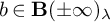 $b \in \mathbf {B}(\pm \infty )_\lambda $
, we set
 $\operatorname {wt}(b) := \lambda $
.
Let
 $\omega $
denote the Chevalley involution on
 $\mathbf {U}$
– that is, the algebra automorphism such that
 $$\begin{align*}\omega(E_i) = F_i, \ \omega(K_h) = K_{-h} \ \text{ for all } i \in I,\ h \in Y. \end{align*}$$
Given a
 $\mathbf {U}$
-module V, let
 ${}^\omega V = \{ {}^\omega v \mid v \in V \}$
denote the
 $\mathbf {U}$
-module V twisted by
 $\omega $
:
 $$\begin{align*}u \cdot {}^\omega v = {}^\omega(\omega(u) v) \ \text{ for each } u \in \mathbf{U},\ v \in V. \end{align*}$$
Let
 $\dot {\mathbf {U}}$
denote the modified form of
 $\mathbf {U}$
with idempotents
 $\{ 1_\lambda \mid \lambda \in X \}$
, and
 $\dot {\mathbf {B}}$
the canonical basis of
 $\dot {\mathbf {U}}$
.
2.3 Weight and integrable modules
A
 $\mathbf {U}$
-module V is said to be a weight module if it admits a linear space decomposition
 $$\begin{align*}V = \bigoplus_{\lambda \in X} V_\lambda \end{align*}$$
such that
 $$\begin{align*}V_\lambda = \{ v \in V \mid K_h v = q^{\langle h, \lambda \rangle} v \ \text{ for all } h \in Y \}. \end{align*}$$
For each
 $v \in V_\lambda \setminus \{ 0 \}$
, we set
 $\operatorname {wt}(v) := \lambda $
.
For each
 $\lambda \in X$
, let
 $M(\lambda )$
denote the Verma module of highest weight
 $\lambda $
with highest weight vector
 $m_\lambda $
.
For each
 $\lambda ,\mu \in X$
, set
 $$\begin{align*}M(\lambda, \mu) := {}^\omega M(\lambda) \otimes M(\mu) \end{align*}$$
and
 $$\begin{align*}m_{\lambda, \mu} := {}^\omega m_\lambda \otimes m_\mu \in M(\lambda, \mu). \end{align*}$$
The linear map
 $$\begin{align*}\dot{\mathbf{U}} 1_{-\lambda + \mu} \rightarrow M(\lambda, \mu);\ u \mapsto u m_{\lambda, \mu} \end{align*}$$
is a
 $\mathbf {U}$
-module isomorphism ([Reference Lusztig15, 23.3.1 (c)]). The
 $\mathbf {U}$
-module
 $M(\lambda , \mu )$
(or rather
 $\dot {\mathbf {U}} 1_{-\lambda +\mu }$
) is a universal weight module of weight
 $-\lambda + \mu $
in the following sense. For each weight
 $\mathbf {U}$
-module V and a weight vector
 $v \in V_{-\lambda +\mu }$
, there exists a unique
 $\mathbf {U}$
-module homomorphism
 $M(\lambda , \mu ) \rightarrow V$
which sends
 $m_{\lambda , \mu }$
to v.
A weight
 $\mathbf {U}$
-module V is said to be integrable if for each
 $\lambda \in X$
and
 $v \in V_\lambda $
, there exist
 $(a_i)_{i \in I}, (b_i)_{i \in I} \in \mathbb {Z}_{\geq 0}^I$
such that
 $$\begin{align*}E_i^{(a_i+1)} v = F_i^{(b_i+1)} v = 0 \ \text{ for all } i \in I. \end{align*}$$
For each
 $\lambda \in X^+$
, let
 $V(\lambda )$
denote the integrable highest weight module of highest weight
 $\lambda $
. It is the maximal integrable quotient of the Verma module
 $M(\lambda )$
:
 $$\begin{align*}V(\lambda) := M(\lambda)/\sum_{i \in I} \mathbf{U} F_i^{(\langle h_i, \lambda \rangle + 1)} m_\lambda. \end{align*}$$
Twisting it by the Chevalley involution
 $\omega $
, we obtain
 $$ \begin{align} {}^\omega V(\lambda) \simeq {}^\omega M(\lambda)/\sum_{i \in I} \mathbf{U} E_i^{(\langle h_i, \lambda \rangle + 1)} \cdot {}^\omega m_\lambda. \end{align} $$
Let
 $v_\lambda \in V(\lambda )$
denote the image of the highest weight vector
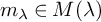 $m_\lambda \in M(\lambda )$
. Let
 $\mathbf {B}(\lambda )$
denote the canonical basis of
 $V(\lambda )$
. The linear map
 $$\begin{align*}\mathbf{U}^+ \rightarrow {}^\omega V(\lambda);\ u \mapsto u \cdot {}^\omega v_\lambda \end{align*}$$
gives rise to a bijection
 $$\begin{align*}\mathbf{B}(-\infty)[-\lambda] := \{ b \in \mathbf{B}(-\infty) \mid b \cdot {}^\omega v_\lambda \neq 0 \} \rightarrow {}^\omega \mathbf{B}(\lambda) := \{ {}^\omega b \mid b \in \mathbf{B}(\lambda) \}. \end{align*}$$
Combining this fact with the presentation (2.3.1), we obtain
 $$ \begin{align} \sum_{b \in \mathbf{B}(-\infty) \setminus \mathbf{B}(-\infty)[-\lambda]} \mathbf{U} b \cdot {}^\omega m_\lambda = \sum_{i \in I} \mathbf{U} E_i^{(\langle h_i, \lambda \rangle + 1)} \cdot {}^\omega m_\lambda. \end{align} $$
For each
 $\lambda , \mu \in X^+$
, set
 $$\begin{align*}V(\lambda, \mu) := {}^\omega V(\lambda) \otimes V(\mu) \end{align*}$$
and
 $$\begin{align*}v_{\lambda, \mu} := {}^\omega v_\lambda \otimes v_\mu \in V(\lambda, \mu). \end{align*}$$
By [Reference Lusztig15, Proposition 23.3.6], we have
 $$ \begin{align} V(\lambda,\mu) \simeq M(\lambda,\mu)/(\sum_{i \in I} \mathbf{U} E_i^{(\langle h_i, \lambda \rangle + 1)} m_{\lambda,\mu} + \sum_{i \in I} \mathbf{U} F_i^{(\langle h_i, \mu \rangle + 1)} m_{\lambda,\mu}). \end{align} $$
The
 $\mathbf {U}$
-modules
 $V(\lambda , \mu )$
are universal integrable
 $\mathbf {U}$
-modules in the following sense. Let V be an integrable
 $\mathbf {U}$
-module and
 $v \in V$
a weight vector. Then, there exist
 $\lambda , \mu \in X^+$
and a
 $\mathbf {U}$
-module homomorphism
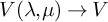 $V(\lambda , \mu ) \rightarrow V$
which sends
 $v_{\lambda , \mu }$
to v ([Reference Lusztig15, Proposition 23.3.10]).
2.4 Levi and parabolic subalgebras
In this subsection, we fix a subset
 $J \subseteq I$
, and set
 $K := I \setminus J$
. We often regard J as a Cartan datum and
 $$\begin{align*}(Y, X, \langle , \rangle, \{ h_j \mid j \in J \}, \{ \alpha_j \mid j \in J \}) \end{align*}$$
as a root datum of type J.
Let
 $\mathbf {L} = \mathbf {L}_J$
denote the Levi subalgebra of the quantum group
 $\mathbf {U}$
associated with J – that is, the subalgebra generated by
 $$\begin{align*}\{ E_j,\ F_j,\ K_h \mid j \in J,\ h \in Y \}. \end{align*}$$
The algebra
 $\mathbf {L}$
itself is the quantum group associated with the root datum of type J above. Let
 $\mathbf {L}^-$
and
 $\mathbf {L}^+$
denote the negative and the positive parts of
 $\mathbf {L}$
, respectively. Noting that the Cartan part of
 $\mathbf {L}$
is
 $\mathbf {U}^0$
, we have a triangular decomposition
 $$ \begin{align} \mathbf{L} = \mathbf{L}^- \mathbf{U}^0 \mathbf{L}^+ \simeq \mathbf{L}^- \otimes \mathbf{U}^0 \otimes \mathbf{L}^+. \end{align} $$
For each
 $\lambda \in X$
, let
 $M_{\mathbf {L}}(\lambda )$
denote the Verma module over
 $\mathbf {L}$
of highest weight
 $\lambda $
with highest weight vector
 $m_{\mathbf {L}, \lambda }$
. Similarly, for each
 $\lambda , \mu \in X$
, set
 $M_{\mathbf {L}}(\lambda , \mu ) := {}^\omega M_{\mathbf {L}}(\lambda ) \otimes M_{\mathbf {L}}(\mu )$
and
 $m_{\mathbf {L};\lambda ,\mu } := {}^\omega m_{\mathbf {L},\lambda } \otimes m_{\mathbf {L},\mu } \in M_{\mathbf {L}}(\lambda , \mu )$
. Then, we have
 $M_{\mathbf {L}}(\lambda , \mu ) \simeq \dot {\mathbf {L}} 1_{-\lambda + \mu }$
as
 $\mathbf {L}$
-modules, where
 $\dot {\mathbf {L}}$
denotes the modified form of
 $\mathbf {L}$
.
Let
 $\mathbf {P}^+ = \mathbf {P}^+_J$
and
 $\mathbf {P}^- = \mathbf {P}^-_J$
denote the parabolic and the opposite parabolic subalgebra of
 $\mathbf {U}$
associated with the subset J, respectively. Namely,
 $\mathbf {P}^+$
is the subalgebra of
 $\mathbf {U}$
generated by
 $\mathbf {L}$
and
 $\{ E_k \mid k \in K \}$
, and
 $\mathbf {P}^-$
generated by
 $\mathbf {L}$
and
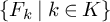 $\{ F_k \mid k \in K \}$
.
We have triangular decompositions:
 $$ \begin{align} &\mathbf{P}^+ = \mathbf{L}^- \mathbf{U}^0 \mathbf{U}^+ \simeq \mathbf{L}^- \otimes \mathbf{U}^0 \otimes \mathbf{U}^+; \end{align} $$
 $$ \begin{align} &\mathbf{P}^- = \mathbf{U}^- \mathbf{U}^0 \mathbf{L}^+ \simeq \mathbf{U}^- \otimes \mathbf{U}^0 \otimes \mathbf{L}^+; \end{align} $$
Although the algebras
 $\mathbf {P}^\pm $
are not quantum groups, we can construct their modified forms
 $\dot {\mathbf {P}}^\pm = \bigoplus _{\lambda \in X} \dot {\mathbf {P}}^\pm 1_\lambda $
in a canonical way. Just like the modified forms of quantum groups, the
 $\dot {\mathbf {P}}^\pm $
have natural
 $\mathbf {P}^\pm $
-bimodule structure. Furthermore, the
 $\mathbf {L}$
-bimodule structure on
 $\mathbf {P}^\pm $
gives rise to an
 $\dot {\mathbf {L}}$
-bimodule structure on
 $\dot {\mathbf {P}}^\pm $
.
Let
 $\mathbf {R}^\pm = \mathbf {R}^\pm _J$
denote the nilradical part of
 $\mathbf {P}^\pm $
. That is,
 $\mathbf {R}^+$
is the two-sided ideal of
 $\mathbf {U}^+$
generated by
 $\{ E_k \mid k \in K \}$
, and
 $\mathbf {R}^-$
generated by
 $\{ F_k \mid k \in K \}$
. Then, we have
 $$ \begin{align} \mathbf{U}^\pm = \mathbf{L}^\pm \oplus \mathbf{R}^\pm. \end{align} $$
Proposition 2.4.1. As a
 $\mathbb {Q}(q)$
-linear space, we have
 $$ \begin{align} \mathbf{P}^+ = \mathbf{L} \oplus \mathbf{L}^- \mathbf{U}^0 \mathbf{R}^+. \end{align} $$
Moreover, the subspace
 $\mathbf {L}^- \mathbf {U}^0 \mathbf {R}^+$
coincides with the two-sided ideal of
 $\mathbf {P}^+$
generated by
 $\{ E_k \mid k \in K \}$
.
Proof. By the decompositions (2.4.2), (2.4.4) and (2.4.1), we have
 $$\begin{align*}\mathbf{P}^+ = \mathbf{L}^- \mathbf{U}^0 (\mathbf{L}^+ \oplus \mathbf{R}^+) = \mathbf{L} \oplus \mathbf{L}^- \mathbf{U}^0 \mathbf{R}^+. \end{align*}$$
This proves the first assertion.
To prove the second assertion, let us compute as
 $$ \begin{align} \mathbf{L}^- \mathbf{U}^0 \mathbf{R}^+ = \sum_{k \in K} \mathbf{L}^- \mathbf{U}^0 \mathbf{U}^+ E_k \mathbf{U}^+ = \sum_{k \in K} \mathbf{P}^+ E_k \mathbf{U}^+. \end{align} $$
For each
 $k \in K$
, we have
 $$ \begin{align} \mathbf{P}^+ E_k \mathbf{P}^+ = \mathbf{P}^+ E_k \mathbf{L}^- \mathbf{U}^0 \mathbf{U}^+ = \mathbf{P}^+ \mathbf{L}^- \mathbf{U}^0 E_k \mathbf{U}^+ = \mathbf{P}^+ E_k \mathbf{U}^+. \end{align} $$
Combining equations (2.4.6) and (2.4.7), we obtain
 $$\begin{align*}\mathbf{L}^- \mathbf{U}^0 \mathbf{R}^+ = \sum_{k \in K} \mathbf{P}^+ E_k \mathbf{U}^+ = \sum_{k \in K} \mathbf{P}^+ E_k \mathbf{P}^+, \end{align*}$$
as desired. Thus, we complete the proof.
Lemma 2.4.2. Let
 $\lambda \in X$
. We denote by
 $1^{\mathbf {U}}_\lambda $
and
 $1^{\mathbf {P}^-}_\lambda $
the idempotents in
 $\dot {\mathbf {U}}$
and
 $\dot {\mathbf {P}}^-$
corresponding to
 $\lambda $
, respectively. Then, as
 $\mathbb {Q}(q)$
-linear spaces, we have
 $$ \begin{align} \mathbf{P}^- 1^{\mathbf{P}^-}_\lambda \simeq \mathbf{U} 1^{\mathbf{U}}_\lambda/\mathbf{U} \mathbf{R}^+ 1^{\mathbf{U}}_\lambda. \end{align} $$
Proof. By the decompositions (2.2.1) and (2.4.4), we have
 $$\begin{align*}\mathbf{U} 1^{\mathbf{U}}_\lambda = \mathbf{U}^- \mathbf{U}^0 \mathbf{U}^+ 1^{\mathbf{U}}_\lambda = \mathbf{U}^- \mathbf{U}^0 (\mathbf{L}^+ \oplus \mathbf{R}^+) 1^{\mathbf{U}}_\lambda = (\mathbf{P}^- \oplus \mathbf{U} \mathbf{R}^+) 1^{\mathbf{U}}_\lambda. \end{align*}$$
Hence, we obtain a linear isomorphism
 $$ \begin{align} \mathbf{P}^- 1^{\mathbf{U}}_\lambda \simeq \mathbf{U} 1^{\mathbf{U}}_\lambda/\mathbf{U} \mathbf{R}^+ 1^{\mathbf{U}}_\lambda. \end{align} $$
Since the triangular decomposition (2.4.3) of
 $\mathbf {P}^-$
is consistent with the one (2.2.1) of
 $\mathbf {U}$
, both the linear spaces
 $\mathbf {P}^- 1^{\mathbf {U}}_\lambda $
and
 $\mathbf {P}^- 1^{\mathbf {P}^-}_\lambda $
are isomorphic to
 $\mathbf {U}^- \otimes \mathbf {L}^+$
in canonical ways. Thus, we complete the proof.
Remark 2.4.3. The linear isomorphism (2.4.9) has appeared in [Reference Bao and Wang3, § 3.5].
Proposition 2.4.4. Let V be a weight
 $\mathbf {L}$
-module. Then, as a
 $\mathbf {U}$
-module, we have
 $$\begin{align*}\operatorname{Ind}_{\mathbf{P}^+}^{\mathbf{U}} V := \mathbf{U} \otimes_{\mathbf{P}^+} V = \dot{\mathbf{P}}^- \otimes_{\dot{\mathbf{L}}} V; \end{align*}$$
here, we regard V as a
 $\mathbf {P}^+$
-module via the projection
 $\mathbf {P}^+ \rightarrow \mathbf {L}$
with respect to the decomposition (2.4.5), and
 $\dot {\mathbf {P}}^- (= \bigoplus _{\lambda \in X} \mathbf {P}^- 1_\lambda )$
as a
 $\mathbf {U}$
-module via the linear isomorphism (2.4.8).
Proof. Let
 $$\begin{align*}\phi \colon \operatorname{Ind}_{\mathbf{P}^+}^{\mathbf{U}} V \rightarrow \dot{\mathbf{P}}^- \otimes_{\dot{\mathbf{L}}} V \text{ and } \psi \colon \dot{\mathbf{P}}^- \otimes_{\dot{\mathbf{L}}} V \rightarrow \operatorname{Ind}_{\mathbf{P}^+}^{\mathbf{U}} V \end{align*}$$
denote the linear maps given as follows. Let
 $\lambda \in X$
,
 $v \in V_\lambda $
,
 $\mu \in Q^+$
,
 $u^- \in \mathbf {U}^-$
,
 $u^0 \in \mathbf {U}^0$
,
 $u^+ \in \mathbf {U}^+_\mu $
, and
 $p \in \mathbf {P}^-$
. Then, we set
 $$\begin{align*}\phi(u^-u^0u^+ \otimes v) := u^- 1_{\lambda+\mu} \otimes u^0u^+v \text{ and } \psi(p 1_\lambda \otimes v) := p \otimes v. \end{align*}$$
That these maps are well defined can be straightforwardly verified. Clearly, we have
 $\phi \circ \psi = \mathrm {id}$
, and see that
 $\psi $
is a
 $\mathbf {U}$
-module homomorphism. Thus, we complete the proof.
Corollary 2.4.5. Let
 $\lambda , \mu \in X$
. Then, as
 $\mathbf {U}$
-modules, we have
 $$\begin{align*}\operatorname{Ind}_{\mathbf{P}^+}^{\mathbf{U}} M_{\mathbf{L}}(\lambda, \mu) \simeq \operatorname{Ind}_{\mathbf{P}^+}^{\mathbf{U}} \dot{\mathbf{L}} 1_{-\lambda + \mu} \simeq \dot{\mathbf{P}}^- \otimes_{\dot{\mathbf{L}}} \dot{\mathbf{L}} 1_{-\lambda + \mu} \simeq \dot{\mathbf{P}}^- 1_{-\lambda+\mu}. \end{align*}$$
3 Quantum symmetric pairs
After formulating basic notation regarding quantum symmetric pairs following mainly [Reference Bao and Wang3], we will introduce the notion of integrable modules over an
 $\imath $
quantum group.
3.1 Quantum symmetric pair
Let
 $(I, I_{\bullet }, \tau )$
be a generalized Satake diagram ([Reference Regelskis and Vlaar21, Definition 1]). From now on, we assume that the root datum
 $(Y, X, \langle , \rangle , \Pi ^\vee , \Pi )$
is a Satake datum of type
 $(I, I_{\bullet }, \tau )$
([Reference Watanabe26, Definition 3.1.3]). In particular,
 $I_{\bullet }$
is a subdatum of I which is supposed to be of finite type,
 $\tau $
is an involutive automorphism on the Cartan datum I, and Y and X are supposed to be equipped with involutive automorphisms
 $\tau $
which are compatible with the one on I. Let
 $w_{\bullet } \in W$
denote the longest element of the Weyl group
 $W_{\bullet } \subseteq W$
associated with
 $I_{\bullet }$
. Set
 $$ \begin{align*} \theta &:= -w_{\bullet} \tau \in \operatorname{Aut}(\mathbb{Z}[I]), \operatorname{Aut}(Y), \operatorname{Aut}(X); \\ Y^{\imath} &:= \{ h \in Y \mid \theta(h) = h \}; \\ X^{\imath} &:= X/\{ \lambda - \theta(\lambda) \mid \lambda \in X \}; \\ I_\circ &:= I \setminus I_{\bullet}. \end{align*} $$
Also, let
 $$\begin{align*}\overline{\cdot} \colon X \rightarrow X^{\imath} \end{align*}$$
denote the quotient map, and
 $$\begin{align*}\langle , \rangle \colon Y^{\imath} \times X^{\imath} \rightarrow \mathbb{Z} \end{align*}$$
the bilinear pairing induced from the one on
 $Y \times X$
.
For later use, let us recall one of the axioms for generalized Satake diagrams from ([Reference Regelskis and Vlaar21, (2.19)]):
 $$ \begin{align} \langle h_i, \theta(\alpha_i) \rangle \neq -1 \ \text{ for all } i \in I. \end{align} $$
Lemma 3.1.1. Let
 $k \in I_\circ $
. If
 $\tau (k) = k \neq w_{\bullet } k$
, then we have
 $$\begin{align*}\langle h_k, w_{\bullet} \alpha_k - \alpha_k \rangle \leq -2. \end{align*}$$
Proof. Since
 $w_{\bullet } \alpha _k - \alpha _k \in \sum _{j \in I_{\bullet }} \mathbb {Z}_{\geq 0} \alpha _j$
, we have
 $$\begin{align*}\langle h_k, w_{\bullet} \alpha_k - \alpha_k \rangle \in \mathbb{Z}_{\leq 0}. \end{align*}$$
Our assumption on k that
 $w_{\bullet } k \neq k$
implies that this value cannot be
 $0$
.
However, taking into account the assumption that
 $\tau (k) = k$
, we compute as follows:
 $$\begin{align*}\langle h_k, w_{\bullet} \alpha_k - \alpha_k \rangle = \langle h_k, -\theta(\alpha_k) - \alpha_k \rangle = -2 - \langle h_k, \theta(\alpha_k) \rangle. \end{align*}$$
By the axiom (3.1.1), the rightmost-hand side cannot be
 $-1$
. Hence, the assertion follows.
Let
 $\mathbf {U}^{\imath }$
denote the
 $\imath $
quantum group associated with the Satake datum
 $(Y, X, \langle , \rangle , \Pi ^\vee , \Pi )$
and parameters
 ${\boldsymbol \varsigma } = (\varsigma _k)_{k \in I_\circ } \in (\mathbb {Q}(q)^\times )^{I_\circ }$
,
 ${\boldsymbol \kappa } = (\kappa _i)_{k \in I_\circ } \in \mathbb {Q}(q)^{I_\circ }$
. It is the subalgebra of the quantum group
 $\mathbf {U}$
generated by
 $$\begin{align*}\{ E_j,\ F_j,\ B_k,\ K_h \mid j \in I_{\bullet},\ k \in I_\circ,\ h \in Y^{\imath} \}, \end{align*}$$
where
 $$\begin{align*}B_k := F_k + \varsigma_k T_{w_{\bullet}}(E_{\tau(k)}) K_k^{-1} + \kappa_k K_k^{-1} \end{align*}$$
for each
 $k \in I_\circ $
. The parameters are supposed to satisfy the following for all
 $k \in I_\circ $
:
-
•
 $\varsigma _k = \varsigma _{\tau (k)}$
if
$k \cdot \theta (k) = 0$
.
-
•
$\kappa _k = 0$
unless
$\tau (k) = k$
,
$a_{k,j} = 0$
for all
$j \in I_{\bullet }$
, and
$a_{k,k'} \in 2\mathbb {Z}$
for all
$k' \in I_\circ $
such that
$\tau (k') = k'$
and
$a_{k',j} = 0$
for all
$j \in I_{\bullet }$
.


They are as general as [Reference Kolb11, Definition 5.6].
Let
 $\dot {\mathbf {U}}^{\imath }$
denote the modified form of
 $\mathbf {U}^{\imath }$
with idempotents
 $\{ 1_\zeta \mid \zeta \in X^{\imath } \}$
.
Let
 $\mathbf {L}$
,
 $\mathbf {P}^\pm $
, and
 $\mathbf {R}^\pm $
denote the Levi, parabolic subalgebras, and the nilradical parts associated with
 $I_{\bullet }$
, respectively.
Proposition 3.1.2 (cf. [Reference Bao and Wang2, Lemma 3.22])
Let
 $\lambda \in X$
and
 $\zeta := \bar {\lambda } \in X^{\imath }$
. As
 $\mathbf {U}^{\imath }$
-modules, we have
 $$\begin{align*}\dot{\mathbf{U}}^{\imath} 1_\zeta \simeq \mathbf{U}^{\imath} 1_\lambda \simeq \dot{\mathbf{P}}^- 1_\lambda. \end{align*}$$
3.2 Weight modules
A
 $\mathbf {U}^{\imath }$
-module V is said to be a weight module ([Reference Watanabe26]) if it admits a linear space decomposition
 $$\begin{align*}V = \bigoplus_{\zeta \in X^{\imath}} V_\zeta \end{align*}$$
such that
-
•
$V_\zeta = \{ v \in V \mid K_h v = q^{\langle h, \zeta \rangle } v \ \text { for all } h \in Y^{\imath } \}$
; -
•
$E_j V_\zeta \subseteq V_{\zeta + \overline {\alpha _j}}$
,
$F_j V_\zeta \subseteq V_{\zeta - \overline {\alpha _j}}$
for all
$j \in I_{\bullet }$
; -
•
$B_k V_\zeta \subseteq V_{\zeta - \overline {\alpha _k}}$
for all
$k \in I_\circ $
;





A weight
 $\mathbf {U}$
-module
 $V = \bigoplus _{\lambda \in X} V_\lambda $
has a canonical weight
 $\mathbf {U}^{\imath }$
-module structure:
 $$ \begin{align} V = \bigoplus_{\zeta \in X^{\imath}} V_\zeta, \ V_\zeta := \bigoplus_{\substack{\lambda \in X \\ \bar{\lambda} = \zeta}} V_\lambda. \end{align} $$
For each
 $\lambda , \mu \in X$
, set
 $$\begin{align*}M^{\imath}(\lambda, \mu) := \operatorname{Ind}_{\mathbf{P}^+}^{\mathbf{U}} M_{\mathbf{L}}(-w_{\bullet} \lambda, \mu) \end{align*}$$
and
 $$\begin{align*}m^{\imath}_{\lambda, \mu} := 1 \otimes m_{\mathbf{L}; -w_{\bullet} \lambda, \mu} \in M^{\imath}(\lambda, \mu). \end{align*}$$
Then, by Corollary 2.4.5, we have
 $$ \begin{align} M^{\imath}(\lambda, \mu) \simeq \operatorname{Ind}_{\mathbf{P}^+}^{\mathbf{U}} \dot{\mathbf{L}} 1_{w_{\bullet} \lambda + \mu} \simeq \dot{\mathbf{P}}^- 1_{w_{\bullet} \lambda + \mu} \end{align} $$
as
 $\mathbf {U}$
-modules. The
 $\mathbf {U}^{\imath }$
-module
 $M^{\imath }(\lambda , \mu )$
is a universal weight module of weight
 $\overline {w_{\bullet } \lambda + \mu }$
in the following sense.
Proposition 3.2.1. Let
 $\lambda , \mu \in X$
and set
 $\zeta := \overline {w_{\bullet } \lambda + \mu } \in X^{\imath }$
. Let V be a weight
 $\mathbf {U}^{\imath }$
-module and
 $v \in V_\zeta $
. Then, there exists a unique
 $\mathbf {U}^{\imath }$
-module homomorphism
 $M^{\imath }(\lambda , \mu ) \rightarrow V$
which sends
 $m^{\imath }_{\lambda , \mu }$
to v.
Proof. By the isomorphism (3.2.2) and Proposition 3.1.2, we have
 $$\begin{align*}M^{\imath}(\lambda,\mu) \simeq \dot{\mathbf{U}}^{\imath} 1_\zeta \end{align*}$$
as
 $\mathbf {U}^{\imath }$
-modules. Then, the assertion can be found in [Reference Watanabe26, after Definition 3.3.5].
3.3 Integrable modules
For each
 $\lambda , \mu \in X^+$
, set
 $V^{\imath }(\lambda , \mu )$
to be the quotient
 $\mathbf {U}$
-module of
 $M^{\imath }(\lambda , \mu )$
factored by the submodule generated by
 $$ \begin{align} \{ E_j^{(\langle h_j, -w_{\bullet} \lambda \rangle + 1)} m^{\imath}_{\lambda, \mu},\ F_j^{(\langle h_j, \mu \rangle + 1)} m^{\imath}_{\lambda, \mu},\ F_k^{(\langle h_k, w_{\bullet}\lambda + \mu \rangle + 1)} m^{\imath}_{\lambda,\mu} \mid j \in I_{\bullet},\ k \in I_\circ \}. \end{align} $$
Let
 $v^{\imath }_{\lambda ,\mu } \in V^{\imath }(\lambda ,\mu )$
denote the image of
 $m^{\imath }_{\lambda ,\mu } \in M^{\imath }(\lambda ,\mu )$
under the quotient map.
Lemma 3.3.1. Let
 $\lambda , \mu \in X^+$
. Then, the
 $\mathbf {U}$
-module
 $V^{\imath }(\lambda , \mu )$
is isomorphic to the quotient module of
 $\dot {\mathbf {U}} 1_{w_{\bullet } \lambda + \mu }$
factored by the submodule generated by
 $\mathbf {R}^+ 1_{w_{\bullet } \lambda + \mu }$
and the set (3.3.1)
Proof. The assertion follows from the definition of
 $V^{\imath }(\lambda , \mu )$
and the isomorphisms (3.2.2) and (2.4.8).
Lemma 3.3.2. Let
 $\lambda , \mu \in X^+$
. Then, there exist a finite number of dominant weights
 $\nu _1,\dots ,\nu _r \in X^+$
such that
 $$\begin{align*}\mathbf{L} v^{\imath}_{\lambda, \mu} \simeq \bigoplus_{s=1}^r V_{\mathbf{L}}(\nu_s) \end{align*}$$
as
 $\mathbf {L}$
-modules and
 $$\begin{align*}V^{\imath}(\lambda, \mu) \simeq \bigoplus_{s=1}^r V(\nu_s) \end{align*}$$
as
 $\mathbf {U}$
-modules, where
 $V_{\mathbf {L}}(\nu )$
denotes the integrable highest weight
 $\mathbf {L}$
-module of highest weight
 $\nu \in X_{\mathbf {L}}^+$
.
Proof. By the definition of
 $V^{\imath }(\lambda , \mu )$
and the presentation (2.3.3) of
 $V_{\mathbf {L}}(-w_{\bullet }\lambda , \mu )$
, there exists an
 $\mathbf {L}$
-module homomorphism
 $$\begin{align*}V_{\mathbf{L}}(-w_{\bullet} \lambda, \mu) \rightarrow \mathbf{L} v^{\imath}_{\lambda, \mu} \end{align*}$$
which sends
 $v_{\mathbf {L};-w_{\bullet }\lambda , \mu }$
to
 $v^{\imath }_{\lambda , \mu }$
. This homomorphism is clearly surjective. Since the domain is finite-dimensional, so is the codomain. This implies that there exist
 $\nu _1,\dots ,\nu _r \in X_{\mathbf {L}}^+$
such that
 $$\begin{align*}\mathbf{L} v^{\imath}_{\lambda, \mu} \simeq \bigoplus_{s=1}^r V_{\mathbf{L}}(\nu_s). \end{align*}$$
However, the
 $\mathbf {U}$
-module
 $V^{\imath }(\lambda , \mu )$
is integrable, and
 $$ \begin{align} \mathbf{U}^+ v^{\imath}_{\lambda, \mu} = \mathbf{L}^+ v^{\imath}_{\lambda, \mu} \end{align} $$
Since the right-hand side is finite-dimensional, the weights of
 $V^{\imath }(\lambda , \mu )$
are bounded above. Therefore, the
 $\mathbf {U}$
-module is a direct sum of submodules isomorphic to integrable highest weight modules. By equation (3.3.2), we see that the highest weight vectors in the
 $\mathbf {U}$
-module
 $V^{\imath }(\lambda , \mu )$
are exactly those in the
 $\mathbf {L}$
-module
 $\mathbf {L} v^{\imath }_{\lambda , \mu }$
. This implies that
 $$\begin{align*}\nu_1,\dots,\nu_r \in X^+ \end{align*}$$
and
 $$\begin{align*}V^{\imath}(\lambda, \mu) \simeq \bigoplus_{s=1}^r V(\nu_s). \end{align*}$$
Thus, we complete the proof.
Proposition 3.3.3. Let
 $L^{\imath }(\lambda ,\mu )$
denote the
 $\mathbf {U}$
-submodule of
 $V(\lambda ) \otimes V(\mu )$
generated by
 $v_{w_{\bullet } \lambda } \otimes v_\mu $
, where
 $v_{w_{\bullet } \lambda }$
denotes the unique element in
 $\mathbf {B}(\lambda )$
of weight
 $w_{\bullet } \lambda $
. Then, we have
 $$\begin{align*}V^{\imath}(\lambda,\mu) \simeq L^{\imath}(\lambda,\mu) \end{align*}$$
as
 $\mathbf {U}$
-modules.
Proof. It is easily verified that
 $\mathbf {R}^+ (v_{w_{\bullet } \lambda } \otimes v_\mu ) = 0$
and
 $$\begin{align*}E_j^{(\langle h_j, -w_{\bullet} \lambda \rangle + 1)} (v_{w_{\bullet} \lambda} \otimes v_\mu) = F_j^{(\langle h_j, \mu \rangle + 1)} (v_{w_{\bullet} \lambda} \otimes v_\mu) = F_k^{(\langle h_k, w_{\bullet} \lambda + \mu \rangle + 1)} (v_{w_{\bullet} \lambda} \otimes v_\mu) = 0 \end{align*}$$
for all
 $j \in I_{\bullet }$
,
 $k \in I_\circ $
. Hence, Lemma 3.3.1 implies that there exists a
 $\mathbf {U}$
-module homomorphism
 $$\begin{align*}V^{\imath}(\lambda, \mu) \rightarrow L^{\imath}(\lambda,\mu) \end{align*}$$
which sends
 $v^{\imath }_{\lambda , \mu }$
to
 $v_{w_{\bullet } \lambda } \otimes v_\mu $
.
However, since
 $\mathbf {L}(v_{w_{\bullet } \lambda } \otimes v_\mu ) \simeq V_{\mathbf {L}}(-w_{\bullet } \lambda , \mu )$
, there exists an
 $\mathbf {L}$
-module homomorphism
 $$\begin{align*}\mathbf{L}(v_{w_{\bullet} \lambda} \otimes v_\mu) \rightarrow \mathbf{L} v^{\imath}_{\lambda, \mu} \end{align*}$$
which sends
 $v_{w_{\bullet } \lambda } \otimes v_\mu $
to
 $v^{\imath }_{\lambda , \mu }$
.
Combining the two homomorphisms above, we see that
 $\mathbf {L} v^{\imath }_{\lambda , \mu } \simeq \mathbf {L}(v_{w_{\bullet } \lambda } \otimes v_\mu )$
. By Lemma 3.3.2, the
 $\mathbf {U}$
-module structure of
 $V^{\imath }(\lambda , \mu )$
is determined by the
 $\mathbf {L}$
-module structure of
 $\mathbf {L} v^{\imath }_{\lambda , \mu }$
. However, by [Reference Watanabe25, Proposition 3.4.3], the
 $\mathbf {U}$
-module structure of
 $L^{\imath }(\lambda ,\mu )$
is determined by the
 $\mathbf {L}$
-module structure of
 $\mathbf {L}(v_{w_{\bullet } \lambda } \otimes v_\mu )$
. Hence, the assertion follows.
Definition 3.3.4. A weight
 $\mathbf {U}^{\imath }$
-module V is said to be integrable if for each weight vector
 $v \in V$
, there exist
 $\lambda , \mu \in X^+$
and a
 $\mathbf {U}^{\imath }$
-module homomorphism
 $V^{\imath }(\lambda , \mu ) \rightarrow V$
which sends
 $v^{\imath }_{\lambda , \mu }$
to v.
As explained in Section 1, the
 $\mathbf {U}$
-modules
 $L^{\imath }(\lambda , \mu )$
in Proposition 3.3.3, which are isomorphic to
 $V^{\imath }(\lambda , \mu )$
, are counterparts of
 $V(\lambda ,\mu )$
in the theory of
 $\imath $
canonical bases [Reference Bao and Wang2], [Reference Bao and Wang3], and the latter can be used to define integrable
 $\mathbf {U}$
-modules. From this point of view, Definition 3.3.4 is quite natural.
4 Properties of integrable modules
Although Definition 3.3.4 is a natural generalization of the definition of integrable
 $\mathbf {U}$
-modules, it is not quite useful to determine whether a given
 $\mathbf {U}^{\imath }$
-module is integrable or not. This is because we only know presentations of the
 $V^{\imath }(\lambda ,\mu )$
’s as
 $\mathbf {U}$
-modules, but not as
 $\mathbf {U}^{\imath }$
-modules. In this section, we shall give presentations as
 $\mathbf {U}^{\imath }$
-modules.
4.1 Some elements
$\mathfrak {B}_{k,\zeta }^{(n)}$

The aim of this subsection is to introduce a family
 $\{ \mathfrak {B}_{k,\zeta }^{(n)} \mid k \in I_\circ ,\ \zeta \in X^{\imath },\ n \in \mathbb {Z}_{\geq 0} \}$
of elements in
 $\dot {\mathbf {U}}^{\imath }$
, which will be used to express the
 $\mathbf {U}^{\imath }$
-modules
 $V^{\imath }(\lambda ,\mu )$
in terms of generators and relations.
4.1.1 Case
$1$
:
$\tau (k) = k = w_{\bullet } k$


First, let us consider the case where
 $\tau (k) = k = w_{\bullet } k$
. For each
 $\zeta \in X^{\imath }$
and
 $\lambda \in X$
such that
 $\bar {\lambda } = \zeta $
, the parity of integer
 $\langle h_k, \lambda \rangle $
is independent of the choice of
 $\lambda $
. We call it the parity of
 $\zeta $
at k. Set
 $p_k(\zeta ) \in \mathbb {Z}/2\mathbb {Z} = \{ \bar {0}, \bar {1} \}$
to be
 $\bar {0}$
if the parity of
 $\zeta $
at k is even, and to be
 $\bar {1}$
otherwise. Similarly, for each integer n, set
 $p(n)$
to be
 $\bar {0}$
if n is even, and to be
 $\bar {1}$
otherwise.
For each
 $\zeta \in X^{\imath }$
and
 $n \geq 0$
, define the element
 $\mathfrak {B}_{k, \zeta }^{(n)} \in \dot {\mathbf {U}}^{\imath } 1_\zeta $
inductively as follows:
-
•
$\mathfrak {B}_{k, \zeta }^{(0)} := 1_\zeta $
. -
• If
$p_k(\zeta ) = \bar {0}$
, then
$\mathfrak {B}_{k,\zeta }^{(1)} := (B_k - \kappa _k)1_\zeta $
. -
• If
$p_k(\zeta ) = p(n)$
and
$n \geq 1$
, then
$\mathfrak {B}_{k,\zeta }^{(n)} := \frac {1}{[n]_k} B_k \mathfrak {B}_{k,\zeta }^{(n-1)}$
. -
• If
$p_k(\zeta ) \neq p(n)$
and
$n \geq 2$
, then
$$\begin{align*}\mathfrak{B}_{k, \zeta}^{(n)} := \frac{1}{[n]_k[n-1]_k}(B_k^2 - (q_k^{n-1} + q_k^{-n+1})\kappa_k B_k + (\kappa_k^2 - [n-1]_k^2 q_k \varsigma_k)) \mathfrak{B}_{k, \zeta}^{(n-2)}. \end{align*}$$








Let us see where this definition comes from. Let
 $\mathbb {K}$
be an algebraic closure of the field
 $\mathbb {Q}(q)$
, and consider the following quadratic equations
 $$\begin{align} x^2 - (q_k + q_k^{-1}) a x + a^2 - b = 0 \end{align} $$
with variable x and constants
 $a,b \in \mathbb {K}$
. Since this equation is symmetric with respect to x and a, it follows that if
 $c \in \mathbb {K}$
is a solution to
 $(\mathrm {QE})_{a,b}$
, then a is a solution to
 $(\mathrm {QE})_{c,b}$
.
Given scalars
 $a^{(0)}, b \in \mathbb {K}$
, define a family
 $(a^{(n)})_{n \in \mathbb {Z}} \in \mathbb {K}^{\mathbb {Z}}$
of scalars as follows: The
 $a^{(1)}$
and
 $a^{(-1)}$
are the solutions to the quadratic equation
 $(\mathrm {QE})_{a^{(0)},b}$
; the ambiguity will not matter in the subsequent argument. Suppose that we have defined
 $a^{(m)}$
for
 $-n \leq m \leq n$
for some
 $n \geq 1$
. Then, set
 $a^{(\pm (n+1))} := (q_k + q_k^{-1}) a^{(\pm n)} - a^{(\pm (n-1))}$
.
By the construction above, it is clear that the
 $a^{(n+1)}$
and
 $a^{(n-1)}$
are the solutions to the quadratic equation
 $(\mathrm {QE})_{a^{(n)}, b}$
for each
 $n \in \mathbb {Z}$
. In particular, we have
 $$ \begin{align*} &a^{(n+1)} + a^{(n-1)} = (q_k + q_k^{-1}) a^{(n)}, \\ &a^{(n+1)} a^{(n-1)} = (a^{(n)})^2 - b. \end{align*} $$
Then, one can straightforwardly verify that for each
 $n \geq 1$
, the
 $a^{(n)}$
and
 $a^{(-n)}$
are the solutions to the quadratic equation
 $$\begin{align*}x^2 - (q_k^n + q_k^{-n}) a^{(0)} x + (a^{(0)})^2 - [n]_k^2 b = 0. \end{align*}$$
Now, let us consider the
 $(n+1)$
-dimensional irreducible representation
 $\mathbf {V}_n$
of
 $U_q(\mathfrak {sl}_2)$
, which we identify with the subalgebra of
 $\mathbf {U}$
generated by
 $E_k$
,
 $F_k$
, and
 $K_k^{\pm 1}$
. By a similar argument to [Reference Watanabe23, § 3.1], one can show that the
 $B_k \in \mathbf {U}^{\imath }$
acts on
 $\mathbf {V}_n$
semisimply with eigenvalues
 $\kappa ^{(n)}, \kappa ^{(n-2)}, \dots , \kappa ^{(-n)}$
, where we set
 $\kappa ^{(0)} := \kappa _k$
and
 $b := q_k \varsigma _k$
. Therefore, we see that
 $$\begin{align*}\mathfrak{B}_{k,\zeta}^{(n+1)} = \frac{1}{[n]_k!}P_n(B_k) 1_\zeta \ \text{ for all } \zeta \in X^{\imath} \text{ with } p_k(\zeta) = p(n), \end{align*}$$
where
 $P_n(x)$
denotes the minimal polynomial of the action of
 $B_k$
on
 $\mathbf {V}_n$
.
The following are straightforward consequences of the argument above.
Proposition 4.1.1. Let V be a weight
 $\mathbf {U}$
-module,
 $\lambda \in X$
,
 $v \in V_\lambda $
. Assume that
 $n := \langle h_k, \lambda \rangle \geq 0$
and
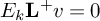 $E_k \mathbf {L}^+ v = 0$
. Then, we have
 $$\begin{align*}\mathfrak{B}_{k, \bar{\lambda}}^{(n+1)} v = F_k^{(n+1)} v. \end{align*}$$
Proposition 4.1.2. Let V be an integrable
 $\mathbf {U}$
-module,
 $\lambda \in X$
, and
 $v \in V_\lambda $
. Then, there exists
 $N \in \mathbb {Z}_{\geq 0}$
such that
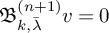 $\mathfrak {B}_{k, \bar {\lambda }}^{(n+1)} v = 0$
for all
 $n \geq N$
.
4.1.2 Case
$2$
:
$\tau (k) = k \neq w_{\bullet } k$


Next, let us consider the case where
 $\tau (k) = k \neq w_{\bullet } k$
. For each
 $\zeta \in X^{\imath }$
and
 $n \geq 0$
, set
 $$\begin{align*}\mathfrak{B}_{k, \zeta}^{(n)} := \frac{1}{[n]_k!} B_k^n 1_\zeta. \end{align*}$$
Set
 $Y_k := B_k - F_k$
and
 $Z_k := F_k Y_k - q_k^{-2} Y_k F_k$
. Then, the following hold (cf. [Reference Bao and Wang3, § 5.2]):
-
•
$Z_k$
commutes with both
$F_k$
and
$Y_k$
. -
•
$Z_k \in \mathbf {L}^+_{w_{\bullet }(\alpha _k) - \alpha _k}$
. -
•
$Y_k \in \mathbf {L}^+ E_k \mathbf {L}^+$
.


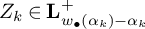

Hence, for each
 $n \geq 0$
, we have
 $$ \begin{align} B_k^n = \sum_{f + 2z + y = n} a_{f,z,y} F_k^f Z_k^z Y_k^y \end{align} $$
for some
 $a_{f,z,y} \in \mathbb {Q}(q)$
.
Proposition 4.1.3. Let V be a weight
 $\mathbf {U}$
-module,
 $\lambda \in X$
,
 $v \in V_\lambda $
. Assume that
 $n := \langle h_k, \lambda \rangle \geq 0$
and
 $E_k \mathbf {L}^+ v = 0$
. Then, we have
 $$\begin{align*}\mathfrak{B}_{k, \bar{\lambda}}^{(n+1)} v = \sum_{f+2z = n+1} a_{f,z} F_k^{(f)} Z_k^z v \end{align*}$$
for some
 $a_{f,z} \in \mathbb {Q}(q)$
such that
 $a_{n+1,0} = 1$
.
Proof. The assertion is immediate from equation (4.1.1).
Proposition 4.1.4. Let V be an integrable
 $\mathbf {U}$
-module,
 $\lambda \in X$
, and
 $v \in V_\lambda $
. Then, there exists
 $N \in \mathbb {Z}_{\geq 0}$
such that
 $\mathfrak {B}_{k, \bar {\lambda }}^{(n+1)} v = 0$
for all
 $n \geq N$
.
Proof. Since V is integrable, the element
 $Y_k$
, which is a scalar multiple of
 $T_{w_{\bullet }}(E_{\tau (k)}) K_k^{-1}$
, acts on V locally nilpotently. In particular, there exists
 $y_0 \geq 0$
such that
 $$\begin{align*}Y_k^{y} v = 0 \ \text{ for all } y> y_0. \end{align*}$$
Recall that the algebra
 $\mathbf {L}^+$
is a quantum group of finite type. Hence, the
 $\mathbf {L}^+$
-submodule of the integrable module V generated by the finite set
 $\{ Y_k^y v \mid y \geq 0 \}$
is finite-dimensional. Hence, there exists
 $z_0 \geq 0$
such that
 $$\begin{align*}Z_k^z Y_k^y v = 0 \ \text{ for all } y \geq 0,\ z> z_0. \end{align*}$$
Since the
 $F_k$
acts on V locally nilpotently, and the number of vectors of the form
 $Z_k^z Y_k^y v$
with
 $z,y \geq 0$
is finite, there exists
 $f_0 \geq 0$
such that
 $$\begin{align*}F_k^f Z_k^z Y_k^y v = 0 \ \text{ for all } z,y \geq 0,\ f> f_0. \end{align*}$$
Now, set
 $$\begin{align*}N := f_0 + 2z_0 + f_0. \end{align*}$$
By equation (4.1.1), we have
 $$\begin{align*}B_k^{N+1} v = \sum_{f+2z+y=N+1} a_{f,z,y} F_k^f Z_k^z Y_k^y v. \end{align*}$$
All the summand in the right-hand side is
 $0$
by the definition of N. Hence, the assertion follows.
4.1.3 Case
$3$
:
$\tau (k) \neq k$


Finally, let us consider the case where
 $\tau (k) \neq k$
. For each
 $\zeta \in X^{\imath }$
and
 $n> 0$
, set
 $$\begin{align*}\mathfrak{B}_{k, \zeta}^{(n)} := \frac{1}{[n]_k!} B_k^n 1_\zeta. \end{align*}$$
Set
 $Y_k := B_k - F_k$
. Then, the following hold (cf. [Reference Bao and Wang3, § 5.5]):
-
•
$F_k Y_k - q_k^{-2} Y_k F_k = 0$
. -
•
$Y_k \in \mathbf {L}^+ E_{\tau (k)} \mathbf {L}^+$
.


Hence, for each
 $n \geq 0$
, we have
 $$ \begin{align} B_k^n = \sum_{f + y = n} a_{f,y} F_k^f Y_k^y \end{align} $$
for some
 $a_{f,y} \in \mathbb {Q}(q)$
.
Proposition 4.1.5. Let V be a weight
 $\mathbf {U}$
-module,
 $\lambda \in X$
,
 $v \in V_\lambda $
. Assume that
 $n := \langle h_k, \lambda \rangle \geq 0$
and
 $E_k \mathbf {L}^+ v = E_{\tau (k)} \mathbf {L}^+ v = 0$
. Then, we have
 $$\begin{align*}\mathfrak{B}_{k, \bar{\lambda}}^{(n+1)} v = F_k^{(n+1)} v. \end{align*}$$
Proof. The assertion is immediate from equation (4.1.2).
Proposition 4.1.6. Let V be an integrable
 $\mathbf {U}$
-module,
 $\lambda \in X$
, and
 $v \in V_\lambda $
. Then, there exists
 $N \in \mathbb {Z}_{\geq 0}$
such that
 $\mathfrak {B}_{k, \bar {\lambda }}^{(n+1)} v = 0$
for all
 $n \geq N$
.
Proof. One can prove the assertion in the same way as Proposition 4.1.4.
4.1.4 Summary
Let us summarize in a unified manner what we have obtained in the preceding argument.
Proposition 4.1.7. Let V be a weight
 $\mathbf {U}$
-module,
 $\lambda \in X$
,
 $v \in V_\lambda $
, and
 $k \in I_\circ $
. Assume that
 $\langle h_k, \lambda \rangle \geq 0$
and
 $E_k \mathbf {L}^+ v = E_{\tau (k)} \mathbf {L}^+ v = 0$
. Let
 $\mathbf {U}_k^-$
denote the subalgebra of
 $\mathbf {U}$
generated by
 $F_k$
. Then, the following hold.
-
(1)
$\mathfrak {B}_{k,\zeta }^{(\langle h_k, \lambda \rangle + 1)} v - F_k^{(\langle h_k, \lambda \rangle + 1)} v \in \sum _{b \in \mathbf {B}_{\mathbf {L}}(-\infty ) \setminus \{ 1 \}} \mathbf {U}^-_k F_k^{(\langle h_k, \lambda + \operatorname {wt}(b) \rangle + 1)} b v$
, where we understand that
$F_k^{(n)} = 0$
if
$n < 0$
. -
(2)
$E_k \mathfrak {B}_{k, \zeta }^{(\langle h_k, \lambda \rangle + 1)} v \in \sum _{b \in \mathbf {B}_{\mathbf {L}}(-\infty ) \setminus \{ 1 \}} \mathbf {U} F_k^{(\langle h_k, \lambda + \operatorname {wt}(b) \rangle + 1)} b v$
. -
(3)
$b' \mathfrak {B}_{k, \zeta }^{\langle h_k, \lambda \rangle + 1} v \in \sum _{\substack {b \in \mathbf {B}(-\infty ) \\ \operatorname {wt}(b) \geq \operatorname {wt}(b')}} \mathbf {U}^-_k F_k^{(\langle h_k, \lambda + \operatorname {wt}(b) \rangle + 1)} bv$
for all
$b' \in \mathbf {B}_{\mathbf {L}}(-\infty )$
.




Proof. By Lemma 3.1.1, the first assertion follows from Propositions 4.1.1, 4.1.3 and 4.1.5. The other assertions are immediate from the first one.
Proposition 4.1.8. Let V be an integrable
 $\mathbf {U}$
-module,
 $\zeta \in X^{\imath }$
, and
 $v \in V_\zeta $
. Then, there exist
 $(a_j)_{j \in I_{\bullet }}, (b_j)_{j \in I_{\bullet }} \in \mathbb {Z}_{\geq 0}^{I_{\bullet }}$
,
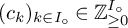 $(c_k)_{k \in I_\circ } \in \mathbb {Z}_{\geq 0}^{I_\circ }$
such that
 $$\begin{align*}E_j^{(a_j+1)} v = F_j^{(b_j+1)} v = \mathfrak{B}_{k,\zeta}^{(c_k+1)} v = 0. \end{align*}$$

4.2 A Presentation of the
$\mathbf {U}^{\imath }$
-module
$V^{\imath }(\lambda , \mu )$


In this subsection, we fix
 $\lambda , \mu \in X^+$
, and set
 $$ \begin{align*} &\nu := w_{\bullet} \lambda + \mu, \\ &\mathcal{E} := \sum_{j \in I_{\bullet}} \mathbf{U} E_j^{(\langle h_j, -w_{\bullet} \lambda \rangle + 1)} m^{\imath}_{\lambda, \mu}, \\ &\mathcal{E}' := \sum_{j \in I_{\bullet}} \mathbf{U}^{\imath} E_j^{(\langle h_j, -w_{\bullet} \lambda \rangle + 1)} m^{\imath}_{\lambda, \mu}, \\ &\mathcal{F} := \sum_{j \in I_{\bullet}} \mathbf{U} F_j^{(\langle h_j, \mu \rangle + 1)} m^{\imath}_{\lambda, \mu}, \\ &\mathcal{F}' := \sum_{j \in I_{\bullet}} \mathbf{U}^{\imath} F_j^{(\langle h_j, \mu \rangle + 1)} m^{\imath}_{\lambda, \mu}, \\ &\mathcal{F}_\circ := \sum_{k \in I_\circ} \mathbf{U} F_k^{(\langle h_k, w_{\bullet} \lambda + \mu \rangle + 1)} m^{\imath}_{\lambda, \mu}, \\ &\mathcal{B} := \sum_{k \in I_\circ} \sum_{b \in \mathbf{B}_{\mathbf{L}}(-\infty)[w_{\bullet} \lambda]} \mathbf{U} F_k^{(\langle h_k, \nu + \operatorname{wt}(b) \rangle + 1)} b m^{\imath}_{\lambda, \mu}, \\ &\mathcal{B}' := \sum_{k \in I_\circ} \sum_{b \in \mathbf{B}_{\mathbf{L}}(-\infty)[w_{\bullet} \lambda]} \mathbf{U}^{\imath} \mathfrak{B}_{k, \overline{\nu + \operatorname{wt}(b)}}^{(\langle h_k, \nu + \operatorname{wt}(b) \rangle + 1)} b m^{\imath}_{\lambda, \mu}. \end{align*} $$
The aim of this subsection is to show that
 $$\begin{align*}\mathcal{E} + \mathcal{F} + \mathcal{F}_\circ = \mathcal{E} + \mathcal{F} + \mathcal{B} = \mathcal{E}' + \mathcal{F}' + \mathcal{B}'. \end{align*}$$
This provides us with a presentation of the
 $\mathbf {U}^{\imath }$
-module
 $V^{\imath }(\lambda , \mu )$
.
Lemma 4.2.1. Let V be a weight
 $\mathbf {U}$
-module, and
 $W \subseteq V$
a subspace. If
 $\mathbf {U} \mathbf {R}^+ W \subseteq W$
, then
 $\mathbf {U} W = \mathbf {U}^{\imath } W$
.
Proof. The assertion follows from the isomorphism
 $\mathbf {U}^{\imath } 1_\lambda \simeq \dot {\mathbf {P}}^- 1_\lambda \simeq \dot {\mathbf {U}} 1_\lambda / \mathbf {U} \mathbf {R}^+ 1_\lambda $
, which is obtained from Proposition 3.1.2 and Lemma 2.4.2.
Lemma 4.2.2. We have
 $$\begin{align*}\mathcal{E} = \mathcal{E}'. \end{align*}$$
Proof. Let
 $j \in I_{\bullet }$
and set
 $v := E_j^{(\langle h_j, -w_{\bullet } \lambda \rangle + 1)} m^{\imath }_{\lambda , \mu } \in M^{\imath }(\lambda , \mu )$
. Since
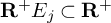 $\mathbf {R}^+ E_j \subset \mathbf {R}^+$
, we have
 $$\begin{align*}\mathbf{R}^+ v \subset \mathbf{R}^+ m^{\imath}_{\lambda, \mu} = 0. \end{align*}$$
Applying Lemma 4.2.1 to the
 $1$
-dimensional subspace spanned by v, we obtain
 $$\begin{align*}\mathbf{U} v = \mathbf{U}^{\imath} v. \end{align*}$$
This implies the assertion.
Lemma 4.2.3. We have
 $$\begin{align*}\mathcal{F} = \mathcal{F}'. \end{align*}$$
Proof. Let
 $j \in I_{\bullet }$
and set
 $v := F_j^{(\langle h_j, \mu \rangle + 1)} m^{\imath }_{\lambda , \mu } \in M^{\imath }(\lambda , \mu )$
. Let
 $x \in \mathbf {L}^+$
and
 $k \in I_\circ $
. By the triangular decomposition (2.4.1) of
 $\mathbf {L}$
, the vector
 $E_k x v$
is, up to scalar multiplies, of the form
 $E_k x^- x^+ m^{\imath }_{\lambda , \mu }$
with
 $x^- \in \mathbf {L}^-$
,
 $x^+ \in \mathbf {L}^+$
. Since
 $E_k$
commutes with the elements in
 $\mathbf {L}^-$
, we have
 $$\begin{align*}E_k x^- x^+ m^{\imath}_{\lambda, \mu} = x^- E_k x^+ m^{\imath}_{\lambda, \mu} \in x^- \mathbf{R}^+ m^{\imath}_{\lambda, \mu} = 0. \end{align*}$$
The argument above implies that
 $\mathbf {R}^+ v = 0$
. Hence, the assertion follows by applying Lemma 4.2.1 as in the proof of Lemma 4.2.2.
Lemma 4.2.4. We have
 $$\begin{align*}\mathcal{B} + \mathcal{E} = \mathcal{B}' + \mathcal{E}. \end{align*}$$
Proof. For each
 $k \in I_\circ $
and
 $b \in \mathbf {B}_{\mathbf {L}}(-\infty )$
, set
-
•
$\lambda _b := \nu + \operatorname {wt}(b)$
, -
•
$v_{k,b} := F_k^{(\langle h_k, \lambda _b \rangle + 1)} b m^{\imath }_{\lambda , \mu }$
, -
•
$v^{\prime }_{k,b} := \mathfrak {B}_{k, \overline {\lambda _b}}^{(\langle h_k, \lambda _b \rangle + 1)} b m^{\imath }_{\lambda , \mu }$
, -
•
$W_{> b} := \sum _{k \in I_\circ } \sum _{\substack {b' \in \mathbf {B}_{\mathbf {L}}(-\infty ) \\ \operatorname {wt}(b') > \operatorname {wt}(b)}} \mathbf {U} v_{k,b'} + \mathcal {E}$
, -
•
$W^{\prime }_{> b} := \sum _{k \in I_\circ } \sum _{\substack {b' \in \mathbf {B}_{\mathbf {L}}(-\infty ) \\ \operatorname {wt}(b') > \operatorname {wt}(b)}} \mathbf {U}^{\imath } v^{\prime }_{k,b'} + \mathcal {E}$
, -
•
$W_{\geq b} := \mathbb {Q}(q) v_{k,b} + W_{> b}$
, -
•
$W^{\prime }_{\geq b} := \mathbb {Q}(q) v^{\prime }_{k,b} + W^{\prime }_{> b}$
,






Since
 $b m^{\imath }_{\lambda ,\mu } \in \mathcal {E}$
for all
 $b \in \mathbf {B}_{\mathbf {L}}(-\infty ) \setminus \mathbf {B}_{\mathbf {L}}(-\infty )[w_{\bullet }\lambda ]$
by equation (2.3.2), we have
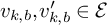 $v_{k,b},v^{\prime }_{k,b} \in \mathcal {E}$
for all
 $k \in I_\circ $
and such
 $b \in \mathbf {B}_{\mathbf {L}}(-\infty )$
. Hence, it holds that
 $$\begin{align*}W_{>b} = \sum_{k \in I_\circ} \sum_{\substack{b' \in \mathbf{B}_{\mathbf{L}}(-\infty)[w_{\bullet}\lambda] \\ \operatorname{wt}(b') > \operatorname{wt}(b)}} \mathbf{U} v_{k,b'} + \mathcal{E}, \text{ and } W^{\prime}_{>b} = \sum_{k \in I_\circ} \sum_{\substack{b' \in \mathbf{B}_{\mathbf{L}}(-\infty)[w_{\bullet}\lambda] \\ \operatorname{wt}(b') > \operatorname{wt}(b)}} \mathbf{U}^{\imath} v^{\prime}_{k,b'} + \mathcal{E}. \end{align*}$$
In particular,
 $$\begin{align*}\mathbf{U} W_{\geq 1} = \mathcal{B} + \mathcal{E} \text{ and } \mathbf{U}^{\imath} W^{\prime}_{\geq 1} = \mathcal{B}' + \mathcal{E}. \end{align*}$$
We shall show that
 $$\begin{align*}\mathbf{U}^{\imath} W^{\prime}_{\geq b} = \mathbf{U} W_{\geq b} \end{align*}$$
for all
 $b \in \mathbf {B}_{\mathbf {L}}(-\infty )$
by descending induction on
 $\operatorname {wt}(b)$
. If this is the case, then we obtain
 $$\begin{align*}\mathcal{B} + \mathcal{E} = \mathbf{U} W_{\geq 1} = \mathbf{U}^{\imath} W^{\prime}_{\geq 1} = \mathcal{B}' + \mathcal{E}, \end{align*}$$
as desired.
When
 $\operatorname {wt}(b) \gg 0$
, it holds that
 $b' \notin \mathbf {B}_{\mathbf {L}}(-\infty )[w_{\bullet } \lambda ]$
for all
 $b' \in \mathbf {B}_{\mathbf {L}}(-\infty )$
such that
 $\operatorname {wt}(b') \geq \operatorname {wt}(b)$
. These imply that
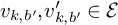 $v_{k,b'}, v^{\prime }_{k,b'} \in \mathcal {E}$
and hence the subspaces
 $W_{\geq b}$
and
 $W^{\prime }_{\geq b}$
are equal to
 $\mathcal {E}$
. Hence, our claim follows in this case.
Assume that the claim holds for all
 $b' \in \mathbf {B}_{\mathbf {L}}(-\infty )$
with
 $\operatorname {wt}(b')> \operatorname {wt}(b)$
. Since
 $$\begin{align*}W_{> b} = \sum_{\substack{b' \in \mathbf{B}_{\mathbf{L}}(-\infty) \\ \operatorname{wt}(b') > \operatorname{wt}(b)}} \mathbf{U} W_{\geq b'} \text{ and } W^{\prime}_{> b} = \sum_{\substack{b' \in \mathbf{B}_{\mathbf{L}}(-\infty) \\ \operatorname{wt}(b') > \operatorname{wt}(b)}} \mathbf{U}^{\imath} W^{\prime}_{\geq b'}, \end{align*}$$
these spaces are identical to each other.
Let us show that
 $\mathbf {U} \mathbf {R}^+ W^{\prime }_{\geq b} \subseteq W^{\prime }_{\geq b}$
. Since
 $W^{\prime }_{\geq b} = \mathbb {Q}(q) v^{\prime }_{k,b} \oplus W_{> b}$
and
 $\mathbf {U} W_{> b} = W_{> b}$
, we only need to show that
 $\mathbf {R}^+ v^{\prime }_{k,b} \in W_{> b}$
. To this end, we will prove that
 $E_{k'} b" v^{\prime }_{k,b} \in W_{> b}$
for all
 $k' \in I_\circ $
and
 $b" \in \mathbf {B}_{\mathbf {L}}(-\infty )$
. It is easily seen that the vector
 $E_{k'} b" v^{\prime }_{k,b}$
is equal to
 $0$
unless
 $k' = k$
. Hence, we may assume that
 $k' = k$
.
When
 $b" = 1$
, by Proposition 4.1.7 (2), we have
 $$\begin{align*}E_k v^{\prime}_{k,b} \in \sum_{b_1 \in \mathbf{B}(-\infty) \setminus \{ 1 \}} \mathbf{U} F_k^{(\langle h_k, \nu + \operatorname{wt}(b) + \operatorname{wt}(b_1) \rangle + 1)} b_1 b m^{\imath}_{\lambda, \mu}. \end{align*}$$
Since
 $b_1 b$
is a linear combination of
 $b_2 \in \mathbf {B}(-\infty )$
with
 $\operatorname {wt}(b_2) = \operatorname {wt}(b) + \operatorname {wt}(b_1)$
, we see that
 $$\begin{align*}F_k^{(\langle h_k, \nu + \operatorname{wt}(b) + \operatorname{wt}(b_1) \rangle + 1)} b_1 b m^{\imath}_{\lambda, \mu} \in \sum_{\operatorname{wt}(b_2)> \operatorname{wt}(b)} \mathbb{Q}(q) F_k^{(\langle h_k, \nu+\operatorname{wt}(b_2) \rangle + 1)} b_2 m^{\imath}_{\lambda,\mu}. \end{align*}$$
Therefore, we obtain
 $$\begin{align*}E_k v^{\prime}_{k,b} \in W_{> b}, \end{align*}$$
as desired.
When
 $b" \neq 1$
, by Proposition 4.1.7 (3), we have
 $$\begin{align*}E_k b" v^{\prime}_{k,b} \in \sum_{\operatorname{wt}(b') \geq \operatorname{wt}(b")} \mathbf{U} F_k^{(\langle h_k, \nu + \operatorname{wt}(b) + \operatorname{wt}(b') \rangle + 1)} b' b m^{\imath}_{\lambda, \mu} = W_{> b}. \end{align*}$$
This completes the proof of the claim that
 $\mathbf {U} \mathbf {R}^+ W^{\prime }_{\geq b} \subseteq W^{\prime }_{\geq b}$
.
Let us apply Lemma 4.2.1 to obtain
 $$\begin{align*}\mathbf{U} W^{\prime}_{\geq b} = \mathbf{U}^{\imath} W^{\prime}_{\geq b}. \end{align*}$$
By Proposition 4.1.7 (1), we have
 $$\begin{align*}v^{\prime}_{k,b} - v_{k,b} \in W_{> b}. \end{align*}$$
This shows that
 $$\begin{align*}W^{\prime}_{\geq b} = W_{\geq b}. \end{align*}$$
Thus, we complete the proof.
Lemma 4.2.5. We have
 $$\begin{align*}\mathcal{F}_\circ + \mathcal{E} = \mathcal{B} + \mathcal{E}. \end{align*}$$
Proof. Clearly, we have
 $\mathcal {F}_\circ \subseteq \mathcal {B}$
. Hence, we only need to show that
 $F_k^{(\langle h_k, \nu + \operatorname {wt}(b) \rangle + 1)} b m^{\imath }_{\lambda , \mu } \in \mathcal {F}_\circ $
for all
 $k \in I_\circ $
and
 $b \in \mathbf {B}_{\mathbf {L}}(-\infty )$
. Since
 $b m^{\imath }_{\lambda , \mu } \in \mathcal {E}$
if
 $b \notin \mathbf {B}_{\mathbf {L}}(-\infty )[w_{\bullet } \lambda ]$
, we may assume that
 $b \in \mathbf {B}_{\mathbf {L}}(-\infty )[w_{\bullet } \lambda ]$
. Noting that
 $\operatorname {wt}(b) \in \sum _{j \in I_{\bullet }} \mathbb {Z}_{\geq 0} \alpha _j$
and
 $(\lambda - w_{\bullet } \lambda ) - \operatorname {wt}(b) \in \sum _{j \in I_{\bullet }} \mathbb {Z}_{\geq 0} \alpha _j$
, we see that
 $$\begin{align*}\langle h_k, \operatorname{wt}(b) \rangle \leq 0 \text{ and } \langle h_k, w_{\bullet} \lambda + \mu + \operatorname{wt}(b) \rangle \geq \langle h_k, \lambda + \mu \rangle \geq 0. \end{align*}$$
Therefore, the vector
 $F_k^{(\langle h_k, \nu + \operatorname {wt}(b) \rangle + 1)} b m^{\imath }_{\lambda , \mu }$
is a scalar multiple of the vector
 $$\begin{align*}E_k^{-\langle h_k, \operatorname{wt}(b) \rangle} b F_k^{(\langle h_k, w_{\bullet} \lambda + \mu \rangle + 1)} m^{\imath}_{\lambda, \mu}. \end{align*}$$
This implies our claim, and the proof is completed.
Theorem 4.2.6. We have
 $$\begin{align*}\mathcal{E} + \mathcal{F} + \mathcal{F}_\circ = \mathcal{E}' + \mathcal{F}' + \mathcal{B}'. \end{align*}$$
In other words, the
 $\mathbf {U}^{\imath }$
-module
 $V^{\imath }(\lambda , \mu )$
coincides with the quotient
 $\mathbf {U}^{\imath }$
-module of
 $M^{\imath }(\lambda , \mu )$
factored by the submodule generated by
 $$\begin{align*}\{ E_j^{(\langle h_j, -w_{\bullet} \lambda \rangle + 1)} m^{\imath}_{\lambda, \mu},\ F_j^{(\langle h_j, \mu \rangle + 1)} m^{\imath}_{\lambda, \mu} \mid j \in I_{\bullet} \} \end{align*}$$
and
 $$\begin{align*}\{ \mathfrak{B}_{k, \overline{w_{\bullet} \lambda + \mu + \mathrm{wt}(b)}}^{(\langle h_k, w_{\bullet} \lambda + \mu + \operatorname{wt}(b) \rangle + 1)} b m^{\imath}_{\lambda, \mu} \mid k \in I_\circ,\ b \in \mathbf{B}_{\mathbf{L}}(-\infty) \}. \end{align*}$$
Corollary 4.2.7. Let V be an integrable
 $\mathbf {U}^{\imath }$
-module. Then, for each
 $\zeta \in X^{\imath }$
and
 $v \in V_\zeta $
, there exist
 $(a_j)_{j \in I_{\bullet }}, (b_j)_{j \in I_{\bullet }} \in \mathbb {Z}_{\geq 0}^{I_{\bullet }}$
and
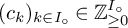 $(c_k)_{k \in I_\circ } \in \mathbb {Z}_{\geq 0}^{I_\circ }$
such that
 $$\begin{align*}E_j^{(a_j+1)} v = F_j^{(b_j+1)} v = 0 \ \text{ for all } j \in I_{\bullet} \end{align*}$$
and
 $$\begin{align*}\mathfrak{B}_{k,\zeta}^{(c_k+1)} v = 0 \ \text{ for all } k \in I_\circ. \end{align*}$$
4.3 Some sufficient conditions
In this subsection, we give some sufficient conditions for a weight
 $\mathbf {U}^{\imath }$
-module to be integrable.
Proposition 4.3.1. Let V be a weight
 $\mathbf {U}^{\imath }$
-module generated by a weight vector v of weight
 $\zeta $
. Suppose that there exist
 $(a_j)_{j \in I_{\bullet }}, (b_j)_{j \in I_{\bullet }} \in \mathbb {Z}_{\geq 0}^{I_{\bullet }}$
and
 $(c_k)_{k \in I_\circ } \in \mathbb {Z}_{\geq 0}^{I_\circ }$
such that
 $$\begin{align*}E_j^{(a_j+1)} v = F_j^{(b_j+1)} v = 0 \ \text{ for all } j \in I_{\bullet} \end{align*}$$
and
 $$\begin{align*}\mathfrak{B}_{k,\zeta}^{(c_k+1)} v = 0 \ \text{ for all } k \in I_\circ. \end{align*}$$
Then, V is integrable.
Proof. The assumption on v implies that the
 $\mathbf {L}$
-module
 $\mathbf {L} v$
is integrable. Since
 $\mathbf {L}$
is a quantum group of finite type, every cyclic integrable module is finite-dimensional. Therefore, the set
 $$\begin{align*}B_V := \{ b \in \mathbf{B}_{\mathbf{L}}(-\infty) \mid bv \neq 0 \} \end{align*}$$
is finite.
Let
 $\lambda ,\mu \in X^+$
be such that
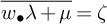 $\overline {w_{\bullet } \lambda + \mu } = \zeta $
. By replacing
 $\lambda $
and
 $\mu $
by
 $\lambda + \tau (\nu )$
and
 $\mu + \nu $
, respectively, for a suitable
 $\nu \in X^+$
, we may assume that
 $$ \begin{align*} &\langle h_j, -w_{\bullet} \lambda \rangle \geq a_j, \\ &\langle h_j, \mu \rangle \geq b_j, \\ &\langle h_k, w_{\bullet} \lambda + \mu + \operatorname{wt}(b) \rangle \geq c_k \end{align*} $$
for all
 $j \in I_{\bullet }$
,
 $k \in I_\circ $
, and
 $b \in B_V$
. These imply that
 $$ \begin{align*} &E_j^{(\langle h_j, -w_{\bullet} \lambda \rangle + 1)} v \in \mathbf{U}^{\imath} E_j^{(a_j+1)}v = 0, \\ &F_j^{(\langle h_j, \mu \rangle + 1)} v \in \mathbf{U}^{\imath} F_j^{(b_j+1)}v = 0, \\ &\mathfrak{B}_{k, \overline{w_{\bullet}\lambda + \mu} + \mathrm{wt}^{\imath}(b)}^{(\langle h_k, w_{\bullet}\lambda + \mu + \operatorname{wt}(b) \rangle + 1)} bv = b \mathfrak{B}_{k, \overline{w_{\bullet}\lambda + \mu}}^{(\langle h_k, w_{\bullet}\lambda + \mu + \operatorname{wt}(b) \rangle + 1)} v \in \mathbf{U}^{\imath} \mathfrak{B}_{k,\zeta}^{(c_k+1)} v = 0 \end{align*} $$
for all
 $j \in I_{\bullet }$
,
 $k \in I_\circ $
, and
 $b \in B_V$
. Hence, the assertion follows from Theorem 4.2.6.
Proposition 4.3.2. An integrable
 $\mathbf {U}$
-module is integrable as a
 $\mathbf {U}^{\imath }$
-module.
Proof. Let V be an integrable
 $\mathbf {U}$
-module. It is a weight
 $\mathbf {U}^{\imath }$
-module. Let
 $\zeta \in X^{\imath }$
and
 $v \in V_\zeta $
. Let us write
 $$\begin{align*}v = \sum_{r=1}^s v_r \end{align*}$$
for some
 $s \in \mathbb {Z}_{> 0}$
,
 $v_r \in V_{\lambda _r}$
, and
 $\lambda _r \in X$
with
 $\overline {\lambda _r} = \zeta $
.
Since V is an integrable
 $\mathbf {U}$
-module, there exist
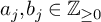 $a_j,b_j \in \mathbb {Z}_{\geq 0}$
for
 $j \in I_{\bullet }$
such that
 $$\begin{align*}E_j^{(a_j+1)} v_r = F_j^{(b_j+1)} v_r = 0 \end{align*}$$
for all
 $r = 1,\dots ,s$
. Hence, we obtain
 $$\begin{align*}E_j^{(a_j+1)} v = F_j^{(a_j+1)} v = 0 \ \text{ for all } j \in I_{\bullet}. \end{align*}$$
Also, for each
 $k \in I_\circ $
, by Proposition 4.1.8, there exists
 $c_k \geq 0$
such that
 $$\begin{align*}\mathfrak{B}_{k,\zeta}^{(c_k+1)} b v = 0 \ \text{ for all } b \in \mathbf{B}_{\mathbf{L}}(-\infty). \end{align*}$$
This completes the proof.
5 Quantized coordinate algebras
In this section, we assume the following:
-
• the Cartan datum I is of finite type,
-
• the involution
$\rho $
on
$\mathbf {U}$
([Reference Lusztig15, 19.1.1]) given by preserves
$$\begin{align*}\rho(E_i) = q_i K_i F_i, \quad \rho(F_i) = q_i K_i^{-1} E_i, \quad \rho(K_h) = K_h, \end{align*}$$
$\mathbf {U}^{\imath }$
,
-
• the canonical basis
$\dot {\mathbf {B}}^{\imath }$
of
$\dot {\mathbf {U}}^{\imath }$
possesses the stability property (or strong compatibility) (cf. [Reference Bao and Wang2, Remark 6.18]).


For example, if
 $\kappa _i$
are all zero and each
 $\varsigma _i$
is a certain signed power of
 $q_i$
as in [Reference Watanabe26, proof of Lemma 4.2.1], then the last two conditions above are satisfied by [Reference Bao and Wang2, Proposition 4.6] and [Reference Watanabe26, Theorem 4.3.1]. The parameters in [Reference Watanabe26, proof of Lemma 4.2.1] are almost the same as in [Reference Bao and Wang2, Table 3], where the constraints are deduced by requiring that each
 $\varsigma _i$
is a signed power of
 $q_i$
and that the bar-involution (which was used to construct
 $\dot {\mathbf {B}}^{\imath }$
) on
 $\mathbf {U}^{\imath }$
exists.
5.1 Simple integrable modules
Let
 $\lambda , \mu \in X^+$
and consider the
 $\mathbf {U}^{\imath }$
-module
 $V^{\imath }(\lambda , \mu )$
. It is equipped with a nondegenerate symmetric bilinear form
 $(,) = (,)_{\lambda , \mu }$
such that
 $(v^{\imath }_{\lambda , \mu }, v^{\imath }_{\lambda , \mu }) = 1$
and
 $$\begin{align*}(x u, v) = (u, \rho(x) v) \ \text{ for all } x \in \mathbf{U}^{\imath},\ u,v \in V^{\imath}(\lambda, \mu) \end{align*}$$
(cf. [Reference Bao and Wang2, § 6.6]). Since
 $V^{\imath }(\lambda , \mu )$
is finite-dimensional, the existence of such a bilinear form ensures that it is semisimple. In fact, if W is a submodule of
 $V^{\imath }(\lambda ,\mu )$
, and
 $W^\perp $
denotes the orthogonal complement of W with respect to
 $(,)_{\lambda ,\mu }$
, then
 $W^\perp $
is also a submodule of
 $V^{\imath }(\lambda ,\mu )$
since
 $\rho $
preserves
 $\mathbf {U}^{\imath }$
. With some index set
 $\Gamma $
, let
 $$\begin{align*}\{ V(\gamma) \mid \gamma \in \Gamma \} \end{align*}$$
denote a complete set of representatives for the isomorphism classes of simple
 $\mathbf {U}^{\imath }$
-modules appearing as a submodule of
 $V^{\imath }(\lambda , \mu )$
for some
 $\lambda , \mu \in X^+$
. Since the
 $\mathbf {U}^{\imath }$
-module
 $V^{\imath }(\lambda ,\mu )$
is integrable by Proposition 4.3.2, so is each
 $V(\gamma )$
.
Let V be a simple integrable
 $\mathbf {U}^{\imath }$
-module, and
 $v \in V$
a nonzero weight vector. Then, there exist
 $\lambda , \mu \in X^+$
and a
 $\mathbf {U}^{\imath }$
-module homomorphism
 $V^{\imath }(\lambda , \mu ) \rightarrow V$
which sends
 $v^{\imath }_{\lambda , \mu }$
to v. Since V is simple, this homomorphism must be surjective. The semisimplicity of
 $V^{\imath }(\lambda , \mu )$
implies that it has a simple submodule isomorphic to V. Therefore, V is isomorphic to
 $V(\gamma )$
for some
 $\gamma \in \Gamma $
.
The argument above shows that the set
 $\{ V(\gamma ) \mid \gamma \in \Gamma \}$
is a complete set of representatives for the isomorphism classes of simple integrable
 $\mathbf {U}^{\imath }$
-modules.
Lemma 5.1.1. Let
 $\gamma \in \Gamma $
. Then, almost all the elements in
 $\dot {\mathbf {B}}^{\imath }$
acts on the
 $\mathbf {U}^{\imath }$
-module
 $V(\gamma )$
as
 $0$
:
 $$\begin{align*}\sharp \{ b \in \dot{\mathbf{B}}^{\imath} \mid b V(\gamma) \neq 0 \} < \infty. \end{align*}$$
Proof. Let
 $B(\gamma ) = \{ v^\gamma _i \mid i \in I_\gamma \}$
be a basis of
 $V(\gamma )$
consisting of weight vectors. Since
 $V(\gamma )$
is finite-dimensional, the index set
 $I_\gamma $
is finite. By the integrability of
 $V(\gamma )$
, for each
 $i \in I_\gamma $
, we may take
 $\lambda _i,\mu _i \in X^+$
such that there exists a
 $\mathbf {U}^{\imath }$
-module homomorphism
 $V^{\imath }(\lambda _i,\mu _i) \rightarrow V(\gamma )$
which sends
 $v^{\imath }_{\lambda _i,\mu _i}$
to
 $v^\gamma _i$
.
Since the
 $\dot {\mathbf {B}}^{\imath }$
possesses the stability property, we have
 $$\begin{align*}\sharp \{ b \in \dot{\mathbf{B}}^{\imath} \mid b v^{\imath}_{\lambda,\mu} \neq 0 \} = \dim V^{\imath}(\lambda,\mu) \ \text{ for all } \lambda,\mu \in X^+. \end{align*}$$
Hence, the number of elements
 $b \in \dot {\mathbf {B}}^{\imath }$
such that
 $b v^{\imath }_{\lambda _i,\mu _i} \neq 0$
for some
 $i \in I_\gamma $
is finite.
Now, suppose that
 $b \in \dot {\mathbf {B}}^{\imath }$
acts on
 $V(\gamma )$
as nonzero. Then, there exists
 $i \in I_\gamma $
such that
 $b v^{\imath }_{\lambda _i,\mu _i} \neq 0$
. By the argument above, the number of such elements is finite.
5.2 Space of matrix coefficients
Given a linear space V, let
 $V^{*}$
denote the linear dual space
 $\operatorname {Hom}_{\mathbb {Q}(q)}(V, \mathbb {Q}(q))$
, and
 $\langle \ \mid \ \rangle \colon V \times V^{*} \rightarrow \mathbb {Q}(q)$
the canonical pairing.
Set
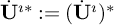 $\dot {\mathbf {U}}^{\imath *} := (\dot {\mathbf {U}}^{\imath })^{*}$
. It is equipped with the following
 $\mathbf {U}^{\imath }$
-bimodule structure:
 $$\begin{align*}\langle u \mid x \phi y \rangle = \langle y u x \mid \phi \rangle \ \text{ for all } x,y \in \mathbf{U}^{\imath},\ u \in \dot{\mathbf{U}}^{\imath},\ \phi \in \dot{\mathbf{U}}^{\imath *}. \end{align*}$$
For each
 $\gamma \in \Gamma $
,
 $v \in V(\gamma )$
and
 $\phi \in V(\gamma )^{*}$
, let
 $c^\gamma _{v, \phi } \in \dot {\mathbf {U}}^{\imath *}$
denote the corresponding matrix coefficient:
 $$\begin{align*}\langle x \mid c^\gamma_{v, \phi} \rangle = \langle xv \mid \phi \rangle \ \text{ for all } x \in \dot{\mathbf{U}}^{\imath}. \end{align*}$$
The matrix coefficients
 $\{ c^\gamma _{v,\phi } \mid v \in V(\gamma ),\ \phi \in V(\gamma )^{*} \}$
form a simple
 $\mathbf {U}^{\imath }$
-bimodule isomorphic to
 $V(\gamma ) \otimes V(\gamma )^{*}$
; the matrix coefficient
 $c^\gamma _{v, \phi }$
corresponds to the vector
 $v \otimes \phi $
.
Let
 $\mathbf {O}^{\imath }$
denote the subspace of
 $\dot {\mathbf {U}}^{\imath *}$
consisting of
 $\phi \in \dot {\mathbf {U}}^{\imath *}$
such that the
 $\mathbf {U}^{\imath }$
-submodule
 $\mathbf {U}^{\imath } \phi $
and the right
 $\mathbf {U}^{\imath }$
-submodule
 $\phi \mathbf {U}^{\imath }$
are integrable.
Lemma 5.2.1. Every integrable cyclic
 $\mathbf {U}^{\imath }$
-module is finite-dimensional.
Proof. Let V be an integrable cyclic
 $\mathbf {U}^{\imath }$
-module with a cyclic vector v. Without any loss of generality, we may assume that v is a weight vector. By the definition of integrable
 $\mathbf {U}^{\imath }$
-modules, there exist
 $\lambda ,\mu \in X^+$
and a
 $\mathbf {U}^{\imath }$
-module homomorphism
 $V^{\imath }(\lambda ,\mu ) \rightarrow V$
which sends
 $v^{\imath }_{\lambda ,\mu }$
to v. Since V is cyclic, the homomorphism must be surjective. Hence, the finite-dimensionality of
 $V^{\imath }(\lambda ,\mu )$
implies that of V. Thus, we complete the proof.
The following two statements can be proved by a similar way to classical results (e.g., see [Reference Procesi20, 6.2.6]).
Lemma 5.2.2. Let
 $\phi \in \dot {\mathbf {U}}^{\imath *}$
. Then, the following are equivalent:
-
•
$\mathbf {U}^{\imath } \phi $
is integrable. -
•
$\phi \mathbf {U}^{\imath }$
is integrable.


Proposition 5.2.3. The
 $\mathbf {O}^{\imath }$
is a
 $\mathbf {U}^{\imath }$
-bisubmodule of
 $\dot {\mathbf {U}}^{\imath *}$
. Moreover, the assignment
 $$\begin{align*}V(\gamma) \otimes V(\gamma)^{*} \rightarrow \dot{\mathbf{U}}^{\imath *};\ v \otimes \phi \mapsto c^\gamma_{v,\phi} \end{align*}$$
gives rise to a Peter-Weyl type decomposition:
 $$\begin{align*}\bigoplus_{\gamma \in \Gamma} V(\gamma) \otimes V(\gamma)^{*} \simeq \mathbf{O}^{\imath} \ (\text{as } \mathbf{U}^{\imath}\text{-bimodules}). \end{align*}$$
Let
 $\dot {\mathbf {B}}^{\imath *} := \{ \delta _b \mid b \in \dot {\mathbf {B}}^{\imath } \}$
denote the dual basis to
 $\dot {\mathbf {B}}^{\imath }$
:
 $$\begin{align*}\langle b_1 \mid \delta_{b_2} \rangle = \delta_{b_1, b_2} \ \text{ for all } b_1,b_2 \in \dot{\mathbf{B}}^{\imath}. \end{align*}$$
Theorem 5.2.4. The
 $\dot {\mathbf {B}}^{\imath *}$
is a linear basis of
 $\mathbf {O}^{\imath }$
.
Proof. First, we shall show that
 $\dot {\mathbf {B}}^{\imath *} \subset \mathbf {O}^{\imath }$
.
Let
 $b \in \dot {\mathbf {B}}^{\imath }$
. Take
 $\lambda , \mu \in X^+$
in a way such that
 $b v^{\imath }_{\lambda , \mu } \neq 0$
. Set
 $$\begin{align*}B := \{ b' \in \dot{\mathbf{B}}^{\imath} \mid b' v^{\imath}_{\lambda, \mu} \neq 0 \}. \end{align*}$$
Note that the set B is finite. In fact, since the
 $\mathbf {U}^{\imath }$
-module
 $V^{\imath }(\lambda , \mu )$
is integrable, there exist
 $(a_j)_{j \in I_{\bullet }}, (b_j)_{j \in I_{\bullet }} \in \mathbb {Z}_{\geq 0}^{I_{\bullet }}$
,
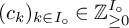 $(c_k)_{k \in I_\circ } \in \mathbb {Z}_{\geq 0}^{I_\circ }$
such that
 $$\begin{align*}E_j^{(a_j+1)} b' v^{\imath}_{\lambda,\mu} = F_j^{(b_j+1)} b' v^{\imath}_{\lambda,\mu} = \mathfrak{B}_{k, \zeta}^{(c_k+1)} b' v^{\imath}_{\lambda,\mu} \ \text{ for all } j \in I_{\bullet},\ k \in I_\circ,\ b' \in B, \end{align*}$$
where
 $\zeta \in X^{\imath }$
denotes the weight of
 $b' v^{\imath }_{\lambda , \mu }$
.
We shall show that
 $\delta _b x = 0$
for all
 $$\begin{align*}x \in \{ E_j^{(a_j+1)},\ F_j^{(b_j+1)},\ \mathfrak{B}_{k, \zeta}^{(c_k+1)} \mid j \in I_{\bullet},\ k \in I_\circ,\ \zeta \in X^{\imath} \}. \end{align*}$$
Let
 $b_1 \in \dot {\mathbf {B}}^{\imath }$
and write
 $$ \begin{align} x b_1 = \sum_{b_2 \in \dot{\mathbf{B}}^{\imath}} c_{b_2} b_2 \end{align} $$
with
 $c_{b_2} \in \mathbb {Z}[q,q^{-1}]$
. Then, we have
 $$\begin{align*}\langle b_1 \mid \delta_b x \rangle = \langle x b_1 \mid \delta_b \rangle = c_b. \end{align*}$$
We want to show that
 $c_b = 0$
. By equation (5.2.1), we have
 $$\begin{align*}x b_1 v^{\imath}_{\lambda, \mu} = \sum_{b_2 \in B} c_{b_2} b_2 v^{\imath}_{\lambda, \mu}. \end{align*}$$
The left-hand side equals
 $0$
by the definition of x. Since the elements
 $\{ b_2 v^{\imath }_{\lambda ,\mu } \mid b_2 \in B \}$
form a basis of
 $V^{\imath }(\lambda ,\mu )$
, we must have
 $c_{b_2} = 0$
for all
 $b_2 \in B$
. In particular, we obtain
 $c_b = 0$
.
Next, we shall prove that the
 $\dot {\mathbf {B}}^{\imath *}$
spans
 $\mathbf {O}^{\imath }$
. Let
 $\{ v^\gamma _i \mid i \in I_\gamma \}$
be a linear basis of
 $V(\gamma )$
and
 $\{ \phi ^\gamma _i \mid i \in I_\gamma \}$
its dual basis. By the Peter-Weyl type decomposition 5.2.3,
 $\mathbf {O}^{\imath }$
has the following linear basis:
 $$\begin{align*}\{ c^\gamma_{v^\gamma_i, \phi^\gamma_j} \mid i,j \in I_\gamma \}. \end{align*}$$
We can formally express these basis elements as
 $$\begin{align*}c^\gamma_{v^\gamma_i, \phi^\gamma_j} = \sum_{b \in \dot{\mathbf{B}}^{\imath}} c^\gamma_{v^\gamma_i, \phi^\gamma_j}(b) \delta_b. \end{align*}$$
Since
 $c^\gamma _{v^\gamma _i,\phi ^\gamma _j}(b) = 0$
for almost all
 $b \in \dot {\mathbf {B}}^{\imath }$
(Lemma 5.1.1), the right-hand side is a finite sum. This proves the assertion.
Corollary 5.2.5. The space of matrix coefficients for the semisimple integrable
 $\mathbf {U}^{\imath }$
-modules coincides with the quantum coordinate algebra of
 $\dot {\mathbf {U}}^{\imath }$
in [Reference Bao and Song1, 3.2.2].
Proof. The former is the
 $\mathbf {O}^{\imath }$
, and the latter is the subspace of
 $\dot {\mathbf {U}}^{\imath *}$
spanned by the dual basis
 $\dot {\mathbf {B}}^{\imath *}$
. Hence, the assertion follows from Theorem 5.2.4.
Acknowledgements
The author thanks Paul Terwilliger for comments on the representation theory of
 $\imath $
quantum groups, especially the q-Onsager algebra. He is also grateful to Stefan Kolb for fruitful discussion on a sufficient condition for a weight
 $\mathbf {U}^{\imath }$
-module to be integrable, which stimulates him to formulate Proposition 4.3.1. He would like to express his gratitude to the anonymous referees for valuable comments and suggestions. This work was supported by JSPS KAKENHI Grant Number JP24K16903.
Competing interests
The author has no competing interests to declare.
Data availability statement
Data sharing not applicable to this article as no datasets were generated or analyzed during the current study.



