As the eminent political sociologist Seymour Martin Lipset reminded us decades ago, elections are the “democratic translation” of conflict among competing groups (Lipset Reference Lipset1963: 230–32). That is, democracy manages conflict resulting from the structural divisions in society—be they, as Lipset suggests, along class, religious, ethnic, national, or other demographic dimensions—by structuring political competition in such a way as to enable the peaceful (i.e., nonviolent) change of government. In theory, democratic governments allow for challenges to their rule at specified intervals (election periods) and voluntarily relinquish power at the end their term without recourse to physical violence. In this sense, democracy can be said to inhibit political violence by institutionalizing political conflict through competitive elections. This has become known as “the ballot replaces the bullet” thesis (Hughes Reference Hughes2010; Rummel Reference Rummel1994: 23). Indeed, some claim that “political violence. . . is necessarily undemocratic since it involves force rather than democratic process” (Magill Reference Magill and Honderich2005: 198).
While cross-national research suggests that democracies—especially mature democracies—tend to experience less political violence than nondemocratic regimes (Hegre et al. Reference Hegre, Ellingsen, Gates and Gleditsch2001; Henderson Reference Henderson1991; Rummel Reference Rummel1984), there are notable exceptions. As Hughes (Reference Hughes2010) points out, even established democracies have experienced serious episodes of political violence including the United Kingdom (the Irish Republican Army in Northern Ireland), Canada (the Front de libération du Québec in Quebec), the United States (the Black Panther Party), and Spain (Euskadi Ta Askatasuna [ETA] in the Basque region). However, as these exceptional incidences of political violence within consolidated democracies reveal, such violence is typically along religious, linguistic, and/or ethnic lines.
Jamaica is an interesting case as it is a consolidated democracy that experiences political violence, but not along religious, linguistic, ethnic, or even class divides.Footnote 1 Rather, partisan violence occurs among a relatively homogenous population “consisting of poor, black, modestly educated, ill-housed persons who share a common culture, identical religious affiliations, and similar deprivations” (Eyre Reference Eyre1984: 26). Furthermore, political violence in Jamaica seeks to influence electoral outcomes; it does not seek revolutionary change or the overthrow of the state as the examples listed in the preceding text have done (Sives Reference Sives2010: xi). These two features of political violence in Jamaica make it exceptional among mature democracies.
Most literature analyzing the dynamics of political violence in Jamaica focuses on the postindependence period. Specifically, the literature identifies the crucial role garrison communities play in the propagation of partisan violence since their establishment in 1963, the year following Jamaica's independence. Garrison communities are zones free of the rule of law in underprivileged urban neighborhoods (mostly concentrated around Western Kingston) that are controlled by local strongmen—known as dons. The dons are often associated with organized crime, but also tend to be affiliated with a political party, acting as intermediaries for the distribution of political patronage among politically homogenous community residents with strong party loyalties (Figueroa and Sives Reference Figueroa and Sives2002). In Jamaica, political violence is concentrated around the garrison communities, with dons and their gangs engaging in violent confrontations with their counterparts affiliated with rival political parties, particularly during elections (Sives Reference Sives2002, Reference Sives2010).
Although we know that democratic political violence in Jamaica is now inextricably linked to the garrison phenomenon, we know less about the origins of political violence. While the garrisons contributed to the postindependence stabilization of political violence and continue to be a major factor in its maintenance, political violence in Jamaica predates the garrison phenomenon. Consequently, this article will focus on the preindependence origins of partisan violence through an examination of the conditions that led to its emergence, escalation, and institutionalization during the late colonial period.
Through original archival research, this article supports past findings identifying personality politics, the politicization of race/class divisions, and clientelism as contributing factors to the development of political violence. The article also makes a significant new contribution by providing evidence that the policy of nonintervention adopted by colonial authorities during the early stages of political violence was a crucial factor leading to its escalation and then institutionalization. This finding gives the British colonial state a different and more central role than the extant literature suggests. Furthermore, it has important implications for the management of political violence within democratic contexts, suggesting that the failure to quickly suppress political violence may have adverse long-term consequences that could become increasingly difficult to address with the passage of time.
Political Violence and the Garrison Phenomenon in Postindependence Jamaica
Although political violence preceded the garrison phenomenon, it is nonetheless important to provide an overview of its relationship to garrison communities postindependence, in order to identify any continuities with the preindependence period. Within Jamaica's strong two-party democracy, the two dominant political parties, the Jamaica Labour Party (JLP) and the People's National Party (PNP), have affiliated garrison communities. The year after Jamaica's independence in 1962, construction began on the housing project that quickly became the first garrison community—Tivoli Gardens. Subsequently, more of these communities were established during the 1960s and 1970s as a result of the allocation of public housing projects on the basis of partisanship by the government of the day (Figueroa and Sives Reference Figueroa and Sives2002; Irish-Bramble Reference Irish-Bramble2010). Although projects of this kind have been prohibited since the establishment of the National Housing Trust statutory corporation in 1976, these large-scale housing projects built in the 1960s and 1970s still form the core of the garrisons today. These communities are found in approximately 10 percent of the island's constituencies and are largely concentrated around Western Kingston (Figueroa and Sives Reference Figueroa and Sives2002; Rapley Reference Rapley2003).
In the establishment of the garrison communities during the 1960s and 1970s, politicians forged relationships with local youth gangs to act as partisan enforcers—that is, to provide protection for the party and to intimidate political opponents. The politicians armed these enforcers and incorporated them into the patronage system, while also using them as their intermediaries to distribute patronage to neighborhood residents, bringing about the emergence of the dons and establishing the basis of their authority in the community. The establishment of the garrison phenomenon saw an increase in political violence (Lacey Reference Lacey1977; Sives Reference Sives2010). This largely took the form of party-affiliated gangs committing acts of political intimidation and partisan violence, particularly against rival partisan gangs during election campaigns. Political violence reached its peak during the general election year of 1980; violence as a result of the election campaign is estimated to have been the cause of the majority of the 889 homicides that year (Irish-Bramble Reference Irish-Bramble2010; Sives Reference Sives2010).
In the early 1980s, austerity measures resulted in a substantial decrease in state resources, limiting the amount of patronage available (Clarke Reference Clarke2006; Irish-Bramble Reference Irish-Bramble2010; Sives Reference Sives2002). Although violence in the garrisons continued to escalate to the point that Jamaica now has one of the highest murder rates in the world (UNODC 2011), these developments changed its nature. The emerging cocaine trade within garrison communities led to a situation in which “gang disputes, protection of drug turf, and revenge killings now account for a larger proportion of the violence than political rivalries” (Sives Reference Sives2002: 82; see also Clarke Reference Clarke2006; Irish-Bramble Reference Irish-Bramble2010). Nonetheless, political violence continues to be an issue as partisan identities remain strong despite the decrease—or in some cases the absence—of political patronage (Sives Reference Sives2010).Footnote 2 Dons have generally maintained their partisan connections, and political violence does occur when gangs come together to fight traditional political rivals during elections (Sives Reference Sives2002). Although political violence (as measured by politically motivated homicides) has declined since its apex in 1980, it remains a significant and entrenched feature of Jamaican politics.
Current Explanations of the Origins of Democratic Violence in Jamaica
As outlined in the preceding text, there are a number of works that examine postindependence political violence in Jamaica, specifically focusing on its relationship to garrison communities. However, several works (Eaton Reference Eaton1975; Figueroa and Sives Reference Figueroa and Sives2002; Gray Reference Gray2004; Irish-Bramble Reference Irish-Bramble2010; Munroe and Bertram Reference Munroe and Bertram2006; Post Reference Post1981; Sives Reference Sives2010) acknowledge that political violence developed during the 1940s and 1950s; that is, prior to independence and the establishment of the garrison phenomenon. Notwithstanding that the garrisons were—and remain—a crucial factor in the perpetuation of political violence postindependence, political violence predates the garrison phenomenon, and therefore the garrisons are not its original cause. In order to explore the initial causes of political violence, one has to examine the preindependence period. Despite the just-mentioned acknowledgment of earlier violence, few studies attempt to identify the factors that led to the development and institutionalization of political violence prior to independence.
Munroe and Bertram (Reference Munroe and Bertram2006: xxix) identify the politicization of “the prolonged historical antagonism and deep social divide between ‘blacks’ and ‘browns’” in Jamaica as the primary cause of political violence. However, they do not conduct a rigorous test of this assertion as it was not the objective of their research. Likewise, Stone (Reference Stone1980) and Gray (Reference Gray2004) do not set out to specifically examine the preindependence origins of political violence, but they both argue that political violence developed as a consequence of the system of clientelistic politics that was established after the first universal suffrage election in 1944 and as a consequence of the development of an intense emotional partisan loyalty among segments of the working class. As Gray (ibid.: 27) notes:
the practice of political discrimination [i.e., patronage distributed by the JLP after the 1944 election] had unleashed an orgy of political violence and industrial strikes as the PNP-TUC resisted Bustamante's bid to monopolize power, dominate trade union and political activity in Kingston, and distribute jobs on a purely partisan basis. . .. Bustamante's political unionism triggered a cycle of violence in which labourers, thuggish recruits and other sympathizers fought bloody battles in the name of their respective parties with the passion and zeal resembling commitment to a messianic cause.
Furthermore, Stone (Reference Stone1980: 100) contends that after its development, the propensity toward political violence tended to increase as more patronage benefits were allocated to community residents.
Only Sives (Reference Sives2010) directly treats the question of the origins of partisan violence in detail. Her basic argument is that, during the 1940s and 1950s, the political inexperience of the majority of Jamaicans (a product of a history of political marginalization) resulted in politics that became focused on personality cults emphasizing attachment to the leader, rather than on political parties or ideologies. This approach to politics, initially cultivated by the JLP, created an atmosphere in which adherents were less willing to tolerate political rivals, making them more prone to engage in acts of political violence against challengers. Sives's analysis indicates that the JLP was the initiator of political violence, with the PNP initially responding with defensive violence.Footnote 3 She acknowledges that there is “some evidence” of nonintervention by police during the early 1940s when the JLP were the aggressors, but concludes that the PNP “clearly took a strategic decision [to fight violence with violence]. . . rather than approaching the colonial administration to demand protection from JLP attacks” (ibid.: 16). Although she argues that clientelism was crucial to the rise of political violence prior to independence, she also provides some evidence that political violence preceded patronage politics.
This article engages the literature by both corroborating and challenging certain insights. It corroborates past findings in identifying the politicization of initial race/class divisions between the parties, personality politics, and clientelism as contributing factors to the development of political violence. However, this analysis divides the causal factors into two categories, taking time into account. Certain factors early in the period can be identified as those causing the initial instances of political violence, while later a different combination of factors led to its perpetuation, escalation, and institutionalization. The analysis suggests that the politicization of initial race/class divisions and personality politics were fundamental to the initial development of political violence. However, once political violence had become an established practice, this combination of factors—particularly the politicization of race/class divisions—became less relevant to its perpetuation and entrenchment than did clientelism and the policy of nonintervention by the colonial state. Moreover, this analysis substantiates Sives (Reference Sivesibid.) by providing new historical evidence of a significant level of political violence prior to clientelism (i.e., prior to the 1944 election). Consequently, while clientelism is identified as an important factor in the escalation and institutionalization of political violence preindependence, it is not a root cause of political violence.
This study also contributes to the literature by highlighting the nonintervention of colonial authorities as the critical factor in the institutionalization of political violence during the late colonial period. The archival research conducted for this study provides new evidence of nonintervention on the part of the police and colonial administration regarding initial instances of political violence. In particular, the article challenges the extant literature in suggesting that during the early years of political violence, the PNP did approach the colonial administration to demand protection, and only after this request was refused did the party make the conscious decision to fight violence with violence. This corrective to the historical analysis has very important implications for the origins of democratic violence, as it gives colonial authorities a more significant role than has been suggested in the current literature concerning the development of partisan violence in Jamaica.
Methodologically, the article takes a historical sociological approach and analyzes the late colonial period (1938–62) in Jamaica by drawing upon both the secondary literature and primary sources. I examine this period not only because the literature identifies it as the period that witnessed the emergence and entrenchment of political violence and patronage politics, but also because it was a period of major constitutional change that led to the establishment of the two political parties and their affiliated trade unions that have since dominated Jamaican politics. The primary research involved conducting original archival research by examining colonial documents, correspondence, government documents, union archives, newspapers, and other historical documents at the University of the West Indies, the National Library of Jamaica, and the Jamaica Archives Office.
The Labor Riots of 1938 and the Formation of the Two Arms of the Labor Movement
Although slavery was abolished in Jamaica (and throughout the British Empire) in 1838, by 1938—a full 100 years after emancipation—its legacy remained apparent. The blacks (i.e., the descendants of the former slaves) remained poor, the whites privileged, while those of Afro-European descent (known locally as “browns”) occupied the middle class (Curtin Reference Curtin1955; Smith Reference Smith1965). It was this social structure that formed the basis of the labor disturbances of 1938.
The 1930s were tumultuous times for Jamaica's economy, the brunt of which was borne by the working class. Not only did it have to contend with the economic depression and falling sugar prices, but the sugar industry was also giving way to less labor-intensive banana production in the late 1930s. This resulted in increasing unemployment in the countryside and contributed to the large migration of the unemployed to Kingston (Roberts Reference Roberts1957).
High unemployment and low wages among the working class contributed to rising tensions. Working-class frustration culminated in a dispute over wages at the Frome Estate in the parish of Westmoreland on April 29, 1938. The dispute escalated to violence when police were called in to restore order. Battles between laborers and the police lasted 10 days and resulted in four deaths (including a pregnant woman), nine hospitalized, and 89 imprisoned (Jamaica Information Service 1969).
As news of the Frome riots reached and spread through Kingston, working-class anger and frustration turned into mobilization. On May 23, 1938, dock workers took the lead and went on strike, while other groups of manual laborers followed. Upon hearing the news of the work stoppages and the gathering of laborers at the wharves, Alexander Bustamante immediately headed there to address the crowds. At that time, Bustamante was a middle-class moneylender without any extensive postsecondary education, who was known for his prolabor editorials.Footnote 4 When the crowds that Bustamante came to address refused to disperse, the police were given the order to fire on them, as they did at the Frome Estate. However, Bustamante stepped in front of the police, removed his shirt, exposed his chest, and said “If you're going to shoot, shoot me!” (Hill Reference Hill1976: 31). He was arrested, but work stoppages, demonstrations, and riots ensued.
It seemed to some, including Norman Manley, that Bustamante's release would be crucial in ending the riots. Manley was Bustamante's cousin, a Rhodes Scholar who had fought in World War I and had established himself as one of the country's most respected lawyers. Manley pushed for Bustamante's release, which he eventually secured on May 28th and the disturbances eventually subsided. Between the 21st and 31st of May, the riots resulted in 46 deaths and 429 injuries (Munroe Reference Munroe1990).
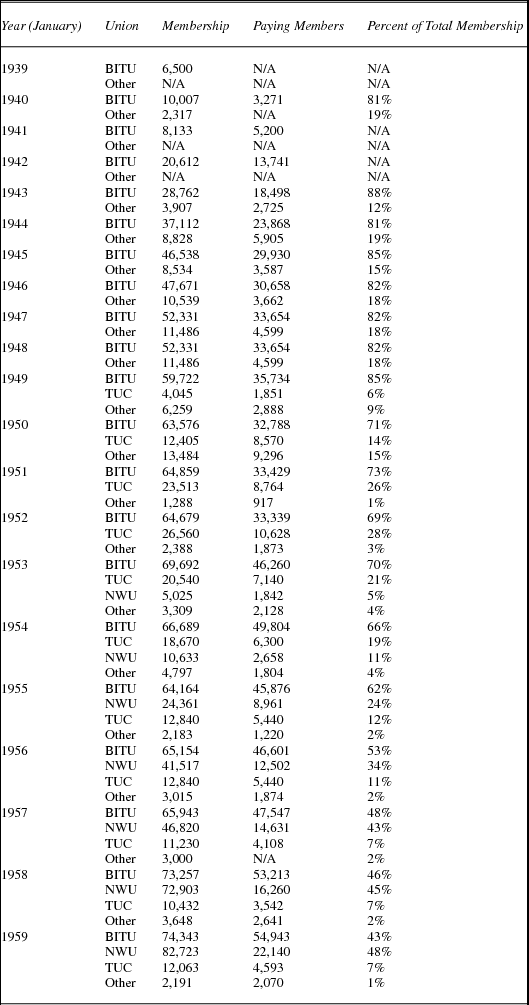
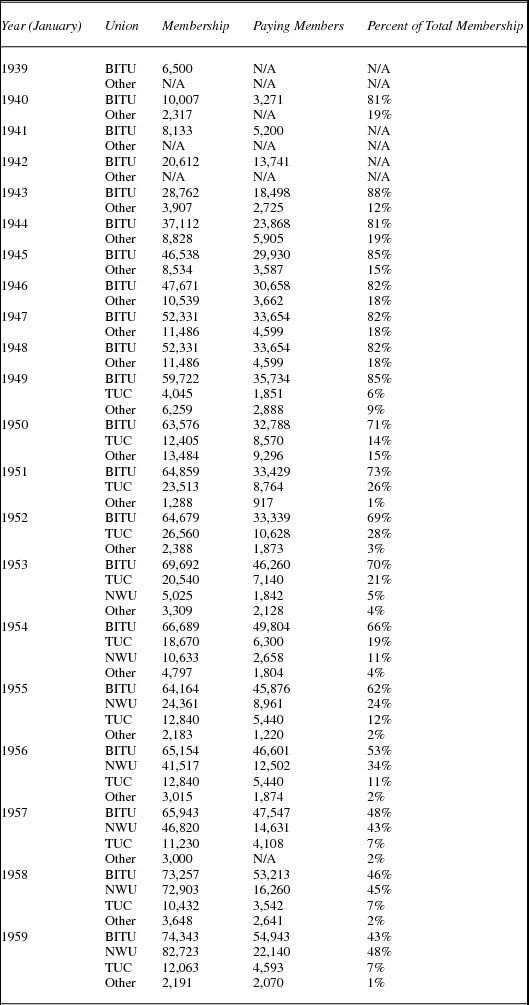
In the wake of the labor riots, Alexander Bustamante set out to form a labor union under his leadership. The Bustamante Industrial Trade Union (BITU) was formally registered on January 19, 1939. Both its name and structure reflected the autocratic nature of Bustamante's leadership. The rules of the BITU submitted during registration stated that “Mr. Alexander Bustamante shall be the permanent President of the Union, and shall hold office during his lifetime. . .. The President shall preside as Chairman at all meetings of the Union and the Managing Executive Committee” (as cited by Hart Reference Hart1999: 19). Furthermore, the Managing Executive Committee was to be composed of officers that were all directly or indirectly appointed by the president. In addition, the rules gave the president full control of the terms of employment of all paid officers and employees of the union, including the power to dismiss them at his discretion. Although the structure of the BITU was uncommonly dictatorial for a labor union, the workers rallied behind their leader, who had risked his life and went to jail on their behalf, and accepted this arrangement. Richard Hart, who was involved in the trade union movement, contends that “there can be little doubt that at this time the concept of the BITU as belonging to the leader rather than the membership was acceptable to the overwhelming majority of the workers” (ibid.: 23). By the time of its registration the BITU was already the largest labor union on the island (see appendix).
The labor riots also led Norman Manley to publicly express the need for a labor party and actively participate in its formation (Manley c. Reference Manley1938–62). On September 18, 1938, the PNP held its inaugural meeting. In his speech, Norman Manley, as leader of the PNP, informed the audience that the party pledges to support the labor movement and “the progressive forces of this country and to work for the raising of the standard of life of the common people” (Manley 1938a: 2). Manley indicated that the PNP would begin the process of preparation for self-government, agitate for suffrage expansion, and educate the working class on the advantages of self-government and democratic rule. Regarding party structure, Manley stated that the “Party will be modelled on strictly democratic lines” (ibid.: 7). In short, all party members within an electoral district sent delegates to the Ward Committee, where election candidates were selected. In addition, each Ward Committee elected delegates to the General Party Conference to elect the council, who in turn elected the Executive Committee. Both the council and the Executive Committee were to be “the heart and brain of the organisation where the plans and programmes and organisation of the Party will be studied and worked out” (ibid.: 9). Bustamante was not asked to join the leadership of the PNP. He became a member of the party in 1939, but was never an active participant in the organization (Hart Reference Hart2006; Munroe and Bertram Reference Munroe and Bertram2006).
Divisions within the Labor Movement, 1938–42: Colonial Authorities Abet a Rift between the Two Arms
The labor movement seemed to be gaining momentum. In the latter half of 1938, both a new union that began reaching significant numbers of Jamaican workers and a labor party supportive of the movement were in place. At first blush, a powerful and united labor movement with both a trade union arm and a political party seemed to be taking shape after the disturbances earlier that year. However, divisions within the movement were evident even during these early stages. These divisions between the leadership of the BITU and PNP were primarily based on differences of strategy and leadership style of the two organizations.
Prior to the formal registration of the BITU and the inaugural meeting of the PNP, differences in strategy between the two leaders were already evident. Bustamante wanted to increase the membership of his union and was more than happy to demonstrate the union's organizational power in the face of opposition. A letter to Norman Manley dated August 24, 1938 from the union leader illustrates his position. Bustamante indicated his impatience with the Conciliation Board and its recommendation not to call any strikes before arbitration. He wanted to call a general strike before attempting to arbitrate three outstanding grievances at various sugar estates, stating that “we can tie up the entire country and fight these abuses once and for all. . . by stopping the cogs of industrial machines” (Bustamante 1938). Manley replied in his own letter that a general strike would be strategically fatal to the labor movement and advocated reserving organized action only for the specific problem estates. Furthermore, Manley (Reference Manley1938b) advised that Bustamante should pursue “a closer organisation of the Union membership and structure on the spot so as to strengthen the local force of the Union.” Of course, decentralization of the organization of the union would imply that Bustamante would have to relinquish some of his authority over operational decisions. Given the organizational structure outlined in the preceding text, it is evident that Bustamante decided not to pursue this suggestion.
Divisions between the PNP and the BITU became more pronounced in 1939. During February, Bustamante decided to call a spontaneous, island-wide general strike after the United Fruit Company refused his request to dismiss a Jamaica Workers and Tradesman Union (JWTU) member who had an altercation with a BITU organizer who was trying to poach JWTU members (Hart Reference Hart1999). Manley saw this decision as a strategic blunder for the BITU and the labor movement as a whole. He immediately informed Bustamante of his dissatisfaction with the decision and with the organizational structure of his union. In a letter to Bustamante, Manley (Reference Manley1939a) lamented that “owing to the error made in calling a Strike which was not justified. . . the whole of public opinion was alienated.” He also criticized the BITU's organizational structure, writing that “I do not in any way believe in an organization which is based on autocratic methods,” and suggested that the BITU change its constitution so that the election of officers and strike decisions be determined democratically and that the organization change its name. Nevertheless, Manley and the PNP acted as a mediator between the governor and Bustamante and negotiated a settlement in which the severe emergency regulations (including Bustamante's potential incarceration) and the general strike were both called off with the establishment of the Trade Union Advisory Council (TUAC). The TUAC was composed mostly of PNP executives and its mission was “to assist in the orderly and progressive development in the trade union movement” (as cited in Munroe Reference Munroe1990: 69), which aimed to avoid unwarranted strikes and promoted democratic constitutions for its affiliated unions. Bustamante, under pressure from the emergency regulations that would come into effect had he not acquiesced, agreed to the arrangement.
The TUAC began putting pressure on Bustamante to make the constitution of the BITU more democratic. On April 1, 1939, an article appeared in Public Opinion (a newspaper supportive of the PNP) under the penname “Philosopher” (a member of the PNP) that criticized the autocratic nature of the BITU. Bustamante was outraged, and in a letter to Manley wrote that the BITU is “not going to accept any attack from one of your officers without retaliation. If there is going to be a fight, let there be a fight” (Bustamante 1939). Manley (Reference Manley1939b) replied that he strongly believed in a free press and “fair criticism” and that members of the PNP were “as free to criticise the Party as [they are] to criticise Trade Unions.” He also pointed out that he believed strongly in the labor movement and stated that “I will never attack that Movement and that stands whether my Movement is attacked or not. When you attacked the PNP I did not retaliate by attacking Labour Unions. . .. Once I have made up my mind about the righteousness of a cause I stick to it” (ibid.). Shortly thereafter, Bustamante withdrew the BITU from the TUAC (which he was able to do now that the pressure of emergency regulations had subsided) and continued to resist the adoption of a democratic constitution for the BITU. He also remained true to his promise of retaliation against the PNP. In June 1939, BITU supporters began harassing the party and in August Bustamante was reported to have driven into the crowd of a PNP meeting at a dangerous speed, which resulted in two summonses against him (Commissioner of Police 1939; Munroe Reference Munroe1990). Bustamante's hostility was significant enough for a PNP organizing committee to report that “their work was greatly handicapped by the campaign against the party being waged by Mr Bustamante” (as cited in Munroe Reference Munroe1990: 71). However, given their mutually reinforcing roles, a type of truce can be said to have gradually developed between the PNP and BITU so that by February 1940, the PNP executive reported that “Mr Bustamante had ceased his attacks on the party” (as cited in ibid.).
The somewhat uneasy truce between the two organizations held throughout 1940, a time when the island was preoccupied with the events of World War II. At the outset of the war, the PNP had declared a moratorium on its campaign for self-government in support of the British Empire's war effort. However, by September 1940, the PNP resumed its campaign for self-government as a result of war contingency arrangements made by Britain where the Anglo-Caribbean territories would potentially become the responsibility of the United States (Munroe Reference Munroe1990). At the same time, the party also made the decision to declare itself socialist (Post Reference Post1981). Self-government and socialism became the two central pillars of PNP policy. By contrast, Bustamante frequently expressed loyalty to the British Empire and was ardently opposed to communism (Bustamante 1940a, 1940b).
On September 8, 1940, shortly after the PNP's declaration of support for self-government and socialism, the governor issued an order for Bustamante's arrest under the Jamaica Defence Regulations of 1939. According to reports received by the governor, Bustamante was inciting violence, race/class war, and revolution at a public meeting (Post Reference Post1981). With its president detained, the BITU executive reached out to the PNP for assistance. About a month after Bustamante's arrest, the BITU and PNP officers set up formal mechanisms for communication and collaboration between the two organizations (Hart Reference Hart1999). During this time of close cooperation, the PNP agitated for Bustamante's release. Manley met personally with the governor to lobby on Bustamante's behalf (Richards 1940). While Bustamante was in prison, the BITU executive sought Manley's advice and leadership, and Manley regularly visited Bustamante. Thus, Manley was effectively given strategic control of the BITU in Bustamante's absence.
By the end of 1941, Manley had significantly strengthened the BITU. At the time of Bustamante's internment, the BITU was struggling financially. Bustamante must have been concerned about the survival of his union and as such welcomed any assistance Manley and other PNP executives could give the organization to keep it afloat in his absence. However, after some time it was clear that his union was not only surviving, but thriving. Under Manley's stewardship, the union had built up a healthy cash balance and increased its membership fivefold (Ranston Reference Ranston1989). This undoubtedly became a cause for concern for Bustamante. During January 1942, divisions between the two cousins began to resurface publicly, with Bustamante assuring the colonial administration that he was against self-government and that he intended to terminate the association between the BITU and the PNP (Hart Reference Hart1999). About the same time, Bustamante also withdrew from his regular meetings with Manley (Ranston Reference Ranston1989). News of Bustamante's release was announced on January 10, 1942 (Munroe Reference Munroe1990). Interestingly, on January 5th, a dispatch from the Colonial Office informed the governor that Jamaica was to be granted full universal suffrage as soon as the electoral lists could be prepared (British Colonial Office 1942). However, the governor did not make this information public until February 10th, two days after Bustamante's release (Munroe Reference Munroe1990).
Upon his release on February 8th, Bustamante immediately denounced Manley, the PNP, and certain BITU officers (Munroe and Bertram Reference Munroe and Bertram2006). Bustamante then fired the BITU executives who had been working closely with the PNP. When they refused to leave and insisted that the union become more democratic, Bustamante allegedly responded using physical violence by smashing chairs over their backs until they left the premises (Ranston Reference Ranston1989). After learning of Bustamante's public attack on the PNP, Manley wrote to him stating:
For the sake of the progress of the country I have shut my mouth for three and a half years about you. I have borne all your attacks in silence. I have been stoned at your request—I have seen you try to break up the movement for no reason except your personal interest. . . I am not sitting down and keeping quiet any longer. If it is war, it is your choice. (Manley Reference Manley1942a)
In the same letter, he also wrote: “I do not forget that you told me, last year September, that funny story about how you were sent for by the Colonial Secretary and promised your release if you would attack the PNP” (ibid.). On February 16th, Manley went public with the accusation that Bustamante made a deal with the governor that secured his release from prison in exchange for denouncing the PNP (Munroe Reference Munroe1990). Although both Bustamante and the governor denied that a deal had been made, the timing of Bustamante's release seems to suggest that it was related to the granting of universal suffrage, and as a result a strategic decision was made by the governor to create a division between the two organizations. In a personal letter written four months later, Governor Richards comments:
Bustamante is a damned nuisance, admittedly, and he too is stirring up trouble all over the Island. The difference is that he is first and last out for Bustamante and Bustamante's credit. He is not fundamentally anti-Government and subversive. On the other hand the Manley group is fundamentally anti-Government and subversive. It is out to discredit and if possible to break the present administration and it works, night and day, in season and out, for that end under Manley's guidance. It aims—now openly—at conscription of all wealth and property, at complete self Government and at an entirely Communist set-up. Its methods and technique are closely modelled—comparing small things with great—on the Nazi plan—to end in the dictatorship of Manley, who has become more bitter and irreconcilable with the passage of time.
Nuisance, though Bustamante is, there is no doubt that had he not been released or had he gone in with Manley the situation would be far more serious than it is. (as cited in Post Reference Post1981: 221)
Thus, from the historical record, the evidence seems to point to the colonial administration (through the governor) attempting to divide the labor movement (either with or without an explicit arrangement) by timing Bustamante's release with the news of a new constitution for Jamaica. After this episode the labor union and the labor party that emerged from the disturbances of 1938 to lead the labor movement were never to collaborate again.
The Beginnings of Organized Political/Union Violence, 1942–44
The division between the two organizations was particularly difficult for the PNP. Support for the BITU remained strong among organized labor (see appendix) and among the overwhelmingly black working class. For the PNP, the feud with the BITU resulted in the loss of a substantial proportion of its working-class support. Moreover, Bustamante and his supporters proved to be relatively successful in thwarting attempts of the PNP to organize among the workers. Paradoxically, the PNP became a labor party without a working-class base, whose support came primarily from the middle class.
The PNP did, however, remain involved with the TUAC. After the withdrawal of the BITU from the TUAC in 1939, the TUAC lost not only its largest union member, but also its role as advisory body for all organized labor. It thus became an organization of loosely associated small unions. However, in 1941 the organization took on a more formal structure, began to meet regularly, and changed its name to the Trade Union Council (TUC). The TUC's original, modest-membership unions (including the Jamaica Workers and Tradesmen Union, the Tramway, Transport and General Workers Union, and the Jamaica United Clerks Association) were then joined by unions of subordinate government employees that were organized in 1942, providing the PNP-affiliated TUC the beginnings of a mass working-class base (Hart Reference Hartn.d.).
For his part, Bustamante continued working on consolidating the power of the BITU. It became evident that he was not opposed to using intimidation and physical violence to this end. During April 1942, the Jamaica United Workers Union (JUWU)—a TUC-affiliated union founded by the former BITU officers that were dismissed after Bustamante's internment—became a frequent target of his attacks. Manley (Reference Manley1942b) notes that “as a result of the nature and tone of recent speeches delivered by Bustamante at meetings. . . the Jamaica United Workers Union is being subjected to an organized campaign of mob violence.” In the same letter, Manley pointed out the unwillingness of the police to take action. He indicated that upon a request by a JUWU officer for police protection for a lawful meeting, the police informed him:
-
1. That he was advised not to hold any meeting
-
2. That if he did the Police would in no way be responsible for his safety or for the prevention of disorder at the meeting
-
3. That he ought to leave Kingston and speak in the country
-
4. That he. . . would have to assume and accept responsibility if contrary to the advice he held the meeting and disorder arose. (ibid.)
Violent confrontations between the BITU and the JUWU occurred throughout April to June, usually with Bustamante appearing on the site of a union dispute, which inevitably resulted in fights between the workers (Post Reference Post1981). When a threat of violence was made against Bustamante in the official newsletter of the JUWU, Bustamante did not respond by requesting police protection. Rather, he requested the return of his revolver that was seized by the police during his arrest in 1939. In a letter to Inspector Orrett, he wrote: “I would like to have my Revolver. I have a perfect right to defend my life. That's all the protection I need” (Bustamante 1942a). Although Bustamante's request was not granted, it does show his disregard for the rule of law. Furthermore, Bustamante routinely violated the terms of his release (Bustamante 1942b, 1942c), which required him to advise the police before leaving Kingston. This disregard for the law was indirectly supported by police, whose general inaction allowed Bustamante and his supporters to continue the violations with impunity.
Given that universal suffrage elections were imminent, and given his support among the working class, Bustamante seized the opportunity to further consolidate his power. On July 9, 1942, Bustamante announced the formation of the JLP, although the party's official launch only came a year later (Hart Reference Hart1999). The party, like the BITU, was headed by Bustamante who had given himself complete control, including over the selection of electoral candidates. When Richard Hart of the PNP and Clem Tavares of the JLP discussed their respective parties' decision-making processes, Hart informed Tavares that:
differences of opinion in the PNP Executive were decided by majority vote and that there had been occasions when Party President Manley had been out-voted. At the JLP Executive Committee meetings, Tavares had told Hart, Bustamante listened to what members had to say then made the decision as to what was to be said or done by the Party. (Hart Reference Hart2006: 251)
The JLP had no constitution (until 1951) and likely no members by the time it contested its first election in 1944 (Hart Reference Hart2006). Thus, the party had no structure, and its organization base was essentially a network of BITU officials throughout the island (Ranston Reference Ranston1989).
The formation of the JLP, which was an extension of the BITU, signaled the beginning of the era of political unionism in Jamaica. Given the animosity between the BITU and the TUC-affiliated unions, the establishment of the JLP/BITU complex encouraged closer collaboration between the PNP and the TUC, and also created their natural rival. Thus, two labor union/political party complexes were created, although at the time the BITU had a much larger membership than all the TUC unions together (see appendix), while the PNP had a well-structured political party with a solid middle-class membership base (Munroe Reference Munroe1990; Post Reference Post1981).
After the official launch of the JLP, Bustamante wasted no time intensifying his campaign against the PNP. In August 1943, BITU supporters unsuccessfully attempted to break up a PNP rally, while the police, although present, did not intervene (Post Reference Post1981). This followed a general pattern of JLP/BITU harassment along with minimal intervention by the police. The harassment on occasion was nonviolent. As Richard Hart recalled, a BITU “union follower just gets up on the fence and conducts the audience in the singing of God Save the King. . . making the speaker quite inaudible and making it impossible to continue the meeting” (as cited in Sives Reference Sives2010: 11). Manley (Reference Manley1943) described it as the “vigour with which quite obvious organised groups conduct themselves in their effort to maintain a sing-song or sometimes what looks like a revivalist meeting at one side of the street whilst a political meeting goes on on the other side. . . making it impossible to hold a meeting.” The police often would not act, claiming that the BITU sympathizers were not in violation of the law. Manley, a respected lawyer, called the inspector of police's attention to specific sections of the Towns and Communities Law, which gave the police the power to intervene in precisely those situations (ibid.). However, the harassment also involved violent physical intimidation such as throwing stones and beatings (Gray Reference Gray2004; Sives Reference Sives2010).
The violence had escalated to such a point that by the end of August 1943, the Jamaica Progressive League (supporters of the PNP) wrote to the commissioner of police concerning the “state of lawlessness” that had resulted in physical harm to PNP followers at the behest of Bustamante and his supporters, while the police did little to intervene (Secretary of the Jamaica Progressive League 1943). The letter urges police action, upon whose failure would “then become the Right of every good citizen to Arm himself in whatever way he can as a protection against possible hurt by enemies of orderly society” (ibid.). In September, the Kencot Group of the PNP passed a resolution stating:
that respectable people and taxpayers have been deliberately attacked and beaten in the streets, under the eyes of the Police, to the extent that they have been obliged to be treated at the Government Hospital,
that on the night of Thursday the 9th of September 1943 in this area of Kencot people were threatened in their homes by mobs of terrorists prepared to do violence, and marching the streets with clubs and other dangerous implements,
that the people of the corporate area and Kencot are alarmed at the. . . indifference of the police with their unwillingness to give protection to the public against the marauding element of lawlessness
. . . BE IT RESOLVED. . . [to] urge the Commissioner of Police to take immediate action. . . and restore law and order. (Secretary of the PNP Kencot Group Reference Group1943)
In October, after a complaint received by the colonial secretary, the commissioner of the police (Commissioner of Police 1943b) reported that the Jones Town Citizens' Committee was formed primarily by PNP members who were “nervous” as a result of the conduct of the “hooligan followers of Bustamante” and was lobbying the government to “prevent future violence resulting from differences of political opinions.” These requests came not only from PNP supporters. The Jamaica Liberal Party (a party that failed to win a seat in the 1944 elections and subsequently disbanded) passed a resolution condemning “the tendency toward mobocratic rule and the incentive to lawlessness and violence” and asked that the colonial government “ensure the preservation of: 1) Law and Order at all public meetings; 2) Freedom of Speech; 3) Freedom of Assembly; 4) That the government. . . trace the origins of the perpetrator of lawlessness” (Jamaica Liberal Party 1944).
The standard response from the police was either that the violence reported by PNP sympathizers was a “gross exaggeration” or that the political rivalry was being “dealt with according to Law as occasion demands” (Commissioner of Police 1943a, 1943c). The standard response from the colonial administration was to refer the matter to the commissioner of police or to report that the issue of lawlessness was “under consideration” (Colonial Secretary 1943, 1944). After these complaints, the clashes continued unabated with no significant changes to the status quo regarding police intervention.
The violent tactics used by the JLP were designed to frighten PNP supporters, hinder them from holding meetings, and limit their campaigning. They continued up until the first universal suffrage election on December 14, 1944 (Munroe and Bertram Reference Munroe and Bertram2006). The new constitution brought significant change, increasing the electorate about tenfold (to 663,069 electors), where previously the political franchise was restricted to those who met the property or income qualifications (Handbook of Jamaica 1925: 96; Munroe and Bertram Reference Munroe and Bertram2006: 84; Post Reference Post1981: 483).
The major parties that contested the 1944 elections were the PNP, the JLP, and the Jamaica Democratic Party (JDP). The JDP was essentially a conservative party that was strongly procapitalist and the least progressive of the three as far as labor was concerned. The PNP espoused a strong socialist philosophy and constitutional decolonization. Aside from promoting itself as being prolabor but capitalist-friendly, the JLP did not present a detailed platform. Of the 32 seats contested in the 1944 election, the JLP captured 22, the PNP five, with independent candidates capturing the other five seats, leaving the JDP with no seats at all. Although it was a resounding victory for the JLP, the popular vote was somewhat closer (with the JLP receiving 41.1 percent of the vote and the PNP receiving 23.5 percent) (Munroe and Bertram Reference Munroe and Bertram2006).
The Jamaica Labour Party Government, 1945–55: Clientelism, Colonial Noninterference, and the Formation of Rival Partisan Strong-Arm Groups
After the election, Bustamante and the JLP became the majority party in the House of Representatives, and Bustamante, along with four elected members of the JLP, became members of the Executive Council. The House of Representatives had limited power; the bills it passed could be blocked by the nonelected members of the Executive Council, who held a majority. However, an arrangement was made to give the five elected members of the Executive Council some ministerial responsibilities over specific government departments, even though this was not formalized in the new constitution (Handbook of Jamaica 1946). As such, Bustamante became Minister of Communications, while his deputies were given the following portfolios: Finance and General Purposes; Education; Social Welfare; and Agriculture, Lands, and Commerce.
Although the electoral victory was certainly celebrated by Bustamante and the JLP, the responsibility of taking democratic office also posed a challenge. Without a comprehensive party platform, Bustamante's popularity among the voters rested primarily on his charismatic appeal—that is, the legend surrounding his throwing himself in front of police guns during the 1938 riots to protect the workers, his incarceration (interpreted as a detention based on principle and solidarity with the working class), his exceptional oratorical abilities to elicit emotional responses in public meetings with supporters chanting “We will follow Bustamante till we die” (Brown Reference Brown1979: 101), and in effectively exploiting and politicizing the race/class divisions between party supporters during the election campaign by implying that a PNP victory would result in slavery under the brown man (i.e., the middle class) (Post Reference Post1981). Consequently, the JLP attempted to maintain popular support through the continued use of political/union violence and the development of a system of political patronage.
The Jamaica Labour Party's Partisan Use of the State
Almost immediately after taking office, Bustamante, who remained president of the BITU, set out to use the power of government to weaken his political and union rivals. In February 1945, when it became clear that members of the TUC-affiliated Jamaica Government Railway Employees Union were not going to defect to the BITU despite the JLP's electoral victory, Bustamante reneged on his campaign promise of pressing for wage increases and refused to officially recognize the union (Hart Reference Hart2004; Manley Reference Manley1946). As Manley (Reference Manley1946) writes, Bustamante then attacked the union's members under false pretences and threatened serious consequences as a result.
By April 1945, Bustamante had excluded a personal enemy from the island; won an illegal strike without agreeing to arbitrate in advance of the Inquiry Board's decision; exercised control over the distribution of tickets to laborers wanting to work in the United States; raised the salary of members of the House of Representatives, in spite of opposition by the governor in the Executive Council; and threatened violence to his political enemies (Post Reference Post1981: 522). In a time of high unemployment, the issue surrounding the distribution of overseas employment tickets was of critical importance. The JLP-dominated government granted workers the coveted employment tickets on the basis of political or trade union affiliation (i.e., supporters of the JLP or BITU). As such, the JLP was able to use the distribution of tickets (numbering around 2,000 per month at the beginning of 1945) as an effective form of political patronage (Post Reference Post1981). Aside from holding illegal strikes and distributing tickets on a partisan basis, Bustamante also used the state in other partisan ways to advance his union. For instance, during March and April 1945, Bustamante allowed “his own union to keep up its activities among dock workers in defiance of the government to which he now belonged” (ibid.: 523).
These actions were committed without intervention from the governor. Hart (Reference Hart2004) argues that the Colonial Office strategically withheld direct intervention in order to support the new government as it had a vested interest in the long-term success of the new constitution. Even the US State Department, which had a history of supporting the suppression of socialist political parties in the Anglo-Caribbean (e.g., Guyana) and thus should have been sympathetic to the JLP, opposed the Colonial Office's position. Its representative thought that the governor was overly tolerant of Bustamante's abuses of power, and he attempted to use his influence in order to curtail the practice of allotting employment tickets on a partisan basis (Post Reference Post1981: 533). However, the colonial administration remained firm on the policy of nonintervention in the affairs of the new government.
It was clear that the JLP's exploitation of the state apparatus for partisan advantage was not going to be challenged in any significant way by the colonial administration. As the provision of patronage was proving to be a successful strategy, the JLP-dominated government made partisan and union affiliation the main criterion for awarding most government work contracts (Eaton Reference Eaton1975). Consequently, the partisan use of state power continued, and the JLP successfully made patronage a centerpiece of its administration and the basis of its popular support.
By May 1945, the war with Germany had ended, and political and union violence, primarily against the PNP and TUC, continued unabated. In June, a labor dispute at the Match Factory between the BITU and management ensued. BITU pickets attempted to keep workers of the TUC-affiliated union at the Match Factory from crossing the picket line. When they did cross, Bustamante visited the premises and used the influence of government to have 48 TUC employees dismissed (Post Reference Post1981). In other labor disputes later that month, Bustamante personally instructed his followers to “beat up all PNP people wherever they might be found,” including two specific TUC executives and one PNP member of the House of Representatives that he singled out (ibid.: 527). The Colonial Office continued its policy of little to no intervention in these matters, as they did during the preelection period. Therefore, along with patronage politics, violence became the other centerpiece of the JLP administration.
Manley's Appeal to the Colonial Office
After a year of the new government using its power to promote its own partisan and union interests without action from the governor, Norman Manley decided to make a plea directly to the Colonial Office. In a letter to Creech Jones, the Under-Secretary of State for the Colonies, Manley (Reference Manley1946) writes:
I have, as a matter of policy and good faith, refrained from writing anything about the actions of the existing regime since it was established following on the general elections of 1944. The present situation goes, however, so far beyond the bounds of fair play and involves principles of such importance, that I feel it a duty to break my self-imposed silence.
After describing severe abuses of government power in an obviously partisan manner, Manley points out that:
Mr. Bustamante continues to be life President of the Bustamante Industrial Trade Union, notwithstanding his seat on the Executive Council and it is open and avowed policy of the Union to eliminate and destroy all other trade union activity. . . [and that these abuses of power] drives one to the conclusion that anything may take place which will further Bustamante's aim of destroying all political and union opposition. (ibid.)
Manley (ibid.) then goes on to make his appeal to the Colonial Office, which is worth quoting at length:
The People's National Party and the Democratic Trade Union movement have never asked for any help from Government, or even for the sympathy of Government. All that it has asked is that Government in the person of the Governor and the official machinery of the country should hold the scales level as between Government and the opposing trade unions or political movements and should not favor one rather than the other or act so as to assist one in his efforts to destroy the other.
. . . Unfortunately, Colonial officials, and this includes those whom we have in Jamaica today,. . . seem to think that it would be a good thing for Jamaica if the majority party succeeded in destroying all party opposition.
. . . it is clear that if Government pursues its present policy, all unions which have been organized among subordinate government employees will be compelled to fight for their very existence. That policy must inevitably mean that the unions would cease to exist because they would be unable to do anything on behalf of their members. There could be no compromises about such an issue and it would be better to die fighting than to die from axphixiation [sic]. Moreover,. . . the whole country would be plunged into a bitter struggle, but it would be absolutely unavoidable.
. . . I make one single appeal and I make it with all the urgency at my command. All that we ask is fair play, that the scales be held level and that the development of the political life of our country be allowed to proceed without the weight of the official government with its vast powers being thrown into support of one side, by deliberate acts which must have that tendency and result.Footnote 5
Manley received a reply from the under-secretary of state for the colonies on February 12th. Jones wrote:
I was very apprehensive about the future when I found that the dominant group in the Chamber was somewhat hostile to your party and far from constructive in their approach, and to some extent under the domination of a somewhat erratic leader!
. . . as Jamaica is pioneering an experiment in self-government in the West Indies, its people made an unfortunate choice [in electing the JLP]. It is the more unfortunate because we in the Colonial Office feel that our intervention in Jamaican affairs should be restrained to a degree that our supervision and intervention disappear altogether. (Under-Secretary of State for the Colonies 1946)
This response was significant for two reasons. First, Creech Jones was a British trade union leader, a member of the British Trades Union Congress (after which the PNP-affiliated TUC was modeled), a founding member of the Trades Union Congress Colonial Affairs Committee, and the founder of the Fabian Colonial Bureau. If ever there was to be a minister in the Colonial Office sympathetic to the plight of the PNP and TUC, it was Creech Jones. Second, although it seems that Jones was sympathetic to Manley and the PNP, it was evident in the tone of his reply that the Colonial Office would not be intervening in the abuses of state power by the JLP.
This message certainly must have dispirited Manley, as the Colonial Office, which at that time was the ultimate wielder of state power in Jamaica, refused to restrain Bustamante's excesses. Accordingly, Manley and the PNP/TUC knew that a confrontation with the JLP/BITU government was now inevitable (Hart Reference Hart2004). They began planning a strike of all government subordinate staff, when news came of a surprise strike at the Mental Hospital (which employed TUC-affiliated government subordinate employees) on February 15th—three days after the reply from Jones.
A Shift in Strategy—Fighting Violence with Violence
A TUC-affiliated union leader and PNP member of the House of Representatives had called a strike at the Mental Hospital without consulting the TUC executive. Manley was irate, but realized he had no choice but to move forward with the plan of a strike of all subordinate government staff (Hart Reference Hart2004). Unsurprisingly, Bustamante was not sympathetic to the strike and telegraphed the governor instructing him to “take an iron hand in this matter; no sympathy whatsoever must be shown” (Daily Gleaner Reference Gleaner1946a). He instructed all BITU workers at the hospital to immediately return to work, adding that “if you are intimidated you will get protection. If you join with the evil doers you will get no protection from my union nor my government—rest assured” (ibid.). The next morning, Bustamante and Frank Pixley (both JLP members of the House and ministers in the Executive Council) descended upon the hospital with about 3,000 BITU supporters armed with sticks and iron pipes, and the TUC pickets “fled for their lives” (Hart Reference Hart2004: 33). A PNP supporter, John Nicholas, who was investigating the commotion at the hospital, was spotted and chased by Clifford Reid, a BITU delegate, and a group of BITU supporters. The crowd attacked Nicholas, who then fired on Reid with his revolver. Both men later died at the Public Hospital. Over the next few days, the TUC continued with its plan and other TUC-affiliated government employees began going on strike, starting with the Railway Union, then the Fire Brigade, the Prison Warders, the Government Printing Office workers, and finally the Public Works employees. Meanwhile, the PNP were attacking Bustamante's decision to appear at the Mental Hospital, and pressured him to acknowledge the authority under which he had been acting. Bustamante stated in the House that he acted “exclusively in his capacity as a member of the Government in the pursuit and execution of his official responsibility” (Public Opinion 1946c). In a public statement, Manley declared that “the public realise that the Labour Department is no longer an impartial body but has become an instrument to assist Bustamante on every occasion of strife which he calls to secure his aims” (Public Opinion 1946a).
On February 17th, Bustamante publicly defied the TUC to try to physically assault him (Daily Gleaner Reference Gleaner1946b). In response, Noel Newton Nethersole (then chairman of the TUC) released a statement that made front-page headlines:
I have issued no challenge to Mr. Bustamante nor have I threatened to attack him. . .. What I have stated is that. . . [we] are prepared to provoke no violence but are determined to resist attacks on our persons and property by rebellious people who use their private armies for unconstitutional purposes. And we will resolutely oppose and resist all demagogic thugs who attempt to reduce us into servility and to suppress our rights to hold and express our individual opinions and to join and participate in the institutions and organizations which we support.
We will defend these vital and fundamental rights to the death and we will fight our attackers in the streets, in the lanes, on the housetops until we have driven them into the sea. (Daily Gleaner Reference Gleaner1946d; Public Opinion 1946b)
This statement represents a significant shift in the public pronouncements of TUC and PNP policy. Up to then, their strategy had been to document abuses and violations of the law and petition the colonial state in the hope that it would enforce the rule of law.Footnote 6 This shift signified that they would no longer take abuse and wait for the police or another arm of the state to take action and adjudicate fairly. Rather, the statement indicates in no uncertain terms that the PNP/TUC complex will now respond to violent attacks with violence. This follows the spirit of Manley's ultimatum to the Colonial Office that “it would be better to die fighting than to die from asphyxiation” in the absence of equality before the law.
In reaction to the strike, the governor vowed not to negotiate with the unions, banned all public gatherings, and a week later began arresting pickets (Daily Gleaner Reference Gleaner1946c, Reference Gleaner1946e). However, against such overwhelming odds, public support began mounting for the striking TUC members including the Daily Gleaner (Reference Gleaner1946f) newspaper, which had historically favored the JLP. All striking workers were eventually reinstated, and some union demands were met (Hart Reference Hart2004). Bustamante and Pixley were charged with manslaughter for their role in the death of John Nicholas, but were later acquitted.
Although the government employee strike was a victory for the PNP/TUC, the threat of violent reprisals remained. After enduring perennial inaction by the colonial authorities, the PNP decided that the creation of strong-arm groups, to defend against attacks at political meetings, was necessary to survive. As such, the PNP began organizing these groups around the time of the municipal election campaign during the fall of 1947. These municipal elections were the first to be held by universal suffrage. Both the JLP and PNP were campaigning hard to promote their municipal candidates in the Kingston and St. Andrew Corporate area and across the island. Both parties had a great deal at stake. Although only a municipal election, the JLP was eager to retain its electoral hold in the city, while the PNP was just as eager to make an electoral breakthrough. The intense competition and rivalry between the two party/union complexes came to a head on October 2nd in what became known as the “Battle of Rose Town.”
A meeting in Rose Town (Western Kingston) by PNP candidate Ken Hill was attacked by JLP supporters, who began “throwing stones at the speakers and listeners, and demanded that the meeting cease immediately” (Daily Gleaner Reference Gleaner1947a). The PNP attendees decided to fight back. A PNP supporter who was injured during the scuffle had made it to the much-larger PNP meeting nearby where Norman Manley was in attendance. In learning about the attack on the meeting in Rose Town, Manley (Reference Manley1947) indicated that he:
brought the meeting to a close and led those at that meeting and would follow up to Trench Pen [Rose Town]. . .. This was done pursuant to a policy which we have been following throughout these Elections whereupon learning that any meeting is being victimised by organised disorder the crowd from the nearest meeting is taken there so that there is a sufficiently large number of persons present in support of the meeting to ensure that order is preserved and that peaceful citizens are protected from hooliganism and violence.
This statement further demonstrates that PNP leaders had decided to take security into their own hands and not rely on the impartial enforcement of the law by the colonial authorities, which in their experience had not been forthcoming. Indeed, Manley acknowledged that this security strategy dealing with the disruption of public meetings was now party policy. With the arrival of reinforcements, the meeting in Rose Town was able to continue and was successfully held (ibid.). However, according to another PNP eyewitness, news of the confrontation in Rose Town also reached the mass JLP meeting in nearby Trench Town, with supporters of that meeting also deciding to walk over to Rose Town to assist JLP supporters there (Daily Gleaner Reference Gleaner1978a). PNP and JLP supporters clashed throughout the night, with the PNP successfully fighting off the JLP. Two JLP supporters were beaten to death and a PNP city councillor (among many others) was severely beaten (Daily Gleaner Reference Gleaner1947b).
The PNP publicly regretted the violence and denounced the attacks as self-defense against a JLP/BITU offensive designed to disrupt their meeting. However, the significance of this event was that it demonstrated that the PNP could now successfully counter violence with violence and win street battles. Henceforth, the party and its supporters had to be taken seriously as a physical force, and the JLP could no longer expect to be able to attack political meetings with impunity and chase the PNP off the streets. As Manley later remarked, it “is our meetings that the other side tried to break up only to find that we are too strong today” (as cited by Sives Reference Sives2010: 20). After the Battle of Rose Town, it became clear that the PNP could now protect itself.
After successfully fighting off the JLP at the Battle of Rose Town, the PNP formed strong-arm groups so that its supporters could be easily mobilized in the event of other street confrontations. The Pioneer Group was created to protect the PNP at public meetings, drawing members from the predominantly black communities in and around Western Kingston. As one member recollected, there was a:
need to formulate a super organisation for the defence and protection of Party members and the PNP organisation. So we banded ourselves together with various diehards—fearless comrades—and formed a super group at Edelweiss Park which was the Pioneer Group.
. . . The group grew to 560 members, and we used to scout out meeting sites, make sure of refuge and assistance if the meetings were attacked and generally provided security from attack. Soon we could hold most of our group meetings and street meetings without molestation although the violence still continued.Footnote 7 (Daily Gleaner Reference Gleaner1978b)
The Pioneer Group disbanded in 1951, but many members were subsumed under Group 69—named after their base at 69 Matthews Lane in Western Kingston (ibid.). Following the Pioneer Group, Group 69 was formed with the purpose of “staving off the many attacks launched against PNP people, particularly in Central Kingston” (Daily Gleaner Reference Gleaner1978c). As a former member of the group later reminisced:
As vanguards of the PNP we contributed considerably to protecting our brothers and sisters from the tyranny of the then majority party, whose intention it was to drive us off the streets of Kingston and to make it impossible for us to keep meetings and therefore to cripple our organization.
. . . Who were the people in Group 69? We were all young men and women then. We came from Chestnut Lane, West Street, Luke Lane, Pink Lane and from all over the Corporate Area. (ibid.)
The momentum of the PNP “victory” in Rose Town was maintained with the establishment of strong-arm groups and their entrenchment within the PNP party structure. The PNP were no longer easily chased off the streets; however, as the former member of the Pioneer Group recalls, street confrontations and violence between the PNP and the JLP continued.
In 1949, violence between the PNP and the JLP intensified prior to the general election campaign and a JLP supporter was killed during a municipal by-election in July. After the incident, political violence between the two parties continued throughout the general election campaign, with accusations that both sides were throwing stones and attempting to disrupt the meetings of the other (Sives Reference Sives2010). The election was held on December 20, 1949. The PNP received 43.5 percent of the vote compared to the JLP's 42.7 percent; however, the JLP won 17 seats to 13 for the PNP, with two going to independent candidates (Munroe and Bertram Reference Munroe and Bertram2006). Consequently, the JLP remained the majority party in the House of Representatives holding 17 of 32 seats. Nonetheless, the PNP made gains in key ridings, including both Central Kingston and Western Kingston, where much of the political violence was concentrated.
The Second Jamaica Labour Party Government, 1949–55
During the JLP's second mandate, violence between the two rival unions affiliated with the JLP and PNP escalated, as the newly centralized TUC began making some headway on the BITU regarding membership numbers and into industries that the BITU had previously dominated. Moreover, in 1951 the TUC was able to break the BITU's monopoly in the sugar industry after a two-month battle between JLP and TUC supporters at the Worthy Park Estate (Eaton Reference Eaton1975; Munroe and Bertram Reference Munroe and Bertram2006). However, after the protracted two-month-long confrontation, in 1952 an amendment to the Trade Union Law was passed that banned professional pickets (Jamaica 1952: 6290). Consequently, unions could no longer truck in supporters from other areas to picket and apply pressure in support of their cause. This had the effect of significantly reducing the violence between the BITU and TUC (Eaton Reference Eaton1975), with violence between the JLP and the PNP henceforth becoming strictly partisan in nature.
That year, internal conflict within the PNP resulted in the expulsion of the left wing of the party (among them prominent TUC executives). The TUC was immediately disaffiliated from the PNP, and the party launched the National Workers Union (NWU) two days later (People Reference People1952). By the next general election in 1955, the NWU had won over the vast majority of organized labor from the TUC (see appendix), ironically in part because of the TUC education programs that had emphasized loyalty to the PNP (Eaton Reference Eaton1975).
The subsequent general election was held in January 1955, with the PNP receiving 50.5 percent of the vote compared to the JLP's 39 percent. This translated into 18 seats for the PNP, with the remaining 14 going to the JLP, making the PNP the majority party in the House of Representatives. In addition, the power of government had increased in 1953, when the Executive Council increased its elected member representation from five to eight members, thereby making the elected members the numeric majority in the Executive Council. Moreover, all eight members were government ministers (including the chief minister), which granted the majority party formal control over a larger number of government departments (Handbook of Jamaica 1955).
The People's National Party Government, 1955–62: The Institutionalization of Political Violence and Clientelism
After more than 10 years in opposition, the PNP had won the general elections. From the historical record, it is evident that the PNP achieved electoral success in large part through emulating the tactics and strategy of the JLP/BITU. Specifically, the PNP had been transformed from a party whose supporters petitioned the commissioner of police, the governor, and the Colonial Office to intervene in violence perpetrated against it into a party that protected itself (and occasionally went on the offensive) through its own partisan vigilante strong-arm groups. Moreover, the leadership of the PNP began to take on a more charismatic style. Manley and the other PNP executives would routinely speak at public outdoor “monster mass meetings” that included members of the party's strong-arm groups, where oratorical skill and rhetoric were deployed in a rallying of the troops. Manley's persona began to take on “heroic dimensions” and “messianic proportions,” and during the 1955 election campaign this image was reinforced by the widely circulated PNP brochure “Man of Destiny,” which painted Norman Manley in heroic light (Bradley Reference Bradley1960: 397; Nettleford Reference Nettleford1971: xv).
The emulation of JLP strategy, specifically the formation of strong-arm groups such as the Pioneer Group and Group 69, carried with it certain operational consequences for the PNP. Since attaining office in 1944, the JLP was able to use state resources, mostly in the form of government work contracts, to reward supporters, especially party stalwarts who fought street battles on behalf of the JLP/BITU (Sives Reference Sives2010). Thus, Bustamante set the pace for the clientelistic practice of partisan preferential hiring (Eaton Reference Eaton1975; Stone Reference Stone1980). Consequently, the formation of strong-arm groups within the PNP came with the expectation of eventual reward for loyalty when the party came to power.
In 1949, the PNP gained control of the Kingston municipal council. As Richard Hart (a PNP executive at the time) recalls, members of the PNP strong-arm groups, many of whom were unemployed, were given municipal work contracts in return for their partisan loyalty and support (Sives Reference Sives2010: 38).Footnote 8
Now that the PNP formed the new government, it had a much larger coffer from which to distribute patronage and reward supporters. By 1958, three years into its mandate, Hart (Reference Hart1958) suggests that the PNP had outdone the JLP in patronage and partisan employment for state contracts, and as such have “consolidated a core of aggressive PNP support loyal for bread and butter.” During 1959, it was alleged that in order to secure a government contract, road workers had to publicly denounce the JLP, while a PNP Party Group Leaders Training Document instructed the PNP group leaders to ensure that PNP supporters get the lion's share of government work (Sives Reference Sives2010). Beyond rewarding partisan loyalty, preferential employment also had the consequence of bolstering the NWU membership numbers. By the time of the next elections in 1959, the NWU had a larger overall membership base than the BITU (see appendix). Thus, the PNP beat the JLP at its own game by offering an unprecedented amount of patronage to both reward supporters and mobilize electoral support.
This institutionalized clientelistic relations in Jamaican politics, creating an expectation of benefits when one's party got into power. As a result, it became difficult for any one party to break the cycle of patronage, as to do so would result in the inability to reward strong-arm supporters (who, given the environment of political violence, were necessary to ensure the survival of the party) and to maintain support among segments of the working-class loyal for political patronage. Therefore, by the end of the PNP's first term in power, both political violence and patronage politics had become mainstays of the democratic culture.
With both parties now entwined in the system of political violence and patronage, the subsequent election campaign in 1959 brought increased political violence (ibid.). Notably, the violence escalated from sticks and stones to the use of guns in partisan battles, while political gangs began attacking homes and individuals merely because they resided in certain communities in Western Kingston that were known to provide a strong support base for a particular party (ibid.). This trend continued after independence was achieved in 1962, providing the foundation for the establishment of the first garrison community—Tivoli Gardens—in 1963.
Discussion and Conclusion
This research suggests that personality politics, in conjunction with the politicization of race/class divisions, were key factors leading to the initial instances of political violence during the late colonial period in Jamaica. It provides some support to Munroe and Bertram's Reference Munroe and Bertram(2006) proposition that political violence followed the politicization of the historical social divide between “black” and “brown” populations of Jamaica, as manifested by strong working-class and therefore black support of the JLP and the solid middle-class and therefore brown support of the PNP at the time of the first universal suffrage election in 1944. Likewise, it corroborates Stone (Reference Stone1980), Sives (Reference Sives2010), and Gray (Reference Gray2004) who suggest that the early development of intense partisan loyalty, particularly strong feelings of attachment to the charismatic leader Bustamante, was crucial in the development of democratic violence. However, the analysis also suggests that once political violence had been unleashed, a different combination of factors accounted for its perpetuation, escalation, and entrenchment.
This analysis documents that, in addition to personality politics, patronage politics and colonial nonintervention emerged as principal factors that enabled the perpetuation, escalation, and eventual institutionalization of political violence. As mentioned, the extant literature does identify clientelism as an important factor in the development of democratic violence in Jamaica. However, the historical record reveals that political violence occurred prior to political patronage. Instances of violence were documented as early as the summer of 1939, while “an organized campaign of mob violence” (Manley Reference Manley1942b) was underway by 1942. Yet, the first universal suffrage general election as part of the new constitution was not held until the end of 1944, prior to which neither the JLP nor the PNP had access to state coffers to distribute patronage. Only after the JLP formed the government in 1945 (with the PNP following suit in 1955 with its electoral victory) was patronage politics established—two and a half years after relatively sustained episodes of political violence. According to basic causal logic, any cause must temporally precede its effect. As such, clientelism can be ruled out as an initial cause of political violence in late colonial Jamaica.
Once established, however, clientelism was unarguably a crucial factor in the intensification and stabilization of political violence during the late colonial period. As documented in the literature, after the 1944 election the JLP government used political and union affiliation as a criterion in awarding coveted overseas employment permits and government work contracts. Consequently, in addition to a strong sense of partisan attachment, political violence intensified as partisan supporters were also fighting for a share of the state's largess. This also had the effect of stabilizing political violence in that patronage was used as the currency to pay off supporters responsible for the violence, effectively providing the funds to maintain partisan paramilitary forces. Given that this system of patronage politics developed well after the advent of partisan violence, clientelism was more the consequence than the initial cause of partisan violence.
Another important factor leading to the intensification and entrenchment of democratic violence in preindependence Jamaica was the colonial state's policy of nonintervention. The literature does acknowledge that colonial policy had some responsibility for political violence, particularly through the colonial administration's role in dividing the labor movement. As the historical record suggests, the governor purposefully timed Bustamante's release from jail with the news of impending universal suffrage elections, in order to create a rift between the BITU and the PNP. Beyond this, however, the research for this article has provided evidence that the colonial state's primary responsibility in the perpetuation of political violence lay in its inaction in quelling initial instances of partisan violence. This effort goes well beyond an effort to split the progressive movement.
The historical research provides new archival evidence of nonintervention by the police and the colonial administration both prior to and after the first full suffrage election in 1944. This evidence corroborates the extant literature in identifying the JLP/BITU as the initial aggressor of partisan violence, with the PNP/TUC as their primary targets. However, the literature also suggests that the PNP contributed to the escalation of political violence in that “the PNP/TUC clearly took a strategic decision that organising [strong-arm] groups of supporters would be the most effective method of ensuring their survival rather than approaching the colonial administration to demand protection from JLP attacks” (Sives Reference Sives2010: 16). This article challenges this view by providing evidence that the PNP did not simply decide to respond to violence with its own vigilante violence without regard for the rule of law. Rather, the archival research shows that the PNP did make an urgent appeal for protection from the colonial authorities, which was unambiguously declined in a formal response by Under-Secretary of State for the Colonies Creech Jones. It was only after the PNP was formally refused protection from the Colonial Office did its leaders feel that they had no other choice but to fight or face annihilation, making the decision to fight violence with violence. I contend that this refusal by the colonial government is the single most significant contributing factor that led to the institutionalization of political violence in Jamaica during the late colonial period. Had the colonial authorities cracked down hard on initial instances of political violence and had the rule of law been properly enforced, it would have provided disincentives for the JLP to engage in violence. This would then have removed the need for the PNP to organize strong-arm groups, which would likely have curtailed political violence and potentially stemmed its entrenchment. This finding makes an important contribution to the literature in that it gives the colonial state a central role in the institutionalization of democratic violence in Jamaica.
However, in order to attribute such a role to the colonial state, it is important to establish whether the colonial authorities had the ability to intervene and whether they had a general policy of nonintervention during transitions to independence. First, let's examine the question of whether the colonial authorities had the capacity to intervene—that is, if they had the ability to effectively control the violence had they so chosen. Discussions surrounding the capacity of the colonial state to intervene is often centered around police resources, as measured by the size of the police force. It is generally acknowledged that during the late colonial period, the size of the Jamaican police force as a proportion of the total population was relatively small compared to the other Anglo-Caribbean colonies (ibid.), thereby casting doubt on its capacity to intervene. A review of table 1 suggests that Jamaica had a comparatively small regular police force.

However, among these countries Jamaica was unique in that it employed a Rural Police Force to complement its Regular Constabulary Force. The Rural Police Force was paid for by public funds and its duties were “akin to those of the Regular Constabulary and their power of arrest similar” (British Colonial Office 1946b). Including its Rural Police Force, Jamaica's total police force was roughly the same size as other Anglo-Caribbean islands (see table 1). Moreover, the table also indicates that Jamaica had a similar sized regular police force to that of Mauritius, an African island plantation colony governed by the British in the same manner as its Caribbean territories. This is significant in that in Mauritius there were two deadly instances of political/ethnic violence in the years leading up to independence where the state intervened. In both cases, British troops were sent in from abroad to help the local police in quelling the violence and in maintaining law and order (Selvon Reference Selvon2012: 153–54, 190–91). Consequently, relying on police resources to determine the Colonial Office's capacity to intervene in episodes of political violence may be misleading. This suggests that regardless of the size of the police force, the colonial authorities likely had the capacity to quell political violence in Jamaica by the time of Manley's plea in 1946, when British troops would have been available to be sent in from abroad after the end of World War II.
If we accept that the colonial authorities likely had the ability to control the violence if they had wanted to, it is then important to determine whether the British Colonial Office followed a general policy of nonintervention during the decolonization process. This appears to be the case when Under-Secretary of State for the Colonies Creech Jones replied to Manley's appeal indicating that “we in the Colonial Office feel that our intervention in Jamaican affairs should be restrained to a degree that our supervision and intervention disappear altogether” (Under-Secretary of State for the Colonies 1946). However, an examination of other Anglo-Caribbean colonies reveals that there was no overarching policy of British colonial nonintervention during the decolonization process. This is made clear by the case of Guyana (colonial British Guiana), where the colonial authorities actively intervened in politics during the transition to independence. The colonial state aggressively worked against the People's Progressive Party in Guyana, a socialist and anticolonial political party—a party with many similarities to Jamaica's PNP. The British turned a blind eye to “politically and ethnically motivated strikes and riots” thereby legitimizing the violence of the opposing People's National Congress Party (Lange Reference Lange2009: 124, 127). In doing so, they followed the same pattern of nonintervention as with the JLP-instigated instances of political violence in Jamaica. However, in Guyana the colonial administration also actively thwarted the efforts of the People's Progressive Party. Its leaders were forbidden to hold political meetings and were incarcerated on the grounds of their political affiliation, while the constitution was suspended and the electoral rules changed to favor the opposing party “until their [the colonial administration's] man finally won” (ibid.: 124). Although the transition to universal suffrage in Guyana occurred later than in Jamaica, the actions taken by the British Colonial Office suggest a continuity of intolerance toward socialist, anticolonial political parties and a willingness to abet their political rivals. What first began in Jamaica as a strategy of nonintervention to aid the rise of the JLP was later supplemented in Guyana with bolder, more active intervention explicitly supporting one side.
In sum, the analysis indicates that the colonial state had both the capacity to intervene and did not have a general policy of nonintervention with respect to political violence, suggesting that noninterference in Jamaica was a result of colonial authorities picking political favorites (i.e., supporting the rise of Bustamante's JLP). Given the timing of these events, most evidence in this regard is necessarily circumstantial. Nonetheless, when placing the case of Jamaican decolonization in comparative context, the historical record does seem to suggest that the British Colonial Office's inaction during the transition to universal suffrage was politically motivated. This decision had important ramifications for Jamaica's decolonization process and, as outlined in the following text, had long-term consequences.
Moving beyond the idiosyncrasies of the Jamaican case, this study also has important implications for the origins of democratic violence more generally. That is, it provides insight into how political violence between demographically homogenous groups became an enduring feature of what would eventually develop into a relatively mature democracy. Specifically, the analysis indicates the seriousness of failing to properly enforce the rule of law and act to quell initial instances of political violence, emphasizing the significant and lasting consequences of this inaction. In the case of Jamaica, the decision not to intervene early on in the development of democratic violence had long-term repercussions where, 70 years after the first universal suffrage elections, political violence continues to impact democratic politics. Although political violence today has different causes than it did during the 1940s and 1950s, my research suggests a certain level of continuity. That is, the initial instances of preindependence political violence that went unabated ultimately resulted in the development of the garrison phenomenon. This corresponds to what Mahoney (Reference Mahoney2000: 512) labels a self-reinforcing sequence, where “the initial steps in a particular direction induce further movement in the same direction such that over time it becomes difficult or impossible to reverse direction.” Consequently, this insight stresses the necessity of rapidly and effectively enforcing the rule of law to quickly suppress political violence should it occur within democratic environments. Failure to do so may have deleterious long-term consequences that would be hard to stop once set in motion.