Introduction
The British-officered Indian Army (hereafter Indian Army), selected contingents of the princely states (known as the Imperial Service Troops), and the British regiments stationed in India, constituted the three components of the Army in India, which had three functions: a colonial police force geared to crush internal rebellions within the subcontinent; it was designed to check a Russian-sponsored Afghan invasion along the north-west frontier of the subcontinent; and was used as an imperial fire brigade force to quell disorders in the extra-Indian territories of the British Empire.Footnote 1 In the twentieth century, the Army in India acquired a new role. During the First World War, it was called upon to conduct warfare against the European and Asian enemies of the British Empire and, as a result, underwent a massive expansion.
Of the three components of the Army in India, the Indian Army was numerically the strongest. In peacetime, the Indian Army recruited between 15,000 and 20,000 peasants annually, being a multi-ethnic volunteer force. This paper analyses the administrative mechanism as well as the imperial assumptions and attitudes which shaped the recruitment policy of the Indian Army during the First World War. The motivation of the groups selected for enlistment and the impact of military service on them will be touched upon. The focus remains on the recruitment of the combatants to the Indian Army. As this paper will show, despite the massive pressures of wartime demand and radical changes made to the mechanism of recruitment, overall, the ‘martial race’ character of the Indian Army persisted up to 1918.
Imperial ideologies and recruitment policies
From the late nineteenth century, the Martial Race theory shaped recruitment policy. With minor modifications this theory remained in operation until the first decade of the twentieth century. However, as this section will show, discourse on the Martial Race theory from the late nineteenth century to the 1920s was full of contradictions. This was partly because its chief advocates were military officers and not trained anthropologists. Furthermore, the theory legitimized the manpower demands of the army in relation to changing circumstances.
The Martial Race theory was premised on the fact that only selected communities within the subcontinent, due to their biological and cultural superiority, were capable of bearing arms. Lord Roberts (Commander-in-Chief of India 1885–1893) portrayed himself as the father figure of the Martial Race theory. Actually Roberts systematized and publicized the various strands of ideas about the ‘martial races’ which were already in vogue. On 30 June 1882, he argued that the people living in west and south India lacked courage and possessed an inferior physique.Footnote 2 He believed that the fighting races of the subcontinent were Sikhs, Gurkhas, Dogras, Rajputs and Pathans.Footnote 3 The wheat-eating small peasants (those peasant households who each owned an average 60 acres of land and 4 bullocks) and communities inhabiting the cold frontier regions were considered martial. Roberts claimed that the heat of India results in the degeneration of martial capabilities.Footnote 4
Many military officers both in Britain and in India believed that the cold climatic mountainous regions generated better warriors. It is interesting to note that Lord Bacon (Francis Bacon 1561–1626) in his Essays notes: ‘. . .the Northern tract of the world is in nature the more martial region. . . . The cold of the Northern parts. . .doth make the bodies hardiest and the courage warmest’.Footnote 5 From the eighteenth century onwards, the West European medical practitioners also tried to differentiate between healthy and unhealthy localities. Regions with a climate which resembled that of Britain were considered as healthy. In the writings of Montesquieu, Buffon and others, influenced partly by Hippocratic notions of environmental influence, climate is assumed to exert an important influence in physical characteristics of the communities. James Johnson challenged the Orientalist William Jones’ assertion that humanity spread from a single source. For Johnson, each race was distinct and the unique product of a particular environment. Overall, the medical men believed that an unhealthy climate produced unhealthy or unwholesome races. Like Bacon, they claimed that hilly regions with a temperate climate produced tall, robust and well proportioned humans whereas malarial tropical regions with swamps and marshes, such as Bengal Terai and Arakan, produced unhealthy races.Footnote 6 However, the military and intellectual circle's attitude within India, with regard to the inter-linkages between climate and courage of the communities, was ambiguous. Some pointed out that due to the operation of other factors such as discipline, public spirit, or religion, good warriors were also found in the hotter regions.Footnote 7
Hence the Kashmiris, despite hailing from a cold mountainous region, were regarded as unmartial. In contrast, one ‘martial race’ which British officials thought very highly of were the Jat cultivators from eastern Punjab and Delhi-Agra region—which is neither cold nor mountainous. In addition, those Jat peasants who had embraced Sikhism (the British considered it a martial religion) from central Punjab were favoured. Major A. E. Barstow of the 2nd Battalion of the 11th Sikh Regiment noted in 1928: ‘The position of the Jat Sikh, however, is considerably higher than that of his Hindu confrere. This may be attributed partly to the fact that he is a soldier as well as an agriculturist, and partly to the freedom and boldness which he has inherited from the traditions of the Khalsa’.Footnote 8 The general belief of the British officers was that peasants make good soldiers and most of the martial races (who happened to be of middle castes) were of peasant stocks. The British administrators believed the rural population of Punjab to be the paragon of virtue and the urban population as ‘degenerate’ villains. A modern historian writes that the positive view of the rural population of Punjab was rooted in the paternalistic ethos and psychology of British rulers. The British belief that the rural people of Punjab were loyal, courageous and manly was somewhat shaped by the early Victorian ‘muscular’ Christianity.Footnote 9 Brigadier-General C. G. Bruce, writing in 1927, claimed that most of the peasantry of Nepal belonged to the military clans.Footnote 10
The Gurkhas from Nepal, Garhwalis from Simla and the Pathans from the Indus border were the other favoured ‘martial races’ of the Indian Army.Footnote 11 Some of the advocates of the Martial Race doctrine were somewhat influenced by the Aryan Invasion theory. They believed that in ancient times, the tall slender, light skinned Aryans with blue eyes from the cold northern regions of Eurasia invaded India and defeated the dark and short uncultured Dravidians who were then pushed back down to south India. The degenerate and the defeated Dravidians, like the Tamils or Telugus, were looked down upon by the spokesmen of the Martial Race theory. The traditional warriors of India, the British assumption ran, were from the Kshatriyas who made up the second caste of the chaturvarna system of the Aryans. One of the ‘martial races’ of the British, the Rajputs, were considered to be descendants of the Kshatriyas. During the Muslim invasion of medieval India, several Rajput clans escaped to Nepal and intermarried with local women. Their descendants, the British officers believed, were the Gurkhas. Several Rajput communities also defended themselves in the mountainous enclaves of Punjab (modern Himachal Pradesh) and they were the Garhwalis. Many Rajputs accepted Islam in medieval India and became Rangars and intermarried with the Muslims and became Punjabi Muslims (Muslims in west Punjab, especially in the Salt Range). Hence, these two communities were also given the status of being martial races. In the first half of the twentieth century, Lieutenant-General G. F. MacMunn (he at least is well informed about the different positions taken by the scholars of the Aryan invasion of India during the late nineteenth and early twentieth centuries) and other spokesmen of the Martial Race theory partly sidelined the climactic and geographical determinism of Roberts, but nevertheless accepted the theory of the Aryan invasion.Footnote 12
The theory of the Aryan invasion can be traced back to William Jones who, in 1786, introduced the concept of the Indo-European language family. However, the 1840s witnessed the rise of comparative anatomy. Racial essentialism based on biology became somewhat dominant by the 1850s. Comte Gobineau in his publication entitled, Essay on the Inequality of Races (1853–1855), claimed that the Aryan race was the carrier of true civilization. And when Aryan blood was diluted due to mixing it with other races then civilization degenerated. Peter Van Der Veer writes that the nineteenth century witnessed the replacement of science based on language with the notion of science based on biology. Friedrich Max Muller rejected philology but accepted the Aryan Invasion theory and connected it with the biological evidence of racial groupings in India. And there was much enthusiasm amongst British civil servants in India regarding the views of Max Muller.Footnote 13
The British looked down upon the Eurasians as imbued with the worst characteristics of both the European and Indian ‘races’.Footnote 14 Hence, the Eurasians were not recruited to the army except as drummers in the regiments. A sort of quasi-Martial Race theory also shaped recruitment in the Indian police. As in the army, Eurasians, low castes and untouchables were not recruited to the police for racial and social reasons.Footnote 15 The British equated criminality with the low castes and inferior races. Overall, indigenous recruitment of the colonial police was a break with the pre-colonial past as the pre-colonial regimes recruited mostly the hill tribes like Bhils and low castes as village chaukidars and watchmen of the highways. Except for a Bhil unit, the British relied on the ‘martial races’ to fill up the police units. For instance, the military police in Burma and Assam comprised the high castes of north India, Sikhs, Punjabi Muslims and the Gurkhas.Footnote 16 And the village police in Punjab and north-west India comprised the ‘martial races’ like the Pathans and Punjabi Muslims.Footnote 17
The core concept of the Martial Race theory was race, which meant different things for different people in different times. And this created further incoherence and heterogeneity within the Martial Race theory. In Enlightenment as well as in Evangelical and Utilitarian thinking, race meant a geographically bound community which shared a common genealogical descent. At the same time, the concept of race is hierarchical. Different races of people represented differing levels in the ladder of progress. Towards the end of the nineteenth century, the term race for some denoted an immutable biological set of observable characteristics. Traits such as skin colour, head size and shape of the nose, which were believed to be determined by heredity, became markers of different races. And the markers were susceptible to scientific measurement and empirical evidence.Footnote 18 Nevertheless, despite the dominance of the biological views on race, some officers also noted the importance of culture and physical geography in shaping the physique and mentality of the martial groups.
The Martial Race theory was partly the product of anthropological quest by the British civilian and military officers. They engaged in ethnology which meant the study of racial physiognomy and ethnography, or study of social customs.Footnote 19 During the late nineteenth and early twentieth centuries, the Government of India undertook a series of anthropometric projects. These were classificatory in nature and geared to generate information that would make, the imperialists’ assumed, the colonial administration more effective. The individuals were physically measured and presented as biological data. Anthropometric projects slotted the individuals into racial hierarchies according to the colonial calculations of their physical dimensions.Footnote 20
Colonel L. W. Shakespear (who was aware of the various debates regarding comparative anatomy that were going on amongst Victorian intellectuals) commanding officer of the 2nd Gurkha Rifles in 1912 noted:
The genuine Goorkha is recognized by his high cheek bones, broad Tartar features, small elongated eyes, and the absence of whisker or moustache, with the exception of a few straggling hairs on the upper lip. . . . As a race, they are considerably below the average height of the natives of Hindustan, broad-chested and bull-necked, with the muscles of the thigh and leg so greatly developed as in some instances to appear unnatural.Footnote 21
Edmund Candler writing in 1919 about the two tribes who constituted the Gurkha ‘race’ noted: ‘The Magars and Gurungs are the most Tartar like, short, with faces flat as scones’.Footnote 22
Besides the military officials, the civilian intellectuals of the Raj also conducted an ethnographic survey, in fact, their survey of the Indian Army during the hunt for martial races was part of the larger process of an intellectual programme of the Raj's civilian intellectuals. For instance, the Director of Ethnography for India, H. H. Risley (1851–1911) in his, The People of India, emphasized the existence of different castes and races in the subcontinent.Footnote 23 W. Brook Northey and Major C. J. Morris published a book on the Gurkhas in 1927. Whilst discussing the practicability of recruiting Gurkhas from eastern Nepal, they depended on Risley's Tribes and Castes of Bengal published in 1891. For understanding the languages of the people of Nepal, Northey and Morris also drew on the expertise of Captain R. L. Turner who, in the 1920s, was Professor of Sanskrit at the University of London.Footnote 24 Lieutenant-Colonel J. M. Wikeley when writing the Handbook on the Punjabi Muslims in 1915 depended on the Census Reports of 1891, 1901 and 1911 and also on the Gazetteers of the Punjab and North-West Frontier Provinces.Footnote 25
The process of categorization and classification was part of the larger Enlightenment endeavour. The objective was to observe and study the world outside Europe in order to understand it. ‘An urge to count and classify the various things the British encountered’, writes Thomas R. Metcalf, ‘characterized much of [the] Victorian intellectual programme’. The categories used by the British in order to denote India's society were caste, community and tribe. According to Metcalf, after the 1857 Mutiny, in order to rule India without disrupting the social structure, the British attempted a scientific understanding of India's myriad peoples.Footnote 26
In the pre-1857 era, the British relied on caste categories in order to recruit selected communities to the army. However, the 1857 Mutiny of the Bengal Army resulted in the replacement of the policy of categorizing diverse communities of India by caste with that of race.Footnote 27 During the nineteenth century, the British administrators held two contradictory views about caste. According to one camp (which included William Crooke and Denzil Ibbetson, Superintendent of Census Operations in Punjab), caste was a social category. Caste merely reflected the occupational categories of the individuals. In contrast, for the other camp (which included H. H. Risley and James Wise, Civil Surgeon of Dacca), caste indicated racial origin and hierarchy. And the racial types were revealed through anthropometric analysis (naso-malar index and craniometry—measurement of the size of the cranium). The relationship between cranial structure and racial hierarchy was put forward by phrenological analysis as pursued by the phrenological societies from the 1820s. The science of phrenology which attempted to link culture with physical features was pursued by a number of central European scholars during the early nineteenth century and then was accepted by British scholars like George Combe.Footnote 28 In 1891, Risely wrote that high social position was associated with a certain physical type, and low social position with a markedly different type. Risely believed that due to the endogamous nature of the caste, one could discern racial typologies within the Indian populace. The restriction on intermarriage made anthropometry scientific.Footnote 29
The wider intellectual climate influenced the British civilian and military elite. Darwinism influenced the pseudo-scientific theory, that acquired characteristics were inherited and a hierarchy of human races could be constructed reflecting superior and inferior qualities.Footnote 30 Susan Bayly rightly comments that the civilian scholar-administrators who provided much of the intellectual backup data as regards the Martial Race theory were very much concerned with a wider body of speculative scholarship in which the biological and moral qualities of race were perceived as universal human endowments.Footnote 31 Nineteenth century Victorians believed in a hierarchy of races and also that racial characteristics could be passed on genetically from one generation to another.Footnote 32 They believed that warrior instincts were characteristics of some blood types.Footnote 33
Martiality for the British was mostly an attribute of race because it passed down through the blood lines. In addition, they believed that social milieu and physical geography also shaped the martial characteristics of the races.Footnote 34 In March 1874, Lieutenant-Colonel R. Sale Hill of the 1st Gurkha Light Infantry emphasized: ‘. . . the Gurkha's acquaintance with the forest, makes him perhaps as a Pioneer in a jungle, almost unrivalled; where with his “Kukri” to suit himself with, he is quite at home’.Footnote 35 There was constant tension amongst Victorian British intellectuals, bureaucrats and military officers about the nature (heredity) versus nurture (cultural habitat) debate. They believed that occasionally bad behaviour further reinforced bad heredity. Since environment influences heredity, the character of the communities could be improved by altering their physical and cultural environment.Footnote 36 To give an example, those Gurungs who moved out of their original habitat in central Nepal and settled in eastern Nepal were considered non-martial by the British. The British officers concluded that the migrant Gurungs had lost their martial capabilities due to intermarriages with local women of east Nepal. Furthermore, the Gurungs’ habit (especially dietary habit) had also degenerated due to the customs of east Nepal. Hence, only the Gurungs from central Nepal were recruited to the army.Footnote 37
Gavin Rand asserts that the Martial Race theory was the product of imperial power and governance.Footnote 38 In a similar vein, anthropologist Lionel Caplan by focusing on the imperial discourse on the Gurkhas, asserts that although the Gurkha martial capability was portrayed in a romantic manner, the issue of power was very much there. The ‘childlike Gurkhas’ were portrayed as subordinate and dependent on British officers.Footnote 39 The British discourse on the Gurkhas portrays the latter as having both elements of the gentlemanly characteristics of the British officers as well as being perpetually juvenile requiring a strong controlling hand.Footnote 40 Candler, who wrote a treatise on the soldiers of India one year after the end of the First World War, noted about the Gurkhas: ‘The relations between officers and men are as close as between boys and masters on a jaunt together out of school and the Gurkha no more thinks of taking advantage of this when he returns to school. It is part of his jolly, boyish, uncalculating nature’.Footnote 41 The animal imagery also comes out in Candler's writing about the relationship between the British officer and the Gurkhas: ‘. . .once accepted, he is served with a fidelity and devotion that are human and dog-like at the same time’.Footnote 42 The same could be applied with regard to British discourse on other martial races. Barstow, in his Handbook on the Sikhs published in 1928, noted:
The typical Jat Sikh is faithful and true to his employer, seldom shows insubordination, and with a good deal of self-esteem has a higher standard of honour than is common amongst most Orientals. . . . He requires a strong hand, and punishment, when it is meted out, should not err on the side of leniency, but should savour rather of the principle of full weight, if seldom as opposed to that of lightly and often; this latter method approximates too closely to pin pricks thus causing a feeling of discontent in his mind.Footnote 43
The colonial discourse emphasized India's ethnic diversity in order to assert the point that India was not a nation. The argument of the Martial Race theory's spokesmen was that had it not been for the presence of the British, then the martial races would have gobbled up the non-martial races. Major G. F. MacMunn in his, The Martial Races of India published in 1933, noted: ‘. . .it is these virile races that have dominated India in the past, and as the Simon Report has stated, would do so again if British control were removed’.Footnote 44
DeWitt C. Ellinwood and Cynthia H. Enloe following the political sociological approach both assert that the ethnic imbalances characterized the social composition of the Sepoy Army. Furthermore, ethnic imbalances in the army were the deliberate product of the policies of the imperial elite. Enloe claims:
By making military vocations an integral part of a group's sense of its own ethnicity, the central state elites hopes not only to make the military recruiter's task easier, but to wed ethnicity to state allegiance. The consequence for the group targeted to be a “martial race” is often an increased sense of ethnic cohesion bought at the price of growing vulnerability to state manipulation.Footnote 45
Enloe coins the term ‘Gurkha Syndrome’ to refer to state-fostering of ethnicity.Footnote 46 To an extent, Enloe's statement holds water. For instance, in the nineteenth century, the British fostered war cry of the Gurkhas became ‘Maro Sangin Gorkhali ki jai’.Footnote 47 Following Eric Hobsbawm, it could be argued that the British constructed martial traditions for the designated martial races.Footnote 48
The perfect martial race is the one which produces loyal, disciplined and brave soldiers. The regimental history of the 2nd Gurkha Rifles published in 1912 noted: ‘They are a tractable folk, and very amenable to discipline’.Footnote 49 It noted General Hugh Gough's (Commander-in-Chief of British-India during the Anglo-Sikh Wars) appreciation of the Gurkha soldiers: ‘Soldiers of small stature, but indomitable spirit, they vied in ardent courage with the grenadiers of our own nation, and armed with the short weapon of their country, were a terror. . .’.Footnote 50
Heather Streets says that the martial race stereotypes were fictitious and consciously constructed by the imperial elite for practical political ends.Footnote 51 Enloe writes that generally a martial race occupies a geographically distinct territory at the periphery of the state. And the imperial elite used them against the dissident lowland population.Footnote 52 Enloe claims that the recruitment policies of the imperial powers in the colonies were generally ethnically restrictive because recruitment was guided by the fact of political reliability and martial capabilities of the different communities inhabiting the colonies.Footnote 53 Karl Hack and Tobias Retting note that every imperial power feared the majority population it ruled. For example, Burmans, Javanese, Malays, and Vietnamese might display disloyalty if inducted to the colonial armies. Hence, each colonial power constructed ‘knowledge’ about its populations and the ‘martial’ qualities of these groups designed in such a way as to underpin imperial control over the colonies. Basically, the Martial Race theory was a technique of ‘divide and rule’ policy that generated plural armies to rule over plural societies.Footnote 54 The British were afraid that if the Burmans were recruited in large numbers then they might rebel. The best way to establish British control over central Burma was to rely mainly on troops of Indian origins and marginal communities who were from the hilly frontier regions of Burma.Footnote 55 Hence, whilst constructing the colonial army in Burma, ethnic minorities like the Karens, Chins and Kachins were enlisted.Footnote 56 Sarah Womack claims that the French, in the light of the Martial Race theory of British-India, constructed the Garde indigene in Cambodia during the 1880s. The guiding principle of constructing the force was to use recruits from different ethnic groups to balance each other. Historical enmities between central Vietnamese and Khmers and between northern Vietnamese and the Laos were not only exploited but widened and solidified in order to maximize imperial control and prevent any unity among the subject populace.Footnote 57
The Martial Race theory, for Streets, was not merely an instrument of colonial control. Rather, it also operated in the metropole—in the British Army in Britain. For instance, the Scottish Highlanders were regarded as a martial race just like the Sikhs and the Gurkhas. In fact, Candler emphasized that the Gurkhas had the nerve of a Highlander. Hugh Trevor-Roper would have agreed with Streets. Trevor-Roper shows that the British constructed the tradition of martial Highland Scottish soldiers from the 1740s.Footnote 58 Streets continues that the military elite used the Martial Race theory to manage global imperial politics. The British media popularized the racial and gendered constructs of savage martiality of certain communities in the guise of the Martial Race theory. In Streets’ language, the Martial Race stereotype represented the idealized version of masculinity.Footnote 59 In George Hamilton's (Secretary of State of India) suggestions to Viceroy Elgin penned in 1897, the most disloyal and unmartial elements within India were the ‘babus, pleaders and the students’.Footnote 60 The Deccani and Maratha Brahmins, due to their education, were considered seditious.Footnote 61 Hence, the implication was that they should not be recruited. The educated urban middle class Indians were considered as effeminate. These communities from the beginning of the twentieth century challenged the Raj by initiating mass demonstrations and party politics.
Ellinwood says that British belief in racial distinctions between various communities amalgamated with India's social distinctions along the lines of castes, religion, and occupation, and that the end product was the Martial Race theory.Footnote 62 Similarly, Philip Constable (unlike Enloe) asserts that the Martial Race theory was not merely an ‘Orientalist’ invention by British officers for strategic recruitment and hegemonic control but was also the product of incorporation of an indigenous social differentiation of Kshatriya identity.Footnote 63 For Enloe, the martial race categorization was mostly a deliberate imperial project for implementing the policy of divide and rule. David Omissi claims that the issue was not merely on who the British selected but also on those groups who were eager to serve in the British-led Indian Army. So, those communities with inherent warrior instinct joined the Indian Army. Hence, the Martial Race theory was not purely a figment of British imagination.Footnote 64 For instance, the British believed that the best Gurkhas came from central Nepal, and actually men from central Nepal (Magars and Gurungs) joined the Khalsa Army of Ranjit Singh. Since they went to Lahore for enlistment they were known as lahures. Even during the second decade of the twentieth century, the men from central Nepal who came to join the Gurkha regiments were still known as lahorias.Footnote 65
The Army in India's racial classification process depended both on the civilian and military ethnographers of the British state as well as on the colonized. The Indians played an important role in the formation of the Martial Race theory. The Brahmin informants and assistants provided information to their British masters which in turn shaped the ethnographic project.Footnote 66 Several times the British attempted to designate a community as martial but the refusal of that community to serve in the army resulted in the failure of the British experiment. One example is that the British considered the Coorgis as a martial race of south India. However, in 1904 the disbandment of the 71st Coorg Rifles occurred due to lack of recruits.Footnote 67
The Martial Race theory contained many elements which were imagined by the British officials who thought that such categorization and classification would aid them in army recruitment and governance. The construction of the ‘martial races’ enabled the British to play off different communities against each other and prevented the emergence of a unified anti-British sentiment amongst the colonized. The Government of India set up an army commission in April 1912. Its president was Field-Marshal Lord Nicholson and its three members were Lieutenant-General Percy Lake, Lieutenant-General Robert I. Scallon and an Indian Civil Service officer named William S. Meyer. This commission tabled the Minority Report which noted that there was not much ‘racial’ difference between the Jats and the Jat Sikhs. However, these two communities should always be organized in different regiments in order to prevent them from conspiring together against the Raj.Footnote 68
Lieutenant-Colonel J. M. Wikeley who served in the 17th Cavalry and then worked as a recruiting officer for the Punjabi Muslims, noted in the Handbook on that particular ‘martial race’ published in 1915:
The term Punjabi Musalman roughly describes those Muhammadan classes and tribes which are to be found in that portion of the Punjab and North-West Frontier Province which lies between the Indus and Sutlej rivers to the south of the main Himalayan Range. The recruiting area for this class includes the Hazara District, portions of Jammu and Poonch. . .and the Hill tracts of the Rawalpindi District. The term does not denote ethnographical classification; it is more a form of military nomenclature originated by recruiting requirements. Punjabi Musalmans may be classed under four main heads: (i) Rajputs (ii) Jats (iii) Gujars (iv) Foreign tribes who claimed to be none of the first three groups.Footnote 69
Wikeley continued that in the Punjabi Musalman recruiting area there are many types of the race, distinguished from one another by their moral and physical characteristics. He favoured those Rajputs who inhabited Punjab and accepted Islam in the medieval era and became Punjabi Muslims. He noted that although most of the Rajputs of north India were Aryans, many who inhabited west Punjab had descended from the Central Asian mounted nomads (he categorized them as the Huns and the Scythians) who had invaded India during the ancient and early medieval eras. These Central Asian nomadic warriors settled in India and fought against the Buddhists. As a reward, they were given Rajput status by the grateful Brahmins. Amongst these Rajputs, those who failed to follow the social customs properly were downgraded as Jats. Later these Rajputs and Jats accepted Islam and became Punjabi Muslims.Footnote 70 Again, the Dogras recruited from eastern Punjab and the hills of Jammu and Kashmir were actually Rajputs who inhabited the mountainous regions of the above mentioned provinces.Footnote 71
Similarly, Brigadier-General C. G. Bruce noted whilst writing the foreword of Brook Northey and Morris’ 1927 edition of the book on the Gurkhas that, the term Gorkha/Goorkha/Gurkha was actually a construction of the British. The term originally referred to a small state in the Kathmandu Valley. The ruler of this state during the late eighteenth century unified Nepal. The subjects of this kingdom who were an amalgam of Mongolian hill tribes, Newars, Rajputs, Brahmins and other menial clans were called Gorkhalis after their patron saint Gorakh Nath. The British used the term Gurkhas to refer to the conglomeration of military races found mostly in central Nepal and parts of west and east Nepal.Footnote 72 During the mid-nineteenth century, the British obtained recruits from Kumaun and Garhwalis and they were also categorized as Gurkhas.Footnote 73 Thus, the term Gurkha was never a homogeneous category. Linguistic and cultural boundaries divided the men from Nepal who joined the British-Indian Army.Footnote 74
At the beginning of the twenty-first century, it is easy to criticize the Martial Race theory as an Orientalist construction when the anthropologists themselves are abandoning the idea of discrete races. And the archaeologists and historians have abandoned the Aryan Invasion theory. To sum up, it would be too mechanistic to argue that the Martial Race theory was a fictitious construction of indigenous society. The Martial Race theory was a blend of both reality and imagination. Caste system, Kshatriya tradition of pre-Islamic India and Mughal recruitment tradition resulted in the monopolization of military service by certain communities. Most of the acharyas of ancient India argued that warfare is the dharma of the Kshatriyas. In early medieval India, warfare was almost monopolized by the Kshatriyas (Thakurs/Rajputs). And the Mughals believed that the Turanis from the cold mountainous regions of Central Asia were the best warriors. This was part of a wider Islamic belief which also operated in case of the other medieval Islamic regimes. Within India, the Mughals mainly recruited Rajputs from Rajputana and the Marathas under pressure of war during the mid seventeenth century. The Tamils, Telegus and Bengalis rarely featured in the Mughal combatant branch.Footnote 75 The British elaborated, rigidified and systematized these trends by adding certain elements drawn from the West European intellectual discourse on race and heredity. The Martial Race theory was partly functionalist and partly ideological in nature. Segmented Indian society and the West European intellectual trends strengthened the British ‘divide and rule’ policy. This enabled the British to construct a multi-ethnic army of long service volunteers drawn from different communities. But, the Raj ran into problem when the Indian Army had to fight multi-million mass armies in the Age of Total War. Then, the Martial Race theory was partly modified. The Martial Race theory was not frozen in time but evolved gradually. For instance, with rising military manpower demands, between the late nineteenth and early twentieth centuries, the cultural and climactic elements were sidelined in favour of racial-biological elements. Race became the stream in which all the other variables such as climate and custom had to swim.
Ellinwood writes that from the 1890s, the Indian Army followed an ethnic recruitment policy. In accordance with this policy only the ‘martial races’ were recruited and they were organized on an ethnic basis. During the start of the First World War, the Indian Army stuck to the pre-1914 ethnic ‘martial race’ recruitment policy. But, due to extensive recruitment during the course of the War, new groups were recruited from rural and urban areas.Footnote 76 And the most recent work on the martial races by Streets also does not focus on the actual mechanics of recruitment during the Great War. The complexities involved in the process and the continuities as well as discontinuities between pre 1914 and post 1914 recruitment policies are highlighted in the following sections.
Recruitment to the Indian Army before 1914
In 1913, there were 128,854 sepoys and 25,036 sowars. The Imperial Service Troops numbered about 22,479 men.Footnote 77 The British garrison in India amounted to 75,000 personnel, and overall, the Army in India had 239,561 soldiers.Footnote 78 The Indian soldiers were eligible for a pension after the completion of 21 years’ service. The men served in the reserves until they had completed 25 years’ service. However, those soldiers who had served for 32 years were not allowed to enter the reserves as they were considered to be too old. And in the irregular (silladari) cavalry, most of the men served for a full 32 years in order to receive the maximum pension after discharge from the service. Each Gurkha battalion had a reserve of about 100 men and the military officers calculated that they could supply the unit for at least 6 months in peacetime. In 1913, when the Adjutant-General Major-General F. J. Aylmer tried to increase the number of reserves in the Gurkha regiments, the Nepal durbar (court) opposed the scheme. The Government of India deliberately kept the number of reservists of the other ‘martial’ communities small. In 1913, the Indian Army comprised only 34,767 reservists. The Minority Report in 1913 argued that a small peace establishment of the Indian Army with a large reserve might prove to be dangerous for British rule in India. The short service scheme, modelled on West European armies, was also considered politically dangerous.Footnote 79 The Raj was nervous that a large number of free-floating indigenous people, after acquiring military skills, might be ready-material in the hands of political agitators. On the other hand, large scale attritional warfare required the presence of a large number of reserves. So a contradiction developed between the political imperatives of the Raj and the military capability of the Indian Army.
The advent of the ‘martial races’ at the expense of the Madrassis and west Indians which had started with Roberts continued under Lord Kitchener (Commander-in-Chief of India, 1902–1909) and his successor General O'Moore Creagh (1909–1914).Footnote 80 Following Roberts, Kitchener believed that the unmartial Madrassi soldiers (Tamils, Telugus and Deccani Muslims) should be replaced by the martial Gurkhas and Sikhs.Footnote 81 Roberts, then considered an authority on the Indian Army, whilst posted outside India, supported Kitchener's policy of replacing the ‘inferior Madrassis with fighting races’.Footnote 82
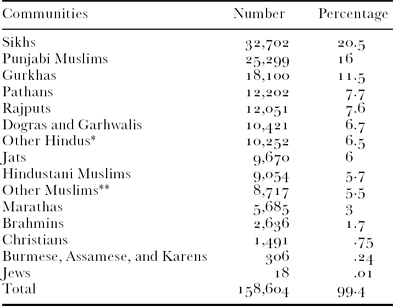
Besides the senior military officers, British politicians also accepted the Martial Race theory. In 1900, Hamilton informed Viceroy Curzon that the fighting power of the Marathas had degenerated.Footnote 83 In 1913, W. Meyer, a civil bureaucrat, warned that the recruiting ground of the Indian Army being very narrow posed a political danger. Lieutenant-General William Birdwood responded: ‘True. The Maratha once best soldiers of India had lost the respect and Pax Britannica had reduced the fighting material of peninsular India. Some Rajputs of Rajputana are available for enlistment’.Footnote 84 The Minority Report noted that Deccan and Bengal were inhabited by ‘unwarlike races’, whereas Punjab was full of ‘warlike races’. The favoured recruiting regions within India were Punjab, Nepal and the North-West Frontier Province.Footnote 85Table 1 shows the effect of the Martial Race theory on the social composition of the Indian Army. The so called non-martial races comprised less than 17 per cent of the Indian Army.
Social composition of the Indian Army in 1912

* Ahirs, Gujars, Mers, Mians, Bhils, Pariahs and Tamils.
** Muslims recruited from the cities of north India for the artillery branch.
Source: Proceedings of the Army in India Committee, 1912 (Simla: Government Central Branch Press, 1913), vol. 1-A, Minority Report, p. 156.
Administrative reorganization and expansion of the Indian Army during the First World War
Roberts asserted that the martial races loved fighting and the excitement of war.Footnote 86 Ellinwood argues that the sepoys and sowars joined the Indian Army to acquire social prestige and to make monetary gains.Footnote 87 At least two members of the Army Committee of 1912 (Meyer and Adjutant-General Aylmer) accepted that the sepoys and the sowars were basically mercenaries.Footnote 88 Even those military officers who were the most ardent proponents of the Martial Race theory accepted the importance of tangible incentives in attracting recruits to the military ranks. In 1927, C. G. Bruce noted: ‘As a Gurkha, living in India, once said to me, “The whole question is this. . .the rupee will always win”. . . . There was a distinct analogy between the Switzerland of the Middle Ages and Nepal. The Swiss were poor and made fine soldiers. . . . The Nepalese are the same.’Footnote 89 Actually, large scale migration from central Nepal began from the mid nineteenth century due to land shortages resulting from a rise in the population. The hill dwellers also left their homes to avoid high taxation, forced labour service, and loss of land to the high castes. Also, the high caste officers of the Nepali Army liked to recruit men from their own castes rather than from the Tibeto-Burman groups who flocked to British-India.Footnote 90 Philip Mason, a ‘liberal’ bureaucrat who served in the Government of India's military department during the Second World War, noted in his account of the Indian Army that prior to 1919 most of the ‘martial races’ had been recruited from the backward politically insulated regions. The recruits joined military service for izzat (honour), abstract loyalty to the King-Emperor, and for the pay.Footnote 91
Initially, there was much enthusiasm for recruitment as the recruits were under the impression that they were enlisted for a short imperial expedition. Furthermore, in late 1914, the rise in the price of wheat and sugar also pushed the sons of small peasantry towards military service.Footnote 92 To an extent, the manpower flow into the army was also partly shaped by non-material factors. A wave of enthusiastic loyalty, writes Algernon Rumbold, spread through the ranks of articulate Indians and this surprised the authorities. This feeling was based on an acceptance of the rightness of Britain's decision to fight in defence of Belgium with the hazy idea that a German victory would harm India. The prospect that Indian soldiers would fight beside the British, generated a sense of pride amongst certain sections of the Indians and they believed that India's contribution in the defence of the British Empire would be rewarded by the sahibs later.Footnote 93
However, the manpower flow somewhat subsided with time. Probably, the news of ‘horrendous’ carnage on the Western Front due to capital-intensive attritional warfare which filtered back to India, was responsible for the flagging enthusiasm of potential recruits.Footnote 94 Generally, Indians joined the army for material gain and upward social mobility. They were accustomed to fighting ‘limited wars/small wars’ along the north-west frontier. In such campaigns, casualties were few. However, from late 1914 onwards, the Indian Army was engaged in Total War. In Flanders field, casualties mounted amongst the Indians and their morale dipped when they encountered the machine-guns and heavy artillery of the Germans in the trench lines amidst frostbite, inadequate clothing and lack of adequate modern weapons. News of the transformation of warfare and the increasing lethality of combat, filtered back to the home front in India and resulted in a sagging enthusiasm amongst potential recruits.Footnote 95
In order to stimulate recruitment, the military authorities initiated several measures for remunerating the recruiters. Furthermore, an attempt was made to make the military service more remunerative by offering tangible incentives in order to attract volunteers to the ranks. On 2 November 1914, a grant of Rs. 3 was initiated for a military personnel bringing a candidate who was selected in a combatant branch. On 26 April 1915, promotion to the rank of jemadar was initiated for a junior non-commissioned officer who was able to bring in 114 recruits. Promotions to the slots of havildars and naiks were also initiated for those serving soldiers who were able to find 20 recruits each. The short service scheme in place of long term volunteer military service was introduced under the pressure of war. In October 1916, the general rule was that men should be engaged for the duration of war.Footnote 96 The last measure was initiated to tap farmhands who were unwilling to serve in the army throughout life but who might enter military service to tide over unfavourable seasons.
In August 1916, the quarter-master general was faced with a serious shortage of transport personnel. With the aid of the Punjab Government large bonuses were offered: Rs. 50 for muleteers and Rs. 75 for camel drivers. Due to these large bonuses many Punjabi Muslims, rather than join the combatant branch, joined as transport drivers.Footnote 97 This happened despite Wikeley's assertion in 1915 that the Punjabi Muslims regarded employment in the non-combatant branches of the army as beneath their dignity.Footnote 98
In January 1917, the War Office decided that the Indian infantry units serving overseas should be raised to the size of the British war establishment. This measure involved the recruitment of an additional 36,754 men. It was suggested that by the spring of 1918, India should be able to deploy another 100,000 soldiers. On 22 January 1917, the scheme of issuing free rations was started for all the recruits and serving soldiers. In May 1917, the new demands necessitated recruitment of 23,000 combatants per month for the next 8 months. In May 1917, it was decided that 20,000 gunners and drivers were required for service in Egypt alone. In response, a bonus of Rs. 50 was given to all recruits. In 1917, in an attempt to raise the volume of recruitment, the following concessions were offered to the recruiters: (i) any interference in the domestic affairs of the soldiers whilst absent on overseas service became a cognizable offence; (ii) immediate allotment of a part of the land earmarked for military service; (iii) removal of the ban placed on the enlistment of returned emigrants. From 22 October 1917 onwards, free clothing was issued to new recruits.Footnote 99
On 1 January 1918, a consolidated allowance of Rs. 2 per recruit was given to meet the cost of rail fares and a subsistence allowance. In April 1918, to stimulate recruitment, the following measures were taken: (i) to extend the age limit of the combatant recruits from 18 to 30; (ii) to reduce the height standard for the infantry recruits from 5 feet 6 inches to 5 feet 2 inches; (iii) to recommend a decoration for good service to Indians. On 13 August 1918, it was decided that the recruits on completing the training course would be granted a gratuity of Rs. 15 and a bonus of Rs. 10. If they were certified fit by the medical officer, they also received another Rs. 40 before they were sent overseas. Furthermore, on completion of 6 months’ service, a war bonus at the following rates was issued: resaldar/subadar = Rs. 60; resaidar, jemadar = Rs. 30; non-commissioned officers, sepoys and sowars = Rs. 20 each.Footnote 100 When war broke out, in order to induce the peasantry to join the army, the Lieutenant-Governor of Punjab, Michael O'Dwyer placed at the disposal of the army 180,000 acres of canal irrigated land for allotment to the Viceroy's Commissioned Officers and men who had served with distinction in the field.Footnote 101 About 15,000 acres of irrigated canal lands were granted to those who aided in recruitment.Footnote 102 Overall, the Punjabis gained a lot due to the welfare policies pursued by the Raj in its attempt to mobilize military manpower. From a micro perspective the example of the Gurgaon District is taken. Between 1915 and 1917 remittance and pension exceeded the land revenue (average Rs. 16 lakhs per year) by about Rs. 75,000.Footnote 103
In addition, the Government of India restructured the recruitment machinery. Centralization was considered necessary. So, in October 1916, recruitment in all branches was vested in the adjutant-general. Prior to that date, recruiting parties had been sent out by the regiments themselves to enlist recruits in their own areas. One of the linked units was stationed in the regimental centre in order to train the reservists and collect the recruits acquired by the recruiting officers.Footnote 104 Some examples include: the 28th Light Cavalry enlisted Jats from Hoshiarpur and the Nowshera tehsil (sub-division) of Jalandhar in Punjab; the 20th Infantry recruited the Dogra Rajputs and the Brahmins of the Simla Hill States; the 69th Punjabis inducted Brahmins who were zamindars from Rawalpindi Civil Division and Poonch State; the 12th and 48th Pioneers took Jats from Cis-Sutlej, Punjab; and the 1st Battalion of 155th Pioneers recruited Rajput Muslims, Kaimkhanis and Khanazads.Footnote 105 The British believed that Rajput Muslims were those Rajputs who had accepted Islam during the medieval era—one such group being the Rangars from Haryana and eastern Punjab .Footnote 106
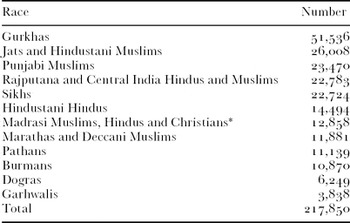
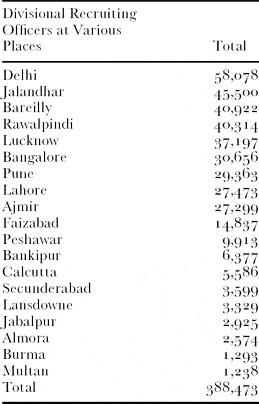
Early in 1917, it was found that the system of class recruiting officers was ill-suited to the increasing demands of manpower generated by the war. Under the class recruiting system, there were recruiting officers for each ‘martial class/race’. For instance there was a class recruiting officer for the Punjabi Muslims and another class recruiting officer for the Sikhs. This system made the army units localized and the tapping of new classes difficult. Furthermore, several classes were found in the same area causing overlapping. It was therefore decided to abandon the class system and conduct recruitment on a territorial basis. The territorial recruiting scheme came into existence in December 1917. Under the new system, a recruiting officer was made responsible for recruitment of all the groups in a particular region corresponding to a civil division. This streamlined cooperation with the civilian authorities. Each recruiting division was divided into circles. Each circle was in charge of an assistant recruiting officer and in each district which was considered to possess martial race(s), one or more district assistant recruiting officers were posted. These officers were civilians who were nominated by local government. They constituted a direct link between the local civil government and the military recruitment staff. This system was first introduced in Punjab and then extended to the other provinces but not introduced in Assam and Baluchistan, which were considered to be regions inhabited by non-martial races.Footnote 107 The fact that the territorial recruiting scheme was more advantageous than recruitment by the class recruiting officers is clear, if we compare Table 2 and Table 3.
Recruitment by the Class Recruiting Officers from August 1914 up to the introduction of the Territorial Recruiting Scheme in December 1917

Notes: *Communities considered non-martial but recruited under the pressure of war.
Source: Recruiting in India before and during the War of 1914–1918, p. 64, L/MIL/17/5/2152, India Office Records, British Library, London.
Recruitment by the Divisional Recruiting Officers under the Territorial Recruitment Scheme up to 30 November 1918

Source: Recruiting in India before and during the War of 1914–1918, p. 64, L/MIL/17/5/2152, India Office Records, British Library, London.
Tan Tai-Yong notes that the demands of military manpower mobilization resulted in greater cooperation between the civilian infrastructure and the army, resulting in the genesis of a militarized bureaucracy in Punjab.Footnote 108 This observation is partially true for some of the other provinces as well. On 11 June 1917, the Government of India formed a central recruiting board which advised on recruitment and served as a link between Army Headquarters and local governments. Its president was the Finance Member Sir William Meyer. Two other members of the viceroy's council (the adjutant-general and the secretary of the Army Department), two Indian princes and Michael O'Dwyer, were the other members comprising the central recruiting board. The objective was to tap the untapped regions and to avoid competition with industrial requirements. In August 1917, local governments were asked to form provincial recruiting boards. By August 1917, every province had a provincial recruiting board run by the divisional recruiting officers of that area. In Punjab and North-West Frontier Province, all the divisions were under the charge of army officers who worked in close cooperation with the provincial recruiting boards of which they were members. The lieutenant-governor was the president of the provincial recruiting board in Punjab. In other provinces, the civil administration took a more active role. In Bombay, Central Provinces, Bihar and Orissa, the duties of the divisional recruiting officers were performed by members of the Indian Civil Service who held commissions in the Indian Army as reserve officers. In the Central Provinces, the divisional recruiting officer was secretary to the provincial war board. In the United Provinces, two out of three divisional recruiting officers were members of the local civil administration whereas the third was an army officer. Especially in Punjab, the local gentry were inducted to the civilian bureaucracy and, in return, they utilized clan and kinship networks to mobilize recruits for the Raj. The civilian recruiters were able to induct larger number of recruits during the later part of the war. For instance, in August 1918, whilst the military officers acquired 6,216 recruits from Punjab, the corresponding figure for recruitment by the civilian recruiters was 10,622.Footnote 109 During the course of the First World War, 10 recruiting centres were opened in Nepal. Under the direction of the Premier Chandra Shamsher, the Nepalese civil and military officials liaised with village headmen in order to ensure smooth flow of Gurkha recruits to the Indian Army.Footnote 110
However, by early 1918, as military manpower demand increased, the British officials realized that they could not extract more manpower from the ‘martial races’ merely by voluntary enlistment and by increasing the material attractions of military service. There was some talk by a minority section amongst British officials for imposing a limited military conscription in the ‘martial’ province of Punjab. One such official was Michael O'Dwyer who, on 4 May 1918, delivered a speech at the University Hall, Lahore, in which he asserted:
No one, of course, dreams of conscripting the whole of India's manhood for the half million combatants required. . . . But, splendid as has been the volunteer response of the Punjab hitherto, we must face the fact that the strain has been severe, that the burden has not been evenly distributed, and that the tribes and localities which have done their duty are not a little resentful against those who have not. The landowning classes feel that they are paying the main burden of the war both in purse and in person and that there are other classes who pay little or nothing in either form. Inequality of burdens as between classes is always a legitimate grievance. . . . I believe that in the Punjab at any rate there is now a strong feeling in favour of some form of conscription to raise the necessary quotas both within the province and as between the various provinces. . . .Footnote 111
For political reasons, the Government of India never resorted even to limited conscription not to speak of wholesale conscription, as occurred in Europe. Rather, the army and the Government of India, as the next section shows, pursued different schemes to tackle the ever increasing demand for military manpower.
Widening the paradigm of recruitment
Faced with the rising demands for manpower, the Government of India tried to include some of the tribes and clans which were hitherto considered non-martial within the ambit of the martial races. This was done especially in the regions from which traditional ‘martial races’ were recruited. Two such regions were Nepal and Punjab. Nepal is a narrow tract of country extending about 520 miles along the southern slopes of the central portion of the Himalayas. Nepal is bound by Tibet in the north, Sikkim in the east, by Bihar and the United Provinces in the south and in the west by Kumaun and the Maha Kali River. The total area of Nepal was 54,000 square miles, with a total population of 5.5 millions.Footnote 112 The total number of combatants recruited from Nepal during the First World War numbered 58,904.Footnote 113 British officials considered that tribes such as the Dotis who lived in the western division of Nepal, were not martial.Footnote 114 Before the outbreak of the First World War, there were 10 Gurkha regiments, each with two battalions. Of these 20 battalions, 16 were enlisted from central Nepal (14 consisting of Magars and Gurungs, two of Thakurs and Chetris), and four battalions were from eastern Nepal consisting of recruits from the Limbus and Rais tribes.Footnote 115 In 1913, Aylmer argued that to increase the volume of Gurkha recruitment, Limbus and Rais who had settled in Sikkim should be enlisted and that the military police should not be allowed to recruit from these particular communities in that region. Furthermore, Aylmer asserted that during an emergency, a large number of recruits should be enlisted from eastern Nepal.Footnote 116 During the First World War, due to the demand for military manpower, besides the Magars, Gurungs, Chetris, Limbus and Rais, other tribes from Nepal such as the Khas, Sunwars, and Lohars, were also recruited in large numbers to the 10 Gurkha regiments.Footnote 117
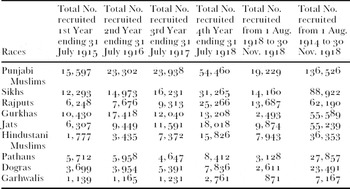
Punjab, being the recruiting ground for Sikh and the Punjabi Muslims, comprised 9.7 per cent of the total recruiting area of British-India.Footnote 118 In 1911, male Sikhs numbered 1,651,595.Footnote 119 In 1885, only Jat Sikhs were recruited. At that time, Sikhs in the Indian Army amounted 17,774 men. But, with the doubling in number of Sikh recruitments by the first decade of the twentieth century, all types of Sikh were enlisted. Furthermore, one British officer warned that Sikhs were becoming ‘swollen head’ [big-headed or arrogant] and that the number of Jat Sikhs should be reduced.Footnote 120 To the contrary, however, with the outbreak of war, the number of Jat Sikhs in the army went up. Nevertheless, as Table 4 makes clear, the army took care to recruit more Punjabi Muslims than Sikhs.Footnote 121 Before the First World War, Punjab provided half the combatant personnel of the Indian Army, including 33,000 Sikhs.Footnote 122 From 1 August 1914 to 30 November 1918, Punjab provided 349,688 combatants, thus representing 42 per cent of the combatants recruited during the whole war.Footnote 123
Recruitment of the Martial Races during the First World War

Source: India's Contribution to the Great War (Calcutta: Superintendent of Government Printing, 1923), p. 276.
About one million Pathans lived in west Punjab and another one million in the region between Indus and Afghanistan. The tract between Indus and Afghanistan was known as the North-West Frontier Province. British officers believed that the Indus tribes such as the Afridis, Waziris, and Swatis were hostile towards the British. Furthermore, the frontier tribes venerated the Amir of Afghanistan.Footnote 124 Moreover, the declaration of jihad by the Ottoman Sultan on 14 November 1914 made the Government of India anxious about vastly expanding the recruitment of frontier Pathans, especially for fighting against the Turks in Mesopotamia.Footnote 125 Since the frontier tribes were considered of doubtful loyalty, a large increase in their recruitment was not considered to be a safe option. Again, the Afridis, Khattaks and the Bangash were not willing to serve away from their homeland.Footnote 126
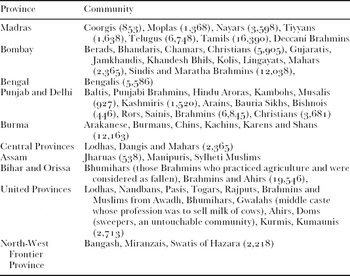
In August 1917, faced with the rising demand for military manpower and the apparent exhaustion of traditional recruiting regions, the provinces without any ‘martial’ traditions were ordered to recruit combatants. From July 1917 to March 1918, the number of combatants recruited was 200,871 compared with 84,384 combatants for corresponding periods in previous years. The German offensive at the end of March 1918 and the British Prime Minister Lloyd George's message for more manpower from India, partly altered the scenario. On 16 April 1918, it was decided to raise 500,000 combatants. The objective was to raise 41,700 combatants per month, but in 1918, it was possible to raise only 30,000 combatants monthly. From June 1917 to November 1918, 526,918 combatants were recruited. On 23 April 1918, at the meeting of the Central Recruiting Board, the adjutant-general asserted that the minimum monthly quota was 41,700. Of this monthly quota, 29,964 men were needed to replace wastage and the rest for the raising and upkeep of new units. The adjutant-general further ordered that no more could be asked of Punjab, North-West Frontier Province, Nepal and Rajasthan and that the new provinces must be tapped.Footnote 127 In mid 1918, it was decided to raise 500,000 combatants between June 1918 and May 1919. The quota for June 1918 was 41,000 combatants, but only 28,000 were enlisted,Footnote 128 and the number of recruits raised between June 1918 and Armistice Day on 11 November 1918 was only 211,000. This period witnessed an expansion of recruitment of new groups from the United Provinces.Footnote 129 From the beginning of the First World War to January 1917, only 35,000 combatants came from the United Provinces. However, recruitment in this province intensified after mid 1917. During the latter half of 1917, 28,000 combatants were enrolled from the United Provinces, and in 1918, 56,000 combatants were recruited from this province.Footnote 130 As recruitment spread into the hitherto untapped areas, communities who were previously considered non-martial were also recruited. Despite Elgin's assertion that the Maratha/Deccani Brahmins and Bhumihars (‘fallen Brahmins because they practiced agriculture’), were unmartial, some of them, as evident from Table 5, were also enlisted.
Recruitment of new communities during the First World War

Source: Recruiting in India before and during the War of 1914–1918, pp. 65, 75, L/MIL/17/5/2152, India Office Records, British Library, London; India's Contribution to the Great War (Calcutta: Superintendent of Government Printing, 1923), p. 276.
In response to the increasing demand for military manpower was an increasing focus on recruitment from the princely states where about 20 per cent of the subcontinent's population lived.Footnote 131 In fact, recruitment was quite intense in selected princely states which were supposed to be inhabited by the ‘martial races’. Some examples include: the Patiala State in Punjab comprising 5,951 square miles which sent 35,000 recruits, or about 15 per cent of its population who were eligible for military service; the princely state of Nabha sent 5,600 persons constituting 16 per cent of its eligible population; the princely state of Maler Kotla comprising 167 square miles with a population of 71,144, sent 3,934 men representing 31.7 per cent of those eligible for military service, and the Loharu State with an area of 222 square miles and a population of 18,597 (3,060 of whom were of military age), sent 281 recruits.Footnote 132 About 88,958 recruits were also enlisted from other princely states outside Punjab, such as Mysore, Baroda, and Kashmir. In total, all the princely states, except Nepal, provided 115,891 recruits.Footnote 133
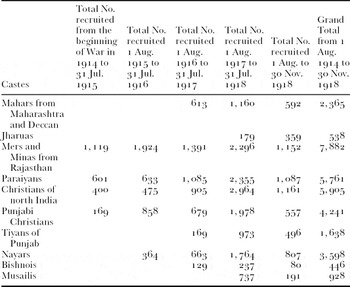
Stephen P. Cohen claims that high intensity warfare demanded a greater quantum of military manpower which allowed the lower castes to serve in the army—something generally denied them in peacetime.Footnote 134 This proved to be partly true during the First World War, as the next few examples show. According to the 1911 Census Report there were 40,000 Rors who claimed a Rajput origin and their chief occupation was agriculture. They inhabited Rohtak, Delhi and Karnal districts and the Jhind State.Footnote 135 They were never recruited to the army before 1914. But due to the demands of war, some Rors, as Table 5 shows, were inducted in to the army. The Mahars (an untouchable group) from Maharashtra, who served in the pre-1857 Bombay Army, were denied entry by the Martial Race theorists from the 1880s.Footnote 136 As Table 5 and Table 6 show, they were recruited in small numbers from the latter part of the First World War. Overall, Table 6 shows that the induction of the low castes remained limited, bearing in mind that there were 60 million people categorized as low castes, including the ‘untouchables’.Footnote 137
Recruitment of Low Castes and Eurasians during the First World War

Source: Recruiting in India before and during the War of 1914–1918, p. 65, L/MIL/17/5/2152, India Office Records, British Library, London.
Net Assessment
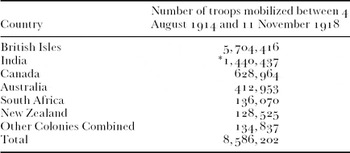
The spokesmen of the Martial Race theory believed, even after the First World War, that from India's 300 million, only around 25,000,000 were warlike. The warlike inhabitants were concentrated in the cooler regions, where even amongst them, the martial quality varied.Footnote 138 On 21 July 1943, when the Raj was fighting another Total War, Lieutenant-General G. N. Molesworth noted: ‘During the Great War, by various methods amounting ultimately to desperation, we managed [to] get about 850,000 good fighting men over 4 years. We did not spread our net very much wider than the “martial classes”, but we drained those to the last drop’.Footnote 139 The actual total number of combatants provided by India during the First World War amounted to 985,000 (including 757,747 privates/jawans), and of them, 579,252 were sent overseas.Footnote 140 During the Great War, France raised 200,000 men from West Africa and 550,000 from its empire as a whole. Canada, Australia, New Zealand and South Africa provided the British Empire with 1.2 million men. As is evident from Table 7, despite the fact that the number of recruits raised from India was greater compared with Britian's other colonies of limited demographic base, the Military Participation Ratio in India remained quite low due to the fact that its population was 300 million.Footnote 141 On 11 November 1918, the combat strength of the Indian Army numbered 573,484 men.Footnote 142 The size of the army raised by India pales into insignificance compared with the multi-million mass-armies raised by the European powers. The largest number of soldiers was raised by Russia. The figure was 15 million men.Footnote 143 The total strength of the American Army transported to West Europe up to October 1918 was 2,040,000.Footnote 144
Number of troops mobilized by the British Empire during the First World War

* This figure also includes 447,000 non-combatants.
Source: India's Services in the War, 2 vols (1922, reprint, Delhi: Low Price Publications, 1993), vol. 1, p. 43; Statistical Abstract of Information regarding the Armies at Home and Abroad, 1914–1920, p. 764, L/MIL/17/5/2382; Recruiting in India before and during the War of 1914–1918, p. 26, L/MIL/17/5/2152, India Office Records, British Library, London.
Overall, Indian recruits came mostly from the rural sector, in the main, peasants from Punjab, Nepal, United Provinces and some tribes from the North-West Frontier Province. Most of the recruits were illiterate and not politically aware.Footnote 145 The Government of India wanted recruits from the agrarian context who lacked higher aspirations. Punjab and Uttar Pradesh provided 75 per cent of the combatant recruits whilst the ‘non-martial regions’, however, remained under-represented For example, Punjab with a population of 20 millions sent 349,000 recruits during the war, whereas Bengal with a population of 45 millions provided only 5,500 combatants.Footnote 146
Conclusion
Which community from a region will be recruited and in what percentage, to a great extent, was shaped by imperial policies. From the late nineteenth century, the Martial Race theory dominated recruitment to the Indian Army. The Martial Race theory was not a coherent body of ideas. There was much tension between different strands of thought. Nevertheless, a broad consensus existed amongst the doctrinaires of the theory. The Martial Race theory, which was suited to imperial control over the colonies, received a jolt when the colonies along with the metropolitan countries got sucked in to the Great War. During the War, the Indian Army's recruitment system witnessed innovations both in theory and in practice. In the theoretical sphere, many communities which had been classified as non-martial pre-1914 were recruited. Not only was the Martial Race theory inflated by including groups (clans and sub-clans) hitherto considered as non-martial within the umbrella of martial races, but also the Government of India resorted to recruiting (albeit in limited numbers) the non-martial communities. In practice, the class recruiting system gave way to the territorial recruiting system. Due to innovations in the theory and practice of recruitment, the volume of recruitment showed a linear increase from 1914 to 1918, with maximum intensification of recruitment occurring during the period 1917–1918. During the First World War, a conscripted army representing the society did not emerge in British-India. This was due to imperial policies, the inherent social divisions of Indian society, and also because the demands for military manpower remained relatively low when compared with India's demographic resources. If the war had lasted longer, British-India might have been forced to raise a multi-million mass-army. Then probably all the distinctions as regards martial and non-martial races would have been wiped out and the Indian Army might have been transformed into a popular conscript force. However, as the war ended in November 1918, despite the entry of several new communities, the bulk of the Indian Army (as shown in Table 4), still comprised the traditional martial races. And once retrenchment had begun during 1919 the Martial Race theory returned in a much more rigid form. Just after the end of the First World War, the Government of India felt it was imperative to maintain a small army for internal policing and guarding the north-west frontier. The civilian-military elite of British-India fell back to the time-tested policy of maintaining an army comprised mostly of martial races. However, during the Second World War as pressures for mass-army expansion increased, the Government of India had again to experiment with recruiting the non-martial classes, albeit on a larger scale. But, that is another story.