This article is about vowel changes, specifically changes in diphthongs in London English. We will discuss what forces might be at work when an established, purportedly universal or natural phonetic change seems to have been halted and is, in fact, reversing. Reversals of apparently completed changes are reported for mergers; however, mergers are the phonological consequence of phonetic changes, not the process that may have led to this consequence. Prime examples of such processes are vocalic chain shifts (Hock, Reference Hock1986:156–158, 637–639; Labov, Reference Labov1994), which are held to be subject to functional (Meillet, Reference Meillet1967:104–105) and psychoacoustic (Lindblom, Reference Lindblom, Ohala and Jaeger1986) constraints, leading to the maintenance of phonetic distance between phonological units and an apparent striving for phonological symmetry. Labov expanded the chain shift notion by considering vowel systems as wholes, often with subsystems that he labeled “long” and “short,” and, importantly, by making general claims about directionality. From a series of observations, he derived three Principles of Vowel Shifting (1994:115–122), which we give here because of their relevance to our later discussion:
Principle I
In chain shifts, long vowels rise.
Principle II
In chain shifts, short vowels fall.
Principle IIa
In chain shifts, the nuclei of upgliding diphthongs fall.
Principle III
In chain shifts, back vowels move to the front.
(Labov, Reference Labov1994:116)
Labov further identified four frequently occurring patterns, or combinations of changes, governed by the three principles. Two of these patterns will be relevant here: the raising and backing of open vowels and the fronting of back close and mid vowels (Labov's pattern 3); the raising of front short vowels and the lowering of the onsets of fleece and faceFootnote 1 (Labov's pattern 4). These patterns are found in accents undergoing the “Southern Shift,” reportedly taking place in the southern United States, Australia, New Zealand, and in parts of southeast England, including London (Labov, Reference Labov1994:201–208).
Labov stated that his principles are not universal (“no directions of vowel shifting are forbidden to speakers of human language” [1994:116]), but rather they are directions that are taken much more often than not. The reason why they are not universal, by which we mean exceptionless, is that the application of a principle is subject to both linguistic and social constraints that apply probabilistically. He expressed this as follows:
If we had enough data, we would expect to find that Principles I–III govern the outcome with frequencies varying from moderately high to close to 1.00, and we would be able to isolate those features of the contextual situation that are responsible for the principle's applying with a given probability. (Labov, Reference Labov1994:137)
Social constraints (the “contextual situation”) not only have the potential to inhibit, but even to reverse an ongoing shift. Labov mentioned three cases where social factors appear to lead to a reversal, and these seem to be driven by relatively conscious “social pressures” (1994:140). Labov's account, however, lacks detail. The clearest example he mentioned is a reversal of the Parisian chain shift (Lennig, Reference Lennig1978, Reference Lennig and Thibault1979), where a merger of the oral vowels /a/ and /ɑ/ leads to a reversal of raising (/ɔ/ moves down to the space vacated by /ɑ/, violating Principle I) and a reversal of fronting (the fronted allophones of /o/ and /ɔ/ move back, violating Principle III). This occurs at the same time as the Parisian nasal vowels continue to move in an counterclockwise direction, following Labov's principles, in a change from below (Hansen, Reference Hansen2001). The “correction” of the Parisian shift is overt and such forces have also been found to influence vowel shifts in Philadelphia and New York, but Labov pointed out that “they do not affect the innovative forces and the new and vigorous changes that operate below the level of social consciousness” (1994:140). Are there, then, covert effects on vowel shifts? In Figure 18.5 in the Atlas of North American English (Labov, Ash, & Boberg, Reference Labov, Ash and Boberg2005), the authors described a reversal in the centralization of face (i.e., changes in F2): the centralization is receding over time, leading to a smaller distance between face and dress in the F2 dimension. They pointed out that this is a reversal of the Southern Shift, but because there is no significant change in F1 (i.e., vowel height), it is problematic to claim that it is a general reversal of the shift.
We have earlier described a short vowel shift in Reading in southeast England that exhibited a series of changes that could not be accounted for by any chain shift model. We proposed that dialect contact leading to regional dialect leveling (supralocalization) was the underlying language-external factor (Torgersen & Kerswill, Reference Torgersen and Kerswill2004). In the present article, we add detail to the understanding of how social forces at a speech community level can reverse a well-established vowel shift.
DIPHTHONG SHIFT—A NATURAL PROCESS?
The set of possibly linked vowel changes we will deal with in this article have been collectively labeled Diphthong Shift (Wells, Reference Wells1982:306–310). It is found in southeast England, including London, and also in Birmingham and elsewhere in the Midlands. The Survey of English Dialects (SED) (Orton & Tilling, Reference Orton and Tilling1970; Orton & Wakelin, Reference Orton and Wakelin1967) shows shifted qualities in an area stretching from the south coast to Derbyshire and Staffordshire in the Midlands. The shifted qualities have been present for a long time: Ellis described diphthong-shifted qualities in his “Eastern” areas stretching from Bedfordshire to Essex (for face, price, mouth, and goat [1889:192–193, 199–200, 209–210]) but also in parts of the “Southern” area in Berkshire. We can find examples of shifted mouth and price in Hampstead Norris (near Newbury, Berkshire) (Ellis, Reference Ellis1889:95–96). Diphthong Shift is also a feature of Australian and New Zealand English (Wells, Reference Wells1982:597–600, 607–608). Labov implicitly discussed Diphthong Shift as a component of Southern Shift: the onsets of what Labov claimed to be the nonperipheral vowels (with onsets located more toward the center of the vowel system) fleece and face move to a lower position, while the peripheral vowels rise (Labov, Reference Labov1994:208–218) (see Torgersen & Kerswill [2004:28–29] for a discussion of the process involving the short vowels). price and mouth are considered peripheral; their onsets move up along the back (price) and front (mouth) peripheral tracks, respectively.
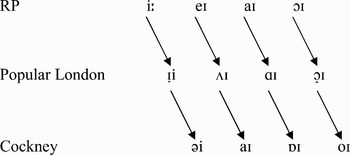
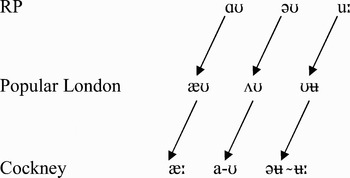
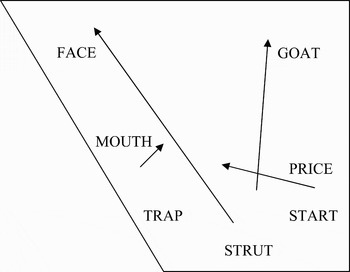
In Diphthong Shift, front closing diphthongs shift counterclockwise. Figure 1 shows the movement with Received Pronunciation (RP) as baseline. According to Wells's (1982) model, fleece, face, price, and choice shift by about one cardinal vowel. Meanwhile, back closing diphthongs shift clockwise. Figure 2 shows the (claimed) movements for mouth, goat, and goose. For example, price shifts from [aɪ] to [ɑɪ] and mouth from [aʊ] to [æʊ]. This leads to the “price-mouth crossover” (Wells, Reference Wells1982:310), whereby price has a back onset and mouth a front onset—unlike RP, which is assumed to be more conservative on this point.
Diphthong Shift in front closing diphthongs Adapted and modified from Wells (Reference Wells1982:308).

Diphthong Shift in back closing diphthongs Adapted and modified from Wells (Reference Wells1982:310).

All this presupposes that RP does actually represent an earlier stage in the realization of the diphthongs. However, this may not give a true picture of the development: we do not know if London English ever passed through this stage. For example, we have evidence from Britain (Reference Britain, Bell, Harlow and Starks2005) that a preshifted quality of mouth as [əʊ] was relatively widespread in rural 19th-century dialects in southeast England and the Midlands, alongside the shifted qualities [æʊ]~[ɛʊ], whereas the open variant [aʊ] was virtually unknown, especially in what are today's diphthong-shifting areas. Consequently, the development of [æʊ]~[ɛʊ] (assuming these are the later forms) was fronting, not raising. Britain (Reference Britain2001, Reference Britain, Bell, Harlow and Starks2005) argued that shifted variants of mouth and price were certainly already present in the speech of the majority of the British settlers in New Zealand, and the development there of diphthong-shifted vowels was not a raising from open to open-mid front realizations (such as [ɛ˕ə˔]), but more a leveling process, in this case dialect contact, where the open-mid front realization won because it was the “dominant, majority and innovative form” (Britain, Reference Britain, Bell, Harlow and Starks2005:171) in the community. However, Britain also pointed out that diphthong-shifted variants of face were probably rare among the immigrants to New Zealand, which led him to argue that much of the lowering of the onset of face “would have taken place on New Zealand soil” (2005:179)—a conclusion that is fully compatible with drift. Whatever their origin, diphthong-shifted vowels are today a feature of almost all New Zealand varieties of English.
If Diphthong Shift is inevitable in the sense of being the consequence of a linguistically motivated principle, it follows that it must be the outcome of a natural process. Such processes have been described in natural phonology, according to which phonological variation arises from variable success in suppressing natural processes: phonological processes always occur unless they are overridden (Stampe, Reference Stampe1979). It may be the case that, unlike in England, social constraints on Diphthong Shift were never sufficiently strong in New Zealand English to prevent its universal spread (or, particularly for shifted mouth, the maintenance of its position), and indeed it has become phonetically even more marked than in England (Trudgill, Reference Trudgill2004).
A claim of universality is certainly implied for Diphthong Shift. However, it may not be the case that a process or feature observed in a large number of vernacular varieties of a language, and therefore regarded as a kind of language-specific universal, occurs in all vernacular varieties of that language. Szmrecsanyi and Kortmann (forthcoming) discuss such features in English (referring to them as Angloversals). They state that some grammatical features, at least, may have a geographically restricted distribution: some vernacular “universals” are found in all varieties of American English, but not in all other Englishes. We therefore need to be skeptical when referring to “language-specific” universals. We turn now to the historical and contemporary evidence for Diphthong Shift in New Zealand and the south of England.
DRIFT AND DIPHTHONG SHIFT IN NEW ZEALAND ENGLISH
Trudgill (Reference Trudgill2004, Trudgill et al., Reference Trudgill, Gordon, Lewis and Maclagan2000) argued that New Zealand English inherited the tendency toward diphthong shifting, not the forms themselves. Among the oldest New Zealanders recorded, born from 1850 to 1869, 68% have at least some diphthong shifting, and these vowels can, presumably, be described as imported from Britain. However, for those born from 1870 to 1889, the figure rises to 81% (Trudgill, Reference Trudgill2004:50), suggesting, Trudgill claimed, a continuation of the process of Diphthong Shift. The shift, in fact, becomes phonetically more marked with the later-born informants, who in addition have a still higher proportion of shifted variants, and shifting also occurs in a larger number of vowels. It is argued that New Zealand English today has diphthongs that are more shifted than varieties of English English (Gordon et al., Reference Gordon, Campbell, Hay, Maclagan, Sudbury and Trudgill2004:241). Measurements of diphthongs in Australian English also show the persistence of the shifted qualities (Cox, Reference Cox1999). Shifting, according to Trudgill (Reference Trudgill2004:50), followed a fixed route, occurring first in mouth, before it moved on to price, goat, face, goose, and fleece. Consequently, a speaker could have shifted variants in mouth and price, but not in face. Another combination, shifted vowels in mouth and face, but not in price, is not found (Gordon et al., Reference Gordon, Campbell, Hay, Maclagan, Sudbury and Trudgill2004:241).
The inherent tendency to change is, according to Trudgill, a feature of what Sapir (Reference Sapir1921) described as “drift.” The term was introduced to show how dialects and languages arise and change. Sapir suggested that differences between dialects are not due to idiolectal variation, but to inherent properties within language: “Language moves down time in a current of its own making. It has a drift” (1921:150). This means that social norms have little impact on the way a language will develop. The idea is that “dialects arise … because two or more groups of individuals have become sufficiently disconnected to drift apart, or independently, instead of together” (Sapir, Reference Sapir1921:150). This reflects what happened in New Zealand and accounts for the gradual divergence of New Zealand and British varieties. However, drift also refers to shared, or parallel changes in geographically separated varieties, and it is this that Trudgill (Reference Trudgill2004) focuses on in his discussion of New Zealand English. According to Sapir, in the formation of dialects, and languages, there are some features that “dialects keep together long after they have grown to be mutually alien forms of speech. But that is not all. The momentum of the more fundamental, the pre-dialectic, drift is often such that languages long disconnected will pass through the same or strikingly similar phases” (Sapir, Reference Sapir1921:172). Sapir mentioned the development of noun plurals with umlaut in English and German as an example of this; even though the forms appear 300 years later in German, there was an inherent tendency in Germanic to develop the forms even though proto-Germanic itself did not have them. In other words, the language had a propensity to change. Trudgill claimed that drift is the force behind the occurrence of similar features in modern day English English and New Zealand English: “we can argue that some similarities between geographically separated varieties of English may, in some cases, be due not to their having derived from similar dialect mixtures, nor to characteristics inherited directly from some parent variety, nor to any diffusion or direct contact between them, but to drift” (Trudgill, Reference Trudgill2004:132). Even if, as Britain (Reference Britain, Bell, Harlow and Starks2005:171) pointed out, Diphthong Shift in New Zealand English is partly a matter of leveling, the continuation of the phonetic processes are still compatible with a drift explanation. Following Trudgill's argument, and if we regard Diphthong Shift as a “natural” process, we should be able to observe similar developments in diphthongs in present-day London English, because London is within an area that traditionally had both central and shifted onsets of diphthongs as well as being, it is often argued, the major center of innovation in British English (Wells, Reference Wells1982:301).
However, we should be careful not to treat drift as one single force in language change: a language can have several drifts not necessarily going in the same direction (Fortescue, Reference Fortescue2006:312). Instead, we should understand drift to mean a “slowly occurring change … bearing on a single, isolated, undisturbed evolutionary strain or streak” (Malkiel, Reference Malkiel1981:566). However, although such a process is “theoretically defensible,” it should nevertheless be regarded as “highly speculative and unrealistic as regards real-life developments of speech communities” (Malkiel, Reference Malkiel1981:566). Malkiel instead proposed the term slant to describe processes such as Diphthong Shift in New Zealand English: “those [resemblances] resulting from common descent of two or more given languages, and traceable to an earlier common stage (recorded or reconstructed)” (Malkiel, Reference Malkiel1981:566) (following the discussion in Britain and Sudbury [Reference Britain, Sudbury, Jones and Esch2002:231], though those authors argued that Diphthong Shift probably did not meet the criteria for being an example of slant). What characterizes this type of change is “its inherent or intrinsic character … slowness … [and] fundamentally unconscious, submerged character” (Malkiel, Reference Malkiel1981:547). Clearly, none of these characteristics, as given by Malkiel, can be classified as resulting from external factors. We argue, instead, that it is external factors, in particular dialect contact and possibly normative forces, that play a stronger role in change than the putative internal factor of drift. Comparing the typologically similar phonetic varieties of New Zealand and London, with their entirely different sociolinguistic histories, enables us to discern what the nature of that role is.
DIPHTHONG SHIFT IN LONDON ENGLISH
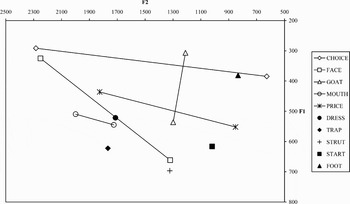
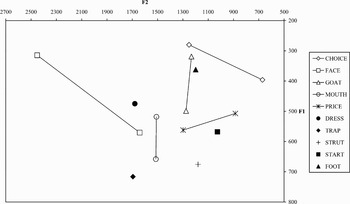
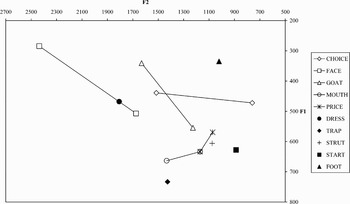
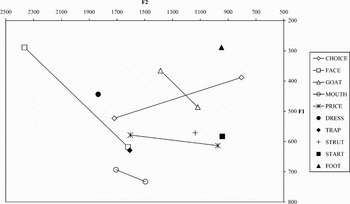
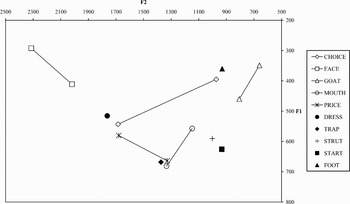
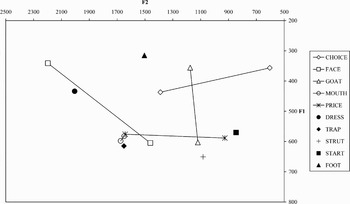
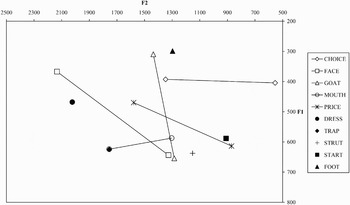
We can observe diphthong-shifted vowels very clearly among elderly speakers in London. Figures 3 and 4 show vowel plots for representative working class speakers from established families in inner London. Because the shift is (traditionally) more dramatic in Cockney than in Popular London English, we should be able to observe fully shifted vowels. Figure 3 shows the diphthongs for a male speaker born in 1938 (average onset and offset values for the diphthongs are normalized; normalized average formant values for the monophthongs dress, trap, strut, start, and foot and the diphthong choice are included for reference; see later discussion for information on the normalization procedure). mouth is fronted and is nearly monophthongal and sits just below dress and above and slightly ahead of trap. price has a back and raised onset and is more back and higher than start. goat has a lowered onset. face has a very open onset, just above strut. foot is close and back, and choice has a raised onset. In sum, this speaker has a fully diphthong-shifted system such as that envisaged by Wells in Figures 1 and 2.
Elderly male speaker from Hackney born 1938.

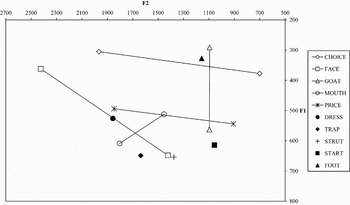
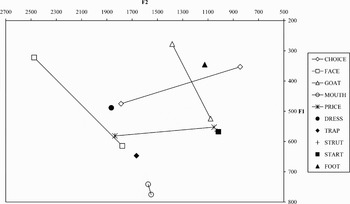
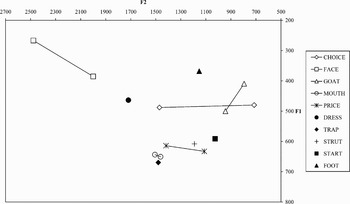
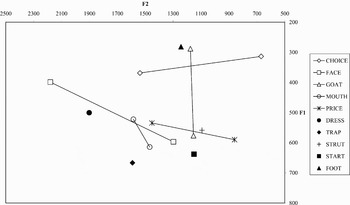
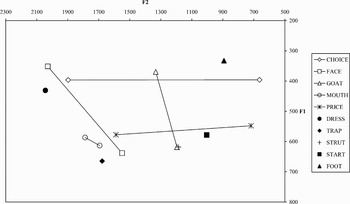
Elderly female speaker from Hackney born 1928.

Figure 4 shows the system for a female speaker born in 1928. Again, average values for dress, trap, strut, start, foot, and choice are included for reference on the vowel plot. As with the male speaker, the female speaker also has a very open onset for face, near strut, and price has a back raised onset, which is above and is more back than start. There is a raised onset for choice. mouth is front with a short offglide and is placed above and in front of trap, but lower in relation to dress compared with the male speaker in Figure 3. goat has a central onset and is just behind foot. Again there is Diphthong Shift, but to a slightly lesser degree than for the male speaker. The relationships between mouth/trap and price/start for both the male and the female speakers are similar to the ones on the plots for Londoners Marie Colville and John Gale, who were recorded in the 1960s (Labov, Reference Labov1994). Marie Colville has mouth realized with a fronted nucleus that we can represent as [eü], above and in front of trap and higher than the nucleus of face (as our speaker on Figure 3). price is in the region of [ɔɪ] and is fully backed and raised with its nucleus higher than goat (Labov, Reference Labov1994:169–170). John Gale (Labov, Reference Labov1994:209–210) shows similar vowel movements, but even more extreme lowering of fleece and face, following Labov's shift pattern 4.
We find similar qualities in impressionistic descriptions. Sivertsen studied diphthongs in London's East End (the eastern part of the inner city). mouth could have a long, fully open front unrounded monophthong [aː] (Sivertsen, Reference Sivertsen1960:66), which was found “only among men and boys of a less polished type.” The most common variant is apparently a diphthong in the [ɛ-ǝ-] to [ɛ -ʊ] area. The quality is said to be closer than RP: almost front and slightly closer than open-mid (Sivertsen, Reference Sivertsen1960:67). price has [ɑ-ɪ] with a “truly back initial element” that is generally unrounded and more back than bath (Sivertsen, Reference Sivertsen1960:64). Matthews (Reference Matthews1938:79) described price with a raised onset. Wells (Reference Wells1982:308) stated that the onset may be rounded [ɒ] in “vigorous, ‘dialectal’ Cockney,” and the offset may be reduced. goat is described as [œʊ], which is more front than RP, and also “wider” (Sivertsen, Reference Sivertsen1960:88). The starting point is between front and central and open-mid. Wells (Reference Wells1982:308–309) stated that this is between [æ¨] and [ɐ]. The end point may be rounded or unrounded. face is described as having a much more open initial element than RP, but with considerable variation in both quality and quantity: “make” [mæĭk] (she used [Ĭ] to indicate a nonsyllabic vowel). The most open realizations are considered “rougher,” more characteristically Cockney and vernacular: these are realizations in the area of cardinal [a].
Hurford (Reference Hurford1967) studied the speech of one East End (Bethnal Green) family with members born between 1885 and 1953. mouth (Hurford, Reference Hurford1967:403–405) shows mainly monophthongal realizations among the elderly males (born 1885, 1923, and 1924) in the region of [ɐ˕+]. Diphthongs start around [a˔], very near [æ], and sometimes also slightly more central; they are more frequent among women than men. The end point is usually around [ʊ], [ǝ], or [ɐ]. The young male informant (born 1953) has an end point around [ɛ]. price (Hurford, Reference Hurford1967:456) has a majority of diphthongal realizations, though there are some monophthongs, especially in the word “I.” The elderly speakers have a starting quality around [ɑ], and some realizations may be rounded. The youngest speakers (born 1949 and 1953) have starting points that are slightly more central and less open: [ɑ¨˔]. Some starting points for the young speakers may be even more fronted to around [ɐ˕+] and even [a]—these qualities suggest a “reversal” of Diphthong Shift—if we follow Wells's description of the process, though as Britain (Reference Britain, Bell, Harlow and Starks2005:172–174) pointed out, such open onsets were rare in southeast England 100 years ago, but central schwalike onsets were more widespread, from which the shifted, open-mid back variants could have developed. The end points for price vary from [ǝ] to [ɪ]. goat (Hurford, Reference Hurford1967:462) always has diphthongal realizations starting with [ɐ+], but also [æ¨]. End points are around [ǝ] and [ʊ], but in one female speaker (born 1929) may be fronted to [ʉ] or even [ʏ]. This may be the first time that goat-fronting is reported. face (Hurford, Reference Hurford1967:453–454) nearly always has diphthongal realizations. There is considerable variation in the starting points. All are shifted and are located in an area stretching from [ɛ] to [a] to [ɐ˕], though the end point is usually [ɪ]. There is no systematic variation across age groups.
Beaken (Reference Beaken1971) studied the language of children ages 4–9 in Bow in the East End. The 9-year-olds have a diphthong system broadly similar to that found by Hurford. mouth (Beaken, Reference Beaken1971:230–231) may (more often) be a monophthong [æː] or a diphthong [æǝ], [æɤ¨], or [æʊ]. price (Beaken, Reference Beaken1971:247) has a centralized starting point in an area around [ɐ¨] or [ɐ˕+]. Beaken notes that “glides from fully back seem to be characteristic of vigorous or dialectal types of speech” (1971:247). Diphthongs with these back starting points may be slightly or fully rounded. goat (Beaken, Reference Beaken1971:242–243) is [ɐɤ¨], [ɐɤ-], or [ɐʊ]. Girls may have a fronted, rounded offset: [ɐø¨] or [ɐÿ˕]. These variants were never found among boys. Again, this is an early report of goat-fronting. goat may also be monophthongal in some stressed positions, especially in the words no [nɑː] and know [nɐː]. face (Beaken, Reference Beaken1971:234) is realized as [æ˕ɪ], [äɪ], or [æɪ]. The more open variants are more common than the closer ones. Monophthongs are also found in some stressed positions but these were rare with nursery children. Overall, the nursery children (aged 4) had more variation in their realization of all the diphthongs, but it was not systematic.
Hudson and Holloway (Reference Hudson and Holloway1977) examined goose, face, goat, mouth, and price in their study of variation among schoolchildren ages 14 and 15 from north and west London (the working class and middle class informants came from different parts of London, and the middle class girls were drawn from two different schools, so a direct comparison based only on class is problematic). It must be noted that the authors used recordings of speakers describing events shown in a series of pictures, so the speech is not likely to represent the most casual style. In addition, only 3–4 min of speech were recorded per informant. They found a greater use of shifted variants for mouth, goat, and face among the working class speakers than middle class speakers. The results for price are not quantified, but they report shifted qualities of the [ɑ¨ɪ] type and also a monophthongal realization [ɑ¨ː]. Working class boys and girls used the most shifted variants for face and mouth. These variants were [ɛ¨˕ɪ] and [ɛ¨˕] for face and [æː] and [æɤ¨] for mouth. Middle class speakers used variants similar to RP realizations. For face, the working class boys used the most shifted variants 92% of the time. Working class girls used the shifted variant [ɛ¨˕ɪ] 38% of the time and the more close, and RP-like, variant [ɛ¨˔ɪ] 39% of the time. Middle class speakers generally used [ɛ¨˔ɪ] and [e˕ɪ]. For mouth, the distribution among working class boys was [æɤ¨] 84% and [æː] 13%. Working class girls used [æɤ¨] (83%) and the more open variant [aː] (13%). Middle class speakers used the RP-like variant [ɑ¨ʊ]: boys used it 79% of the time and girls used it 15% and 33% of the time (depending on which of the two schools they came from). However, the [æɤ¨] variant was the most frequent among middle class girls (62% and 42%, respectively). goat has [ʌɤ¨] (the [ʌ] symbol is used by the authors to describe a front-centralized open vowel in the region of [ɐ˕+]) as the most frequent variant among working class boys (80%), followed by a variant with an even fronter onset, [æ¨ɤ¨] (14%). The working class girls also have [ʌɤ¨] as the most frequent variant (72%), followed by [ǝʊ] (16%). This latter variant is also the most frequent with middle class boys (62%) and the two groups of middle class girls (51% and 46%). Middle class girls use a variant with an extremely fronted onset, [ɛ˔ʊ], 30% and 16% of the time. The authors stated that this variant is “confined to the middle class and historically associated with Advanced RP” (Hudson & Holloway, Reference Hudson and Holloway1977:18).
Tollfree (Reference Tollfree, Foulkes and Docherty1999) found shifted diphthongs among working class informants (her South East London English speakers). She gave [æː]~[ɛː] for mouth, where the first variant may have an [ʊ] offglide. The younger speakers may have more open onsets, [aʊ] or [aɤ]. price typically has [ɑ¸ɪ], but the second element can be centralized or altogether lacking. She found no age differences for this vowel. goat has [ʌʊ], [ʌɤ], and [ɐɤ]. face has [a˔ɪ] or even more open [aɪ], which may be slightly rounded [a¸ɪ]. She also examined the speech of middle class speakers, who had near-RP qualities for all the diphthongs—that is, with hardly any shifting at all.
Labov, Sivertsen, Hurford, Beaken, Hudson and Holloway, and Tollfree all found shifted diphthongs in their studies in London, with the exception of some of Tollfree's younger speakers for mouth and some of Hurford's younger speakers for price. If the process of Diphthong Shift is continuing in London, one would then expect all speakers, especially younger ones, in the diphthong-shifting area to have these or very similar vowel qualities—and indeed to have even more shifted vowels. This turns out not to be the case, as we shall discuss.
Recent developments in diphthongs in south-east England
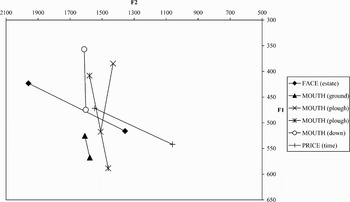
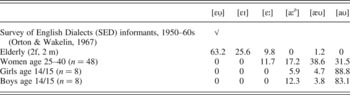
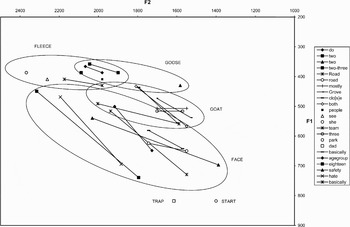
Previous work in Reading and Milton Keynes shows a movement away from the shifted qualities toward RP-like qualities (Kerswill & Williams, Reference Kerswill and Williams2005), similar to the ones Tollfree (Reference Tollfree, Foulkes and Docherty1999) noted for her middle class South East London Regional Standard speakers. This process goes against the notion of drift: if there is a propensity to develop shifted vowels, one does not expect nonshifted variants to appear in young speakers. For mouth, there is a replacement of both rural and urban local forms by an RP-like [aʊ]. The development is shown in Tables 1 and 2. The change in urban areas is from a fronted [ɛʊ] to an RP-like quality. The change in rural areas is from a raised, central [ɛ¨˔ʊ+], again to the RP-like quality. Figure 5 shows acoustic measurements of mouth vowels in the SED recording of Swallowfield, just south of Reading. Two of four onsets are centralized, and two of them are open. This indicates variation in the realization of this vowel, doubtless stylistically determined and indicative of change even in the 1950s.
mouth vowels in Swallowfield (SED).

Percentage use of variants of /au/ (mouth), Milton Keynes working class, interview style

From Kerswill and Williams, Reference Kerswill and Williams2005:1036.
Percentage use of variants of /au/ (mouth), Reading working class, interview style

From Kerswill and Williams, Reference Kerswill and Williams2005:1036.
We can say that the result is a regionally and socially unmarked form. It is not, however, the result of leveling toward the majority variant, because the apparent RP-like target is a minority realization in the southeast. We can speculate that the process is a move away from individual regionally marked forms (both urban and rural) to a socially and regionally more neutral variant—a case of nonlinguistic factors propelling change. This process is apparently a reversal of Diphthong Shift: the shift from [ɛʊ+] to [aʊ] goes in the opposite direction to the clockwise shift discussed by Wells (Reference Wells1982)—always assuming, of course, that [aʊ] was the starting point, which as we have seen is an unlikely scenario.
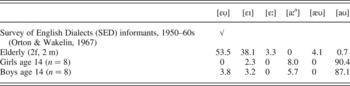
For price, we can observe the replacement of the widely stereotyped [ɔɪ] by a regionally and socially unmarked—and probably more urban—[ɑ+ɪ]~[ɑɪ]. Tables 3 and 4 show the distribution across age and gender groups. We can notice that the change is faster in Milton Keynes than in Reading, probably due to the presence of less close-knit social networks in Milton Keynes than in Reading. If we take Wells's (1982) account at face value, the shift is easy to see as a reversal of Diphthong Shift: the change observed reverses the development that we assume happened in the past. However, we argue, with Britain (Reference Britain, Bell, Harlow and Starks2005), that the trajectory of change might not have encompassed a stage with an open-mid onset. Instead, the change seems to us to have been as follows: [əɪ] → [ɔɪ] → [ɒɪ] → [ɑɪ] → [ɑ+ɪ], with the social motivation provided by an avoidance of local and stereotyped or stereotypable forms, in the same manner as we argue for the introduction of an RP quality for mouth.
Percentage use of variants of /ai/ (price), Milton Keynes working class, interview style

From Kerswill and Williams, Reference Kerswill and Williams2005:1037.
Percentage use of variants of /ai/ (price), Reading working class, interview style

From Kerswill and Williams, Reference Kerswill and Williams2005:1037.
According to Williams and Kerswill (Reference Williams, Kerswill, Foulkes and Docherty1999), Milton Keynes shows stability in face—working class speakers have a broad diphthong close to [æ-ɪ] or [ɐɪ], whereas middle class speakers are likely to use [e˕ɪ] (the RP variant). Acoustic measurements of data from Reading show a similar or slightly lesser degree Diphthong Shift for face compared with Milton Keynes (see Figure 7).
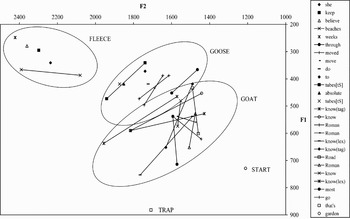
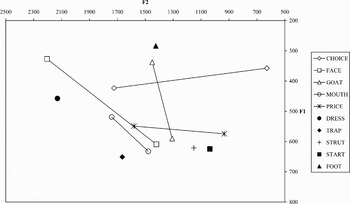
Another development is the fronting of the offset of goat (Kerswill & Williams, Reference Kerswill and Williams2005). Unlike changes in mouth, price, and face, this is not a matter of dialect leveling or neutralization, but the shared adoption of a new variant. Figure 6 shows the start and end points of several tokens in the speech of a representative elderly man in Reading. He has a lowered onset, typical of the shifted goat vowel. The offset is not fronted. The boy shown in Figure 7 illustrates the fronting: there is little change in the onset but the offset is clearly fronted. goat-fronting, not really a part of Diphthong Shift, has been present in London for a while, as observed by Hurford (Reference Hurford1967) and Beaken (Reference Beaken1971).
Male born 1915, Reading (recorded 1996).

Male born 1981, Reading (recorded 1996).

DIPHTHONGS IN LONDON TODAY
Given recent interest in the processes of dialect supralocalization and innovation in British dialectology (e.g., papers in Foulkes & Docherty, Reference Foulkes and Docherty1999; Milroy, Reference Milroy2002; Kerswill, Reference Kerswill, Britain and Cheshire2003) and Wells's (1982:301) assertion that London is the source of innovation in British English, it is of the utmost relevance to discover the relationship between the changes discussed earlier and the present-day speech of young people in the capital. The questions are: (a) Are the older changes in London still ongoing there, that is, have they in some sense progressed further? (b) Is there evidence that features that appear to have started in London have actually diffused from there to other places in the southeast, such as Reading and Milton Keynes? (c) Are there changes outside London that are not found in the city itself? Two recent projects enable us to begin to answer these questions.
The first is Fox's (2007) investigation of young speakers of Bangladeshi and white British origin in Tower Hamlets in East London, recorded in 2001. There, she found a similar, more extreme move away from the shifted qualities in price and face (she did not study other vowels). The young speakers as a whole largely used the diphthongs [aɪ] and [ɐɪ] in price, where the offsets might be weakened to [ɛ] or even zero, a monophthongal variant [æ] and also diphthong-shifted qualities such as [ɑɪ]. The elderly speakers had only the traditional shifted qualities [ɑ˔], [ɑɪ], and [ɑː]. In particular, the young speakers of Bangladeshi origin used the unshifted variants. The young white British speakers also had a large proportion of [ɑɪ]. The white British boys, of whom many mixed with the Bangladeshi boys, had a greater proportion of the unshifted variant than the white girls did. There was a similar distribution of the variants of face. The young speakers had [e˔ɪ], [eɪ], and [ɛɪ], sometimes with monophthongal qualities. Here, the speakers of Bangladeshi origin had a greater proportion of the most unshifted variants. Again, it was the white British boys who had more of the nonshifted variants than the white girls did. The elderly speakers had the shifted qualities [æɪ] and [aɪ]. Among the young speakers, it was the speakers aged 15 and younger who had the most unshifted qualities. The most frequent variant among all young speakers was the RP-like [ɛɪ], which was interpreted as leveling or accommodation between speakers of different ethnicities. According to Fox (Reference Fox2007:276), the innovative unshifted qualities for both price and face possibly have their origin in contact with both Bengali Sylheti (which does not have diphthongs) and L2 English, as well as the London Bangladeshis' relative isolation from other ethnic groups. What is clear is that the unshifting of price and face is led by the Bangladeshi speakers and, among white young people, boys.
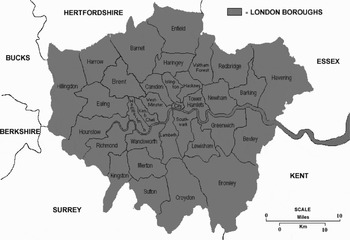
The remainder of this article will focus on the second project,Footnote 2 which is part of an ongoing program of research on linguistic change in London funded by the Economic and Social Research Council.Footnote 3 Our data are collected from two boroughs: Hackney (inner London) and Havering (outer London) in 2004 and 2005. The localities were selected on the basis of demographic and social differences: Hackney is ethnically very diverse and economically relatively deprived, and Havering is an area with higher mobility and higher levels of prosperity. Hackney is in the traditional East End. Havering is on the eastern edge of London, formerly a part of Essex, but now administratively a London borough. The localities are shown in Figure 8.
Map of London (from www.cityoflondon.gov.uk/Corporation/maps/london_map.htm).

Speakers
Two age groups were sampled. The older informants are in their 70s and 80s and come from local families. There are four women and four men in each group. The young informants are 16–19 (the majority were 17) years old and were recruited at local colleges. In Hackney, half of our young informants have a “white London” background; that is, their families have relatively local roots (Anglo). The other half are the children or grandchildren of immigrants, almost all from developing countries (non-Anglo). The young speakers in Havering are Anglo, with a few exceptions; this reflects the ethnic distribution in the borough. We also included some speakers who attended college in Havering but who commuted daily from other boroughs. Table 5 shows a breakdown of the speakers. The commuters are listed after the + symbol.
Breakdown of speakers

Measurements
All recordings were made with a Marantz solid state recorder using a 48,000-Hz sampling rate at 16-bit resolution. All sound files were downsampled to 11,025 Hz to allow for acoustic analysis. F1 (first formant) measurements, representing vowel height, and F2 (second formant) measurements, representing vowel front/backness, were taken at two measurement points using the Praat phonetic analysis program. These were steady state areas on the spectrogram as far away as possible from the influence of surrounding segments for both the onset and the offset of the diphthongs. In the remaining diagrams, the measurements are presented as mean values of several observations for each vowel, excluding preceding or following nasal or liquid environments, for individual speakers. All the component vowels of diphthong shift were analyzed. fleece and goose in our data are mainly near-monophthongs—that is, reversed. We found very few tokens with an [əʉ] quality for goose, especially in Hackney. Formant analysis of the nucleus shows a close vowel, without a central onset. The same was found for fleece, though this vowel was not quantified. The total number of tokens analyzed for each speaker ranges from 20 for the most frequent vowels down to 5 for the least frequent vowels, giving a total of about 4500. For each vowel, we will refer to the location of the start and end points of the formant trajectories in relation to other vowels in the speaker's system, and not to specific hertz values. The plots below represent mean F1 and F2 values for the onsets and offsets of the tokens of each diphthong.
Statistical analysis
Raw formant data were normalized using the Lobanov metric (Lobanov, Reference Lobanov1971). The monophthong data for all speakers (Torgersen, Kerswill, & Fox, Reference Torgersen, Kerswill, Fox and Hinskens2006) were included in this calculation. Multivariate ANOVAs were then carried out on the mean F1 and F2 onsets and offsets for each diphthong.
HACKNEY
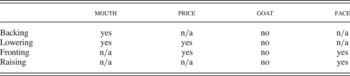
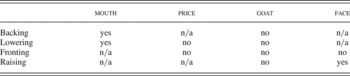
Tables 6 and 7 present summary information on significant effects in Hackney. The statistical testing confirms the Diphthong Shift reversal found in London by Fox (Reference Fox2007) and the findings of Kerswill and Williams (Reference Kerswill and Williams2005) in Reading and Milton Keynes. mouth shows an effect of age (p < 0.001). There is centralization (p < 0.001) and lowering (p < 0.001) of the onset for young speakers. The girls have a more open (p < 0.001) and more back (p < 0.05) onset than the boys, suggesting a female-led change. The non-Anglo speakers have a more back onset than the Anglo speakers (p < 0.05). price shows a significant effect of age (p < 0.001), with fronting (p < 0.001) and lowering (p < 0.001) of the onset for young speakers compared with the elderly speakers. There is also an effect of ethnicity: non-Anglo speakers have a more fronted (p < 0.05) and more open (p < 0.05) onset than the Anglo speakers. All these findings are in line with Fox's findings for Tower Hamlets. For the onset of goat, there is no overall effect of age, but ethnicity is significant. The non-Anglo speakers have a more raised onset compared with the Anglo speakers (p < 0.05), and the Anglo speakers have a more fronted offset than the non-Anglo speakers (p < 0.05). Girls have a more fronted offset than boys do, but the difference is not significant (p = 0.08). face also shows an effect of age (p < 0.001). The young speakers have a less open (p < 0.001) and more front (p < 0.001) onset. Boys have a less open onset than girls do (p < 0.001), suggesting this time a male-led change. The non-Anglo speakers have a less open (p < 0.001) and more front (p < 0.005) onset than the Anglo speakers do—a finding that, when combined with results for age, indicates it may be non-Anglo boys who are in the lead in the change—a finding consonant with Fox's. Here we also have an effect of friendship network: non-Anglo speakers have a more fronted onset than do Anglo speakers with a largely Anglo friendship network (less than 40% multiethnic friendship network) (p < 0.05), but not Anglo speakers with a largely non-Anglo friendship network (more than 40% multiethnic friendship network)—again, a finding that parallels that for Fox's Anglo boys. In sum, the development is toward nonshifted diphthong qualities in mouth, price, and face.
Significant effects in Hackney—backing, lowering, fronting, and raising refer to main effects of age

Significant effects in Hackney—sex and ethnicity refer to main effects (young speakers only)

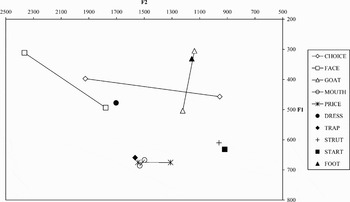
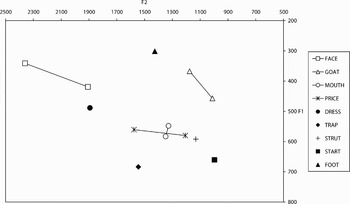
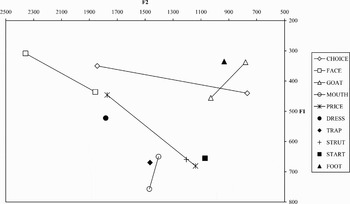
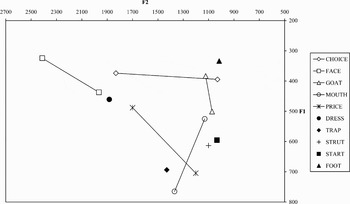
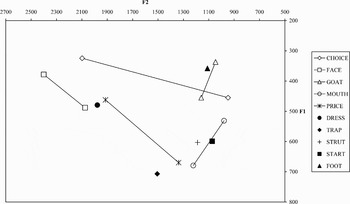
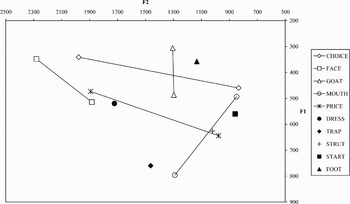
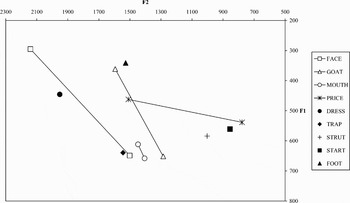
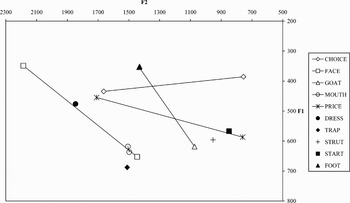
In Figures 9–25, we provide vowel plots for representative speakers (boys and girls, Anglo and non-Anglo). The plots show the diphthong trajectories and also the monophthongs dress, trap, strut, foot, and start. As can be seen in these diagrams, acoustic measurements of monophthongs for young and elderly speakers in London show great stability for start but backing for trap and backing and raising of strut (Figures 3 and 4; Torgersen, Kerswill, & Fox, Reference Torgersen, Kerswill, Fox and Hinskens2006). The formant frequencies shown are the normalized, mean values measured for each speaker. Notice in particular the vowels where Diphthong Shift reversal is most straightforward to see: mouth in relation to dress and trap (lowering and backing), the onset of price in relation to start (lowering), and the onset of goat in relation to strut (raising).
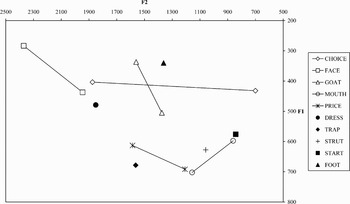
Jack, Anglo, Hackney.

Andrew, Anglo, Hackney.

Mark, mixed race, Hackney.

Gary, Anglo, Hackney.

Dave, Anglo, Hackney.

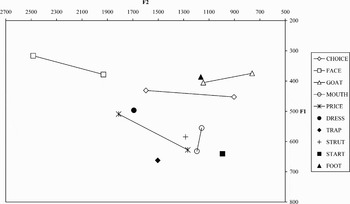
Danielle, Anglo, Hackney.

Claire, Anglo, Hackney.

Laura, Anglo, Hackney.

Brian, Afro-Caribbean, Hackney.

Chris, Afro-Caribbean, Hackney.

Alan, Middle Eastern, Hackney.

Grant, Portuguese, Hackney.

Rashid, Bangladeshi, Hackney.

Nazma, Bangladeshi, Hackney.

Grace, Nigerian, Hackney.

Maria, Moroccan, Hackney.

Serena, Afro-Caribbean, Hackney.

Anglo speakers: Boys
Here we present vowel plots for five speakers. The two boys shown in Figures 9 and 10 have a majority of white friends. Jack (Figure 9) and Andrew (Figure 10) have a diphthong-shifted price, which sits above and behind start, as also seen among the elderly speakers in Hackney presented earlier. However, there is a slight Diphthong Shift reversal, as the onset of face is less open (again compared with the elderly speakers). mouth is moving back (and for Jack also down); however, it is keeping its monophthongal quality and so is not converging with the RP-like [aʊ] of Reading and Milton Keynes. goat is not fronted, as reported in Milton Keynes and elsewhere in the southeast, but the onset is becoming less open.
Figures 11–13 show three mixed race and Anglo speakers who have networks with a high proportion of black friends and an interest in garage, grime, and hip-hop music. These speakers are Mark (mixed race Afro-Caribbean/white British; Figure 11), Gary (Anglo; Figure 12), and Dave (Anglo; Figure 13). We can note Diphthong Shift reversal for all vowels, but the onset of face is more raised (in terms of his vowel system) for Mark than it is for Jack and Andrew. For all three speakers the onset of price is well in front of start, the offset of goat is fronted (the vowel stays nonfronted with Gary), and mouth is backed and lowered. The onset of goat is raised and backed. Notice how strut is more raised in relation to start than for the two boys with a majority of white friends. price is clearly moving away from a position above and behind start to a more central position, either being lowered or raised.
Anglo speakers: Girls
The three Hackney Anglo girls shown in Figures 14–16 have some features in common: the offset of goat is fronted and mouth (the onset has a higher F1 than the offset) is moving down and back (in relation to trap). Laura (Figure 16) has slightly different price and face vowels than the other two girls, possibly reflecting her more multiethnic network. Her price onset is more fronted than Danielle's (Figure 14) or Claire's (Figure 15). Her onset for face is also more raised in relation to trap (Laura's trap vowel is also more backed).
Non-Anglo speakers: Boys
Even though the non-Anglo boys have different backgrounds, there are many similarities between their vowel systems. Compared with the Anglo boys in Hackney, all diphthongs have shorter trajectories. The difference is most marked for face, which has a raised onset. The onset of price is fronted in relation to start, as seen with the Anglo boys with a multiethnic network. mouth (starting point is with higher F1) is lowered and backed in relation to trap. Brian (Figure 17) and Alan (Figure 19) have a monophthongal quality for this vowel, whereas Grant (Figure 20), Chris (Figure 18), and Rashid (Figure 21) have a diphthong in the region of [ɑʊ]—a backer variant than the RP-like pronunciations in the southeast. Four of the boys (Brian, Chris, Alan, and Rashid) have a goat vowel that is almost monophthongal and backed. Grant has a fronted offset for goat.
Non-Anglo speakers: Girls
Nazma (Figure 22.), Grace (Figure 23), Maria (Figure 24), and Serena (Figure 25) share some of the boys' diphthongal features. We can see the raised onset of face, fronting of the onset of price, and the backing of goat. The mouth vowel is diphthongal for all the girls and resembles the [ɑʊ] quality used by two of the non-Anglo boys. Nazma and Grace have a mouth vowel that is more central than those of Maria and Serena.
HAVERING
Tables 8 and 9 show the significant effects found in Havering. As in Hackney, mouth shows an effect of age: the young speakers have a more open (p < 0.05) and more central (p < 0.001) onset than the elderly speakers do. The non-Anglo speakers have a more back (p < 0.05) and more open (p < 0.001) onset than the Anglo speakers do. Unlike in Hackney, the onset of price shows no effects for age, indicating maintenance of the shifted quality. Boys have a more central (p < 0.005) and more open (p < 0.005) onset than girls do. As in Hackney, goat shows no effects for age. The non-Anglo speakers have a more raised (p < 0.005) and more backed (p < 0.001) onset than the Anglo speakers do. The Anglo speakers with a largely non-Anglo friendship network have a more backed onset than do the Anglo speakers with a largely Anglo friendship network (p < 0.05). Girls have a more fronted offset than boys (p < 0.001) overall; this may be related to the fact that the non-Anglo girls have a more fronted offset than the non-Anglo boys. The Anglo speakers have a more fronted offset than the non-Anglo speakers (p < 0.001). For face, the young speakers have a less open onset than the elderly speakers (p < 0.05). The boys have a more raised onset compared with the girls (p < 0.001). The non-Anglo speakers have a more raised (p < 0.001) and more fronted onset (p < 0.001) than the Anglo speakers do. To sum up, we have a movement away from shifted qualities in Havering as well, but the process only involves mouth and face. price and goat are maintaining their shifted qualities, with some variation between ethnic groups and friendship networks. As the non-Anglo speakers in Havering are very similar to the non-Anglo speakers in Hackney, and the Anglo speakers with multiethnic friendship networks in Havering are similar to Anglo speakers in general in Hackney, we will only show vowel plots for Anglo speakers in Havering who display traditional vowel qualities unlike the Hackney speakers.
Significant effects in Havering—backing, lowering, fronting, and raising refer to main effects of age

Significant effects in Havering—sex and ethnicity refer to main effects (young speakers only)

Anglo speakers: Boys
We present vowel plots for four boys with almost exclusively Anglo friendship networks. The boys display Diphthong Shift, which generally resembles that of the Anglo speakers in Hackney with a mainly Anglo network. Ian (Figure 26), Kevin (Figure 27), Lewis (Figure 28), and Derek (Figure 29) all have an open onset for face. The onset for price is back, near the start vowel. mouth is monophthongal, or diphthongal with relatively short trajectories and, unlike in Hackney, front/central and has not moved down in relation to trap. Thus, the Havering speakers are more conservative in the realization of this vowel (i.e., the young speakers in Havering are more like the elderly speakers in Hackney than are the young speakers in Hackney in the production of mouth). The onset of goat is quite open. The offset of goat may be slightly fronted, but not so much as the quality found in Milton Keynes (Kerswill & Williams, Reference Kerswill and Williams2005).
Ian, Anglo, Havering.

Kevin, Anglo, Havering.

Lewis, Anglo, Havering.

Derek, Anglo, Havering.

Anglo speakers: Girls
We present the vowel systems of three girls with a largely Anglo network: Mandy (Figure 30), Michelle (Figure 31), and Kelly (Figure 32). In total, the girls' vowel systems resemble those of the boys in Havering. However, a difference is the fronting of the offset of goat.
Mandy, Anglo, Havering.

Michelle, Anglo, Havering.

Kelly, Anglo, Havering.

Summary
The speakers in Havering have diphthong systems that resemble both the elderly speakers in Hackney and, to a lesser degree, the young speakers in Hackney. We argue that the Havering young speakers have a system that seems to be intermediate between the Hackney young speakers and elderly speakers. There were significant age differences only for mouth and face, suggesting less change overall here than in Hackney. mouth is backing among the young speakers in relation to the elderly speakers, and the onset of face is rising. price is moving to the front, but not so much as in Hackney, indicating a greater degree of Diphthong Shift in Havering. The offset of goat is fronted, as seen in Milton Keynes, but the onset is not as raised as in Hackney. Non-Anglo speakers in Havering use the backed monophthongal variant of goat, but the absence of an overall significant effect of age for raising and backing indicates more Diphthong Shift than in Hackney.
SUMMARY AND DISCUSSION
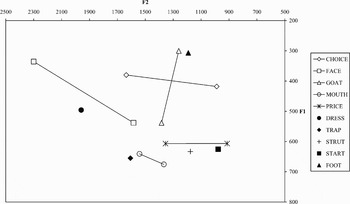
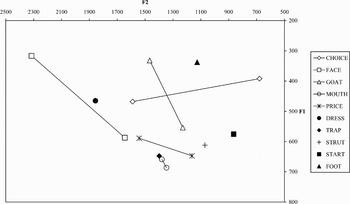
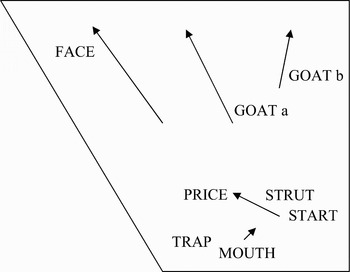
Figure 33 shows the main elements of the traditional diphthong system in London found among our elderly speakers. This is largely the system described by Wells (Reference Wells1982) with diphthong-shifted vowels. If we accept the drift argument in accounting for the developments in the production of diphthongs in New Zealand, we would expect a further, parallel development in the same vowels in London. This turns out not to be the case. In some ways, London is in line with the rest of southeast England where RP-like diphthongs and shared new variants have been found (i.e., a movement away from the shifted diphthongs previously found across much of the area). However, London also appears to have developed new diphthong variants, and indeed new monophthongs, that are different from those found elsewhere in the region. The main developments are as follows.
Traditional London diphthong system with shifted diphthongs.

mouth is backed to a low-centralized near monophthong for all speakers. There is little sign of the leveled southeastern RP-like [aʊ], though the onset is becoming more like the starting point of this variant. Girls in Hackney often have an [ɑʊ] quality for this vowel, demonstrating backing, but not monophthongization. price shows fronting and lowering of the onset among both Hackney and some Havering youth. This is a reversal of Diphthong Shift if we buy into the theory that the back open-mid onset developed from a low mid onset—for which, as we have seen, there is little evidence. It represents a further increase in what we would now interpret as the same move toward a fully open onset in the southeast “periphery” towns of Reading and Milton Keynes revealed by the figures in Tables 3 and 4. price is also often a near monophthong among Hackney young people, especially the non-Anglo speakers. face shows a reversal of Diphthong Shift to a front closing diphthong; this is seen most strongly among the non-Anglos. In this case, we are probably dealing with a genuine reversal. Although the rather open onsets of our elderly London speakers are also found in much of the rural south toward the end of the 19th century (see earlier presentation of Ellis's 1889 data), they were not universal (to judge from data provided in Britain [2005:177–179]) and existed alongside more raised variants, which are assumed to be older. We have already seen how the lowering of face continued in New Zealand to a greater extent than predicted by the input variants. goat has two highly divergent variant pronunciations. The first is the new fronted offset (the “Milton Keynes” variant). This is more common in Havering than Hackney and more often found among girls than boys. The other variant is a back close near monophthong, which is found mainly, but not exclusively, among non-Anglo boys and girls in Hackney. Examination of Euclidean distances reveals that the elderly speakers in both Hackney and Havering are always among those with the longest trajectories from onset to offset in the diphthongs. The non-Anglo speakers are always among the speakers with the shortest trajectories. This shows the difference between elderly and young speakers and between Anglo and non-Anglo speakers: the young speakers are producing diphthongs with shorter trajectories, and the non-Anglo speakers are in the lead in the monophthongization process.
Table 10 summarizes the main processes involved in the diphthongs in inner London.
Summary of the changes in diphthongs in inner London

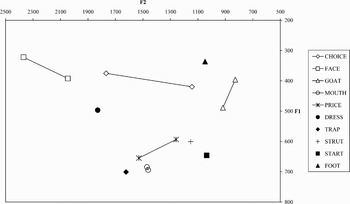
Figure 34 shows the main elements of the emergent diphthong system in London. For all diphthongs (except mouth, which is generally monophthongal anyway), the main processes involve (a) shorter trajectories for face, goat, and price and (b) lowering and centralization of mouth and price. For these processes, we can use the label Diphthong Shift reversal without necessarily accepting the diachronic ramifications of this term. In addition, goat has two different realizations: either the fronted variant (labeled a) or the backed variant (labeled b). Finally, there is a new, back variant of mouth, [ɑʊ], not covered by the two processes given above.
Emergent London diphthong system with unshifted diphthongs and monophthongal qualities.

The monophthongization of price, goat, and face seems to be correlated with four interacting scales. The first of these is ethnicity. The speakers of Afro-Caribbean heritage (Brian and Chris) have the shortest trajectories, which mean that they are in the lead in the reversal of Diphthong Shift. They are followed by speakers of other non-Anglo origins (Rashid and Alan) and then the Anglo speakers. The second scale is the ethnicity of the friendship group: Anglo speakers with a largely multiethnic friendship network (Gary, Dale, and Laura) have more advanced Diphthong Shift reversal than those without such a network (Jack and Andrew) and the speakers from Havering. The third scale is gender. Male non-Anglo speakers from Hackney seem to have more extreme Diphthong Shift reversal than the females. The fourth scale is geographical location in relation to inner London. The Hackney speakers are clearly more advanced in the reversal of Diphthong Shift than those from Havering. The tables displaying data for mouth and price from Reading and Milton Keynes show use of shifted variants around 15% of the time for 14 and 15 year olds, placing these peripheral localities together with Havering. The new, leveled variants ([əʏ] in goat, [aʊ] in mouth, and [ɑ+ɪ] in price) are found more in the southeast periphery and among girls in outer London, apart from mouth, which has a monophthongal quality in both Hackney and Havering. The leveled variants are rare in inner London, and the innovative back [ɑʊ] in mouth may be used by non-Anglo girls in inner London.
The fronted qualities for price, the raising of face, the raising and backing of goat, and the backing and lowering of mouth represent a more radical move away from the earlier diphthong-shifted variants by comparison with Reading and Milton Keynes, which have intermediate qualities. This suggests that Diphthong Shift reversal is more advanced in London than in the southeast periphery.
Developments in London and the southeast, then, run counter to the idea of drift—the diphthongs are getting less, not more shifted. The reason behind this is likely to be dialect contact (with other varieties of English than British), language contact, and contact with L2 Englishes. This leads to innovation and hence divergence in London. The changes found in the periphery (e.g., in Reading and Milton Keynes) but not in inner London, especially goat fronting, are therefore not interpretable as diffusing from inner London—a point we will return to.
Differences in the realization of diphthongs between speakers of different ethnicities have also been found elsewhere. Horvath (Reference Horvath1985) studied the English of immigrants in Sydney in Australia and found that immigrant teenagers of Greek and Italian origin used less broad (i.e., less shifted) Australian English diphthongs than Anglo teenagers. This finding was interpreted as a reversal of a chain shift (Horvath, Reference Horvath1985:94). As a result, the immigrant teenagers seemed to be spearheading change—in this case away from heavily shifted qualities toward more “cultivated,” less shifted qualities. Thus, the teenagers differentiated themselves from their immigrant parents, who had more shifted qualities. This was interpreted as a movement away from low-prestige variants, which were associated with migrants generally and their parents specifically, to achieve native status.
This explanation is not suitable for our London data, where the young non-Anglo speakers use new, near-monophthongal qualities that are remote from local southeastern vernaculars and from varieties close to RP. Our results resemble instead those of Fox (Reference Fox2007) in Tower Hamlets and those in another large city in the U.K. In Khan's (Reference Khan2006) study of price and goat in Birmingham, the older informants used traditional diphthong-shifted variants for price ([ɑɪ] and [ɔɪ]) and goat ([ʌʊ] and [ɐʊ]), whereas young speakers frequently use [a-ɪ] for price and [ǝʊ], [oː], and [ɔʊ] for goat. The use of [a-ɪ] for price is clearly a reversal of Diphthong Shift, as is the increased use of [ǝʊ] in goat among the young male speakers. Differences are observed between speakers of white British, Pakistani, and Caribbean backgrounds. Whereas the white British young speakers favor the non-localized and nonshifted variants for goat, which is interpreted as dialect leveling, Pakistani and Caribbean speakers use the backed and monophthongal variants [ɔʊ] and [oː]. White British teenagers use [ɑɪ] for price, but less than the elderly speakers, and the nonshifted [a-ɪ] and [äɪ]. The Pakistani and Caribbean teenagers use little [ɑɪ], preferring [a-ɪ] and [äɪ]. Khan argues that [oː] is an innovative variant with roots in the Pakistani and Caribbean communities. The changes in Birmingham are seen by Khan as generated within the city, the use of these variants being a marker of ethnic orientation, which is a sensitive variable for the Pakistani and Caribbean speakers but not for the white British.
There are striking parallels with the findings in London: the back variants for goat and fronted onsets for price are typical of non-Anglo speakers in both London and Birmingham. We then get a series of young people's Englishes that are predicted by heritage, ethnicity, and friendship network. We need to investigate the causes of these parallel developments in London and Birmingham (and probably other large cities such as Manchester). These could be parallel developments caused by a similar dialect mixture (phonetically similar diphthongs in London and Birmingham coupled with similar mixes of recent immigrant speech varieties), or else there could be contact between people, particularly of immigrant origin, between cities.
Where do the monophthongal qualities come from? Szmrecsanyi and Kortmann (forthcoming) have carried out a statistical analysis of several grammatical features in different varieties of English. They found that L2 Englishes are less morphosyntactically complex than L1 English vernaculars. English creoles and pidgins are even less complex. Is it therefore the case that L2 Englishes also favor less complex vowel systems? Learner varieties of English may use a monophthong for face if the first language does not have a comparable diphthong (Flege, Schirru, & MacKay, Reference Flege, Schirru and MacKay2003), as do most “outer circle” (Kachru, Reference Kachru1986) varieties for both face and goat, such as West and East African, Indian, and West Indian Englishes (Wells, Reference Wells1982). In parts of inner London, they may have been adopted in the first place because they were in a numerical majority, after which they spread through social networks involving nonminority ethnic people for whom the new variants represent a positive social identity (cf. Le Page & Tabouret-Keller, Reference Le Page and Tabouret-Keller1985). Fox (Reference Fox2007) explained the frequent use of near-monophthongal qualities of price and face among young speakers in Tower Hamlets in this way.
Our data is a demonstration of the influence of nonlinguistic factors on what is normally held to be a “natural” or quasi-universal process or “principle.” As Labov (Reference Labov1994:140) stated, such factors have the power to override linguistic constraints, at least in vowels shifts. In this article, as well as in our previous work (Torgersen & Kerswill, Reference Torgersen and Kerswill2004), we have been able to add a good deal of precision to this claim. Drift is not negated by our work. The contrast between London and the southeast on the one hand and New Zealand on the other in a sense strengthens the claims made for drift. Since the second half of the last century, London and the southeast have been characterized by a great increase both in geographical mobility and by immigration. Mobility across the region has led to dialect leveling (dialect supralocalization, in the words of Milroy, Milroy, & Hartley, Reference Milroy, Milroy and Hartley1994), and immigration to London and (we can speculate) a strong sense of ethnic identity has led not to leveling, but to innovation, led by the second generation of new immigrants. In the wider southeast, leveling tendencies lead to the replacement of diphthong-shifted variants by a series of new forms, characterized by their lack of both regional and social marking. In inner London, diphthong-shifted variants are ousted not so much by these neutral forms as by new, often socially and ethnically marked variants generated from the ethnic mix. For New Zealand, the critical period for Diphthong Shift is not the present time, but the formation of the new variety itself from 1850 onward (Trudgill, Reference Trudgill2004). As we have seen, shifted variants dominated, and (Trudgill argued) the lesser degree of social stigma attached to the shifted variants, at least in the early period and certainly for the first generation of children growing up, gave the Diphthong Shift changes free reign, enabling them to be phonetically accentuated in relation even to the input varieties. None of this is true of the English southeast right now: powerful and extremely varied social forces are at play in reversing the process.
INNOVATION, LEVELING, AND THE METROPOLIS
The inner city–driven phonetic changes we have described are far-reaching and rapid and are to a more limited extent paralleled by morphosyntactic changes (Cheshire & Fox, Reference Cheshire and Fox2007). We now ask the question of how these fit into the overall patterns of change in Great Britain. The current debate concerns the definitions and relative importance of (dialect) leveling, supralocalization, diffusion, and dedialectalization. Williams and Kerswill defined dialect leveling as follows:
dialect levelling and by extension accent levelling, a process whereby differences between regional varieties are reduced, features which make varieties distinctive disappear, and new features emerge and are adopted by speakers over a wide geographical area (1999:149)
The limitation of this proposal is that it does not deal with the sources, the mechanisms, or the motivations of the changes. Sources can be endogenous innovation (driven by language-internal factors) or else borrowing from prestige varieties, from standard/literate varieties, from neighboring varieties, or from in-migrant varieties. Mechanisms are, again, innovation (coinciding in this case with a source), mutual accommodation following long-term dialect contact, one-sided convergence with other speaker groups who may or may not be in contact with the speakers, and divergence from such groups. Subsumed under mechanisms are two geographical factors: geographical (directional) diffusion (Britain, Reference Britain, Chambers, Trudgill and Schilling-Estes2002; Kerswill, Reference Kerswill, Britain and Cheshire2003) and mutual leveling (Kerswill, Reference Kerswill, Britain and Cheshire2003), by which speakers in a geographically delimited high-contact area have the opportunity to accommodate to each other, most obviously in a new town such as Milton Keynes (Kerswill & Williams, Reference Kerswill and Williams2000). Motivations vary from place to place and time to time, but many can be subsumed under identity (Le Page & Tabouret-Keller, Reference Le Page and Tabouret-Keller1985). In Britain, the avoidance of a local and old-fashioned identity is said to lead to one of the leveling changes in northeast England, the abandonment of the local diphthong [ɪə] in face in favor of a general northern [eː] (Watt, Reference Watt2002). Greater mobility and the loss of dense social networks lead to new, less localized identities and concomitant dialect/accent supralocalization (Milroy, Reference Milroy2002), which is close to the definition of dialect leveling given above. At the same time, British dialects have been subject to dedialectalisation, by which the distribution of phonemes across the lexicon comes to fall in line with Standard English—a process that, according to Maguire (Reference Maguire2007), has been underway for over 150 years.
Kerswill (Reference Kerswill, Britain and Cheshire2003) and Trudgill (Reference Trudgill, Foulkes and Docherty1999) argued that most of the nonstandard phonological changes in British English, in particular TH-fronting (the use of [f] for /θ/ and [v] for noninitial /ð/) are spreading by geographical diffusion, not by leveling—which would imply the simultaneous adoption throughout the area. At the same time, it was assumed that London was for the most part the origin of these changes, and indeed, the evidence for a London origin for TH-fronting is compelling despite its cropping up sporadically in other places. With the data presented here, we are in a position to provide much more detail, and the results are surprising. We take each of the Diphthong Shift vowels we have analyzed in turn.
mouth
In inner London (Hackney), the vowel is lowered from a mid-front position, but remains a monophthong. A second, very distinct variant is a back diphthong [ɑʊ]. In outer London (Havering), the same lowering applies, but less strongly. In the southeast periphery (Reading, Milton Keynes), all of these variants are very rare; instead, the RP-like realization [aʊ] has made inroads. All the new variants share the feature lowering, suggesting a common origin. However, the phonetic differences are striking and nearly categorical between speaker groups. This suggests there are two discrete innovations in inner London, full lowering and backing/diphthongization, which have not (yet) diffused out. The southeast periphery variant [aʊ], which is not shared by any of our London speakers, seems to be the result of the selection of a nonlocal variant and not of dialect leveling (in Trudgill's [2004] sense of majority features winning out), because it is not found as a vernacular variant anywhere in the southeast. The success of [aʊ] seems to be an example of supralocalization, albeit different from the expansion of [eː] for face in the northeast in that it is not the adoption of a majority variant, but rather one that is socially unmarked.
price
In inner London, price has changed from having an open-mid rounded onset to a fully open central onset with variable monophthongization with non-Anglo speakers in the lead. As with mouth, the same process is observed in outer London, but not so strongly, and the old variant is preserved by a few speakers. In the periphery, open, but fully back onsets are the norm, with no monophthongization. The changes in price follow a single track, following the ordered processes of lowering, fronting, and monophthongization, and the geographical spread is very much as predicted by the diffusion model. However, as with [aʊ] for mouth, it is doubtless helped by the fact that it resembles an RP variant.
face
As discussed earlier, face seems to be the only genuine example of Diphthong Shift reversal. Inner London has changed from a diphthong with an open-mid onset [ɛɪ] to a narrow diphthong [e˕ɪ] or [e˔ɪ] with non-Anglo speakers leading, a change that is found to a lesser extent in outer London and the periphery. This again seems a clear case of diffusion.
goat
Many inner London speakers, particularly but not exclusively non-Anglos, have strongly raised and back onsets, giving the impression of a close-mid back monophthong. Outside inner London, this variant is probably mostly used by non-Anglos. Outer London has some onset raising, but generally preserves a central diphthong with a long trajectory. In outer London, there is also some fronting of the offset (goat fronting), a feature that is, however, a very strong, female-led change in the periphery. There is a relationship between all these variants in that they all have raised onsets when compared with elderly speakers. However, we must recognize two recent, discrete, phonetically diverging processes: backing/raising and offset fronting. Backing/raising is an inner city innovation, very much associated with non-Anglo speakers. So far, it has not spread to the mainstream of the southeastern population, except to those Anglos who have ethnically mixed networks. Offset fronting, however, is widely found in the southeast among both working class and middle class speakers (Cheshire, et al., Reference Cheshire, Gillett, Kerswill and Williams1999). Offset fronting shares with the use of [aʊ] for mouth the fact that it seems to have appeared throughout the southeast simultaneously, without involving (inner) London. Unlike the mouth variant, it cannot be ascribed to a prestigious, or at least nonlocalizable variety and, unlike it, too, it attracts mild opprobrium in the media. However, it is clearly now a supralocal variant, but with a different origin from [aʊ] for mouth.
The picture that has emerged is of high complexity, yet the outlines of dialect change remain intact: innovation, diffusion, and supralocalization all play a part, coupled with links that can be made to social parameters (and that have barely been explored in this article). Studying dialect change in a metropolis such as London is, however, of extreme importance to the understanding of the overall dynamic of linguistic change in contemporary Western societies. Metropolises do not look to other, larger cities within their geographical territories for influences. They are at the apex of a regional or national economic hierarchy. They have historically been the strongest magnets for both immigration and in-migration, a fact that has been accentuated since the mid-20th century (though massive migration has taken place in the past). London, along with other large European cities, has seen new varieties of the host language emerging from within the large minority-ethnic groups who are immigrants or the recent descendents of immigrants (Cornips, Reference Cornips, Bennis, Extra, Muysken and Nortier2002; Kotsinas, Reference Kotsinas, Androutsopoulos and Scholz1998; Quist, forthcoming). Cross-ethnic social contacts allow these new forms of speech to diffuse to other speakers and from there to enter the mainstream of the speech community. This is what we are beginning to see in the diphthong changes described in this article.