Introduction
Corn earworm (Helicoverpa zea) is widely understood to be the most destructive pest of sweet corn (Zea mays) and one of the costliest of all crop pests in North America (Del Valle and Miller, Reference Del Valle and Miller1963; Snyder, Reference Snyder1967; Yadav, Reference Yadav1980; Pimentel et al., Reference Pimentel, Friedman, Kahn and Pimentel1997; Huang, Reference Huang and Soberón2015). The biology of corn earworm makes it a challenging pest to manage for several reasons: (1) its migratory pattern makes it unpredictable and challenging to manage on a farm scale, (2) it feeds on a wide range of host plants, limiting the efficacy of cultural controls such as crop rotation, and (3) it oviposits and feeds on the protected corn ear, limiting the efficacy of some chemical controls (Barber, Reference Barber1941; Neunzig, Reference Neunzig1963; Hardwick, Reference Hardwick1965; Sudbrink and Grant, Reference Sudbrink and Grant1995; Kennedy and Storer, Reference Kennedy and Storer2000; Cook et al., Reference Cook, Carter, Westgate and Hazzard2003, Reference Cook, Carter, Westgate and Hazzard2004; Ni et al., Reference Ni, Sparks, Riley and Li2011; Huang, Reference Huang and Soberón2015; Olmstead et al., Reference Olmstead, Nault and Shelton2016). Conventional growers can manage corn earworm with a range of insecticides and transgenic Bt varieties (Lynch et al., Reference Lynch, Wiseman, Sumner, Plaisted and Warnick1999; Burkness et al., Reference Burkness, Hutchison, Bolin, Bartels, Warnock and Davis2001, Reference Burkness, Hutchison, Weinzierl, Wedberg, Wold and Shaw2002; Speese et al., Reference Speese, Kuhar, Bratsch, Nault, Barlow, Cordero and Shen2005). However, corn earworm is an especially challenging pest for organic sweet corn growers, since few effective management strategies are permissible under the National Organic Program (NOP) (Cook et al., Reference Cook, Carter, Westgate and Hazzard2003, Reference Cook, Carter, Westgate and Hazzard2004; Ni et al., Reference Ni, Sparks, Riley and Li2011). Plant breeding remains one of the few promising tools for reducing the economic damage caused by corn earworm. Our purposes for conducting this research were to:
(1) Examine the impact of corn earworm on organic sweet corn production,
(2) Reveal the ways in which organic sweet corn growers are currently managing corn earworm on their farms, and
(3) Identify opportunities for plant breeding and research efforts to reduce the overall impact of corn earworm on organic sweet corn production.
Materials and methods
The survey was designed and distributed using the Tailored Design Method (Dillman et al., Reference Dillman, Smyth and Christian2009). The questionnaire was four pages in length, contained 21 questions and took an estimated 10–15 min to complete. Questions covered farm and farmer characteristics (e.g., duration farming, location, acreage), sweet corn management practices (e.g., succession planting, markets, variety selection), major insect pests and insect management practices, and earworm-specific management practices. The questionnaire (see Appendix A) design was informed by initial interviews with several organic sweet corn growers and was reviewed for content and clarity by some of these growers as well as by UW-Extension faculty and a specialist from the IPM Institute of North America. A copy of the questionnaire is included in Appendix A.
The questionnaire was distributed by mail to 441 organic sweet corn growers in 26 U.S. states. The mailing list was acquired from the Organic Integrity Database, a publicly-available database of certified organic producers maintained by the USDA Agricultural Marketing Service (AMS) (USDA-AMS, 2017) and included all U.S. farmers listing certified organic sweet corn as one of their crops. Farmers were contacted a total of five times between November and December of 2017, including a pre-survey notice, two mailings of the questionnaire and two reminder postcards. One hundred seventeen responses were received, but 14 respondents were deemed ineligible because they did not grow organic sweet corn in 2017. Of the 427 remaining recipients, 103 valid survey responses were received for a response rate of 24%. Survey data were filtered, sorted and tabulated using RStudio Version 1.2.1335.
Results and discussion
Responses came from across the U.S., and states with the highest representation were Wisconsin (26 responses), Vermont (18 responses), New York (14 responses), Minnesota (8 responses) and California (7 responses). A χ2 contingency table showed no significant relationship between state and response rate (χ2 = 21.9, df = 25, P = 0.64). Survey respondents produced a mean and median of 12.2 and 1.7 acres of organic sweet corn, respectively. Survey respondents sold their sweet corn in a range of markets, but direct-to-consumer markets such as CSA (50% of respondents) and farmers' market (45% of respondents) were the most common. Only 12% of respondents sold organic sweet corn to the processing market, but these farmers produced organic sweet corn at a larger scale than other survey respondents, with a mean of 77.3 acres.
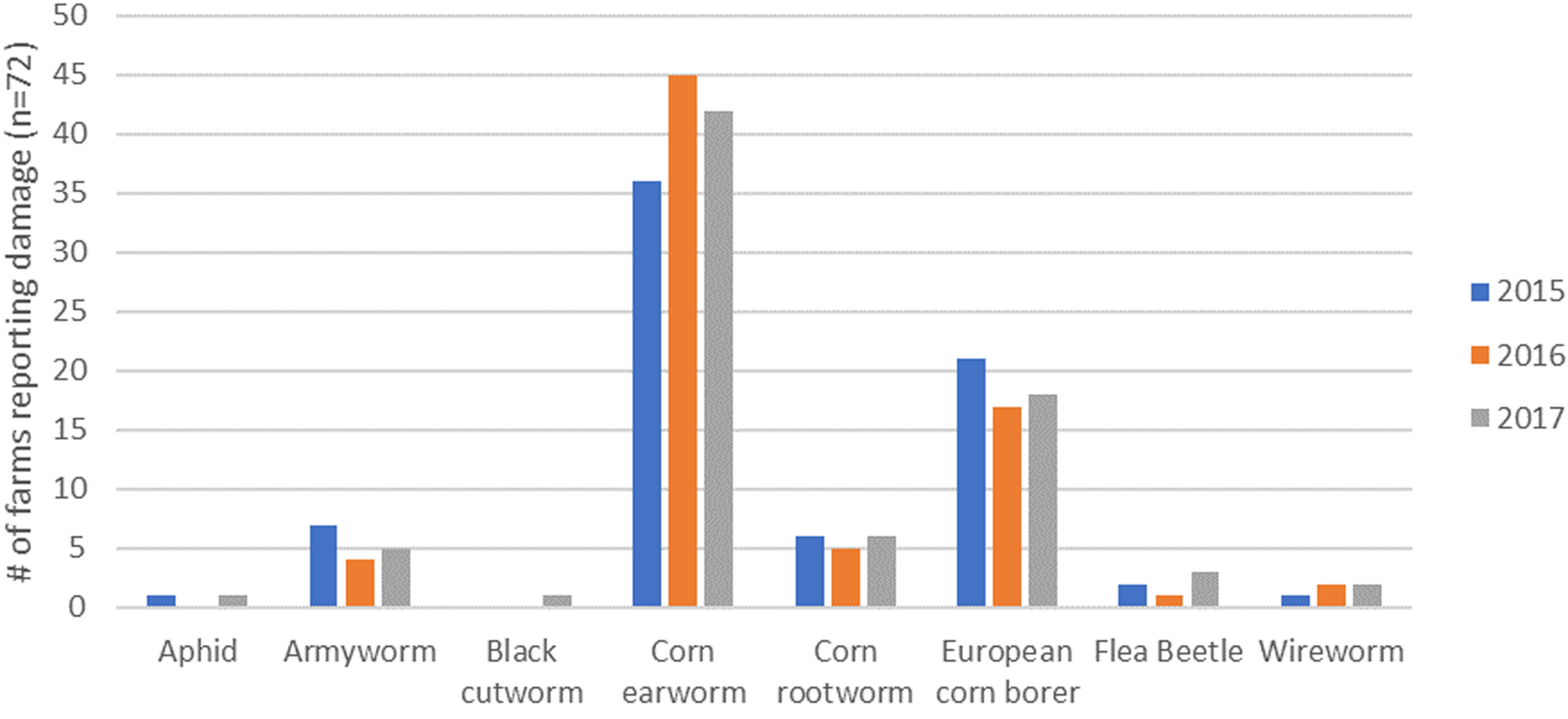
Ninety-one percent of respondents reported seeing earworm damage on their farm in 2017, and 93% reported seeing damage in a typical growing season. Respondents reported seeing a mean of 20% of their sweet corn ears with what they perceived to be corn earworm damage in both 2017 and in a typical growing season. Seventy-nine percent of respondents noted earworm damage that they considered to be ‘significant’ in at least one of the previous 3 years. As shown in Figure 1, in any given year, about twice as many producers identified corn earworm as causing significant damage compared to any other sweet corn pest.
Survey respondents' insect damage in sweet corn, 2015–2017. Survey respondents indicated which insects caused ‘significant damage’ in their sweet corn over the previous three growing seasons. These data are summarized by the number of growers affected by each pest in a given year. Only 72 of the 103 respondents answered the question.

Survey respondents reported varying levels of tolerance for corn earworm damage among their different markets. The mean thresholds for corn earworm damage (i.e., the ‘maximum acceptable proportion of earworm-damaged ears’) reported by respondents ranged from 9% (wholesale) to 29% (CSA). Notably, the mean reported damage thresholds for respondents selling to CSA, farmers' markets and restaurants (29, 28 and 23%, respectively) are higher than the mean percentage of ears respondents reported as damaged in 2017 and in a typical year (20%), while respondents selling through wholesale, farm stand and direct-to-retail/institution report damage thresholds below this level (9, 10 and 14%, respectively), suggesting that producers may face challenges in managing corn earworm when selling to markets with higher standards.
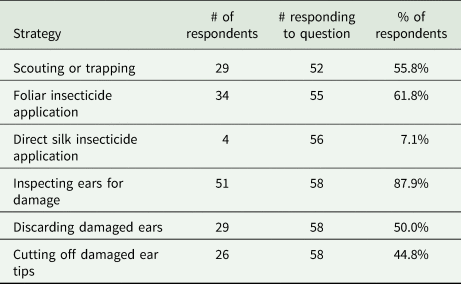
Fifty-six percent of respondents use some practices to manage corn earworm. Notably a substantial proportion of producers do not manage for the pest despite seeing significant earworm damage. Among those respondents managing for corn earworm, the most common management strategy was inspecting ears for damage during or after harvest (88%), and either discarding damaged ears (50%) and/or cutting off the damaged ear tips (45%). The majority also sprayed OMRI-approved insecticides (62%) and trapped or scouted for the pest (55%) (Table 1). The most commonly reported insecticides were Bt-based (17 respondents), followed by spinosad-based insecticides (13 respondents). Only four survey respondents reported doing direct silk applications of insecticides using the Zea-Later (Hazzard and Westgate, Reference Hazzard and Westgate2005)—a hand-held applicator used to apply oil and/or pesticides directly to the corn silks. All four of these respondents reported using a combination of oil and Bt. In addition to the specific practices mentioned in the questionnaire, eight respondents mentioned using crop timing (primarily early planting) to avoid earworm pressure. Three respondents also introduce parasitic wasps (Trichogramma spp.) as a biological control against corn earworm. Eight respondents also mentioned other cultural practices, such as crop rotation, integrated crop–livestock production, intercropping, tillage and weed management, as ways to manage earworm. However, since corn earworm is a migratory pest with many alternate hosts, the utility of many of these cultural practices is likely to be limited.
Corn earworm management strategies

The 58 survey respondents who managed for corn earworm indicated specific strategies they used to manage the pest. For each question, the number of respondents varied, see third column.
Variety selection was not commonly identified by respondents as a corn earworm management tool. Of the 79 respondents who indicated a specific reason for choosing varieties, flavor was by far the most common selection criterion (35 respondents, or 44.3%). Only two respondents (2.5%) specifically cited resistance to pests or diseases as a primary selection criterion, though eight respondents (10.1%) mentioned husk traits such as tip cover and husk tightness as main selection criteria, and the desire for these husk traits may be related to protection from pests. Survey respondents were asked whether they had observed differences in susceptibility or resistance to corn earworm in the sweet corn varieties they grew. Of the 47 respondents who answered this question, only six (12.8%) noted differences between varieties. Four of these respondents specifically mentioned varieties with long and/or tight husks as being more resistant to corn earworm, and the other respondents did not mention a specific mechanism influencing the resistance or susceptibility of varieties. Survey respondents were also asked about their perceptions of various traits associated with corn earworm resistance, and whether having these traits would pose an obstacle to marketing the variety. Dark silks (associated with maysin content) and long husks were not perceived as obstacles by a majority of respondents, but poor tip fill (a potential consequence of very long husks) was perceived as a potential obstacle by over 80% of respondents.
Conclusion
Our survey results support previous work identifying that corn earworm is the most important insect pest for organic sweet corn, adversely affecting most producers in most years. Some market outlets have more stringent standards for the permitted extent of corn earworm damage, making it especially important to develop effective corn earworm management strategies for producers selling to wholesale, farm stand or direct-to-retail/institution buyers. While a slim majority of respondents are doing some kind of management for corn earworm, many are affected by the pest but report doing nothing to manage it, and even among those managing corn earworm, the most common management tool is post-harvest sorting and either cutting away damaged portions or throwing away damaged ears entirely. Currently, few producers consider insect resistance in their sweet corn variety selection, likely because insect-resistant varieties are not available for organic producers. Provided breeders can develop resistant varieties while maintaining important quality traits, breeding for resistance is a potential solution that could reduce costs, labor and waste associated with current organic sweet corn production.
Supplementary material
The supplementary material for this article can be found at https://doi.org/10.1017/S1742170520000204.
Acknowledgements
This project was possible due to funding from the Northern Organic Vegetable Improvement Collaborative (funded by USDA-Organic Agriculture Research and Education Initiative), University of Wisconsin-Madison College of Agriculture and Life Sciences (CALS) Hatch Formula Grant, Clif Bar Family Foundation, Organic Valley and the Organic Farming Research Foundation (OFRF).
Financial support
This paper is based upon research that is supported by the National Institute of Food and Agriculture, U.S. Department of Agriculture, under award number 2014-51300-22223, the Clif Bar Family Foundation, the Organic Farming Research Foundation (OFRF), the Organic Valley Endowed Chair for Organic Plant Breeding, and the College of Agricultural and Life Sciences.