INTRODUCTION
Boring aptitude is spread through sponge families. The greatest number of boring species is known in the order Hadromerida where two families, Clionaidae and Alectonidae, are exclusively composed of boring species. Among the non-hadromerid boring sponges, the best known species are those belonging to the phloeodictyid genus Aka entirely composed of excavating species (e.g. Schönberg & Tapanila, Reference Schönberg and Tapanila2006; Calcinai et al., Reference Calcinai, Cerrano and Bavestrello2007). In the family Acarnidae the genus Zyzzya includes highly destructive species (Calcinai et al., Reference Calcinai, Cerrano, Sarà and Bavestrello2000) while Acarnus nicoleae van Soest, Hooper & Hiemstra, Reference van Soest, Hooper and Hiemstra1991, is suspected to be boring. Moreover the enigmatic monotypical family Samidae includes the genus Samus making tiny holes and corridors in calcareous substrata (Van Soest & Hooper, Reference van Soest, Hooper, Hooper and van Soest2002). Although several astrophorid genera like Stoeba and Jaspis were suspected to include excavating species (Carter, Reference Carter1880; Thomas, Reference Thomas1973), the only genus in this order with a recognized boring ability is Holoxea with the species H. excavans (Calcinai et al., Reference Calcinai, Bavestrello, Cerrano and Sara2001, Reference Calcinai, Arillo, Cerrano and Bavestrello2003).
Sponges etch limestone by a two-step (chemical and mechanical) mechanism, based on the activity of peculiar etching cells (Pomponi, Reference Pomponi1977), that produce the detachment of chips of carbonates resulting in a typical pitting pattern on the wall of the excavations (Rützler & Rieger, Reference Rützler and Rieger1973). The uniformity of the morphological pattern observed in many species strongly suggests a homogeneity of the boring process in several, non-taxonomically related sponges. Differences recorded in the micro-morphology of pits that may show a smooth surface or the presence of concentric or sometimes radial scars (Borchiellini et al., Reference Borchiellini, Alivon and Vacelet2003; Calcinai et al., Reference Calcinai, Arillo, Cerrano and Bavestrello2003, Reference Calcinai, Bavestrello and Cerrano2004b), probably reflect differences in etching cell morphology and/or physiology but not in the general excavating mechanism. Recently the relationships between chemical and mechanical action were studied, suggesting that the first step is not negligible and sometimes is more important than the second (Zundelevich et al., Reference Zundelevich, Lazar and Ilan2007; Nava & Carballo, Reference Nava and Carballo2008).
In the crevices of carbonate substrata a diversified group of insinuating sponges co-exists together with recognized boring species. For example, in the Mediterranean coralligenous conglomerate 26 insinuating species were recorded (Bertolino, unpublished data). These species are known only from a taxonomic point of view while no information is available about their ecology and behaviour. For several of these species the boring aptitude was just hypothesized but never confirmed.
In this paper we describe the new species Triptolemma strongylata and implement the incomplete description of T. simplex (Sarà, Reference Sarà1959). The new species was recorded in the scleraxis of precious corals from the Pacific Ocean and T. simplex in colonies of Corallium rubrum (Linnaeus, 1758) and in coralligenous concretions both from the Mediterranean Sea. The SEM analysis of the cavities occupied by both species suggests that they are able to dissolve, probably only by a chemical action, the substratum.
MATERIALS AND METHODS
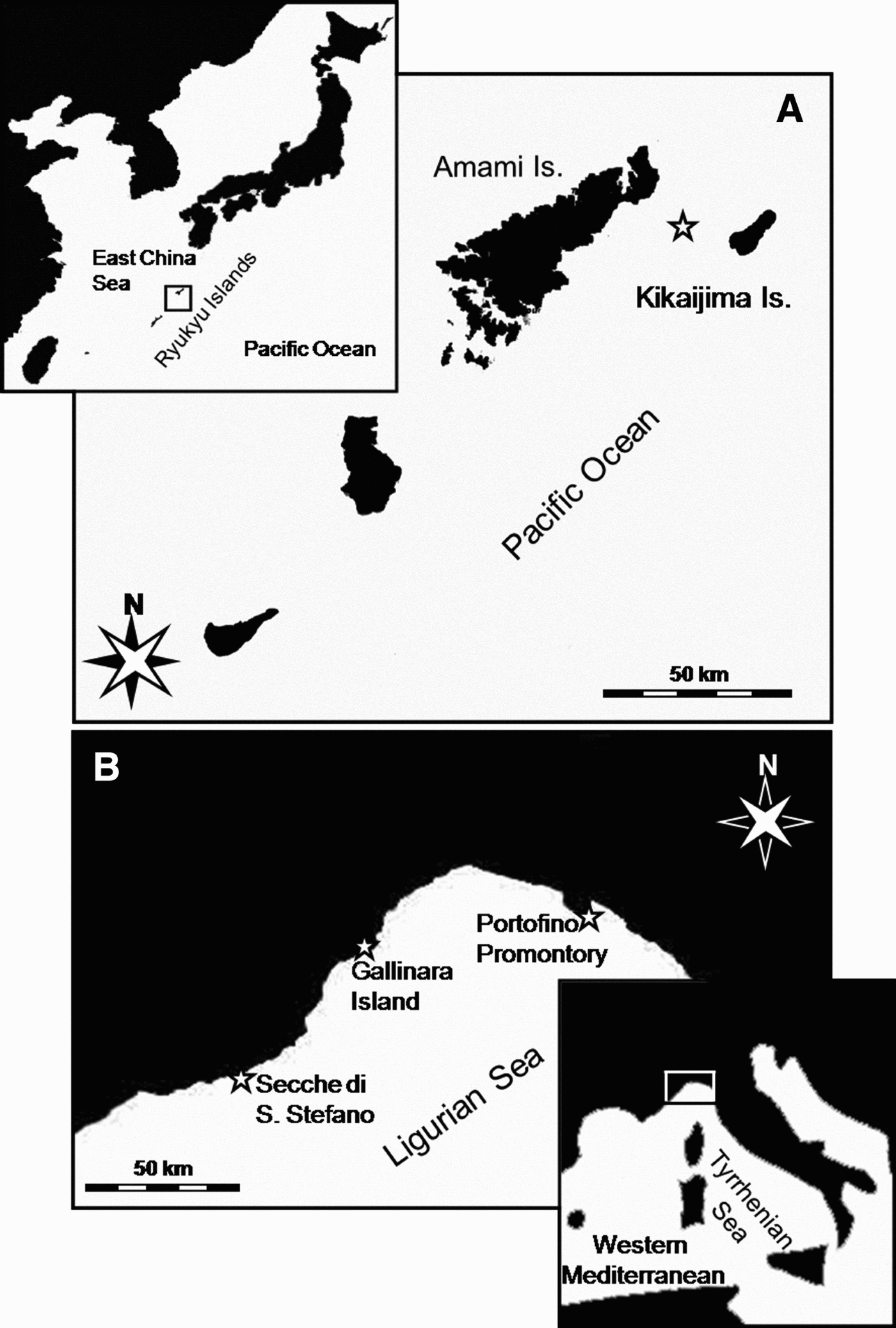
Specimens were collected from the Pacific Ocean and the Mediterranean Sea (Figure 1A, B). The Pacific Ocean material consisted of colonies of Paracorallium japonicum (Kishinouyi, 1903) collected by the ROV ‘Hakuyo 2000’ during a cruise conducted by the RV ‘Shinsei Maru’ in March 2009 off Amami Island (Northern Ryukyu Islands, Japan). In this area the flat bottom at 200 m depth is covered by calcareous concretions of coralline algae. The macro-benthic community is composed of a rich population of P. japonicum exploited by professional fishermen, with whip black corals of the genus Stichopathes sometimes showing high densities, pennatulaceans, gorgonians and stylasterid hydrozoans.
Sampling areas. (A) Amami Island (Pacific Ocean); (B) Ligurian Sea. The stars indicate the sampling site.
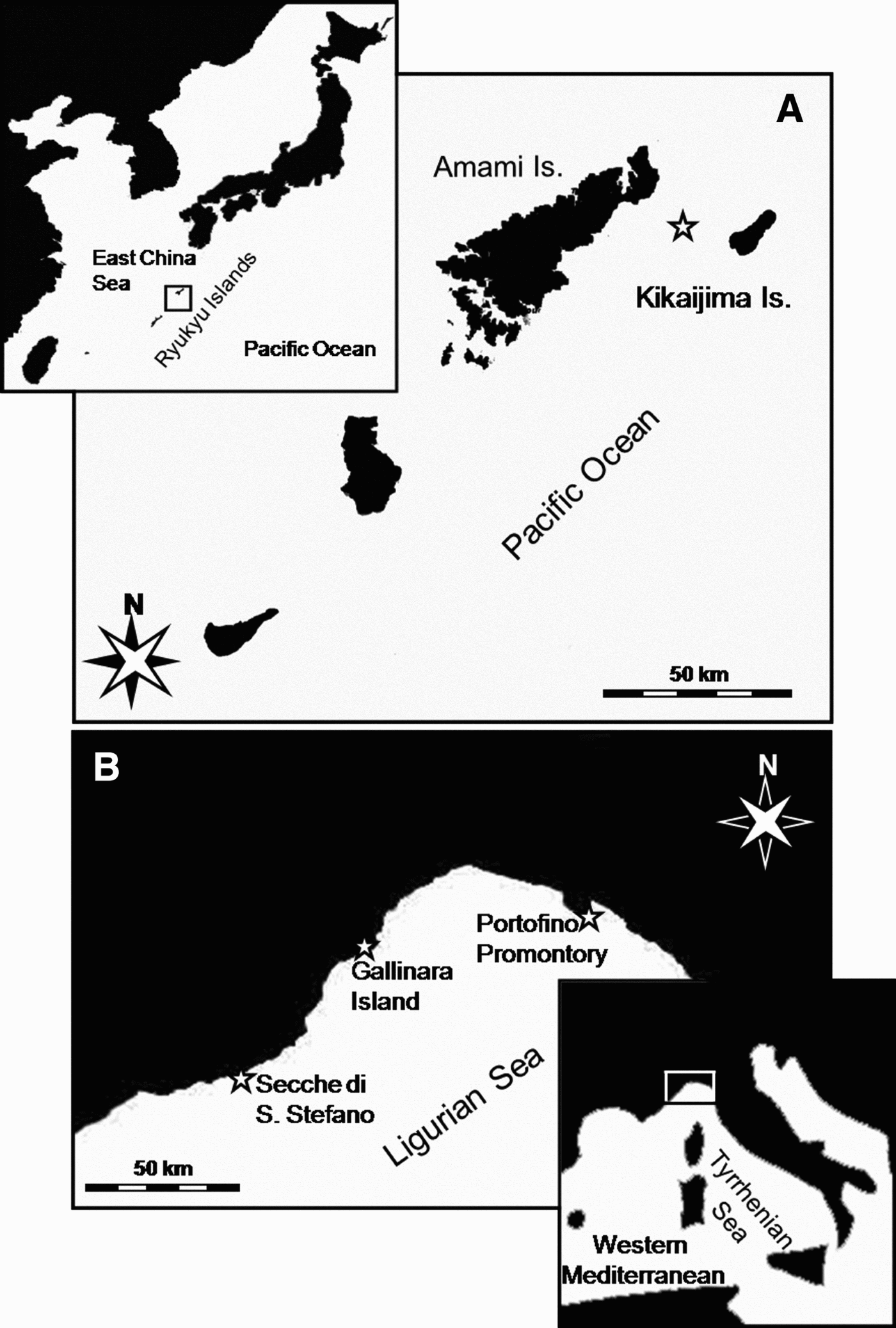
The Mediterranean material was recorded during a study of the coralligenous conglomerates in different localities of the Ligurian Sea (Portofino, Santo Stefano al Mare and Gallinara Island). Blocks of this conglomerate were collected by SCUBA divers at depths between 30 and 40 m. Many organisms with a carbonate skeleton, mainly colonies of the precious coral Corallium rubrum (Linnaeus, 1758), were settled on these blocks. Specimens of Triptolemma were observed both inside the scleraxis of the red coral and into the calcareous substratum.
Sponge specimens were alcohol (70%) preserved or dried. Skeletal architecture, when possible, was examined by light microscope. Hand-cut sections of the ectosome and choanosome were made following Hooper (Reference Hooper2000). Spicule complement was analysed according to Rützler (Reference Rützler, Stoddart and Johannes1978). From 30 measurements for each spicule type, the size-range and mean were obtained. For SEM analyses dissociated spicules were transferred onto stubs and sputtered with gold. These preparations were observed by a Philips XL 20 scanning electron microscope.
The holotypes of Triptolemma simplex (Sarà, Reference Sarà1959) (as Triptolemus simplex: GG 418), Triptolemma intexum (Carter, Reference Carter1876) (as Pachastrella intexa: BMNH 1910.1.1.1693–1697) and Triptolemma incertum (Kirkpatrick, Reference Kirkpatrick1903) (as Triptolemus incertus: BMNH 1902.5.26.5–6) were examined. Moreover, another specimen (GG 1718) labelled by Sarà Triptolemus simplex, coming from the type locality of the species, was studied.
RESULTS
DIAGNOSIS
Cryptic Pachastrellidae with skeleton formed by short-shafted meso(dicho)triaenes with diversely branched clads and frequently by monoaxonic megasclere (oxeas or strongyles) that support the skeleton. Microscleres include amphiasters, metasters transitional to spirasters and spiny microrhabds in one or two categories, which may be partially absent (modified from Maldonado, Reference Maldonado, Hooper and van Soest2002).
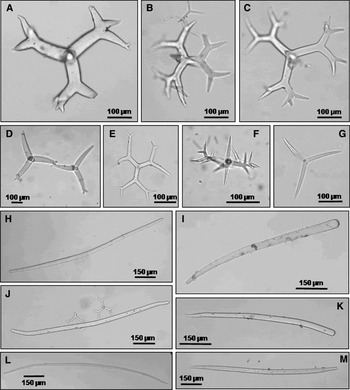
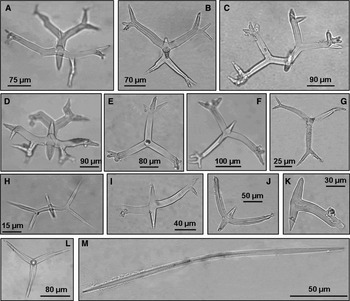
Triptolemma strongylata sp. nov. (A–F) Dichomesotriaenes; (G) mesocalthrop with curved clads; (H–M) sinuous strongyles.

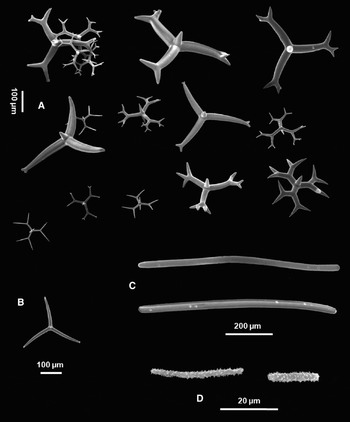
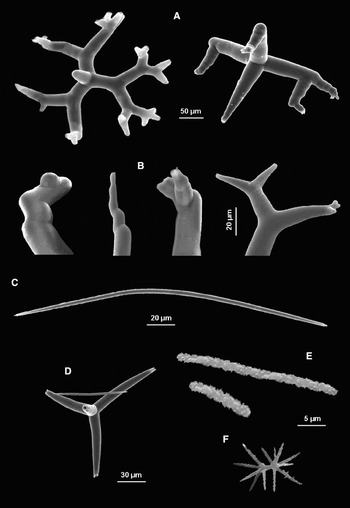
Triptolemma strongylata sp. nov. (A) Dichomesotriaenes, with short, sharp and symmetrical rhabdomes and straight clads in a single plane; (B) mesocalthrop with curved clads; (C) sinuous strongyles; (D) thin, slightly spined microrhabds.

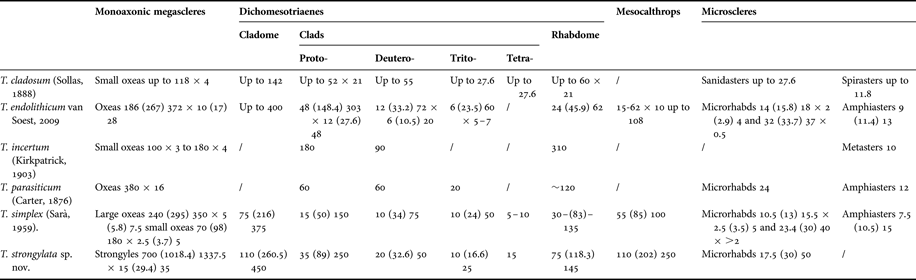
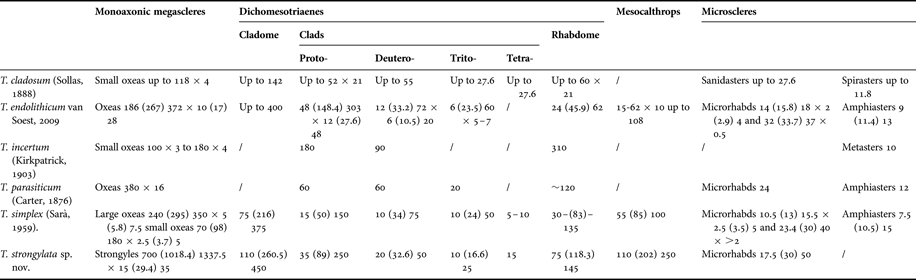
Spicular complement of the valid species of the genus Triptolemma (measures in µm).
TYPE MATERIAL
Holotype: (Museo Civico di Storia Naturale ‘G. Doria’ of Genoa (MSNG) 55503) AMAMI 15A; a dry specimen and one slide, Amami Island, Japan, Pacific Ocean, depth 200 m, collected 3 March 2009.
DESCRIPTION
Sponge insinuating and burrowing into a fragment of Paracorallium japonicum excavated by Spiroxya sp. The fragment of coral is completely pervaded by canals and holes. Triptolemma strongylata is located in the inner part of the specimen while Spiroxya is near the coral surface. The dry preservation of the sample did not allow the detection of sponge consistency and colour.
SKELETON
Not observed.
SPICULES
Megascleres: (i) dichomesotriaenes with a large variability in size and shape (Figures 2A–F & 3A). All the forms show short, sharp and symmetrical rhabdomes. The most frequent form is represented by dichomesotriaenes with cladome in a single plane. Clads are bi- tri- and/or, more rarely, tetrafurcated. Dimensions: cladome 110 (260.5) 450 µm; protoclads 35 (89) 250 µm, deuteroclads 20 (32.6) 50 µm, tritoclads 10 (16.6) 25 µm, tetraclads about 15 µm; rhabdomes 75 (118.3) 145 µm; (ii) mesocalthrops 110 (202) 250 µm, mainly with curved clads (Figures 2G & 3B); (iii) strongyles sinuous, rarely modified into styles, 700 (1018.4) 1337.5 × 15 (29.4) 35 µm (Figures 2H–M & 3C).
Microscleres: microrhabds thin, slightly spined, 17.5 (30) 50 µm (Figure 3D).
ETYMOLOGY
The specific name refers to the presence of sinuous strongyles.
REMARKS
The new species lacks amphiasters. This species, like T. simplex and T. incertum, has monaxonic megascleres (strongyles) confirming the presence of these elements in the spicular complement of the genus.
This is the first record of the genus Triptolemma from Japanese waters.
Triptolemma simplex (Sarà, Reference Sarà1959). (A) Sample in the coralligenous accretions (arrows); (B) detail of the sponge ectosome with mesotriaenes layer; (C) choanosome: oxea tracts diverging in bouquets that support the crust of mesotriaenes.

Triptolemma simplex (Sarà, Reference Sarà1959). (A–K) Deformed dichomesotriaenes; (L) mesocalthrop; (M) large oxea.

Triptolemma simplex (Sarà, Reference Sarà1959). (A) Deformed dichomesotriaenes; (B) details of the dichomesotriaene tips; (C) large oxea; (D) small oxea and mesocalthrop; (E) spiny microrabd in two size-categories; (F) amphiaster with spiny rays.

STUDIED MATERIAL
(MSNG 55502), Specimen S.S.S.–Caryon–BL.1–F12A–SPB, dry state, Santo Stefano al Mare, 43°49′N 7°54E, depth 35 m, collected 14 February 2008; Specimen Gall.–Falc.–BL.2–Sciaf.–SP11, spicule slide, Gallinara Island (Falconara) 44°01′22′′N 8°13′34′′E, depth 35 m, collected 17 June 2009; Specimen PdF–BL1–Sciaf. Inf.-SP7, spicule slide, Portofino (Punta del Faro), 44°18′N 9°B′E, depth 40 m, collected 2 August 2007; (MSNG 55856) GG 1718, spicules slide, Grotta della Gaiola, Gulf of Naples, depth 0–1 m.
Holotype: (MSNG 55843), GG 418, spicules slide of the sponge with Aaptos aaptos (Schmidt, 1864), Grotta della Gaiola, Gulf of Naples, depth 0–1 m, collected 22 November 1959.
DESCRIPTION
Sponge is encrusting and penetrating in the basal part of living or dead colonies of Corallium rubrum, and in the coralligenous concretions. The colour is beige in alcohol and grey in dry state. Consistency is soft. In Corallium colonies the new species was recorded in the cavities produced by Spiroxya corallophila (Calcinai, Cerrano & Bavestrello, 2002) while in the conglomerate it was observed in the cavities produced by Cliona sp. (Figure 4A). The ectosome forms a crust on the substratum surface while the choanosome fills holes and galleries, 1–2 mm in diameter, penetrating into the calcareous substrata to a maximum depth of 0.5–1 cm. The excavations occupied by Triptolemma simplex, were probably originally produced by the associated sponges.
SKELETON
Ectosome 50–60 µm thick, composed of a layer of disorderly arranged mesotriaenes, forming a superficial crust supported by the choanosomal skeleton (Figure 4B, C).
Choanosome made up by oxea bundles filling the galleries. Toward the surface diverging tracts of oxeas support the crust of mesotriaenes (Figure 4C). Large amount of spiny microrhabds are observed inside the excavations.
SPICULES
Megascleres: (i) large, thick and deformed dichomesotriaenes (Figures 5A–K & 6A) with clads irregularly bi- tri- and/or tetrafurcated at different distances from the centrum of the spicule. Tips may be rounded, acerate, asymmetrical, mucronate or deformed (Figures 5A–J & 6B). Dimension: cladome (of symmetrical spicules) 75 (216) 375; protoclads 15 (50) 150 µm, deuteroclads 10 (34) 75 µm, tritoclads 10 (24) 50 µm, tetraclads rare about 5–10 µm; rhabdome short 30 (83) 135 µm, generally symmetrical; (ii) mesocalthrops (Figures 5L & 6E), rare 55 (85) 100 µm; (iii) oxeas smooth and slightly curved, with hastate tips (Figures 5M & 6E). They may be divided in two size-categories: 240 (295) 350 × 5 (5.8) 7.5 µm; 70 (98) 180 × 2.5 (3.7) 5 µm.
Microscleres: spiny microrhabds in two size-categories (Figure 6E): 10.5 (13) 15.5 × 2.5 (3.5) 5 µm; 23.4 (30) 40 × >2 µm. Amphiasters (Figure 6F) with thin axis 7.5 (10.5) 12.5 µm and two verticils of 6 long, slightly spined rays.
REMARKS
Triptolemma simplex (Sarà, Reference Sarà1959) was described on the base of a slide labelled GG 418 including few spicules of the new species associated with spicules of Aaptos aaptos. We have found, in Sarà's collection, another slide (GG 1718) labelled T. simplex, deriving from a specimen coming from the same site of the holotype (Grotta della Gaiola, Gulf of Naples) with numerous spicules including deformed dichomesotriaenes and smooth oxeas perfectly fitting with our material. The description of Sarà must be therefore considered incomplete and is integrated in this paper.
Here we describe for the first time the complete skeleton of the genus Triptolemma. So far the presence of the monaxonic megascleres has been debatable because it is difficult avoiding contamination with spicules of neighbouring sponges (van Soest, Reference van Soest2009). Maldonado (Reference Maldonado, Hooper and van Soest2002), in fact, considered the oxeas in T. cladosum (Sollas, Reference Sollas1888) as foreign and did not include monoaxonic megascleres in the genus definition. Van Soest (Reference van Soest2009) recorded oxeas in T. endolithicum that, due to their shape and size, were interpreted as reduced triaenes. The observation of oxeas in the skeleton of Triptolemma simplex definitively establishes that this genus has monaxonic spicules.
The analysis of the samples of Triptolemus sp. (=Triptolemma) found in the coralligenous community of Bogliasco (Pansini & Pronzato, Reference Pansini and Pronzato1973), Portofino (Sarà et al., Reference Sarà, Balduzzi, Boero, Pansini, Pessani and Pronzato1978) and Mitigliano cave (Napoli) (Pansini & Pronzato, Reference Pansini and Pronzato1982) indicates that they belong to T. simplex.
Triptolemus simplex was collected up to 40 m depth. Triptolemma endolithicum van Soest, Reference van Soest2009 was collected in relatively shallow waters, 25 m depth. While other known species were found in deeper waters: T. cladosum (Sollas, Reference Sollas1888), 250 m depth, off the Kai Islands, Indonesia; T. incertum (Kirkpatrick, Reference Kirkpatrick1903), 150–180 m depth, off the east coast of South Africa; T. strongylata sp. nov., 200 m depth, Amami Island, Japan.
CONCLUDING REMARKS
The genus Triptolemus (=Triptolemma) was established by Sollas (Reference Sollas1888) for T. cladosum. This species was re-described in detail by Maldonado (Reference Maldonado, Hooper and van Soest2002). The other species generally attributed to Triptolemma are: T. intextum (Carter, Reference Carter1876 as Pachastrella intexta); T. parasiticum (Carter, Reference Carter1876 as Pachastrella parasitica); T. incertum (Kirkpatrick, Reference Kirkpatrick1903 as Triptolemus incertus); T. simplex (Sarà, Reference Sarà1959 as Triptolemus simplex); T. endolithicum van Soest, Reference van Soest2009; and T. strongylata sp. nov. The differences between the different valid species of the genus are summarized in Table 1.
Triptolemma endolithicum was recently described by van Soest (Reference van Soest2009).
Carter (Reference Carter1876) described P. intexta associated to a specimen of the lithistid Corallistes bowerbanki (Johnson, 1863). The examination of the original slides of the holotype (British Museum, Natural History (BMNH) 1910.1.1.1693–1697) showed the presence of calthrops in large size, almost trifurcated mesotriaenes, two categories of oxeas, oval slightly centrotylote microstrongyles. These spicules indicate that this species must be considered as belonging to the genus Pachastrella according to Carter's original description.
Triptolemus parasiticum (Carter, Reference Carter1876) is poorly described and the loss of the type material does not allow any sure comparison with other co-generic species. The synonymization of this species with Pachastrella intexta (Lévi & Lévi, Reference Lévi and Lévi1983) is highly suspected.
In the BMNH collection, Kirkpatrick deposited three slides (BMNH 1902.5.26.5–6) of T. incertum. Two slides show spicules of the new species associated to spicules of Discodermia natalensis Kirkpatrick, Reference Kirkpatrick1903 as stated by the same author (1903) in the original description. A third slide contains the spicules of P. intexta and this fact is confirmed by the contemporaneous presence of spicules of Corallistes bowerbanki as in Carter's original description. Probably Kirkpatrick, when describing his species, prepared for comparison a slide from the Carter's material erroneously labelling it as T. intextum.
All the species of the genus Triptolemma live in association with other sponges and Maldonado (Reference Maldonado, Hooper and van Soest2002) suggested they are able to penetrate the tissues of other species by acting as parasites. Van Soest (Reference van Soest2009) described T. endolithicum as insinuating inside corridors and holes, approximately 1 mm in diameter and 5–10 mm long, present in a piece of coral covered by Diplastrella megastellata Hechtel, 1965.
Triptolemma strongylata sp. nov. and T. simplex live inside holes and galleries produced by boring sponges, Spiroxya sp. and S. corallophila in the precious coral and Cliona sp. in the coralligenous concretions.
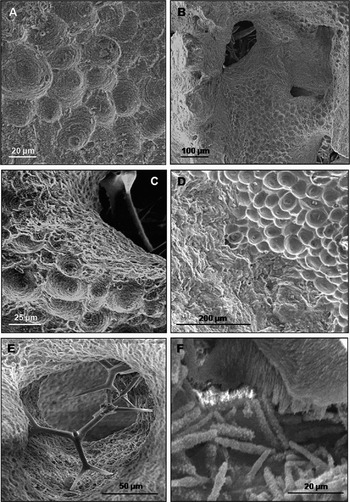
Spiroxya spp. were identified for the presence of spirasters and for the micro-pattern of the excavation walls characterized by fingerprint like ornamentations (Figure 7A). Nevertheless, in the portion of excavations, where the tissue of Triptolemma was recorded, the erosion pattern of Spiroxya appears progressively modified (Figure 7B). This corrosion evolved to a complete abrasion of the wall of the cavities that was characterized, at the end of the process, by an irregular corrugation of the substratum (Figure 7 C, D). The foramina connecting the boring chambers of Spiroxya are also irregularly widened (Figure 7D). Moreover, in several places, numerous recently formed calcium carbonate crystals probably indicate a local re-crystallization followed by a strong and quick dissolution of the original calcareous matrix (Figure 7E, F).
Triptolemma erosion. (A) Pits of Spiroxya sp. in the scleraxis of Paracorallium japonicum, showing the characteristic pattern of ornamentation; (B) in the cavities colonized by T. strongylata (see the spicules in the hole) the erosion pattern of Spiroxya is progressively modified giving rise to an irregular etching of the substratum; (C) enlargement of the previous; (D) a similar process is shown by T. simplex in Corallium rubrum; (E) foramen connected boring chambers of Spiroxya irregularly widened and etched by T. strongylata (see the dichomesotrianes); (F) detail of coralligenous accretion eroded by T. simplex (see the spiny microrhabds). The local carbonate re-crystallization suggests a strong and quick dissolution of the original calcareous matrix.

On the basis of this evidence we hypothesize that Triptolemma insinuates into erosions produced by other sponges and it could be able to enlarge them by an etching mechanism based only on chemical dissolution.
Recently all the boring species recorded in the precious coral both in the Mediterranean Sea and the Pacific Ocean were summarized by Calcinai et al. (Reference Calcinai, Cerrano, Iwasaki and Bavestrello2008). It is interesting that the number of species recorded in Corallium rubrum from the Mediterranean Sea (15) is similar to that reported for the Pacific precious coral species (13). All the involved genera (Holoxea, Alectona, Spiroxya, Cliona, Thoosa, Dotona and Aka) with only the exception of Delectona have species associated both to Mediterranean and Pacific precious coral. This fact supports the idea that the sponge species associated to precious corals reflect the same Tethyan relict distribution of the genus Corallium (Calcinai et al., Reference Calcinai, Azzini, Bavestrello, Iwasaki and Cerrano2004a). It is interesting that also the two described species of Triptolemma confirm this biogeographical pattern.
ACKNOWLEDGEMENTS
We wish to thank the captain and crew members of RV ‘Shinsei Maru’ and the operations team of ROV ‘Hakuyo 2000’ (SNK Ocean Co. Ltd.) for sampling, and Professor Maurizio Pansini (Genova) and the anonymous referees for the helpful suggestions that contributed to improve our manuscript.