In 1850, a paper was read before the Royal Historical Society of Ireland regarding a group of Chinese porcelain seals that had come to light during the previous eighty years in Ireland. In total there were about sixty seals which it was claimed had been discovered in various places throughout Ireland, ranging from Belfast all the way to Cork. In addition to their wide dispersion pattern, the seals were found in the strangest places – in an orchard, a cave, bogs, and so on. The discovery could not be easily explained at the time and when the inscriptions turned out to be written in the Chinese seal script, a number of fanciful hypotheses were advanced as to how these seals “of great antiquity” appeared in Ireland. According to these explanations, the seals were either brought over by the Phoenicians, or by ancient Irish tribes after their wanderings in China, or by mediaeval Irish monks travelling from the Middle East. All along, the emphasis was on the extent to which these artefacts corroborated Ireland's ancient connection with the Orient, an idea that was believed and promoted at the time by both Irish nationalists and English imperialists. Both sides, albeit from a different standpoint and driven by different motives, saw the Irish as a distinctly non-European culture, whose ancestors must have originated from distant lands far beyond the perimeters of western civilisation.
Voices arguing against the antiquity of the seals were stifled by the rising fame of this “greatest archaeological mystery of recent years” and their significance in proving long-lost connections between Ireland and the Orient. Doubts raised by reputable scholars, whose qualified opinion should have mattered most in this discussion, were ignored and the Chinese seals of Ireland gradually came to be known as one of the great unexplained mysteries of the world.
Some of the seals in question are still extant and can be seen at the National Museum of Ireland. For a modern researcher the seals can be identified as early Qing porcelain seals from the Dehua kilns in Fujian Province. Accordingly, even though nowadays they would be considered antique, they are much newer than purported by those in the nineteenth century who wished to see in them a proof of an ancient link with China. The supposedly ancient writing on them is in the Chinese seal script which, although at the time identified correctly as having been in use at the time of Confucius, was still used on seals in the eighteenth century, as it continues to be used today.
In this article, rather than analysing the seals themselves, I would like to document how and why they were misinterpreted in Ireland. What interests me is how these objects, which at some point in modern times came over to Europe presumably as souvenirs from an exotic land, were almost purposefully misunderstood so that they would fit contemporary intellectual currents, and how little attention was paid to the cautioning voices of those who were qualified to form an opinion on the subject.
1
The small porcelain cubes with inscriptions on their bases started to appear on the Irish antiquarian scene from the end of the eighteenth century. As far as the available records testify, the first seal was found in 1780 by a turf cutter in a bog near the town of Mountrath, Queen's County. In the following decades, more seals were recovered in different parts of the country by various means: in a cave near the mouth of Cork Harbour; while digging up the roots of an old pear-tree in an orchard in Kirkcassock, County Down; at Clonliffe Parade, near Dublin; while ploughing near Burrisokane, County Tipperary; in the bed of the Boyne river while raising gravel near Clonard, County Meath, etc. By 1853, over fifty had been collected from different parts of Ireland. All were made of white porcelain in the shape of a small cube, with a seated animal on top. The similarity of their physical appearance implied that they belonged together, even though they were found hundreds of miles apart.
Beside the mystery of why these objects were scattered throughout the island, another interesting phenomenon was that they were exclusive to Ireland, without a single one reported in England or any other place in Europe. This circumstance was part of the reason why these seals came to signify a long-lost link with China, a connection particular to Ireland.
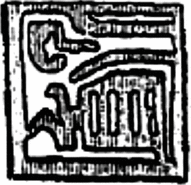
The first written reference to a Chinese seal in Ireland comes from the 1793 edition of Anthologia Hibernica Footnote 1 (Fig. 1), where a reader asked the advice of others to translate and explain a seal impression. At a first glance, the seal impression does not even seem to be in Chinese, and identification of the inscription is only possible from later reproductions. It is rather surprising that the person supplying the image identified it correctly as Chinese.
The first publication of a seal found in Ireland from a 1793 edition of Anthologia Hibernica. The image is aligned incorrectly and needs to be rotated 90° counter-clockwise. The inscription consists of the character 頌 (song, ‘to praise’), probably a personal name.

In the following decades, more seals were discovered and in the 1830s two enthusiasts of antiquities, Joseph Huband Smith and Joseph William Murphy, became involved in the research, gathering impressions and casts. These two gentlemen originally worked separately but later met to compare their findings. By the end of the decade, the two of them had acquired over a dozen seal impressions.
In December 1839, Smith gave a talk at a meeting of the Royal Irish Academy, exhibiting one seal and impressions of several others in seal-wax, stating that all the objects were in the form of an exact cube with a handle which was modelled after some animal (probably an ape).Footnote 2 In terms of their physical appearance, the seals were all alike, differing only in the inscription at the bottom. Smith referred to the Chinese grammar of Abel Rémusat,Footnote 3 which “showed that the inscriptions on these Seals, are those of a very ancient class of Chinese characters, ‘in use since the time of Confucius’, who [sic] is supposed to have flourished in the middle of the sixth century B.C”. Based on this information, he concluded that the seals were very old, disregarding the fact that although the seal script had indeed been in use since the time of Confucius, it continued to be used on seals up to modern times. This was a crucial point in the study of these seals because Smith's reference to Rémusat's work became the basis for the assumption that they were some two thousand years old.
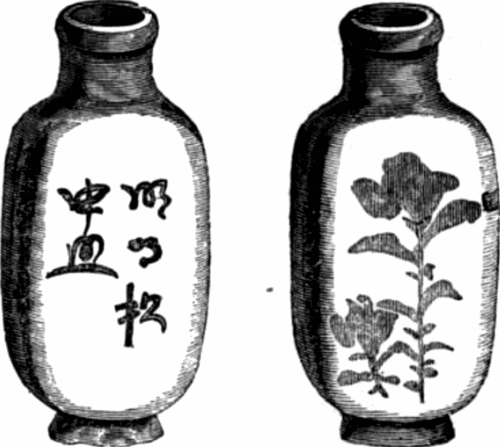
Obviously, the appearance of Chinese artefacts of such, albeit supposed, antiquity in Ireland called for an explanation. Smith suggested that they “may have arrived hither from the East, along with the weapons, ornaments, and other articles of commerce, which were brought to these islands, by the ships of the great merchant princes of antiquity, the Phoenicians, to whom our ports and harbours were well known”. He also connected the mystery of the seals with a recent discovery of Chinese inscribed vases allegedly found in Egyptian tombs at Coptos and Thebes. A couple of such small vases or flasks had been found by Professor Rosellini around 1828 during his research in Egypt in a tomb dating to 1800–1100 BC. Later on, other travellers, including John Gardner Wilkinson, discovered or acquired similar items. John F. Davis's book The Chinese showed pictures of a porcelain flask with an inscription (Fig. 2), saying that this type of vessel was quite common in China at that time and their discovery in an Egyptian tomb was puzzling.Footnote 4 Five years later Davis published pictures of three more inscribed flasks and this time he expressed doubts regarding the alleged age of the objects, commenting that “the portion of the internal evidence which most militates against the high antiquity of these specimens is the form of the character, which certainly is not that which the Chinese ascribe to their remotest period”.Footnote 5 As a result, Davis thought it possible that the flasks dated to Roman times, or even the period of the Arabian trade with Egypt. A few years later, Samuel W. Williams asserted similar doubts: “The strongest proof of their modern origin is the material and the date of the style of writing, neither of which could have been prior to the Han dynasty if Chinese records are worth anything”.Footnote 6
Porcelain flasks which it is claimed were found in Egyptian tombs.Footnote 7

It was, thus, the forms of the characters of the inscriptions which led to doubt. Those Chinese who saw them asserted that they could not be as old as Europeans were claiming. Still, these doubts and revelations regarding the Chinese porcelain flasks came to light only after Smith's paper, and he regarded them instead as yet further proof of the ancient interaction between East and West. Partially based on this evidence, Smith also concluded that the porcelain seals found their way into Ireland “at some very distant period”.Footnote 8
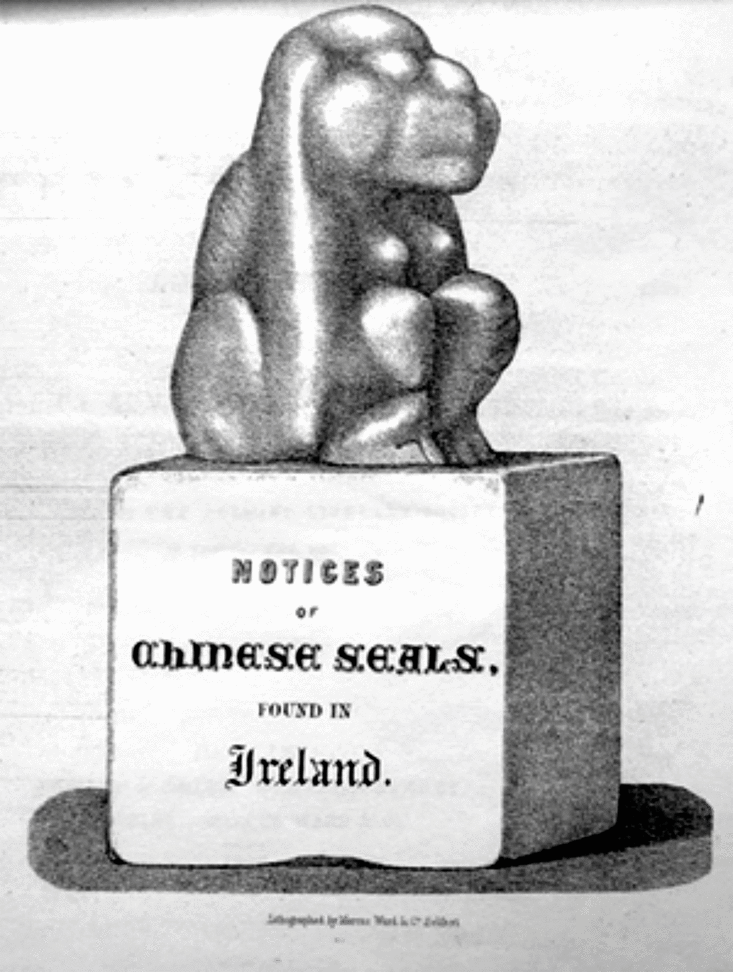
Meanwhile, the seals began to acquire a certain reputation as more came to light. In May 1850, Edmund Getty, a well-known Irish antiquary and linguist, reported on the state of research in a paper read before the Belfast Literary Society, which also came out as a book the following year under the title of Notices of Chinese Seals Found in Ireland (Fig. 3).Footnote 9 In this work Getty describes how he solicited the advice of several friends and acquaintances residing in China to obtain information about the seals. Davis, who had written about the Chinese flasks found in ancient Egyptian tombs, for example, wrote of the characters on the seals that “they are perfectly recognizable as the ancient seal characters in China, often used at the present day on the seals of public and private persons”.Footnote 10 Another friend was J. G. Comelate who helped Getty in finding translators in China, including Rev. Karl Gutzlaff, the renowned Protestant missionary who was at the time working as the Chinese secretary for the British government. Gutzlaff wrote that he had shown them to a learned Chinese and was told that “they are Chinese seal characters, namely, only used for seals, particularly in old times”.Footnote 11
Cover design of Getty's book Notices of Chinese Seals Found in Ireland (1851).

In addition, Getty suggested yet another possible link between Ireland and the Orient, namely, mediaeval Irish pilgrims who had travelled to Egypt and the Holy Land. He referred to a book entitled Liber de mensura orbis terrae by the Irish monk Dicuil, in which the author had written about a party of such pilgrims who sailed up the Nile, described and measured the pyramids, crossed to the Red Sea through a canal, and so on. As a reference, Getty also appended to his book an extract from the work of Dicuil, since the original was a rare work.
Using his friend Comelate as a liaison, Getty succeeded in obtaining translations for the seal impressions and a small group of other inscriptions found on art objects from four different sources in China. Later on, Gutzlaff sent him another set of translations. Thus there were a total of five sets, all of which were fastidiously listed in Getty's book.Footnote 12 But besides publishing the translations, Getty also tried to offer some sort of explanation for the objects' appearance in Ireland. He noted that while Chinese seals made of steatite were often seen in antique shops in Britain, he had not seen any made of porcelain. He dismissed another possibility, namely, that the seals might have come to Ireland in connection with the embassy of Lord Macartney, on the grounds that the Macartney collection had no specimens of such seals.
Getty's book only further promoted the fame of the seals and their mystery. The story appeared not only in Irish and English magazines but also across the Atlantic. A number of American papers and periodicals told the story of the Irish seals, including the Scientific American, which also provided its own hypothesis on the origin of the seals: “It is supposed that they may have been brought there by ancient Phoenicians, but it is our opinion that they were brought there by some of the ancient Irish tribes, who no doubt journeyed through and came down from China”.Footnote 13
Following their fame in the media, the seals were also rapidly becoming sought-after objects of antiquarian collections. At the May 1852 meeting of the Kilkenny Archaeological Society, for example, among the exhibited artefacts was “one of those very curious porcelain seals, consisting of a perfect cube, surmounted by a rudely-shaped monkey, serving as a handle, and inscribed with Chinese characters on the under surface, which just now excite so much interest amongst antiquaries, and are as great a puzzle to them as the round towers themselves”.Footnote 14 At the Irish Industrial Exhibition held in Dublin in 1853, a series of curious white Chinese porcelain seals featured among the items supplied by the Duke of Northumberland.Footnote 15 In 1854 at the auction of the Crofton Croker collection, among the items that attracted most attention were “12 Chinese motto seals found in Ireland, formed of porcelain, inscribed in the most ancient character, sold for 5l, 7s. 6d”.Footnote 16
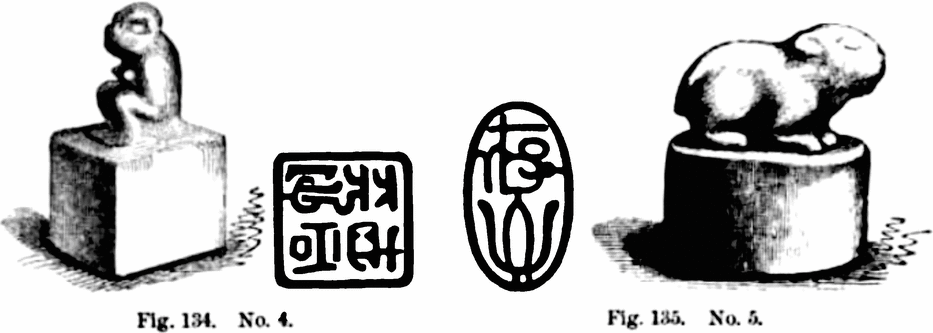
The 1857 catalogue of the Museum of the Royal Irish Academy summed up existing information available about the porcelain seals, claiming that at least one hundred of them had already been discovered, of which Getty published sixty-three.Footnote 17 The catalogue also carried a picture of two seals (see Fig. 4), only one of which appeared in Getty's list. The inscription of the seal on the left is aligned incorrectly both here (90° clockwise) and in Getty's book (180°). The seal on the right is unique because it is the only specimen with an oval base – all the ones in Getty's list are square. According to the catalogue, this oval seal was found at Rathkeale, County Limerick, and was presented to the Museum by its president, the Rev. Todd.
Seals from the 1857 catalogue of the Museum of the Royal Irish Academy.

Accordingly, perhaps as a result of the increased antiquarian interest, quite a few seals not listed by Getty were recovered from the possession of individuals throughout Ireland, who claimed to have found them years before. Despite the fact that they came from different sources and were found at different times, they were all made of porcelain and were clearly of the same origin.Footnote 18
2
While the ancient connection of Ireland with China occupied the minds of many, there were others who expressed doubts regarding the antiquity of the seals. One of the first of these was the translator from Shanghai, of whom Comelate wrote to Getty that “the translator informs me that the same characters are now in use, and expressed doubt about the originals being found in an Irish bog”.Footnote 19 In a paper read in January 1868, before the Royal Irish Academy, W. Frazer presented a well-informed argument in favour of a more recent date.
The history of these seals, if investigated, presents one common point of agreement that seems of much importance. They have never yet, in a single instance, been discovered associated with other objects of antiquarian interest, in burrows or mounds, with bronze or stone weapons, celtic remains, or works of art – never with Danish or Anglo-Norman coins, nor even with modern articles of manufacture. The invariable story of their find is what we might expect if they had been accidentally dropped, at no very distant period, in or near the localities whence they were afterwards unearthed. Thus they have been picked up by labourers, as the plough-share passed over an old untilled field: one was extracted from the uprooted fibres of an aged pear tree; another obtained on or near the situation of a disused road; two in caves; one in a potato garden; others in heaps of rubbish or clay near human dwellings – in a word, under circumstances that at once raise a conjecture they cannot possibly be of any extremely ancient date. There also seems to be satisfactory evidence that similar seals have never yet been found in England or on the Continent.
The peculiar characters on these seals are admittedly of great antiquity; but this signifies little. It is the common seal-writing employed by the Chinese for centuries, and still seen on their ordinary seals made and used in the present day: somewhat resembling our own black letter, which is practically obsolete, though in daily use for legal writings, deeds, &c.Footnote 20
To refute an earlier argument that such seals could not be obtained any longer in China, Frazer exhibited three such porcelain seals sent to him from Canton by the Rev. James Legge, who is primarily known today on the account of his translations of the Chinese classics. Legge claimed that these seals could be obtained in China but they were not in use anymore. He also offered his own judgment of the mystery: “The question as to how these seals found their way to Ireland will probably ever remain a problem not fully solved. The above detail throws a little light on it. It was during the ‘Ming’ dynasty that such articles came to be ‘the rage’ in China, and it was at the same time that European commerce with the Empire commenced; Queen Elizabeth sent an envoy to the Emperor in 1596. Some of the earliest visitors from England and Ireland must have taken the seals back with them from China. How they came to be sown over so large a tract of Ireland we shall never be able to discover”.Footnote 21 More importantly, Legge drew attention to the connection with Fujian province, noting that the seals were still produced there and sold under the name of “seals from the Fuh-Keen potteries”. Thus he effectively provided a solution to the origin of these objects.
Backed by Legge's comments, Frazer concluded that “that these seals cannot be older than the end of the fourteenth or commencement of the fifteenth century; how much later than this era they came to Ireland we have as yet no evidence. The antiquity of the seal inscriptions is of no moment; seal writing, ‘black letter’, is a remnant of past times which has not yet entirely disappeared; indeed the Chinese, eminently conservative in their ideas, still employ for their seals those extremely ancient characters, which are well understood by the learned of that land”.Footnote 22
A couple of years later, William Lockhart, a medical missionary stationed in China, told the story about buying in Shanghai a small collection of seals identical to those in Getty's book, bearing the same or similar inscriptions.Footnote 23 He also found out that these were fairly recent objects, the oldest being only two hundred years old. Later on, when he had a chance to visit Dublin, he met with Edward Chittam of the Royal Irish Academy who, upon Lockhart's enquiries, related a story told to him by a woman from whom he had bought a couple of such seals for the Duke of Northumberland:
Her reply was that an ancestor of hers, an Irishman, was in the China trade about a century ago, and he was in the habit of bringing home a quantity of China-ware for friends, to whom he said that the shopkeepers from whom he had made his purchases gave him many of the seals, to which he had taken a fancy, and that he used constantly to give them away to friends in Ireland, and that they were carried about in all directions, being curious and interesting little things. The woman said that what she had been paid for were the remains of the large quantities formerly brought by her ancestor. Mr. Clittarn [sic] said that this was the true account of the diffusion of the seals through many parts of Ireland. I also was told that the accounts given of the finding of the seals in many places of undisturbed sepulture of great antiquity are simply untrue, and will not bear investigation. Such I believe to be the story of the seals.
(W. Lockhart, M. D.)Footnote 24In retelling this story, Lockhart was replying to a question posted in the previous issue of The Phoenix, where a certain W. G. A. had asked the readers about these seals because the information contained in Getty's book was “extremely meagre”.Footnote 25 Another reply to the same inquiry appeared in the March issue of the same magazine, where J. H. Lamprey, the Librarian of the Royal Geographical Society, essentially retold the same story, which he had received from the Secretary of the Royal Irish Academy.Footnote 26 He also added that the curator of the RIA had gone to the old lady's house and examined some specimens which had still been wrapped in the original paper as they came from China.
Thus these two replies posted in The Phoenix provided an important clue as to the mystery of how the seals were scattered throughout Ireland. It is also worth noting that, by this time, a number of Chinese seals identical to those found earlier were being brought into the country. Lockhart had a small collection, while Legge and travellers visiting the celestial kingdom also sent some back to Ireland. Therefore it would not be unreasonable to assume that some of these seals that came over during the second half of the nineteenth century turned up on the antique market as “Chinese seals found in Ireland”.Footnote 27
While the above scholars, and some others, expressed their reservations regarding the age of the seals, others continued to write about them as objects of great antiquity. Similarly, many publications still referred to these seals as an unsolved puzzle. For example, in his archaeological dictionary of 1883, J. W. Mollet wrote that such seals had not been made in China for several hundred years and that the Irish specimens were believed to have come to Ireland in “a period anterior to history”.Footnote 28 It seemed that, fuelled by a desire to see an ancient connection between Ireland and China, the mystery survived its own solution.
By the end of the nineteenth century, references to the subject had grown fewer and fewer. Then, following a period of relative obscurity, the story suddenly reached a wider audience via Charles Fort's Book of the Damned, which aligned them with the other great mysteries of the world, such as UFOs and frogs falling from the sky. This book, with nearly twenty editions following its publication in 1919, had a larger circulation than all of the other material together, reaching millions of readers. Although Fort only described the circumstances of the discovery without providing a solution or supplying new information, due to the large readership of his book the subject stayed in the focus of public interest.Footnote 29
Fort's description of the seals also inspired the makers of the TV series Arthur C. Clarke's Mysterious World around 1980. In the book version of this series,Footnote 30 which appeared shortly after and became a bestseller, the seals, based on the expert opinion of Jan Chapman from Dublin's Chester Beatty Library, were identified as blanc de chine porcelain coming from a factory near Amoy in Fujian province. Chapman believed that the seals dated from the early eighteenth century when the factory exported this type of porcelain to Europe. As to the strange diffusion of the seals throughout Ireland, Clarke could only speculate that they might have entered the country at Cork, since all of them were found east of a line drawn from Lough Foyle to Cape Clear.
3
It was clear from the start that the discovery was more about Ireland than about the seals themselves or China, their place of origin. Very little discussion addressed the context of such seals in their native environment, their manufacture, or Chinese cultural and artistic trends. They were treated in the light of what they signified for Ireland, being a proof of its link with the Orient. George Smith and William Makepeace Thackeray, the celebrated English writer, began their interpretation of the story of the seals in the Cornhill Magazine with the following thought:
Ireland is a country of many problems; a land of beauty and sorrow, of political strife, or religious and racial hatreds. But apart from these things the island is the home of a number of unsolved archaeological puzzles, and not the least of these is the mystery of the Chino-Irish seals – a minor antiquarian enigma of such a curious and unusual type as to make the whole question and details worthy of recapitulation for the benefit of the present year of grace.Footnote 31
These poetic words expressed a sentiment which suggests that the seals had greater significance in Ireland than being mere archaeological relics. They signified a connection between Ireland and the East before the Christian era, a connection that had been suspected to have existed, but had never been conclusively proven. Consequently, the problem shifted from the age of the objects, which was accepted as being very old, to explaining how these could have arrived in Ireland at such a remote time.
With their distinctly non-Irish brand of cultural imperialism, Smith and Thackeray were part of the English intellectual trend that exoticised the Irish, often through disconnecting their history with European civilisation and highlighting their alleged Scythian origin. This narrative portrayed Ireland, in spite of its physical proximity to England, in a way that was closely reminiscent of contemporary visions of Oriental cultures. This, of course, at the same time provided a convenient justification for why this essentially ‘backward’ and ‘barbaric’ country was in dire need of a guiding hand from her powerful neighbour.
As a result, while the finding of the seals so far from China was, on the one hand, an astonishing archaeological discovery, on the other hand it came as no surprise to many leading intellectuals, who could conveniently fit it within their own interpretation of Irish history. To be sure, this was not a one-sided English view of their colonised neighbour, as there were just as many Irish citizens interested in the subject. The eighteenth to nineteenth century in Ireland represented a period when nationalistic historiography sought to demarcate the country from England's political and cultural influence, by establishing a past which was ancient and at the same time distinctly non-English. Although sporadic Asian origin theories had been present within the Irish tradition from the mediaeval period onwards, it was England's colonial expansion that gave rise to a massive wave of Celtic pride that wished to emphasise that it was ethnically distinct from ‘Englishness’. An Irish connection with ancient Oriental civilisations, thus, became a tempting counter-balance to Ireland's contemporary political situation.Footnote 32 A foremost example of the direction in which historians and scholars sought Ireland's unique past was the linguist Charles Vallancey, who compared Irish to Oriental languages such as Phoenician, Iranian, Hindi, Arabic, Algonquin, Japanese and Chinese. He also speculated that Confucius, mis-spelled as ‘Confulus’, was none other than the seventh-century Gaelic legislator Cenn Faelad. Despite the absurdity of these speculations today, at the time Vallancey's stature in the world of Irish academia was eminent and his linguistic theories inspired generations of later scholars.Footnote 33
Next to linguistic and philological conjectures of pseudo-historians such as Vallancey, archaeological ‘evidence’ at the time appeared scientific and exact. Perhaps this was the reason why there was relatively little interest in dating the porcelain seals more precisely, or at least listening to the advice of experts whose knowledge with respect to China and the Chinese language was otherwise acknowledged and respected. Instead, the public seemed more excited about the possibility of early links between Ireland and China. In other words, the discovery and its implications were almost anticipated, rather than coming as a surprise.
Looking at the seals today, based on their design we can fairly accurately identify them as Dehua ware from Fujian province, also known in the West as blanc de chine.Footnote 34 They appear to date to the eighteenth century but definitely not earlier than the seventeenth and, as Chapman has asserted, were most likely brought to Ireland after the early eighteenth century when the Dehua kilns began exporting to Europe. The inscriptions on the seals are consistent with those on late Ming and early Qing leisure seals, in contrast with other seals from earlier times.
As for the seemingly random distribution of the seals throughout Ireland and the baffling conditions under which they were found, we can observe a couple of interesting circumstances. First, all of the seals undeniably came from a single collection: this is confirmed by their nearly identical physical form, otherwise completely unattested in Europe. No matter how scattered the finds were, all of the seals were found in Ireland, which clearly shows a common point from which the original collection was dispersed. Secondly, there is the revealing fact that the fifty odd seals were all discovered between 1780 and 1853, with virtually no findings outside this period. This, together with the diverse conditions under which they came to light, precludes the possibility that they could have found their way into the country much earlier than their earliest finding. Otherwise a few seals would have certainly been found earlier. In addition, the fact that no more seals were found after 1853 implies that the discoveries of the seals were not completely accidental or mutually unrelated, as claimed at the time. Here we are reminded of the story that Lockhart recorded about the woman who admitted that the seals were brought to Ireland by an ancestor of hers who liked giving them away to friends in Ireland, and that the stories of finding them “in many places of undisturbed sepulture of great antiquity” were not true.
Needless to say, there is no way that we can ascertain that none of the seals were found under the conditions reported. It is more likely that the first few indeed were, and only later ones were assigned false provenance under pressure from an emerging market. In addition, many of the seals lacked information about their origin, beside the general claim that they came from Ireland. In other words, it was enough merely to misrepresent the source of a few seals in order to make the narrative develop in a certain direction. The misrepresentation, however, was not necessarily intended as a farce or forgery, at least not by the collectors and scholars involved. It is equally possible, that when a collector, such as the Duke of Northumberland, offered to pay for each new seal brought to him, people tried to meet the demand by supplying both the object and the story necessary to sell it.
Naturally, such receptiveness to the idea of an ancient connection with China, be it directly with the Chinese or via the Phoenicians, can only be explained in the light of a fascination, with the non-Englishness of the Celtic peoples which was found on both sides of the Irish Sea during the nineteenth century. The ultimately common attitude in interpreting an ‘archaeological’ discovery is an intriguing example of the intellectual currents that existed side by side in a complex colonial situation.
Appendix
Below are the seal imprints published in Getty's Notices of Chinese seals found in Ireland in 1851. In his original list of 63 imprints, Getty also included images which came from other Chinese art objects found throughout Ireland. While for the sake of convenience I preserve Getty's original numbers, I only list images of actual seal inscriptions. Thus there are a total of 46 imprints listed in the table below.
Although some of the original translations provided by Gutzlaff and the other sources from China were correct, many of them were clearly wrong. Instead of going through these early translations and pointing out their mistakes, I provide a new set of translations.Footnote 35 Characters I was not able to decipher are marked with an empty square (◻). Similarly, uncertain and missing English translations are marked with a question mark (?). Although in a few cases I could not adequately decipher the inscription, I was still able to invalidate earlier translation attempts.
All of the inscriptions are read from top to bottom, right to left. Thus, in a four-character inscription, the first character is in the top right corner and the last in the bottom left. The seal script used on the objects is often heavily simplified and hard to read. Fortunately, the same style of script is used on almost all of the seals, thus a correct reading of one inscription sometimes helps identifying similar characters on another one. Still, I was not able to decipher all of the inscriptions – this will have to be done by more capable researchers.

Note: No. 49: If we read the first character as wen, we arrive at the reading “brilliant writing”. No. 52: The first character here could also be rendered as wen. No. 56: A possible reading is “controlling the waters of the Yangtze River”.