Introduction
Over the last two decades, significant advances have been made in the early detection, diagnosis, and treatment of cancer, resulting in more and more patients being able to recover from their cancer (Kondylakis et al., Reference Kondylakis, Bucur and Dong2017). Cancer is now recognized as a chronic disease that requires long-term surveillance (Phillips and Currow, Reference Phillips and Currow2010). As survival rates continue to increase, more individuals will have to live with the negative and long-term effects of cancer. Therefore, it is important that support for cancer patients improves to meet this growing demand (Webb et al., Reference Webb, Murray and Younger2021). Since the severe side effects that occur with the experience of cancer affect the quality of life of individuals negatively, individuals diagnosed with cancer start to use coping mechanisms to adapt to the treatment and to overcome the disease. In this process, “religion/spirituality” is frequently seen among the coping mechanisms (Sabancı, Reference Sabancı2020). Religion/spirituality is an important coping resource for Muslim patients who are faced with chronic illnesses (Irajpour et al., Reference Irajpour, Moghimian and Arzani2018).
The religious and spiritual beliefs adopted by people affect the way that individuals, families, and community groups react to significant life events such as illness, disability, and aging (Ahmad and Khan, Reference Ahmad and Khan2016). In Islam, spirituality is introduced as the basis of human evolution and the most crucial aspect of the spiritual needs of Muslim patients in understanding the meaning of the human nature and their relationship with God (Irajpour et al., Reference Irajpour, Moghimian and Arzani2018). In the Islamic world, religion has to contribute to the health and well-being of its believers. In Islam, religion and medical care share similar basic premises concerning the nature of human beings and their responsibilities. Both Islamic religion and medicine consider human beings to be imperfect creations that need elevation onto the ideal status as Islam sees it. Consequently, the “imperfect human being” needs to obey the recommendations conveyed to him by both his religion and the medical professionals (Silbermann and Hassan, Reference Silbermann and Hassan2011).
Recent new research has found that religion and spirituality have a strong influence on many chronic diseases (medical and surgical patients, mental illness, cancer) and how people deal with these diseases (Al-Ghabeesh et al., Reference Al-Ghabeesh, Alshraifeen and Saifan2018; Dilmaghani, Reference Dilmaghani2018; Ekas et al., Reference Ekas, Tidman and Timmons2019; Merath et al., Reference Merath, Kelly and Hyer2019). Patients diagnosed with cancer may experience a particularly high burden of spiritual needs, as they often experience feelings of fear, anxiety, despair, and doubt about their future plans (Robb et al., Reference Robb, Haley and Balducci2007). An integrative review in patients with advanced cancer highlighted six major themes religion/spirituality influenced well-being: self-awareness, coping and adjusting effectively with stress, relationships and connectedness with others, sense of faith, sense of empowerment and confidence, and living with meaning and hope (Lin and Bauer-Wu, Reference Lin and Bauer-Wu2003). In addition, spirituality is an indispensable element of patient-centered care and has a critical importance in coping with the disease, survival, relapse, and death of cancer patients during the diagnosis and treatment period (Puchalski, Reference Puchalski2012). Studies show that spiritual distress or unmet spiritual needs have negative effects on patients’ health outcomes (Höcker et al., Reference Höcker, Krüll and Koch2014; Astrow et al., Reference Astrow, Kwok and Sharma2018; Balboni and Balboni, Reference Balboni and Balboni2019). An appropriate assessment of the spiritual needs of cancer patients is essential to alleviate spiritual distress, provide adequate support for these needs, and support them for transcendence (Sastra et al., Reference Sastra, Büssing and Chen2020).
Assessing and meeting such needs is an important responsibility of nurses and other healthcare professionals. Nurses and other healthcare professionals should be able to identify and support patients’ spiritual distress as a component of providing holistic care (Timmins and Caldeira, Reference Timmins and Caldeira2017). There are many scales in the literature that assess the spiritual needs of cancer patients (Galek et al., Reference Galek, Flannelly and Vane2005; Flannelly et al., Reference Flannelly, Galek and Flannelly2006; Hermann, Reference Hermann2006; Yong et al., Reference Yong, Kim and Han2008; Sharma et al., Reference Sharma, Astrow and Texeira2012). Although there are many scales on the subject, the scale used to diagnose the spiritual needs of cancer patients should have cross-cultural compatibility and validity features. In Iran, a scale to assess the spiritual needs of cancer patients has recently been developed by Hatamipour et al. (Reference Hatamipour, Rassouli and Yaghmaie2018). The religious beliefs and cultural structure of Iran, which is Turkey's border neighbor, are mostly similar to the cultural structure of our country. For this reason, it was thought that adapting the “Spiritual Needs Assessment Scale of Patients with Cancer” (SNASPC)” in Turkish cancer patients would be a more effective measurement tool in determining the spiritual needs of patients. Because of these characteristics, it is planned to adapt the “Spiritual Needs Assessment Scale of Patients with Cancer” to Turkish cancer patients.
This research was conducted to determine the psychometric characteristics of the “Spiritual Needs Assessment Scale of Patients with Cancer” in Turkish patients.
Methods
Design
This study used psychometric methods to test the adapted tool. To ensure the quality of the adapted scale, international norms were performed while carrying out the adaptation. The phases carried out were (1) translation, (2) content validity, and (3) pilot application and psychometric testing (factor analysis, a reliability coefficient, and inter-item correlations).
Participants
The participants of this study were patients with a diagnosis of cancer in the outpatients and inpatients medical oncology and hematology clinics of in a university hospital east of Turkey. This research is being carried out in the university hospital is located in the Eastern Anatolian region in Turkey. Nearly all of the people living in this region belong to the religion of Islam, that is, they are Muslim. Muslims living here are divided into various sects within themselves. An important part of the people living in the Eastern Anatolian region practices their beliefs in the Sunni sect. The next widespread sect is Alevism. By performing a power analysis with an error of 0.05, a 0.95 confidence interval, an effect size of 0.6, and a population representation of 0.95, it was determined that the minimum sample size was 400 patients. Patients who did not want to participate in the study (52), who were in contact isolation (12), and who completed data collection forms incompletely/incorrectly (25) were excluded from the study. Data were collected from patients until the sample size was reached. Consequently, in order to give each individual in the population an equal probability of selection, simple random sampling with a randomized probability sampling method was conducted. The following are the inclusion criteria used to select the participants: (1) aged 18 years or older, (2) no history of psychiatric illness that was determined from records of the patients, and (3) ability to communicate (oral and written).
Process of cultural adaptation
The cultural adaptation process of the scale was conducted into three stages: (1) language validity, (2) content validity, and (3) pilot application.
Translation procedures
In the first instance, the Spiritual Needs Assessment Scale was translated into Turkish. The Turkish version was then translated into English by two Turkish lecturers, who worked independently on the translation. The lecturers both worked as professors who teach the English language at a university. The two translated versions were compared by the author and analyzed until there was a consensus about the initial translation. Their initial translation into Turkish was back-translated into English. The translation phase had the purpose of checking for discrepancies between the content and meaning of the original version and the translated instrument. All of the versions were evaluated by the authors and a final version was formed.
Content validity
After the language adaptation of the scale, the content validity was then conducted with the expert opinion method to evaluate its validity. Content validity is the degree to which an instrument has an appropriate sample of items for the construct being measured and is an important procedure in scale development. The content validity index (CVI) is the most widely used index in quantitative evaluation. Content validity consists of obtaining expert opinions in order to determine whether the items in the measurement tool are suitable for the purpose of the measurement and whether or not they represent the field to be measured. For this purpose, expert opinions were obtained from six academicians (two from Public Health Nursing had conducted research on validity and reliability and spirituality, one from Fundamentals of Nursing had conducted research on spiritual care, and two from Psychiatric Nursing had conducted research on psychosocial and spiritual nursing care). The scale was sent to them via e-mail. They were informed about the measurements and concepts involved. The experts were asked to evaluate whether or not each scale item measured the Spiritual Needs Assessment and the understandability of the scale items on a scale rated between 1 and 4. On this scale, “not suitable” is 1 point, “needs to be made suitable” is 2 points, “suitable but requires small changes” is 3 points, and “very suitable” is 4 points.
Pilot application
After expert opinion, the final version of the scale, 15 of the patients were applied pretest. The intelligibility of the scale items was assessed by pretesting them to 15 patients who were not present in the sample but had similar characteristics to those to whom the measurement was to be performed. In the pilot application, it was evaluated whether there was an incomprehensible item. At the end of the application, each item was found to be understandable. Each item of the scale was found intelligible, and no change has been made in the pilot application. It takes approximately 15–20 min to complete the scale.
Construct validity
The data were analyzed using principal component analysis with varimax rotation. The varimax method was selected that minimizes the number of variables that have high loadings on each factor. This method simplifies the interpretation of the factors (Brown, Reference Brown2009). To attain the best-fitting structure and the correct number of factors, the following criteria were used: eigenvalues higher than 1.0, factor loadings higher than 0.40, and the so-called “elbow criterion” regarding the eigenvalues (DeVellis, Reference DeVellis2012). Before conducting the principal component of the Spiritual Needs Assessment Scale, the Kaiser–Meyer–Olkin (KMO) measure of sampling adequacy and Bartlett's test were calculated to evaluate whether the sample was large enough to perform a principal component analysis.
Spiritual Needs Assessment Scale
The purpose of the scale developed by Hatamipour et al. (Reference Hatamipour, Rassouli and Yaghmaie2018) was to measure the Spiritual Needs Assessment Scale of Patients with Cancer. The spiritual needs scale in patients with cancer can measure different aspects of spiritual needs. An exploratory factor analysis indicated the five factors of the designed scale, and five factors were accepted that express 48.2% of the variance. Finally, a scale was obtained with 38 terms in five subscales and its scoring was determined in a 6-episode Likert. Cronbach's α for the total scale was estimated to be 0.81; for the religious dimension, this was 0.88, for meaning and purpose 0.77, for peace 0.70, for connection 0.74, and for support and nationalism 0.67. The result of the retest was also estimated to be ICC = 0.89 (Hatamipour et al., Reference Hatamipour, Rassouli and Yaghmaie2018).
Internal consistency
Cronbach's α was calculated to determine internal consistency. Westen (Reference Westen2005) indicates that internal consistency may be a necessary condition for homogeneity or unidimensionality of a scale and Cronbach's α should be 0.70 and more. Furthermore, the item-total correlations were included in the analysis. Westen (Reference Westen2005) recommended using the inter-item correlation as a criterion for internal consistency. This should be greater than or equal to 0.15. Corrected item-total correlation is the correlation of the item designated with the summated score for all other items (Giliem and Giliem, Reference Giliem and Giliem2003).
Stability
The stability of the scale was established by measuring the test–retest reliability. In this study, the respondents completed the same instrument again after four weeks. Based on a code each respondent received, the respondent's data of the first and second measurements could be matched, allowing the test–retest reliability to be calculated.
Data collection
The researcher visited the oncology and hematology clinics on five working days every week and conducted interviews with the patients. The data were collected in 2018. The questionnaire was explained to the participants, who then read it and marked their answers on the sheets. The questionnaire took approximately 15–20 min to complete and could be understood by people with minimal reading ability. It was given to patients in a separate quiet room in the oncology and hematology clinics. All participants completed the questionnaire. The test–retest of the scale was conducted after four weeks.
Data analysis
In statistical analysis of the study, Pearson's product-moment correlation was used to determine correlation scores of items — total scale. Kendall's W analysis was performed for content validity. Before conducting the factor analysis of the scale, KMO and Bartlett's test were calculated to evaluate whether the sample was large enough to perform a satisfactory factor analysis. Varimax rotation and factor analysis were conducted for construct validity. Cronbach's α coefficient was calculated for internal consistency.
Ethical consideration
Permission was obtained with necessary correspondences on the Turkish adaptation of the Spiritual Needs Assessment Scale developed by Hatamipour et al. (Reference Hatamipour, Rassouli and Yaghmaie2018). To conduct the study, the ethical approval (Decision No.: 2018/15-28) was obtained from Inonu University Health Sciences Scientific Research and Publication Ethics Committee. For the research, the permission of the institution was obtained from Malatya Training and Research Hospital Chief Physician. The researchers informed the participants about the study purpose, including their research activities, their potential benefits and risks, and their right to refuse to answer any questions and to terminate their participation in the interview at any time. The researcher received participants’ written or oral (based on their preference) consent before administering the questionnaire.
Results
Demographic characteristics of participants
The average age of the patients participating in the study was determined to be 48.5 ± 10.9 years. It was determined that 51% of the patients were male, 80% were married, 30% were at the primary education level, and 74.8% had a medium-income level. It was determined that the duration of diagnosis was 1.6 ± 0.8 years Table 1.
Demographic characteristics of participants

Validity
Content validity
The translated scale, consisting of 38 items, was judged by the expert panel for relevance and phrasing of the items. The agreement level of the expert opinions was examined with Kendall's W analysis. It was seen that the scores given by the experts were not statistically different (Kendall's W = 0.278; p = 0.340), and there was an agreement between the experts. As a result of this assessment, the panel did not suggest any modification or changes in the scale and approved the item clarity and content validity. The CVI was calculated as 0.88. Thus, content validity of the scale was provided for the Turkish population.
Construct validity
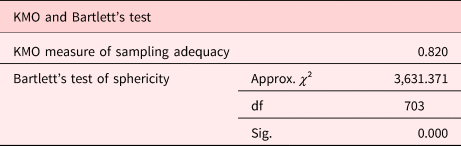
The computed KMO was 0.820 with a p-value of <0.001, indicating that the sample was large enough to perform a satisfactory principal component analysis with varimax rotation. The first step of the factor analysis was a principal component analysis (Table 2).
KMO measure and Bartlett's test results

Eigenvalues greater than 1 were used to determine the number of factors by factor analysis. There were not any cross-loadings. The analysis showed five factors with an eigenvalue of higher than 1 (Table 3). Factor loadings of 38 items were above 0.30 and ranged from 0.31 to 0.54. Principal components analysis was practiced to explain the variations in the total scale and its factors. The five factors jointly explained 39.18% of the variance.
Principal components analysis followed by varimax rotation, factor loadings, Cronbach's α, explained variance, and inter-item correlations of items of the scale

The first factor was found to be associated with the religious need subscale. This factor explained 11.79% of the variance. Item loadings for the first factor ranged from 0.35 to 0.50. The second factor was related to the finding meaning and purpose subscale. This factor explained 9.82% of the total variance, and Item loadings extended 0.31–0.48 in the factor. The third factor connected to the seeking peace subscale and explained 8.28% of the total variance. Item loadings for this factor ranged from 0.33 to 0.49. The fourth factor was the need to communicate and explained 5.26% of the total variance. Item loadings of this factor ranged from 0.33 to 0.54. The fifth factor was the support and independence. This factor explained 4.01% of the total variance and Item loadings extended 0.34–0.50 (Table 3).
Reliability
Internal consistency
The Spiritual Needs Assessment Scale was obtained to have an overall coefficient α of 0.85. α values of the five factors ranged from 0.52 to 0.79 (see Table 3). α values for the 38 items were 0.83–0.85, and coefficient α values were acceptable level. The corrected item-total correlations were acceptable, and the item-total correlations ranged from 0.12 to 0.53 for the 38 items, and the corrected item-total correlations were acceptable level.
Stability
The stability of the scale was determined by measuring the test–retest reliability, which was 0.72.
Discussion
The results of this study showed that the psychometric characteristics of the Turkish version of the “Spiritual Needs Assessment Scale of Patients with Cancer’ were promising. The panel review of the Turkish version of the scale showed that there is no need to change its translation and content. According to expert opinions, it can be said that the scale is suitable for the measurement purpose and represents the area to be measured. As a result of expert opinions and recommendations, the content validity criteria were met. In the present study, the KMO value is 0.820, and Bartlett's test of sphericity is significant p = 0.000. The KMO value is accepted as 0.60 medium, 0.70 good, 0.80 very good, and 0.90 excellent, a KMO value less than 0.50 indicates that factor analysis cannot be continued (Büyüköztürk, Reference Büyüköztürk and Büyüköztürk2012). Bartlett's test is used to determine the appropriateness of scale scores for factor analysis. If the p < 0.05 regarding the test statistics, the correlation matrix is considered to be suitable for the factor analysis (Bryman and Cramer, Reference Bryman and Cramer1999). In this study, both test results were found to be suitable for the literature. Hatamipour et al. (Reference Hatamipour, Rassouli and Yaghmaie2018) determined that in their study, the KMO measure of sampling adequacy was robust at 0.84 and Bartlett's test of sphericity was significant (χ 2 = 3787.006, p < 0.001), provided support for proceeding with factor analysis.
As a result of the factor analysis in this study, it was determined that there were five factors with an eigenvalue greater than 1. The five factors jointly explained 39.18% of the variance. In the Hatamipour et al. (Reference Hatamipour, Rassouli and Yaghmaie2018) study, five factors were accepted that express 48.2% of the variance. It was seen that the results of the research were compatible with each other. In this study, it was found that the item factor loads of the scale ranged from 0.31 to 0.54. The factor structure of the data is determined with the help of factor loadings. The factor structure of the data is determined with the help of factor loadings. To explain the structure, factor loads between 0.30 and 0.40 are defined as the lowest acceptable level loads, loads of 0.50 and above as application significance loads, and loads of 0.70 and above are defined as loads that can explain the structure well (Alpar, Reference Alpar2016). In this study, no item was removed from the scale, since the factor load of each item was above 0.30. Factor loadings were not reported in the original study of the scale.
In the present study, Cronbach's α coefficient of the scale was 0.85 (0.83–0.85). Cronbach's α of five factors were found to vary between 0.52 and 0.79. Hatamipour et al. (Reference Hatamipour, Rassouli and Yaghmaie2018), who developed the scale, found Cronbach's α coefficient of the scale to be 0.91. Cronbach's α of five factors were found to vary between 0.67 and 0.88 (Hatamipour et al., Reference Hatamipour, Rassouli and Yaghmaie2018). It is seen that the study results are similar. Cronbach's α coefficient takes a value varying between 0 and 1. It shows that as the value approaches 1, the items of the scale are consistent with each other and that the scale consists of items with the same feature (Kiliç, Reference Kiliç2016). In our study, since Cronbach's α value of the scale is 0.85, it shows that the items are consistent with each other and the internal consistency of the scale is high. The following results have been found in other scales to be developed to assess spiritual needs in the literature. Ismailoglu et al. (Reference Ismailoglu, Ozdemir and Erol2019) found Cronbach's α of the Spiritual Care Needs Inventory as 0.93. Büssing et al. (Reference Büssing, Recchia and Koenig2018) found that Cronbach's α of the Spiritual Needs Questionnaire (SpNQ) ranged from 0.71 to 0.81. As a result, the item reliability analysis of the scale was found to be acceptable level.
The test–retest reliability of the scale was 0.72. According to the results of this study, the construct validity of the scale was obtained. It is usual to state that measurements of repeatability for group comparisons should be at least 0.70 (Yang and Green, Reference Yang and Green2011; DeVellis, Reference DeVellis2012). The test–retest reliability was adequate for the scale and its subscales. According to the results of the analysis, the beliefs and attitudes of the substance abuse scale were reliable and valid.
Limitations
Our study was conducted with Muslim cancer patients. The results can be generalized to Muslim patients in our country, since all of the patients participating in the study are Muslim and patients of a different religion are not encountered. It is recommended that the reliability of the scale be tested in patients of different religions. In addition, our sample was conducted in a hospital center. It is recommended to investigate the suitability of the scale for larger populations.
Conclusion
As a result of this study, it has been found that the validity and reliability of the Turkish Spiritual Needs Assessment Scale of Patients with Cancer allow it to be used in Turkish-speaking Muslim cancer patients. This scale can be used by all healthcare professionals to assess the spiritual needs of patients with cancer. With this scale, the spiritual needs of the cancer patient can be determined and the care they need can be planned and applied.
Acknowledgments
The authors thank the participants who took part in the study.
Author contributions
We declare that H.A. and B.E. meet the authorship criteria and agreed with the content of the manuscript. B.E. particularly contributed to the study planning; data collection and data analysis were conducted by H.A. and B.E.. The preparation of the manuscript was conducted by all the authors.
Funding
No financial support was received for this study.
Conflicts of interest
The authors declare that they have no conflict of interest.