INTRODUCTION
The protozoan parasite Toxoplasma gondii can infect nearly all birds and mammals, including humans and livestock, worldwide (Dubey, Reference Dubey2010; Dubey et al. Reference Dubey, Lago, Gennari, Su and Jones2012; Xu et al. Reference Xu, Liu, Fu, Nisbet, Shi, He, Pan, Zhou, Song and Zhu2012). Toxoplasmosis, caused by T. gondii, is among the most prevalent parasitic diseases of humans and animals, and it has long been a major medical and veterinary problem. Toxoplasma gondii infection is currently incurable because the parasite can change from the rapidly replicating tachyzoite stage to the dormant bradyzoite/tissue cyst stages, and the latter are impervious to host immunity and also to drugs. The bradyzoites persist in the brains of infected hosts and convert to virulent tachyzoites when the immune system is impaired (Robert-Gangneux and Darde, Reference Robert-Gangneux and Darde2012; Rodriguez and Szajnman, Reference Rodriguez and Szajnman2012). Therefore, opportunistic infection with T. gondii is also seen in HIV-infected individuals where it can lead to lethal toxoplasmic encephalitis (Sibley and Boothroyd, Reference Sibley and Boothroyd1992; Lehmann et al. Reference Lehmann, Marcet, Graham, Dahl and Dubey2006; Olguin-Lamas et al. Reference Olguin-Lamas, Madec, Hovasse, Werkmeister, Callebaut, Slomianny, Delhaye, Mouveaux, Schaeffer-Reiss, Van Dorsselaer and Tomavo2011).
It has been reported that T. gondii infection can induce lifelong protective immunity against reinfection (Yu et al. Reference Yu, Xia, Liu, Liu, Ding and Zhang2007). Other studies have shown that reinfection, with a strain of different genotype to the original infection, can occur. As such, hosts which have been infected with the ME49 strain of T. gondii can be reinfected with the C56 and its variant form R-C56, and Ned (Type III) infected mice can be reinfected with PRU (Type II) strain. This phenomenon suggested that a primary toxoplasmosis infection cannot fully protect the host from secondary infection, which makes vaccination against T. gondii infection very challenging. Therefore, caution against infection should be exercised during pregnancy, even in putatively immune individuals (de Roever-Bonnet, Reference de Roever-Bonnet1969; Araujo et al. Reference Araujo, Slifer and Kim1997; Dao et al. Reference Dao, Fortier, Soete, Plenat and Dubremetz2001). It was known that different genotypes have different virulence in the host, although the differences between their genome sequences are surprisingly low (Khan et al. Reference Khan, Taylor, Ajioka, Rosenthal and Sibley2009). Toxoplasma gondii Type I strain shows high virulence in mice with an LD100=1 and this level of virulence may be associated with the death of AIDS patients (Howe and Sibley, Reference Howe and Sibley1995; Ajzenberg et al. Reference Ajzenberg, Banuls, Tibayrenc and Darde2002). Type II and III strains of T. gondii show low virulence in mice with an LD100⩾103. Type II strains are the principal strains causing toxoplasmosis of humans (Sibley and Boothroyd, Reference Sibley and Boothroyd1992). Therefore, there must be some regulatory mechanisms at the translation or post-translation level that influence the virulence of each genotype.
MicroRNAs (miRNAs) are a class of non-protein-encoding RNAs that regulate gene expression at the post-transcriptional level, resulting in post-transcriptional repression, cleavage or destabilization, and they are considered a key mechanism of gene regulation (Lewis et al. Reference Lewis, Burge and Bartel2005; Lim et al. Reference Lim, Lau, Garrett-Engele, Grimson, Schelter, Castle, Bartel, Linsley and Johnson2005; Wu et al. Reference Wu, Fan and Belasco2006; Zhang et al. Reference Zhang, Wang and Pan2007). MicroRNAs corresponding with Argonaute like protein (Tg-AGO) of T. gondii were identified, with 14 miRNA families found in the RH strain (Type I, ToxoDB10), and it was proposed that miRNAs are related to the virulence of different strains of T. gondii (Braun et al. Reference Braun, Cannella, Ortet, Barakat, Sautel, Kieffer, Garin, Bastien, Voinnet and Hakimi2010). To extend from this study, here we compared the expression profiles of miRNAs in 5 T. gondii strains representing 3 genotypes with different levels of virulence. Classical strains with high virulence (RH, Type I, ToxoDB10) (Reikvam and Lorentzen-Styr, Reference Reikvam and Lorentzen-Styr1976) and low virulence (PRU, Type II, ToxoDB1) (Dao et al. Reference Dao, Fortier, Soete, Plenat and Dubremetz2001; Yildiz et al. Reference Yildiz, Kul, Babur, Kilic, Gazyagci, Celebi and Gurcan2009), as well as 3 strains isolated from different provinces of China, namely TgXD (Type I, ToxoDB10) (Zhou et al. Reference Zhou, Sun, Yin, Yang, Yan, Yuan, Zhu and Zou2011), QHO (Type II, ToxoDB1) (Zhou et al. Reference Zhou, Zhang, Lin, Zhang, Song, Su and Zhu2009), and TgC7 (ToxoDB9) with unique genotype (Zhou et al. Reference Zhou, Zhang, Lin, Zhang, Song, Su and Zhu2009), were used in the present study.
MATERIALS AND METHODS
Ethics statement
All animals were handled in strict accordance with good animal practice according to the Animal Ethics Procedures and Guidelines of the People's Republic of China, and the study was approved by the Animal Ethics Committee of Lanzhou Veterinary Research Institute, Chinese Academy of Agricultural Sciences (Permit No. LVRIAEC2010-006).
Parasite strains
Highly virulent Type I-RH strain was kept and maintained in our own laboratory, cryopreserved in liquid nitrogen; low virulent Type II-PRU strain was provided by the Department of Parasitology, Xinxiang Medical University, Henan Province, China. Type I-TgXD strain isolated from pigs was provided by the Department of Parasitology, Huazhong Agricultural University, Hebei Province, China; Type II-QHO strain was isolated from a sheep in Qinghai Province, China; and the TgC7 strain was isolated from a cat in Guangdong Province, China by our group. Tachyzoites of all of the parasites were preserved in liquid nitrogen before use.
Collection of T. gondii tachyzoites
Tachyzoites of RH, TgXD, QHO and TgC7 strains were collected using conventional methods as described previously with slight modifications which can obtain purified suspensions of T. gondii tachyzoites from mouse peritoneal exudate with an average yield of 78% and average purity of 99·96% (Mirovsky and Valkoun, Reference Mirovsky and Valkoun1981; Jerome et al. Reference Jerome, Radke, Bohne, Roos and White1998). Briefly, tachyzoites of each genotype were intraperitoneally inoculated into specific-pathogen-free (SPF) grade Kunming mice that were 8 weeks old (from the Animal Center of Sun Yat-Sen University) and passaged for 3 generations to recover their activity and virulence. The mice were euthanized and the body cavity was washed with PBS solution (pH 7·2). The washing solution containing tachyzoites was collected and centrifuged for 15 min at 1200 g and the pellet washed 3 times. The pellet was digested with 10 mL of 0·25% trypsin at 37 °C for 20 min to remove host cells, and then centrifuged as previously described. Finally, the pellet was suspended in PBS, pipetted into 1·5 mL Eppendorf tubes, centrifuged and then the parasite pellet was preserved at −80 °C until use for total RNA preparation.
For the collection of tachyzoites from the low virulent PRU strain, the SPF mice were subcutaneously injected with 0·2 mg of dexamethasone (DSMS) every other day. One day after the third injection, the mice were peritoneally infected with 100–150 cysts of Type II-PRU and the injection schedule with DSMS was maintained. At the 9th day after infection, the mice were euthanized and tachyzoites were collected as described above.
Total RNA and small RNA isolation
In order to harvest total RNA for Solexa sequencing, the prepared tachyzoites were ground into a fine powder in a mortar and pestle with liquid nitrogen. Total RNA was then extracted from the powder using TRIzol Reagent according to the manufacturer's protocol (Invitrogen Co. Ltd). Small RNA isolation was performed as described previously (Lau et al. Reference Lau, Lim, Weinstein and Bartel2001). Briefly, 10 μg total RNA were used for the isolation of RNA fragments of 20–40 bases long using a Novex 15% TBE-Urea gel. The fragments were ligated to 5´ and 3´ adaptors (Illumina), reverse transcribed with an RT-PCR kit and purified using a 6% TBE PAGE gel. All the gels and kits for small RNA purification and amplification were purchased from Invitrogen Co. Ltd.
High-throughput sequencing and computational analysis
Samples prepared as described above were analysed using a process that we have described previously (Xu et al. Reference Xu, Liu, Nisbet, Cai, Yan, Lin, Yuan, Song, He and Zhu2010). First, nucleic acids were sequenced using a Solexa sequencer. Adaptor sequences and reads with low quality or those smaller than 17 nt were removed from the raw dataset. Non-coding RNA, such as rRNA, tRNA, snRNA, snoRNA, and other ncRNAs were removed by searching against the GenBank and Rfam databases (version 10.1) (http://rfam.sanger.ac.uk/). Repetitive sequences were removed using RepeatMasker (http://www.repeatmasker.org). Filtered reads were then mapped onto the genome of T. gondii (http://toxodb.org) using the Short Oligo nucleotide Analysis Package (SOAP). Novel miRNAs were predicted with Mfold (http://www.bioinfo.rpi.edu/applications/mfold) and evaluated by MirCheck. The precursor (hairpin) miRNAs were inspected manually to remove false predictions. The Toxoplasma transcripts for Tg-miRNA downloaded from NCBI and RNAhybrid were used to scan Toxoplasma transcripts for Tg-miRNA complementarity sites (Kruger and Rehmsmeier, Reference Kruger and Rehmsmeier2006). The functions of predicted targets were analysed with the GO database (the Gene Ontology, http://www.geneontology.org/) and DAVID database (http://david.abcc.ncifcrf.gov/). In addition, published studies focusing on miRNA function were used to inform molecular function in the present work.
Analysis of miRNA expression level
Modified stem-loop real-time RT-PCR (ABI PRISM® 7300 Sequence Detection System) was used as stem-loop primers can provide more specificity and sensitivity than linear primers (Chen et al. Reference Chen, Ridzon, Broomer, Zhou, Lee, Nguyen, Barbisin, Xu, Mahuvakar, Andersen, Lao, Livak and Guegler2005). All of the primers were synthesized by Shenggong Co, Ltd., China. Real-time quantitative PCR was performed in a 20 μL reaction. All reactions were carried out in triplicate. The alpha-tubulin gene of T. gondii (GenBank Accession No. M20024.1) was used as the endogenous control. The primer pairs for tubulin quantification were: forward primer: 5′-CAGGCAACAATGTGGCTA-3′; reverse primer: 5′- GTCCCGTAAACGCAATAAAC-3′. The cycle conditions were as follows: 95 °C for 5 min, followed by 30 cycles of 95 °C for 15 s, 65 °C for 30 s and 72 °C for 32 s. The quantification of each miRNA relative to alpha-tubulin gene was calculated using the equation: N=2−ΔCt, ΔCt=CtmiRNA−Cttubulin (Xu et al. Reference Xu, Liu, Nisbet, Cai, Yan, Lin, Yuan, Song, He and Zhu2010).
RESULTS
Profile characteristics of short RNAs
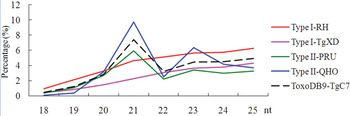
Deep sequencing by Solexa yielded 14·31–19·05 million reads respectively for the 5 strains of T. gondii, and all the data have been deposited in GEO of NCBI (http://www.ncbi.nlm.nih.gov/geo/) with accession number GSE45007. After filtering low quality reads, 3′ and 5′ adaptor contaminants, and reads smaller than 17 nt, the remaining reads were performed for length distribution analysis, which showed a high percentage of sRNA focused on 21 and 23 nt (Fig. 1). Then the reads were matched to the T. gondii genome sequence data (ToxoDB). It was found that 7·71 (55·85% of total reads), 10·82 (62·60%), 10·99 (61·64%), 10·42 (68·33%), 11·63 (63·58%) million reads were perfectly matched for the RH, TgXD, Pru, QHO and TgC7 strains, respectively.
Length distribution of small RNAs of 5 Toxoplasma gondii strains. Trend lines were used for each strain to show a clear changing tendency of reads length from 18–25 nt. It showed that most of the reads were focused on 21 and 23 nt. There were obvious differences in the length distribution of small RNAs among the examined T. gondii strains representing 3 genotypes.

The total percentage of non-coding RNA including rRNA, snRNA, snoRNA and tRNA were 14·72, 15·38, 25·23, 19·19 and 17·08% for RH, TgXD, PRU, QHO and TgC7, respectively. Comparison with mRNA data for highly expressed genes revealed that only 0·07–1·11% reads of the 5 strains came from intron of mRNA, which suggested that the sRNA fraction contained only a very low level of degradation products from longer mRNAs. The data were then searched against Repeat database to remove repeat sequences, which revealed 0–0·02% of total reads of the 5 strains.
Analysis of miRNA profiles of different genotypes
To find putative miRNA candidates, we used stringent criteria as follows: (1) the putative precursor of a miRNA showed standard stem-loop structure; (2) the dG energy (mfe) of the stem-loop structure is lower than −20 kcal/mol; (3) the mature miRNA was located at the 5′ or 3′ arm of the stem-loop structure of a precursor, instead of the loop position; (4) when applicable, precursors with mature miRNAs found at both of the 5′ and 3′ arms or a miRNA had more than one genomic locations were highly accepted. Based on these criteria, a total of 7, 15, 10, 12 and 10 miRNAs were found from the sRNA data of RH, TgXD, PRU, QHO and TgC7, respectively (Additional file 1 – in Online version only).
A distinguished character of miRNA profiles of different genotypes was that most of the miRNAs were located on the 3′ arms of their precursors. This phenomenon was particularly obvious in the Genotype I strains (RH and TgXD). For RH, no miRNA was found at the 5′ arms, and for TgXD, only 13·3% (2/15) was found at the 5′ arms; while for the Genotype II strains (PRU and QHO), they had more miRNAs located at the 5′ arms of their precursors, with percentages of 40% (4/10) and 75% (9/12), respectively. For TgC7, it showed similar character to that of Genotype I, with 20% (2/10) of miRNAs located at the 5′ arms. This phenomenon indicated a different expressing manner of miRNAs of different T. gondii genotypes, thus indicating a different regulation mechanism of gene expression among different genotypes.
The second character of miRNA profiles of different genotypes was that the copy numbers of all these miRNAs were small. The highest copy number was found at XD-miR-14 which had 171 copies, and it was followed by Pru-miR-8 and XD-miR-12 with 149 and 147 copies, respectively. Comparatively, for RH in another study, some miRNAs had higher copy numbers, as high as 280 723 (Braun et al. Reference Braun, Cannella, Ortet, Barakat, Sautel, Kieffer, Garin, Bastien, Voinnet and Hakimi2010). This might be due to the difference in living conditions. In that study, the parasite was kept in cells which were suitable for the living and development of the parasite. In the present study, the parasites were obtained from SPF mice which had immune attack and feedback inhibition to the parasite.
The third character of the miRNA profiles was that there were few precursors with mature miRNAs at both 5′ and 3′ arms. Among the 54 miRNAs found in the 5 strains, only 7 precursors showed this character (Additional file 1 – in Online version only, pink colour), which was consistent with that of Braun et al. (Reference Braun, Cannella, Ortet, Barakat, Sautel, Kieffer, Garin, Bastien, Voinnet and Hakimi2010). Interestingly, for Genotype I strains (RH and TgXD), no precursors with mature miRNAs at both 5′ and 3′ arms were found; while for Genotype II strains (PRU and QHO), 3 such precursors were found; and for strain TgC7 which represents a common genotype, only 1 such precursor was found.
Comparison of miRNA profiles
The miRNAs of different strains were first compared with miRNAs found in another study of RH strains, where 14 miRNA families were found (Braun et al. Reference Braun, Cannella, Ortet, Barakat, Sautel, Kieffer, Garin, Bastien, Voinnet and Hakimi2010). The results revealed that, except for the TgC7 strain, the miRNA dataset of the other 4 strains were only mapped with known miRNA of the tg-miR-4 family (Additional file 2 – in Online version only). For RH strains in the present study, two miRNAs (RH-miR-6-3p and RH-miR-7-5p) were perfectly matched, and for the other 3 strains including TgXD (XD-miR-18-3p), PRU (Pru-miR-9-3p) and QHO (QHO-miR-10-5p), only 1 miRNA was matched. For TgC7 strain, no hit was found.
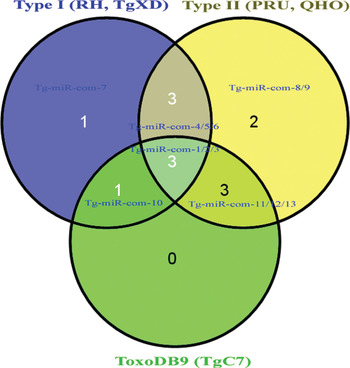
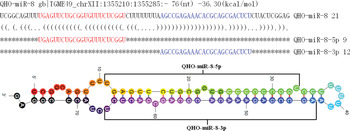
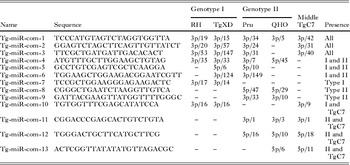
The miRNAs of different strains were then compared with each other. In total, 13 miRNAs were found to be shared in different T. gondii strains (Table 1). Among them, three miRNAs was found in the 3 genotypes (Tg-miR-com-1, Tg-miR-com-2, Tg-miR-com-3); and another 3 miRNAs was found in genotype I and genotype II (Tg-miR-com-4, Tg-miR-com-5, Tg-miR-com-6). One was genotype I specific (Tg-miR-com-7) and two were genotype II specific (Tg-miR-com-8 and Tg-miR-com-9). The remaining 4 were found in genotype I and the specific type (TgC7) or II and the specific type (TgC7) (Fig. 2). In addition to the common miRNAs, 19 miRNAs were considered strain specific (Additional file 3 – in Online version only), including one for RH, 7 for TgXD, one for PRU, 6 for QHO and 4 for TgC7 strains. Almost all of the precursors which had mature miRNAs located on the 5′ arms belonged to genotype II, except the XD-miR-6-5p. A standard stem-loop structure of miRNA is shown in Fig. 3, with QHO-miR-8 as an example.
Pie chart for the 13 commonly shared miRNAs between different genotypes of Toxoplasma gondii.

A standard stem-loop structure of miRNA precursor using QHO-miR-8 as an example. The mature miRNA from the 5′ arm is marked in red, and mature miRNA from the 3′ arm of the precursor is in blue. Homologues of mature miRNA (members of each miRNA family) are not shown.

The presence of miRNAs in the 5 strains

Note: Tg-miR-com: the common miRNA coming from different strains had different names, therefore, in this form they were renamed to the same name; 3p/19: means a miRNA detected was located at the 3′ arm of the precursor with 19 copies. It can be seen that most of the miRNAs originated from the 3′ arm of a precursor and all of the miRNAs had low copy numbers.
Target prediction and functional analysis
The commonly expressed miRNAs as well as strain-specific miRNAs were then analysed to predict putative targets. The RNAhybrid was used to scan Toxoplasma transcripts for Tg-miRNA complementary sites. In order to avoid false positives, two stringent match criteria were used: (1) the match energy was set as lower than −25 kcal/mol; (2) the P value was set as lower than 0·01. Under such conditions, 1147 targets were found for the 5 strains (Additional file 4 – in Online version only). Twelve commonly expressed miRNAs shared 197 targets, and one commonly expressed miRNA named Tg-miR-com-13 had no target. Four miRNAs had more than 100 targets, including Pru-miR-3-3p (105), QHO-miR-1-5p (156), QHO-miR-6-5p (185) and QHO-miR-8-5p (100). The structures of the best matched miRNA-targets are shown in additional file 4 – in Online version only, which revealed a complete or nearly complete complementary relationship of miRNAs with their targets. This was consistent with results of a previous study (Braun et al. Reference Braun, Cannella, Ortet, Barakat, Sautel, Kieffer, Garin, Bastien, Voinnet and Hakimi2010). This study found that the complementary relationship of miRNA with its target was complete or nearly complete in T. gondii; and it was similar to the miRNA-target relationship of plant and fungi, but not the same as that of animals where the complementary is not so complete. Functional analysis showed that these targets were mostly focused on catalytic activity (191 targets), such as hydrolase activity (73), transferase activity (65) and isomerase activity (20); followed by binding activity with 183 targets, including ion binding (62), nucleic acid binding (57) and protein binding (29). Detailed information is shown in additional file 5 – in Online version only.
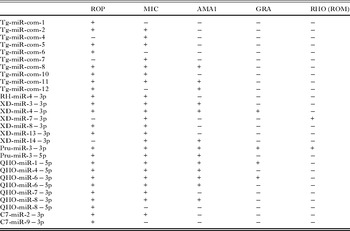
Furthermore, 5 kinds of proteins, including ROP (Rhoptry Protein) (Boothroyd and Dubremetz, Reference Boothroyd and Dubremetz2008), MIC (Microneme Protein) (Huynh et al. Reference Huynh, Harper and Carruthers2006), AMA1 (Apical Membrane Antigen 1) (Tyler et al. Reference Tyler, Treeck and Boothroyd2011), GRA (Dense Granule Antigen Protein) (Nam, Reference Nam2009), RHO (Rhomboid-Like Protease, ROM) (Dowse and Soldati, Reference Dowse and Soldati2005) which are closely related to the virulence or invasion of T. gondii, were specifically analysed (Table 2). It was found that most of the commonly shared miRNAs and strain-specific miRNAs had targets focused on ROP and MIC. For RH and TgXD strains (Genotype I), they had few miRNAs focusing on AMA1, GRA and RHO. For Pru and QHO strains (Genotype II), they had more miRNAs targeting AMA1 and GRA, which was markedly different from Genotype I strains. For the strain TgC7 (a special genotype), its miRNAs were also focused on ROP and MIC, but not on AMA1, GRA and RHO. This character was also similar to the character of Genotype I strains. Another distinguished character that should be noted was that the virulence-related factors were mostly regulated by miRNAs located at 3′ arms of their precursors. Although two miRNAs with both 5′ and 3′ were found (Table 2), miRNAs from 3′ arms had more targets than 5′ arms.
MicroRNA target related to representative virulence proteins

Note: +: related to; −: not related to; ROP: rhoptry protein; MIC: microneme protein; AMA1: Apical Membrane Antigen 1; GRA: Granule Antigen Protein; RHO (ROM): Rhomboid-Like Protease.
MicroRNA quantification analysis
To evaluate the relative expression levels of different miRNAs, 8 miRNAs, including 1 of RH, 2 of QHO and TgC7 each, and 3 of PRU, were randomly selected and examined with modified stem-loop RT-PCR. The tubulin gene of T. gondii (GenBank Accession No. M20024.1) was used as inner reference gene. Four miRNAs were found to be in a similar expression level, including C7-miR-1 (2·07±0·34), C7-miR-7 (1±0·15), PRU-miR-6 (1±0·07), and QHO-miR-3 (1·68±0·12). Some miRNAs had higher expression levels, including PRU-miR-8 and QHO-miR-10, which had copy numbers of 147 and 45, and corresponded with 90·92±10·06 and 56·78±0·93 times higher than that of the tubulin gene, respectively. The expression level of the other two miRNAs, RH-miR-1 and PRU-miR-7, which had 17 and 48 copies, were 42·95±6·17 and 4·7±0·53 times higher than that of the reference gene, respectively.
DISCUSSION
Comparison of the miRNA profiles of different genotypes showed a distinguished character of the miRNAs of the 5 strains, in that most of the miRNAs were located on the 3′ arms, instead of the 5′ arms of their precursors. Although the copy numbers of mature miRNAs from the 3′ arms were not high, they were normally higher than the miRNAs from the 5′ arms if these existed. This phenomenon was especially distinct in miRNAs with virulence or invasion proteins such as ROP, MIC and AMA1 as targets. In another study of miRNAs of T. gondii Type I strain, it was found that most of the miRNAs came from the 5′ arms of their precursors (Braun et al. Reference Braun, Cannella, Ortet, Barakat, Sautel, Kieffer, Garin, Bastien, Voinnet and Hakimi2010), unlike our present study, although the same reference genome was used in these two studies (ToxoDB.org). The most likely reason for this phenomenon might be the different living conditions. In the present study, parasites were cultured and harvested from the mammal host (mice), while RH strain was kept in living cells in the study of Braun et al. (Reference Braun, Cannella, Ortet, Barakat, Sautel, Kieffer, Garin, Bastien, Voinnet and Hakimi2010). Parasites will encounter and have to deal with the immune system of the host, which may result in different miRNA and gene expression patterns.
In the present study, we obtained 7–15 mature miRNAs from the 5 examined T. gondii strains, respectively, which were consistent with the studies of Braun et al. (Reference Braun, Cannella, Ortet, Barakat, Sautel, Kieffer, Garin, Bastien, Voinnet and Hakimi2010) who found 14 miRNAs from the T. gondii RH strain. In another study, 336 and 201 miRNAs respectively were identified from the T. gondii RH and ME49 strains, among which more than 99% of the miRNAs were species-specific (Wang et al. Reference Wang, Liu, Jia, Lu, Peng, Piao, Hou, Cai, Yin, Jiang and Chen2012). Because miRNA expression is very sensitive to environmental changes of cells or organisms, the most likely reason for the differences in numbers and mapping might be the differences in strains and experimental conditions. For example, only 1 and 7 miRNA families of Braun et al. (Reference Braun, Cannella, Ortet, Barakat, Sautel, Kieffer, Garin, Bastien, Voinnet and Hakimi2010) were matched with that found in the present study and that of Wang et al. (Reference Wang, Liu, Jia, Lu, Peng, Piao, Hou, Cai, Yin, Jiang and Chen2012), respectively. This is interesting and might indicate the complex expression patterns of miRNAs among different T. gondii genotypes.
Comparative analysis of miRNA profiles of different T. gondii genotypes showed that, for the 13 miRNAs that were shared by 2 or more strains, there was no marked bias in the distribution of particular miRNAs. For example, for the 3 miRNAs that were shared by all of the 3 genotypes, only 1 (Tg-miR-com-1) was shared by all of the 5 strains, while the other 2 (Tg-miR-com-2 and Tg-miR-com-3) were only shared by 4 strains, with the exception of the QHO strain. More miRNAs were strain-specific. On the other hand, despite being shared or strain specific, some of them had a higher number of targets (Additional file 4 – in Online version only). Besides, most of the miRNAs were focused on some virulence proteins of T. gondii as targets. This might indicate that there was a complex regulating mechanism of gene expression in each genotype and strain, but proteins about virulence and invasion are their key and fundamental targets. Therefore, we proposed that difference in miRNAs profiles of different T. gondii genotypes are related to their difference in virulence, as indicated by Braun et al. (Reference Braun, Cannella, Ortet, Barakat, Sautel, Kieffer, Garin, Bastien, Voinnet and Hakimi2010). In addition, it is likely that one virulence or invasion factor might be controlled by several miRNAs. This might be the reason why there are few reports about successful gene-silencing by RNAi in T. gondii.
In conclusion, the present study characterized comparatively the miRNA profiles of 3 different genotypes of T. gondii, identified genotype-shared miRNAs and strain-specific miRNAs, and found that they had a large numbers of targets with most of them being focused on some key proteins relating to virulence and/or invasion. Thus difference in miRNAs profiles of different T. gondii genotypes may be related to their virulence. To our knowledge, the present work represents the first comparative study of the global miRNA profiles of different T. gondii genotypes.
FINANCIAL SUPPORT
Project support was provided, in part, by the National Natural Science Foundation of China (Grant nos. 31230073, 31172316, 31228022 and 31101812), the International Science and Technology Cooperation Program of China (Grant no. 2013DFA31840), the International Science and Technology Cooperation Project of Gansu Province (Grant no. 1204WCGA023) and the Science Fund for Creative Research Groups of Gansu Province (Grant no. 1210RJIA006).