The wind dispersal of a plant propagule is likely to be improved by any structure that increases air resistance, e.g. the pappus of the achene of Asteraceae, the wings of Acer or dipterocarp fruits, or the plumose seed appendage which is characteristic of species of the subfamily Tillandsioideae in the Bromeliaceae. Not surprisingly then, promotion of airworthiness is usually assumed to be the primary function of this so-called ‘coma’ found in epiphytic Werauhia, Tillandsia, Guzmania or Catopsis species (Benzing Reference BENZING1980, Reference BENZING2000). However, the diverse structure of coma hairs with bifurcate cross-walls or hooks also assists in sticking to rough surfaces, such as tree bark and rocks, which indicates another important function: keeping seeds in place until germination and the development of roots (Benzing Reference BENZING2000, Palací et al. Reference PALACÍ, BROWN and TUTHILL2004). Multiple rather than singular functions of seed plumes or pappi have also been shown for soil-rooted plants in other plant families, where these structures are not only highly efficient for wind dispersal, but also for attachment to animal fur (Couvreur et al. Reference COUVREUR, CHRISTIAEN, VERHEYEN and HERMY2004).
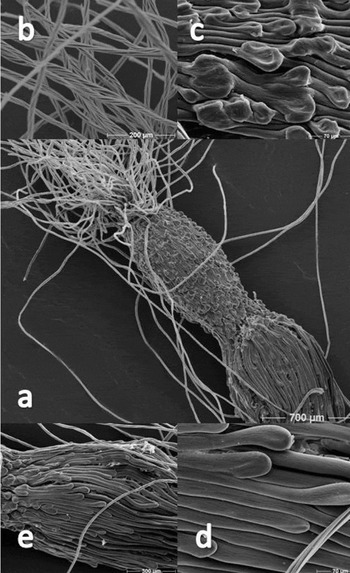
Coma hairs in the Tillandsioideae can be distinguished due to location and genesis. In most genera, e.g. Guzmania, Tillandsia or Vriesea, the appendages constitute cell rows derived from longitudinal splitting of the outer integument, which remain attached to the basal part of the seed, i.e. near the micropyle. Being believed to promote wind dispersal, the structure is often called a ‘flight apparatus’ (Benzing Reference BENZING2000). The apical part of the coma, at the chalazal end of the seed, extends with a short plume and sometimes consists of no more than a short, membranous hood (Benzing Reference BENZING2000, Szidat Reference SZIDAT1922). In Catopsis, in which the coma is formed of separate rows of multicellular hairs, the basal coma is short and densely packed, resembling a small, pointed tuft (Figure 1a, d, e), and the flight apparatus is found at the apical extreme (Figure 1a, b; Gross Reference GROSS1988, Reference GROSS1992; Palací et al. Reference PALACÍ, BROWN and TUTHILL2004). These characteristics distinguish Catopsis from all other genera in the family (Palací et al. Reference PALACÍ, BROWN and TUTHILL2004).
SEM photographs of a Catopsis sessiliflora seed. Habit of the seed with apical coma forming the flight apparatus on the left and basal coma on the right (a), detail of apical coma hairs (b), seed coat completely covered with short coma hairs (c), basal coma (d), and detail of basal coma hairs illustrating the wick-like structure (e).

Whereas seed morphology and anatomy are generally well studied in the species-rich Bromeliaceae (Benzing Reference BENZING2000, Gross Reference GROSS1988, Reference GROSS1992; Müller Reference MÜLLER1895, Palací et al. Reference PALACÍ, BROWN and TUTHILL2004, Szidat Reference SZIDAT1922), seed ecology has received relatively little attention. There are, for example, few studies that address germination in an ecophysiological context (Bader et al. Reference BADER, MENKE and ZOTZ2009, Goode & Allen Reference GOODE and ALLEN2009, Mantovani & Ricardo Rios Reference MANTOVANI and RICARDO RIOS2008), or deal with the possible deterministic effect of species-specific differences in dispersal and germination characteristics for community composition (Benzing Reference BENZING1978, Bernal et al. Reference BERNAL, VALVERDE and HERNANDEZ-ROSAS2005, Cascante-Marín et al. Reference CASCANTE-MARÍN, WOLF, OOSTERMEIJER and DEN NIJS2008). No information is available at all about the aerodynamic properties of bromeliad seeds, which contrasts with the wealth of detailed studies of this aspect in anemochorous diaspores of other large families such as Orchidaceae or Asteraceae (Arditti & Ghani Reference ARDITTI and GHANI2000, Murren & Ellison Reference MURREN and ELLISON1998, Sheldon & Lawrence Reference SHELDON and LAWRENCE1973).
The current report deals with an aspect of the water relations of seeds of epiphytic Catopsis species. Seeds of this genus have features that facilitate dispersal (flight apparatus) and attachment (coma hairs with terminal hooks), but observations during germination experiments with seeds of Catopsis sessiliflora (R. & P.) Mez suggested a third function of coma hairs. When watering seeds, the apical coma hairs in C. sessiliflora performed like a wick by soaking up water almost instantaneously. The water was quickly transferred to the seed and the outer seed coat. From these initial observations we hypothesized that tuft-like basal coma hairs facilitate the water supply of seeds by gathering and storing water. This should result in a higher percentage of germinating seeds and faster germination rates in comparison to seeds without basal coma hairs. Remarkably, a similar suggestion by Szidat (Reference SZIDAT1922) for other bromeliad species has never been followed up. Now, almost a century later, we provide experimental evidence that supports this notion.
Seed capsules of Catopsis sessiliflora were collected from several plants growing in Annona glabra trees in the Barro Colorado Nature Monument in Panama in June 2009 and transferred to Germany. Seeds were stored at room temperature and c. 30% relative humidity in a dark closet until the start of experiments 6 mo later.
In six randomly chosen seeds, basal coma hairs were carefully removed under a stereo microscope using a scalpel and forceps. Another six seeds that served as control were randomly chosen and left intact. All seeds were put on filter paper (MN 651, 82 mm diameter, Macherey-Nagel, Germany; resolution 0.1 μg) in a plastic Petri dish and watered with 1 ml of de-ionized water. The Petri dish was closed with its lid and placed in a climate chamber (Economic Delux, Snijders Scientific, Tilburg, The Netherlands) at 25 °C and approximately 60% rH. After 1 d the Petri dish was opened and left until filter paper and seeds were dry. Then each seed was placed on a balance pan (micro M2P, Sartorius, Göttingen, Germany) in such a way that the flight apparatus hairs were attached to a piece of adhesive tape that was placed on the pan. This left the seed hanging freely with no contact point to any part of the balance. First, the dry weight of the attached seed was measured. Immediately afterwards a drop of de-ionized water hanging from a pipette was allowed to touch the basal coma hairs, or in the case of seeds in which the coma was removed, the seed itself for 10 s. Water was soaked up by the seed immediately and seed weight was measured again.
To study the impact of the basal coma hairs on seed water loss, six seeds were randomly chosen and basal coma hairs removed as described above; six unmanipulated seeds served as controls. Seeds were put in a Petri dish filled with de-ionized water and left for 24 h to saturate. For determining the time that it took the water to evaporate, a soaked seed was placed on a balance (micro M2P, Sartorius, Göttingen, Germany) and initial weight was recorded. Every 30 s the seed weight was recorded until no further decrease in weight could be observed. In addition, a drop of 1 ml of water was put on the balance to determine the time course of free evaporation. The experiment was carried out under laboratory conditions of 22 °C and 30% rH.
A total of 480 Catopsis sessiliflora seeds were randomly chosen from the batch of collected seeds. For facilitation of further handling the apical flight-apparatus hairs were clipped off with scissors. The basal part of the coma was removed in one group and left intact in the controls. Seeds were then sterilized in 70% ethanol for 2 min followed by 40 min immersion in a solution of 2.5% NaClO and two drops of Tween 20. Subsequently, seeds were rinsed in sterile water twice for 5 min. Seeds were put on creped filter paper (82 mm diameter) in a plastic Petri dish (90 mm in diameter) and watered with de-ionized water. Three Petri dishes with 20 seeds each were set up per water treatment. Seeds were stored in lid-closed Petri dishes to avoid rapid desiccation and contamination and placed in the same climate cabinets as above that were programmed to run a 12-h day/12-h night cycle. PFD was 200 μmol m−2 s−1 and relative humidity c. 60%. Four water treatments (WT) were used: WT1 seeds were continuously supplied with water by initially filling the Petri dishes with 1 ml of de-ionized water and refilling of 0.5 ml every 2 d to replenish water loss by evaporation. In WT2 seeds were watered every day with 1 ml of water and exposed to short periods of drought by opening Petri dishes in the morning for 3 h. It took about 1 h for the filter paper to dry out so that seeds experienced a drought period of at least 2 h. In WT3 seeds were watered with 1 ml and Petri dishes opened for 7 h to achieve c. 6 h of drought. Finally in WT4 each Petri dish with seeds was given 1 ml of water and Petri dishes opened the following day for 22 h, and rewatered the day after. Petri dishes in all treatments but WT1 were given 1 ml of de-ionized water after the drought period and watering procedures were repeated accordingly until the end of the germination experiment. Progress of germination was monitored daily under a stereo microscope. The duration of the experiment was 22 d. After germination, we continued to cultivate emerging seedlings under the same conditions as during germination for a period of 6 wk. Seedlings remained attached to the seed coat for the entire period. Seedling size was determined as the length of the longest leaf as an indicator of growth. All analyses were done with R Version 2.11.1 (R Development Core Team, Vienna).
Intact seeds of Catopsis sessiliflora showed a higher potential for storing water than seeds in which the tufted basal coma hairs had been removed. In intact seeds the stored water was equivalent to 65.5% ± 10.8% (mean ± SD, n = 6) of seed dry weight, more than twice the amount of water observed in manipulated seeds (25.9% ± 12.9% dry weight; t-test, t = 5.8, P < 0.001). Apparently, the densely packed basal coma hairs act like a wick with a large number of crevices and lumina in contrast to the relatively even seed surface (Figure 1a, c).
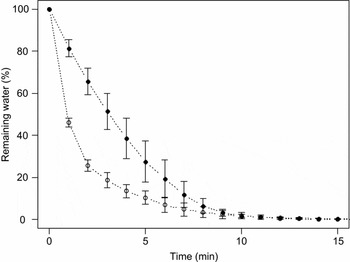
Water was not only taken up at a higher rate, it was also released more slowly (Figure 2). Given the experimental conditions, under which we studied the loss of water from seeds that had been allowed to saturate, it took c. 4 min for 90% of a drop of distilled water to evaporate. It took only slightly longer for a seed without coma to lose the same proportion of the water it had taken up (c. 5 min, Figure 2), but almost twice as long (more than 7 min) for the intact seed.
Evaporation from water-saturated seeds of Catopsis sessiliflora with intact coma (closed symbol) and seeds where basal coma hairs were removed (open symbol). Data are mean ± SE, n = 6.

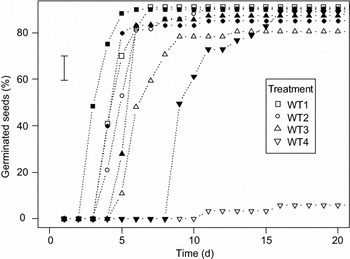
Intact seeds germinated consistently faster than seeds without basal coma hairs in all four water-supply treatments (Figure 3), but the final proportion of seeds that germinated after 3 wk in manipulated seeds and controls differed only in the driest treatments. Under the driest experimental conditions (WT4), final germination success was dramatically reduced to < 10% in seeds without coma, while controls reached a level of c. 90%. The significant interaction between water-supply treatment and presence of coma (two-way ANOVA, F3,19 = 24.1, P < 0.001) was exclusively due to the low germination success of the WT4 seeds without coma (Tukey HSD test, P < 0.05).
Time courses of germination of Catopsis sessiliflora seeds under four different water regimes from continuous supply (WT1) to driest conditions (WT4). Open symbols represent seeds without basal coma, closed symbols represent controls. Data are means of three batches of 20 seeds. No error terms are shown for clarity – the average SD is indicated in the upper left corner (10.4%).

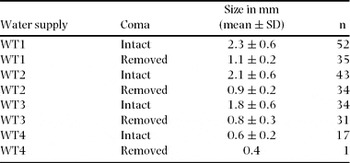
The presence of a coma continued to show an effect during early seedling growth: mean seedling size after 6 wk in seedlings, in which the coma had been removed, generally reached less than 50% of controls. Again, the driest treatment had the most dramatic effect. With one exception, all seedlings in which the tufted basal coma hairs had been removed died (Table 1). Apparently, the presence of the coma provided a more stable, moist environment around the emerging seedling which facilitated more continuous and vigorous growth.
Mean plant size of Catopsis sessiliflora seedlings 6 wk after germination that were subjected to different watering treatments. Water supply decreased from continuously supplied (WT1) to 22 h drought per 48 h (WT4). For more details see main text. A two-way ANOVA showed that both water supply (F3,242 = 40.2, P < 0.001) and presence of the basal coma (F1,242 = 349, P < 0.001) had a highly significant effect on final seedling size.

Although the function of the coma in bromeliad seeds is usually seen in promoting seed mobility and attachment to a substrate (Benzing Reference BENZING2000), our study provides quantitative evidence that the tufted basal coma hairs typical for the genus Catopsis may also be relevant for the water relations of germinating seeds and, even more remarkably, emerging seedlings. Since water supply is arguably the most critical aspect of the ecology of vascular epiphytes, particularly during the early stages of ontogeny (Zotz et al. Reference ZOTZ, HIETZ and SCHMIDT2001), this functional aspect may be ecologically very important. Catopsis sessiliflora frequently grows on twigs in the outer canopy of the forest of moist forests in Panama (Zotz & Schultz Reference ZOTZ and SCHULTZ2008), where water supply even in the rainy season is highly fluctuating. Under such conditions, prolonging the time until a seed or a seedling loses the water that superficially adheres to it after a rain event, even for just a few minutes, may be highly critical for successful establishment. The demonstration of higher water retention in intact seeds and slower release of externally stored water alone (Figure 2) are no proof of functional significance (compare Szidat Reference SZIDAT1922) because it remains unclear whether living tissue can actually take advantage of this external water. However, the results of the germination experiment and the growth experiment with small seedlings, which were still physically connected to the seed coat, are strong evidence for the proposed function. The significant differences in the time to germination in the driest treatment between plants without the basal coma hairs and controls (Figure 3), or in growth and survival of the emerging seedlings under the same stressful conditions (Table 1) indicates that this morphological structure may be crucial for this species to get established under the very dry conditions of the periphery of tree crowns.
ACKNOWLEDGEMENTS
We thank the Republic of Panama for making its natural resources available for study (permit SEX/ P-13-09). Silvia Kempen's (Oldenburg) technical help with the experiments and Imke Notholt's (Oldenburg) help with the SEM photographs are acknowledged.