Introduction
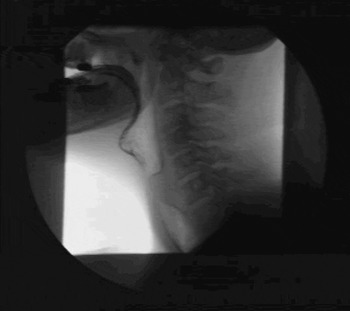
Surgical voice restoration, in the form of tracheoesophageal puncture and a one-way valve prosthesis, is now performed in the vast majority of patients undergoing laryngectomy. One of the main causes of failure to achieve good voice using this technique is an inability to achieve relaxation of the pharyngoesophageal segment (Figure 1).Reference Singer and Blom1, Reference Sloane, Griffin and O'Dwyer2 Perry described a spectrum of pharyngoesophageal segment tonicity, and demonstrated that patients with severe hypertonia (32–72 mmHg) or spasm (38–100 mmHg) were likely to have poorer voice. There is wide variation in the reported incidence of tracheoesophageal voice failure due to pharyngoesophageal spasm. Singer and Blom described an incidence of 12 per cent, while others have reported figures of between 7.3 and 79 per cent.Reference Singer and Blom1, Reference Ramachandran, Arunachalam, Hurren, Marsh and Samuel3, Reference Baugh, Lewis and Baker4 It is thought that airflow-induced spasm is the primary cause of sustained hypertonicity in this segment, preventing adequate airflow through the pharynx and hence causing poor voice.Reference Singer and Blom1, Reference Chodash5
Videofluoroscopy showing hypertonic pharyngoesophageal segment.

Traditionally, surgical treatments (including further myotomy of the pharyngeal constrictors, myectomy, dilatation or pharyngeal plexus denervation) have been the mainstay in the management of this problem. However, many studies have explored the possibilities of chemical denervation of the pharyngeal constrictor muscles with botulinum toxin, in order to allow fluent voice without the potential complications of a surgical procedure.
Mechanism of action
Botulinum toxin type A is produced by the bacterium Clostridium botulinum and is a potent neurotoxic agent. Botulinum toxin exerts its neurotoxic effects by preventing the release of acetylcholine at the neuromuscular junction. The toxin consists of a heavy and light chain linked by a disulphide bond. Normal release of acetylcholine from the pre-synaptic nerve terminal is mediated by a group of molecules known as the SNARE (Soluble NSF Attachment Protein Receptor) proteins. Botulinum toxin light chain cleaves these proteins, preventing acetylcholine release and subsequent neuromuscular transmission. The blockade is dose-dependent, and there is no alteration of the electrical conductivity of the nerve.Reference Sellin6 The chemical blockade that results is temporary, with nerve impulse transmission returning to normal three to nine months after exposure.Reference Blitzer, Brin, Greene and Fahn7
Botulinum toxin preparations
Two different preparations of botulinum toxin type A are clinically available. Botox® (Allergan Pharmaceuticals, Irvine, California, USA) is more commonly used in the USA, whilst Dysport® (Ipsen, Slough, UK) is available in the UK and Europe. Botox is available in 100 unit vials, whereas Dysport is distributed in 500 unit vials. Botox is approximately three to four times more potent on a per unit basis, and this is reflected in the doses used to generate a similar clinical effect.Reference Ranoux, Gury, Fondarai, Mas and Zuber8–Reference Sampaio, Ferreira, Simões, Rosas, Magalhães, Correia, Bastos-Lima, Martins and Castro-Caldas10 Both preparations are reconstituted by dilution with saline. Dilution techniques are based largely on personal preference; however, theoretically, more concentrated solutions reduce reliability in delivering a specific unit dose, and more dilute solutions lead to greater diffusion of the toxin.
Botulinum toxin is used in many different clinical scenarios in the head and neck, including focal dystonias, spasmodic dysphonia and post-operative complications such as Frey's syndrome.Reference Blitzer and Sulica11–Reference Eckardt and Kuettner13 Its use in the primary treatment of pharyngoesophageal hypertonicity following laryngectomy has been documented over the last 10 to 15 years.
This systematic review aims to explore the evidence behind the use of botulinum toxin in post-laryngectomy voice restoration, to assess the outcome measures utilised and to discuss the possible benefits of this treatment modality.
For the purpose of this review, the terms pharyngoesophageal hypertonicity and spasm are used interchangeably (as noted in the literature) as indicators for the use of botulinum toxin.
Methodology of review
A Medline literature review (1966 to January 2009) was conducted using the following search terms: ‘botulinum toxin and speech’, ‘botulinum toxin and laryngectomy’ and ‘botulinum toxin and voice’. The titles and abstracts of the articles thus retrieved were screened for adherence to the inclusion and exclusion criteria.
In addition, a search of the Cochrane database was performed. We also screened the bibliographies of collected papers and our personal archives for references pertaining to the use of botulinum toxin in laryngectomy patients. The full text of articles fulfilling the inclusion criteria, and those containing ambiguous abstracts, underwent further analysis. Only articles published in English were scrutinised.
Inclusion criteria
We included articles describing case series or trials in which botulinum toxin was used in patients who had documented voice failure following laryngectomy.
Exclusion criteria
We excluded articles describing voice problems in patients who had not undergone laryngectomy, those involving animal studies and those that did not fully explain their outcome measures.
Results of review
A total of nine published studies were identified from the literature review, dating from between 1995 and 2008.Reference Ramachandran, Arunachalam, Hurren, Marsh and Samuel3, Reference Hoffman, Fischer, VanDenmark, Peterson, McCulloch and Karnell14–Reference Chone, Teixeira, Andreollo, Spina, Barcellos and Quagliato21 The majority of authors were from North American institutions, with only one paper originating from a UK institution. The nine papers described a total of 134 patients with documented speech failure post-laryngectomy who were treated with botulinum toxin.
As expected from the total number of patients treated, we identified no randomised, controlled trials. Six of the nine studies were prospectiveReference Ramachandran, Arunachalam, Hurren, Marsh and Samuel3, Reference Blitzer, Komisar, Baredes, Brin and Stewart15, Reference Zormeier, Meleca, Simpson, Dworkin, Klein and Gross17–Reference Lewin, Bishop-Leone, Forman and Diaz19, Reference Chone, Teixeira, Andreollo, Spina, Barcellos and Quagliato21 and three were retrospective.Reference Hoffman, Fischer, VanDenmark, Peterson, McCulloch and Karnell14, Reference Crary and Glowasky16, Reference Hamaker and Blom20
Confirmation of pharyngoesophageal segment spasm
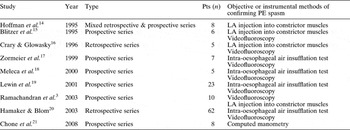
In addition to the subjective finding of failure to achieve good tracheoesophageal voice, all of the studies performed objective and/or instrumental measurement to confirm hypertonicity or spasm of the pharyngoesophageal segment. Taub and Spiro and Lewin et al. have previously described an air insufflation test to predict post-laryngectomy voice failure.Reference Taub and Spiro22, Reference Lewin, Baugh and Baker23 Four of the nine papers identified used this test as part of objective assessment prior to botulinum toxin injection.Reference Zormeier, Meleca, Simpson, Dworkin, Klein and Gross17–Reference Hamaker and Blom20 Further objective measurement is possible using videofluoroscopy, which allows visualisation of the vibratory segment (after being coated in an opaque medium). Seven of the papers used this method.Reference Ramachandran, Arunachalam, Hurren, Marsh and Samuel3, Reference Blitzer, Komisar, Baredes, Brin and Stewart15–Reference Hamaker and Blom20 Chone et al. described the use of computed manometry as an objective measure of pharyngoesophageal spasm.Reference Chone, Teixeira, Andreollo, Spina, Barcellos and Quagliato21 Several authors described the use of local anaesthetic infiltration into the constrictor muscles with resultant improvement in tracheoesophageal puncture voice as a confirmatory step prior to botulinum toxin injection (Table I).Reference Ramachandran, Arunachalam, Hurren, Marsh and Samuel3, Reference Hoffman, Fischer, VanDenmark, Peterson, McCulloch and Karnell14–Reference Crary and Glowasky16
Summary characteristics of studies using botulinum toxin for post laryngectomy voice restoration

Pts = patients; PE = pharyngoesophageal; LA = local anaesthetic
Dosage and method of injection
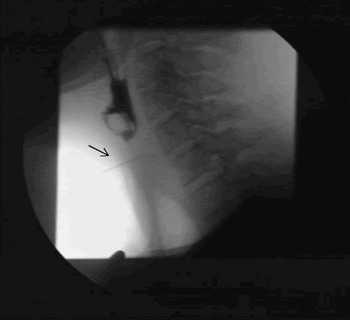
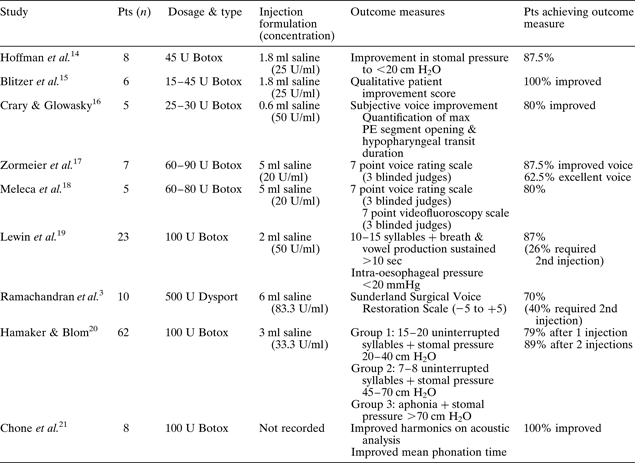
There did not appear to be a consensus on the dosage of botulinum toxin used for post-laryngectomy voice restoration; reports described the injection of between 15 and 100 units of Botox. Hoffman et al. used 15 units of Botox®, injected unilaterally at three sites, to achieve a total dose of 45 units along the pharyngoesophageal segment, correct positioning confirmed by a videofluoroscopy study (Figure 2).Reference Hoffman, Fischer, VanDenmark, Peterson, McCulloch and Karnell14 Zormeier et al. and Meleca et al. described almost identical methods, but used a total dose of 60–90 units.Reference Zormeier, Meleca, Simpson, Dworkin, Klein and Gross17, Reference Meleca, Dworkin, Zormeier, Simpson, Shibuya and Mathog18 Ramachandran et al. described the use of 500 units of Dysport applied in a similar fashion.Reference Ramachandran, Arunachalam, Hurren, Marsh and Samuel3 (One unit of Botox is equivalent to approximately three to four units of Dysport, the latter being more common in the UK, as stated above.) Lewin et al. Hamaker and Blom, and Chone et al. discussed injection of botulinum toxin in conjunction with electromyogram (EMG) testing.Reference Lewin, Bishop-Leone, Forman and Diaz19–Reference Chone, Teixeira, Andreollo, Spina, Barcellos and Quagliato21 The EMG was observed for signs of large, sharp action potentials, confirming the position of the needle within the inferior constrictor muscle and allowing accurate injection of Botox. These three studies described the use of 100 units of Botox, divided into two or more unilateral injections along the hypertonic pharyngoesophageal segment. Blitzer's group used an EMG-guided injection of 15–45 units of Botox bilaterally into the cricopharyngeus muscle.Reference Blitzer, Komisar, Baredes, Brin and Stewart15 Injection volumes, like total doses, varied between authors, with volumes of between 0.5 and 6 ml being utilised (Table II).
Videofluoroscopy showing needle position for botulinum toxin injection (arrow).

Summary of dosage and outcome measures
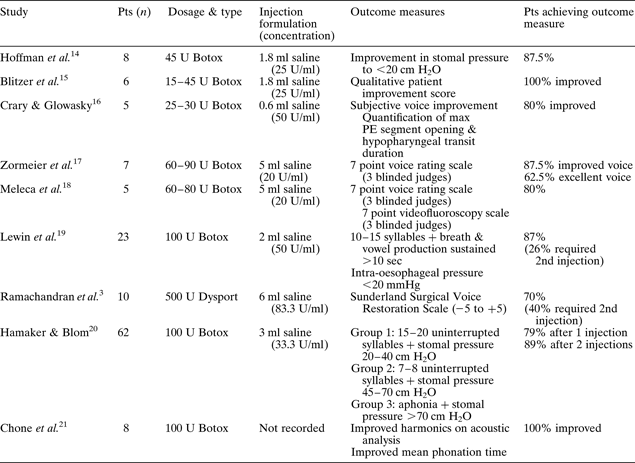
Pts = patients; max = maximum; PE = pharyngoesophageal; sec = seconds
Outcome measures
The maximum effect of the toxin was not apparent until 72 hours after injection; this observation was confirmed by all the authors. The different studies used a variety of different outcome measures, making comparison difficult. The subjective outcome in all of the studies was improved tracheoesophageal puncture voice, but their objective and instrumental measures differed (Table II).
Ramachandran et al. described the use of the qualitative Sunderland surgical voice restoration scale. This utilises a perceptual rating scale from −5 to +5, with 0 indicating normal tonicity.Reference Ramachandran, Arunachalam, Hurren, Marsh and Samuel3
Zormeier et al. and Meleca et al. both adopted a similar outcome measure in the form of a seven-point, equal-appearing interval scale deployed by three judges who were blinded to patient identity.Reference Zormeier, Meleca, Simpson, Dworkin, Klein and Gross17, Reference Meleca, Dworkin, Zormeier, Simpson, Shibuya and Mathog18 In addition, Meleca et al. used a seven-point scale to judge videofluoroscopic appearance.
Blitzer and colleagues asked their patients to provide a qualitative rating of their voice improvement.Reference Blitzer, Komisar, Baredes, Brin and Stewart15
Hamaker et al. split their objective outcomes into three groups. Group one represented the optimum outcome, with fluent voice, defined by 15–20 uninterrupted syllables and intra-tracheal phonation pressures of 20–40 cm H2O on manometry testing. Group two was defined by the ability to achieve seven to eight uninterrupted syllables, with pressures of 45–70 cm H2O. Group three represented the aphonic group, with pressures in excess of 70 cm H2O.Reference Hamaker and Blom20
Lewin et al. defined a positive outcome as the ability to produce 10–15 syllables per breath and to sustain vowel production for at least 10 seconds at intra-oesophageal pressure levels of less than 20 mmHg on manometry testing.Reference Lewin, Bishop-Leone, Forman and Diaz19
Hoffman et al. quantified their objective outcome by showing an improvement in stomal pressure to 20 cm H2O.Reference Hoffman, Fischer, VanDenmark, Peterson, McCulloch and Karnell14
Finally, Chone et al. used acoustic analysis of voice and an improvement in mean phonatory time as their outcome measures.Reference Chone, Teixeira, Andreollo, Spina, Barcellos and Quagliato21
Outcome results
All of the studies reported favourable results, with the use of botulinum toxin achieving good post-laryngectomy speech (Table II). In the largest of the studies, Hamaker and Blom observed that 79 per cent of their 62 patients achieved optimum or near-optimum voice after one injection, rising to 89 per cent after a second injection.Reference Hamaker and Blom20 Other studies reported positive outcomes in 70–100 per cent of patients. Zormeier and colleagues observed that 87.5 per cent of their eight patients had improved voice, with 62.5 per cent having excellent voice.Reference Zormeier, Meleca, Simpson, Dworkin, Klein and Gross17 In the UK, Ramachandran's group had success in 70 per cent of cases, with 50 per cent only requiring one injection, while 40 per cent required further injections.Reference Ramachandran, Arunachalam, Hurren, Marsh and Samuel3 Lewin's group reported overall success in 20 of their 23 patients (87 per cent). They also monitored duration of effect, which averaged 20.4 months (standard deviation 11.1); the longest sustained effect was 37 months and the shortest only five months.Reference Lewin, Bishop-Leone, Forman and Diaz19 Hamaker and Blom noted a response of up to 11 years in one of their patients.Reference Hamaker and Blom20
Complications were rare, with only two recorded in all the patients studied. Hamaker and Blom described a single case of dysphagia following bilateral injection and resultant chemical neurectomy, whilst Crary and Glowasky reported a single patient who suffered from regurgitation whilst lying flat.Reference Crary and Glowasky16, Reference Hamaker and Blom20
Discussion
It is clear from the results of these studies that good quality post-laryngectomy voice can be achieved in the majority of patients suffering from pharyngoesophageal segment spasm, by the use of botulinum toxin. This applies to patients with tracheoesophageal (valve) and oesophageal voice. The combination of videofluoroscopy and EMG studies allows adequate and accurate placement of injections. Complications are rare, and the procedure is not difficult to perform. The effect of botulinum toxin is dose-dependent, and although the studies reviewed disagreed regarding dosage and points of injection, results were comparable.
Unfortunately, further conclusions are difficult to draw. One of the main problems identified is the difficulty of comparing the final outcome of the intervention with the original surgical procedure performed. Documentation of cricopharyngeal myotomy and pharyngeal closure during the original laryngectomy is incomplete or absent in some of the studies reviewed. Such operative details may well affect the incidence of spasm and also the duration and extent of botulinum efficacy. In the UK, most laryngectomy patients would now be offered the option of primary surgical voice restoration. It has been argued that primary tracheoesophageal puncture, cricopharyngeal myotomy and layered pharyngeal closure should be performed, as this allows for optimum post-operative voice.Reference Hamaker, Singer, Blom and Daniels24–Reference Chone, Gripp, Spina and Crespo26
Although not all of the studies assessed duration of action, it was apparent that, in a select number of patients, there appeared to be a sustained response to a single injection of botulinum toxin. The expected duration of action of the botulinum toxin was no longer than six to nine months, but in some patients a further injection was often not required. Explanations were proposed by some authors. It was felt that the pharyngeal mucosa may be ‘retrained’ following injection of the toxin, such that the usual reflex of spasm in response to abnormal pharyngeal airflow no longer occurred.Reference Ramachandran, Arunachalam, Hurren, Marsh and Samuel3, Reference Lewin, Bishop-Leone, Forman and Diaz19, Reference Hamaker and Blom20 An alternative explanation was that denervation of the pharyngeal constrictor muscles occurred due to pre-synaptic blockade by the toxin.Reference Chone, Teixeira, Andreollo, Spina, Barcellos and Quagliato21
Botox costs £152 for an individual vial, and Dysport £180; this compares very favourably with the potential cost of a surgical procedure, as botulinum toxin injection is usually undertaken as a single out-patient procedure, with great success in the majority of cases. It should also be noted that the surgical options of cricopharyngeal myotomy or pharyngeal plexus denervation are not without risk of complication. This risk is increased by the fact that these procedures are undertaken in a previously operated field, and possibly after radiotherapy.
It is clear that there are significant benefits in the use of botulinum toxin in post-laryngectomy patients suffering from pharyngoesophageal segment spasm. However, further studies from institutions with an interest in troublesome post-laryngectomy voice are certainly warranted, with importance placed on accurate documentation of pre-operative status and surgical techniques, as well as on standardised subjective and objective outcome measures.