Implications
Our results indicate that the inclusion of a laminarin–fucoidan extract from Laminaria spp. in piglet diets may alleviate some of the common problems that occur after weaning in the absence of in-feed antibiotics. It was observed that a combination of laminarin and fucoidan were more effective in terms of reducing post-weaning diarrhoea; meanwhile, laminarin was found to reduce faecal Escherichia coli population and to increase daily gain and gain-to-feed ratio, and thereby would provide a dietary means to improve gut health after weaning.
Introduction
Pigs are faced with many new challenges during the post-weaning period such as a change in diet, removal from the sow and other littermates and a new environment (Pluske et al., Reference Pluske, Hampson and Williams1997). These stressors can lead to an intestinal imbalance between beneficial and non-beneficial microflora (Estrada et al., Reference Estrada, Drew and Van Kessel2000), which has been associated with reduced growth rates, changes in gut morphology and microbial population, and with increased susceptibility to disease such as post-weaning diarrhoea (Estrada et al., Reference Estrada, Drew and Van Kessel2000; Drew et al., Reference Drew, Van Kessel, Estrada, Ekpe and Zijlstra2002). Since the introduction of ban on in-feed antibiotics, there is an urgent need to identify reliable alternatives to reduce stress-associated problems in newly weaned pigs. Recently, seaweeds and seaweed extracts have been investigated as a potential feed additive in pig diets due to antimicrobial and immunomodulatory properties (Gardiner et al., Reference Gardiner, Campbell, O’Doherty, Pierce, Lynch, Leonard, Stanton, Ross and Lawlor2008; Reilly et al., Reference Reilly, Sweeney, Pierce, Callan, Julka and O’Doherty2008; Gahan et al., Reference Gahan, Lynch, Callan, Julka and O’Doherty2009). Seaweed extracts are a potential source of soluble dietary fibres such as laminarins and fucoidans (Michel et al., Reference Michel, Lahaye, Bonnet, Mabeau and Barry1996)
The chemical structure of laminarin consists mainly of a linear β (1→3) – linked glucose units with some random β (1→6) – linked side chains depending on the variety of seaweed (Brown and Gordon, Reference Brown and Gordon2005). Recently, Lynch et al. (Reference Lynch, Sweeney, Callan, O’Sullivan and O’Doherty2009) has shown that laminarin has antimicrobial properties. Fucoidans are sulphated polysaccharides extracted from the cell wall of various species of brown seaweeds (Berteau and Mulloy, Reference Berteau and Mulloy2003). Fucoidans have been shown to have antitumour (Zhuang et al., Reference Zhuang, Itoh, Mizuno and Ito1995), antiviral (Lee et al., Reference Lee, Hayashi, Hashimoto, Nakano and Hayashi2004) and antibacterial (McClure et al., Reference McClure, Moore, Blanc, Scotting, Cook, Keynes, Weber, Davies and Weiss1992) properties. Overall, laminarin and fucoidan may offer a dietary means to modulate the gut environment and/or modulate immunity, thereby reducing the risk of diarrhoea and promoting productivity in the absence of in-feed antibiotics. Recently, Reilly et al. (Reference Reilly, Sweeney, Pierce, Callan, Julka and O’Doherty2008) showed that the inclusion of a combination of laminarin and fucoidan had an inhibitory effect on the Enterobacteria population within the caecum and colon of weaned pigs. Similarly, Dillon et al. (Reference Dillon, Sweeney, Callan and O’ Doherty2009) showed that the inclusion of a combination of laminarin and fucoidan extract increased daily gain and gain-to-feed ratio of post-weaned piglets mainly through increasing nutrient digestibility and decreasing Escherichia coli population in the gut. Furthermore, the work carried out by Gahan et al. (Reference Gahan, Lynch, Callan, Julka and O’Doherty2009) showed that a combination of laminarin and fucoidan could replace the need for a high concentration of dietary lactose without adversely affecting piglet performance in antibiotic-free diets. The inclusion of high levels of lactose in weaned pig diets has resulted in improved intestinal health mainly through a reduction in intestinal pH and increases in Lactobacilli and short-chain fatty acids and reductions in coliforms (Pierce et al., Reference Pierce, Callan, Brophy, McCarthy, Sweeney, Fitzpatrick, Byrne, NiCheallaigh and O’Doherty2006). The objective of the current experiment is to investigate the effect of inclusion of laminarin and fucoidan as sources of algal polysaccharides, independently or in combination in the diet of the newly weaned pig on performance, faecal population of selected microflora and faecal volatile fatty acid (VFA) concentrations. It is hypothesised that the inclusion of both laminarin and fucoidan will improve piglet performance after weaning due to the biological properties of laminarins and fucoidans, resulting in an altered microflora in the gastrointestinal tract.
Material and methods
Animals and diets
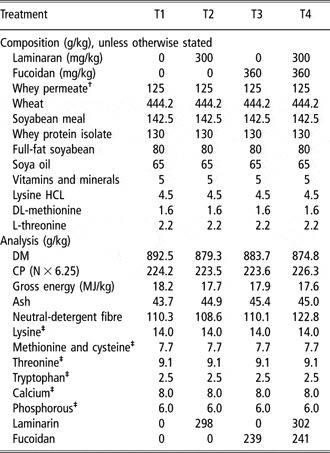
The experiment was designed as a 2 × 2 factorial. One hundred and ninety-two piglets (progeny of Large White × (Large White × Landrace)) weaned at 24 days of age, with an initial live weight of 6.4 kg (s.d. = 0.785 kg), were used in the experiment. The piglets were blocked on the basis of initial live weight, and within each block were assigned to one of the four dietary treatments. The dietary treatments consisted of (T1) basal diet, (T2) basal diet with 300 p.p.m. of laminarin, (T3) basal diet with 240 p.p.m. of fucoidan, (T4) basal diet with 300 p.p.m. of laminarin and 240 p.p.m. of fucoidan. These concentrations were deemed optimum inclusion levels in terms of maximum growth rate for seaweed extracts based on the work of Reilly et al. (Reference Reilly, Sweeney, Pierce, Callan, Julka and O’Doherty2008) and Gahan et al. (Reference Gahan, Lynch, Callan, Julka and O’Doherty2009). The diets were offered as mesh form for 21 days after weaning. Diets were formulated to have identical concentrations of digestible energy (DE; 16 MJ/kg) and ileal digestible lysine (14 g/kg). All amino-acid requirements were met relative to digestible lysine (Close, Reference Close1994). The laminarin and fucoidan were derived from Laminaria spp. and sourced from Bioatlantis Ltd (Kerry Technology Park, Tralee Co. Kerry, Ireland). The ingredient composition and chemical analysis of the dietary treatments are presented in Table 1.
Composition and chemical analysis of experimental diets (as fed)

T1 = basal diet; T2 = basal diet with 300 p.p.m. laminarin; T3 = basal diet with 240 p.p.m. fucoidan; T4 = basal diet with 300 p.p.m; DM = dry matter.
Provided (mg/kg completed diet): Cu 175, Fe 140, Mn 47, Zn 120, I 0.6, Se 0.3, retinol 1.8, cholecalciferol 0.025, α-tocopherol 67, phytylmenaquinone 4, cyanocobalamin 0.01, riboflavin 2, nicotinic acid 12, pantothenic acid 10, choline chloride 250, thiamine 2 and pyridoxine 0.015. Chromium III oxide included at 150 mg/kg complete diet.
†Lactofeed 70: Volac international Ltd, Orwel, Royston, SG8 5QX, UK. The chemical analysis is as follows (g/kg, unless otherwise stated): DM 955, CP 125, oil 50, ash 90, fibre 10, gross energy content of 15.5 MJ/kg and a pH of 6.5 to 7.
‡Calculated from the tabulated nutritional composition (Sauvant et al., Reference Sauvant, Perez and Tran2004).
Management
Pigs were housed in groups of four (12 replicates per treatment) on fully slatted pens (1.68 m × 1.22 m). House temperature was maintained at 30°C in the first week after weaning and then reduced by 2°C per week. Pigs were weighed at the beginning of the experiment (day of weaning = day 0), days 7, 14 and 21. The pigs were fed ad libitum from a four-space feeder with trays placed underneath the feeders in order to avoid wastage of feed. Water was available ad libitum from nipple drinkers. Food was available up to weighing, then weighed back for the purpose of calculating feed intake.
Representative feed samples of each dietary treatment were taken at regular intervals throughout the experiment. Multiple fresh faecal samples were collected daily from all pens on days 10 to 15 and mixed with sodium benzoate and phenylmethylsulfonyl fluoride, in order to stop any bacterial activity and minimise the effects of post-thawing fermentation on resulting VFAs. The samples were then stored at −20°C for the VFA analysis. Multiple fresh faecal samples were collected from all pens on day 10 and stored in sterile containers (Sarstedt, Wexford, Ireland) on dry ice and transported to the laboratory within 3 h for the enumeration of E. coli and Lactobacilli according to the method described by O’Connell et al. (Reference O’Connell, Sweeney, Callan and O’Doherty2005). Multiple fresh faecal samples were taken on day 17 for pH determination. All pH measurements were carried out immediately after collection on an MP 220 pH metre (Mettler-Toledo S.P.A., Milano, Italy), which was standardised with certified pH 4 and 7 buffer solutions. Distilled water was added to each sample in a ratio of 1 : 1 to enable their pH to be read.
Faeces scoring and morbidity
Pigs were observed for clinical signs of diarrhoea from days 0 to 21 of the experiment, and a scoring system (Pierce et al., Reference Pierce, Callan, McCarthy and O’ Doherty2005) was applied to indicate its presence and severity. Faeces scoring began on day 0 on the experimental diets and continued until day 21. Scores were given daily for individual pens and the average faecal score value per pen was given. The following scoring system was used: 1 = hard firm faeces; 2 = slightly soft faeces; 3 = soft; partially formed faeces; 4 = loose, semi-liquid faeces (mild diarrhoea); and 5 = watery, mucous-like faeces (severe diarrhoea).
Laboratory analysis
The feed samples were milled through a 1-mm screen (Christy and Norris hammer mill, Ipswich, UK). The dry matter (DM) of the feed was determined after drying at 103°C for a minimum of 16 h. Ash was determined after ignition of a known weight of concentrates in a muffle furnace (Nabertherm, Bremen, Germany) at 500°C for 4 h. Crude protein (CP) content was determined as Kjeldahl N × 6.25 using the LECO FP 528 instrument (Leco instruments, UK Ltd, Cheshire, UK). The NDF was determined according to Van Soest et al. (Reference Van Soest, Robertson and Lewis1991). The gross energy of the feed was determined using a Parr 1201 oxygen bomb calorimeter (Parr, Moline, IL, USA). The laminarin content in the diet was determined using a Megazyme assay kit (Megazyme, Bray, Ireland). Fucoidan level in the diet was measured according to the method of Usov et al. (Reference Usov, Smirnova and Klochkova2001). Thawed faecal samples were analysed for VFA concentration and profile using the method of O’Connell et al. (Reference O’Connell, Callan and O’Doherty2006).
Microbiology
A 1.0-g sample was removed from the faecal sample, serially diluted (1 : 10) in 9.0 ml aliquots of maximum recovery diluent (Oxoid, Basingstoke, UK), and spread plated (0.1 ml aliquots) onto selective agars as follows. Lactobacillus spp. were isolated on de Man, Rogosa, Sharp agar (Oxoid) with overnight (18 to 24 h) incubation at 37°C in a 5% CO2 environment, as recommended by the manufacturers (Oxoid). The API 50 CHL (BioMerieux, Montpellier, France) kit was used to confirm suspect Lactobacilli spp. E. coli species were isolated on MacConkey agar (Oxoid), following aerobic incubation at 37°C for 18 to 24 h. Suspect colonies were confirmed with API 20E (BioMerieux). Typical colonies of each bacteria on each agar were counted, and the numbers of bacteria were expressed as log colony-forming units (CFUs) per gram of fresh faeces.
Statistical analysis
The experimental data were analysed as a 2 × 2 factorial using the general linear model procedure of the Statistical Analysis System Institute (SAS, 1985). The statistical model used included the main effects of laminarin and fucoidan and the associated interaction between laminarin and fucoidan. The individual pen represented the experimental unit. The performance data were adjusted for initial live weight by covariance analysis. All the data were checked initially for normality using the PROC univariate procedure in SAS (1985). The microbial counts were log transformed before statistical analysis. The probability level that denotes significance is P < 0.05. The data in the tables are presented as least square means ± s.e.m.
Results
Performance
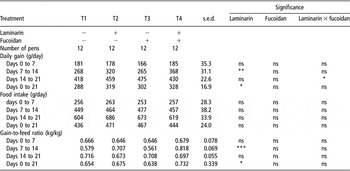
The effects of laminarin and fucoidan supplementation on average daily gain (ADG), average daily feed intake and gain-to-feed ratio are presented in Table 2. Pigs fed laminarin-supplemented diets had an increased ADG (344 v. 266 g/day, s.e ± 15.6, P < 0.01) during days 7 to 14 and during the entire experimental period (324 v. 232 g/day, s.e. ± 8.0, P < 0.01) compared to pigs offered diets without laminarin supplementation. Pig fed laminarin-supplemented diets had an improved gain-to-feed ratio during days 7 to 14 (0.763 v. 0.569 kg/kg, s.e. ± 0.034, P < 0.01) and during the entire experimental period (0.703 v. 0.646 kg/kg, s.e. ± 0.016, P < 0.05) compared to pigs fed diets without laminarin supplementation.
The effect of seaweed extract on pig performance after weaning (LSD ± s.e.d.)

LSD = least significant difference; s.e.d. = standard error of the difference; T1 = basal diet; T2 = basal diet with 300 p.p.m. laminarin; T3 = basal diet with 240 p.p.m. fucoidan; T4 = basal diet with 300 p.p.m; ns = not significant.
*P < 0.05; **P < 0.01; ***P < 0.001.
There was a significant interaction (P < 0.05) between laminarin and fucoidan supplementation on ADG during days 14 to 21. Pigs offered the fucoidan diet had a significantly higher ADG than pigs offered the basal diet; however, there was no effect of fucoidan when added to a laminarin diet. There was no effect of laminarin or fucoidan inclusion on average daily feed intake.
Faecal pH, DM and faecal score
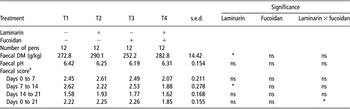
The effects of laminarin and fucoidan supplementation on faecal DM, faecal pH and faecal score are presented in Table 3. Pigs offered diets supplemented with laminarin had an increased (P < 0.05) faecal DM content (286.4 v. 262.4 g/kg, s.e. ± 7.20) compared to pigs fed diets without laminarin supplementation. Pigs offered diets supplemented with laminarin had a decreased faecal score during days 7 to 14 (P < 0.05; 2.05 v. 2.57 s.e. ± 0.139) compared to pigs offered diet without laminarin supplementation.
The effects of dietary treatment on faecal dry matter, faecal score of experimental diets (LSD ± s.e.d.)

LSD = least significant difference; s.e.d. = standard error of the difference; T1 = basal diet; T2 = basal diet with 300 p.p.m. laminarin; T3 = basal diet with 240 p.p.m. fucoidan; T4 = basal diet with 300 p.p.m; ns = not significant; DM = dry matter.
*P < 0.05.
†1 = hard faeces; 2 = slightly soft faeces; 3 = soft, partially formed faeces; 4 = loose, semi-liquid faeces; and 5 = watery, mucous-like faeces.
There was a significant interaction between laminarin and fucoidan inclusion on faecal score during the entire experimental period (days 0 to 21; P < 0.05). Pigs offered the combination of laminarin and fucoidan had a reduced faecal score compared to pigs offered the fucoidan alone diet. However, there was no effect of laminarin inclusion on faecal score compared to the basal diet.
Microbiology and VFAs
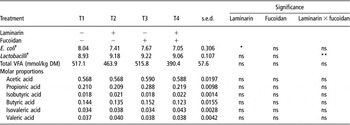
The effects of laminarin and fucoidan supplementation on selected microbial populations, total VFA concentrations and molar proportions of VFAs are presented in Table 4. Pigs offered laminarin diets had a reduced (P < 0.05) faecal E. coli population compared to pigs offered diets without laminarin supplementation (7.22 v. 7.84 Log10 CFU/g, s.e. ± 0.153).
The effect of dietary treatment on faecal Lactobacilli and Escherichia coli populations and faecal molar proportions of volatile fatty acids (LSD ± s.e.d.)

LSD = least significant difference; s.e.d. = standard error of the difference; T1 = basal diet; T2 = basal diet with 300 p.p.m. laminarin; T3 = basal diet with 240 p.p.m. fucoidan; T4 = basal diet with 300 p.p.m; ns = not significant; DM = dry matter.
*P < 0.05; **P < 0.01.
†Log transformed.
There was a significant interaction (P < 0.01) between laminarin and fucoidan on faecal Lactobacilli populations. Pigs offered the fucoidan diet had increased Lactobacilli numbers compared to pigs offered the basal diet (9.22 v. 8.93 Log10 CFU/g, s.e. ± 0.076); however, there was no effect of fucoidan on faecal Lactobacilli populations when laminarin was added.
There was no significant effect of treatment on total faecal VFA concentration or on the molar proportions of faecal VFAs.
Discussion
Earlier works at this laboratory (Dillon et al., Reference Dillon, Sweeney, Callan and O’ Doherty2009; Gahan et al. Reference Gahan, Lynch, Callan, Julka and O’Doherty2009) have shown the benefits of using a combination of laminarin and fucoidan on performance of weaner pigs. The improved performance concomitantly occurred with increased total tract nutrient digestibility and decreased faecal E. coli population (Dillon et al., Reference Dillon, Sweeney, Callan and O’ Doherty2009). The objective of the current experiment was to investigate the effect of inclusion of laminarin and fucoidan as sources of algal polysaccharides, independently or in combination in the diet of the newly weaned pig on performance, faecal populations of selected microflora and VFA concentrations. The diets used in the current experiment were formulated to create the greatest nutritional challenge possible to the post-weaned pig in the absence of in-feed antibiotics. These diets contained a high CP level, high level of soyabean meal and low level of lactose. High level of dietary CP has been suggested to predispose the pig to post-weaning colibacillosis (Prohaszka and Baron, Reference Prohaszka and Baron1980) due to the high acid-binding capacity in the stomach, which allows E. coli to escape the less acidic environment of the stomach and colonise the small intestine. Manipulation of dietary protein supply, in order to increase protein availability to ETEC in the distal small intestine, and the consequent production of harmful fermentation by-products, such as amines, is one way in which this could be achieved (Prohaszka and Baron, Reference Prohaszka and Baron1980).
Soyabean protein is not included in large quantities in weanling’s diets. It has been proposed that many of the morphological changes that take place in the young pig’s gut after weaning are due to a transient hypersensivity to antigenic components present in the diet (Miller et al., Reference Miller, Newby, Stokes and Bourne1984); soya antigens are particularly implicated (O’Doherty et al., Reference O’Doherty, Nolan and McCarthy2004). The composition of the carbohydrate fraction and the possibility of antinutritional factors (Huisman and Tolman, Reference Huisman and Tolman1992) are two more motivations for restricting the amount of soyabean meal in diets for young piglets. Pierce et al. (Reference Pierce, Callan, Brophy, McCarthy, Sweeney, Fitzpatrick, Byrne, NiCheallaigh and O’Doherty2006) found that the inclusion of high levels of lactose in weaned pig diets resulted in improved intestinal health mainly through a reduction in intestinal pH and increases in Lactobacilli and short-chain fatty acids and reductions in coliforms.
Pig offered the laminarin-supplemented diets increased ADG and gain-to-feed ratio compared to pigs offered diets without laminarin suppementation. This positive response to laminarin maybe due to the reduced E. coli population in the gut of these pigs. Although many species of E. coli are commensal, high levels of specific E. coli (like ETEC) will increase the risk of disease. The diets supplemented with laminarin resulted in pigs having a reduced faecal E. coli population, which resulted in reduced faecal DM and less diarrhoea (lower faecal score) during days 7 to 14, compared to pigs offered diets containing no laminarin. Similar results were reported by Lynch et al. (Reference Lynch, Sweeney, Callan, O’Sullivan and O’Doherty2009). These authors found that the inclusion of laminarin in the diet resulted in a reduced Enterobacteria population in the gut of the pig. Similarly, Kogan and Kocher (Reference Kogan and Kocher2007) showed how β-glucans from a specific yeast cell wall supplied in feed are able to block fimbriae of pathogenic bacteria, and prevent their adhesion to the mucous epithelium; adhesion is the first step of microbial infection. Rice et al. (Reference Rice, Adams, Ozment-Skelton, Gonzalez, Goldman and Lockhart2006) reported that once laminarin is ingested, it is transported from the gastrointestinal tract to the circulation system, which produce significant immunomodulatory effects and increase survival rates in mice challenged with Staphylococcus aureus or Candida albicans. The glucans are bound by gastrointestinal epithelial and gut-associated lymphoid tissue (GALT) cells, and they modulate the expression of pattern recognition receptors in the GALT, increase interleukin-12 (IL-12) expression and induce protection against infectious challenge (Rice et al., Reference Rice, Adams, Ozment-Skelton, Gonzalez, Goldman and Lockhart2006).
The proliferation of Lactobacilli spp. in the fucoidan supplemented diets would suggest that a proportion of the supplemented fucoidan was escaping hydrolysis in the foregut and passing into the colon for bacterial fermentation. Saccharolytic species of bacteria, such as Lactobacilli spp., take part in the breakdown of complex carbohydrates (Salyers, Reference Salyers1979). Fucoidan is soluble in water making it a rapidly fermentable carbohydrate source (Rupérez et al., Reference Rupérez, Ahrazem and Leal2002), and Lactobacillus spp. have been reported to ferment a number of monosaccharides including L-fucose (Salyers et al., Reference Salyers, West, Vercellotti and Wilkins1977). In agreement with this study, Lynch et al., (Reference Lynch, Sweeney, Callan, O’Sullivan and O’Doherty2009) found that the concentration of Lactobacillus spp. in the colon increased with the inclusion of fucoidan. Despite the increase in the Lactobacilli population, there was no dietary effect on VFA concentration or profiles. The quantity of VFA produced in the large intestine depends on the amount and composition of the substrate and on the microflora present (MacFarlane and MacFarlane, Reference Macfarlane and Macfarlane2003). Faecal VFA concentrations are the outcome of production, absorption and degradation within the gut. Faecal VFA concentrations may not be a totally accurate way to show fermentation intensity in the large intestine. However, the faecal VFA concentrations found in this study are consistent with those found in the literature (Lynch et al., Reference Lynch, Callan and O’Doherty2007; Pierce et al., Reference Pierce, Callan, McCarthy and O’Doherty2007).
Despite the increase in the faecal Lactobacilli population, there was no positive effect of fucoidan on pig performance or diarrhoea score. It was observed from the results of the current experiment that fucoidan did not affect piglet’s performance and health when offered in the diet alone, but the addition of laminarin with its antimicrobial properties proved to be effective. In the current experimental conditions, feed additives that contained antibacterial properties were more effective to the pig in dealing with the stresses associated with weaning than feed additives that display ‘prebiotic’ properties.
The diet supplemented both fucoidan and laminarin was most effective at reducing post-weaning diarrhoea throughout the duration of the experiment. This could be attributed to a number of reasons. First, it could be due to an immune response from feeding the combination diets. Earlier work by Reilly et al. (Reference Reilly, Sweeney, Pierce, Callan, Julka and O’Doherty2008) showed that the inclusion of a laminarin and fucoidan extract similar to the one used in the current experiment increased the expression of IL-8 mRNA. IL-8 is a chemokine that is involved in the recruitment and activation of neutrophils from the blood to the site of infection. Second, there was a numerical decrease (P = 0.079) in faecal E. coli numbers with the combination treatment. Pigs that express the symptoms of diarrhoea harbour massive numbers of haemolytic E. coli (Smith and Jones, Reference Smith and Jones1963); therefore, a reduction in the numbers of E. coli present in the gut would reduce the severity of diarrhoea and ultimately reduce piglet morbidity after weaning.
Conclusions
Overall, the reduction in faecal E. coli population and the increase in daily gain and gain-to-feed ratio suggest that laminarin may provide a dietary means to improve gut health after weaning. However, a combination of laminarin and fucoidan is more effective in terms of reducing post-weaning diarrhoea.