Introduction
The latest technological management processes, organizational knowledge and experiences borne from today's 4th Industrial Revolution have prompted a heightened global interest in how domestic and foreign organizations are responding to digitization. Such an interest therefore, demands a strengthening of the professionalism of future-oriented knowledge management systems (Alavi & Leidner, Reference Alavi and Leidner2001) and human resources development, as well as, establishing a global identity. As a result, there is a growing need for collaborative frameworks (Khadka, Shetty, Whiting, & Banic, Reference Khadka, Shetty, Whiting and Banic2016) that support differentiated and innovative research centered around the practices of knowledge creation, transfer and skill development (Gibbons, Limoges, Nowotny, Schwarzman, Scott, & Trow, Reference Gibbons, Limoges, Nowotny, Schwarzman, Scott and Trow1994; Nonaka & Konno, Reference Nonaka and Konno1998); where these processes are central to the effective functioning and survival of organizations in the context of present society, which is increasingly driven by the phenomenon of Digital Darwinism (Goodwin, Reference Goodwin2018). In short, organizations need to be better prepared to adapt and keep pace with rapid technological and societal changes.
Within the context of government organizations, responding to emergent social issues is a complex task as stakeholders are faced with the significant challenge of engaging in the processes of problem-solving, collaboration, alongside negotiating governance and accountability (Waardenburg, Groenleer, de Jong, & Keijser, Reference Waardenburg, Groenleer, de Jong and Keijser2020). Although such processes may seem fairly simplistic, they are in fact wrought with various challenges, ranging from the difficulty of deriving shared objectives, consolidating different perspectives, and determining changing directionality of priorities. These challenges are what constitute wicked problems, where ‘wickedness’ is driven in-part by complexity (Head, Reference Head2008). As Waardenburg et al. (Reference Waardenburg, Groenleer, de Jong and Keijser2020) states, the ‘challenge lies in turning antagonistic conflict into constructive conflict’ (p. 389) that improves organizational flexibility and adaptability. In order for organizations to operate effectively and sustain themselves, ongoing efforts to seek and tackle wicked problems are needed.
Organizational sustainability in essence requires better exchange of knowledge (Paulin & Suneson, Reference Paulin and Suneson2012) and understanding of knowledge sharing behavior (Appel-Meulenbroek, Weggeman, & Torkkeli, Reference Appel-Meulenbroek, Weggeman and Torkkeli2018). However, the implications of adopting a multiple perspective approach or method to managing organizational complexity (Lindgren & Wallström, Reference Lindgren and Wallström2000) are fragmentarily addressed within the literature. Furthermore, there is a lack of research which explores how government organizations in Australia can specifically implement this approach.
Merali (Reference Merali2006) describes complex organizations as referring to organizations with many people, processes, rules, strategies and basic units in the emergent domain, where ‘measuring knowledge exchange activities is… difficult’ (Bager, Reference Bager2018: 4).
Therefore, organizations should implement a framework which considers and synthesizes multiple perspectives, with the goal of redefining problems at hand and finding alternative solutions (Sorensen & Torfing, Reference Sorensen and Torfing2011).
The development of a holistic, multiple perspective framework may be achieved by combining the individual perspectives on organizational aspects (i.e., business, organizational, knowledge, and social) that have been presented in the current literature. Although the merging of multiple perspectives is imperative to understanding knowledge flow within organizations (Appleyard, Reference Appleyard1996), decision-making processes remain challenging due to the difficulty of ascertaining the co-ordination of individual organizational roles and activities.
Simply put, research points to the need for modeling methods that allows for an understanding of wicked problems and how they cater for complex characteristics from an empirical and theoretical viewpoint.
This research therefore outlines a conceptual framework which focuses on enhancing collaboration with respect to visualizing knowledge flow in Australian government organizations and suggests the use of an open-model developed by an Information Technology (IT) research team which can help to better manage and understand the complexity of organizations.
Theoretical background
Modeling organizational complexity
Organizational systems are ever-changing and are therefore, inevitably subject to changing limitations or external pressures (Amagoh, Reference Amagoh2008; Ferlie, Reference Ferlie2007 Goodwin, Reference Goodwin2018). Constant changes to an organization may be underscored by evolving dimensions of organizations or approaches to identifying stable perspectives across stakeholder communities. Consequently, a greater insight into the features of complex systems may allow organizations to manage business operations more effectively and sustainably.
Furthermore, Smith and Humphries (Reference Smith and Humphries2004) state that complexity theory is important and requires new approaches not limited to behavioral perspectives of social network and organizational structures. The goal is not to simply see the situation as a set of complex problems that work on particular sub-goals and collaborate to provide a holistic solution. This may not often be sustainable because complex problem differences will prevent or at least delay an outcome. The objective here is to also define complex problems where the goal is to ensure sustainability through monitoring and assistance in resolving any conflicting issues by selection of a social structure to match collaboration and task, selection of technology to match the social structure, and management of systems to collaboratively communicate between the functional units within an organization.
The literature of collaborative innovation suggests several approaches to dealing with different design models to support new process implementation in self-organized business processes. It is often defined as the creation of knowledge and coordination across organizational boundaries (Gasson & Elrod, Reference Gasson and Elrod2006; Lichtenstein & Brian, Reference Lichtenstein and Brian2006).
In the study conducted by Sorenson, Rivkin, and Fleming (Reference Sorenson, Rivkin and Fleming2006), a quantitative approach was used to measure knowledge complexity and transfer. Although it was found that highly complex knowledge resists effective diffusion across organizational boundaries, the statistical method for mapping knowledge flows fell short of providing a holistic visualization of how knowledge can be shared among multiple stakeholders.
The organizational environment according to Mason (Reference Mason2007) is composed of ‘factors beyond the control and management of the organization as well as a system of relationships between stakeholders’ (p. 10). With the ever-increasing complexity of the organizational environment, the systems concept no longer seems adequate due to the management of knowledge flow and social interactions in dealing with complex phenomena (Amagoh, Reference Amagoh2008: 1). This drawback, in addition to others, has prompted complexity theory to surface which attempts to emphasize the occurrence of new structures and patterns. Furthermore, the complexity paradigm is underscored by systems that self-organize themselves into something new and constantly evolve (Byeon, Reference Byeon2005; Ferlie, Reference Ferlie2007; White, 2000).
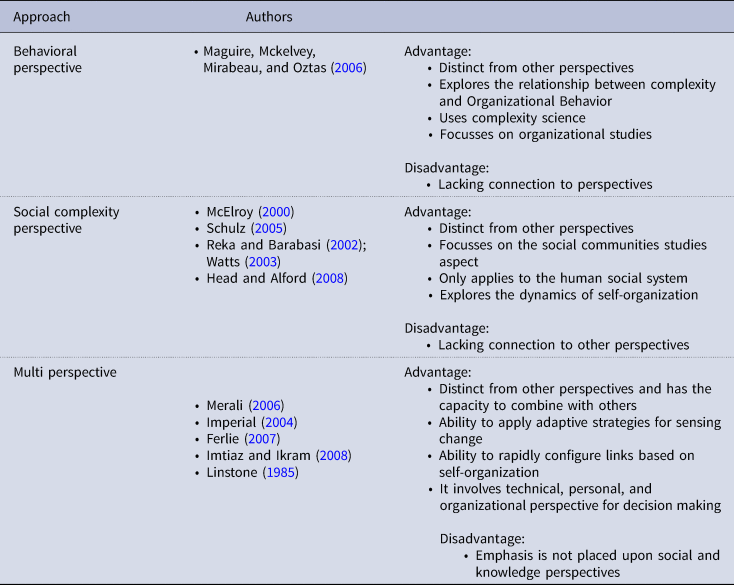
Existing views of the approach appear to fall into three categories: behavioral perspective; social complexity perspective; and multi perspectives. These categories highlighted different methods for adapting to changes in complex systems. Table 1 indicates that a method based on a multi perspectives approach will be more advantageous in terms of using the model for complex organizations. It should be noted that the multi perspective approach that has been addressed in the literature refers to the integration of the behavioral and social complexity perspectives.
Comparison of different approaches to model complex organization

The role of a wicked problem in modeling organizational complexity
A ‘wicked’ (Rittel & Webber, Reference Rittel and Webber1973) problem is one for which each attempt to create a solution changes the understanding of the problem. Wicked problems cannot be solved because the problem definition evolves as new possible solutions are considered and implemented. In organizational contexts, wicked problems create social complexity which makes communication and interaction difficult among multiple stakeholders. An example is a network of construction project management firms to build a large social housing development. Thus, it requires clear understanding of how knowledge flows through an organization for working collaboratively across boundaries.
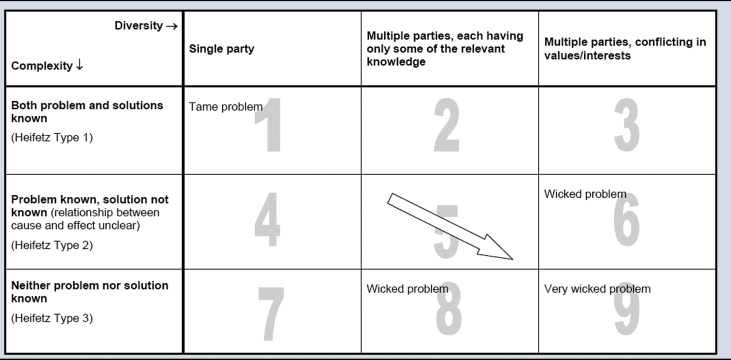
Head and Alford (Reference Head and Alford2008) have emphasized that challenges to tackle wicked problems often leads to social complexity. They demonstrated the typology of problems as described in Table 1 and techniques to manage the complex issues with wicked elements. Roberts (Reference Roberts2000) distinguish that type 2 problems have the definition but not the solution, whereas in type 3 problems there are no agreements over either the definition or solution. In the literature, the key finding around wicked problems is that it causes social complexities rather than technical complexities. Solution to wicked problems usually involves coordinated action by a range of stakeholders including organizations.
The literature thus emphasizes that attempts to resolve wicked problems leads to the emergence of social complexity. Thus, there is a need to look from many perspectives including, organization, business, knowledge, and social perspective where these become integrated and help to tackle such problems through an identification of the origin and eventual processes leading to the output of solutions.
In this study, the dimensions of the multiple perspective framework are explored and examined in such a way that new methods of integrated modeling will be proposed. These methods may help organizations to detect issues in organizational processes, as well as, supporting them to adapt swiftly to emergent changes (Table 2).

Multiple perspective model and research questions
Research question for validating the model
In response to identified gaps aforementioned, the following research question was investigated through the use of case studies that aimed to resolve organizational complexity within collaborative environments:
How does a multiple perspectives framework improve the capacity of stakeholders within Australian government organizations to develop a flexible strategy for managing complex business processes?
The purpose of examining this research question was to explore three interrelated areas of interest. First, whether a multiple perspective approach supports the understanding of organizational complexity in the face of unanticipated events. Second, how changing events affect organizations' capacities to tackle wicked problems, and finally, how organizations respond to unanticipated events in a way that supports better visualization of knowledge flow.
In summary, the participants' interviews were transcribed and then analyzed by the researcher. After analyzing the interview data, the researcher used NVivo analysis to validate the multiple perspectives model. This validation process enhanced the researchers' understanding of the participants' experiences thus allowing the model's effectiveness to be determined.
Multiple perspective model
Modeling methods that focus on individual perspectives namely organizational, business, knowledge, and social have been documented extensively in the literature (Boyd & Ellison, Reference Boyd and Ellison2007; Brooks, Reference Brooks2003; Heller, Reference Heller2000; Schulz, Reference Schulz2005). The field study carried out by Scozzi, Garavelli, and Crowston (Reference Scozzi, Garavelli and Crowston2005) for instance, highlight communication and information flow as constituting knowledge and organizational perspectives which can be identified through modeling techniques that are ‘entity, information and role-based’ (Scozzi, Garavelli, & Crowston, Reference Scozzi, Garavelli and Crowston2005: 132). Nevertheless, the study does not account for other ways of addressing complexity, that is, either from business and social perspectives.
Moreover, although, the multi perspective approach has been proposed, this method only accounts for the merging of behavioral and social-complexity perspectives (Ferlie, Reference Ferlie2007; Imperial, Reference Imperial2004; Imtiaz & Ikram, Reference Imtiaz and Ikram2008; Linstone, Reference Linstone1985; Merali, Reference Merali2006).
In other words, the existing models fall short of integrating all dimensions of perspectives, with respect to combining organization, business, social, knowledge, and economic perspectives. The existing methods are thus not properly combined to provide organizations with sufficient and targeted support to solve wicked problems.
The innovation behind the proposed model is that it focuses on the development of a holistic perspective that allows collaboration to be established upon a common platform. Despite the isolation of activities and individual roles among stakeholders, the model allows for greater reduction and elimination of unnecessary strategic planning. Consequently, organizations are better prepared to govern business operations more efficiently and effectively.
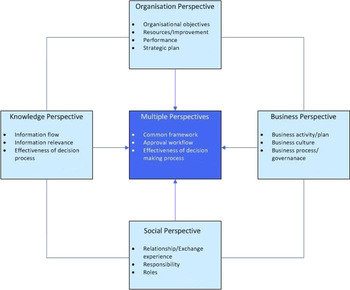
Figure 1 displays a schematic of a multiple perspectives model which outlines the relationship between five separate yet interrelated perspectives. These include:
• organization perspective: refers to the formal positions upheld by stakeholders within organizations.
• Knowledge perspective (Li, Fang, Lei, & Qiang, Reference Li, Fang, Lei and Qiang2004; Sorenson, Rivkin, & Fleming, Reference Sorenson, Rivkin and Fleming2006): refers to knowledge shared in communities of practice within organizations.
• Business perspective: refers to how business activities, roles, and responsibilities are formalized and constitutes stakeholder interactions with different roles within organizations.
• Social perspective: refers to social complexity and processes of change that occur within and across other perspectives (Prahalad & Krishnan, Reference Prahalad and Krishnan2008; Rouse, McGinnis, Basole, Bodner, & Kessler, Reference Rouse, McGinnis, Basole, Bodner and Kessler2009).
Multiple perspectives model.

Figure 1 also reveals how a multiple perspectives framework can provide improved visualization of organizational complexity that manifests in a diverse range of collaborative processes undertaken within organizations.
Method and data collection
Research approach
Case studies are a valuable research method as they allow for a thorough investigation of unique, contemporary phenomena within their real-world context (Yin, Reference Yin2018). Therefore, a multiple case study approach was deemed the most suitable approach to evaluate the issue of organizational complexity, specifically pertaining to knowledge flow between stakeholders, arising within collaborative environments. Three separate case studies were undertaken across three different government organizations, over an 8-month period. A pilot study was also conducted during this period to ensure that any methodological issues could be addressed and resolved prior to the official data collection procedures.
Sample
Given the limited number of studies concerning the implementation of a multiple perspectives framework to support collaborative practices within Australian government organizations, the researcher recruited 35 participants from three, New South Wales government organizations involved in various social housing construction projects funded under the Australian Government's Nation Building Economic Stimulus Plan (NBESP). There was a need to validate the framework through these chosen organizations as they were faced with emergent changes requiring collaboration among multiple stakeholders. Such changes included the clustering of government organizations to handle shared projects in a more sustainable manner, and deviations from ‘business as usual’ decision-making processes and established public policies.
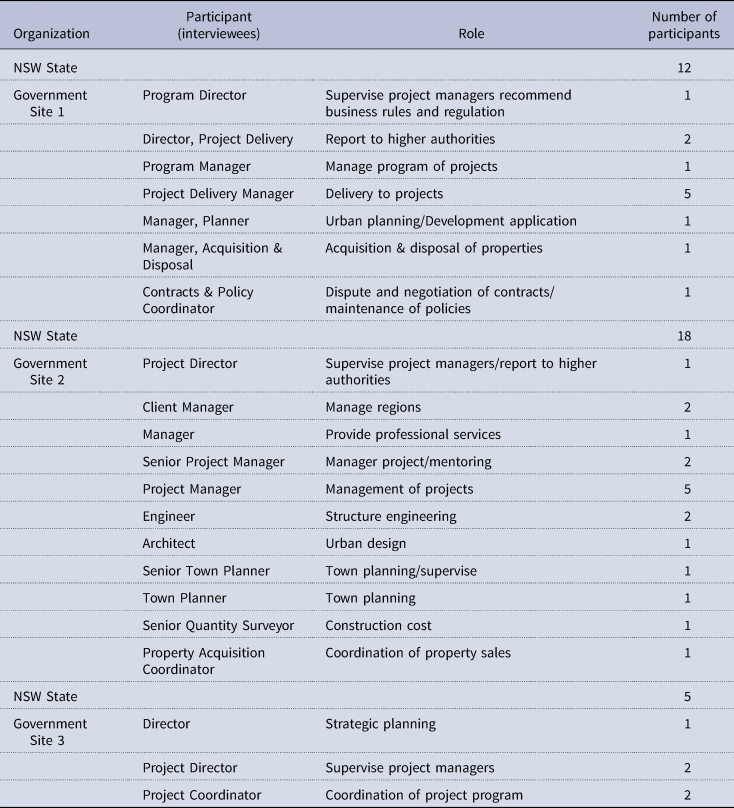
Purposive sampling was used to select participants who were identified as key stakeholders responsible for managing and overseeing the collaborative processes involved in government initiative projects. Table 3 outlines the participants that were involved in the study. It also highlights participants' individual roles and responsibilities within their respective organizations.
Participants in the study

Development of an open-model tool based on a multiple perspective framework
The researcher also engaged in collaborative work with the OMILAB within Vienna University Austria, (http://www.omilab.org), to develop an open-source modeling tool called MeLCa on ADOxx. This modeling tool served to support the researcher's proposed multiple perspective model as well as enabling participants to understand visually, the purpose and objectives of the framework. This tool displays the relationship between various stakeholders across different organizations and a range of collaborative activities often undertaken within these contexts, for example, processes associated with decision-making, planning, and management of activity/task co-ordination. The researcher's involvement was in testing the tool through the case studies to determine whether it could support the management of complex processes in organizations.
Data collection
According to Walsham (Reference Walsham2006), ‘interviews are a part of most interpretive studies as a key way of accessing the interpretations of informants in the field’ (p. 323). Research participants were therefore asked to take part in an interview, responding to a combination of open and closed-ended questions. The aim of these interviews was to determine how a multiple perspective model could support them to understand complex processes and issues around collaboration they were experiencing within their respective organizations.
Prior to the interviews, participants were provided with a diagram of a multiple perspective framework (refer to Figure 1) and the researcher demonstrated how the open-model tool operates. It should be noted that participants were not required to use these open-model tools, rather, the intention was to only familiarize them with its functionality.
The researcher made notes and observations during each interview, along with individual responses to the structured questions that were asked.
Data analysis and findings
Data analysis
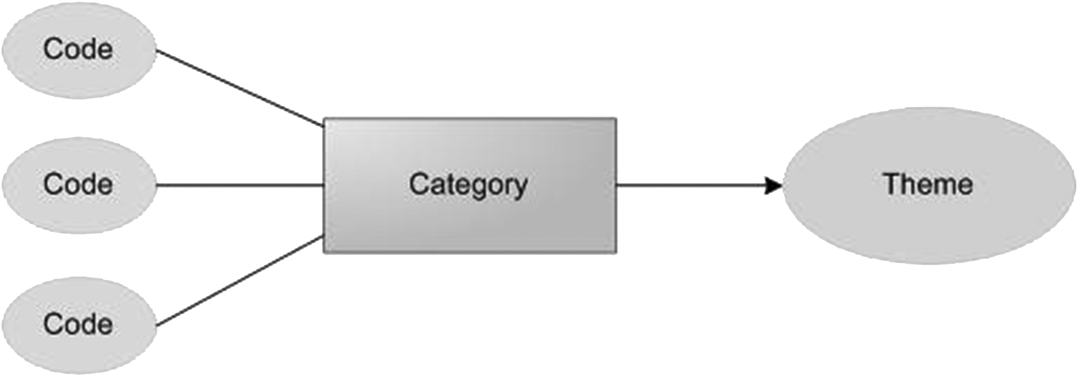
Interviews were transcribed using NVivo. Content analysis was undertaken where key words and phrases were initially coded and separated into various categories. Within these categories, key words and phrases were further clustered into invariant constituents, while themes emerged from a subsequent grouping of the invariant constituents. Figure 2 shows a schematic from a coding manual for NVivo analysis that was followed to generate themes.
Coding for qualitative data.

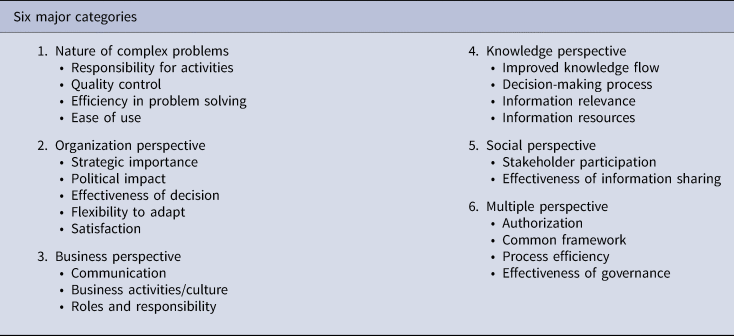
The researcher identified six major categories from the interview transcriptions: (1) methods used to manage a complex problem; (2) organizational perspective; (3) knowledge perspective; (4) business perspective; (5) social perspective; and (6) multiple perspectives. These categories are summarized in Table 4. Themes developed from a grouping of invariant constituents under each category are specified as bullet-points in the table.
Categories and themes identified

In the following section, key findings which emerged from the multiple case studies will be summarized.
Categories, invariant constituents, and themes
Major category 1: nature of complex problems
In response to the interview questions about complex issues experienced within an organization, participants responded in the following ways.
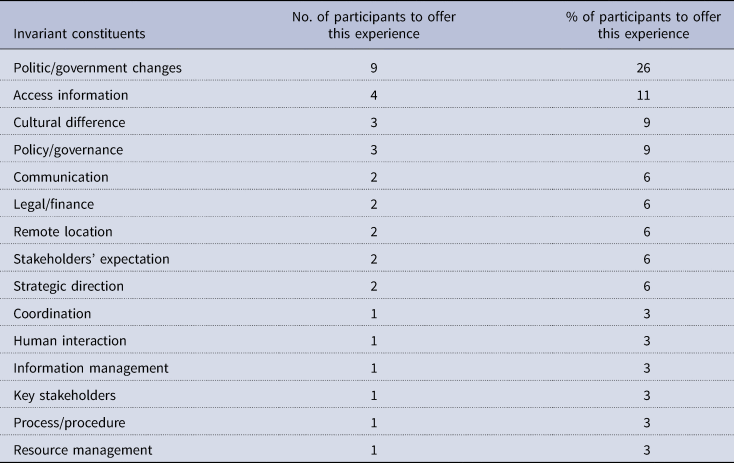
A full 26% of the sample mentioned politics/government changes. Only 11% of the sample brought up information access, whereas only 6% of the sample referred to communication. Some response examples are provided below.
Politics/government changes were described as,
“I have to understand new standards and government regulation for building and environmental impact for public housing. I think that political impact has critical effects on business.”
Decision making was described as,
‘In most cases, time management, information exchange and priority of work are impacting on my programs and it is important for delivery of milestones.’
Other responses included,
‘I follow up by meeting and discussion with clients to manage all projects are on track.’
Table 5 outlines a range of complex problems experienced by participants within their organizations.
Complex issues experienced within organizations

The invariant constituents from Major category 1 were grouped into four distinct themes related to, Responsibility for activities, Quality control, Efficiency in problem solving, and Ease of Use.
Major category 2: organization perspective
The second category included data obtained from all groups and demonstrated the participants' understandings with regard to the organization perspective.
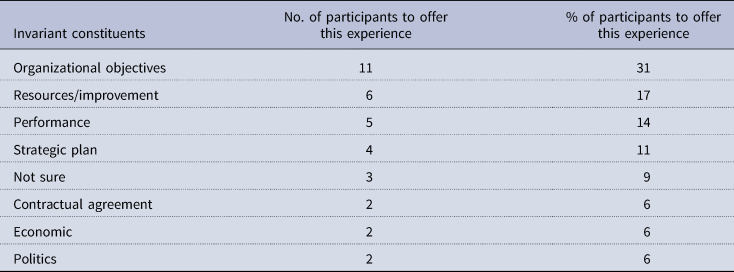
In response to interview questions related to the importance of the organizational perspective in controlling changes in the unlikely event of unforeseen circumstances, majority of participants believed organizational objectives to be the most important (31%).
A response example is as follows,
‘I continuously improve process that, what is work and what is not through brainstorming and place right processes to set up and get approval in most effective way. And also consider on evidence basis to analyse benefit of the changes.’
Table 6 displays the range of factors participants perceived as being critical to the organizational perspective.
Organization perspective

The invariant constituents from Major category 2 were grouped into five distinct themes related to, Strategic importance, Political impact, Effectiveness of decision, Flexibility to adapt, and Satisfaction.
Major category 3: business perspective
The third category included data obtained from all groups and demonstrated the participants' understandings with regard to the business perspective.
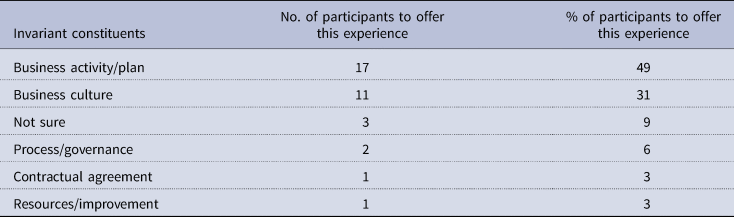
Participants made references to business activities and plans describing situations where the rules and guidelines were not clear.
‘I come across that requirement and procedures are not clear from the government. I have to exercise my best ability to deal with all parties involved and develop procedure for guidelines.’
Table 7 displays the range of factors participants perceived as being critical to the business perspective.
Business perspective

The invariant constituents from Major category 3 were grouped into three distinct themes related to, Communication, Business activities/culture, and Roles and responsibility.
Major category 4: knowledge perspective
The fourth category included data obtained from all groups and demonstrated the participants' understandings about the knowledge perspective.
The researcher asked participants in this study about the importance of the knowledge perspective in the case of unforeseen circumstances.
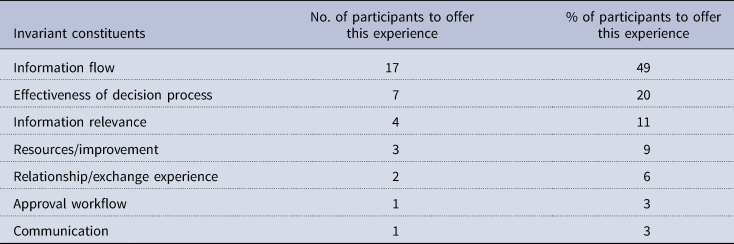
References to information flow were the most common,
‘I follow up feedback and professional opinions from experts, assessing potential risks and analyse possible opportunities.’
Table 8 displays the range of factors participants perceived as being critical to the knowledge perspective.
Knowledge perspective

The invariant constituents from Major category 4 were grouped into four distinct themes related to, Improved knowledge flow, Decision-making process, Information relevance, and Information resources.
Major category 5: social perspective
The fifth category included data obtained from all groups and demonstrated the participants' understandings regarding the social perspective.
Some participants shared an idea with their co-workers or group very often,
‘I'm collaborating with other stakeholders to share issues through meeting and training sessions.’
Most participants thought that their work group was cooperative,
‘I communicate clearly on negotiation skill, project management and financial issues (builders claim more money than contract agreement) through discussion session to help them to improve current situation.’
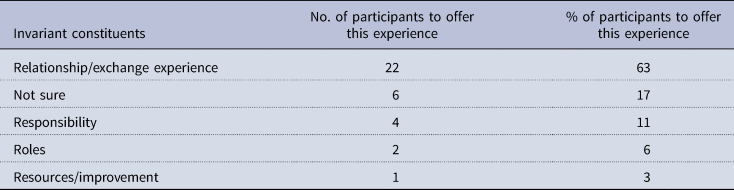
Table 9 displays the range of factors participants perceived as being critical to the social perspective.
Social perspective

The invariant constituents from Major category 5 were grouped into two distinct themes related to, Stakeholder participation and Effectiveness of information sharing.
Major category 6: multiple perspectives
The sixth category included data obtained from all groups and demonstrated participants' understandings about the multiple perspectives framework.
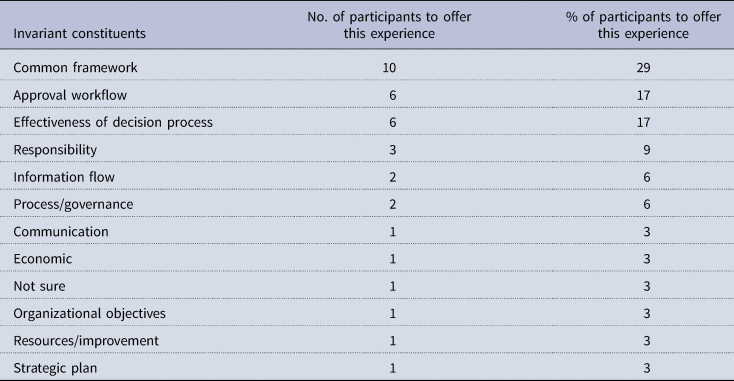
Majority of references were made to the need for a common framework,
‘Multi perspective framework is very important for multiple stakeholders. Organization must create the common platform for all key stakeholders prior to complex project commences.’
Table 10 displays the range of factors participants perceived as being critical to multiple perspectives.
Multiple perspectives

The invariant constituents from Major category 6 were grouped into four distinct themes related to, Authorization, Common framework, Process efficiency, and Effectiveness of governance.
Discussion
From the three case studies conducted across three different government organizations within the state of New South Wales, Australia, some novel insights into how a multiple perspectives framework could improve organizations' capacities to flexibly manage complex business processes were provided.
First, the findings highlighted various complex issues or wicked problems faced by organizations. Uncertainty is a major aspect of wicked problems (Koppenjan & Klijn, Reference Koppenjan and Klijn2004), where majority of participants mentioned changes in internal/external policies and priorities, namely, politics, as the predominant issue impacting organizations' strategic planning and performance.
When engaging participants in discussions around the importance of the organizational perspective, the most frequent responses centered on organizational objectives. Hence, this suggested that through the implementation of a multiple perspectives model, organizations could better control decision-making and governance processes in the unlikely event of unforeseen circumstances.
Moreover, in relation to the business perspective, participants mainly honed in on the issues of maintaining business activities/plans, alongside, business culture. As a result, the multiple perspectives model could potentially allow for the tracking and clearer visualization of each specific role/s upheld by individual employees.
Knowledge sharing is underscored by the exchange of work-related understandings and expertise across and between individuals (Yi, Reference Yi2009), where participants’ understandings about this process were revealed through a discussion around the knowledge perspective. Most participants made reference to knowledge flow as being critical to the knowledge perspective, thus, suggesting the proposed model's capacity to facilitate organizations to engage in ongoing ‘co-operative behaviours… such as collaboration, communication, co-ordination and interaction’ (Appel-Meulenbroek, Weggeman, & Torkkeli, Reference Appel-Meulenbroek, Weggeman and Torkkeli2018: 268).
With regard to the social perspective, participants typically referred to the significance of relationship and social exchange experiences, ultimately alluding to the multiple perspectives model supporting the identification of experts and monitoring of communication levels with respect to the frequency of interactions.
Finally, the case studies revealed that the multiple perspectives framework functions as a common platform for improved decision making and collaboration between multiple stakeholders. More specifically, the major significance of implementing a multiple perspectives framework was underscored by its potential to allow stakeholders across different organizations to work against a common framework of strategic planning and action. Key decision makers could be immediately identified in response to emergent changes and unanticipated events, as a result, expediting the co-ordination of organizational plans and objectives. The identification of a multiple perspective model ultimately builds upon Scozzi, Garavelli, and Crowston's (Reference Scozzi, Garavelli and Crowston2005) proposed ontologies for supporting innovation, where predominant focus is placed on promoting collaboration between stakeholders using knowledge and organizational perspectives. Without an emphasis on multiple perspectives, new ways of modeling to adapt to organizational changes and maintaining sustainability becomes a challenge. Furthermore, the use of a multiple perspectives framework was considered to improve visualization of knowledge flows in complex environments, both internally and externally of organizations.
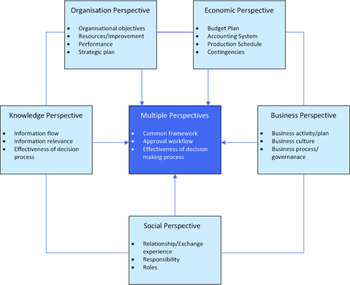
Under Major categories 2 and 6, the emergence of ‘Economic’ as an invariant constituent was significant as it signaled the possibility of managing complexity within organizations from an additional perspective that was not previously identified in the initial multiple perspectives model developed by the researcher. Figure 3 shows the inclusion of the newly identified economic perspective.
Multiple perspectives model with economic perspective.

Contribution to theory and practice
A significant aspect of this research was to visualize a complete picture of a complex environment, alongside the relationships maintained between and across multiple stakeholders.
Attempts to map knowledge flows across organizations have been made, as evidenced in Sorenson, Rivkin, and Fleming's (Reference Sorenson, Rivkin and Fleming2006) empirical study, although such efforts have only offered a partially complete picture of how to visualize organizational complexity.
The purpose of developing a multiple perspective framework was to derive a common platform to support collaboration through visualization of knowledge flows. This research draws upon the perspectives and experiences of various individuals upholding diverse roles and positions within Australian Government Organizations, which dealt with their management of organizational complexity. In order to acquire an understanding of the effectiveness of their complex projects, the multiple perspectives model was shown to enable the effective visualization of solutions to wicked problems. In relation to the implementation of a multiple perspectives model, it was found that this framework could potentially support the simplification of decision-making processes to coordinate their projects and improve the management of information systems.
Research limitations and future improvements
A potential shortcoming of this study was with respect to the generalizability of the findings. Only three government organizations in New South Wales, Australia participated in the study, hence the findings may not be reflective of organizations across other states, as well as, other countries. Nonetheless, it should be noted that, as a qualitative approach was adopted for this study, statistical generalizability was not the overarching aim. Rather, the intention was to gain deeper, descriptive insights into the phenomena under investigation, that is, how a multiple perspectives model could support government organizations to tackle wicked problems.
In terms of the future research directions, the researcher may potentially undertake case studies in private organizations in Australia, given that this study was limited to the public sector. Furthermore, the economic perspective also merits further attention in future studies as it was not considered in the a priori development of the multiple perspectives model.
Conclusion
Currently, the absence of appropriate methods to eliminate wicked problems has resulted in organizations responding ineffectively to emergent changes that affect business practices. In particular, the growing complexity within organizations has motivated the construction of a new framework. In effect, all major categories were linked to the four perspectives and generated themes which suggested that the demand for a new model was critical for business sustainability. Furthermore, research should therefore concentrate on the investigation of dynamic complexity which can be evaluated to support higher levels of adaptability to manage system evolution for the private sector and across other countries.
Acknowledgements
I would like to thank all participants from the NSW State Government in Australia who took part in my research. Furthermore, I extend gratitude to my wife and daughters for their enduring support and encouragement throughout the process of writing this paper.
Choon Bae (Paul) Yoo was manager of quality systems, and is currently a business analyst at the NSW State Government in Australia. More recently, he has been involved in data analysis and the development of prediction models for Asset Life-Cycle Management. Currently, he is a lecturer and industry fellow in the School of Professional Practices & Leadership at the University of Technology Sydney.