

Over the past four decades, attachment researchers have found considerable support that attachment representations influence perceptions, feelings, and behaviours in a variety of relationships, including the student-instructor relationship (Henson & Scharfe, Reference Henson and Scharfe2011). Although Bowlby (Reference Bowlby1969/1997) proposed that the effects of our attachment representations would be most evident when distressed, ill or afraid, researchers typically examine the impact of attachment representations without considering the influence of distress. However, researchers have consistently reported a strong association between attachment and distress (e.g., Thomas & Gadbois, Reference Thomas and Gadbois2007), particularly in the academic environment (e.g., Mattanah, Lopez, & Govern, Reference Mattanah, Lopez and Govern2011). Furthermore, both attachment representations (Henson & Scharfe, Reference Henson and Scharfe2011) and distress (Fraser & Fisher, Reference Fraser and Fisher1983) have been linked to students’ perceptions of teaching effectiveness. In the current study, we expanded the methodology of Henson and Scharfe (Reference Henson and Scharfe2011). Specifically, we collected longitudinal data and tested the prospective associations between T1 attachment and T2 instructor evaluations and measured distress symptoms to test whether distress moderated attachment-evaluations associations.
Adult Attachment
Bowlby (Reference Bowlby1969/1997) proposed attachment theory to explain children's propensity to establish close affectionate bonds with caregivers. According to Bowlby, the nature of early relationships with caregivers impacts the development of internal representations of the self and others. Specifically, the view of the self reflects one's anxiety about the worthiness to receive love and support, while the view of others determines an individual's tendency to approach or avoid others when distressed, ill, or afraid. In Reference Bartholomew and Horowitz1991, Bartholomew and Horowitz operationalised Bowlby's proposal that the underlying foundation of attachment representations included one's view of the self as worthy of love and support, and one's perceptions of others as trustworthy to provide that support. Since 1991, researchers have provided substantial support for the idea that individuals with positive self-models (low attachment anxiety) possess positive self-schemas and high self-esteem, and consequently feel they deserve love, attention and support from others (e.g., Riggs & Han, Reference Riggs and Han2009); whereas individuals with negative self-models (high attachment anxiety) tend to have lower self-esteem (e.g., Park, Crocker, & Mickelson, Reference Park, Crocker and Mickelson2004; Riggs & Han, Reference Riggs and Han2009) and view themselves as undeserving of love and support (e.g., Birnbaum, Reis, Mikulincer, Gillath, & Orpaz, Reference Birnbaum, Reis, Mikulincer, Gillath and Orpaz2006; Derrick & Murray, Reference Derrick and Murray2007). Furthermore, there is considerable support for the concept of the other-model (i.e., attachment avoidance). Individuals with positive other-models (low avoidance or high approach behaviour) perceive people as trustworthy and caring (e.g., Bartholomew & Horowitz, Reference Bartholomew and Horowitz1991), are confident in others’ availability to provide comfort and support in times of need (e.g., Pascuzzo, Cyr, & Moss, Reference Pascuzzo, Cyr and Moss2013), and tend to report positive interpersonal interactions (e.g., Ross & Furetes, Reference Ross and Fuertes2010). In contrast, individuals who have a negative other-model (high attachment avoidance) demonstrate the tendency to be distrusting of others (e.g., Ross & Furetes, Reference Ross and Fuertes2010), remain distant in social interactions (e.g. Onishi, Gjerde, & Block, Reference Onishi, Gjerde and Block2001), and avoid seeking others for support (e.g., Pascuzzo et al., Reference Pascuzzo, Cyr and Moss2013).
Attachment and Distress
The view that attachment representations are activated when individuals are distressed, ill, or afraid is a cornerstone of Bowlby's original theory (1969/1997). Correspondingly, researchers have reported positive associations between attachment anxiety and the tendency to be more physiologically reactive during distressing events (Diamond & Fagnudes, Reference Diamond and Fagnudes2010) — individuals who report high scores on anxious attachment tend to ruminate on negative experiences (Gentzler, Kerns, & Keener, Reference Gentzler, Kerns and Keener2010) and struggle with emotional regulation (Marganska, Gallagher, & Miranda, Reference Marganska, Gallagher and Miranda2013) compared to adults with secure attachment representations. Accordingly, individuals who report high scores on anxious attachment experience high levels of transition stress (Haydon, Reference Haydon2015), negative emotions (Birnbaum et al., Reference Birnbaum, Reis, Mikulincer, Gillath and Orpaz2006), and internalising symptoms (Derrick & Murray, Reference Derrick and Murray2007). In the academic setting, students who report high attachment anxiety also report more negative emotional reactions during stressful academic situations (e.g., during exams; Horppu & Ikonen-Varila, Reference Horppu and Ikonen-Varila2001) and often engage in self-destructive thoughts and behaviours (e.g., refusing to seek counselling when distressed; Cheng, McDermott, & Lopez, Reference Cheng, McDermott and Lopez2015). As a result, individuals who report high scores on anxious attachment are often more prone to developing psychological disorders, including depression (Marganska et al., Reference Marganska, Gallagher and Miranda2013; Surcinelli, Rossi, Montebarocci, & Baldaro, Reference Surcinelli, Rossi, Montebarocci and Baldaro2010), anxiety (Schimmenti & Bifulco, Reference Schimmenti and Bifulco2015), and adult separation anxiety disorder (Kohlhoff, Barnett, & Eapen, Reference Kohlhoff, Barnett and Eapen2015), compared to individuals who report high scores on secure attachment.
Similarly, attachment avoidance is also associated with stress management, reports of distress, and psychological health. In particular, individuals with negative views of others (i.e., high attachment avoidance) tend to deny and repress feelings of distress (Garrison, Kahn, Sauer, & Florczak, Reference Garrison, Kahn, Sauer and Florczak2012) but have elevated physiological responses to stressful events (Diamond & Fagnudes, Reference Diamond and Fagnudes2010; Diamond & Hicks, Reference Diamond and Hicks2005). Not surprisingly, researchers have also found that individuals who report both high attachment avoidance and high attachment anxiety report the highest levels of distress (Declercq & Willemsen, Reference Declercq and Willemsen2006; Onishi et al., Reference Onishi, Gjerde and Block2001), depression (Malik, Wells, & Wittkowski, Reference Malik, Wells and Wittkowski2015; Shaver, Schachner, & Mikulincer, Reference Shaver, Schachner and Mikulincer2005) and anxiety (Derrick & Murray, Reference Derrick and Murray2007). Interestingly, however, despite the established associations between attachment and distress, and the importance of distress in the theoretical framework of attachment, the majority of researchers neglect to assess levels of distress when examining the influence of attachment on perceptions, behaviours and relationships.
Evaluations of Teaching Performance
Recently, researchers have found that attachment is a powerful predictor of university students’ experience. For example, attachment representations have been found to be associated with students’ tendency to approach, or avoid, teachers and counsellors when experiencing academic difficulties (Larose, Bernier, & Tarabulsy, Reference Larose, Bernier and Tarabulsy2005; Larose, Boivin, & Doyle, Reference Larose, Boivin and Doyle2001). Holt (Reference Holt2014) found that college students with high parental attachment security were more likely to possess positive attitudes toward academic help-seeking. Furthermore, insecure college students were less likely to seek help from teachers when experiencing academic difficulties and less likely to seek counselling support compared to securely attached students (Cheng et al., Reference Cheng, McDermott and Lopez2015; Larose et al., Reference Larose, Bernier and Tarabulsy2005; Larose et al., Reference Larose, Boivin and Doyle2001). In addition, insecure students tend to report negative views about their instructors’ willingness to provide help and tend to decline instructors’ offers of support (Perrine, Reference Perrine1999). Henson and Scharfe (Reference Henson and Scharfe2011) expanded this work and reported a strong association between attachment representations and students’ evaluations of instructors’ teaching effectiveness. Specifically, students who reported high attachment anxiety with their parents reported more negative perceptions of their university instructors than students who reported low attachment anxiety.
Interestingly, researchers have provided some evidence to suggest that levels of depressive symptoms may moderate the relationship between attachment and students’ evaluations of instructors’ teaching performance. Specifically, high levels of anxiety in students have been shown to be negatively associated with teaching evaluations in both elementary students (Fraser & Fisher, Reference Fraser and Fisher1983) and undergraduate students (Sinclair & Ryan, Reference Sinclair and Ryan1987). More recently, Lui (Reference Liu2012) found that students’ perception of their relationship with their teacher was associated with higher test anxiety, while Reddy, Rhodes, and Mulhull (Reference Reddy, Rhodes and Mulhall2003) reported that improvements in perception of teacher support was associated with decreased depressed mood. Together, these results highlight the importance of assessing distress to understand students’ perceptions of instructors
The Present Study
Bowlby (Reference Bowlby1969/1997) proposed that high levels of anxiety ignite an individual's attachment orientation, which guides one's behaviours and perceptions of events (see also Bartholomew, Reference Bartholomew1990). For example, in a laboratory setting, Simpson, Rholes, and Nelligan (Reference Simpson, Rholes and Nelligan1992) found that participants who reported high attachment avoidance were less likely to seek comfort from others and perceived less availability of social support compared to participants who reported low attachment avoidance. Moreover, insecure individuals tend to hold more negative perceptions of ambiguous situations (Collins & Feeney, Reference Collins and Feeney2004). Despite the fact that the experience of distress is a cornerstone of Bowlby's attachment theory and that previous researchers have established that both attachment representations and levels of distress have been shown to predict students’ perceptions of their instructors, the moderating effect of distress on the attachment-course evaluation association has yet to be examined. In the present study, we tested the effects of mother, father, and peer attachment to predict evaluations of instructors’ teaching. Consistent with the findings of Henson and Scharfe (Reference Henson and Scharfe2011), we expected that insecure attachment would be negatively associated with students’ evaluations of instructors’ teaching performance, but in this study we collected longitudinal data and tested the prospective associations between Time 1 (T1) attachment and Time 2 (T2) instructor evaluations. Next, consistent with Bowlby's theory, we expected that attachment-evaluations associations would be moderated by level of distress.
Method
Participants and Procedure
Data were collected at a small (less than 8,000 students) liberal arts university in Canada. Prior to the start of the semester, five university instructors (1 male, 4 females) agreed to allow the researchers to contact students in their courses about the study. In total, students from seven different second- and third-year courses were contacted. During the first week of classes, students were sent an email that provided information about the nature of the study and a link to the online questionnaire, which included surveys to assess attachment representations with mother, father, and close friends. A total of 356 undergraduate students (84% female, 16% male) completed these attachment surveys. At the end of the semester, participants were contacted via email to complete a second set of online questionnaires to assess the course and the instructor, as well as their current levels of anxiety and depression; 102 students (91% female) completed these surveys. At both T1 and T2, participants had a choice of receiving a research credit or entering into a lottery for a chance to win $50.
Participants with complete data were primarily Caucasian (92%), full-time (97%) first-year students (63%) who ranged in age from 17 to 38 years old (M = 19.77, SD = 3.11). Although we were not aware of why participants decided not to complete the second survey (e.g., not interested, dropped the course), we did find that there were two differences between participants who completed the T2 surveys and participants who did not. Interestingly, participants who completed T2 surveys reported lower mother avoidance, t(352) = 2.18, p = .03, and lower father avoidance scores, t(352) = 2.49, p = .013, at the beginning of the semester compared to those participants who did not complete the T2 surveys.
Measures
Attachment representations were assessed with the Relationship Scales Questionnaire (RSQ; D.W. Griffin & Bartholomew, Reference Griffin, Bartholomew, Bartholomew and Pearlman1994) at the beginning of the semester (T1). Specifically, participants were asked to rate a series of 17 statements regarding the nature of their relationship with their mother, father, and close friends. Each item was rated on a 7-point Likert-type scale ranging from 1 (not at all like me) to 7 (very much like me). Bartholomew (Reference Bartholomew1990) developed the RSQ to operationalise attachment and assess the two dimensions proposed in her dimensional model (i.e., anxiety/self-model and avoidance/other model). Higher scores on attachment anxiety/avoidance dimensions indicated higher levels of attachment anxiety and attachment avoidance; each score (mother, father, peer) was a reliable indicator of the latent models in analyses described below (i.e., parameter estimates were significant, ranging from .25 to .83).
Distress was assessed at the end of the semester using two subscales from the 90-item Symptom Checklist (SCL–90; Derogatis & Clearly, Reference Derogatis and Cleary1977). Anxiety was assessed using 11 items concerning feelings, symptoms, and complaints related to anxiety (e.g., trembling), and depression was assessed using 12 items concerning feelings, symptoms and complaints related to depression (e.g., feeling blue). Participants were asked to rate each of the symptoms on a 5-point scale ranging from 0 (not bothered by the symptom) to 4 (the symptom is an extreme bother over the past month). Internal consistency of both scales were high (α = .92 for both anxiety and depression). Using the median scores (0.818 for anxiety and 1.08 for depression) participants were categorised into high and low symptom groups.
To assess students’ evaluations of instructors’ teaching performance, participants were asked to complete 17 items from the Student Rating of Instruction Instrument (SRI; B.W. Griffin, Reference Griffin2001, Reference Griffin2004) and 19 items from the department's Teaching Evaluation Questionnaire (TEQ) at the end of the semester (T2). Students rated each item on a 5-point Likert-type scale, ranging from 1 (strongly disagree) to 7 (strongly agree). Consistent with Henson and Scharfe (Reference Henson and Scharfe2011), items from both the SRI and TEQ were used to calculate four subscales that assessed students’ perceptions of instructors’ dynamic teaching style (four items; e.g., ‘The instructor was dynamic and energetic in conducting the course’; α = .91), knowledge (four items; e.g., ‘The instructor is very knowledgeable in the subject of this course’; α = .91), organised (seven items; e.g., ‘The instructor presented the material in a clear and understandable manner’; α = .93), and fair (seven items; e.g., ‘Methods of evaluating student work were fair and appropriate’; α = .89). To avoid the possibility of final grades influencing students’ evaluations of instructors, questionnaire packages were completed prior to students receiving their final semester grades in that psychology course.
Results
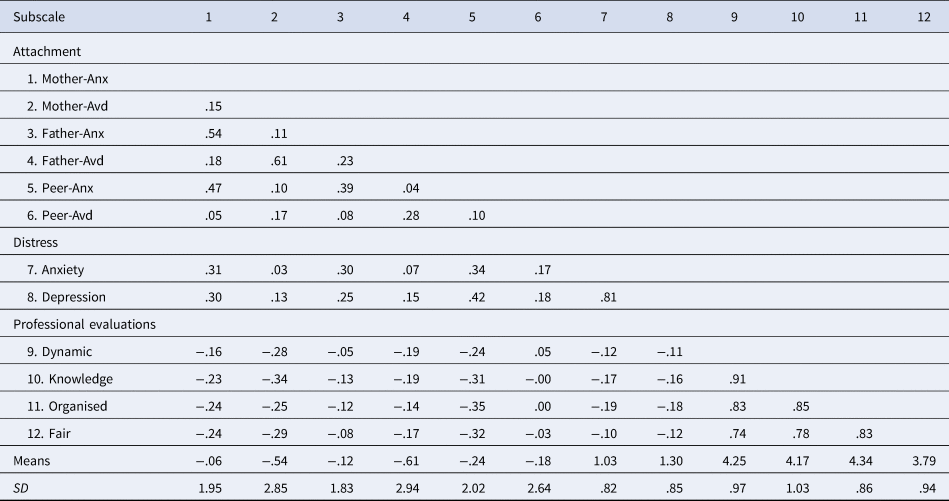
Correlations between attachment representations, distress, and evaluations of instructors are presented in Table 1. Significant effects ranged from small to medium, and upon review of Cohen (Reference Cohen1992) we determined that we had sufficient power (i.e., greater than 0.80) to test our hypotheses. As shown in Table 1, maternal, paternal and peer attachment anxiety at the beginning of the semester were positively associated with students’ anxiety and depressive symptoms reported at the end of the semester. Furthermore, maternal and peer attachment anxiety at the beginning of the semester were significantly and negatively associated with students’ evaluations of instructors at the end of the semester. As well, maternal attachment avoidance, and less strongly, paternal attachment avoidance at the beginning of the semester were negatively associated with evaluations of instructors at the end of the semester.
Means, Standard Deviations, Item Reliabilities, and Correlations for Attachment, Distress, and Instructors’ Evaluations

Note: N = 102. Correlations > .22 are significant at p < .05; Anx = attachment anxiety at T1, Avd = attachment avoidance at T1; Anxiety and depressed mood subscales from the SCL-90 distress at Time 2. Evaluation of instructors’ on the dynamic, knowledge, organised and fair scales from Henson and Scharfe (Reference Henson and Scharfe2011).
It may be that the association between attachment and course evaluations are overestimated with correlational analyses, and one of the advantages of SEM is that it controls for measurement error (i.e., common random error or shared method variance), which may overestimate the associations between variables (see Scharfe, Reference Scharfe2007, for an example with attachment and depression associations). To address this statistical weakness, structural equation modelling (SEM) was used to simultaneously test the association between exogenous latent variables of the attachment dimensions of the self- (anxiety) and other- (approach-avoidance) models and endogenous latent variables measuring the course evaluation using the same scales as Henson and Scharfe (Reference Henson and Scharfe2011). SEM also provides statistics to test the fit of the observed data to the proposed model (see Hu & Bentler, Reference Hu, Bentler and Hoyle1995), and several indices will be reported: ratio of χ2 to degrees of freedom (values of 2.0 or lower indicate good fit), root mean square error of approximation (RMSEA; good fit if 0.06 or less), the comparative fit index (CFI; good fit if greater than 0.95), the standardised root mean square residual (SRMR; good fit if 0.08 or less), and the Bentler and Bonett's non-normed fit index (NNFI; good fit if greater than 0.90).
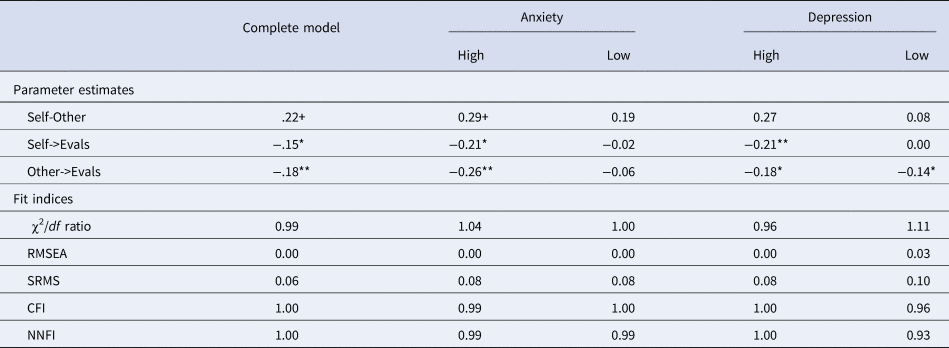
Scores on self/anxiety dimensions from mother, father, and peer were used as indicators of the self/anxiety latent variable. Scores on other/approach-avoidance dimensions from mother, father, and peer were used as indicators of the other/approach-avoidance latent variable. Scales reported by Henson and Scharfe (dynamic, knowledgeable, organised, and fair) were used to measure an endogenous latent variable assessing the student's evaluation of the instructor at the end of the semester. Several steps were taken before reaching the final model. First, the complete model with all possible paths was computed. Next, as suggested by Loehlin (Reference Loehlin1992), standardised residuals were inspected: Low residuals indicate good fit between the model and the data and large residuals are an indication that the data do not fit the proposed model. Two residuals (dynamic-organised; father anxiety-father avoidance) were found to be above 0.10 and correlated residuals (within time) were added to avoid overestimating the paths between latent variables. The complete model did not require adding correlated errors (across time). Once the correlated residuals were added to the model, several fit indices indicated excellent fit between the model and the data, χ2/df = 0.99; RMSEA = 0.00 (range from 0.00 to 0.07); CFI = 1.00; SRMR = 0.06; NNFI = 1.00. See Table 2 (column for complete model). As expected, both the self-model/anxiety scores (−0.15, p = .021) and the other-model/avoidance (−0.18, p = .006) were negatively associated with course evaluations, indicating that high attachment anxiety and high avoidance were associated with poorer course evaluations.
Parameter Estimates and Fit Indices for Overall and High-Low Models

Note: N = 102. Attachment representations were evaluated at T1. Distress and evaluations of instructors’ were assessed at T2. Self-other represents the correlation between the latent variables of the Self and Other. Self->Evals represents the path from the latent variable of the Self to the latent variable of course evaluations. Other->Evals represents the path from the latent variable of the Other to the latent variable of course evaluations.
+p < .10, *p < .05, **p < .01, ***p < .001
The second aim of this study was to determine whether the associations between attachment and course evaluations were different for students who reported high anxiety at the end of the semester (n = 53) compared to students who reported low anxiety at the end of the semester (n = 49). Building upon the structural model discussed above, we tested whether the attachment-course evaluations model differed with these two groups; all paths, including correlated residuals, are the same as the complete model and the fit indices are presented in Table 2. These two models (high and low anxiety) fit the data, but, as expected, the association between attachment and course evaluations was stronger for students who reported high anxiety at the end of the semester; in fact, the associations between attachment and course evaluations were close to zero for students who reported low anxiety. We used multigroup invariance testing to test these effects. We compared the unconstrained model with the model where the structural weights are constrained to equality (i.e., regression weights from self/anxiety and other/avoidance to evaluations were constrained to equality between the two groups) and found support for the conclusion that the models for participants reporting high and low anxiety were not equivalent, Δχ2(19) = 38.40, p = .005.
Finally, the models were tested for students who reported high depressed mood (n = 56) compared to students who reported low depressed mood at the end of the semester (n = 46). All paths are the same as the complete model, and the fit indices are presented in Table 2. Once again, the associations between attachment and course evaluations were stronger for students who reported high depressed mood at the end of the semester (both attachment anxiety and attachment avoidance were negatively associated with instructor evaluations). For students who reported low depressed mood at the end of the semester, attachment avoidance, but not attachment anxiety, was negatively associated with instructor evaluations. Once again, we used multigroup invariance testing to test these effects. We compared the unconstrained model with the model where the structural weights are constrained to equality (i.e., regression weights from self/anxiety and other/avoidance to evaluations were constrained to equality between the two groups) and found support for the conclusion that the models for participants reporting high and low anxiety were not equivalent, Δχ2(9) = 36.49, p < .001. Furthermore, given the differences between the self-other associations, we also tested the unconstrained model with the model where the structural covariances (i.e., self-other associations) were constrained to equality and found support that the two groups were not equivalent, Δχ2(12) = 40.18, p < .001.
Discussion
Bowlby (Reference Bowlby1969/1997) proposed that our internal working models of attachment guide our thoughts, feelings and behaviours, and in this study we replicated previous findings that our models of attachment are associated with students’ perceptions of instructors’ teaching performance. Using SEM we found that attachment anxiety and avoidance reported at the beginning of the semester were negatively associated with students’ views of their instructors at the end of the semester. Consistent with Bowlby's original proposal that effects of attachment would be more pronounced during stress, we found that attachment-evaluations association were stronger for students’ who reported high anxiety and high depression at the end of the semester.
Despite the similarity between our findings and Henson and Scharfe (Reference Henson and Scharfe2011) in demonstrating the predictive power of attachment representations on students’ evaluations of instructors, there a few differences between the two studies. Specifically, we found that attachment predicted evaluations of instructors’ teaching performance over time, whereas Henson and Scharfe (Reference Henson and Scharfe2011) assessed attachment representations and evaluations of instructors at the same time. Second, Henson and Scharfe (Reference Henson and Scharfe2011) did not assess distress at the end of the semester, and our findings suggest students’ distress at the end of the semester may play a role in course evaluations. Interestingly, the associations between attachment and course evaluations were stronger for participants who reported high levels of distress compared to participants who reported low levels of distress. It may be that students who are experiencing heightened levels of stress at the end of the semester are more likely to ‘fall back’ on their views of close relationships (i.e., attachment anxiety and avoidance) when asked to evaluate their instructors.
Despite Bowlby's (Reference Bowlby1969/1997) proposal that distress plays an integral role in prompting access to our attachment representations, to our knowledge, we are the first to test this effect and demonstrate how attachment representations and distress may interact to influence perceptions. Clearly, our results need further study. Although Bowlby (Reference Bowlby1969/1997) argued that effects of our attachment representations would be most prominent when distressed, ill or afraid, Bowlby's emphasis on the role of distress in activating attachment representations may be evident under conditions of acute anxiety (e.g., fear) rather than more chronic symptomatology (e.g., sadness, fatigue), and it would be interesting to study the effects under conditions of chronic anxiety.
Alternatively, our findings may reflect the unique manifestations of anxiety and depressive symptomatology explained by the theory of depressive realism as proposed by Alloy and Abramson, Reference Alloy and Abramson1979 (i.e., depressed individuals may possess more realistic and accurate appraisals of the world than non-depressed individuals). Several researchers have reported results that support the notion of depressive realism, including findings that depressed individuals more accurately perceive contingencies (Alloy, Abramson, & Kossman, Reference Alloy, Abramson, Kossman, Brush and Overmier1985), levels of control (Dobson & Pusch, Reference Dobson and Pusch1995), evaluations of interpersonal behaviour with roommates (Siegel & Alloy, Reference Siegel and Alloy1990), as well as descriptions of close others (Yeh & Liu, Reference Yeh and Liu2007). Unfortunately, we could not test this interesting alternative hypothesis — specifically, the hypothesis that individuals who reported higher levels of depression (or anxiety) were more accurate in their perceptions of the professors. Our participants assessed several different instructors and, due to our ethics board requirement to keep the instructors’ identity anonymous, it was not possible to determine whether the evaluations of the depressed individuals were more realistic or accurate (as would be suggested by the theory of depressive realism). We look forward to future work exploring these effects with evaluations of ‘known’ faculty.
Both the current findings and the findings reported in Henson and Scharfe (Reference Henson and Scharfe2011) highlight the importance of attachment representations on students’ evaluations of instructors’ teaching performance. Together, these studies suggest that our view of acquaintances may be strongly influenced by the nature of our more intimate relationships, and these findings add to the growing literature suggesting that attachment representations predict adjustment during stressful life transitions (i.e., leaving home to attend post-secondary institutions, transition to parenthood). However, our results suggest that universities may benefit (i.e., with higher student retention) from a proactive approach by providing educational workshops to first-year students and their families to promote parents’ involvement in the transition process to foster security and help reduce students’ levels of distress. Specifically, these workshops would provide the opportunity for parents to be educated on the integral role of familial relations to optimise academic achievement and learn strategies to improve or maintain close familial bonds when students leave their home for school (i.e., phoning regularly, visiting students). Future research should examine efficacy of such educational workshops in improving attachment security and its influence on students’ levels of distress and academic performance during their first year.
Although the design of the present study has several strengths (i.e., examining maternal, paternal, and peer attachment representations separately, prospective design, and replicating prior research), there are some limitations that need to be considered when interpreting the data; specifically, the majority of the students and university instructors who participated in the study were female. Previous researchers have highlighted gender differences in students’ evaluations of instructors’ effectiveness and gender-specific factors underlying their ratings (Anderson, Reference Anderson2010). In particular, parental attachment representations may be more influential when students evaluate female compared to male instructors (due to the caregiving affiliation with the traditional role of women). In contrast, factors such as perceptions of power or intelligence may be more important when students evaluate male instructors. Another limitation was that students completed the online questionnaires on their own computers. The lack of monitoring associated with this method of data collection may influence the reliability of reports; future work could address this by more closely monitoring participants or by using additional methodologies such as interviews. Finally, we recruited students from ‘typical’ courses and believe that the effect of students’ attachment representations on evaluations of instructors’ effectiveness would be stronger in anxiety-inducing courses, such as required statistics courses.
The importance of students’ evaluations in the post-secondary sector is undeniable. Specifically, students’ evaluations of instructors’ teaching performance influences instructors’ applications for further teaching contracts, for tenure and promotion, and for merit-based pay increases, but may also indirectly influence student retention — through student satisfaction with their courses and instructors — thereby influencing institutions’ reputation and financial sustainability. Our results suggest that student evaluations of teaching alone may not be fair or accurate measures of teaching performance and should be supplemented with, for example, supervisor or peer evaluations of teaching. Furthermore, faculty would benefit from understanding the importance of creating a secure learning environment to receive optimal ratings. Specifically, as students’ internal other-model (attachment avoidance) was consistently found to be negatively associated with evaluations of teaching performance, we suggest that instructors may find it helpful to use positive reinforcement in their courses and convey approachability to facilitate feelings of security, build trust and reduce levels of distress, particularly for transitioning students. For example, instructors could incorporate personal experiences into lectures, allowing students to relate to the instructor on a personal level rather than just an authority figure. Moreover, creating a supportive and emotionally safe learning environment that encourages students to share their thoughts by using positive reinforcement teaching strategies (e.g., praising students for participating in class discussion) would likely promote security and consequently improve instructors’ evaluations. Overall, fostering a secure student-instructor relationship would facilitate students to develop positive views of the instructor, encourage students to approach instructors for help, enhance learning and, in the end, may promote positive teaching evaluations, increase students’ satisfaction with their post-secondary experience, and improve retention.
Acknowledgements
Portions of these data were included in Jessica Reid's honours thesis (Trent University, 2010) and were presented at the Society for Teaching and Learning in Higher Education Conference, Toronto, Ontario, Canada, June 2010.
Financial support
None.
Conflict of Interest
None
Ethical standards
The authors assert that all procedures contributing to this work comply with the ethical standards of the Tri-Council Policy Statement: Ethical Conduct for Research Involving Humans (TCPS 2 2014, Canada)