1 Introduction
Research on creole-speaking communities is traditionally invested in describing the systematicity and regularity of its object of study. While this focus is a necessary reaction to prevailing notions of creoles as ‘corrupted’ languages, it leaves the interactional dynamics in many such communities understudied. This is particularly regrettable since creole-speaking societies often constitute hothouses of sociolinguistic meaning. Certainly, this is the case in Jamaica, where creole and lexifier coexist in intricate ways, social hierarchies are eroding, language attitudes are complex and shifting (Beckford Wassink Reference Beckford Wassink1999), and developing endocentric norms of English compete with several exocentric models (Sand Reference Sand1999: 175).
Linguistic interaction in Jamaica can be described as taking place on a continuum (DeCamp Reference DeCamp and Hymes1971; Rickford Reference Rickford1987) between an acrolect (Jamaican Standard English) and a basilect (the variety of Jamaican Creole that is most distant from the standard; although see Irvine Reference Irvine2008 for a critique of the circular definition of basilect and acrolect as each other's opposites). These two represent idealized poles, with the vast majority of actual speech production situated somewhere in-between, the so-called mesolect. There is substantial evidence that mesolectal speech itself is highly structured by sociolinguistic rules (Patrick Reference Patrick1999). Each speaker commands a certain range on this continuum, being able to move between more basilectal and more acrolectal speech within the confines of that range. However, the normative status of English occasionally pressures basilectal and lower-mesolectal speakers to aim at producing a target beyond the range of their natural competence. Often, though not always, such behavior results in mockery or derisive comments from other speakers, who accuse their counterparts of talking speaky-spoky.
Such was the case when a Television Jamaica (TVJ) crew interviewed Clifton Brown, a resident of the rural community Roberts Field, in June 2011 (NUKdeluxe98 2012). Heavy rains had flooded a road, effectively cutting off Roberts Field from the rest of the island, and reporters were on site to shoot a news story on the issue. In the footage Brown is seen wearing a white hard hat with the flooded road in the background. He explains that the current is very dangerous to cross and that he and other locals are on the spot to help people get safely from one side to the other. He also urges officials to commission the building of a new bridge across the river. What caught the audience's attention, however, was not the political message, but the way Brown spoke. Cues on various levels of linguistic description suggested that he was attempting to speak ‘proper English’ for the camera while at the same time clearly lacking the linguistic competence to do so. The interview with Brown became famous when Jamaican DJ Kevin Hamilton (‘DJ Powa’) remixed samples from it over an electronic beat and published the result on the video-sharing website Youtube (kevy2c 2011). The music video went viral and sparked a wave of subsequent interviews, parodies and metalinguistic commentary. The title of the song – ‘Nobody canna cross it’ – has become emblematic of this entire sequence of recontextualizations of Brown's original interview.Footnote 2
In this article, I focus on the early stages in the recontextualization of Brown's utterances. I trace their path, from the initial interview to their rekeying as musical performance to their uptake as identifiable texts in a language game in which Brown himself involuntarily participates. The prevailing attitudes are humor and mockery, although I argue that the framings leave room for different kinds of relational positioning vis-à-vis Brown's discourse and its linguistic form. I focus on the linguistic material not primarily for the sake of formal description, but rather to determine which parts of it hold significance from a local perspective, how they are drawn upon by participants to construct Brown's discourse as speaky-spoky and what social meanings are attached to this label.
2 Theoretical background
2.1 Speaky-spoky
Peter Patrick (Reference Patrick1999) gives a definition of the linguistic elements involved in speaky-spoky: a speaker ‘typically manipulates a few prestigious, highly salient sociolinguistic variables, rather than an entire grammatical system’ (277; cf. Patrick Reference Patrick and Schneider1997, Patrick & McElhinny Reference Patrick, McElhinny, Guenter, Kaiser and Zoll1993). The main features in question are the rounding and sometimes raising of low back vowels and the insertion of [h] in front of syllable-initial vowels, even in contexts where Standard English lacks these sounds. According to this pattern, the word rafting will be pronounced [rɒːftɪŋ] or [rɔ:ftɪŋ], and even unmarked prepositions such as in receive a glottal fricative before the vowel. /ɔ:/ is a phoneme that is considered to be entirely absent from Jamaican Creole (JC) (Devonish & Harry Reference Devonish, Harry, Schneider, Burridge, Kortmann, Mesthrie and Upton2004: 463), although Beckford Wassink (Reference Beckford Wassink2001: 145) shows that some speakers, depending on gender and acrolect- vs. basilect-dominance, maintain a qualitative distinction between /ɔ/ and /a/. Word-initial, prevocalic [h] is an optional resource in stressed syllables (Devonish & Harry Reference Devonish, Harry, Schneider, Burridge, Kortmann, Mesthrie and Upton2004: 466). Additional elements include malapropisms when speakers attempt to use ‘big words’ but fail to do so correctly as well as certain elements of voice quality (Patrick & McElhinny Reference Patrick, McElhinny, Guenter, Kaiser and Zoll1993: 288). Yet Patrick acknowledges that linguistic criteria alone are ‘neither necessary nor sufficient’ (Reference Patrick1999: 277) for framing a stretch of discourse as speaky-spoky, and mentions ideologies of ownership of and access to ‘proper English’.
In this regard, speaky-spoky is similar to other recently studied situations where speakers employ linguistic resources to inhabit identity categories that are not normally regarded as ‘theirs’, whether successfully (e.g. Rampton Reference Rampton1995) or less so (Cutler Reference Cutler1999). A case that bears particular similarity is that of ‘locally acquired foreign accent’ (LAFA) in Ghana (Shoba et al. Reference Shoba, Dako and Orfson-Offei2013), where speakers without any exposure or network ties to the United States adopt an American-influenced way of speaking. Shoba et al. list some linguistic features that contribute to LAFA, but maintain that ‘[s]uccessfully sounding American in such circumstances is “an ethnographic question”, rather than a matter for variationist linguistics (Johnstone Reference Johnstone1999: 509)’ (Reference Shoba, Dako and Orfson-Offei2013: 232). While much the same can be said about speaky-spoky, Shoba et al. analyze LAFA as heteroglossic practice, with a focus on speakers’ agency and stylistic choices. By contrast, as I argue below, speaky-spoky has a lot to do with the uptake a speaker's words receive after they have been uttered, and this uptake often entails a negation of stylistic choice and frustration of the speaker's communicative goals. While the original speaker produces language that allows for a reading of their discourse as speaky-spoky, the label itself is applied ascriptively after the fact and connotes social evaluations that run counter to the original speaker's identity construction.
To account for these mechanisms, Patrick's description of speaky-spoky needs to be further developed and empirically studied in situ, in a theoretical framework that is more clearly centered around local interaction. The chief interest of Patrick's work is a coherent description of the Jamaican mesolect as a structured sociolinguistic system unto itself. In contrast to earlier descriptions, which tend to treat variation as a problem that is often accounted for by imperfect speaker competence (see Patrick Reference Patrick, Schneider, Burridge, Kortmann, Mesthrie and Upton2004: 409), Patrick's work demonstrates the regularity and (probabilistic) rule-dependence of everyday Jamaican speech. This represents a major stepping-stone both for Jamaican sociolinguistics and for creole studies in general. The success of this project, however, is premised on a variationist notion of the Jamaican speech community, defined by macro-level community agreement in terms of production and evaluation of linguistic variables (Labov Reference Labov1972: 120–1). This notion of the speech community, and the Parsonian view of society that it relies on, stresses consensus and treats social categories as pre-existing, stable givens. Patrick is aware that speaky-spoky ‘suggests a more dialectal model of the creole speech community [and] a dynamic notion of stratification’ (Reference Patrick1999: 278), but does not trace the processes involved empirically. In the data below, speaker identities and the social meanings of linguistic features become contested issues. Therefore, a more social constructivist approach to linguistic interaction is better suited to trace the small, but important moves that are made as hypercorrect speech is taken up, recycled and given new meanings in new contexts.
Finally, it should be noted that, rather than speaky-spoky, Brown's language is most often referred to as ‘twangin’ in blogs and comments, as also reflected in his later alias ‘Clifftwang’. The two terms may not connote completely identical evaluations, but for the sake of terminological consistency, I continue to use the speaky-spoky concept here. This is justified for two reasons. First, as the analysis below will show, the hypercorrect linguistic features in Brown's speech coincide with those identified by Patrick, with a couple of additional ones potentially contributing to the effect. Second, while ‘twangin’ is the dominant label in comments sections on Youtube and blog entries about ‘Nobody canna cross it’, several of these do make reference to speaky-spoky as well, showing that the label is relevant, if not dominant, in local interpretations of the interview and remix.
2.2 Language, mobility and globalization
The data at hand concern a stretch of discourse that travels from its original context of utterance to new ones and in the process receives new interpretations. Mobility is an important issue here, and so is globalization. Although I confine my analysis to uptake within Jamaica, both technologies (the internet, and in particular Youtube) as well as discourses of globalization shape the path of Brown's utterances and the reactions they inspire.
Given this focus, the key concepts of Blommaert's (Reference Blommaert2010) ‘sociolinguistics of globalization’ provide a good theoretical vantage point from which to approach ‘Nobody canna cross it’. These comprise an emphasis on repertoires over abstract languages, on mobility across scales (ibid.: 32–5) and on polycentricity (ibid.: 39–41). Blommaert points out that the resources at a speaker's disposal never encompass the entirety of what is traditionally understood as ‘a language’ and almost always contain forms from more than one language. Therefore, it makes empirical sense to investigate repertoires of specific resources in interaction rather than purely linguistic abstractions. Nowadays, these repertoires are less confined to specific localities than they used to be. Thus, Blommaert claims, the mobility of resources deserves attention over the traditional notion of locally defined speech communities (ibid.: 102–6).
However, mobility does not equate to freedom from local constraints. People and their linguistic repertoires may travel, but they will always find themselves measured in terms of locally salient norms. Here, the concept of polycentricity (Blommaert Reference Blommaert2010: 39–41) becomes important: norms are never defined purely in terms of one ‘center’ (ibid.: 39), such as the nation state's codified standard. Instead, there are numerous institutions at various levels – from the peer group to internationally circulating discourses such as ‘globalism’ (ibid.: 15–16) – that enter into the process of norm formation by structuring ‘orders of indexicality’ (ibid.: 37–9). This fact creates uneven territories for linguistic exchanges, in which multiple and potentially conflicting standards may apply. Determining which of these become salient is a matter of determining the ‘scale’ on which an interaction takes place (ibid.: 34–7). Here, inequality crucially enters the picture: the ability to jump between scales (and especially up on the scale hierarchy) is unevenly distributed. Some actors and some resources travel across scales easily while others are highly localized and lose or change their meaning as they enter new scale levels. Brown, firmly rooted in the periphery of the Jamaican context, can be expected to belong to the latter group.
2.3 Entextualization and enregisterment
In addition to being subjected to new interpretations while traveling through different scales, Clifton Brown's words also witness a change in status: from straightforward utterances in an institutional interaction (the news interview) to cultural texts, rendered recognizable through their framing in DJ Powa's music remix and quoted and elaborated upon by participants in later interactions. Thus, they need to be read through the lens of performance rather than measured by any standard of authentic speech. As such, they are lifted out of the flow of everyday interaction and moved ‘into a reflexive arena where they can be examined critically’ (Bauman & Briggs Reference Bauman and Briggs1990: 60). This detachment from the immediate context of interaction in which the utterances are originally produced is referred to as entextualization (Bauman & Briggs Reference Bauman and Briggs1990; Silverstein & Urban Reference Silverstein and Urban1996).
Yet the text that results from such processes is only apparently stable. Each time it is drawn upon and recontextualized in a new interaction, there is potential for participants to attach new stances, participant roles and social meanings to it (Silverstein & Urban Reference Silverstein and Urban1996: 12–14). Thus, subtle differences in the way a text is embedded in different settings can shift and recalibrate its meaning. In the discussion below, I draw attention to such differences between the videos under analysis and to the way different embeddings of Brown's entextualized utterances enregister them (Agha Reference Agha2005) as speaky-spoky.
2.4 Frame analysis and production formats
This rough sketch provides a promising perspective on discourse in motion. The notions of scales and scale-jumping hold purchase for the analysis below, but Blommaert remains relatively vague on how the navigation between scales is achieved in interaction. To sharpen the empirical focus, I draw on an additional range of tools developed by Erving Goffman (Reference Goffman1974, Reference Goffman1981). Here, Goffman's writing on frames (Reference Goffman1974) is helpful. In principle, every ‘strip of activity’ (ibid.: 64) in the world is subject to interpretative acts of reframing or ‘rekeying’ (ibid.: 79). Several rekeyings can (and often do) exist on top of and in competition with each other. Tracing the transition of a stretch of discourse through different levels of keying can reveal a good deal about its evolution as a text. As new frames are applied to it, new ways of interpreting its meaning and its relation to the contexts around it emerge. In this process, aspects that were marginal to the original stretch of discourse may be foregrounded and transformed to become central elements of the newly defined text. Likewise, important features of the initial activity may be neglected or erased.
Another feature of rekeyings, and one that applies more directly to language, is that the different agencies behind the production of an utterance may be separated from each other. Goffman's (Reference Goffman1981) distinction between author, animator and principal is helpful to illustrate the processes at work here. The author is the (real or purported) original source of an utterance. In any current moment of utterance the animator is the person actually engaging in the articulatory work of producing discourse, whether his words are understood to be his or those of a separate author. That these two agencies do not always coincide can be seen in the example of reported speech, where the current animator claims to merely recount words originally spoken by someone else. Following Goffman (Reference Goffman1974: 523; see also Bucholtz Reference Bucholtz1999), it is important to note that in reported speech and similar activities, the author should be treated as a narrative figure rather than defined in terms of the factuality of past utterances. It is, for instance, entirely possible to erroneously attribute a quote and thus construct someone as its author who in reality had nothing to do with its origin or to misrepresent what another person said.
Finally, the principal is the agency that lends force to the statements formulated and commits to their propositional content. It can be understood as the answer to the question on whose behalf or in whose name something is said. Hence, a government representative at a press conference will not simply give her own opinion in response to a question. Rather, the principal she will give voice to will most likely be a larger group such as the government itself or a certain party's majority opinion. A case in which speakers act as animators but not principals of utterances is varidirectional double-voicing (Bakhtin Reference Bakhtin1984; Rampton Reference Rampton1995: 221–4), such as ironic styling of someone else's speech.
Goffman's writing provides the methodological tools to examine participants’ understanding and negotiation of the interactional situation as well as their self-positioning with regard to the discourse they animate. Hence, it allows a structured analysis of the subtle differences between embeddings of Brown's entextualized discourse mentioned above and concomitant attention to the semiotic work achieved through these differences.
3 The original interview
In this section, I introduce the original interview with Clifton Brown in its context of the news story about the road flooding in rural St. Andrew (one of Jamaica's parishes). I examine the linguistic material of Brown's utterances as well as their sequential positioning in the report and the implications of this arrangement for the frame in which the interview is keyed.
My transcription of the data follows the orthographic system used in Cassidy & Le Page (Reference Cassidy and LePage1980). Departure from this system is only made in cases where phonetic realization differs markedly from regular JC pronunciation. While this strategy of representation runs the danger of highlighting some features and hiding other aspects of variation, it is chosen here for clarity of presentation. Short pauses are represented as a full stop in parentheses; any pause longer than 0.5 seconds is transcribed as its length in seconds in parentheses. A question mark at the end of an utterance indicates rising intonation, not necessarily interrogative syntax. To add some additional information about reactions to the video, I include laughter (represented as ‘@@@’) that occurs in another Youtube video of people watching the original airing (tazdkc 2011). This video was uploaded before the creation of DJ Powa's remix and hence gives an idea of initial reactions to the interview, independent of aspects the remix would later highlight. The instances of laughter are aligned with the points in the original video that trigger them and enclosed in curly brackets to indicate that they are not part of the original interview situation. Editing decisions such as cuts are indicated as commentary in parentheses. Likewise, unclear utterances are coded as the transcriber's best guess, followed by a question mark and enclosed in parentheses. Glosses in Standard English are given below each line. Bold features are of particular interest for the discussion below.
After a brief announcement by the studio announcers in Standard Jamaican English, the floor is given to the onsite reporter, Dara Smith. Her speech, like that of the studio announcers, is morphosyntactically standard, but unlike theirs it is phonologically more clearly Jamaican, most notably in rhythm, pitch movement and vowel realization. She furthermore displays features typical of ‘adoptive speakers’ (Shields Reference Shields1989: 46), i.e. upwardly mobile Jamaicans who do not have native-speaker competence in Standard English, such as the insertion of an enclitic schwa after word-final consonants (ibid.: 47). The studio announcers, on the other hand, lack those features and can be described as ‘group 1’ native speakers of Standard English in Shields’ terms.
Smith introduces the inundation in St. Andrew, mentioning the fact that several hundred people have been left marooned by the floods, and listing three roads that have been rendered impassable. Following this is a cut to an interview with a female local resident who expresses her concern in lower-mesolectal JC. Next, in three brief sentences Dara Smith redirects the report to the road flooding at Roberts Field before there is a cut to the first part of the interview with Clifton Brown:
-
(1) TVJ Interview: Part 1


Next, Dara Smith recounts how a truck stalled in the middle of the flooded road. She then moves on to give a local perspective on the situation, expressing residents’ anger at not receiving adequate support in their predicament. After explicitly stating ‘they are appealing for help’ (2:52), there is another cut to Brown:
-
(2) TVJ Interview Part 2

The report then comes to a close with a brief concluding statement by Dara Smith and another short interview with the female resident mentioned above.
In terms of individual features, most of Brown's speech can be classified as mesolectal. It includes creole features such as the absence of the copula (‘wi aroun tu help dem’, line 2), infinitival fi (‘fi kom oova’, line 4), default past reference for bare non-stative verbs (‘wi = almous luuz a boslood a piipl’, line 12; see Patrick Reference Patrick, Schneider, Burridge, Kortmann, Mesthrie and Upton2004: 411), final consonant cluster reduction (e.g. ‘aroun’, line 2, ‘almous’, line 12), and non-occurrence of morphologically distinctive participial forms (‘wi lak awei in di wildanes’, line 20; Patrick Reference Patrick, Schneider, Burridge, Kortmann, Mesthrie and Upton2004: 416). But there are also forms more closely aligned with acrolectal speech, such as the phonetic realization of town as ‘taun’ instead of ‘tong’, a Standard Jamaican English feature ‘which assumes great sociolinguistic significance in the Jamaica language situation’ (Devonish & Harry Reference Devonish, Harry, Schneider, Burridge, Kortmann, Mesthrie and Upton2004: 471). Additionally, there are several intermediate forms that share elements of basilectal as well as upper mesolectal speech. The phrase ‘di kidz dem’ in line 17 uses the basilectal plural marker dem after the noun, but the noun itself is a metropolitan form that contrasts with JC pikni. The plural is also redundantly marked with the Standard English plural allomorph [z]. A feature that could not be represented in the transcript is the rhythm of Clifton Brown's utterances. He rapidly produces stretches of two to ten syllables with typically short, but recognizable pauses in between. The result is a noticeable irregularity in speech tempo.
For the most part, then, Brown's speech seems a typical instance of mesolectal rural Jamaican. However, there are several features which indicate that the speaker is aiming for a position at the acrolectal end of the continuum which is apparently outside his competence. Both phonetic elements of speaky-spoky mentioned by Patrick (Reference Patrick1999: 277) are present in the excerpt: insertion of [h] before word-initial vowels (‘[h]oova’ for oova, line 3; ‘fisha[h]um[ɛː]n’ for fisha uman, line 7) and rounded realization of low back vowels (‘w[ɒː]ta’, line 1; ‘kr[ɒː]s’, line 5; ‘g[ɒː]n’, line 10; ‘g[ɒː]d’, line 13; ‘bik[ɒː]’, line 17; and ‘l[ɒː]s’, line 18). The effect of [h]-insertion is highlighted by the fact that Brown produces some words which do have an initial /h/ in Standard English without a glottal fricative and produces noticeable glottal stops instead (e.g. ‘uu’ for who in lines 1 and 6). Additionally, there is a feature which Patrick does not mention, but which also falls into this category: a fronted and raised realization of the low back vowel (‘fisham[ɛ:]n’ and ‘fishahum[ɛ:]n’ in line 7; variations of the auxiliary k[ɛ]n in lines 4, 5, 8 and 9). These variants are not traditional features of speaky-spoky, but may reflect a reorientation towards North American varieties as carriers of prestige (Hinrichs Reference Hinrichs2006: 13). Particularly the word ‘man’ is a very salient lexical item which has a raised and fronted vowel in most North American varieties of English.
Another salient feature is the enclitic vowel in ‘noobadi kyana kr[ɒː]s it’. This might be interpreted as the same feature described above for news announcer Dara Smith's speech, a common marker of socially mobile non-native speakers of Standard English in Jamaica (Shields Reference Shields1989). As such, it is not linguistically incorrect or foreign, and there is no indication that Dara Smith's usage elicits any strong reactions. Yet it is also connected with a very specific social persona (upwardly mobile, aspiring speakers in formal situations), and the discrepancy between Brown's own social identity and that associated with enclitic vowels after word-final consonants is very salient. It has to be noted, however, that ‘kyana’ is the only context in which Brown inserts a word-final vowel. An alternative interpretation would be that he is modeling his pronunciation of the modal auxiliary after (semi-)modals such as gonna, wanna or gotta. This would be a clear case of qualitative hypercorrection. A less marked instance of hypercorrection is the insertion of a [t] in the coda of ‘assistant’ (Devonish & Harry Reference Devonish, Harry, Schneider, Burridge, Kortmann, Mesthrie and Upton2004: 476).
Phonetically, then, Clifton Brown fulfills all the criteria given by Patrick to stamp someone as talking speaky-spoky. It is important, however, that this interpretation is an ascriptive one imposed from outside. Brown probably does not see himself as talking speaky-spoky, but the English he deems appropriate for an interview on national television. Neither is his orientation towards this target reducible to mere opportunism. Quite the contrary, it appears plausible to assume that Brown is aware of normative pressures that force him to do ‘better’ than he can in his normal speech production, or else risk not being taken seriously. The result is precisely the kind of unfinished discourse that Blommaert emphasizes, a ‘deployment of incomplete communicative forms’ (Reference Blommaert2010: 180) characterized by an awareness of existing norms but lack of sufficient linguistic resources to fully conform to these norms. From the local perspective of Brown, however, it is as close to ‘good English’ as possible.
Next, with the support of additional evidence (the laughter from the Youtube video of people watching the interview), I argue that the features mentioned above are indeed what made Brown's speech so humorous to many Jamaicans. The first instance of laughter that can be heard on the video follows the statement ‘noobadi kyana kr[ɒː]s it’ (line 5). Two lines down, the person holding the camera bursts out into giggles following the utterance ‘laik a fisham[ɛ:]n (.) an a fisha[h]um[ɛ:]n’ (line 7). These two brief snippets neatly contain the three elements of speaky-spoky identified above: rounded realization of a low back vowel (‘kr[ɒː]s’), prevocalic h-insertion (‘fisha[h]um[ɛ:]n’), and a raised and fronted low back vowel (‘m[ɛ:]n’, ‘fishahum[ɛ:]n’). The next clearly audible instance of laughter again follows an intonation unit (line 18) which contains one of these features (‘de l[ɒː]s taim’).Footnote 3 This suggests that listeners are attuned to Brown's infelicitous manipulation of linguistic variables beyond the reach of his competence. A final burst of laughter follows the last line of the interview. This one, I argue, does not react to any specific feature of the preceding discourse, but rather serves as a ‘bracketing’ device (Goffman Reference Goffman1974: 252). It marks the end of ‘the funny part’ and is not triggered by any specific utterance, but gives a retrospective summary of the entire preceding discourse's humorous key, which at the same time marks a transition out of that key.
As Cotter (Reference Cotter2010, Reference Cotter2011) points out, news reporting often reflects language attitudes and ideologies in the wider community. The framing of individual voices in the TVJ story guides the interpretation of the linguistic material it contains. It follows a pattern which assigns clearly defined participant roles to the different speakers. Viewers are addressed by a very officially dressed female announcer in the TVJ studio, whose speech register is that of the written standard and approaches RP-like pronunciation. Next, there is a cut to the onsite reporter who is filmed standing in front of the flooded road, in the midst of the action. Her speech is completely standard in terms of grammar, but has a decidedly more ‘local’ flavor in terms of pronunciation. The persona Dara Smith embodies serves the double function of maintaining the serious, high-register frame of news reporting but at the same time vouching for local authenticity via her physical presence on site as well as her language being phonologically closer to local speech. Alternating with Smith's report is the voice of a local female resident who speaks a lower-mesolectal variety. She is depicted standing in front of thick greenery and bamboo, evoking a place image of wilderness, in stark contrast to the metropolitan setting of the TVJ studio. Hence there is a clear progression: from (a) the studio, a place of editorial authority where people dress properly and Standard English reigns to (b) the voice of the onsite reporter, who performs the double function of representing the metropolitan identity of the network in her dress and speech while at the same time evoking credibility, involvement and proximity to locals, and, finally, (c) the voices of locals themselves, relied upon to construct the immediate, unmitigated and authentic experience of the rural working class. An indexical connection is often made between authenticity and use of vernacular language (Jaffe Reference Jaffe2009; Coupland Reference Coupland2009), and this connection is recognized and drawn upon in news reporting (Cotter Reference Cotter2011: 1897). Hence, the structure of the TVJ story creates expectations as to the language performance of the interviewees. Iconic connections (Irvine & Gal Reference Irvine, Gal and Kroskrity2000: 37) are thus drawn between appearance (dress; skin color also enters the picture), place (urban vs. rural), social class and language production. A binary distinction along these dimensions is recursively applied to the way each pair of juxtaposed speakers (news announcer – Dara Smith, Dara Smith – local resident) contrast with each other.
Into this sequential structure and the expectations created by it, enter Brown, whose depiction in work attire in front of a flooded road (a setting which he himself refers to metaphorically as ‘the wilderness’, 3:13) reinforces a perception of him as a rural, working class individual. But Brown's language performance does not conform to the expectations raised by this framing. Rather than performing the ‘authentic’ rural speaker, he makes his best attempt at ‘proper English’ to convey what, for him, is an important message. This brings about tension with the language-ideological backdrop of the entire news story. Laughter and ridicule are readily available resources to resolve this tension. They locate blame in the speaker rather than requiring a reconsideration of expectations in light of diverging linguistic evidence.
In terms of production formats, it is obvious that the interview presents Brown as the author of the utterances in his interview. Through editing and arrangement choices, the TVJ news team assumes animator capacities similar to those of a narrator delivering reported speech. Animation in this case entails no active, let alone malevolent, distortion of the original utterances, but it nonetheless influences their reception in the ways described above. It is also noteworthy that Brown himself consistently uses the first person plural (‘wi’, lines 2, 12, 15, 18, 20) rather than singular, rendering the principal, the entity in whose name the words are spoken, the whole community rather than his individual standpoint. Seeing Brown as ‘a social climber, opportunist, lame or traitor’ (Patrick Reference Patrick1999: 278) is consequently not an immediately apparent interpretation. Social positioning of and (dis)identification with Brown's language, rather, appear to be more ambiguous and polyvalent, as the following examples demonstrate.
4 DJ Powa's remix
Clifton Brown became a mass cultural phenomenon when Jamaican DJ Kevin Hamilton (‘DJ Powa’) chopped and looped samples from the interview and remixed them with a self-produced electronic beat. The resulting Youtube video reverberated beyond Jamaica and had been accessed more than 5 million times at the time of writing. Apart from the beat, both the linguistic and visual material of the music video are made up of parts of the original news story. Much of the appeal of ‘Nobody canna cross it’, then, relies on the creative juxtaposition and rhythmic patterning of this material. Here, I focus on how this creation highlights aspects of Brown's speech, erases others, and even creates new, recognizable texts that were not part of the original data.
Example (3) is the chorus, which is repeated five times throughout the song. The transcription conventions are the same as above, except that places where there have been cuts to the original material are marked by a double slash.
-
(3) Nobody canna cross it: Chorus

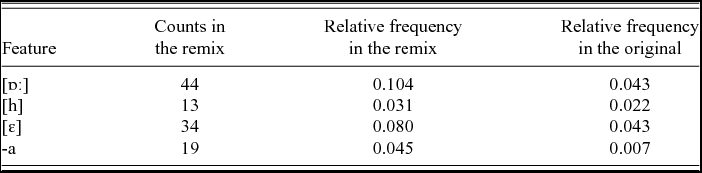
Two aspects are striking about this excerpt. First, in only eight lines, there are fourteen cuts made to the original material. This process builds on and enhances the impression of irregularity in Brown's speech tempo. Second, there is a high density of the phonetic features of speaky-spoky described above, [h]-insertion, the substitution of [ɒː] and [ɛ] for low vowels, and insertion of post-coda vowels. Table 1 gives absolute counts of these in the song, as well as their relative frequencies in the song and the original. The rates of occurrence for all of them are higher than in the original interview, particularly in the case of the enclitic vowel, which only occurs once in the original. The fact that they cluster densely in the chorus lines further foregrounds these four features. Thus, DJ Powa's remix highlights all the ‘non-normal’ parts of Brown's discourse, his rhythm and his speaky-spoky phonetics.
Feature frequencies in ‘Nobody canna cross it’ and in the TVJ interview

At the same time, there are aspects of the original interview that DJ Powa's remix downplays or erases completely. Erasure is a central semiotic process that sustains linguistic ideologies. It ‘renders some persons or activities (or sociolinguistic phenomena) invisible [if they are] inconsistent with the ideological scheme’ applied to a stretch of discourse (Irvine & Gal Reference Irvine, Gal and Kroskrity2000: 38). In the present example, as musical originality, sound play and linguistic irregularity take center stage, the actual situation that caused the interview to be conducted in the first place is lost from sight. What remains of the original story are samples of Dara Smith's voice-over that bracket the beginning and the end of the song. The phrase ‘nat ivm di kidz dem k[ɛ]n // go tu skuul’ (line 56) is the only line in the song that retains traces of Brown's community activism. His call ‘wi niid som asistant = wi niid a brij’ (line 15 in the original interview) is entirely omitted from DJ Powa's remix. These omissions are consequential, as they help to contain the possibility of the original interview's serious frame spilling over and bleeding into the new one (Goffman Reference Goffman1974: 35–6). As it is, the outcome is a text that is purely performative and comic and virtually emptied of any propositional content.
But not only do elements of the original text get highlighted or erased, new forms also emerge. Playing on and intensifying the ‘unfinished’ collocations (Blommaert Reference Blommaert2010: 180) Clifton Brown uses, ‘Nobody canna cross it’ fuses together constituents of the original interview in a way that creates new utterances. The most prominent one is ‘di bos k[ɛ]n swim’, which is found five times altogether (three times in line 39, once in lines 40 and 44) in the song. Its salience is further highlighted by the fact that it is the subtitle to ‘Nobody canna cross it’, and in the SmileJA studio interaction (see section 5 below) DJ Powa wears a T-shirt with these words on it. Yet the sentence itself was never produced by Brown, but is a blending of ‘di bos woz komin from taun’ (line 11 in example (2)) and ‘uu k[ɛ]n swim’ (line 8 in example (1)). The fabrication of this phrase alludes to another feature typically associated with speaky-spoky, the use of malapropisms in an attempt to use ‘big words’ (Patrick & McElhinny Reference Patrick, McElhinny, Guenter, Kaiser and Zoll1993: 288). It is not coincidental that the resulting collocation sounds awkward (with an inanimate subject and a verb generally reserved for animate agents) and thus further frames Brown as maximally distant from the linguistic standard.
What happens in the case of ‘Nobody canna cross it’ is similar to reported speech, for which Goffman (Reference Goffman1981) provides helpful analytical tools. Insofar as DJ Powa is at liberty to cut, mix, clip and distort the original utterances, he can be described as the animator, although he never actually utters words in the strict articulatory sense. This gives him the freedom to recontextualize and rekey Brown's speech.
Brown as the author is credited with producing the linguistic material but loses control over its reappropriation and animation in new contexts. It is important to keep in mind that author in Goffman's sense is best understood as a figure, rather than measured according to objective criteria of veracity. Hence, despite the fact that Brown himself never produced the line ‘di bos k[ɛ]n swim’, the video creates the appearance that he did and thus presents him as the author. To the extent, however, that viewers are aware of DJ Powa's fabrication of ‘di bos k[ɛ]n swim’, they will recognize that Brown the protagonist of ‘Nobody canna cross it’ is not identical with Brown the speaker in the original interview (Bucholtz Reference Bucholtz1999: 446). This non-identity may help to further distance the song from the news story, its serious topic and the social identity of speakers in it, and to highlight its performative and playful nature.
Finally, identifying the principal behind the song is not an easy task. On the surface level, the video shows the face of Clifton Brown vividly accompanying his words. In this regard, it would seem adequate to name him as the authority committed to the song's words. However, despite the individual words being the same as in the original interview, their propositional content gets virtually lost in the act of remixing. The question arises, then, what exactly is being committed to in ‘Nobody canna cross it’. There is simply no clearly identifiable message beyond the meaning of individual lines. One interpretation would be that the song effectively erases the principal as an agency in this specific instance of speech production. Apart from clearly separating the song's humorous key from the serious topic of the news story itself, this erasure of the principal also forecloses an easy identification of any social group that might be the butt of the joke.
The frequent repetition of individual lines demonstrates the entextualizing work the song does, ‘rendering discourse extractable [and] making a stretch of linguistic production into a unit – a text – that can be lifted out of its interactional setting’ (Bauman & Briggs Reference Bauman and Briggs1990: 73). This is most often understood as loosening ties to the specific context of utterance. Yet I suggest that the music remix goes a step further, by not only mitigating contextual embedding, but effectively stripping away any content associated with the original discourse. The result is an almost purely decontextualized language object that is maximally self-referential and contained, and hence freely recontextualizable. Referential meaning gets entirely replaced by the indexicalities of linguistic form (Silverstein Reference Silverstein2003), inviting reflexive attention to the forms themselves.
5 Clifton Brown on SmileJA
I now turn to an interaction that brings the author of the original discourse back into contact with his entextualized words. Shortly after the song went viral on Youtube, Clifton Brown and Kevin Hamilton were invited to an interview on SmileJA, a breakfast show on TVJ hosted at the time by Neville Bell and Simon Crosskill (mryardvybz 2011). As the interview unfolds, different perspectives on the importance of the texts in question arise and compete with each other. These can be fruitfully interpreted as attempts to impose different frames on the interaction. I analyze a stretch of interaction from the beginning of the interview.
The transcription conventions used below extend the ones above in order to deal with the messy flow of real-time conversational data. In addition to line numbers and time code in the video, a column for speaker is added. NB is show host Neville Bell, SC his co-moderator Simon Crosskill, CB Clifton Brown, and DJP Kevin Hamilton (DJ Powa). Overlapping turns are aligned vertically below each other and marked with opening square brackets at the point where the overlap begins. Three dots in parentheses mark stretches of discourse that are not clearly audible. Lexical stress is indicated through use of all capitals. A particular problem lies in representing the different varieties of the speakers orthographically. For Clifton Brown, who speaks lower-mesolectal JC throughout, I continue to use the orthography used in Cassidy and Le Page (Reference Cassidy and LePage1980). NB and SC, however, speak fairly Standard English for most parts of the interview. I represent their speech with standard orthography and only depart from this in cases where they markedly diverge from standard pronunciation.
In the first few lines of the studio interaction, not much is said, but a lot happens. Immediately after the cut into the studio (following a clip of CB's original interview), NB and his colleague are shown shaking with laughter. It takes them seconds to control themselves and address the audience. This is quite an unusual way to open an interview and it breaches the conventional rules of doing so, even in a relaxed atmosphere. Beginning in this way is a powerful bracketing mechanism that leaves little doubt as to the keying of the ensuing interaction. What is to follow, it implies, is not mere light-hearted humor but sheer hilarity that is so overwhelming as to override the demands of genre conventions. Thus, even before Clifton Brown is addressed, before the camera pans in on him for the first time, a frame is established that guides interpretations of the following interaction. Being keyed in such a way, there is little hope for CB to engage in a serious conversation on an equal footing; yet engage he must. At 0:58 there is a cut to CB's face, as he is introduced by NB. He is smiling along with the moderators, but the expression on his face suggests that he is not sure what exactly is so funny. The answer is made perfectly obvious to the audience early on, as NB engages CB in conversation:
-
(4) Smile Jamaica interview: Prompting

This entire sequence is quite obviously engaged in by NB and SC with the sole purpose of prompting Clifton Brown to produce as many instances of the words ‘(noobadi kyana) kr[ɒː]s it’ as possible, at this stage clearly a text of its own, quite independent of its original context of utterance. NB's reference to it as ‘these now immortal words’ in line 3 attests to this fact. It also emphasizes biographical continuity between CB in the studio interaction and CB in the TVJ news story and its musical remix. Throughout the SmileJA studio interaction, CB is asked to explain why he was on site at Roberts Field (line 4) and what prompted him to speak the way he did (line 28), requiring him to explicitly commit to his earlier (linguistic) actions. In this regard, the SmileJA interaction is very different from ‘Nobody canna cross it’. Beyond merely putting language on display, it purposefully draws connections between linguistic form and the social identity of a specific speaker.
The importance of who produces hypercorrect speech in the interaction transcribed above can clearly be seen in the frequent prompting behavior the hosts engage in. Even before addressing Brown directly, Bell introduces the topic of the interaction by quoting his interlocutor in line 1 of example (4), performing the text ‘noobadi kyana kr[ɒː]s it’. This is met with spontaneous laughter by SC. As the interview progresses, NB continuously inserts variations of ‘kr[ɒː]s it’. These are completely unnecessary in terms of eliciting information and hence apparently serve the sole purpose of prompting CB to produce new instances of hypercorrect speech. The fact that no laughter follows the host's production of these phrases indicates that the object of humor is not the entextualized utterance itself anymore, but the speaker who first produced it.
When NB gives over the floor to Brown, it is ostensibly with a straightforward question about the situation at Roberts Field at the time of the inundation and Brown's involvement in it (line 4). But as the latter starts to explain, it becomes clear from NB and SC's reactions that what they really are interested in is getting Brown himself to animate the text ‘noobadi kyana kr[ɒː]s it’. The patterning of laughter is telling. All of NB and SC's outbursts until line 30, which usually occur in conjunction, follow instances of CB producing variants of the text in question (lines 7, 16), with the exception of his saying ‘ya uu k[ɛ]n manij di w[ɒː]ta’ (line 21). This last instance contains at least the vowel in question, making it clear that this is the feature that listeners cue into throughout the exchange.
What is going on here can be described as a form of verbal play which extends the original humorous act of watching DJ Powa's video and quoting from it. Now, it is no longer sufficient to produce the text at the center of the game; the new challenge arises from getting the original author to reanimate the words for the other participants’ amusement. In this sequence from the beginning of the interview NB and SC are quite successful in their endeavor. The resources available to them to ensure success are their institutional roles, their more extended competence in acrolectal Jamaican speech and the ideologies that privilege their social identities over that of CB. While the latter must be aware that there is something in the way he speaks that amuses his interlocutors, his utterances betray no recognition of the specific features that render his performance comedic. CB does not modify his speech to avoid instances of ‘kr[ɒː]s’. Being in a subordinate institutional role and lacking the linguistic privilege that would render him a participant on equal footing, CB has little choice but to play along with the serious key of the interaction and block out the hosts’ mockery (which he is clearly aware of, as his facial expression reveals) as best he can.
At the end of (4), SC even explicitly foregrounds CB's accent as the comic feature in this interaction by asking about its origins (line 28), but Brown still answers in a straightforward, serious manner. Stating that this is his normal, vernacular way of speaking (line 29), he is either unable or unwilling to acknowledge the elements of his linguistic performance that mark it as inauthentic. Consequently, CB is not positioned alongside the moderators and viewers who have reason to laugh, but as an outsider who fails to understand the relevant aspects of the humorous situation. The social distance thus emphasized, again, does not fail to amuse SC and NB, as their laughter in the final lines of the transcript indicates.
This pattern continues for most of the interview, whenever Brown is selected by the moderators as their interlocutor. As they push the game further and further, Brown is getting visibly irritated. However, institutional inequalities and the hosts’ manipulation of the flow of interaction leave him little room to lead the conversation in a direction more aligned with his purposes.
In the course of the interview, as CB gets increasingly wary of his interlocutors’ intentions, they give more of the floor over to him and attempt to hold back their outbursts of laughter. This prompts CB to continue engaging in ‘straight talk’ and picking up the topic of the bridge. But rather than an accommodation to CB's interactional position, the hosts’ behavior is a form of fabrication, ‘the intentional effort of one or more individuals to manage activity so that [another participant] will be induced to have a false belief about what it is that is going on’ (Goffman Reference Goffman1974: 83). It is not an attempt on the part of NB and SC to leave the comic frame, but to make CB believe the comic frame has been left while in reality it is still intact. That this is the case, and that the hosts’ strategy is successful, becomes obvious from the hosts’ reactions as soon as CB lets himself get involved enough to produce further instances of ‘kr[ɒː]s’.
It is telling that despite the clearly marked frame of mockery that extends over almost the entire 12 minutes of the interview, CB never confronts the moderators directly. During their bursts of laughter, when the camera is on him, an uncomfortable and annoyed look registers on his face, but he never verbalizes these feelings explicitly. This fact may be read as evidence of the strongly felt imbalance of institutional power between the hosts and the studio guest. The former speak acrolectal Jamaican English (except for deliberate code-switches), represent the urban middle class, and clearly have a better command of the interactive domain of television talk. In this situation, it is not hard to imagine Brown's linguistic and social insecurity preventing him from speaking his mind. Yet neither does Brown give up on the framing he initially expected, serious talk about the need for a bridge in Roberts Field. Throughout the segment, he sticks to this topic and continuously attempts to redirect the flow of conversation in this direction. While this provides NB and SC with countless opportunities to elicit instances of ‘kr[ɒː]s it’ and other enregistered features of speaky-spoky from Brown, it also keeps the serious topic on the agenda and requires more and more effort from the moderators in their attempts to maintain the comic frame.
6 Discussion
The symbolic violence Brown suffers from the series of entextualizations traced above is both obvious and extensive. The remix as well as the SmileJA interview erase his message, highlight disorderliness in his speech and single him out as an object of ridicule. Thus, the above can be read as a case study of mobile language in a globalized world in Blommaert's terms: a stretch of discourse from the periphery, crafted in accordance with a local understanding of what constitutes ‘proper English’, moves towards a center (relatively speaking), in which new scales, new orders of indexicality apply. From this new perspective, the language used appears unfinished, and this unfinished character draws attention to itself, obliterating the intended message. Brown's discourse is doomed to be met with mockery and disapproval.
However, several points need to be added. The first is that, in all three videos analyzed above, symbolic violence is not something that just happens to Brown's language as it moves through TimeSpace (Blommaert Reference Blommaert2010: 34–6). Rather, linguistic disorderliness is actively highlighted and in part created through the entextualization of the discourse in all three cases: (a) the sequential positioning in the news story; (b) the foregrounding of specific features and erasure of propositional and illocutionary content in DJ Powa's mix; and (c) the way in which NB and SC contain Brown and openly mock him and his linguistic insecurity in the SmileJA interview. While much of this behavior can be explained in terms of systematic inequalities, these inequalities should not be regarded as entirely external and prior to the unfolding interactions. They are available as interpretive backgrounds for the participants, but it is the participants themselves and their choices on the micro-level of interaction that actualize them and render them relevant for the given exchanges in particular ways. As I argue below, how precisely they do so and how they position themselves vis-à-vis their discourse leaves considerable room for individual manipulation.
DJ Powa's remix and the SmileJA interview both effect a pejorative reading of Brown's language use, but there are important differences between the two. These become most obvious from the audience reactions both elicited. While the music video went viral and was largely met with praise, there was considerable protest after the airing of the SmileJA interview. Shortly after, Neville Bell resigned from his post and publicly apologized to Clifton Brown and the viewers. Clearly, quite different readings were applied to the two texts. So what are the differences that sparked such diverging reactions? I argue that the different ways in which participants position themselves and others with regard to language use in these videos play a decisive role here.
The remix comes close to cases of dialect stylization as described by Coupland (Reference Coupland2001). He defines it as ‘a form of strategic deauthentication’ (Reference Coupland2001: 345), but not in the sense of evoking pure inauthenticity. Rather, the practice provides speakers (and audiences) a reflexive distance to the language form being stylized and thus leaves open a range of options for identification and alignment:
[S]tylized utterance dislocates a speaker from the persona he or she voices, and from the pragmatic implications of what is said. This means that, under stylization, it can often be unclear just what levels of ownership, authorship, and endorsement are being implied in a given utterance. (Coupland Reference Coupland2001: 366)
Coupland moreover highlights the performative nature of stylization (Reference Coupland2001: 346). All of these aspects apply to DJ Powa's remix. The difficulty in identifying a principal mentioned in section 4 speaks to the dissociation from pragmatic implications of the utterances. And while the song empties Clifton Brown's speech of its propositional content, it does not give any explicit contextualizing cues (Gumperz Reference Gumperz, Duranti and Goodwin1992) that help pinpoint the relationship between Brown's language, DJ Powa and the audience. The fact that speech is reframed as musical performance and that much contemporary music in Jamaica is strongly associated with JC allows for interpretations of Brown's status as something akin to a dancehall performer. The stress on the unusual and inauthentic mentioned above, however, also leaves open the possibility of more condescending interpretations. The video is semiotically bivalent (Woolard Reference Woolard1999) in this regard. It leaves room for various shades of identification and distancing.
The same cannot be said for the SmileJA interview. Here, the show hosts openly set out to mock not only the linguistic practice of hypercorrection, but the specific speaker. Brown is present in the interaction and becomes the constant target of ridicule and the dupe of Bell and Crosskill's language game. The fact that they put so much effort into getting Brown himself to produce instances of the texts he has become known for coincides with this orientation. There is a shift in the object of amusement: it is no longer a decontextualized linguistic form, but a specific speaker who is physically present. Bell and Crosskill go to lengths in order to not only demonstrate Brown's lack of linguistic competence, but also put his linguistic insecurity on display by explicitly focusing on the origins of his accent. As argued above, Brown's inability to construct himself as someone in the know about the humor of his linguistic performance in response to this question renders him as an outsider and emphasizes social and linguistic distance between him and the studio hosts. Moreover, NB and SC do not even try to separate their metalinguistic humor from the catastrophic situation in Roberts Field. In fact, they freely allude to this situation to edge Brown further on. Thus, there is considerably less room for (dis)identification and (de)authentication in this sequence than in DJ Powa's remix. In a nutshell, the latter leaves open the possibility of laughing with the language that is stylized while the former clearly is laughing at it (Coupland Reference Coupland2001: 371).
The differences in the texts discussed above and the evaluations of hypercorrect speech they entail give an indication of how the social meaning of linguistic forms continues to be negotiated and contested in Jamaica. This process can best be observed if the analysis is sensitive to the immediate context of interaction and takes social positioning not as a fixed starting point, but as an emerging effect of the discourse analyzed. Insights generated from variationist research into the Jamaican speech community inform such a perspective, but a more fine-grained, micro-level view is needed to trace subtle differences that may speak to changing local orientations and ideologies
In light of its interactional versatility and openness to negotiation, what theoretical concept is best suited to account for speaky-spoky? Patrick variously defines it as ‘a mode of talk’ (Patrick & McElhinny Reference Patrick, McElhinny, Guenter, Kaiser and Zoll1993), ‘a creole style’ (Patrick Reference Patrick and Schneider1997: 44) and ‘a negatively-valued label for a style of JC speech’ (Patrick Reference Patrick1999: 277). Each of these terms is accurate to some extent, but focuses attention on certain aspects of speaky-spoky while neglecting others. Defining it as a ‘mode of talk’ foregrounds formal aspects such as linguistic features and situational parameters, but leaves evaluation and negotiation of social meaning implicit. The term ‘style’, especially in its recent usage in sociolinguistics (Coupland Reference Coupland2007; Eckert Reference Eckert2008), is a good choice, since it precisely draws attention to the social meaning of linguistic forms. However, in the same context, style often tends to be associated with agency and choice. Coupland, for instance, indicates that it is frequently ‘treated as an agentive possibility for social identification – how we can style ourselves’ (Reference Coupland2007: 30). I have argued above that speaky-spoky has at least as much to do with how one's discourse is taken up and stylistic agency is denied. This last aspect is best captured by reference to a ‘negatively valued label’. The term makes explicit that speaky-spoky has to do with local evaluations of someone else's language. Yet it runs the danger of blurring the boundaries between the emic act of labeling and an etic description of sociolinguistic reality, thus potentially naturalizing local evaluations.
For a descriptive term that emphasizes the aspects of speaky-spoky I have stressed in the analysis above, I draw on the notion of construct resources recently proposed by Anne Fabricius and Janus Mortensen (Reference Fabricius, Mortensen, Kristiansen and Grondelaers2013). The authors describe construct resources as complexes of social valuation that cluster around emically understood ways of speaking, such as result from processes of enregisterment (Agha Reference Agha2005). On the linguistic side, they can encompass fully fledged varieties in the descriptive sense, but may equally well include only a small number of features, provided participants read meaningful social distinctions into these. While there is often a degree of shared-ness of construct resources among speakers from similar backgrounds, the concept does not presuppose community agreement. Rather, Fabricius and Mortensen emphasize its subjective and relational character, and hence its variability across speakers and malleability over time. Such a focus makes it possible and necessary to study the construct resource in interaction, paying close attention to situational details such as stance-taking, positioning of self and other and the framing of the situation at hand. Thus, understanding speaky-spoky as a construct resource, more accurately observable at the micro level of interaction than from the perspective of the variationist speech community, focuses attention on the kind of analysis exemplified above. I submit that this is necessary for developing a full understanding of the concept in its ideological and interactional versatility.
7 Conclusion
In this article, I have followed the recontextualization of Clifton Brown's news interview through different stages. The theoretical background to my reading has been Blommaert's sociolinguistics of mobile resources in globalization as well as work on performance and entextualization. Methodologically, I paid close attention to the framing of each of the videos analyzed and the ways participants positioned themselves with regard to each other and to the language forms in question.
I have shown that speaky-spoky is a concept that leaves considerable room for strategic and multivalent deployment in interaction and argued that an account of it in terms of speech community norms falls short of capturing its indexical potentials in their entirety. I have argued that speaky-spoky should be understood as a construct resource (Fabricius & Mortensen Reference Fabricius, Mortensen, Kristiansen and Grondelaers2013). Additionally, I have tried to make a methodological case for studying language in globalization from the bottom-up perspective of unfolding interaction and identified concepts such as frame analysis (Goffman Reference Goffman1974) and production formats (Goffman Reference Goffman1981) as promising tools for doing so.