Implications
Feeding a concentrate based on citrus pulp instead of corn to lactating dairy cows consuming excessive energy did not benefit insulin sensitivity parameters, milk production and reproductive outcomes. Adding chromium (Cr)-propionate supplementation to these diets only enhanced insulin sensitivity parameters in cows receiving the corn-based concentrate during a glucose tolerance test (GTT). Given the known negative relationship among excessive energy intake, insulin sensitivity parameters and productive responses in lactating cows, research is still warranted to develop nutritional strategies that mitigate insulin resistance and optimize performance and welfare in dairy cattle.
Introduction
Excessive energy intake decreases insulin sensitivity and leads to insulin resistance in non-lactating and lactating dairy cows (Leiva et al., Reference Leiva, Cooke, Aboin, Drago, Gennari and Vasconcelos2014 and Reference Leiva, Cooke, Brandão, Aboin, Ranches and Vasconcelos2015). This syndrome, characterized by persistent hyperglycemia despite increased insulin secretion, has been shown to impair welfare and reproductive parameters of dairy cattle (Adamiak et al., Reference Adamiak, Mackie, Watt, Webb and Sinclair2005; Leiva et al., Reference Leiva, Cooke, Brandão, Aboin, Ranches and Vasconcelos2015; Baruselli et al., Reference Baruselli, Vieira, Sá Filho, Mingoti, Ferreira, Chiaratti, Oliveira, Sales and Sartori2016). Given that excessive energy intake is common and often inevitable among late-lactating and non-lactating cows in commercial dairies (Van Saun and Sniffen, Reference Van Saun and Sniffen1996), nutritional strategies that mitigate insulin resistance are warranted to optimize productivity and welfare of dairy cattle.
Cr is a critical component of the glucose tolerance factor that facilitates the action of insulin on body cells (Mertz, Reference Mertz1992). Accordingly, Cr-propionate supplementation prevented the decrease in insulin sensitivity caused by excessive energy intake in lactating and non-lactating dairy cows (Leiva et al., Reference Leiva, Cooke, Aboin, Drago, Gennari and Vasconcelos2014 and Reference Leiva, Cooke, Brandão, Aboin, Ranches and Vasconcelos2015). Hyperinsulinemia is also known to downregulate insulin receptors in cells and cause insulin resistance (Moller and Flier, Reference Moller and Flier1991). Hence, reducing dietary content of insulinogenic ingredients, such as starch, may also mitigate the occurrence of this syndrome. Cabrita et al. (Reference Cabrita, Bessa, Alves, Dewhurst and Fonseca2007) reported that reducing starch intake by substituting corn for citrus pulp reduced plasma insulin concentrations in lactating dairy cows, although the effects of this dietary strategy on insulin sensitivity parameters still needs investigation. Based on this information, we hypothesized that replacing corn by citrus pulp in the dietary concentrate lessens the decrease in insulin sensitivity in lactating dairy cows consuming excessive energy, and Cr-propionate supplementation is an alternative to further alleviate this outcome. Therefore, this experiment compared insulin sensitivity parameters, milk production and reproductive outcomes in lactating dairy cows consuming excessive energy, receiving concentrate based on corn or citrus pulp, and supplemented or not with Cr-propionate.
Material and methods
This experiment was conducted at the São Paulo State University – Lageado Experimental Station, in Botucatu/SP, Brazil. The animals utilized were cared for in accordance with the practices outlined and approved by the São Paulo State University Animal Ethics Committee (#17/2015).
Animals and diets
A total of 26 lactating, multiparous, non-pregnant Holstein cows (initial mean±SE; parity=3.3±0.2 parities, BW=574±11 kg, body condition score (BCS)=2.80±0.04, milk yield=25.9±1.0 kg and days in milk=80±2 d) were assigned to the experiment (day 0 to 182). On day 0, cows were ranked by days in milk, milk yield, BW and BCS (Wildman et al., Reference Wildman, Jones, Wagner, Boman, Troutt and Lesch1982), and assigned to 2×2 factorial arrangement design containing the following treatments: (1) concentrate based on ground corn (CRN; n=13) or citrus pulp (PLP; n=13), and (2) supplemented (n=14) or not (n=12) with 2.5 g/day of Cr-propionate (10 mg of Cr/cow daily; KemTrace 0.4% Cr; Kemin Agrifoods South America, Indaiatuba, São Paulo, Brazil). All treatment combinations had equivalent initial average days in milk, milk yield, BW and BCS.
Beginning on day −15 and until day 182, cows were maintained in a single drylot pen with ad libitum access to corn silage, water and a commercial mineral mix without the inclusion of Cr (Table 1). Corn silage was provided in feed bunks that allowed 1.5 m of linear bunk space/cow and offered at daily rates to result in ⩾15% (dry matter (DM) basis) of non-consumed silage, whereas the maximum daily provision of corn silage during the experiment was 14.0 of DM/cow. Cows were milked twice daily in a side-by-side milking system (0600 and 1700 h), and individually received their concentrate through self-locking head gates immediately after each milking.
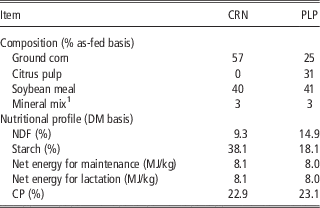
Composition and nutritional profile of concentrate based on ground corn (CRN) or citrus pulp (PLP)

1 Containing 22% Ca, 7.5% P, 6.5% Na, 1.0% K, 3.6% Mg, 2.0% S, 0.003% Co, 0.115% Cu, 0.004% I, 0.220% Mn, 0.003% Se, 0.400% Zn, 400 000 IU/kg of vitamin A, 100 000 IU/kg of vitamin D3 and 0.150% of vitamin E (Milk MAC; M. Cassab Tecnologia Animal, São Paulo, Brazil).
From day −15 to −1 (adaptation period), cows received a concentrate containing (as-fed basis) 40% of soybean meal, 57% of ground corn and 3.0% of the same commercial mineral mix offered for ad libitum consumption (Table 1). From day 0 to 182, cows received concentrate treatments described in Table 1. Concentrate intake was formulated to each individual cow so the diet (concentrate+corn silage) provided 100% (day −15 to −1) or 160% (day 0 to 182) of their daily net energy for lactation (NEL) requirements, as previously described and accomplished by Leiva et al. (Reference Leiva, Cooke, Brandão, Aboin, Ranches and Vasconcelos2015). All dietary treatments were formulated to similarly exceed CP, mineral and vitamin requirements (NRC, 2001). Concentrate intake was adjusted weekly (day −15 to 182) using the Spartan Dairy Ration Evaluator/Balancer (version 3.0; Michigan State University, East Lansing, MI, USA), according to days in milk, milk yield, BW, and BCS, treatment and corn silage intake estimated by the software.
Cr-propionate was offered in the amount recommended by the manufacturer (2.5 g/cow daily of KemTrace), mixed with 97.5 g of finely ground corn and top-dressed daily into the morning concentrate feeding of each supplemented cow. Finely ground corn (97.5 g/cow) was also top-dressed into the morning concentrate feeding of cows not assigned to Cr-proprionate supplementation, but without the addition of the Cr-propionate.
Sampling
Twice monthly, one sample of the offered corn silage and one sample of the offered concentrate were collected. Samples of the same feedstuff were pooled into a single sample at the end of the experiment and analyzed for nutrient content via wet chemistry procedures by a bromatology laboratory (3rlab, Belo Horizonte, Brazil). Calculations of NEL and net energy for maintenance (NEM) used the equation proposed by the NRC (2001). Nutritive value of corn silage was 39.5% DM, 5.76 MJ/kg of NEL, 5.76 MJ/kg of NEM and 7.7% CP (DM basis). Nutritive values of experimental concentrates are described in Table 1. Nutritive value of concentrate offered from day −15 to −1 was 90.3% DM, 8.1 MJ/kg of NEL, 8.1 MJ/kg of NEM and 22.9% CP (DM basis). Cow BW and BCS were recorded weekly before (day −15 to −1) and during the experimental period (day 0 to 182). Cow milk production was recorded daily from day −15 to 182. These parameters were used to adjust concentrate intake of each cow on a weekly basis. Further, BCS was evaluated (Wildman et al., Reference Wildman, Jones, Wagner, Boman, Troutt and Lesch1982) by the same two evaluators throughout the experiment, and evaluators were blinded to which treatment the assessed cow was assigned to.
Milk samples were collected weekly from each cow during both milkings of the day, combined into one daily sample (50 ml from each milking), which was analyzed for fat, protein and total solids content using infrared spectrometry (method 972.16; AOAC, 1999) by a commercial laboratory (Clínica do Leite, Universidade de São Paulo, Piracicaba, Brazil). Blood samples were collected weekly, before the morning concentrate feeding during the experiment for determination of serum glucose, insulin and non-esterified fatty acids (NEFA) concentrations. Insulin : glucose ratio (I : G) was determined by dividing insulin and glucose concentrations within each sampling time (Bernhard et al., Reference Bernhard, Burdick, Rathmann, Carroll, Finck, Jennings, Young and Johnson2012). Concentrations of glucose, NEFA and insulin were used to determine pre-prandial revised quantitative insulin sensitivity check index (RQUICKI) using the equation described by Perseghin et al. (Reference Perseghin, Caumo, Caloni, Testolin and Luzi2001).
GTT were performed on days −3, 60, 120 and 180 by intravenously infusing cows with 0.5 g of glucose/kg of BW, following the same procedures, sampling scheme and calculations for area under the curve (AUC), I : G, glucose clearance rate and half-life described by Leiva et al. (Reference Leiva, Cooke, Brandão, Aboin, Ranches and Vasconcelos2015).
Laboratorial analyses
During the weekly or GTT blood collections, samples were obtained from coccygeal vessels (Tvedten et al., Reference Tvedten, Kopcia and Haines2000) into commercial blood collection tubes (Vacutainer, 10 ml; Becton Dickinson, Franklin Lakes, NJ, USA), placed immediately on ice, centrifuged at 3000×g at 4°C for 30 min for serum collection and stored at −20°C on the same day of collection. Glucose, insulin and NEFA concentrations were analyzed as in Leiva et al. (Reference Leiva, Cooke, Brandão, Aboin, Ranches and Vasconcelos2015). The intra- and interassay CV were, respectively, 3.8% and 5.8% for glucose, 2.8% and 1.8% for insulin and 3.3% and 2.7% for NEFA. Assay sensitivity was 0.0005 mmol/l for glucose, 0.01 mmol/l for NEFA and 0.1 µIU/ml for insulin.
Reproductive management
Follicle aspiration was performed on days −1, 62 and 162 to evaluate treatment effects on production of viable oocytes, as well as subsequent in vitro embryo production. Cows were at random stages of the estrous cycle when assigned to follicle aspiration, which was performed via transvaginal ovum pick-up according to the procedures described by Bilby et al. (Reference Bilby, Block, do Amaral, Sa Filho, Silvestre, Hansen, Staples and Thatcher2006). Oocytes were collected, processed and maturated for IVF as described by Leiva et al. (Reference Leiva, Cooke, Brandão, Aboin, Ranches and Vasconcelos2015), and fertilized with semen from the same sire according to the procedures described by Bilby et al. (Reference Bilby, Block, do Amaral, Sa Filho, Silvestre, Hansen, Staples and Thatcher2006). Presumptive zygotes were incubated at 38.5°C in 5% O2, 5% CO2 in 100% humidified air for 7 days (Bilby et al., Reference Bilby, Block, do Amaral, Sa Filho, Silvestre, Hansen, Staples and Thatcher2006). After incubation, number of cleaved and viable embryos was recorded with a dissecting microscope. Variables that were utilized for the present experiment were; number of oocytes collected that were viable to IVF (Grades I, II and III), number of embryos produced and ratio of embryos produced/viable oocytes collected within each sampling day.
Statistical analyses
Cow was considered the experimental unit given that concentrate type and choice of Cr-supplementation were individually applied to cows. All data were analyzed using cow(concentrate type×Cr-propionate supplementation) as random variable, with the MIXED procedure of SAS (version 9.3; SAS Institute Inc., Cary, NC, USA) and Satterthwaite approximation to determine the denominator df for the tests of fixed effects. The model statement used for analysis of BW and BCS change, as well as initial and final BCS and BW during the experiment contained the effect of concentrate type, Cr-propionate supplementation and the resultant interaction. The model statement used for analysis of daily concentrate and estimated silage intake, as well as weekly BW, BCS, milk yield, serum variables and RQUICKI contained the effects of concentrate type, Cr-propionate supplementation, time (day or week) and the resultant interactions. The model statement used for serum glucose, serum insulin and I : G obtained during the GTT contained the effects of concentrate type, Cr-propionate supplementation, day of GTT (day 60, 120 and 180), min of sampling, all resultant interactions and mean values obtained from the GTT on day −3 as independent covariate. The model statement used for follicle aspiration and IVF outcomes, as well as glucose and insulin AUC, glucose clearance rate and glucose half-life during the GTT contained the effects of concentrate type, Cr-propionate supplementation, day of follicle collection or GTT, all resultant interactions and values obtained from collection on day −1 (reproductive variables) or −3 (GTT) as independent covariate. The specified term for the repeated statement was week for the weekly collections, day for intake and reproductive variables, and hour for the GTT, with cow (concentrate type, Cr-propionate supplementation) as subject. The covariance structure utilized for all repeated statements was autoregressive, which provided the best fit for these analyses according to the Akaike information criterion. Results are reported as least square means, or covariately adjusted means for GTT and reproductive responses, and separated using PDIFF. Significance was set at P⩽0.05, and tendencies were determined if P>0.05 and ⩽0.10. Results are reported according to main treatment effects (concentrate type and Cr supplementation) if no interactions were significant, or according to the highest-order significant (P⩽0.05) interaction containing one of both main treatment effects.
Results and discussion
Intake, BW and body condition score parameters
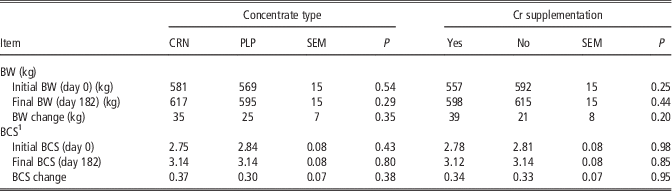
Daily concentrate intake (DM basis) was similar (P⩾0.57) between PLP and CRN cows (6.1 v. 6.3 kg of DM/cow daily, respectively; SEM=0.6), as well as between cows receiving or not Cr-propionate supplementation (6.0 v. 6.2 kg of DM/cow daily, respectively; SEM=0.6). Estimated corn silage intake (DM basis; according to Spartan Dairy Ration Evaluator/Balancer, version 3.0) was also equivalent (P=0.81) among all main treatments effects (11.4, 11.2, 11.3 and 11.5 kg of DM/day for CRN, PLP, Cr-supplemented and non-supplemented cows; SEM=0.16), although cows were group-fed corn silage and actual corn silage intake was not evaluated. No main treatment effects were detected (P⩾0.25) for final BW and BW change, as well as final BCS and BCS change (Table 2). Moreover, all cows gained (day effect, P<0.01) BW (575 v. 606 kg on day 0 and 182, respectively; SEM=10) and BCS (2.79 v. 3.15 of BCS on day 0 and 182, respectively; SEM=0.05) during the experiment. These outcomes were expected and corroborates that cows across all treatment combinations similarly consumed excessive energy as designed, which was accomplished via individually fed concentrates formulated to result in diets providing 160% of cow daily NEL requirements (as in Leiva et al., Reference Leiva, Cooke, Brandão, Aboin, Ranches and Vasconcelos2015).
BW, body condition score (BCS) and milk yield of lactating dairy cows consuming excessive energy, and receiving in a 2×2 factorial arrangement design: (1) concentrate based on ground corn (CRN; n=13) or citrus pulp (PLP; n=13), and (2) supplemented (n=14) or not (n=12) with 2.5 g/day of Cr-propionate

1 According to Wildman et al. (Reference Wildman, Jones, Wagner, Boman, Troutt and Lesch1982).
Serum variables evaluated weekly
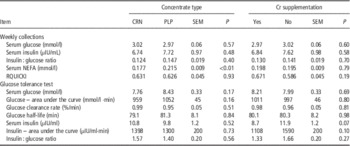
No main treatment effects (P⩾0.57) were detected for serum glucose concentrations (Table 3). Starch is the major dietary precursor for glucose in ruminants (Huntington, Reference Huntington1997); hence, it would be expected that CRN cows had greater plasma glucose concentration compared with PLP cows. Cabrita et al. (Reference Cabrita, Bessa, Alves, Dewhurst and Fonseca2007) reported less plasma glucose concentration in lactating dairy cows receiving a concentrate based on citrus-pulp compared with cohorts receiving corn-based concentrate. However, these authors formulated their experimental diets to meet NEL requirements, whereas cows from the present experiment were fed excessive energy, which may have contributed to the lack of differences in serum glucose between CRN and PLP cows. In addition, Huntington (Reference Huntington1997) reported that cattle are capable of synthesizing glucose from other non-structural carbohydrates such as pectin; the predominant carbohydrate of citrus pulp (NRC, 2001). Regarding the lack of Cr supplementation effects on serum glucose concentrations, Leiva et al. (Reference Leiva, Cooke, Brandão, Aboin, Ranches and Vasconcelos2015) also reported a similar outcome in lactating dairy cows consuming excessive energy and receiving or not Cr-propionate supplementation. Lack of concentrate type and Cr-propionate supplementation effects on serum glucose concentrations can also be associated with the fact that serum glucose is stable in ruminants due to its homeostatic regulation, particularly in lactating cattle due to glucose uptake by the mammary gland (Bickerstaffe et al., Reference Bickerstaffe, Annison and Linzell1974).
Serum parameters and revised quantitative insulin sensitivity check index (RQUICKI) of lactating dairy cows consuming excessive energy, and receiving in a 2×2 factorial arrangement design: (1) concentrate based on ground corn (CRN; n=13) or citrus pulp (PLP; n=13), and (2) supplemented (n=14) or not (n=12) with 2.5 g/day of Cr-propionateFootnote 1

NEFA=non-esterified fatty acids.
1 Glucose tolerance tests were performed on days −3, 60, 120 and 180 as described by Leiva et al. (Reference Leiva, Cooke, Brandão, Aboin, Ranches and Vasconcelos2015). Values obtained on day −3 served as covariate; therefore, values reported are covariately adjusted means.
No main treatment effects were detected (P⩾0.48) for serum insulin concentrations (Table 3). These outcomes were unexpected because starch is classified as an insulinogenic nutrient (Cabrita et al., Reference Cabrita, Bessa, Alves, Dewhurst and Fonseca2007), and Cr-propionate supplementation reduced serum insulin concentrations in lactating dairy cows consuming excessive energy from a corn-based concentrate (Leiva et al., Reference Leiva, Cooke, Brandão, Aboin, Ranches and Vasconcelos2015). The reason for such inconsistency in Cr-propionate effects on serum insulin between experiments is unknown, particularly because the concentrate formulation and energy feeding level used herein were similar to those used by Leiva et al. (Reference Leiva, Cooke, Brandão, Aboin, Ranches and Vasconcelos2015). Nevertheless, overall lack of treatment differences on serum insulin is coherent with design of dietary treatments and results reported for serum glucose, given that circulating insulin concentrations are mainly regulated by nutrient intake and blood glucose (Nussey and Whitehead, Reference Nussey and Whitehead2001).
Cr-propionate supplementation did not impact (P=0.79) serum NEFA concentrations (Table 3), as similarly reported by Leiva et al. (Reference Leiva, Cooke, Brandão, Aboin, Ranches and Vasconcelos2015). Accordingly, Cr supplementation has been shown to modulate circulating NEFA concentrations in periparturient cows (Hayirli et al., Reference Hayirli, Bremmer, Bertics, Socha and Grummer2001), but not in cattle with positive energy balance (Bunting et al., Reference Bunting, Fernandez, Thompson and Southern1994) such as cows utilized herein and by Leiva et al. (Reference Leiva, Cooke, Brandão, Aboin, Ranches and Vasconcelos2015). Conversely, mean serum NEFA concentration was greater (P<0.01) in PLP cows compared with CRN cohorts (Table 3). Circulating NEFA concentrations are negatively associated with energy intake and used as indicator of lipolysis in lactating dairy cattle (Grummer, Reference Grummer1995), whereas PLP and CRN cows similarly consumed excessive energy and gained BW and BCS during this experiment. Hence, differences detected for serum NEFA may be resultant from increased fat synthesis instead of lipolysis in PLP cows, given that diets rich in citrus pulp are known to favor ruminal acetate production (NRC, 2001), which is utilized as substrate for lipogenesis in body tissues (Bergman, Reference Bergman1990). Accordingly, Belibasakis and Tsirgogianni (Reference Belibasakis and Tsirgogianni1996) reported greater serum cholesterol concentrations in dairy cows receiving citrus pulp-based concentrate compared with cohorts fed corn-based concentrate, and attributed this outcome to increased lipogenesis in citrus pulp-fed cows.
No main treatment effects were detected (P⩾0.19) for serum I : G and RQUICKI (Table 3). These variables have been used as indicators of insulin sensitivity and resistance in cattle (Hayirli et al., Reference Hayirli, Bremmer, Bertics, Socha and Grummer2001; Grünberg et al., Reference Grünberg, Donkin and Constable2011). Hence, lack of main treatment effects on serum glucose, insulin, I : G and RQUICKI suggest that neither concentrate type or Cr-propionate supplementation impacted insulin sensitivity parameters during routine management in lactating dairy cows consuming excessive energy. These outcomes also contradict Leiva et al. (Reference Leiva, Cooke, Brandão, Aboin, Ranches and Vasconcelos2015), where Cr-propionate supplementation reduced serum I : G in lactating dairy cows consuming excessive energy from a corn-based concentrate. One can speculate that cows from this experiment did not gain as much BCS compared with the cows utilized by Leiva et al. (Reference Leiva, Cooke, Brandão, Aboin, Ranches and Vasconcelos2015); therefore, the decrease in insulin sensitivity caused by excessive energy intake herein was not as substantial compared with Leiva et al. (Reference Leiva, Cooke, Brandão, Aboin, Ranches and Vasconcelos2015), and hindered the detection of main treatment effects on these parameters. Nevertheless, Leiva et al. (Reference Leiva, Cooke, Brandão, Aboin, Ranches and Vasconcelos2015) also failed to detected Cr-propionate supplementation on RQUICKI, but suggested that RQUICKI is not a viable indicator of insulin sensitivity in lactating dairy cows in positive energy balance. To our knowledge, no other research has compared insulin sensitivity parameters in lactating dairy cows consuming excessive energy from corn-based or citrus pulp-based concentrate. Collectively, these outcomes do not support our hypothesis and indicate that replacing corn by citrus pulp or providing Cr-propionate supplementation failed to modulate insulin sensitivity parameters during routine management in lactating dairy cows consuming excessive energy.
Serum variables evaluated during the glucose tolerance test
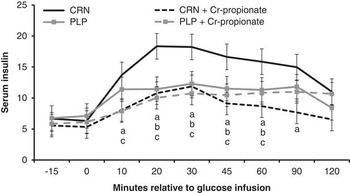
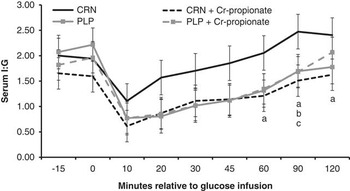
No main treatment effects were detected (P⩾0.16) for serum glucose, glucose AUC, glucose clearance rate and glucose half-life (Table 3), which corroborates the results from weekly samples. However, concentrate type×Cr-propionate supplementation interactions were detected (P⩽0.04) for serum insulin concentrations, serum insulin AUC and serum I : G during the GTT (Table 4). Serum insulin concentrations and AUC were less (P⩽0.05) in CRN cows supplemented with Cr-propionate compared with non-supplemented CRN cohorts, whereas Cr-propionate supplementation did not impact (P⩾0.70) serum insulin parameters within PLP cows (Table 4). Serum I : G tended to be less (P=0.09) in CRN cows supplemented with Cr-propionate compared with non-supplemented CRN cohorts, and similar (P=0.96) in PLP cows receiving or no Cr-propionate supplementation (Table 4). Supporting these outcomes, Leiva et al. (Reference Leiva, Cooke, Brandão, Aboin, Ranches and Vasconcelos2015) also reported that Cr-propionate supplementation reduced serum insulin concentrations and I : G during a GTT in lactating dairy cows consuming excessive energy from a corn-based concentrate. It is important to note that main concentrate type effects were not detected for serum insulin and I : G (Table 3), and the tendencies (P⩽0.10) detected for main Cr-propionate supplementation effects on serum insulin (Table 3) were mainly driven by its effects within CRN cows (Table 4). Although the concentrate type×Cr-propionate supplementation×time interaction was not detected during the GTT (P⩾0.34), differences among treatment combinations were only detected from 10 to 120 min relative to glucose infusion for serum insulin concentrations (Figure 1), and from 60 to 120 min relative to glucose infusion for serum I : G (Figure 2). Hence, Cr-propionate supplementation reduced serum insulin concentrations and I : G within CRN cows only, lessening these variables to the levels observed within PLP cows.
Serum insulin concentrations (µIU/ml) following a glucose tolerance test (intravenous infusion of 0.5 g of glucose/kg of BW at 0 min) of lactating dairy cows consuming excessive energy, and receiving in a 2×2 factorial arrangement design: (1) concentrate based on ground corn (CRN; n=13) or citrus pulp (PLP; n=13), and (2) supplemented (n=14) or not (n=12) with 2.5 g/day of Cr-propionate. Although the concentrate type×Cr-propionate supplementation×time interaction was not detected (P=0.34), differences among treatment combinations were only detected from 10 to 120 min relative to glucose infusion. Within min, letters indicate the following treatment differences (P⩽0.05); a=CRN v. CRN+Cr-propionate, b=CRN v. PLP, c=CRN v. PLP+Cr-propionate.

Serum insulin : glucose (I : G) ratio following a glucose tolerance test (intravenous infusion of 0.5 g of glucose/kg of BW at 0 min) of lactating dairy cows consuming excessive energy, and receiving in a 2×2 factorial arrangement design: (1) concentrate based on ground corn (CRN; n=13) or citrus pulp (PLP; n=13), and (2) supplemented (n=14) or not (n=12) with 2.5 g/day of Cr-propionate. Although the concentrate type×Cr-propionate supplementation×time interaction was not detected (P=0.41), differences among treatment combinations were only detected from 60 to 120 min relative to glucose infusion. Within min, letters indicate the following treatment differences (P⩽0.05); a=CRN v. CRN+Cr-propionate, b=CRN v. PLP, c=CRN v. PLP+Cr-propionate.

Serum parameters during a glucose tolerance test of lactating dairy cows consuming excessive energy, and receiving in a 2×2 factorial arrangement design: (1) concentrate based on ground corn (CRN; n=13) or citrus pulp (PLP; n=13), and (2) supplemented (n=14) or not (n=12) with 2.5 g/day of Cr-propionateFootnote 1 , Footnote 2

1 Glucose tolerance tests were performed on days −3, 60, 120 and 180 as described by Leiva et al. (Reference Leiva, Cooke, Brandão, Aboin, Ranches and Vasconcelos2015). Values obtained on day −3 served as covariate; therefore, values reported are covariately adjusted means.
2 Concentrate type×Cr-propionate supplementation interactions were detected (P⩽0.04) for serum insulin concentrations, serum insulin area under the curve and serum I : G. Hence, values are being reported within concentrate type.
Collectively, serum insulin and I : G results during the GTT suggest that Cr-propionate supplementation alleviated hyperinsulinemia and improved insulin sensitivity caused by GTT within CRN cows. The same Cr-propionate effect was not detected within PLP cows, perhaps due to the fact that the GTT had less impact on serum insulin and I : G within PLP cows (Figures 1 and 2). Supporting these outcomes, previous research from our and other research groups reported that supplemental Cr enhanced insulin sensitivity parameters in lactating cattle receiving corn-based diets during a GTT (Hayirli et al., Reference Hayirli, Bremmer, Bertics, Socha and Grummer2001; Leiva et al., Reference Leiva, Cooke, Brandão, Aboin, Ranches and Vasconcelos2015). Cr is a critical component of the glucose tolerance factor that facilitates the action of insulin on body cells (Mertz, Reference Mertz1992), and Cr supplementation has been shown to enhance glucose metabolism in ruminants (Sumner et al., Reference Sumner, Valdez and McNamara2007). More specifically, Cr modifies glucose metabolism through chromodulin, an oligopeptide that binds with high affinity to four chromic ions and enables Cr to be involved in the autoamplification of insulin signaling, maintaining the active conformation of insulin receptors and promoting greater glucose uptake (Vincent, Reference Vincent2001). Yet, Cr-propionate supplementation may also impact insulin resistance parameters in adipose and other body tissues through immunological signals such as proinflammatory cytokine response (Wellen and Hotamisligil, Reference Wellen and Hotamisligil2005). Therefore, additional research is still warranted to further comprehend the physiological mechanisms responsible for the outcomes observed herein, particularly why Cr-propionate supplementation enhanced insulin sensitivity parameters in CRN cows, but not PLP cows during the GTT.
Milk production
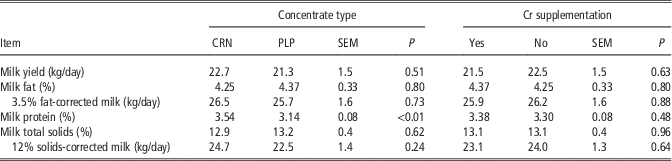
No main treatment effects were detected (P⩾0.51; Table 5) for milk yield, milk fat, 3.5% fat-corrected milk yield, milk total solids and 12% solids-corrected milk yield. No Cr-propionate supplementation effect was detected (P=0.48) for milk protein concentration (Table 5). Insulin resistance may negatively impact milk yield and mammary synthesis of milk constituents in lactating dairy cattle (McGuire et al., Reference McGuire, Griinari, Dwyer and Bauman1995; LeBlanc, Reference LeBlanc2010). Perhaps Cr-propionate supplementation effects detected within CRN cows during the GTT were not sufficient to impact milk production and concentration of constituents. Leiva et al. (Reference Leiva, Cooke, Brandão, Aboin, Ranches and Vasconcelos2015) also failed to detect milk yield differences in cows supplemented or not with Cr-propionate and consuming excessive energy. Nevertheless, milk production by the mammary gland is regulated by lactose synthesis from glucose, whereas glucose uptake by the mammary gland is relatively insulin independent (Zhao et al., Reference Zhao, Dixon and Kennelly1996). Hence, insulin resistance may not be a critical factor influencing milk yield in lactating dairy cows, corroborating with the outcomes reported herein and Leiva et al. (Reference Leiva, Cooke, Brandão, Aboin, Ranches and Vasconcelos2015).
Milk yield of lactating dairy cows consuming excessive energy, and receiving in a 2×2 factorial arrangement design: (1) concentrate based on ground corn (CRN; n=13) or citrus pulp (PLP; n=13), and (2) supplemented (n=14) or not (n=12) with 2.5 g/day of Cr-propionateFootnote 1

1 Milk production was recorded daily and milk samples were collected weekly from each cow, which was analyzed using infrared spectrometry (method 972.16; AOAC, 1999) by a commercial laboratory (Clínica do Leite).
Research evaluating milk production in dairy cows offered corn-based v. citrus pulp-based concentrate has yielded variable results, such as similar (Belibasakis and Tsirgogianni Reference Belibasakis and Tsirgogianni1996; Leiva et al., Reference Leiva, Hall and Van Horn2000) or greater milk production when corn-based concentrate is fed (Leiva et al., Reference Leiva, Hall and Van Horn2000; Cabrita et el., Reference Cabrita, Bessa, Alves, Dewhurst and Fonseca2007). Variables results were also detected when evaluating milk fat and total solids (Belibasakis and Tsirgogianni Reference Belibasakis and Tsirgogianni1996; Leiva et al., Reference Leiva, Hall and Van Horn2000; Cabrita et al., Reference Cabrita, Bessa, Alves, Dewhurst and Fonseca2007). It is important to note that these research studies evaluated cows receiving diets to meet their NEL requirements. In this experiment, all diets were formulated to provide excessive NEL, which likely allowed cows from all treatment combinations to produce their maximum milk yield while the additional energy supplied was converted into BCS (Table 1).
A concentrate type effect was detected for milk protein, which was greater (P<0.01) in CRN cows compared with PLP cows (Table 5). Others have also reported greater milk protein content when concentrate is based on corn instead of citrus pulp (Leiva et al., Reference Leiva, Hall and Van Horn2000; Cabrita et al., Reference Cabrita, Bessa, Alves, Dewhurst and Fonseca2007). This outcome can be attributed to greater availability of glucogenic precursors in the CRN diet such as starch, reducing the utilization of aminoacids for gluconeogenesis and increasing the supply and of these aminoacids to the mammary gland (Lemosquet et al., Reference Lemosquet, Rigout, Bach, Rulquin and Blum2004). Still, differences in milk protein were not sufficient to impact 12% solids-corrected milk in CRN v. PLP cows.
Reproductive variables
No main treatment effects were detected (P⩾0.35) for number of viable oocytes collected, embryos produced per collection, or proportion of embryo produced per oocyte collected (Table 6). Insulin resistance has been shown to impair oocyte fertility (Adamiak et al., Reference Adamiak, Mackie, Watt, Webb and Sinclair2005; Leiva et al., Reference Leiva, Cooke, Brandão, Aboin, Ranches and Vasconcelos2015), and such outcome can be attributed to reduced mRNA concentrations of IGF-I binding proteins as well as insulin receptors within small follicles (Baruselli et al., Reference Baruselli, Vieira, Sá Filho, Mingoti, Ferreira, Chiaratti, Oliveira, Sales and Sartori2016). The lack of treatment differences for reproductive variables herein indicate that both concentrate type and Cr-propionate supplementation did not impact oocyte production and fertility in lactating dairy cows consuming excessive energy. Further, Cr-supplementation effects on insulin sensitivity parameters within CRN cows during the GTT were also not sufficient to impact these reproductive variables, although others have reported reproductive benefits of organic Cr supplementation to dairy cows consuming corn-based concentrate (Bryan et al., Reference Bryan, Socha and Tomlinson2004; Soltan, Reference Soltan2010). Therefore, research is still warranted to develop strategies that mitigate potential reproductive losses caused by excessive energy intake and subsequent increase in insulin resistance in lactating dairy cattle (Leiva et al., Reference Leiva, Cooke, Brandão, Aboin, Ranches and Vasconcelos2015).
Oocyte collection and in vitro embryo production from lactating dairy cows consuming excessive energy and receiving in a 2×2 factorial arrangement design: (1) concentrate based on ground corn (CRN; n=13) or citrus pulp (PLP; n=13), and (2) supplemented (n=14) or not (n=12) with 2.5 g/day of Cr-propionateFootnote 1

1 Follicle aspiration was performed on days −1, 62 and 162 via transvaginal ovum pick-up, processed and maturated for in vitro fertilization and fertilized with semen from the same sire (Bilby et al., Reference Bilby, Block, do Amaral, Sa Filho, Silvestre, Hansen, Staples and Thatcher2006). Values obtained on day −1 served as covariate; therefore, values reported are covariately adjusted means.
Overall conclusions
This experiment evaluated if feeding a concentrate based on citrus pulp instead of corn and providing Cr-propionate supplementation to lactating dairy cows consuming excessive energy would benefit insulin sensitivity parameters, milk production and reproductive outcomes. Feeding the citrus pulp-based concentrate did not improve any of the aforementioned variables, whereas Cr-propionate supplementation only enhanced insulin sensitivity parameters in cows receiving a corn-based concentrate during a GTT. Given the negative relationship among excessive energy intake, insulin sensitivity parameters and productive responses in lactating cows (LeBlanc, Reference LeBlanc2010; Baruselli et al., Reference Baruselli, Vieira, Sá Filho, Mingoti, Ferreira, Chiaratti, Oliveira, Sales and Sartori2016), research is still warranted to develop nutritional strategies that mitigate insulin resistance and optimize performance and welfare in dairy cattle.
Acknowledgments
The Fundação de Amparo à Pesquisa do Estado de São Paulo (São Paulo, Brazil) provided financial support for this research (grant # 2014/13291-6), as well as scholarship for T. Leiva (grants # 2014/14512-6 and # 2015/21224-0).