In the southern Mexican state of Oaxaca, more than four hundred municipalities enjoy a type of local autonomy known as sistemas normativos internos (SNI, or internal normative systems).Footnote 1 SNI status was intended to formally recognize the local customs, usually derived from indigenous cultures and traditions, by which most of these communities had governed themselves for many years.Footnote 2 But in municipalities where customs violated liberal principles of individual rights and equality that are enshrined in the Mexican Constitution, formal recognition of SNI status had the effect of codifying and legitimating illiberal practices.
For example, Recondo (Reference Recondo2001) and Eisenstadt (Reference Eisenstadt2007) estimate that women were prohibited from voting in about 75 of Oaxaca’s SNI municipalities (or 18 percent), based on government data from the late 1990s.Footnote 3 The true total was certainly higher, since the data were self-reported by local officials (Recondo Reference Recondo2001), and since there are many case descriptions of female exclusion in extant literature, which are not coded as such in the official record (e.g., Curiel Reference Curiel2014; Juan Martínez Reference Martínez and Leonel2014). In addition, women have been discouraged from voting in many communities even where they were not formally excluded.Footnote 4 In a 2004 survey, Danielson and Eisenstadt (Reference Danielson and Todd2009, 159) found that 58 percent of respondents did not believe that women participated in their local elections.Footnote 5 Data on women in office are even starker. As recently as 2010, Oaxaca’s 570 municipalities had only 11 female mayors; among those with SNI status, there were only 3.Footnote 6 Notably, these exclusionary practices persisted for many decades, in spite of the formal equality of women under the Mexican Constitution and the advancement of women in many areas of national political life.Footnote 7
These autonomous municipalities have faced increasing pressure to change their exclusionary practices in recent years. State and federal electoral courts began to examine the question of female exclusion shortly after the formal codification of SNI status in the mid-1990s, and court rulings in recent years have unambiguously required the protection of women’s rights of political participation.Footnote 8 Oaxaca’s state legislature passed a series of changes to the state electoral code over a period of years, each change further delineating the political rights of women in SNI municipalities. The state electoral commission shifted from a passive stance toward local practices to a more assertive position that pressured, and ultimately forced, those municipalities with exclusionary practices to change their ways. Changes in the stance of statelevel institutions, combined with increased attention to women’s political rights at the federal level, finally had their effect. On October 4, 2016, women voted in municipal elections—for the first time ever—in the last 59 Oaxacan municipalities that had maintained exclusionary practices to that point (Velásquez Reference Velásquez2016). A year later, women won 23 mayoral elections in SNI municipalities, greatly increasing (to 61) the number of Oaxacan municipalities with female mayors (Castillo 2018). Of course, women still face many informal barriers to political participation, in Oaxaca and elsewhere. But formal discrimination within the SNI legal framework has ended.
How and why did these exclusionary practices crumble, especially in the context of institutional reforms that were intended to protect indigenous autonomy? The answer, I argue, is to be found in the act of formalization itself. Even though many of the SNI reform’s supporters aimed to insulate autonomous communities from the influences of the federal political system, the formal legalization of what had been de facto practices invited homogenizing pressure from the state and federal government, increased judicial scrutiny, and opened new legal avenues for opponents of autonomy (including indigenous citizens) to challenge illiberal practices. In this sense, formalization facilitated the reach of the state into areas (both geographic and juridical) that it had not fully penetrated. Or, as Harbers and Steele (this issue) describe it, formalization pushed a “disjointed” state in a more “uniform” direction, at least with respect to protections for women’s political rights.
Demonstrating empirically that this shift has occurred is straightforward. Establishing the cause is more difficult, since the change entails a fairly long historical process that does not have easy analogues in other states or countries. Therefore the analytical strategy in this article centers on a narrative of the Oaxacan case and counterfactual reasoning regarding how the outcome would have differed under alternative circumstances. As Fearon (Reference Fearon1991) explains, the logic of inference that underlies counterfactual analysis is identical to the logic of comparative case studies, although establishing the legitimacy of the counterfactuals can be more challenging (see also King et al. Reference King, Robert and Verba1994, 77–78). This study assesses several hypotheses by analyzing legal reforms, rulings from the federal electoral tribunal (Tribunal Electoral del Poder Judicial de la Federación, TEPJF), documents and election reports from the state electoral institute (Instituto Estatal Electoral y de Participación Ciudadana de Oaxaca, IEEPCO), information from municipalities in which I have done field research over a period of years, and other primary data.
This article first reviews explanations related to mass attitudes and social movements, but finds them to be inadequate for explaining the changes that occurred in Oaxaca. It therefore introduces a theory according to which the formalization of indigenous autonomy, in the context of a homogenizing liberal state, would ultimately produce the outcome we observe. The article proceeds to offer a detailed narrative account of the actions taken by electoral courts and other state institutions and argues that these actions would not have taken place but for the formalization of autonomy in the mid-1990s. In a short comparative section, it also describes analogous processes of formalization and subordination in the Mexican state of Chiapas, as well as in Bolivia and Colombia. The concluding section speculates about further challenges that Oaxaca’s SNI municipalities might face because of the subordination of autonomy to national law.
Existing Theories of Female Empowerment and Subordinated Autonomy in Oaxaca
The goal of this article is to understand how the autonomy granted under Oaxaca’s SNI reforms was eventually subordinated to liberal principles of justice, resulting in the inclusion of women in municipal electoral processes.Footnote 9 If we view Oaxaca’s transformation as an instance of female incorporation, then several theoretical approaches for understanding the change suggest themselves. We might attribute incorporation to changes in public attitudes about female participation, to which state-level politicians would presumably be eager to respond (Inglehart and Norris Reference Inglehart and Norris2003). Or the case might be explained by the rise of women’s social movements, as in the suffragist movement in the United States (McCammon et al. Reference McCammon2001), the push for legislative gender quotas in many countries (Krook Reference Krook2007; Piscopo Reference Piscopo2015), improvements in indigenous women’s representation (Rousseau and Ewig Reference Rousseau and Ewig2017), or the adoption of policies to combat violence against women (Beer Reference Beer2017; Htun and Weldon 2012). In addition, we might suspect that those who promoted female inclusion were anticipating a partisan advantage or some other political benefit. Similar arguments have been offered for the incorporation of the working class in Europe and Latin America (Collier Reference Collier1999), as well as for the creation of autonomy reforms in Oaxaca and Chiapas (Anaya Muñoz Reference Anaya Muñoz2006; Benton Reference Benton2012; Burguete Reference Burguete2013; Recondo Reference Recondo2007).
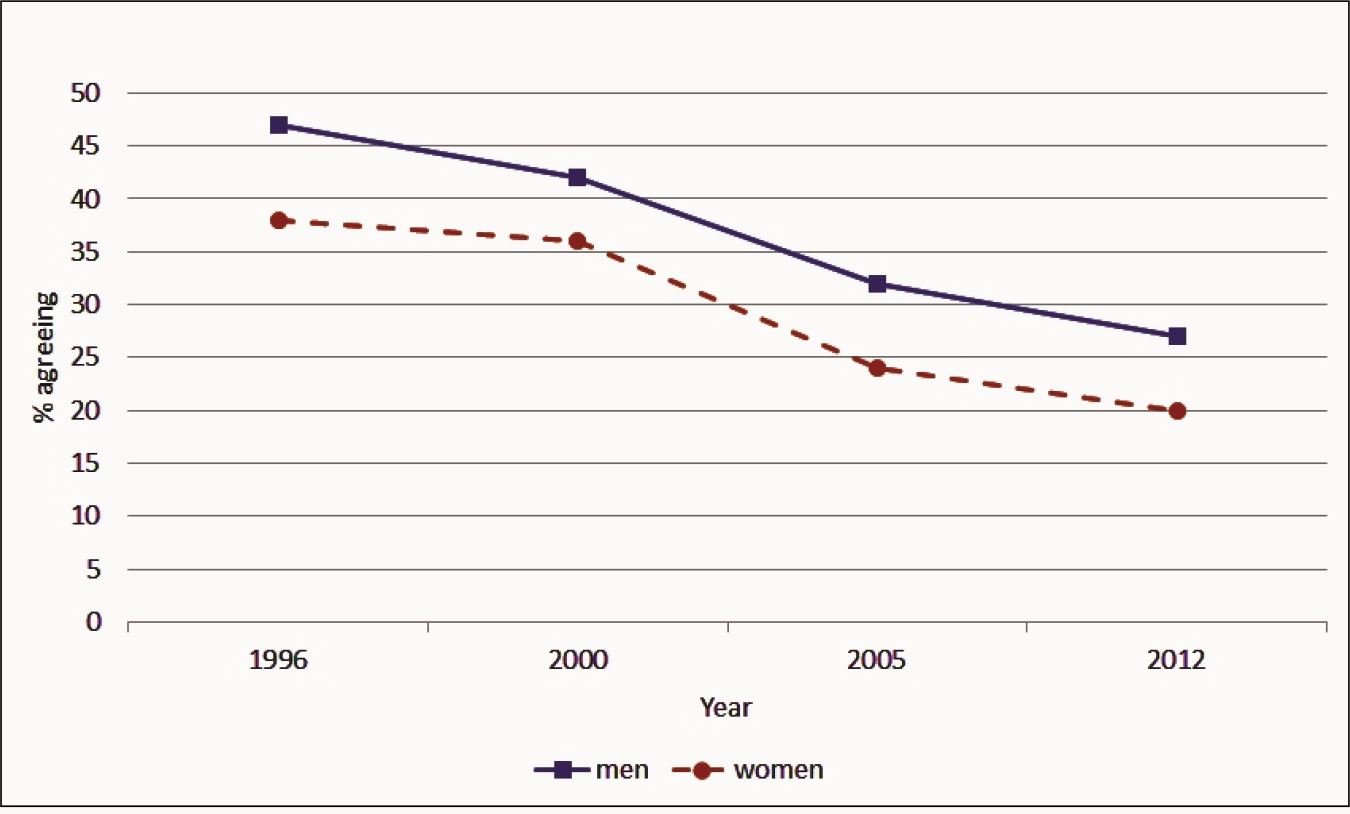
There is some evidence to support the first of these claims. Antifemale political bias in Mexico has decreased substantially in the last 25 years. Figure 1 shows the percentage of Mexicans who believe that men make better political leaders than women, according to national samples collected for four waves of the World Values Survey. As the figure illustrates, almost half of men, and a slightly smaller percentage of women, agreed that men were better leaders in the 1996 survey. By 2012, agreement had fallen by almost half (from 47 percent to 27 percent for men, and from 38 percent to 20 percent for women). In a public opinion survey I oversaw in 2014 in four Oaxacan municipalities, just 28 percent of respondents (31 percent of men and 25 percent of women) agreed that men made better leaders than women. Those numbers are roughly similar to the national averages from 2012 reported in Figure 1, and they are almost certainly lower than they would have been a decade or two earlier.
Decreased Agreement that Men are Better Leaders, in Mexico

This shift in public opinion coincides with national-level reforms aimed at enhancing gender equality. For example, in 2002 Mexico passed a modest gender quota for seats in the national legislature (which was first applied in the 2003 elections), and in late 2013 the country passed a constitutional amendment requiring gender parity in candidate lists for national and state legislatures (Baldez Reference Baldez2004; Estrada-Tanck Reference Estrada-Tanck, Rubio-Marín and Kymlicka2018). These measures have been effective: the World Bank reports a steady increase in the proportion of women in the national legislature, from 14.2 percent in 1997 to 48.2 percent in 2018 (World Bank n.d.). The TEPJF has been active in this area as well, and published two rulings in 2015 that deepened the parity reform: one extended the parity law to municipal elections, and a second clarified that parity needed to exist on each party’s municipal slate and across all candidate slates for the same party (TEPJF 2015, 24–27).Footnote 10 So we do see some evidence of changes in attitudes about gender and the political role of women at the national level. Perhaps similar changes in Oaxaca were conducive to the acceptance of female participation in the SNI municipalities, although it seems unlikely that a general trend in attitudes would be a sufficient explanation of the particular transformation that we observe.
There is less evidence to support the claims that the Oaxacan transformation was the result of pressure from women’s social movements. Women certainly have advocated on their own behalf in many SNI municipalities (Curiel Reference Curiel2014; Vázquez García and Muñoz Rodríguez 2013), and some of these women pursued their claims through the courts once that avenue became available. There are also civic organizations advocating for indigenous women’s rights in Oaxaca City and throughout the state. But there is little evidence that these groups have generated any sort of sustained pressure on the state to enforce women’s rights in the way that it has. In fact, as arguments from critical anthropologists like Blackwell (2012) and Sierra (Reference Sierra and Sieder2013) suggest, indigenous women’s groups often oppose the intrusion of the state into local affairs. My own interactions with social movement leaders have revealed a similar reluctance to ask for state intervention; one leader told me that she thought women’s inclusion needed to happen organically, by persuading the male members of indigenous communities to change their practices (NGO Director 2008).
Neither is there persuasive evidence that state actors enforced female participation rights to gain a partisan political advantage. Unlike the original SNI reforms, which emerged in reaction to a crisis in Chiapas and intense pressure from organized indigenous groups, the political payoff for enforcing these women’s rights seems relatively small and diffuse. For one thing, we would not expect women to vote en masse for a particular party or position in ways that would systematically change electoral outcomes (as we might expect, for example, from the initial incorporation of the working class). Additionally, women in SNI municipalities already participate in state and federal elections (though at lower rates, as Benton [Reference Benton2012] has shown). It seems unlikely, therefore, that a particular ruling party would view disenfranchised indigenous women as a significant electoral prize.
Thus, existing approaches do not offer a sufficient explanation for the state’s enforcement of women’s political rights in Oaxaca’s SNI municipalities. These explanations help in that they reveal a concern for women’s rights at the national level (including the judiciary). But they lack a direct link to customs and practices in marginalized areas of the indigenous countryside, where the state has historically held less sway and little interest. The formalization of SNI status created this link, thereby piquing the state’s interest and spurring its intervention in issues of SNI governance.
The Effect of Formalization on Subordinated Autonomy in Oaxaca
The shift from de facto autonomy and female exclusion to the explicit enforcement of women’s political rights in Oaxaca had a significant top-down character, and is best explained by stateand federal-level drivers of change. Specifically, I argue that the institutions of a homogenizing Mexican state took an interest in the enforcement of women’s rights (see also Piscopo Reference Piscopo2015) and that the legal framework through which SNI status was formalized provided an avenue for enforcement because it subordinated autonomy within a liberal legal framework. Counterfactually, I argue that if either of these two conditions had been absent, the state would not have pursued the enforcement of women’s rights in the same way, and the outcome probably would have been different.
The Homogenizing Mexican State
To understand the context in which formalization resulted in the transformation of women’s participation in Oaxaca, it is important to consider a confluence of changes in the development of the Mexican state, specifically related to the decline of corporatism in the 1970s and the shift toward a neoliberal economic framework in the 1980s and 1990s (Snyder 2001; Yashar Reference Yashar2005). These changes influenced the contours of the 1995 Oaxacan reform in ways that would leave it vulnerable to liberal challenges. Indeed, Mattiace (Reference Mattiace2013, 217) argues that autonomy reforms in Mexico must be understood in tandem with neoliberal reforms. Burguete (2013, 47) concurs, saying that “multiculturalism and neoliberalism entered the constitution of Mexico together. They arrived at the same time and entered through the same door [in the early 1990s].”
Like many Latin American countries in the mid-twentieth century, Mexico developed corporatist political institutions based on the creation of hierarchical linkages between the state and local groups, as a strategy for addressing problems of social order and organization. In the Mexican case, the most important groups were typically labor unions or other “popular sector” groups affiliated with the Partido Revolucionario Institucional (PRI). But in some parts of the countryside, the local unions, cooperatives, and landholding groups were, in effect, representatives of indigenous communities. Thus, corporatism in these areas took the form of a relationship between the state and indigenous communities as corporate entities, and thereby allowed a measure of autonomy for indigenous communities in the provinces. As Yashar argues, corporatism “unwittingly institutionalized autonomous spaces for indigenous peoples” (Reference Yashar2005, 60). The central government may not have intended to promote autonomy for indigenous communities per se, but the delegation of authority through corporatist channels created space for indigenous groups (in corporatist organizations, like peasant cooperatives) to manage their own local affairs.
Yet this equilibrium deteriorated with state retrenchment and the neoliberal policy turn of the 1980s and early 1990s (Yashar Reference Yashar2005; Burguete Reference Burguete2013). The neoliberal turn led to the “emasculation of corporatist organizations, … the promotion of free markets in land and labor” and “increased uncertainty about property regimes,” specifically regarding the legal status of communal land holdings (Yashar Reference Yashar2005, 65– 66). Most counterintuitively, the neoliberal “withdrawal” of the state actually resulted in further state intrusions into local affairs, primarily in the domain of land tenure but in other ways as well (Snyder 2001). Thus, the neoliberal Mexican state now plays a homogenizing role in many facets of national political life, including the subordination of indigenous autonomy in cases where it has been legally formalized.
Formalization in the Context of a Homogenizing State
Facing the disintegration of corporatist forms of interest representation, increased state intrusions into local affairs, and a rupture in the modus vivendi of the previous era, peasants began to mobilize along ethnic lines and to challenge the new liberal order. Their goal was a foundational type of change, based on the argument that indigenous groups had the right to differential status when interacting with state institutions. In several cases across Latin America, the mobilization among indigenous groups was seen, both by outside observers and by the groups themselves, as a direct challenge to neoliberal economic policy and to liberal political ideologies (Burguete Reference Burguete2013; Tockman and Cameron Reference Tockman and Cameron2014).
This is the context in which the Oaxacan reforms happened. The PRI, including then-governor Diódoro Carrasco (1992–98), was driving at a solution that would help to shore up its political advantages (Anaya Muñoz Reference Anaya Muñoz2006; Recondo Reference Recondo2007), and surely it also had electoral motives in mind (Benton Reference Benton2016, 2017; Hiskey and Goodman Reference Hiskey and Gary2011). At the same time, newly mobilized indigenous communities aimed to protect the autonomy that they had previously enjoyed but which they now felt was threatened. Some of them saw formal codification of autonomy in the state constitution and electoral law as a means to do that.Footnote 11 So with the support of indigenous activists, the state congress passed a law in August 1995 that allowed municipal governments to opt for autonomy.Footnote 12
The formalization of autonomy in Oaxaca has certainly helped to protect local practices and support indigenous cultures and communities in some ways, and in particular cases. For example, by establishing nonpartisan electoral processes, the SNI reforms have alleviated some sources of political conflict and have promoted truly communal forms of participation (but see Eisenstadt Reference Eisenstadt2007). State institutions support elections in SNI municipalities and attempt to mediate conflicts when they do arise, although this has not always been the case. These efforts often harmonize with other state efforts at promoting indigenous cultures, such as the educational and language preservation efforts of the CDI (Comisión Nacional para el Desarrollo de los Pueblos Indígenas).Footnote 13 Many “street-level” state bureaucrats are sincere proponents of multiculturalism, and a variety of changes to the legal framework surrounding multicultural issues over the past 20 years have enhanced their ability to support indigenous communities (CDI Director 2011; CDI Staff 2011; SNI Director 2014).
However, formalization in Oaxaca also subordinated autonomy to the liberal principles of the national constitution, thereby creating a conduit through which state actors and individual citizens could challenge indigenous practices and force SNI municipalities into conformity with federal and constitutional law.Footnote 14 This need not have been the case. In other parts of the world, the legal structure for autonomy gives primary standing to local custom, or applies law differentially depending on ethnic or geographic categories.Footnote 15 In contrast, the Mexican system, like most other Latin American systems, explicitly subordinates autonomy (and other state or local laws) to the authority of the federal constitution. Constitutional reforms in 2001 added recognition of the “plurinational” character of the Mexican nation (Article 2). But the constitution specified that autonomy was subject to national law, and recent reforms drive that point home with little ambiguity. Article 2 also states,
The right of indigenous peoples to free determination will be exercised in a constitutional framework of autonomy that will assure national unity (Article 2).
[The application of autonomy is] subject to the general principles of this Constitution, respecting the individual guarantees, human rights, and above all, the dignity and integrity of women (Article 2, A.II).
and
[Elections for local authorities must] guarantee that indigenous women and men enjoy and exercise their right to vote and be voted for in conditions of equality. … In no case may communitarian practices limit the electoral political rights of citizens [los y las ciudadanas] in the election of their municipal authorities (Article 2, A.III, as amended May 22, 2015).Footnote 16
This type of stipulation is replicated in state constitutions and laws as well. Oaxaca’s 2012 electoral code offers a good example.
In the municipalities that elect their authorities via SNI, the requirements for exercising the vote … will conform to their norms, institutions, practices, and democratic traditions … as long as [siempre que] they do not violate human rights that are recognized by the Federal Constitution, by international treaties, and by the State Constitution. (CIPPEO 2012, Article 12, emphasis added).Footnote 17
In a similar context, Freidenberg and Alva Huitrón (2017) show that the Mexican states have rapidly adopted national-level laws regarding women’s political inclusion (though occasionally states are “out in front” of the federal government in terms of passing progressive gender laws). For example, the 2002 federal quota law “led to a surge of reforms in the states,” which eventually resulted in a shift toward parity in the state legislatures (Freidenberg and Alva Huitrón 2017, 24).
Subordinated autonomy has a number of effects on how the state manages SNI practices. For one, it reorients state institutions toward regulating SNI municipalities as they would regulate any other jurisdiction in the country. As I have argued, the Oaxacan reforms happened in the context of a state effort to expand and make more uniform the rule of law, the protection of rights (including property), bureaucratic capacity, and even physical infrastructure into the countryside and marginalized areas. How successful these efforts have been is a complicated matter that I will not address here, but it is reasonable to view many political developments in Mexico over the past 20 to 30 years as an effort to increase state capacity in the outlying areas of the country.
One particularly important aspect of this state-building project is increased judicial activity. Courts have become more assertive over the past 20 years, both in terms of formal authority (given a series of judicial reforms starting under Ernesto Zedillo in 1994) and in terms of behavior (given, among other things, the increased frequency of rulings against the government; see Beer Reference Beer2006; Finkel Reference Finkel2005; RíosFigueroa 2007; Staton Reference Staton2010). Baldez (Reference Baldez2004) points specifically to court action as a contributing factor in the passage of the 2002 gender quota law. Freidenberg and Alva Huitrón (2017, 24) argue that “judicial authorities who were committed to the spirit of the [subsequent state-level] reforms” intervened to enforce the laws.
Piscopo offers a more general argument for the spread of quota and parity laws throughout Latin America, according to which courts and other state institutions become “active promoters of gender equality” because of institutional constraints like written law, as well as normative discourses in favor of gender equality (Piscopo Reference Piscopo2015, 28–29). In the current case, formal autonomy has placed practices and political institutions in SNI municipalities more directly under the purview of the national courts. Especially during a time of expanding judicial assertiveness, this legal incorporation has exposed autonomy to further judicial scrutiny.
How the State Intervened to Protect Women’s Rights Under SNI, 1995–2017
If the explanation offered here is correct, we would expect to observe gradual changes in the state’s approach to women’s political rights in the SNI municipalities, such as state legislative reforms favoring women’s rights in tandem with changes at the federal level, a shift toward enforcement on the part of the state electoral commission, and increased scrutiny of exclusionary practices on the part of the federal electoral courts.
Before 1995, the Mexican state tolerated de facto autonomy in many parts of the country, including hundreds of indigenous municipalities in Oaxaca. The bargain was that the state would not interfere in local affairs as long as these communities were able to maintain social peace and at least a nominal allegiance to the PRI (Anaya Muñoz Reference Anaya Muñoz2006; Recondo 2007). All else equal, the Oaxacan PRI preferred not to intervene in the local affairs of indigenous communities, and at least initially, the 1995 reforms did not change that position. Indeed, Recondo (Reference Recondo2007, chap. 5) argues that the PRI’s original intention was to formalize a type of autonomy in which the SNI municipalities would simply register their municipal cabildos with the PRI once they had been selected. Anaya Muñoz (Reference Anaya Muñoz2006) suggests that the PRI’s goal was to “vaccinate” hundreds of indigenous municipalities against further encroachment by opposition parties, like the Partido de la Revolución Democrática (PRD). In either case, the general goal was to depoliticize the indigenous countryside of Oaxaca, which would make it easier to ignore (Benton Reference Benton2012). The state did not intend to micromanage local political practices.
But the electoral courts began to scrutinize political practices in the SNI municipalities shortly after the 1995 reforms. One early example comes from a 1998 electoral dispute in the municipality of Asunción Tlacolulita. As Eisenstadt (Reference Eisenstadt2007, 2011) explains, some women from the municipality interrupted an electoral assembly to which only men had been called, demanding the right to vote for a mayoral candidate. They were not admitted to the meeting, and later filed suit. In 2000, the TEPJF invalidated the 1998 election and ordered that a new election be held (Eisenstadt 2011, 119). Although the case never arrived at a clean resolution, it served as a precedent that has motivated subsequent court challenges, which were eventually followed by further reforms to the state electoral code (CIPPEO) and changes in the way the state electoral institute (IEEPCO) oversees the electoral process in SNI municipalities (SNI Director 2016).
For example, the basic law regarding female political participation in Oaxaca’s electoral code has been reformed on several occasions since 1995. The 1998 version of the CIPPEO made no mention of women’s voting rights at all, in the SNI municipalities or otherwise.Footnote 18 In a subsequent reform (2008), the code was changed to clarify that while the autonomous municipalities could choose their own “forms … of political organization,” they had to guarantee “the participation of women on equal terms with the men” (CIPPEO, 2008 version, Article 131, paragraph 1). In 2012, that section of the code was further reformed to include the stipulation that women have the right to “vote and be voted for” and to “accept and fulfill public cargos and elected positions” (CIPPEO 2012 version, Article 255, paragraph 7).
Originally, the state electoral authority was reluctant to intervene, even in highprofile cases of electoral conflict and violence. As late as 2007, the electoral authorities responded to such conflicts by suggesting that SNI municipalities were responsible for themselves. The president of the General Council of the state electoral institute (IEE, now IEEPCO), José Luis Echeverría Morales, explained that “those responsible for municipal elections by usos y costumbres are not the IEE but rather municipal presidents…. The IEE does not intervene in assemblies or communal elections and is only present … as an electoral observer … and to give out electoral materials [such as ballots and urnas]” (Noticias 2007). Echeverría Morales intended to wash his hands—and the IEE’s—of any problems that occurred in the SNI municipalities.
But that same year, the TEPJF ruled on three cases that originated in Oaxaca, all of which challenged the state electoral institute’s lack of oversight in SNI elections in cases where electoral conflicts were brewing. For example, the court invalidated elections in San Juan Bautista Guelache because the local authorities had conducted an election in the midst of a dispute between the municipal seat (cabecera) and outlying villages (agencias) about how the vote should be conducted.Footnote 19 The court admonished the IEE for failing to “truly promote conciliation between the groups” and ordered it to arrange a “reasonable number of conciliation talks [pláticas de conciliación]” among the conflicting parties (TEPJF 2007). Two other cases were similar, which led the court to issue a binding ruling (jurisprudencia) in 2008 that obligated the IEE to provide oversight for SNI elections, including conflict resolution where necessary (TEPJF 2009, 16–17).Footnote 20
Staff at today’s IEEPCO pointed to the increased involvement of the courts, as well as the 2012 reform to the state electoral law, as the basis for a significant shift in the way the state treats SNI elections (SNI Director 2014; SNI Director 2016; SNI Staff 2016). In contrast to past practice, the electoral commission began to exercise oversight in SNI elections and to enforce regulations regarding women’s participation. In a May 2016 interview, one IEEPCO staff member suggested that some municipalities would be able to sustain their exclusionary practices, but only if they did not come to the attention of state officials. If “even one woman” were to lodge a complaint, he explained, state authorities would intervene (SNI Staff 2016).
The electoral commission has also undertaken extensive informational and conflict resolution campaigns for SNI municipalities. In some municipalities that prohibited women’s participation in 2013, municipal authorities were “invited” to a workshop titled “Women’s Political Participation in SNI Municipalities” at the office of the SNI directorate.Footnote 21 This was part of a sustained, multiyear educational effort (trabajo de concientización), in which state officials met with local SNI leaders to stress the importance of female participation and to explain changes to state and federal law that mandated such participation. The electoral commission has also produced training materials and guidelines for SNI authorities, which clearly outline the priority of women’s rights over the autonomy rights of indigenous communities (IEEPCO 2016). The state’s highest electoral court has disseminated similar guidelines published by the federal court (TEPJF 2014).
These changes in the application of gender equality laws to SNI municipalities occurred in a context of increasing attention to issues of gender equality at both the state and federal levels. The state electoral court in Oaxaca has begun to publicize cases in which it has ruled for female claimants against SNI authorities, even where some ambiguity has existed regarding the merits of the claims. For example, a woman from the municipality of Santiago Xiacuí brought a case claiming that she was excluded from the public assembly. Municipal authorities said she was excluded because she had not participated in the community and had never accepted a cargo, even though one had been offered. This ambiguity led to a split decision on the three-member court, which nevertheless ruled in the woman’s favor (Tribunal Electoral del Estado de Oaxaca 2016).
In addition, the TEPJF issued a major ruling (jurisprudencia) in 2016, clarifying that SNI electoral processes must embody equal political rights for men and women. The ruling was based on three cases that originated in Oaxaca and that had been decided in the previous two years, in each of which citizens from SNI municipalities had filed suit claiming that women had been denied the right to vote or stand for office. The ruling acknowledges the right to usos y costumbres but states, “that right is not unlimited or absolute since its exercise must invariably be governed by the norms and principles established in the Federal Constitution,” and therefore, customary rights “must promote and respect women’s right to vote and stand for office (tanto en su vertiente activa como pasiva)” (TEPJF 2016, 47–48).
State institutions have responded to this latest ruling. IEEPCO warned that it would no longer certify any election in which there was evidence of female exclusion, either as voters or candidates. It has also begun to chastise SNI municipal leaders for low proportions of female candidates and voters. To cite just one example among many, the official acuerdo summarizing the 2018 SNI election in the municipality of Abejones noted that women attended the assembly in much lower numbers than men. In response, IEEPCO wrote “a respectful appeal to the [local] authorities … so that, in the next election… , they would promote effective measures to guarantee the participation of a greater number of women” (IEEPCO 2018, 6).
Empirically at least, the changes that have occurred with respect to women’s participation in the autonomous municipalities are quite clear. Since the formalization of autonomy in 1995, electoral law has been repeatedly reformed to emphasize women’s rights, state and federal courts have intervened to enforce those laws, and state agencies have used a combination of education and persuasion to get SNI municipalities to drop restrictions on women’s participation. Obviously, many inegalitarian practices remain in traditional rural communities. But given the developments of the past 20 years, and with no reason to believe that the approach of the state or the courts will change in any significant way, it seems reasonable to conclude that further pressure will be brought to bear on SNI municipalities, in any instance where local practices are seen to conflict with women’s political rights.
It would be difficult to conceive of such a transformation if autonomy had not been written into state law, and if the federal government had not been pursuing women’s rights issues more broadly. Many municipalities in Oaxaca (and elsewhere) denied political rights to women for many years before 1995—recall that the intent of the reform was to codify longstanding practices. I am not aware of any Mexican court rulings addressing this situation in Oaxaca before the 1998 case from Asunción Tlacolulita. If such a ruling exists, it was evidently not enforced. Similarly, it is hard to imagine that federal and state institutions would have pushed for women’s rights in the SNI municipalities if they had not also been concerned about such issues at the national level.
While there is always a gap between law and practice, Mexico has undertaken major reforms to enhance women’s enfranchisement and representation in the past two decades (Piscopo Reference Piscopo2015). Surely, this also attracted the attention of the electoral courts when women who had been denied their rights began to appeal to the courts for protection. Yet, as Paredes and Došek (this issue) show in the context of Peruvian quotas for indigenous representatives, reforms with egalitarian intent do not always achieve their objective. In the Mexican case, egalitarian laws would not have produced more equal outcomes on the ground without court action.
Subordinated Autonomy in Comparative Perspective
The theoretical explanation offered here to account for the observed changes in the protection of women’s rights in Oaxaca’s SNI municipalities, based on the existence of a homogenizing state and the formalization of the SNI system, is clearly not a universal explanation: women’s rights in other countries might be protected (or not) for many other reasons. Similarly, homogenizing states in other contexts might intervene against a different custom or practice than the exclusion of women. So it cannot be claimed that the transformation as it happened in Oaxaca would play out in the same way in other cases. However, there are other cases in Latin America in which legal recognition of autonomy has led disjointed states to subordinate indigenous autonomy in the pursuit of uniformity (Harbers and Steele this issue).
In Mexico, autonomy laws in other states have been subject to the same type of judicial scrutiny. Burguete (2013, 50–51) characterizes autonomy in Chiapas as “hollow,” arguing that formal codification served to further subordinate indigenous practices to state law. She cites state law from a 1991 reform that offered only “limited recognition of indigenous institutions and practices … conditioned on liberalization of their cultural practices and acceptance of the hegemonic cultural logic of the state that regulates them” (Burguete 2013, 49). This led, for example, to state regulation of traditional Mayan medicine. Traditional healers were referred to as “assistants [auxiliares] in the promotion of health” and were required to register with the state and complete extensive training (Burguete 2013, 48).Footnote 22
After the Zapatista rebellion in 1994, the state pursued the same sort of subordination and rejected any language in the peace accords that would have suggested a more fundamental form of autonomy (Díaz Polanco Reference Polanco and Rayas1997, 151–52). Indeed, the indigenous rights law in Chiapas stipulated that indigenous practices must conform to “fundamental rights enshrined in the Constitution of the Republic and … human rights” (quoted in Speed and Collier 2000, 886).Footnote 23 The federal government has used this subordination to regulate the activities of indigenous authorities, especially when the state perceives violations of human rights (Speed and Collier Reference Speed and Jane2000).
A similar dynamic of subordination is evident in Bolivia, which enshrined indigenous autonomy in its 2009 Constitution (Tockman and Cameron Reference Tockman and Cameron2014). As in the Mexican case, the new constitution offered a rhetoric of autonomy (for example, by renaming the country the Plurinational State of Bolivia), and it established a system for the autonomy of indigenous first peoples (Tockman and Cameron Reference Tockman and Cameron2014, 46–47). But “the policy framework and practice of indigenous autonomy increasingly appear to be restricted by the logic and goals of the state”—specifically, to the continued pursuit of economic development based on resource extraction (Tockman and Cameron Reference Tockman and Cameron2014, 48).
Centellas (Reference Centellas2013) offers a more favorable interpretation of autonomy in the 2009 Constitution, pointing out that the symbolic reforms reset the terms of indigenous rights debates, and that the autonomy provisions were stronger than anything Bolivia had adopted previously. Nevertheless, Centellas argues that state actors’ refusal to consider jurisdictional boundary changes severely restricted the ability of most indigenous communities to carve out any autonomous space. This “limited the sphere of indigenous politics to rural, small-scale communities,” where autonomy is “fragile” and “de facto subordinate” (Centellas Reference Centellas2013, 48–49). Centellas still sees this as a deeper form of autonomy than what preceded the 2009 Constitution, but Tockman and Cameron see a trend of increased restrictions, which “were already evident in the 2009 Constitution” and which “have become even clearer and more finely tuned in the postconstitutional context” (2014, 49).
Colombia’s legal recognition of indigenous autonomy is often cited as one of the strongest forms of autonomy in Latin America (Van Cott Reference Van Cott2000, 2006, 274). The state created large resguardos (sometimes translated as indigenous reserves, as in Field Reference Field1996, 101) in the late 1980s, and then codified autonomy with specific recognition of cultural, territorial, and self-governing rights in the 1991 Constitution. Van Cott (Reference Van Cott2000, 217–18) suggests that customary law can often take precedence over “ordinary civil law” and that restrictions on autonomy are justified only if they “protect a more important interest than that of cultural diversity.” Yet even in this case, there is evidence that the formal recognition of autonomy has increased judicial scrutiny of indigenous practices and has served the interests of a homogenizing Colombian state.
With regard to judicial review, it is true that the courts have deferred to customary practices in some cases, interpreting the importance of human rights in relation to how they are conceived or practiced by the resguardo community in question (Van Cott Reference Van Cott2000, 218–19). But Van Cott also describes several instances in which indigenous citizens filed suits (writs of protection, or acciones de tutela) against their own local government, claiming violation of fundamental constitutional rights (Van Cott Reference Van Cott2000, 213). In some cases, the courts have ruled in favor of these plaintiffs, based on the Colombian Constitution’s familiar caveat that customary law “must not be contrary to the Constitution and laws of the Republic” (Article 246 of the 1991 Constitution, as translated by Van Cott Reference Van Cott2000, 214).
In addition, scholars have noted that the motivation for the autonomy regime on the state’s part was a governance challenge related to the guerrilla in the 1980s (Rueda-Saiz Reference Rueda-Saiz2017, 278). The state created resguardos as a means of indirect rule, rather than out of concern for indigenous cultural and political rights per se. Accordingly, argues Rueda-Saiz, the creation of the resguardos “also fostered the assimilation of indigenous people and lands into a model of economic development based on resource extraction” (Reference Rueda-Saiz2017, 281).
In some ways, these cases do not make for good comparisons to the case of women’s political rights in Oaxaca. In particular, the Bolivian and Colombian dynamics revolve around issues of economic development and resource extraction, which are absent from the discourse on women’s rights in Oaxaca (though they are present in other parts of the conversation about indigenous autonomy in Mexico). Still, these cases demonstrate that a neoliberal state, combined with formal codification of autonomy regimes, can generate increased legal scrutiny and other pressures for uniformity that result in subordinated forms of autonomy, just as in the Oaxacan case.
Conclusions
This article has focused on the protection of women’s political rights in some of Oaxaca’s autonomous municipalities. It described practices of female exclusion and demonstrated how formalization of SNI institutions generated pressure for change, to the point that just recently, women’s political rights came to be effectively enforced in all of Oaxaca’s municipalities for the first time. While assuming that most readers will view this change as a positive development (as I do), it is also worth considering that it comes at a cost. Although the process has been gradual and has not resulted in significant political conflict or violence, it nonetheless remains true that these changes were instigated from the outside, so to speak. They have upended traditions in many communities and have forced change even where autonomy was meant to prevent it. This is an important political development, and it deserves careful attention at a basic empirical level—both because we need to know more about how these practices change over time and because it would be unwise to assume that the incorporation of women will be the last challenge that these communities will face.
Among SNI municipalities, several additional political practices might be challenged along the same lines that female exclusion has been. For example, some indigenous communities do not allow the participation of citizens from agencias and other outlying settlements within municipal boundaries, who are often culturally or linguistically distinct from the cabecera. Electoral courts have ruled against such practices, and they have nullified elections in which agencia citizens were excluded (Eisenstadt Reference Eisenstadt2007, 2011; Eisenstadt and Rios Reference Eisenstadt and Ríos2014; Hernández-Díaz and Juan Martínez Reference Hernández-Díaz2011). Conflict between agencias and cabeceras is an ongoing issue in many parts of the state, and seems likely to induce further changes to traditional practices in SNI municipalities.
Federal oversight might also threaten common characteristics of the electoral process in many SNI communities. For example, elections are typically nonpartisan—candidates do not announce a party affiliation, and parties do not (openly) back political campaigns. The state electoral commission enforces these practices, but they could be challenged by appealing to the Mexican Constitution, which allows for the freedoms of expression and assembly. Similarly, many SNI municipalities use forms of public voting, like raising a hand or writing a mark on a chalkboard. Yet the “secret vote” is protected by the constitution, which suggests the possibility that the courts might one day rule against that traditional practice as well.
If the incorporation of women into local politics provides a challenge to the maintenance of indigenous customs and cultures, these additional challenges to the SNI framework could reach much farther. For example, the inclusion of citizens from the agencias, especially those who are culturally and linguistically distinct from the cabecera, could present a real challenge to the cohesion of the community. Reintroduction of parties into the local electoral process and the imposition of the secret ballot might also damage communitarian traditions of public assembly and deliberation. Other challenges could have equally troubling effects. It is not clear, then, that the cultural and political practices of these indigenous communities are any more secure today than they were before 1995. Their survival is precarious.
Interviews
CDI Director. 2011. Director of the Tepexi de Rodríguez field office of the Comisión Nacional para el Desarrollo de los Pueblos Indígenas (CDI). Tepexi de Rodríguez, Puebla, March 11.
CDI Staff. 2011. Staffer in charge of “linguistic development,” Tepexi de Rodríguez field office of the CDI. Tepexi de Rodríguez, Puebla, March 11.
NGO Director. 2008. Director of a Oaxacan indigenous rights civic organization. Oaxaca City, April 25.
SNI Director. 2014. Director of the Dirección Ejecutiva de Sistemas Normativos Indígenas, Instituto Estatal Electoral y de Participación Ciudadana de Oaxaca. Oaxaca City, June 20.
SNI Director. 2016. Oaxaca City, May 9, May 16. SNI Staff. 2016. Field Officer. Oaxaca City, May 17.