Introduction
Hoarding disorder (HD) can be defined as a persistent difficulty with discarding items due to distress associated with discarding or a perceived need to save items regardless of their actual value. Difficulty with discarding items must result in the accumulation of clutter, which congests living areas and significantly compromises the intended use of the home. Hoarding behavior must cause significant distress or impairments in functioning and cannot be attributed to another medical or psychiatric disorder (American Psychiatric Association, 2013). Recent research citing a core distinction between hoarding behavior and obsessive–compulsive symptomatology (Abramowitz et al., Reference Abramowitz, Wheaton and Storch2008) has led to the inclusion of HD as a discrete diagnosis in the Diagnostic and Statistical Manual of Mental Disorders (5th ed.; DSM-5; American Psychiatric Association, 2013). This designation of HD as a new diagnostic entity may allow for the more reliable diagnosis of a disorder that is estimated to affect 2–5% of the population (Mataix-Cols et al., Reference Mataix-Cols2010; Pertusa et al., Reference Pertusa2010; Frost, et al., Reference Frost, Steketee and Tolin2012).
Hoarding behavior in late-life is associated with poor outcome as elderly individuals with hoarding have a 5-year mortality rate of approximately 50% (Snowdon et al., Reference Snowdon, Shah and Halliday2007). Evidence suggests that hoarding symptom severity increases with age, with elderly adults showing significantly greater difficulty with discarding, acquiring, and clutter when compared to younger adult participants (Samuels et al., Reference Samuels2008; Ayers et al., Reference Ayers, Saxena, Golshan and Wetherell2010; Reid et al., Reference Reid2011). Understanding the natural history of HD in ageing adults is difficult because hoarding often does not reach clinical attention until late in life (Ayers et al., Reference Ayers, Najmi, Mayes and Dozier2015) and is, still, largely unrecognized and untreated in this population.
Because there is little research using the new DSM criteria for HD, many recent papers focus on hoarding as a symptom as opposed to a clear syndrome. They use various hoarding scales to measure severity. Recent studies that do not use DSM-5 criteria assess a range of hoarding “correlates,” including: co-morbidities, level of functional impairment, and childhood and family history (including trauma). Thus, although the diagnostic criteria used in these papers are not consistent, we have included them in our review to obtain a more comprehensive picture of the available literature.
In the elderly, HD is related to another condition that has been termed domestic squalor (Snowdon and Halliday, Reference Snowdon and Halliday2011). Both squalor and hoarding are characterized by social isolation or withdrawal and can occur regardless of socioeconomic status (Poythress et al., Reference Poythress, Burnett, Naik, Pickens and Dyer2007). Recent reports suggest a comparatively higher referral rate of squalor cases in the geriatric population (Snowdon and Halliday, Reference Snowdon and Halliday2011). In cases of hoarding with squalor, the patient suffers from pathological self-neglect and a primary inability to discard items that may be obstructing the use of the home. In hoarding without squalor, compulsive acquiring is generally a major feature along with difficulty in discarding (Poythress et al., Reference Poythress, Burnett, Naik, Pickens and Dyer2007).
The goal of this paper is to look critically at the literature regarding hoarding behavior in ageing adults, focusing on methodology and key results.
Methods
For the purposes of this review, an electronic search was performed via PubMed and PsychINFO on all extant literature on the topic of hoarding behavior in samples of ageing adults published between 2000 and 2015. Because of the limited nature of the literature, all studies were considered that met one of the three following criteria: a sample of hoarding individuals with a mean age of 65 years or above; a sample where all individual were 60 years and over; and samples that included younger individuals but stratified findings by age and included older cohorts. Studies excluded from methodological analysis included case reports and research using data collected from secondary sources (e.g. primary caretakers and social service personnel). The keywords that were searched included: hoarding, elderly, geriatric population, and HD.
The literature search uncovered a number of papers where the primary focus was domestic squalor. Most of the “squalor” literature consists of case reports and reviews; however, we were able to include two quantitative studies that met our criteria and examined the relationship of squalor to hoarding.
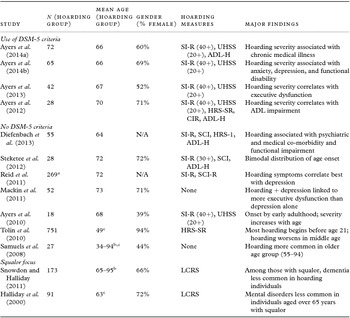
Because of the limited nature of the literature and the paucity of studies based on recognized diagnostic criteria, this paper focuses first on an analysis of methodology. Then, the most salient results of the studies are reported. We found 13 studies that met our criteria (see Table 1).
Summary of findings across hoarding studies

Notes: SCI=Saving Cognitions Inventory; ADLS-H=Activities of Daily Living Scale-Hoarding; SI-R=Savings Inventory-Revised; UHSS=UCLA Hoarding Severity Scale; HRS-SR=Hoarding Rating Scale-Self-Report version; HRS-I= Hoarding Rating Scale Interview; SBS=Saving Behavior Scale; CIR=Clutter Image Rating; LCRS=Living Conditions Rating Scale.
a This study included only a population of non-clinical elderly adults.
b No mean age reported.
c Separate analysis was performed on older participants.
Methodological analysis
Sampling, data collection, and demographic issues
In general, due to the social isolation of many geriatric hoarding patients, recruitment for research can be extremely difficult. Most studies make clear that their samples were self-selecting adding a significant bias to research. A frequently noted limitation of research on older adults who hoard is that many standard recruitment methods (e.g. posters advertising assessment and treatment investigations) may yield participants with greater insight than is typical among HD patients. In contrast, the two studies focusing primarily on squalor (Halliday et al., Reference Halliday, Banerjee, Philpot and Macdonald2000; Snowdon and Halliday, Reference Snowdon and Halliday2011) studied all individuals who were referred to community agencies based on the condition of their homes. An additional study (Samuels et al., Reference Samuels2008) utilized a subset of participants from a large epidemiological survey.
Data were collected in a variety of ways. Most studies included interviews by licensed mental health professional or supervised students/trainees. One study consisted of an internet survey (Tolin et al., Reference Tolin, Meunier, Frost and Steketee2010) and another a questionnaire filled out by participants at a senior center or at home (Reid et al., Reference Reid2011). Three papers, including the two “squalor papers,” included home assessments.
Ten studies included only elderly individuals, and nine had a mean age above 65 years. The tenth had a mean age of 64 years and restricted inclusion to individuals aged 60 years and over (Table 1). The three other studies (Halliday et al., Reference Halliday, Banerjee, Philpot and Macdonald2000; Samuels et al., Reference Samuels2008; Tolin et al., Reference Tolin, Meunier, Frost and Steketee2010) allowed for a broader age range but stratified results to isolate older cohorts. All studies were predominantly Caucasian.
Primary endpoints and diagnostic tools
All 13 studies meeting inclusion criteria had primary endpoints focusing on “correlates” and/or “characteristics” and/or “clinical features” associated with clinically significant hoarding behavior or squalor in an older adult sample. Two studies had a primary endpoint focusing on cognitive deficits associated with hoarding behavior in older adults (Mackin et al., Reference Mackin, Areán, Delucchi and Mathews2011; Ayers et al., Reference Ayers, Wetherell, Schiehser, Almklov, Golshan and Saxena2013) including: executive functioning abilities, memory, attention, and information processing skills. Both studies used a non-clinical control group for comparison. One study (Samuels et al., Reference Samuels2008) looked specifically at the co-occurrence of personality disorders and other Axis I pathology in the context of hoarding in older adults. Another study (Ayers et al., Reference Ayers, Iqbal and Strickland2014a) looked at the rate of co-morbidity of general medical conditions in a sample of older adults as the primary endpoint.
With regard to diagnostic tools, four studies (Ayers et al., Reference Ayers, Schiehser, Liu and Wetherell2012, Reference Ayers, Wetherell, Schiehser, Almklov, Golshan and Saxena2013, Reference Ayers, Iqbal and Strickland2014a, Reference Ayers, Princeton, Howard, Mayes, Porter and Iqbal2014b) used DSM-5 or DSM-5 work group criteria for HD. Other studies assessed for Axis I diagnoses using the SCID for DSM-IV; however, it is not always clear how these studies diagnosed hoarding, as HD had not yet been included as a stand-alone diagnosis. For example, Diefenbach et al. (Reference Diefenbach, DiMauro, Frost, Steketee and Tolin2013) specified that they used only the Anxiety Disorders Interview Schedule portion of the SCID. Ayers et al. (Reference Ayers, Saxena, Golshan and Wetherell2010) and Mackin et al. (Reference Mackin, Areán, Delucchi and Mathews2011) reported evaluation of participants using the SCID for DSM-IV but do not report any symptom rubric under which hoarding behavior was diagnosed.
The use of hoarding self-report measures varied considerably across studies. In Mackin et al. (Reference Mackin, Areán, Delucchi and Mathews2011), diagnosis came from participant self-report with no structured questionnaire. Halliday et al. (Reference Halliday, Banerjee, Philpot and Macdonald2000) and Snowdon and Halliday (Reference Snowdon and Halliday2011) both used the Living Conditions Rating Scale (LCRS) to measure squalor. Snowdon and Halliday (Reference Snowdon and Halliday2011) relied on the individual LCRS items that pertain to hoarding, rather than standardized measures, to identify participants who had both hoarding and squalor. Ayers et al. (Reference Ayers, Saxena, Golshan and Wetherell2010) is a comparatively stronger study in that specific hoarding measures supplemented a diagnostic interview. Of the studies meeting our inclusion criteria, Ayers et al. (Reference Ayers, Saxena, Golshan and Wetherell2010, Reference Ayers, Schiehser, Liu and Wetherell2012, Reference Ayers, Wetherell, Schiehser, Almklov, Golshan and Saxena2013, Reference Ayers, Iqbal and Strickland2014a, Reference Ayers, Princeton, Howard, Mayes, Porter and Iqbal2014b) are most consistent in evaluation protocol and criteria for diagnosis of clinically significant hoarding. The most commonly used self-report measure was the Savings Inventory-Revised (SI-R). This was used as a diagnostic tool in five studies that used a cut-off score, ranging from 30 to 40, to establish clinically significant hoarding. Two other studies that included the SI-R as part of a diagnostic protocol did not report a cut-off score.
Generalizability of findings from studies is difficult because of lack of consistency and replicability across studies. For example, Steketee et al. (Reference Steketee, Schmalisch, Dierberger, DeNobel and Frost2012) developed their format to collect diagnostic data. In this study, classification as a hoarding participant were delineated by two primary factors: (1) an in-home interviewer rating of at least moderate clutter (minimum score of 2 on a 0–4 point scale); and (2) an SI-R score of at least 30. The interview questions were not included in the published report. The authors reported that the presence of obsessive–compulsive disorder (OCD) was assessed by taking select items from the Anxiety Disorders Interview Schedule (ADIS-IV-L), but no specifics are given as to which were chosen. The in-home interview method also makes the study difficult to replicate because the interviewer rating system was not analyzed for reliability.
Assessment of co-morbidities
Assessment of co-morbid mental conditions varied widely across studies and the range of co-morbid diagnoses and symptoms that was investigated was heterogeneous. Three studies used structured diagnostic interviews (Halliday et al., Reference Halliday, Banerjee, Philpot and Macdonald2000; Samuels et al., Reference Samuels2008; Ayers et al., Reference Ayers, Saxena, Golshan and Wetherell2010) in order to establish co-morbid psychiatric diagnoses associated with hoarding or squalor. Two others used similar instruments (Mackin et al., Reference Mackin, Areán, Delucchi and Mathews2011; Ayers et al., Reference Ayers, Wetherell, Schiehser, Almklov, Golshan and Saxena2013) in order to exclude participants with various forms of Axis I pathology. Steketee et al. (Reference Steketee, Schmalisch, Dierberger, DeNobel and Frost2012) used DSM-IV criteria for the purpose of identifying OCD alone. Snowdon and Halliday (Reference Snowdon and Halliday2011) based their diagnoses on consensus assessments of psychiatric raters. Other studies objectively measured psychiatric symptoms including anxiety and depression without assessing for a categorical diagnosis (Reid et al., Reference Reid2011; Ayers et al., Reference Ayers, Wetherell, Schiehser, Almklov, Golshan and Saxena2013, Reference Ayers, Princeton, Howard, Mayes, Porter and Iqbal2014b). Diefenbach et al. (Reference Diefenbach, DiMauro, Frost, Steketee and Tolin2013) reported co-morbid psychiatric diagnoses although there was no description of their diagnostic tool.
Both Halliday et al. (Reference Halliday, Banerjee, Philpot and Macdonald2000) and Snowdon and Halliday (Reference Snowdon and Halliday2011) evaluated participants for dementia. No other study looked for co-morbid dementia or diffuse cognitive impairment; in fact, evidence for dementia was an exclusion criterion in most studies. Only Snowdon and Halliday (Reference Snowdon and Halliday2011) and Samuels et al. (Reference Samuels2008) reported the assessment of personality disorders or personality traits.
Only two studies specifically recorded medical co-morbidities. Ayers et al. (Reference Ayers, Princeton, Howard, Mayes, Porter and Iqbal2014b) utilized a “medical conditions checklist” to assess for common medical disorders. Ayers et al. (Reference Ayers, Saxena, Golshan and Wetherell2010) based medical diagnoses on an interview conducted by a clinical psychologist or psychiatric resident.
Results
Epidemiology and demographics
Samuels et al. (Reference Samuels2008), using a community based sample, is the only study to show that clinically significant hoarding is a more frequent phenomenon in older cohorts. The rate of hoarding in those aged 55–94 years was 6.2%, significantly greater than rate seen in younger adults, which was under 3%. Halliday et al. (Reference Halliday, Banerjee, Philpot and Macdonald2000) showed that, in a community sample of 81 participants living in squalor, 49% were over age 65 years. Research on elderly adults living in domestic squalor estimates the referral rate of elderly persons to be about five times higher than in younger adults (Snowdon and Halliday, Reference Snowdon and Halliday2011). They also found that 66% of patients with moderate to severe squalor had significant hoarding activity.
Reid et al. (Reference Reid2011) did show greater hoarding symptoms in her elderly community participants compared to a younger sample from a separate study but they did not find any difference in hoarding severity based on the age of seniors within their own study. In contrast, Ayers et al. (Reference Ayers, Saxena, Golshan and Wetherell2010) did see severity increasing with age based on patient's recollection of hoarding symptoms over time. Tolin et al. (Reference Tolin, Meunier, Frost and Steketee2010), looking at a wider age range, found a greater frequency of more severe symptoms, among hoarding individuals, beginning at age 46–50 years and continuing into old age. Finally, Diefenbach et al. (Reference Diefenbach, DiMauro, Frost, Steketee and Tolin2013) found that levels of anxiety in hoarding patients actually declined with age.
Both Ayers et al. (Reference Ayers, Saxena, Golshan and Wetherell2010), looking at an older sample, and Tolin et al. (Reference Tolin, Meunier, Frost and Steketee2010), looking at a mixed age sample, found that hoarding generally begins in early life, and almost invariably before age 40 years. Steketee et al. (Reference Steketee, Schmalisch, Dierberger, DeNobel and Frost2012), in contrast, found a bimodal distribution of onset with a second spike after age 50 years.
Of the seven studies focused on HD or hoarding symptoms, where gender was reported in a strictly “late-life” sample (Table 1), the percentage of hoarding participants who were female ranged from 39% to 72% and was over 50% in all but one study. Although Samuels found more males than females in his community sample, the gender results were not restricted to the late-life participants. Reid et al. (Reference Reid2011) did not find a difference in hoarding symptoms between men and women in her sample of community elderly. With regard to squalor, the two relevant studies identified a majority of males who were referred for services (66% and 72%). The two studies that compared marital status in hoarding individuals to controls (Ayers et al., Reference Ayers, Schiehser, Liu and Wetherell2012; Steketee et al., Reference Steketee, Schmalisch, Dierberger, DeNobel and Frost2012) both found that hoarding individuals were at least twice as likely to have never married.
Psychiatric and medical co-morbidities
Hoarding behavior in older adults has been observed concurrently with the following conditions: anxiety disorders, depressive disorders, personality disorders, PTSD, and substance use disorders. The most commonly reported co-morbidities across studies are depression and anxiety disorders. The reported rate of co-morbid depression varied from 14% to 54% across studies, and was by far the most commonly reported diagnosis. In a community sample of aged 60–87 years, Ayers et al. (Reference Ayers, Saxena, Golshan and Wetherell2010) found severe hoarding behavior to be highly co-morbid with major depressive disorder (28%), dysthymia (22%), and OCD (16%). In a larger sample of adults aged 60 years and over, hoarding was reported to occur at higher rates among those with major depressive disorder (51.4%), generalized anxiety disorder (23.3%), OCD (13.3%), specific phobia (13.8%), and post-traumatic stress disorder (7.1%) (Diefenbach et al., Reference Diefenbach, DiMauro, Frost, Steketee and Tolin2013). Samuels et al. (Reference Samuels2008) correlated geriatric hoarding behavior with an increased likelihood of alcohol dependence. According to this data, lifetime incidence of alcohol dependence was significantly more prevalent in participants with clinically significant hoarding behavior than the control group (52.2% vs. 19.5%). In Ayers et al. (Reference Ayers, Saxena, Golshan and Wetherell2010), a history of substance abuse or dependence was reported by a third of the hoarding participants. One study that included a personality measure found a significant association between hoarding and the following traits: paranoid, schizotypal, antisocial, avoidant, and obsessive–compulsive (Samuels et al., Reference Samuels2008). Snowdon and Halliday (Reference Snowdon and Halliday2011) found that 33% of seniors with hoarding, who lived in squalor, had personality disorders compared to only 5% with squalor who were not hoarders. Overall, Halliday et al. (Reference Halliday, Banerjee, Philpot and Macdonald2000) demonstrated that 57% of a mixed-age sample of those living in squalor had an independent mental disorder. The subset over age 65 years manifested a lower rate of mental illness than younger individuals in the sample.
PTSD is also a common co-occurring diagnosis in this population, with four studies (Samuels et al., Reference Samuels2008; Ayers et al., Reference Ayers, Saxena, Golshan and Wetherell2010, Reference Ayers, Schiehser, Liu and Wetherell2012; Diefenbach et al., Reference Diefenbach, DiMauro, Frost, Steketee and Tolin2013) with a formal diagnostic process reporting at least one subject with this diagnosis. Of these studies, reports of co-occurring PTSD range from 3.5% to 18%. More specifically, Samuels et al. (Reference Samuels2008) found a significant association between geriatric hoarding behavior and childhood adversity. They questioned participants about childhood experiences of traumatic events, reporting that not only did hoarding participants experience a higher incidence of childhood adversity, but the odds of hoarding were about four times as great in participants reporting lack of security from home break-ins in childhood and in individuals who reported receiving excessive physical discipline in childhood.
The issue of dementia was best addressed in one of the papers that studied the relationship of hoarding to domestic squalor. Snowdon and Halliday (Reference Snowdon and Halliday2011) found a rate of dementia of 26% in individuals over age 65 years living in squalor and actively hoarding. The portion of their sample with squalor but no hoarding actually had a higher prevalence of dementia (31%)
It is unclear if HD is a risk factor for medical illness or if medical conditions may make it more difficult for individuals to attend to their homes. Impaired insight, self-neglect, and cognitive deficits may make it more difficult for older adults who hoard to engage in self-care (Ayers et al. Reference Ayers, Iqbal and Strickland2014a). Ayers et al. (Reference Ayers, Iqbal and Strickland2014a) reported that 90% of the participants who self -identified as hoarders reported at least one chronic or severe medical condition compared to 44% of non-hoarding older adults. Medical co-morbidities in hoarding included: arthritic conditions (35% with hoarding vs. 12% for controls), sleep apnea (29% vs. 0%), head injury (20% vs. 0%), and diabetes (21% vs. 4%). Hoarding severity was significantly related to the number of reported medical conditions. HD participants were less likely to seek medical assistance, reporting primary care physician visits once every 16 months. Ayers et al. (Reference Ayers, Saxena, Golshan and Wetherell2010) found hypertension to be the most frequently reported co-morbid condition, followed by head injury and arthritis.
Social and safety aspects of hoarding
HD as it affects elderly patients is correlated with a number of public health and safety issues. Older adults who hoard are at risk for falls, fire, avalanche, impaired functional and/or instrumental ability, food contamination, and medication mismanagement (Ayers et al., Reference Ayers, Saxena, Golshan and Wetherell2010, Reference Ayers, Schiehser, Liu and Wetherell2012, Reference Ayers, Princeton, Howard, Mayes, Porter and Iqbal2014b; Reid et al., Reference Reid2011; Steketee et al., Reference Steketee, Schmalisch, Dierberger, DeNobel and Frost2012; Diefenbach et al., Reference Diefenbach, DiMauro, Frost, Steketee and Tolin2013). Precarious structural conditions in the home, exposure to toxic mold and/or dust, and insect or rodent infestation contribute to the overall burden of risk incurred by late-life hoarders. Low rates of physical and mental healthcare (Ayers et al., Reference Ayers, Iqbal and Strickland2014a, Reference Ayers, Princeton, Howard, Mayes, Porter and Iqbal2014b) and limited home access for first responders, skilled nursing or home health professionals, and critical social supports amplify these risks. Although the functional consequences associated with hoarding behavior persist across the lifespan, late-life, or geriatric hoarders are particularly vulnerable to these adverse effects. Because ruptures in family and/or caregiver relationships negatively impact social well-being, isolation features significantly in the presentation of late-life hoarding (Ayers et al., Reference Ayers, Saxena, Golshan and Wetherell2010). In older adults, social isolation is correlated with greater hoarding symptom severity.
Cognitive deficits
The cognitive-behavioral model of hoarding behavior stresses deficits in information processing leading to erroneous beliefs about objects, emotional attachment to the objects, and behavioral avoidance (Frost and Hartl, Reference Frost and Hartl1996). Ayers et al. (Reference Ayers, Wetherell, Schiehser, Almklov, Golshan and Saxena2013) reported that middle aged and older adults with HD perform significantly worse than healthy age-matched controls in the Wisconsin Card Sort Task (WCST) suggesting executive functioning impairment in areas such as categorization, maintaining attention, and utilization of feedback. Concentration and working memory, as measured by the Wechsler Adult Intelligence Test-IV, were also impaired in seniors with hoarding. However, hoarding severity only correlated with impairment in the WCST. Mackin et al. (Reference Mackin, Areán, Delucchi and Mathews2011) reported that older adults with major depression and hoarding symptoms had greater impairment in categorization and problem solving tasks than patients with late-life depression alone suggesting that depression does not fully account for impaired cognition related to hoarding.
Discussion
The relatively small number of studies that met inclusion criteria for this review had a range of limitations. Aside from papers that used DSM-5 criteria, definitions of hoarding were poorly defined and heterogeneous across studies. The studies were also highly variable with respect to means for recruiting samples and the methods used for assessment. In many cases, samples were self-selected. Few studies examined medical co-morbidities. The important co-morbidity of dementia was often listed as an exclusion criterion and was only assessed in papers looking at hoarding in the context of squalor.
Nonetheless, taken together, the available literature paints a clear picture that seniors with hoarding constitute a highly vulnerable population. These individuals commonly face a range of challenges including: unsafe living conditions, impaired activities of daily living, social isolation, and psychiatric and medical co-morbidities. In addition, cognitive impairment in the areas of attention, working memory, and executive function is associated with hoarding. The medical conditions linked with hoarding may well contribute to cognitive dysfunction. For instance, sleep apnea has been associated with impairment in attention, memory, and reasoning ability (Lal et al., Reference Lal, Strange and Bachman2012). In particular, executive dysfunction appears to be specifically associated with compulsive hoarding behavior and not attributable to co-morbid depression (Mackin et al., Reference Mackin, Areán, Delucchi and Mathews2011) or OCD (Morein-Zamir et al. (Reference Morein-Zamir2014). This suggests that frontal lobe dysfunction may play a critical role in late-life hoarding.
Many hoarding patients may have a history of mistreatment and trauma. Additionally, there is evidence that the hoarding symptoms are long standing and increase in severity over time. Although dementia was an exclusion criterion in many of the studies we reviewed, Marx and Cohen-Mansfield (Reference Marx and Cohen-Mansfield2003) found that dementia was highly associated with significant hoarding symptoms in senior day-care participants.
Our review also demonstrated that hoarding and squalor frequently co-occur in late-life but there may be important distinctions between these two. Both studies of squalor were majority male unlike most hoarding studies. Individuals with hoarding and squalor had much higher rates of personality disorder than those with squalor alone. Dementia was more commonly found in those with both conditions.
The cross-sectional studies that we reviewed, by their nature, focus mostly on correlates of hoarding and are restricted with regard to understanding etiology. There is additional literature on hoarding that has identified the role of long-term patterns of self-neglect as a critical factor in the development of this condition. According to Pavlou and Lachs (Reference Pavlou and Lachs2006), self-neglect is defined by lack of attention to health and hygiene, combined with an inability or unwillingness to access remedial services, and often coincides with other prevalent geriatric syndromes such as HD. Hoarding has been linked with a specific form of pathological self-neglect in older adults referred to as “Diogenes Syndrome” (Maier, Reference Maier2004) that consists of extremely poor hygiene and an inability to maintain proper self-care routines, along with syllogomania (e.g. hoarding).
The association between hoarding and self-care deficits in a geriatric population has been linked to personality disorders (Rosenthal et al., Reference Rosenthal, Stelian, Wagner and Berkman1998), female gender, and being single (Clark et al., Reference Clark, Mankikar and Gray1975; Montero-Odasso et al., Reference Montero-Odasso2005). All of these findings are consistent with our review. Snowdon et al. (Reference Snowdon, Shah and Halliday2007) noted the link between systemic self-neglect and a constellation of personality traits. The individuals they sampled were found to be stubborn, aloof, independent, domineering, quarrelsome, and unfriendly. These authors also cite evidence that older adults living in severe domestic squalor commonly display symptoms of frontal lobe dysfunction, including social withdrawal, disinhibition, lack of empathy, and deficits in self-care. Other research has observed that patients with frontal lobe lesions may be at higher risk for developing Diogenes syndrome (Cipriani et al., Reference Cipriani, Lucetti, Vedovello and Nuti2012). These findings are in concert with the deficits in executive function found in the hoarding literature that we reviewed. Consistent with this, neuroimaging has detected differences in activity in parts of the brain associated with decision making when hoarding patients are compared with OCD patients and healthy controls (Tolin et al., Reference Tolin2012). It is, thus, possible that self-neglect leads to declining health status, resulting in worsening frontal lobe function that further impairs self-care.
Preliminary evidence seems to suggest a relatively early age of onset of hoarding (Ayers et al., Reference Ayers, Saxena, Golshan and Wetherell2010) with possible connection to a range of disordered personality traits and to a history of mistreatment or trauma (Samuels et al., Reference Samuels2008). Our review further implicates developmental changes (functional, cognitive, physical, and social) occurring during the aging process as contributing factors as well. These added burdens may account for the evidence that hoarding worsens over time and that hoarding that is recognized in late-life tends to be more severe.
Our review is circumscribed by the small number of recent studies that focus on hoarding behavior in aging individuals. Nonetheless, the studies identify distinct features of hoarding in late-life that give added support for the inclusion of HD as a stand-alone diagnosis in DSM-5 across the age spectrum. The range of variables that influence the presentation of this condition strongly suggests that an integrated biopsychosocial intervention is necessary for effective management. Future work could focus more on personality disorders and the role of co-morbid dementia in this age group (even though dementia is considered an exclusion criterion in DSM-5). A longitudinal study that observes the course of hoarding in geriatric patients over time would aid an understanding of etiology and allow for meaningful assessment of therapeutic interventions.
Conflict of interest
None.
Description of authors’ roles
D. Roane conceptualized the literature review and wrote sections of the paper.
A. Landers systematized the literature search and wrote sections of the paper. J. Sherratt wrote sections of the paper. G. Wilson wrote sections of the paper.
Acknowledgment
The authors thank the Harriet & Robert H. Heilbrunn Fund through UJA-Federation of New York for supporting this work.