INTRODUCTION
Since the first expressive writing study by Pennebaker and Beall (Reference Pennebaker and Beall1986), over 200 studies have been undertaken on a range of participants, using varied instructions, settings, outcome measures, and theoretical frameworks (Smyth & Pennebaker, Reference Smyth and Pennebaker2008). Studies have generally found that participants who write about their thoughts and feelings surrounding traumatic experiences (e.g., for 15–20 minutes per day for 3–5 days) show physical and psychological health benefits over the following months (Frattaroli, Reference Frattaroli2006; Smyth, Reference Smyth1998).
Although early expressive writing studies were generally carried out on students, those carried out in clinical settings also show improvements in clinically relevant outcomes such as reduction in blood pressure in those whose blood pressure is elevated (Beckwith McGuire et al., Reference Beckwith McGuire, Greenberg and Gevirtz2005), improved immune function in HIV+ patients (Petrie et al., Reference Petrie, Fontanilla and Thomas2004), faster wound healing following biopsy (Weinman et al., Reference Weinman, Ebrecht and Scott2008), improvements in patients with severe asthma or rheumatoid arthritis (Smyth et al., Reference Smyth, Stone and Hurewitz1999), reduction in pain in a range of conditions including fibromyalgia (Broderick et al., Reference Broderick, Junghaenel and Schwartz2005), chronic pelvic pain (Norman et al., Reference Norman, Lumley and Dooley2002), and rheumatoid arthritis (Kelley et al., Reference Kelley, Lumley and Leisen1997). With regard to the effects of expressive writing on psychological health, various patient groups also report improvements in psychological well-being (Broderick et al., Reference Broderick, Junghaenel and Schwartz2005), increased positive affect (Norman et al., Reference Norman, Lumley and Dooley2002), and reductions in depressive symptoms (Bodor, Reference Bodor2002).
Stanton et al. (Reference Stanton, Danoff-Burg and Sworowski2002) asked breast cancer patients to write about their deepest thoughts and feelings regarding breast cancer (emotional expression group), positive thoughts and feelings regarding breast cancer (benefit finding group), or a control topic. They found that both the emotional expression and benefit finding groups made significantly fewer medical visits for cancer-related illnesses at a three-month follow-up than the control group.
Analysis of Language Used In Expressive Writing Studies
Using a computerized text analysis programme, Linguistic Inquiry and Word Count (LIWC) (Pennebaker et al., Reference Pennebaker, Francis and Booth2001), researchers have found that increasing use of cognitive mechanism words (e.g., causal words such as because or cause and insight words such as think or consider) from the first to last writing session is linked to greater health improvements (Pennebaker & Francis, Reference Pennebaker and Francis1996; Pennebaker et al., Reference Pennebaker, Mayne and Francis1997). Increases in cognitive mechanism words have also been associated with improvements in posttraumatic psychological growth (Ullrich & Lutgendorf, Reference Ullrich and Lutgendorf2002), improved immune function (Petrie et al., Reference Petrie, Booth and Pennebaker1999), and fewer negative changes brought about by being HIV+ (Rivkin et al., Reference Rivkin, Gustafson and Weingarten2006). Tausczik and Pennebaker (Reference Tausczik and Pennebaker2010) suggest that the use of cognitive mechanism words in describing an event may indicate a process of reappraisal, and that increasing use suggests participants are changing from not processing to actively processing an event.
The expression of positive and negative emotion words has also been linked with health improvements although the picture is somewhat mixed. Some studies find that those using more positive emotion words improve more (Pennebaker & Francis, Reference Pennebaker and Francis1996; Pennebaker et al., Reference Pennebaker, Mayne and Francis1997; Danner et al., Reference Danner, Snowdon and Friesen2001) while others find that greater use of negative emotion words predicts greater health improvement (Pennebaker et al., Reference Pennebaker, Mayne and Francis1997) and greater decline in physical symptoms (e.g., in breast cancer) (Low & Danoff-Burg, Reference Low, Stanton and Danoff-Burg2006).
Self-Compassion
Self-compassion refers to self-kindness (treating oneself with care and understanding rather than self-criticism), common humanity (the ability to perceive experiences as part of the broader human experience rather than feeling isolated by failures), and mindfulness (holding present experiences in balanced perspective) (Neff, Reference Neff2003a; Neff & McGehee, Reference Neff and McGehee2010). Self-compassion has been linked to positive psychological health outcomes, including lower levels of depression, anxiety and negative affect, and greater life satisfaction (Neff et al., Reference Neff, Kirkpatrick and Rude2007b, Reference Neff, Rude and Kirkpatrick2007a; Neff, Reference Neff2003b). Individuals with higher levels of self-compassion are better able to repair negative emotional states than those with low levels (Neff, Reference Neff2003b).
Paul Gilbert (Gilbert, Reference Gilbert and Gilbert2005; Gilbert & Irons, Reference Gilbert, Irons and Gilbert2005) considers self-compassion in the light of attachment theory, an evolved physiological system governing care-giving, where threatening situations activate a person's self-soothing system (associated with feelings of safeness and secure attachment) and deactivates the threat system (associated with feelings of defensiveness and insecure attachment) (see Gilbert et al., Reference Gilbert, McEwan and Mitra2008). Interventions that target self-compassion (e.g., Gilbert, Reference Gilbert2009) improve psychological health (Gilbert & Procter, Reference Gilbert and Procter2006; Neff et al., Reference Neff, Kirkpatrick and Rude2007b; Shapiro et al., Reference Shapiro, Astin and Bishop2005).
Leary et al. (Reference Leary, Tate and Adams2007) evaluated whether self-compassion could be experimentally induced using expressive writing. Participants who wrote about stress in a self-compassionate way reported less negative affect at the end of the experiment than participants who wrote about their deepest thoughts about the event or even those who wrote about stress in a way that would enhance their self-esteem (Leary et al., Reference Leary, Tate and Adams2007).
The Present Study
The present pilot study uses a self-compassion instruction in an expressive writing task to identify the possible effect on psychological outcomes but, whereas Leary et al. (Reference Leary, Tate and Adams2007) induced changes in self-compassion in an undergraduate population over the course of an experiment, this study examines its effect in a Day Hospice population over 1 week.
The second aim of the study is to explore the feasibility of implementing an expressive writing intervention with a clinical population in a Day Hospice setting. Introducing and evaluating a writing intervention in this setting will likely create considerable challenges for a number of reasons: (1) Day Hospices are not resourced or organized to carry out research; (2) in general, patients only attend a Day Hospice once a week for a finite period of time; (3) patients are not obliged or required to attend; (4) attendance can be disrupted by illness or treatment.
The Day Hospice participating in the present study provides care for patients diagnosed with life-limiting illnesses and provides a safe place for patients to find ways of dealing with the changes that their diagnosis has brought to their lives. It supports up to 60 patients a week, typically attending for one day a week for a fixed period of time, usually three months, after which their case is reviewed. The Day Hospice was approached because it was thought that the potential benefits offered by a writing task may be of particular relevance to Day Hospice patients. The National Council for Hospice and Specialist Palliative Care Services (1997) notes that palliative care is concerned with the “psychological and emotional well-being of the patient” (Oliviere et al., Reference Oliviere, Hargreaves and Monroe1998, p. 5), and that there is a psychosocial dimension involved in the work of all the disciplines within palliative care (Oliviere et al., Reference Oliviere, Hargreaves and Monroe1998). The concept of attachment has been particularly influential in the development of psychosocial palliative care (Sheldon, Reference Sheldon1997), which, from Gilbert's (Reference Gilbert and Gilbert2005) perspective, suggests that the concept of self-compassion is in keeping with the aims of the palliative care movement and the type of support it provides to patients.
METHOD
Participants
Thirteen participants (8 females, 5 males) were recruited from a local Day Hospice. The age range of participants was 38–86 (M = 67.5, SD = 14.9). Participants were not asked for their individual diagnoses so as to avoid causing unnecessary distress, however all patients who attend the Day Hospice have been diagnosed with secondary cancer or another life-limiting illness and are not receiving treatment.
Participants were recruited through several information meetings held at the Day Hospice. All participants were native English speakers. Two participants, one in the control group and one in the experimental group, dictated their responses that were transcribed by Day Hospice volunteers.
Thirteen participants completed baseline measures and the first writing session. Eight of these completed the second writing session, of which six completed the follow-up measures (experimental group n = 3, control group n = 3). Seven participants failed to complete the full intervention for health reasons, with two being admitted to hospital between the first and second writing sessions.
Measures
Self-soothing: The Forms of Self-Criticizing/Attacking and Self-Reassuring Scale (FSCRS) (Gilbert et al., Reference Gilbert, Clarke and Hempel2004) consists of three subscales, the inadequate self (IS), the reassure self (RS), and the hated self (HS). The scale asks participants about the thoughts and feelings they have when things go wrong for them and asks them to rate on a five point Likert scale the extent to which each statement is true for them. Responses range from “not at all like me” to “extremely like me.” However, after discussion with the Deputy Director of Hospice Services, it was decided that 14 of the items (including 2 of the RS items) might be too distressing for use with Day Hospice patients. The remaining items were combined to form a single score for self-soothing. Scores range from 0–32 with higher scores indicating higher levels of self-soothing. Internal reliability of participants' answers was high, Cronbach's α = 0.86. On the basis of comparison with unpublished data from other samples using the full 22-item version (total n = 393, female = 344, male = 48), the reduced items included here correlate 0.91 with the full version and the internal reliability compares well (Cronbach's α = 0.94 using the full scale).
Self-esteem: The Single Item Self-Esteem Scale (SISE) (Robins et al., Reference Robins, Hendin and Trzesniewski2001) asks participants to rate how true or untrue the statement “I have high self esteem” is for them on a 5-point Likert scale, with higher scores indicating greater self-esteem.
Mood: The Short Depression-Happiness Scale (SDHS) (Joseph et al., Reference Joseph, Linley and Harwood2004) consists of six items, three positive (e.g., “I felt happy”) and three negative (e.g., “I felt that life was meaningless”). Participants are asked to rank on a 4-point Likert scale (ranging from “never” to “often”) how often they have felt a certain way over the last month. Scores range from 0–18 with higher scores indicating a more positive mood. Cronbach's α for the SDHS = 0.83.
Stress: The 10-item Perceived Stress Scale (PSS10) (Cohen & Williamson, Reference Cohen, Williamson, Spacapan and Oskamp1988) consists of 10 items, six negatively worded (e.g., “How often have you felt nervous and ‘stressed’?”) and four positively worded (e.g., “How often have you felt that things were going your way?”). Participants rate on a 5-point Likert Scale how often they have felt or thought a certain way over the last month, with responses ranging from “never” to “very often.” Scores range from 0–40 with higher scores indicating higher stress levels. Cronbach's α for the PSS = 0.83.
After each writing session participants were given an evaluation sheet asking them to rate on a 5-point Likert scale how personal their writing was, how meaningful their writing was, and how valuable they had found the writing experience.
The computerized text analysis programme, LIWC (Pennebaker et al., Reference Pennebaker, Francis and Booth2001), was used to categorize text into standard language variables (e.g., articles, pronouns), and psychological categories (e.g., emotion words, cognitive processes). The LIWC has been validated and studies provide evidence about the social and psychological implications of word use (Pennebaker et al., Reference Pennebaker, Mehl and Niederhoffer2003). The program runs a word count and categorizes words, giving the proportion of word use in each chosen category as a percentage of the whole text. The word categories examined in this study were positive emotion words, negative emotion words, causal words, insight words and social process words.
Procedure
Participants were tested in groups of 2–7 in a quiet room at the Day Hospice. Testing took place on two afternoons every week over a period of three weeks, with the experimental group being tested on one afternoon and the control group being tested on a different afternoon. This was necessary as patients only visit the Day Hospice one day per week and only one room was available for testing so it was necessary that all participants in the same room were given the same instructions.
Participants in the control (stress-only) group were given instructions that read:
“Please write about something that you have found difficult during the last week. This can be anything you feel comfortable writing about, for example, you may wish to write about something that has happened to you, something that you have seen, something that you have been worrying about or something that you have been thinking about more often than usual. Please don't worry about spelling or grammar when you're writing, just let go and explore your thoughts and feelings about your chosen topic. You will have 20 minutes to write about your topic, but please use as much or as little of this time as you like.”
Participants were asked to begin writing when they were ready. After 20 minutes had elapsed participants were asked to finish writing and were given evaluation sheets to complete.
Participants in the experimental (stress + self-compassion) group received the same instructions as the control group but were informed that, after 10 minutes had elapsed, they would be asked to stop writing and would be given a second set of instructions containing a self-compassion instruction. These additional instructions read:
“You will now be asked to write again about the topic you have just described, but in a slightly different way. Please think about the experience you described, and write a paragraph expressing understanding, kindness and concern to yourself. You may find it helpful to imagine that you are writing to a friend or family member who is undergoing the same experience and imagine what you might say to them.”
Participants were asked to begin writing again and, after 10 minutes had elapsed, were asked to stop writing and were given evaluation sheets to complete.
The following week, both groups received the same instructions they had been given the previous week. They were given 20 minutes to complete the writing tasks and then asked to complete writing-evaluation sheets. On the third session, participants were asked to complete the same questionnaires they had completed in the baseline session. Participants were thanked for their participation in the study and fully debriefed.
Data Analysis
Psychological Health: As this was a pilot case series, there were two few participants to conduct formal inferential statistical analyses. Therefore, consistent with case reports, outcomes were based on raw changes in questionnaire scores from pre-testing to follow-up.
Word Use: Psychological processes represented in the writing (e.g., cognitive processes, positive emotion, negative emotion, social processes) were analyzed using the LIWC. A univariate analysis of variance was used to identify any changes over time in the words used (indicating changes in psychological processes), where the independent variables were writing group and writing session.
Ethical Statement
Ethical approval was obtained from the School of Psychology Ethics Committee at the University of Hertfordshire as well as the Hertfordshire NHS Research Ethics Committee. Permission to conduct research at the Day Hospice was obtained from East and North Hertfordshire Primary Care Trust and the study was carried out with the full permission and support of the Deputy Director of Hospice Services and the Day Hospice Manager. Input into the design of the study was sought from the Day Hospice management and was incorporated fully into the study design including the spacing of the writing sessions, the writing instructions, the support provided (e.g., pastoral support, informing care staff) and the measures used. While many expressive writing studies ask the control group to write about a trivial subject, e.g., ‘describe your shoes’, it was felt that this would be inappropriate here, hence the use of the stress-only control and stress + self-compassion experimental conditions.
RESULTS
Participants' Evaluation of Their Writing
There were no significant differences in ratings between groups. Both groups had ratings well above the mid-point suggesting the writing task was generally perceived as personal, meaningful, and valuable (scored between 1 and 5, means for experimental and control groups respectively were: personal, 3.9 and 4.2; meaningful, 3.8 and 4.0; valuable, 3.5 and 3.7).
Content of Essays
All participants' essays conformed to the assigned writing condition topics. Of the 22 essays, 32% dealt with the effects of illness on relationships with family members; 27% involved physical difficulties resulting from illness; 23% dealt with practical concerns related to illness; 18% involved bereavement; 14% dealt with being diagnosed and adjusting to the illness. Other topics included: adjusting to coming to the end of their time at the Day Hospice (9%), dreams, anxiety, and/or panic attacks (9%), family concern unrelated to illness (4%). The percentages total more than 100% because some essays could be classified into two categories.
Changes in Psychological Health Measures between Baseline and Follow-Up
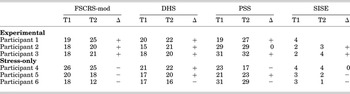
All patients in the self-compassion condition had increased their levels of self-soothing (FSCRS-mod) at follow-up while all of those in the stress-only condition decreased (see Table 1). In terms of self-esteem (SISE), two patients in the self-compassion condition had increased at follow-up (the third completed the SISE at baseline but not at follow-up) while two patients in the stress-only condition decreased their self-esteem and the third was unchanged. All patients in the self-soothing condition had increased their levels of happiness (D-HS) while two patients in the stress-only condition had increased and the third had decreased (albeit only slightly). Interestingly, and in spite of the direction of changes in self-soothing and self-esteem, two patients in the self-compassion condition reported an increase in their levels of stress (the third was unchanged) while two in the stress-only condition reported a decrease in their levels of stress (the third reporting a small increase).
Baseline, follow-up and change in psychological variables

Notes: FSCRS-mod = modified Forms of Self-Criticism and Reassurance Scale; DHS = Depression-Happiness Scale; PSS = Perceived Stress Scale' SISE = Single Item Self-Esteem scale
Δ indicates change: “ + ” indicates an increase in scores, “−” indicates a decrease in scores and “0” indicates no change in scores on each measure.
Text analysis: Linguistic Inquiry and Word Count
Experimental and control groups were compared on the types of words used in each writing session. Since this analysis depends only on those who completed both writing sessions and not on the completion of follow-up questionnaires, the text analysis was carried out on all participants' samples of writing (13 participants, 22 essays). The proportion of positive emotion, negative emotion, causal, insight, and social process words used as a function of writing session and group were explored using a series of two-way univariate ANOVAs.
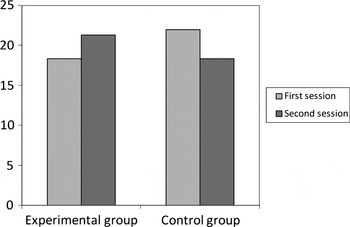
There was a significant main effect showing a reduction in the use of negative emotion words between baseline and follow-up, falling from 3.13% to 1.82% (F 1,18 = 6.97, p < 0.02). More importantly, there was a significant interaction between group and writing session for the proportion of causal words used (F 1,18 = 8.36, p < 0.01) with the experimental group increasing in their use of causal words over the two sessions and the control group decreasing their use (see Figure 1). No other main or interaction effects approached significance.
Changes in the use of causal words in the experimental and control groups across two writing sessions.

DISCUSSION
This pilot study examined the feasibility of carrying out an expressive writing study in a Day Hospice setting and the effects of the inclusion of a self-compassion instruction.
Findings
All three participants in the experimental group reported an increase in self-soothing at one week follow-up while all those in the control group reported a decrease. A similar result was found for changes in self-esteem although participants in the experimental group generally reported an increase in stress levels while more of those in the control group reported a decrease. All but one participant (who was in the control group) reported an increase in happiness. These differences were in spite of the writing tasks being perceived to be equally personal, meaningful, and valuable in both groups.
With regard to changes in word use between groups, the study found that the experimental group's use of causal words increased over time and the control group's use of causal words decreased. Both groups used fewer negative emotion words over time.
Strengths and Limitations
The principal limitation is the small sample size, with 13 participants beginning the study and six completing it. For identifying changes in psychological outcomes there were too few participants to carry out meaningful inferential statistical analyses. The number of participants able to complete the study was affected by their health during the study and the unpredictable nature of their illnesses.
Second, the measures were all self-report and, in the case of the self-soothing measure, necessarily modified for ethical reasons. Other means of measuring these constructs should be considered in future studies, such as physiological assessment of stress (Weinman et al., Reference Weinman, Ebrecht and Scott2008) as well as other relevant clinical outcomes and Quality of Life. A longer follow-up period, although possibly beneficial in order to evaluate more stable changes, needs to weighed against what is feasible and informative.
Practical constraints meant that participants took part in just two writing sessions. Although it is encouraging that meaningful changes were found after only two sessions, meta-analyses show greater effect sizes with more writing sessions (Frattaroli, Reference Frattaroli2006) and future research should explore the effects (and feasibility) of increasing the number of sessions.
Implications
Notwithstanding these limitations, this pilot study has a number of implications. First, a simple modification to standard stress writing seems to improve self-soothing and self-esteem although perhaps at the expense of self-reported stress. However, Lepore (Reference Lepore1997) notes that, while the activity of expressive writing may not reduce a participant's stress levels per se, it may reduce the impact that stress has on them. Furthermore, the increase in the experimental group's use of causal words over time suggests that their cognitive processes are changing in the way that previous research suggests is needed for expressive writing participants to experience longer term benefits (Pennebaker & Francis, Reference Pennebaker and Francis1996).
The findings have implications for the feasibility of implementing expressive writing with a Day Hospice population. Expressive writing was well received and was viewed as personal, meaningful, and valuable. Several participants mentioned that they found it easier to write their feelings down than to talk about them.
Ideally, sessions should be spaced to allow as many patients as possible to participate but without being tiring or detrimental to their health. The varying health of participants is not usually a consideration in the planning of expressive writing studies undertaken with non-clinical populations. In this study, weekly attendance at the hospice necessitated spacing the writing sessions but this increases the chance that participants may not be able to complete the intervention due to admission to hospital or worsening health. The alternatives include writing on consecutive days (as in most expressive writing studies) although, because attendance at the hospice is weekly, this would require participants to write at home. While improvements in psychological health are greater when participants write at home (Frattaroli, Reference Frattaroli2006), it would also mean that the emotional support provided by the hospice is not available should participants become distressed when writing about stress. On the other hand, other writing tasks have shown similar long-term health benefits without the short-term negative emotional consequence, such as writing about life goals (King, Reference King2001) or intensely positive experiences (Burton & King, Reference Burton and King2004). Use of such writing tasks remains a possibility although the evidence base for its effectiveness is much smaller than that for writing about stress.
Another possibility is to provide several writing sessions within a single day (e.g., Chung & Pennebaker, Reference Chung and Pennebaker2008). While this may reduce drop-out rates and facilitate ease of data collection, it was decided that it wouldn't be feasible in a Day Hospice due to the energy and concentration required from participants. Indeed, some participants in the current study found the physical act of holding a pen and writing for 20 minutes challenging, and would have been unable to participate had there been more than one session per day. Lester (Reference Lester, P Firth and Oliviere2005) notes that when running activities with patients with life-limiting illnesses whose health may rapidly deteriorate and who may only be able to manage short periods of concentration, it is important to offer patients a “‘manageable task’ and to finish each session on a positive aspect in case the person is not well enough to continue” (Lester, Reference Lester, P Firth and Oliviere2005, p. 69). It may be more feasible, therefore, to run expressive writing sessions weekly, as in the present study, but to run them over more than three weeks, perhaps on a drop-in basis, so that participants can be more flexible about when they attend and yet still take part in multiple sessions.
Several participants in the experimental group mentioned informally that the instructions should be varied to retain participants' interest. It may be useful to consider writing instructions that introduce different components of self-compassion at each session (i.e., self-kindness, common humanity, mindfulness).
For practical reasons all participants carried out their writing together in the same room. Several participants mentioned that they found it difficult to concentrate and Frattaroli's (Reference Frattaroli2006) meta-analysis found greater psychological health effects when expressive writing takes place in a private room rather than with other participants. However, this finding must be balanced against the time constraints and facilities in a Day Hospice setting. The preliminary evidence presented here suggests there are still benefits to be gained, even when writing communally.
CONCLUSION
In conclusion, the findings of this pilot study suggest that a self-compassion instruction can be used in an expressive writing task to increase self-soothing in a Day Hospice population. Text analysis also shows that these participants' use of causal reasoning increases over time, suggesting that there are meaningful changes in how experimental participants process the experiences they are describing. As only half the participants completed the follow-up measures due to health complications it is important to remain flexible in the way such an intervention is implemented.
ACKNOWLEDGMENTS
The authors would like to thank the patients, management, staff and volunteers at the Day Hospice for their immense support and input on this project.