INTRODUCTION
Many tropical areas can support alternative vegetation communities: open grasslands, mixtures of grasses and savanna trees, or closed-canopy forests. The establishment of forest trees into African grasslands is typically poor, despite the removal of fire, leading to ecological and conservation concerns as forests are removed and not replaced (Chapman & Chapman Reference CHAPMAN, CHAPMAN, Crisman, Chapman, Chapman and Kaufman2003). Kellman & Miyanishi (Reference KELLMAN and MIYANISHI1982) proposed that savanna trees first establish in grasslands and subsequently facilitate the establishment of forest trees. In Serengeti National Park, Tanzania, where establishment of forest trees is effectively limited in grasslands (Sharam et al. Reference SHARAM, SINCLAIR and TURKINGTON2006) we observed stands of Acacia polyacantha Willd., a savanna tree species, establishing as stands in grasslands adjacent to rivers during 1978. Today, regeneration of forest trees is associated with some of these stands. In this paper, we examine the conditions under which stands of savanna trees establish in grasslands and subsequently facilitate the establishment of forests.
The establishment of forest trees into African grasslands is poor, due to repeated fires (Sharam et al. Reference SHARAM, SINCLAIR and TURKINGTON2006), competition with grasses (Chapman et al. Reference CHAPMAN, CHAPMAN, KAUFMAN and ZANNE1999, Sharam et al. Reference SHARAM, SINCLAIR and TURKINGTON2006), low soil fertility, poor seed dispersal (Chapman & Chapman Reference CHAPMAN and CHAPMAN1999), seed predation by rodents (Duncan & Duncan Reference DUNCAN and DUNCAN2000) and browsing by antelope (Sharam et al. Reference SHARAM, SINCLAIR and TURKINGTON2006). In Serengeti, forest stands occur in riparian areas, composed of common species from large forests elsewhere in Africa. Establishment of these forests in Serengeti is primarily limited in grassland by fires, browsing and competition with grasses (Sharam et al. Reference SHARAM, SINCLAIR and TURKINGTON2006).
In contrast, savanna tree species such as Acacia will readily establish in grasslands when conditions are correct – when fires (Sinclair et al. Reference SINCLAIR, MDUMA, HOPCRAFT, FRYXELL, HILBORN and THIRGOOD2007) and/or browsers (Prins & van der Jeugd Reference PRINS and VAN DER JEUGD1993) are removed or dry-season rainfall is higher than average (Higgins et al. Reference HIGGINS, BOND and TROLLOPE2000). However, the relative importance of these variables depends on the site. In recent history, Acacia trees have undergone two pulses of natural establishment in Serengeti. The first occurred from 1890–1930 when the epizootic rinderpest removed cattle and other ungulates, and thus people and fires, from the ecosystem for ~30 y (Sinclair et al. Reference SINCLAIR, MDUMA, HOPCRAFT, FRYXELL, HILBORN and THIRGOOD2007). The second occurred in the late 1970s when a series of wetter-than-average dry seasons coincided with increasing wildebeest (Connochaetes taurinus Burchell) numbers that removed sufficient grass to reduce fire frequency and hence seedling mortality (Sinclair et al. Reference SINCLAIR, MDUMA, HOPCRAFT, FRYXELL, HILBORN and THIRGOOD2007). Savanna trees could facilitate establishment of forest trees by providing shade that excludes grass and fires, and increasing soil moisture (Kellman & Miyanishi Reference KELLMAN and MIYANISHI1982). However, in typical savannas – a matrix of grass interspersed with Acacia trees that do not form a continuous canopy– this facilitation is not observed.
In Serengeti, A. polyacantha established in the late 1970s along the Grumeti and Orangi Rivers and today it occurs in stands of varying size, ranging from solitary canopy trees to 5-ha. Stands support a variety of understorey vegetation, from dense grasses to herbs and thorny shrubs which may exclude browsers. In this paper, we test the hypotheses that stands of A. polyacantha facilitate the establishment of forest trees by examining the distribution, growth and survival of juvenile forest trees. We test: (1) the influence of stand size, (2) the influence of location within stands, (3) the presence of canopy trees, (4) competition from grasses, (5) the effects of fires and (6) the effects of thorny shrubs on herbivore exclusion. We also examined: (7) the effects of the forest canopy on soil moisture, and (8) the conditions for establishment of A. polyacantha in grasslands.
METHODS
Study site
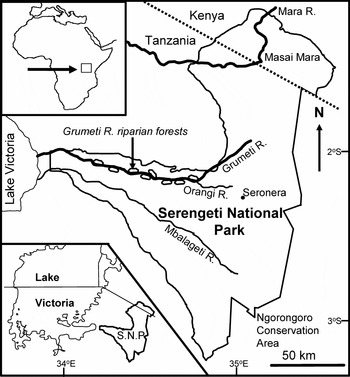
The Serengeti Ecosystem is a mosaic of open grasslands and woodlands covering 25 000 km2 of north-western Tanzania and south-western Kenya (Figure 1). The climate is semi-arid with mean maximum temperatures of 27–28 °C in Seronera. Minimum temperatures vary from 16 °C in the wet season (November–April), to 13 °C in the dry season (May–September). Rainfall occurs bimodally with a short period of rains in November–December and a longer period of rains in February–April. A rainfall gradient follows an altitudinal gradient across the park, with the highest altitude and annual rains in the north of the park (1950 m, 1200 mm y−1), and lowest in the south (1800 m, 500 mm y−1) (Sinclair Reference SINCLAIR, Sinclair and Arcese1995). The most common herbivore in the ecosystem is the wildebeest with a population of approximately 1.3 million (Mduma et al. Reference MDUMA, SINCLAIR and HILBORN1999). Other grazers include zebra (Equus quagga Boddaert) (200 000) and Thomson's gazelles (Gazella thomsoni Günther) (440 000). Browsers and mixed feeders are also common, particularly in riparian forests, including impala (Aepyceros melampus Lichtenstein) (74 000) and smaller numbers of bushbuck (Tragelaphus scriptus Pallas), reedbuck (Redunca redunca Pallas), and dikdik (Rynchotragus (Madoqua) kirkii Günther) (Campbell & Borner Reference CAMPBELL, BORNER, Sinclair and Arcese1995).
Location of riparian forests along the Grumeti River system of Serengeti National Park, Tanzania.

Fires are commonly lit by park rangers and managers at the beginning of each dry season to prevent larger-scale fires lit by poachers later in the dry season that reduce woodland cover. Many riparian areas burn every 2–4 y. However, some areas, such as forests along the Orangi and Grumeti Rivers, often burn every year due to the proximity to roads from which early burns are lit (G. Sharam pers. obs.).
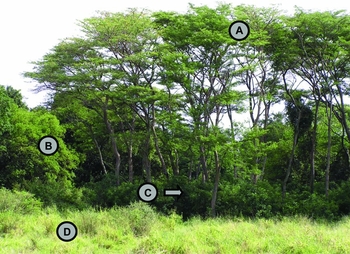
Riparian forests within Serengeti National Park occur on the broad floodplain of the Grumeti River in the west (Figure 1), and on the tributaries of the Mara River in the north of the park. These stands are termed ‘forests’ rather than ‘woodlands’ because they: (1) have a closed canopy, (2) are composed of semi-deciduous species not found in woodlands, and (3) have sparse grass in the understorey. Forest stands typically extend 200–400 m along the river and 100–150 m from the river into the grassland. Riparian forests on the Grumeti River have a dense canopy of Lecaniodiscus fraxinifolius Baker, Elaeodendron buchananii Loes. and Ziziphus pubescens Oliv. The forest edge is a ‘hard’ boundary (Figure 2), with dense shrubs and tree branches of Ziziphus pubescens and Grewia bicolor Juss. Soils are sandy and typical of floodplain levee forest soils (Medley & Hughes Reference MEDLEY, HUGHES, McClanahan and Young1996).
Acacia polyacantha stand on a tributary of the Grumeti River: A = A. polyacantha canopy trees, B = edge of riparian forest, C = understorey of dense shrubs in A. polyacantha stand, D = grassland. The seedlings of forest trees were found in A. polyacantha stands > 0.3 ha where grass and fires were excluded and thorny shrubs excluded browsers.

The Grumeti River flows for 3–4 mo y−1 during the wet season. It is located in a broad floodplain that extends 200–500 m from the river and supports Panicum maximum Jacq. Maximum yearly flow is 200 m3 s−1 (Wolanski & Gereta Reference WOLANSKI and GERETA2001). Yearly flooding is patchy and typically extends 50–100 m into the floodplain. The entire floodplain was flooded during the El Niño year of 1998 but records do not exist prior to this. Extensive floods were likely in other El Niño years with high rainfall (1972, 1989, 1998) (Wolanski & Gereta Reference WOLANSKI and GERETA2001).
Study species
Acacia polyacantha Willd. subsp. campylacantha (Hochst. ex A. Rich.) Brenan, is a semi-deciduous tree, 20–25 m tall, with a long, straight bole having 4–5 cm thorns. The species is widespread in Africa, but at low density, and is generally found near watercourses or in areas with a high water table. Acacia polyacantha stands occur in a variety of sizes in the grasslands adjacent to riparian forests on the Grumeti, ranging from solitary individuals to large stands of 5 ha. Some A. polyacantha stands contain abundant seedlings of forest tree species.
Characterization of Acacia polyacantha stands
Seventy-five A. polyacantha stands ranging from solitary trees to 5 ha were surveyed for stand size, canopy cover, inter-bole distance, shrub cover, herbaceous cover, grass cover and grass height in April 1999. Stand size was estimated by measuring the perimeter of the stand. Canopy cover was estimated using a spherical densiometer. Depending on stand size, inter-bole distances and inter-shrub distances were measured between 25 focal trees or shrubs and their nearest neighbours. In smaller stands having less than 20 canopy trees, the inter-bole distance was measured for all nearest neighbours. The abundance of shrubs was measured using ten 1-m-wide belt transects with observations of shrubs grouped every metre. Herbaceous and grass cover were measured using ten 25-cm-wide belt transects with observations grouped every 25 cm, or as many transects as smaller stands would allow. Grass height was measured every 25 cm along transects. All transects were 30 m long, or until we reached the edge of the stand.
Seedlings of forest tree species in Acacia polyacantha stands
We surveyed the understorey of each A. polyacantha stand for seedlings of riparian forest species by searching three 25 × 25-m quadrats per stand and a 6-m radius around the bole of solitary canopy trees. Seedlings were defined as trees < 50 cm tall rather than by age because small trees did not have yearly growth rings. For each seedling detected, we recorded the species, its height, grass height, distance to the main stem of the nearest shrub, distance to the bole of the nearest A. polyacantha canopy tree, and canopy, shrub, and herb cover in a 1-m2 plot centred on each seedling. We also noted the existence of trails produced by elephant (Loxodonta africana Blumenbach) and Cape buffalo (Syncerus caffer Sparrman) at the site, fallen dead wood, and whether the site had been burned in that year. Seedlings (n = 362) were tagged and monitored for survival every month for 2 y. Experiments using fires, grass competition and shrubs focused on the seedling size class of small trees, since this size class has the lowest survival rate and is most susceptible to the effects of these factors (Sharam Reference SHARAM2005).
Effects of fire
We tested whether fire would penetrate into A. polyacantha stands by lighting experimental burns during the mid-dry season (July) in the adjacent grassland 25 m from the edge of stands that contained tagged seedlings. The distance that fire penetrated into stands (n = 24 stands in 2000, n = 26 stands in 2001) was measured and the fate of tagged seedlings was recorded. Given the unpredictable nature of grassland fires, not all stand sizes were equally represented. Tagged seedlings in burned and control areas were monitored for survival every month for 2 y.
Effects of grass
Burning experiments were conducted to test whether A. polyacantha stands were excluding grasses, and thus fires, in riparian areas. Experimental canopy gaps were constructed in 10 large stands (> 0.5 ha) by removing five 8–10-m-tall trees on the periphery of each stand in April 1999. We determined the time taken for grass to invade the newly created openings from monthly visits. Experimental burns in riparian grassland opposite these gaps measured how far fires progressed into the gaps during the following dry seasons (July 2001 and 2002). Tree seedlings were tagged before canopy trees were removed, and monitored for survival every month for 2 y.
Effects of shrubs
The influence of shrubs on seedling survival was tested by tagging 63 tree seedlings below 20 shrubs in large A. polyacantha stands. Half of the shrubs were removed by cutting at ground level and subsequent seedling survival was monitored every month for 2 y. At the beginning of the experiment and at each sampling session, the cover of shrubs, herbs and grasses was estimated in a 1-m2 quadrat centred on each seedling. Seedlings were inspected for evidence of browsing by ungulates.
Soil moisture measurements
Bulk soil moisture was measured in 10 A. polyacantha stands during the wet season (15 March in 2000 and 2001) and dry season (15 June in 2000 and 2001). Soil was collected at 10 m from the forest boundary inside each stand and at 10 m into the adjacent grassland. Ten soil cores were collected in each of the 20 locations to a depth of 20 cm (5 cm diameter), weighed, air dried for 2 wk, and weighed again.
Acacia polyacantha establishment
Photographs of riparian forests on the Orangi River (a tributary of the Grumeti River) were taken in 1980 by A.R.E. Sinclair. We repeated these photographs in 2001 from the same positions, and visually compared the photos to determine the change in distribution of A. polyacantha stands over the 21 y period. The establishment of both A. polyacantha and forest tree seedlings was also monitored in eight 0.15-ha plots in grasslands adjacent to the Grumeti River. Four plots were burned every year by park rangers and four were protected from fire during 1999 to 2001. Plots were surveyed twice per year (May and December) for 3 y (1999–2001) for establishment of A. polyacantha and forest tree species. Diameter at breast height was recorded for 100 canopy trees in A. polyacantha stands and for 50 A. polyacantha trees in riparian forests to estimate the date of establishment in riparian forests.
Statistical analyses
Analyses were conducted using JMP V5.1, SAS Institute, 2005. Data were first tested for equality of variance and logarithmically transformed when necessary to ensure normality. Canopy cover was compared between plots using single-factor ANOVA. Seedling density was compared to stand size, and grass, herb and shrub cover using linear regression. The density of seedlings was compared between A. polyacantha stands and riparian forests using ANOVA. The distances between seedlings and A. polyacantha trees, and shrubs were compared to a random distribution within stands using t-tests. The random distribution ranged between zero and the mean inter-tree and inter-shrub distance. Because grass, herb, shrub and wildlife trail cover in the 1-m2 plots surrounding seedlings were not normally distributed, we compared values for these plots to the mean values from transect measurements in each A. polyacantha stand using a Kruskal–Wallis test. Survival of seedlings between control plots and plots with canopy trees removed, fires, and shrubs removed were compared using Kaplan–Meier survival curves and log-rank tests (Zar Reference ZAR1974). Differences in soil moisture between seasons and inside/outside of A. polyacantha stands were tested using ANOVA and Tukey HSD tests. The establishment times of A. polyacantha trees in riparian forests were calculated using a simple linear model.
RESULTS
Characterization of Acacia polyacantha stands
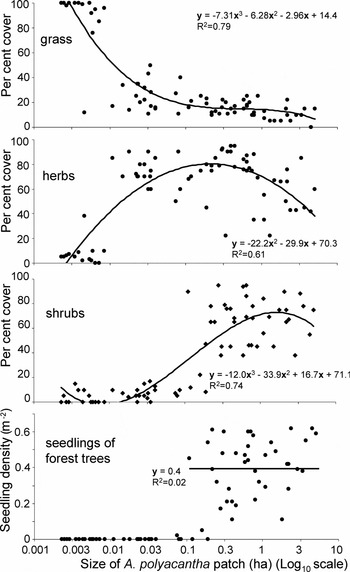
Solitary A. polyacantha trees had an understorey of dense grass, with few herbs or shrubs and no seedlings of forest trees (Figure 3). In stands of 6–10 A. polyacantha trees (0.01–0.1 ha), grass cover declined and herb cover increased. In stands from 0.3–5 ha, herbaceous cover declined and shrubs accounted for > 70% cover of the understorey (Figure 3).
Per cent cover of grass, herbs and shrubs and the density of seedlings of forest trees relative to the size of Acacia polyacantha stands. In stands > 0.01 ha, per cent cover of grass fell, while herbs increased. Shrubs composed the understorey of stands > 0.3 ha and the seedlings of forest trees were found in these stands with shrubs. Curves are best-fit lines. The best-fit line for seedling density used only the values > 0, corresponding to an Acacia polyacantha stand size > 0.1 ha.

Seedlings of forest tree species in Acacia polyacantha stands and grassland plots
Seedlings of the three most common forest tree species were abundant in large stands (> 0.3 ha) of A. polyacantha (Figure 3): Lecaniodiscus fraxinifolius (mean ± SD) = 0.20 ± 0.07 m−2, Elaeodendron buchananii = 0.14 ± 0.05 m−2 and Ziziphus pubescens = 0.07 ± 0.04 m−2. However, seedlings were not found in smaller stands, in grassland plots or at the periphery of larger stands.
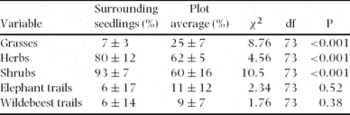
The density of seedlings was related to stand characteristics (ANOVA, F0.05,4,70 = 32.3, P < 0.001), of which the % cover of shrubs (ANOVA, F0.05,1 = 44.6, P < 0.0001) and stand area (ANOVA, F0.05,1 = 2.98, P = 0.038) were better predictors of seedling density than % cover of grasses (ANOVA, F0.05,1 = 0.0.856, P = 0.358) or herbs (ANOVA, F0.05,1 = 0.214, P = 0.645). Within stands, seedlings were found closer to canopy trees (0.89 m, t-test, t0.05,73 = −24.4, P < 0.001) and shrubs (0.45 m, t-test, t0.05,73 = −21.7, P < 0.001) than expected by chance (2.5 m and 1.8 m respectively). Seedlings were found in areas with less grass, more herbs, and more shrub cover than the average for each A. polyacantha stand (Table 1). Seedlings typically occurred away from elephant and wildebeest trails (Table 1).
The per cent cover of grasses, herbs, shrubs, elephant trails and wildebeest trails within Acacia polyacantha patches at locations where seedlings of forest trees were found, the average values of these variables within Acacia polyacantha stands and a Kruskal–Wallis test of the comparisons between these values.

Effects of grass and fire
None of the 16 experimental fires penetrated more than 1 m into intact A. polyacantha stands where grass cover was low. However, fires burned under 19 of 21 solitary canopy trees with almost 100% grass cover. The removal of A. polyacantha trees from the periphery of stands allowed the in-growth of grass over an 8-mo period, with grass cover > 80% in 1.5 y. Grassland fires burned into 70% of these artificial gaps the year after they were created and into 90% the following year. Seedling survival was high in control plots (0.87 y−1), but declined when the canopy was removed and grass established (0.21 y−1) (Chi-square, χ20.05,9 = 7.45, P < 0.001). Seedling survival further declined when the grass in canopy gaps burned during the dry season (0.07 y−1) (Chi-square, χ20.05,9 = 5.40, P = 0.01).
Effects of shrubs
The understorey of thorny shrubs in larger stands of A. polyacantha excluded herbivores. Only 4% of seedlings under shrubs had evidence of browsing, whereas 80% of unprotected seedlings were browsed. The removal of shrubs increased the rate of browsing from 4% to 90%. Seedling survival also declined to 0.46 y−1, compared with seedlings still protected by shrubs (0.87 y−1) (Chi-square, χ20.05,9 = 17.5, P = 0.037).
Soil moisture
During the wet season, soil moisture was high, and similar inside (28% ± 2.8% SE) and outside (27% ± 5.6%) of stands. Soil moisture was lower during the dry season (ANOVA, F0.05,1 = 82.3, P < 0.001) and outside of stands (ANOVA, F0.05,1 = 7.04, P = 0.012). These factors also interacted (ANOVA, F0.05,1 = 4.88, P = 0.034). Soil moisture declined in the grassland (7% ± 5.2%) but did not decline inside stands (19% ± 8.4%).
Acacia polyacantha establishment
Trees in A. polyacantha stands occur in a single size class (dbh (mean ± SD) = 35 ± 5 cm) with no subcanopy or understorey of this species. Seedlings of A. polyacantha were likewise absent from both burned and unburned grassland plots except during 1999 when low numbers of seedlings were found in unburned grassland areas (0.021 ± 0.017 m−2). Large individuals of A. polyacantha were observed in riparian forests (dbh = 84 ± 16 cm), but again no seedlings were observed in the understorey. Using the age and dbh of trees in A. polyacantha stands, the establishment date of larger A. polyacantha trees in riparian forests was calculated as 1918 ± 16 y (ANOVA, F0.05,136 = 8.95, P = 0.042).
DISCUSSION
Establishment of Acacia polyacantha and riparian forests
Seedlings of forest tree species can establish in stands of A. polyacantha because these stands have four interrelated factors: (1) reduced grass density, (2) reduced fire frequency, (3), dense thorny shrubs that exclude browsers and (4) increased soil moisture during the dry season. However, there is a minimum stand size of A. polyacantha where these conditions occur and seedlings of forest trees are found. In addition, A. polyacantha can establish directly into grasslands when both fires are suppressed and dry-season rainfall is higher than normal. In contrast, seedlings of forest tree species cannot by themselves establish in riparian grassland. Therefore, we hypothesize that riparian forests along the Grumeti River in Serengeti establish in a two-step process: Acacia polyacantha first establishes in the grassland and the seedlings of forest tree species then establish in these stands. Our results also suggest that the existing riparian forests in Serengeti are the product of an earlier A. polyacantha establishment event during the period 1890–1930.
Our experimental results show that A. polyacantha can establish in grassland and facilitate the establishment of forest trees. For this process to be considered a successional process, A. polyacantha must be able to establish in grasslands when forest trees cannot. During 3 y of fire suppression, no seedlings of forest species established in the grasslands. In contrast, seedlings of A. polyacantha established during 1999 when there was an elevated dry-season rainfall.
During the late 1970s a wide range of Acacia species, including A. polyacantha, established over much of Serengeti (Sinclair et al. Reference SINCLAIR, MDUMA, HOPCRAFT, FRYXELL, HILBORN and THIRGOOD2007). This pulse of establishment was concurrent with a simultaneous reduction in fire frequency and increased dry-season rainfall (Sinclair et al. Reference SINCLAIR, MDUMA, HOPCRAFT, FRYXELL, HILBORN and THIRGOOD2007). Fire frequency declined because fuel loads were reduced by the heavy grazing from high wildebeest numbers (Packer et al. Reference PACKER, HILLBORN, MOSSER, KISSUI, BORNER, HOPCRAFT, WILMSHURST, MDUMA and SINCLAIR2005). Seedling survival was also promoted by increased dry-season rainfall in the late 1970s. In South Africa, survival of Acacia seedlings relied on a dry-season rainfall event at least once every 30 d (Higgins et al. Reference HIGGINS, BOND and TROLLOPE2000).
Acacia species also underwent a pulse of establishment between 1890 and 1930. In the 1890s the epizootic rinderpest devastated large mammal populations in Serengeti and domestic cattle of the surrounding pastoralist people (Mallet Reference MALLET1923, Sandford Reference SANDFORD1919, Sinclair Reference SINCLAIR, Sinclair and Arcese1979). The subsequent famine reduced the number of pastoralists as people died and emigrated from the area (Ford Reference FORD1971), leading to a reduction in fires. Our results for tree size/age suggest that the existing riparian forests in Serengeti are the result of this 1890–1930 Acacia establishment event. In addition, while some seedlings of A. polyacantha were observed in the grassland, none was found inside A. polyacantha stands or inside riparian forests. This suggests that forest establishment is a uni-directional process by which A. polyacantha establishes into grasslands when conditions allow, followed by establishment of forest tree species, producing a riparian forest.
The role of seed availability for A. polyacantha establishment is not well understood. Acacia polyacantha can grow under a variety of conditions (Nyadzi et al. Reference NYADZI, OTSYINA, BANZI, BAKENGESA, GAMA, MBWAMBO and ASENGA2003), and like other Acacia species, it is likely dispersed by wind and over greater distances by birds and herbivores (Miller Reference MILLER1996). However, during the late 1970s in Serengeti, A. polyacantha established only near riparian areas – which may be a consequence of seed availability or abiotic conditions such as higher soil moisture in riparian areas.
While our observations were limited to riparian areas and A. polyacantha is usually found in riparian areas, it can also grow well in drier areas (Nyadzi et al. Reference NYADZI, OTSYINA, BANZI, BAKENGESA, GAMA, MBWAMBO and ASENGA2003). Moreover, forests also occur on hilltops and ridgelines in Serengeti that are composed of the same tree species found in riparian forests (Sharam et al. Reference SHARAM, SINCLAIR and TURKINGTON2006). Hence, this process may drive, or be capable of driving, forest establishment in a number of savanna environments.
Stand size and forest tree recruitment
Once A. polyacantha trees have established in grasslands, stands of these trees can facilitate the establishment of forest tree species by excluding grasses and fires. This effect is dependent on the stand size. Forest tree seedlings were not found under solitary A. polyacantha trees, smaller stands with greater grass cover, or in the grassland proper, and occurred only in the larger stands with less grass. The per cent cover of grass was also lower in the 1-m diameter area around tree seedlings than the average for each stand. When canopy trees were removed, grasses rapidly invaded canopy gaps, leading to reduced seedling survival. Fires did not burn under large stands of A. polyacantha, but did burn under solitary trees and in experimental canopy gaps with grass. Survival of the seedlings of forest trees after fires was low.
Larger stands also supported a dense understorey of thorny shrubs. These shrubs protected seedlings from browsing by antelope, especially impala, the most common antelope in riparian forests (G. Sharam, pers. obs.). Moreover, when shrubs were removed, the rate of browsing increased on exposed seedlings and their survival declined. Browsers are particularly important in savannas, where impala and other antelope can reach high numbers and prevent regeneration of Acacia trees over large areas, including Serengeti (Belsky Reference BELSKY1984), Manyara NP, Tanzania (Prins & van der Jeugd Reference PRINS and VAN DER JEUGD1993), and Chobe NP, Botswana (Barnes Reference BARNES2001). In Serengeti, browsing by antelope severely reduced growth and survival of forest trees inside riparian forests (Sharam Reference SHARAM2005) and limited survival of seedlings in the grasslands (Sharam et al. Reference SHARAM, SINCLAIR and TURKINGTON2006).
Soil moisture was higher under A. polyacantha stands than in the adjacent grassland and this likely increased the probability of seedling survival. In South Africa, Acacia establishment in grasslands is governed by the duration between dry-season rainfall events (Higgins et al. Reference HIGGINS, BOND and TROLLOPE2000). The seedlings of forest tree species established inside riparian forests only during years with floods in both Serengeti (Sharam et al. Reference SHARAM, SINCLAIR and TURKINGTON2006) and on the Tana River delta in Kenya (Hughes Reference HUGHES1990). This suggests that the abiotic conditions under A. polyacantha stands are also important to the survival of forest tree seedlings. However, whether higher soil moisture inside stands is caused by shading, funnelling rainfall or hydraulic lift by canopy trees (Ludwig et al. Reference LUDWIG, DAWSON, KROON, BERENDSE and PRINS2003) cannot be determined from our experiments.
The establishment of forest trees depends on the size of A. polyacantha stands. Small stands and individual canopy trees are not able to exclude grasses or support a dense understorey of shrubs. Seed transport for forest species is likely accomplished by birds – seeds are small (< 8 mm) and brightly coloured. Hence, seed rain may also be related to higher bird density in larger A. polyacantha stands. However, other studies have reported that seed rain of forest species is high under individual trees in the grassland, but that subsequent establishment there is poor in Uganda (Chapman & Chapman Reference CHAPMAN and CHAPMAN1999) and South America (Kellman & Miyanishi Reference KELLMAN and MIYANISHI1982), which suggests that seed rain is not the limiting factor for these trees. In this study, the smallest A. polyacantha stands which supported seedling establishment was approximately 0.3 ha.
Although elephants have been implicated in preventing Acacia woodland regeneration, we have no evidence of elephants feeding or damaging forest tree seedlings in A. polyacantha stands. Elephants appeared to avoid contact with A. polyacantha trees, although they rubbed against other tree species nearby, damaging bark and covering tree trunks with mud. Acacia polyacantha trees are probably protected from elephants by the large, broad-based spines on their trunks. Consequently, the impact of elephant trampling was much reduced within larger stands.
Implications
The establishment of forest stands via facilitation by A. polyacantha has two wide-reaching implications. First, our results may shed light on the long-term history of riparian forests in East Africa. It has been proposed that riparian forests are the remnants of Central African forests that have survived 8000 y since forest cover was reduced by changing climate and the immigration of agriculturalists (Jolly et al. Reference JOLLY, TAYLOR, MARCHANT, HAMILTON, BONNEFEILLE, BOUCHET and RIOLLET1997, Livingstone Reference LIVINGSTONE and Prance1982). Instead, our results indicate that establishment of forest stands can occur rapidly, but may be controlled by conditions which allow A. polyacantha to establish. Thus, riparian forests may be ephemeral with mass-establishment events and subsequent decline due to grassland fires (Norton-Griffiths Reference NORTON-GRIFFITHS, Sinclair and Norton-Griffiths1979). This dynamic ecology may also have serious implications for protected areas as seed sources, because riparian forests are rare outside parks where these trees are harvested for timber.
Second, efforts to restore forests must consider the effects of fire and browsers, for which A. polyacantha may be used as a management tool. This species is already used in Africa as a green-forage and for intercropping because it fixes nitrogen and is tolerant to a variety of soil and climate conditions (Harmand et al. Reference HARMAND, NJITI, BERNHARD-REVERSAT and PUIG2004, Nyadzi et al. Reference NYADZI, OTSYINA, BANZI, BAKENGESA, GAMA, MBWAMBO and ASENGA2003). Managers should ensure that stand size is sufficient to provide the appropriate conditions for the establishment of the seedlings of forest trees – an understorey with reduced grass and fire, increased soil moisture, and increased thorny shrubs that exclude browsers.
ACKNOWLEDGEMENTS
The authors wish to thank Dr Simon Mduma and Steven Makatcha for advice and assistance in the field, Tanzania Wildlife Research Institute, Tanzania National Parks, Justin Hando, former Chief Park Warden, Serengeti National Park, for support in conducting this research, as well as two anonymous reviewers. This research was funded by an NSERC operating grant to AS and with the assistance of Frankfurt Zoological Society.