Introduction
Amyotrophic lateral sclerosis (ALS) is a progressive and fatal neurodegenerative disease. Patients with ALS experience symptoms that include muscle weakness, atrophy, and spasticity, as well as bulbar symptoms such as dysphagia or dysarthria. The later stages of ALS are characterized by severely limited mobility and respiratory failure, one of the primary causes of death (Clarke & Levine, Reference Clarke and Levine2011). ALS is also associated with nonmotor symptoms, including pain, behavioral and cognitive deficiencies, and psychological problems, such as depression and anxiety (Fang et al., Reference Fang, Jozsa and Al-Chalabi2017). Moreover, patients may pose the risk of economic burden (Oh et al., Reference Oh, An and Oh2015b) and family problems linked to their disease experiences (Oh et al., Reference Oh, An and Oh2015a). In addition to these difficulties, patients afflicted with ALS experience a rapid decline in functioning (King et al., Reference King, Duke and O'Connor2009), during the unrelenting progression of the disease, which negatively affects their lives. Because there is no cure for this disease, caring for patients with ALS typically involves some effort to maximize the quality of life (QOL) (Pagnini & Simmons, Reference Pagnini and Simmons2018).
There is no agreed-on definition of QOL in ALS (Burns et al., Reference Burns, Graham and Rose2012). The World Health Organization defines QOL as ‘‘…a broad-ranging concept affected in a complex way by the person's physical health, psychological state, level of independence, social relationships, personal beliefs and their relationship to salient features of their environment’’ (WHOQOL Group, 1994). Because QOL is a subjective concept reflecting perceived wellbeing in various areas of life, it is influenced not only by health conditions but also cultural perspectives, value, and environmental supports (Simmons et al., Reference Simmons, Felgoise and Bremer2006). There has been some debate on the relationship between QOL and progression of the disease in ALS patients (Shamshiri et al., Reference Shamshiri, Fatehi and Abolfazli2016). Studies in Western countries have provided increasing evidence that the QOL of patients with ALS does not change over time, despite a decrease in functional status (Simmons, Reference Simmons2015); the worse the functional status is, the lower the QOL in non-Western countries’ studies (Geng et al., Reference Geng, Ou and Miao2017; Oh et al., Reference Oh, Oh and Kim2018; Shamshiri et al., Reference Shamshiri, Fatehi and Abolfazli2016). The latter results could be explained by the problems associated with ALS, such as dependence on others and the negative effects on patients as the disease progresses, which restricts their normal daily activities. To preserve the optimal QOL for patients suffering from this devastating disease, it is important to provide supportive care that meets the complex and distinct needs of each patient (Oh & Kim, Reference Oh and Kim2017).
ALS requires a different approach toward each patient, because of the variation in the lived individual experiences as well as the homogeneity of the clinical features, such as personal symptoms and disease stages. Furthermore, in addressing the patients’ needs, consideration must be given not only to the healthcare professionals’ perspectives, but also to each patient's perspective (Ang et al., Reference Ang, Umapathi and Tong2015). Although there has been growing recognition of supportive care needs in ALS, the subject has been analyzed mostly in a qualitative way (Oh & Kim, Reference Oh and Kim2017). Recently, an instrument that assesses the supportive care needs of patients with ALS has been developed (Oh et al., Reference Oh, Oh and Kim2018) based on the supportive care needs framework in ALS patients, which comprises seven subdomains: physical, psychological, emotional, social, spiritual, informational, and practical needs (Oh & Kim, Reference Oh and Kim2017). Supportive care is most extensively studied in cancer, and many of those studies have shown that unmet patients’ care needs are associated with a higher symptom burden and lower QOL (Cheng et al., Reference Cheng, Wong and Koh2016; So et al., Reference So, Choi and Chen2014). However, there is little quantitative study regarding unmet supportive care needs, especially their buffering effects between functional status and QOL, in the ALS population. Therefore, the aims of this study were to identify ALS patients’ unmet care needs and to examine the mediating effect of the unmet supportive care needs in the relationship between functional status and QOL among South Korean patients with ALS.
Methods
Design
This study was a cross-sectional survey study.
Sample and data collection
A total of 190 ALS patients were recruited by convenience sampling from a tertiary hospital (Hanyang University Hospital) in Seoul, South Korea, between September 2017 and June 2018. The study sample size was calculated by G*Power 3.1.9.2 using the following parameters for the F-test in linear multiple regression: an effect size of 0.1, a significance level of 0.05, study power of 95%, two variables for predictive factors, and a 20% dropout rate. All participants were older than 20 years and were diagnosed with definite, probable, probable laboratory-supported, or possible ALS, according to the El Escorial revised criteria (Brooks et al., Reference Brooks, Miller and Swash2000). Participants were excluded if they had been diagnosed with frontotemporal dementia, severe depression, or schizophrenia.
Those who were willing to participate in the study were given a detailed explanation before signing an informed consent form; they were then asked to complete the self-reported Amyotrophic Lateral Sclerosis Supportive Care Needs Instrument (ALSSCN) (Oh et al., Reference Oh, Oh and Kim2018) and the Amyotrophic Lateral Sclerosis Specific Quality of Life – Revised Instrument (ALSSQOL-R) (Oh et al., Reference Oh, Hong and Kim2017). The patients’ responses were filled in by the researcher if they could not mark the questionnaire items because of upper extremity weakness. Also, the following data were collected from a medical chart review: demographics (age, gender, religious beliefs, education level), clinical features (site of symptom onset), and Amyotrophic Lateral Sclerosis Functional Rating Scale-Revised (ALSFRS-R) (Cedarbaum et al., Reference Cedarbaum, Stambler and Malta1999).
Measurements
Functional status was measured using the ALSFRS-R, the most widely used surrogate markers of disease progression of ALS in clinical research, developed by Cedarbaum et al. (Reference Cedarbaum, Stambler and Malta1999). The ALSFRS-R contains 12 items with three domains of bulbar (items 1–3), motor (items 4–9), and respiratory function (items 10–12) (Franchignoni et al., Reference Franchignoni, Mora and Giordano2013). Each item is rated on a 5-point Likert scale (0–4), and the total score is the sum of the scores of 12 items; the higher scores indicate better functional status. In this study, the score evaluated by professionals (neurologists or coordinating nurses) was used from the medical chart review. The Cronbach's alpha was 0.89 in this study.
Unmet supportive care needs were measured using the ALSSCN developed by Oh et al. (Reference Oh, Oh and Kim2018). The ALSSCN is a 37-item self-reported questionnaire comprising seven subscales that assess physical, psychological, emotional, spiritual, social, informational, and practical unmet needs based on a supportive care needs framework (Oh & Kim, Reference Oh and Kim2017). Each item is rated on a 4-point Likert scale (1–4), and the total score (or the subtotal scores) is the average of the scores of all 37 items (or the number of each subdomain's items); higher scores indicate higher unmet supportive care needs. The Cronbach's alpha was 0.94 in this study.
QOL was measured by the ALSSQOL-R developed by Simmons et al. (Reference Simmons, Felgoise and Bremer2006). ALSSQOL-R is a 46-item self-reported questionnaire that assesses six subscales (physical symptoms, bulbar function, negative emotion, interaction with people and the environment, intimacy, and religiosity). Each item is assessed on an 11-point numeric scale (0–10), and several items required transposing (items 1–10, 17, 22, 24, 25, 28, 31, and 34). The total score is an average of 46 items, and the total score varies from 0 (worst) to 10 (best). In this study, a Korean version of ALSSQOL-R, validated by Oh et al. (Reference Oh, Hong and Kim2017) was used. The Cronbach's alpha was 0.91 in this study.
Ethical consideration
This study was conducted with the approval of the Institutional Review Board of the hospital (HYUH 2016-04-045). All patients were informed about the study's objective and gave their informed consent.
Data analysis
SPSS 21.0 was used to analyze the data, and a two-sided p value < 0.05 was considered statistically significant. All variables of the participants were expressed by descriptive or frequency analysis. Pearson's correlation coefficients were calculated to examine the relationship between functional status, unmet supportive care needs, and QOL.
The mediating effects of unmet supportive care needs on functional status and QOL were analyzed using Baron and Kenny's steps for mediation (Baron & Kenny, Reference Baron and Kenny1986). The first step involved regressing the mediator (unmet supportive care needs) on the independent variable (functional status); in the second step, the dependent variable (QOL) was regressed on the independent variable (functional status); and in the third step, we regressed the dependent variable (QOL) on both the independent variable (functional status) and the mediator (unmet supportive care needs). To establish mediation, the following three conditions must be met: first, the independent variable must affect the mediator; second, the independent variable must affect the dependent variable; and third, the mediator must affect the dependent variable. If these conditions all hold in the predicted direction, then the effect of the independent variable on the dependent variable must be less in the third equation than in the second. Perfect mediation holds if the independent variable has no effect when the mediator is controlled (Baron & Kenny, Reference Baron and Kenny1986). Finally, a Sobel test (Sobel, Reference Sobel1982) was performed to examine whether a mediator variable significantly carries the influence of an independent variable on a dependent variable.
Results
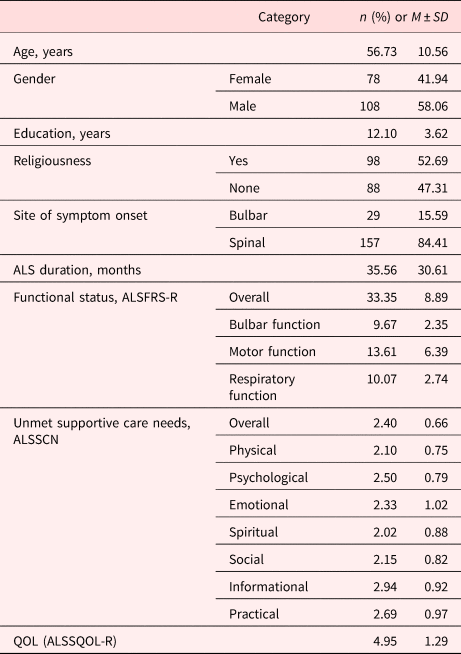
A total of 186 participants were analyzed, excluding four with unreliable data. The mean age of the participants was 56.73 ± 10.56 years; 58.06% of the participants were males. The mean number of years of education was 12.10 ± 3.62, and 52.69% of participants had religious beliefs. The symptom onset site was bulbar in 15.59% of participants. The overall mean scores of functional status, unmet supportive care needs, and QOL were 33.35 ± 8.89 of 48, 2.40 ± 0.66 of 4, and 4.95 ± 1.29 of 10, respectively. The highest scored subdomain of unmet supportive care needs was informational needs (2.94 ± 0.92), followed by practical needs (2.69 ± 0.97), psychological needs (2.50 ± 0.79), emotional needs (2.33 ± 1.02), social needs (2.15 ± 0.82), physical needs (2.10 ± 0.75), and spiritual needs (2.02 ± 0.88) (Table 1).
Descriptive analysis of demographics and study variables

ALSFRS-R, Amyotrophic Lateral Sclerosis Functional Rating Scale-Revised; ALSSCN, Amyotrophic Lateral Sclerosis Supportive Care Needs Instrument; ALSSQOL-R, Amyotrophic Lateral Sclerosis Specific Quality of Life – Revised Instrument.
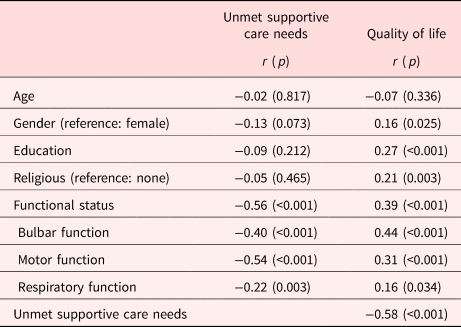
Table 2 shows the correlations between demographics, functional status, unmet supportive care needs, and QOL. Patients who is male or has religious belief had higher QOL, and education lever positively correlated with QOL. Overall functional status was significantly negatively correlated with unmet supportive care needs (r = –0.56, p < 0.001), and positively correlated with QOL (r = 0.39, p < 0.001); and unmet supportive care needs was significantly negatively correlated with QOL (r = –0.58, p < 0.001).
Correlations between functional status, unmet supportive care needs, and quality of life

Regression analysis conducted to verify the mediation effect of the unmet supportive care needs on the relationship between functional status and QOL is described in Table 3. In the first step, the results of the regression analysis indicate that the effect of functional status on unmet supportive care needs was significant (β = –0.56, p < 0.001), supporting functional status as a reasonable explanation for the 31% of variance in unmet supportive care needs. Also, in the second step, functional status significantly affects QOL (β = 0.39, p < 0.001), supporting functional status as a reasonable explanation for the 31% of variance in QOL. In the last step, both functional status, as an independent variable, and unmet supportive care needs, as the mediator, entered the regression model, with QOL as a dependent variable. The results indicated that only unmet supportive care needs were significant predictive variables of QOL (β = –0.53, p < 0.001). In this model, the standardized regression coefficient of functional status from 0.09, and was not significant with respect to QOL (β = 0.09, p = 0.205), indicating that the complete mediating effect of unmet supportive care needs was able to explain 33% of QOL (Table 3, Figure 1). Finally, a Sobel test found that the mediating effects of unmet supportive care needs on the relationship between functional status and QOL was significant (Z = 5.48, p < 0.001).
Analysis of Unmet Supportive Care Needs as a Mediator of the Relation between Functional Status and Quality of Life. **p < .01.

The mediation effect of unmet supportive care needs on the relationship between functional status and quality of life

Discussion
To the best of our knowledge, this is the first study to analyze the relationship between unmet supportive care needs, functional status, and QOL in the ALS population. First, we found that functional status was positively correlated with QOL. Because there has been no biomarker for tracking diseases severity in ALS, functional status is usually used as a primary outcome in clinical trials because it is a feature of disease progression (Paganoni et al., Reference Paganoni, Cudkowicz and Berry2014). Although a number of studies have examined the relationship between the progress of this disease and QOL, such studies have produced inconsistent results concerning such relationship (Shamshiri et al., Reference Shamshiri, Fatehi and Abolfazli2016). Many recent studies have indicated that QOL in patients with ALS appears to be maintained over time as physical function declines and is not equivalent to their disease progression (Felgoise et al., Reference Felgoise, Feinberg and Stephens2018), which can be explained by the results of recalibrating their expectations, the so-called “response shift” (Simmons, Reference Simmons2015). However, other studies show that QOL worsens as the disease progresses. One study conducted among patients from South Korea (Oh et al., Reference Oh, Hong and Kim2017) and other non-Western countries (Geng et al., Reference Geng, Ou and Miao2017; Shamshiri et al., Reference Shamshiri, Fatehi and Abolfazli2016) found a correlation with a medium effect size between functional status and QOL, which is in line with this study.
Second, functional status was associated with unmet supportive care needs. As functional status deteriorated, more complex and more intensive care needs were required in this population. Although this result is intuitive, to the best of our knowledge, the present study is the first to document and quantify this relationship. This is probably because the worse the patient's functional impairment, the more likely he or she will be to face complex difficulties. These include not only the deterioration of motor function, but also associated psychosocial problems such as social isolation, depression, economic difficulties (Oh et al., Reference Oh, An and Oh2015b), and non-motor symptoms (fatigue, pain, and sialorrhea and sleep disturbance) (Fang et al., Reference Fang, Jozsa and Al-Chalabi2017). Also, these results are consistent with previous studies that explored the relationship among patients with cancer and other neurological diseases (Saleem et al., Reference Saleem, Higginson and Chaudhuri2013; Sandgren et al., Reference Sandgren, Fridlund and Nyberg2010). Supportive care needs have been extensively studied in cancer care. Cancer patients generally experience a relatively long period of high functioning, followed by a short period of rapid decline toward death, but with ALS, there is a prolonged period of frailty and disability (Ang et al., Reference Ang, Umapathi and Tong2015). Also, to date, no cure has been found for ALS, whereas generally cancer can be treated in several ways, including surgery and chemotherapy. The rareness of ALS (approximately 1.75 per 100,000 people) (Marin et al., Reference Marin, Boumediene and Logroscino2017) is likely to make patients face greater challenges and experience multiple unmet needs as the disease progresses (von der Lippe et al., Reference von der Lippe, Diesen and Feragen2017). Such findings emphasize the need for further research investigating unmet supportive care needs and the intrinsic and external factors affecting ALS patients.
Third, unmet supportive care needs were negatively correlated with QOL. Moreover, it supports the total mediation role of affect in explaining the relationship between functional status and QOL, which is in line with findings in many studies among cancer patients (Cheng et al., Reference Cheng, Wong and Koh2016; So et al., Reference So, Choi and Chen2014). In other words, this implies that the QOL of patients with ALS, whose physical function is declining, can be maintained when their supportive care needs are satisfied. This finding is important because physical deterioration in ALS is not reversible, and therefore, enhancing the QOL of patients is essential in caring for patients with ALS. In addition, our findings indicate that Korean ALS patients have substantial supportive care needs that may be insufficient. Although Korea is a high-income country with a relatively well-established health care system, this system does not fully meet the patients’ needs (Molassiotis et al., Reference Molassiotis, Yates and Li2017). Recent cross-country studies have revealed that Korean cancer patients have higher unmet needs than patients from Japan, Australia, and India (Molassiotis et al., Reference Molassiotis, Yates and Li2017). Moreover, the care services for patients with rare diseases are even more inadequate and are focused mostly on reducing patient's medical care costs. Accordingly, such services do not play a role in the overall social safety net established for the patients (Chong & Heo, Reference Chong and Heo2015). In other words, the policy does not reflect the specificity of the disease, and so the resulting burden of caring for patients is borne by family members. As a first step, identifying and addressing such needs is likely to prevent patients’ deterioration of QOL in a thorough multidisciplinary approach. Also, care in ALS is most effective when coordinated among a specialized multidisciplinary team, the community-based sector (including primary care), and palliative care teams (Hogden et al., Reference Hogden, Foley and Henderson2017). Our study clearly emphasizes the importance of incorporating supportive care services into community care as well as routine ALS care in hospitals to satisfy patients’ complex practical care needs, including the presence of informal caregivers and transportation. In particular, our findings show that among the highest unmet needs are informational needs, which suggests the importance of offering more information about ALS and ALS related self-care.
This study has the following limitations for generalization. First, the cross-sectional design does not allow a definitive conclusion for causation to be drawn. Second, all of the patients were recruited from a single tertiary referral center, which may lead to selective bias. A further multicenter longitudinal study with a larger sample may help to verify our study. Nevertheless, this study first examines unmet supportive care needs and their relationship with functional status and QOL in ALS patients. Also, because we use disease-specific, validated, and psychometrically sound measurements, validity could be higher. However, this mediating effect should be supported not only by further research with repeated longitudinal design studies, but also studies from other countries because Korea has a different health care social welfare system. Also, other variables that can affect QOL (e.g., mood status, social supports) should be included in further studies.
Although QOL is negatively affected by functional status in our sample, the relationship was fully mediated via unmet supportive care needs. Because there is no cure for ALS, and the illness progresses rapidly with a lethal outcome, providing care and meeting the patients’ needs are critical aspects of caring for them. Through early assessment of supportive care needs, providing services, and referring patients to appropriate resources could enhance their QOL. Relatively high scores of unmet supportive care needs in our study also indicate that gaps may exist between patients’ expectations and their actual experience of services. To meet the patients’ complex needs, it is necessary to develop educational programs for patients, adopt a multidisciplinary approach in a hospital setting, and improve the delivery system of community services.
Author ORCIDs
Juyeon Oh, 0000-0002-6800-1320
Acknowledgments
The authors gratefully acknowledge the patients who agreed to take part in this study.
Conflict of Interest
This research was supported by research funds from Seoul Women's College of Nursing 2018 (SNJC2018-020). None of the authors has any conflict of interest to disclose.