Child abuse is a powerful risk factor for child and adolescent psychopathology (Greger, Myhre, Lydersen, & Jozefiak, Reference Greger, Myhre, Lydersen and Jozefiak2015; McLaughlin, Reference McLaughlin2016; McLaughlin et al., Reference McLaughlin, Green, Gruber, Sampson, Zaslavsky and Kessler2012; McLaughlin & Lambert, Reference McLaughlin and Lambert2017; Mills et al., Reference Mills, Scott, Alati, O'Callaghan, Najman and Strathearn2013). Child abuse is associated with elevated risk for multiple forms of internalizing problems including anxiety, depression, and posttraumatic stress disorder (PTSD) (Green et al., Reference Green, McLaughlin, Berglund, Gruber, Sampson, Zaslavsky and Kessler2010; Jaffee, Reference Jaffee2017; McLaughlin et al., Reference McLaughlin, Green, Gruber, Sampson, Zaslavsky and Kessler2012, Reference McLaughlin, Koenen, Hill, Petukhova, Sampson, Zaslavsky and Kessler2013). Difficulties with emotion regulation are one mechanism that may underlie the association of child abuse with internalizing psychopathology (Alink, Cicchetti, Kim, & Rogosch, Reference Alink, Cicchetti, Kim and Rogosch2009; Heleniak, Jenness, Vander Stoep, McCauley, & McLaughlin, Reference Heleniak, Jenness, Vander Stoep, McCauley and McLaughlin2016; Kim & Cicchetti, Reference Kim and Cicchetti2010; McLaughlin & Lambert, Reference McLaughlin and Lambert2017; McLaughlin, Colich, Rodman, & Weissman, Reference McLaughlin, Colich, Rodman and Weissman2020; Weissman et al., Reference Weissman, Bitran, Miller, Schaefer, Sheridan and McLaughlin2019). In this study, we investigate the role of automatic emotion regulation processes as a mechanism in linking child abuse with internalizing problems.
Emotion regulation has been conceptualized as the “goal-directed processes functioning to influence the intensity, duration and type of emotion experienced” (Gyurak, Gross, & Etkin, Reference Gyurak, Gross and Etkin2011). These processes can be controlled and conscious or automatic and unconscious (Gross & Thompson, Reference Gross, Thompson and Gross2007; Gyurak et al., Reference Gyurak, Gross and Etkin2011), and include a wide range of cognitive, social, behavioral, and attentional mechanisms that modulate emotional responses in the service of conscious and unconscious goals (Beauchaine, Reference Beauchaine2015; Cole & Hall, Reference Cole, Hall, Beauchaine and Hinshaw2008; Gross & John, Reference Gross and John2003). Difficulties with emotion regulation occur when emotions interfere with one's goals, either because of failure to implement an adaptive regulation strategy (e.g., inability to disengage from thoughts about the causes and consequences of negative emotions) or through use of an ineffective emotion regulation strategy (e.g., expressive suppression or rumination) (Beauchaine, Reference Beauchaine2015; Cole & Hall, Reference Cole, Hall, Beauchaine and Hinshaw2008; Gross & John, Reference Gross and John2003; Sheppes, Suri, & Gross, Reference Sheppes, Suri and Gross2015).
Difficulties with emotion regulation and use of specific maladaptive emotion regulation strategies have been associated with internalizing psychopathology both concurrently (Bender, Reinholdt-Dunne, Esbjørn, & Pons, Reference Bender, Reinholdt-Dunne, Esbjørn and Pons2012; Klemanski, Curtiss, McLaughlin, & Nolen-Hoeksema, Reference Klemanski, Curtiss, McLaughlin and Nolen-Hoeksema2017; Kuyken, Watkins, Holden, & Cook, Reference Kuyken, Watkins, Holden and Cook2006; Papadakis, Prince, Jones, & Strauman, Reference Papadakis, Prince, Jones and Strauman2006; Tull, Barrett, McMillan, & Roemer, Reference Tull, Barrett, McMillan and Roemer2007) and prospectively (Abela, Brozina, & Haigh, Reference Abela, Brozina and Haigh2002; Broderick & Korteland, Reference Broderick and Korteland2004; Heleniak et al., Reference Heleniak, Jenness, Vander Stoep, McCauley and McLaughlin2016; Kim & Cicchetti, Reference Kim and Cicchetti2010; McLaughlin, Hatzenbuehler, Mennin, & Nolen-Hoeksema, Reference McLaughlin, Hatzenbuehler, Mennin and Nolen-Hoeksema2011; Michl, McLaughlin, Shepherd, & Nolen-Hoeksema, Reference Michl, McLaughlin, Shepherd and Nolen-Hoeksema2013). Meta-analysis documents that difficulties with emotion regulation are a transdiagnostic factor associated with multiple forms of internalizing and externalizing psychopathology (Aldao, Nolen-Hoeksema, & Schweizer, Reference Aldao, Nolen-Hoeksema and Schweizer2010), and prospective studies demonstrate that emotion regulation difficulties (e.g., rumination, poor emotional understanding, maladaptive expression of sadness and anger) predict subsequent increases in internalizing symptoms in adolescents (McLaughlin et al., Reference McLaughlin, Hatzenbuehler, Mennin and Nolen-Hoeksema2011). Maladaptive emotion regulation strategies also appear to explain the co-occurrence of different forms of psychopathology. For example, engagement in rumination mediates the concurrent and prospective associations between anxiety and depression in adolescents and adults (McLaughlin & Nolen-Hoeksema, Reference McLaughlin and Nolen-Hoeksema2011) and between internalizing and externalizing psychopathology in adolescents (McLaughlin, Aldao, Wisco, & Hilt, Reference McLaughlin, Aldao, Wisco and Hilt2014). This previous research demonstrates that emotion regulation difficulties have well-established links with internalizing psychopathology.
Exposure to child abuse may influence the development of emotion regulation during childhood and adolescence in numerous ways. Children who are exposed to abuse may have limited opportunities to learn adaptive emotion regulation strategies, as their parents are less likely to provide them with emotional support or scaffolding in response to distress (Kim & Cicchetti, Reference Kim and Cicchetti2010; Morris, Silk, Steinberg, Myers, & Robinson, Reference Morris, Silk, Steinberg, Myers and Robinson2007). Youth exposed to abuse are more likely to have their emotional displays dismissed, minimized, or punished by adults (Eisenberg, Fabes, & Murphy, Reference Eisenberg, Fabes and Murphy1996). As a result, they may suppress or inhibit emotional expression and instead employ maladaptive patterns of emotion regulation strategies, such as rumination, suppression, or avoidance (Conway, Mendelson, Giannopoulos, Csank, & Holm, Reference Conway, Mendelson, Giannopoulos, Csank and Holm2004; Krause, Mendelson, & Lynch, Reference Krause, Mendelson and Lynch2003; Sarin & Nolen-Hoeksema, Reference Sarin and Nolen-Hoeksema2010). Moreover, parents from an abusive family are more likely to use maladaptive coping strategies, thereby modeling ineffective emotion regulation (Morris et al., Reference Morris, Silk, Steinberg, Myers and Robinson2007). Children often learn to regulate their emotions by observing how their parents express emotions and react to emotional experiences (Denham, Mitchell-Copeland, Strandberg, Auerbach, & Blair, Reference Denham, Mitchell-Copeland, Strandberg, Auerbach and Blair1997; Eisenberg, Cumberland, & Spinrad, Reference Eisenberg, Cumberland and Spinrad1998). For example, children of mothers with depression tend to engage in passive and ruminative styles of emotion regulation similar to their mothers (Garber, Braafladt, & Zeman, Reference Garber, Braafladt, Zeman, Garber and Dodge1991; Silk, Shaw, Skuban, Oland, & Kovacs, Reference Silk, Shaw, Skuban, Oland and Kovacs2006). Maltreated youth may reference how their parents regulate their emotions and adopt maladaptive strategies.
A large body of research provides evidence for the association between exposure to child abuse and multiple forms of emotion regulation difficulties (Gruhn & Compas, Reference Gruhn and Compas2020; Kim & Cicchetti, Reference Kim and Cicchetti2010; Maughan & Cicchetti, Reference Maughan and Cicchetti2002). Youth exposed to abuse are more likely to use maladaptive emotion regulation strategies, such as rumination, expressive suppression, and avoidance as indicated by self and parent reports and behavioral observations (Conway et al., Reference Conway, Mendelson, Giannopoulos, Csank and Holm2004; Heleniak et al., Reference Heleniak, Jenness, Vander Stoep, McCauley and McLaughlin2016; Shenk, Putnam, & Noll, Reference Shenk, Putnam and Noll2012; Weissman et al., Reference Weissman, Bitran, Miller, Schaefer, Sheridan and McLaughlin2019). Exposure to child abuse is also associated with poor emotional awareness (i.e., difficulty identifying and labeling one's emotions), which underlies emotion regulation difficulties (Barrett, Gross, Christensen, & Benvenuto, Reference Barrett, Gross, Christensen and Benvenuto2001; Kalokerinos, Erbas, Ceulemans, & Kuppens, Reference Kalokerinos, Erbas, Ceulemans and Kuppens2019). A recent study documented that childhood exposure to violence was associated with low emotional awareness, and that low emotional awareness mediated the longitudinal association between exposure to violence and increases over time in transdiagnostic psychopathology symptoms (Weissman et al., Reference Weissman, Nook, Dews, Miller, Lambert, Sasse and McLaughlin2020). Other studies have also documented associations of child abuse with difficulties using adaptive emotion regulation strategies (e.g., cognitive reappraisal) as well as less frequent use of these adaptive strategies as compared to nonmaltreated youth (Burns, Jackson, & Harding, Reference Burns, Jackson and Harding2010; Jenness et al., Reference Jenness, Peverill, Miller, Heleniak, Robertson, Sambrook and McLaughlin2020; McLaughlin, Peverill, Gold, Alves, & Sheridan, Reference McLaughlin, Peverill, Gold, Alves and Sheridan2015; Rodman, Jenness, Weissman, Pine, & McLaughlin, Reference Rodman, Jenness, Weissman, Pine and McLaughlin2019; Shipman et al., Reference Shipman, Schneider, Fitzgerald, Sims, Swisher and Edwards2007). In one study, adolescents who had been abused recruited the prefrontal cortex (PFC) to a greater degree when asked to engage in cognitive reappraisal than nonexposed youth, suggesting that they may require greater cognitive resources to effectively modulate negative emotions (McLaughlin et al., Reference McLaughlin, Peverill, Gold, Alves and Sheridan2015). Thus, substantial evidence suggests that difficulties with emotion regulation are a transdiagnostic mechanism linking childhood abuse with multiple types of internalizing and externalizing psychopathology (Abravanel & Sinha, Reference Abravanel and Sinha2015; Alink et al., Reference Alink, Cicchetti, Kim and Rogosch2009; Heleniak et al., Reference Heleniak, Jenness, Vander Stoep, McCauley and McLaughlin2016; Hopfinger, Berking, Bockting, & Ebert, Reference Hopfinger, Berking, Bockting and Ebert2016; Kim & Cicchetti, Reference Kim and Cicchetti2010; Lilly, London, & Bridgett, Reference Lilly, London and Bridgett2014; Poole, Dobson, & Pusch, Reference Poole, Dobson and Pusch2017), and with the general psychopathology factor (or p factor) (Jennissen, Holl, Mai, Wolff, & Barnow, Reference Jennissen, Holl, Mai, Wolff and Barnow2016; Weissman et al., Reference Weissman, Bitran, Miller, Schaefer, Sheridan and McLaughlin2019).
Prior research on difficulties with emotion regulation in youth exposed to abuse has predominantly focused on explicit emotion regulation strategies, that reflect effortful and deliberate regulatory processes (Gyurak et al., Reference Gyurak, Gross and Etkin2011), such as cognitive reappraisal (McLaughlin et al., Reference McLaughlin, Peverill, Gold, Alves and Sheridan2015; Weissman et al., Reference Weissman, Bitran, Miller, Schaefer, Sheridan and McLaughlin2019), expressive suppression (Balan, Dobrean, Roman, & Balazsi, Reference Balan, Dobrean, Roman and Balazsi2017; McLaughlin et al., Reference McLaughlin, Hatzenbuehler, Mennin and Nolen-Hoeksema2011), avoidance (Reddy, Pickett, & Orcutt, Reference Reddy, Pickett and Orcutt2006; Rosenthal, Hall, Palm, Batten, & Follette, Reference Rosenthal, Hall, Palm, Batten and Follette2005), and acceptance (Hopfinger et al., Reference Hopfinger, Berking, Bockting and Ebert2016). However, there is growing evidence that implicit or automatic emotion regulation processes that are invoked spontaneously and without conscious awareness play a vital role in regulating emotions, parallel to and apart from the processes that operate at a conscious level (Bargh & Williams, Reference Bargh, Williams and Gross2007; Gyurak et al., Reference Gyurak, Gross and Etkin2011). Automatic emotion regulation effectively modulates emotional responses. One study reported that nonconscious prompting of emotion regulation techniques (i.e., emotion control and emotion expression) led to reduction in negative emotions (i.e., anger) (Mauss, Cook, & Gross, Reference Mauss, Cook and Gross2007). Another study demonstrated similar results, whereby unconscious reappraisal priming reduced physiological reactivity to emotionally evocative events, as effectively as conscious emotion regulatory processes (Williams, Bargh, Nocera, & Gray, Reference Williams, Bargh, Nocera and Gray2009). These findings indicate that modulation of emotions can be executed automatically and successfully without conscious awareness. Further, automatic regulation does not result in adverse physiological consequences (Mauss et al., Reference Mauss, Cook and Gross2007) that are often observed in explicit emotion regulation due to their high demand on cognitive resources (Bonanno, Papa, Lalande, Westphal, & Coifman, Reference Bonanno, Papa, Lalande, Westphal and Coifman2004; Gross, Reference Gross1998). Together, these findings demonstrate that automatic emotion regulation serves as an effective means for regulating emotions, potentially operating with less effort and greater efficiency than explicit emotion regulation.
The capacity to regulate emotions automatically by ignoring emotional distracters that could impede a person in achieving their goals can be evaluated behaviorally based on emotional conflict adaptation, assessed using the emotional Stroop task (Egner, Etkin, Gale, & Hirsch, Reference Egner, Etkin, Gale and Hirsch2008; Etkin, Egner, Peraza, Kandel, & Hirsch, Reference Etkin, Egner, Peraza, Kandel and Hirsch2006; Gyurak et al., Reference Gyurak, Gross and Etkin2011). During the emotional Stroop task, a participant is asked to label the facial expression and disregard the overlaid emotion word. Emotional conflict is produced when task-irrelevant stimuli (i.e., overlaid emotion word) interferes with the processing of task-relevant stimuli (i.e., facial expression). Adaptation to the emotional conflict results in lower levels of interference over time, particularly on conflict trials that were directly preceded by another conflict trial (Egner et al., Reference Egner, Etkin, Gale and Hirsch2008; Etkin et al., Reference Etkin, Egner, Peraza, Kandel and Hirsch2006). Adaptation to emotional conflict during the task is associated with increased activation of the medial prefrontal cortex (mPFC) and anterior cingulate cortex (ACC), decreased activation of the amygdala, and greater coupling of the mPFC and ACC with the amygdala (Etkin, Egner, & Kalisch, Reference Etkin, Egner and Kalisch2011; Phillips, Ladouceur, & Drevets, Reference Phillips, Ladouceur and Drevets2008), which is thought to reflect downregulation of emotional responses, in children and adolescents (Marusak, Martin, Etkin, & Thomason, Reference Marusak, Martin, Etkin and Thomason2015) as well as adults (Egner et al., Reference Egner, Etkin, Gale and Hirsch2008; Etkin et al., Reference Etkin, Egner, Peraza, Kandel and Hirsch2006; Etkin, Prater, Hoeft, Menon, & Schatzberg, Reference Etkin, Prater, Hoeft, Menon and Schatzberg2010).
Child abuse may impede effective automatic regulation of emotion. Maltreated youth are more likely to exhibit exaggerated reactivity and attention to threat cues to protect themselves in environments characterized by high levels of danger (Lambert, King, Monahan, & McLaughlin, Reference Lambert, King, Monahan and McLaughlin2017; Machlin, Miller, Snyder, McLaughlin, & Sheridan, Reference Machlin, Miller, Snyder, McLaughlin and Sheridan2019; Pollak & Tolley-Schell, Reference Pollak and Tolley-Schell2003; Shackman, Shackman, & Pollak, Reference Shackman, Shackman and Pollak2007). However, these patterns of response may be maladaptive in safer environments and can interfere with the development of automatic forms of emotion regulation (Lambert et al., Reference Lambert, King, Monahan and McLaughlin2017; Machlin et al., Reference Machlin, Miller, Snyder, McLaughlin and Sheridan2019). Several studies have found that emotional conflict adaptation is associated with both child abuse and internalizing psychopathology (Marusak et al., Reference Marusak, Martin, Etkin and Thomason2015; Powers, Etkin, Gyurak, Bradley, & Jovanovic, Reference Powers, Etkin, Gyurak, Bradley and Jovanovic2015). Powers et al. (Reference Powers, Etkin, Gyurak, Bradley and Jovanovic2015) reported that female adults who experienced child abuse adapted more slowly to emotional conflict, and that the severity of PTSD symptoms was related to these difficulties with emotional conflict adaptation. Lambert et al. (Reference Lambert, King, Monahan and McLaughlin2017) examined the differential associations of threat and deprivation with emotional conflict adaptation based on the dimensional model of adversity and psychopathology (McLaughlin, Sheridan, & Lambert, Reference McLaughlin, Sheridan and Lambert2014; Sheridan & McLaughlin, Reference Sheridan and McLaughlin2014). Youth exposed to trauma, but not deprivation-related adversity, adapted to emotional conflict more slowly (Lambert et al., Reference Lambert, King, Monahan and McLaughlin2017). Conversely, trauma was not associated with performance on a task that required similar levels of cognitive control in response to nonemotional stimuli (Lambert et al., Reference Lambert, King, Monahan and McLaughlin2017). These findings suggest that exposure to trauma, but not deprivation, may be associated with difficulties in emotional conflict adaptation, potentially due to alterations in the neural mechanisms involved in downregulating emotional responses to salient cues.
Even within the dimension of threat, there may be certain processes that are differentially impacted by different types of child abuse. Experiences that vary in the levels of perceived threat may have differential associations with emotion processing and regulation. Physical and emotional abuse may be perceived as more immediately threatening than sexual abuse because children, especially of younger age, often respond to sexual abuse with lack of understanding and may not have explicit awareness or understanding of these abusive experiences (Olson, Daggs, Ellevold, & Rogers, Reference Olson, Daggs, Ellevold and Rogers2007). In particular, emotional abuse may be more strongly associated with alterations in automatic emotion regulation than other forms of abuse. Emotional abuse explicitly conveys to children that “they are worthless, flawed, unloved, unwanted, endangered, or of value only in meeting another's needs” (American Professional Society on the Abuse of Children [APSAC], 1995, p. 2). Consequently, youth who experience emotional abuse are likely to develop negative self-schemas that make it more difficult to inhibit or ignore negative emotions, especially to emotional cues that may signal rejection that could compromise their self-worth (Sachs-Ericsson, Verona, Joiner, & Preacher, Reference Sachs-Ericsson, Verona, Joiner and Preacher2006; Steinberg, Gibb, Alloy, & Abramson, Reference Steinberg, Gibb, Alloy and Abramson2003). Thus, emotional abuse may result in more difficulties in automatic emotion regulation than other types of abuse. Childhood emotional abuse was found to be the strongest predictor of heightened amygdala reactivity to fearful/angry faces compared to other types of abuse in an adult sample (Dannlowski et al., Reference Dannlowski, Stuhrmann, Beutelmann, Zwanzger, Lenzen, Grotegerd and Lindner2012), potentially suggesting larger effects of emotional abuse on automatic regulatory processes. Moreover, childhood emotional abuse was more strongly associated with depression and social anxiety disorder than physical and sexual abuse in adults with psychiatric disorders (Gibb, Chelminski, & Zimmerman, Reference Gibb, Chelminski and Zimmerman2007). Multiple meta-analyses have also evidenced stronger associations of childhood emotional abuse with depression and anxiety disorder as compared to other types of childhood abuse and neglect (Mandelli, Petrelli, & Serretti, Reference Mandelli, Petrelli and Serretti2015; Norman et al., Reference Norman, Byambaa, De, Butchart, Scott and Vos2012). These prior findings on emotional abuse and internalizing disorders may be partially explained by particularly strong associations of childhood emotional abuse with altered automatic emotion regulation.
The current study investigated the associations of child abuse severity with automatic emotion regulation – as indicated by emotional conflict adaptation during the emotional Stroop task. Our hypotheses and the analytic approach to testing them were preregistered (Kim, Weissman, Sheridan, & McLaughlin, Reference Kim, Weissman, Sheridan and McLaughlin2020; https://osf.io/b947u). We hypothesized that the severity of childhood physical abuse, sexual abuse, and emotional abuse, would all be negatively associated with emotional conflict adaptation, reflecting both their high degree of co-occurrence and the convergent impacts of threat-related adversity (McLaughlin, Sheridan, & Lambert, Reference McLaughlin, Sheridan and Lambert2014; Sheridan & McLaughlin, Reference Sheridan and McLaughlin2014). In contrast, we expected that child abuse severity would not be associated with cognitive control on a similar task involving nonemotional stimuli. We further hypothesized that the severity of emotional abuse would be most strongly related to emotional conflict adaptation, reflecting the particularly pronounced impact of emotional abuse on internalizing psychopathology and potentially emotional processing. We also examined the potential role of automatic emotion regulation in linking child abuse severity with internalizing psychopathology. We anticipated that automatic emotion regulation, but not cognitive control, would be associated with more severe symptoms of depression, anxiety, and PTSD, and mediate the longitudinal associations between the severity of child abuse and each form of internalizing psychopathology across a 2-year follow-up period.
Method
Sample
As reported previously (Weissman et al., Reference Weissman, Bitran, Miller, Schaefer, Sheridan and McLaughlin2019), youth aged 8–16 years and a parent or guardian were recruited to participate in a study examining childhood trauma exposure, emotion regulation, and psychopathology. A total of 262 youth aged 8–16 years were enrolled in the study. Exposure to maltreatment and other inclusion and exclusion criteria were assessed during the first study visit, along with several behavioral and self-report measures of emotion regulation. Youth and caregivers were recruited for participation at schools, after-school and prevention programs, adoption programs, food banks, shelters, parenting programs, medical clinics, and the general community in Seattle, Washington, between January 2015 and June 2017. Recruitment efforts were targeted at recruiting a sample where approximately half of the participants had exposure to maltreatment-related trauma. To do so, we recruited from neighborhoods with high levels of violent crime, from clinics that served a predominantly low socioeconomic status (SES) catchment area, and agencies that work with families who have been victims of violence (e.g., domestic violence shelters and programs for parents mandated to receive intervention by child protective services). During recruitment, children who, based on prescreening, were not exposed to any form of abuse or interpersonal violence were matched to children who were on age, sex, and handedness. Exclusion criteria included IQ < 80, presence of pervasive developmental disorder, active psychotic symptoms or mania, active substance abuse, and presence of safety concerns.
Of the 262 children enrolled in the first study visit, three were excluded from all analyses due to low IQ (n = 1), presence of pervasive developmental disorder (n = 1), and presence of psychotic symptoms and drug abuse (n = 1). Of the 259 children and adolescents, six participants were excluded because they did not complete the emotional Stroop task, and 16 participants were excluded because they had an inadequate number of correct trials in the emotional Stroop task. The total sample size for the present analysis was 237 children and adolescents (mean age = 12.73, SD = 2.57; 46.4% girls). The sample size for the analysis involving the cognitive control task was reduced to 144 children and adolescents as the task was administered only to a subsample of participants during a separate neuroimaging visit.
A longitudinal follow-up assessment was conducted approximately 2 years following the baseline assessments (M = 21.96 months, SD = 7.88 months) to assess symptoms of psychopathology. A total of 198 children and adolescents (76.4%) completed a follow-up visit. Of the 65 children who were lost to follow-up, 44 were maltreated (28% attrition) and 21 were not (20% attrition; χ2 = 2.38, p = .123).
All procedures were approved by the Institutional Review Board at the University of Washington. Written informed consent was obtained from legal guardians; children provided written assent. Maltreatment not previously reported to the relevant authorities was reported to child protective services using standard clinical procedures. Children with active safety concerns were not enrolled in the study. See Table 1 for sociodemographic characteristics of the sample.
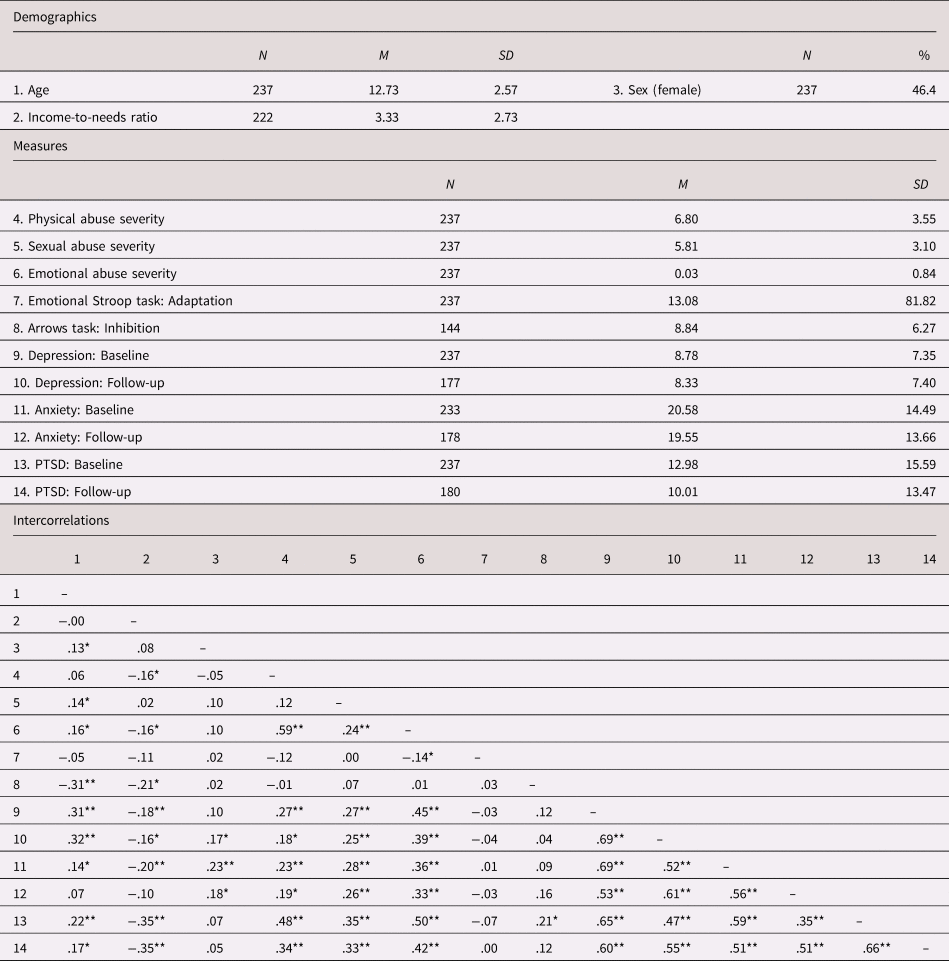
Descriptive statistics and intercorrelations

Note: M = mean, SD = standard deviation. All pairwise, Pearson correlations. *p ≤ .05. **p ≤ .01.
Measures
For younger children in the study (8–10 years old) and those who had difficulty reading, all questionnaires were read out loud by a study team member to ensure comprehension of all items.
Child abuse
In the current study, we focused on the severity of physical, sexual, and emotional abuse. The severity of these experiences was assessed using the childhood trauma questionnaire (CTQ) (Bernstein et al., Reference Bernstein, Fink, Handelsman, Foote, Lovejoy, Wenzel and Ruggiero1994, Reference Bernstein, Stein, Newcomb, Walker, Pogge, Ahluvalia and Zule2003; Bernstein, Ahluvalia, Pogge, & Handelsman, Reference Bernstein, Ahluvalia, Pogge and Handelsman1997) and the childhood experiences of care and abuse (CECA) interview (Bifulco, Brown, & Harris, Reference Bifulco, Brown and Harris1994).
The CTQ is a 28-item self-report questionnaire that assesses the frequency of childhood abuse and neglect, and consists of different subscales, including emotional, physical, and sexual abuse. The CTQ is one of the most widely used measures of childhood maltreatment, and has excellent internal consistency, test–retest reliability, and convergent and discriminant validity with both interview measures and clinician reports of maltreatment (Bernstein et al., Reference Bernstein, Fink, Handelsman, Foote, Lovejoy, Wenzel and Ruggiero1994, Reference Bernstein, Ahluvalia, Pogge and Handelsman1997, Reference Bernstein, Stein, Newcomb, Walker, Pogge, Ahluvalia and Zule2003). The CTQ abuse subscales demonstrated good internal consistency in our sample (physical abuse subscale: α = .82; sexual abuse subscale: α = .94; emotional abuse subscale: α = .83). The CECA interview assesses caregiving experiences, including emotional abuse, which is queried for two caregivers. Interrater reliability for maltreatment reports is excellent, and validation studies suggest high agreement between siblings on maltreatment reports (Bifulco, Brown, Lillie, & Jarvis, Reference Bifulco, Brown, Lillie and Jarvis1997).
Physical and sexual abuse severity were estimated using the CTQ scores, as the sum of physical abuse subscale and the sum of sexual abuse subscale, respectively. Emotional abuse severity was obtained by summing the standardized scores on the CTQ emotional abuse subscale and the CECA Emotional Abuse scale. For CECA scores, the higher score of ratings provided for each caregiver was used.
Internalizing psychopathology
We examined three types of internalizing symptoms: depression, anxiety, and PTSD. Depression symptoms were assessed using the children's depression inventory, second edition (CDI), a recently revised version of the widely used measure of depressive symptoms in children and adolescents (Kovacs, Reference Kovacs1992, Reference Kovacs2011). The CDI, a 28-item self-report instrument, has demonstrated good reliability and validity among children and adolescents (Craighead, Smucker, Craighead, & Ilardi, Reference Craighead, Smucker, Craighead and Ilardi1998). The CDI demonstrated excellent internal consistency in our sample (α = .90).
Anxiety symptoms were assessed with the screen for child anxiety related emotional disorders (SCARED), a 41-item self-report instrument, which measures anxiety disorder symptoms across five domains: panic/somatic, generalized anxiety, separation anxiety, social phobia, and school phobia (Birmaher et al., Reference Birmaher, Khetarpal, Brent, Cully, Balach, Kaufman and Neer1997, Reference Birmaher, Brent, Chiappetta, Bridge, Monga and Baugher1999). The SCARED has sound psychometric properties (Birmaher et al., Reference Birmaher, Khetarpal, Brent, Cully, Balach, Kaufman and Neer1997, Reference Birmaher, Brent, Chiappetta, Bridge, Monga and Baugher1999) and excellent internal consistency in our sample (α = .94).
PTSD symptoms were assessed using the child-report version of the PTSD reaction index (PTSD-RI) (Steinberg, Brymer, Decker, & Pynoos, Reference Steinberg, Brymer, Decker and Pynoos2004). The PTSD-RI assesses PTSD re-experiencing, avoidance/numbing, and hyperarousal symptoms according to the fourth edition of Diagnostic and Statistical Manual of Mental Disorders (DSM-IV) criteria, and a total symptom severity score is generated by summing all items. The PTSD-RI has sound psychometric properties (Steinberg et al., Reference Steinberg, Brymer, Kim, Briggs, Ippen, Ostrowski and Pynoos2013) and had excellent internal consistency in our sample (α = .93).
Behavioral tasks
The emotional Stroop task was administered as a measure of automatic emotion regulation, or cognitive control in an emotional context (Egner et al., Reference Egner, Etkin, Gale and Hirsch2008; Etkin et al., Reference Etkin, Egner, Peraza, Kandel and Hirsch2006), and the arrows task as a measure of cognitive control in a neutral context (Brooks, Sherman, & Strauss, Reference Brooks, Sherman and Strauss2009), consistent with prior work (Lambert et al., Reference Lambert, King, Monahan and McLaughlin2017).
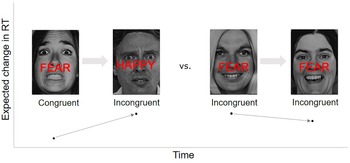
The emotional Stroop task assesses adaptation to emotional conflict, which is interpreted as one form of automatic emotion regulation (Egner et al., Reference Egner, Etkin, Gale and Hirsch2008; Etkin et al., Reference Etkin, Egner, Peraza, Kandel and Hirsch2006, Reference Etkin, Prater, Hoeft, Menon and Schatzberg2010; Gyurak et al., Reference Gyurak, Gross and Etkin2011). On each trial, participants viewed an image of a person with either a happy or a fearful facial expression overlaid with the word “happy” or “fear” (see Figure 1). Participants were asked to categorize the facial expression while ignoring the written word. During congruent trials, the facial expression and the overlaid word matched (e.g., a happy face overlaid with the word “happy”); during incongruent trials, the facial expression and the written word did not match (e.g., a happy face overlaid with the word “fear”), eliciting emotional conflict. Incongruent trials preceded by a congruent trial elicit high levels of emotional conflict while incongruent trials preceded by an incongruent trial elicit relatively lower levels of emotional conflict as the conflict on the previous incongruent trial prompts an increase in emotional control, thus resulting in faster reaction times (Etkin et al., Reference Etkin, Prater, Hoeft, Menon and Schatzberg2010). This adaptation effect is interpreted to be a form of automatic emotion regulation as it occurs outside of conscious awareness (Etkin et al., Reference Etkin, Prater, Hoeft, Menon and Schatzberg2010; Gyurak et al., Reference Gyurak, Gross and Etkin2011). An adaptation to emotional conflict score was calculated by subtracting the mean reaction time (RT) on incongruent trials preceded by a congruent trial from the mean RT on incongruent trials preceded by an incongruent trial, with higher scores indicating worse adaptation.
Adaptation effect on the emotional Stroop task.

The arrows task, an arrows inhibition subset of the developmental neuropsychological assessment II, assesses inhibition of an automatic response (Brooks et al., Reference Brooks, Sherman and Strauss2009). Participants viewed multiple rows of black and white arrows pointing either up or down. In the baseline trial, participants were asked to say the direction that each arrow was pointing. In the inhibition trial, participants were asked to say the opposite direction that each arrow was pointing. The time taken to complete the baseline trial was subtracted from the time required to complete the inhibition trial. Larger differences indicated worse inhibitory control.
Statistical analysis
We conducted linear regression analyses in R-4.0.1 (R Core Team, 2018) to examine each of our hypotheses. We examined the association of physical, sexual, and emotional abuse severity with the adaptation score of the emotional Stroop task and the inhibition score of the arrows task, controlling for age, income-to-needs ratio, and sex. To compare the strength of the associations between the different forms of abuse and automatic emotion regulation, we examined the 95% confidence interval of each standardized coefficient relative to the other standardized coefficients. To investigate the potential role of automatic emotion regulation and cognitive control linking child abuse severity and internalizing psychopathology, we estimated the association of automatic emotion regulation and cognitive control with the severity of depression, anxiety, and PTSD symptoms at follow-up, respectively, adjusting for age, income-to-needs ratio, sex, and the severity of the corresponding internalizing psychopathology at baseline (e.g., for the severity of depression at follow-up, controlled for the severity of depression at baseline). Income-to-needs ratio was controlled for, as it differed as a function of childhood abuse in our sample and prior work has shown that SES is associated consistently with cognitive control ability in children (Lambert et al., Reference Lambert, King, Monahan and McLaughlin2017; Lawson, Hook, & Farah, Reference Lawson, Hook and Farah2018). For income-to-needs ratio in all regression analyses, multiple imputation with 100 imputations was conducted using the “mice” package in R (Buuren & Groothuis-Oudshoorn, Reference Buuren and Groothuis-Oudshoorn2010) as 15 participants did not have data on family income. All analyses were preregistered. Data and analysis code has been made publicly available (Kim et al., Reference Kim, Weissman, Sheridan and McLaughlin2020; https://osf.io/b947u).
Results
Table 1 provides descriptive statistics for all variables and zero-order correlations among these variables.
Child abuse severity and automatic emotion regulation
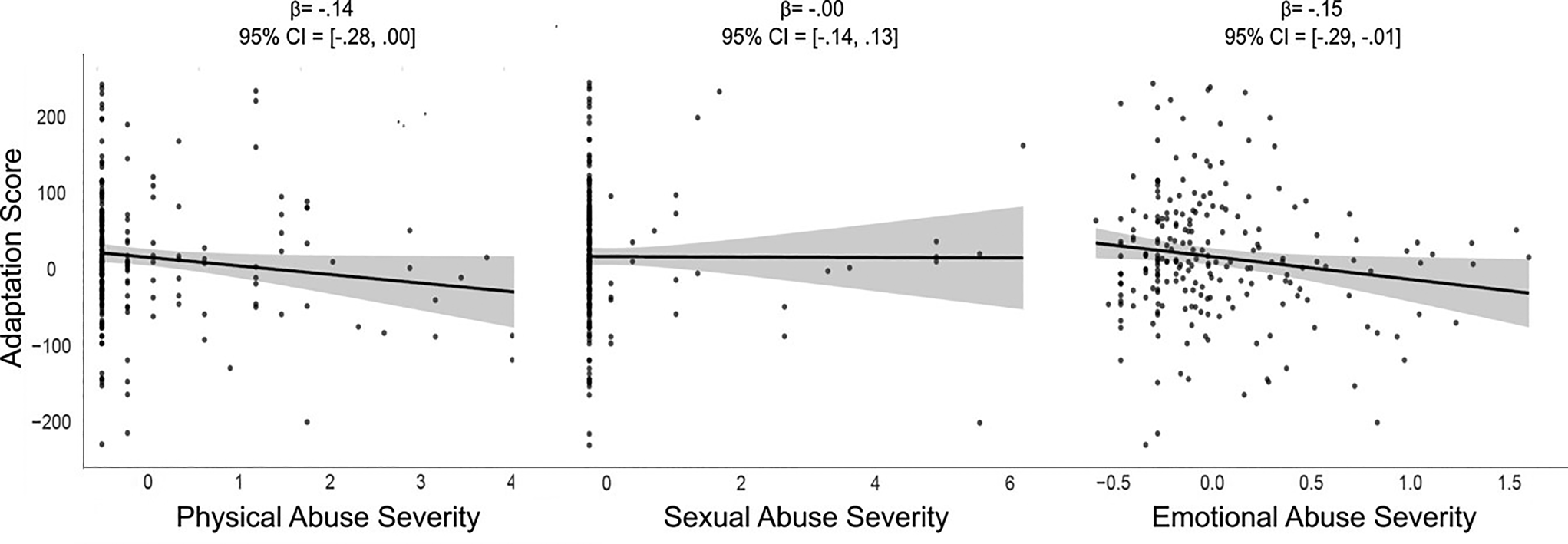
Physical and emotional abuse were negatively associated with emotional conflict adaptation after controlling for age, sex, and income-to-needs ratio (see Figure 2). Specifically, emotional abuse severity (β = −.15, p = .031) and physical abuse severity (β = −.14, p = .048) were each associated with poor adaptation on the emotional Stroop task. The 95% confidence interval of the standardized association between emotional abuse and emotional conflict adaptation (β = −.15, 95% CI = [−.29, −.01]) did not overlap with the standardized coefficient for the association between sexual abuse and emotional conflict adaptation (β = −.00, 95% CI = [−.14, .13]). In contrast, the 95% confidence interval for physical abuse (β = −.14, 95% CI = [−.28, .00]) overlapped with the coefficients for both sexual abuse and emotional abuse.
Child abuse and automatic emotion regulation.
Notes: Higher adaptation scores imply greater adaptation to emotional conflict – in other words, better automatic emotion regulation. The scales for measuring physical, sexual, and emotional abuse were standardized prior to plotting the linear regression models delineating the associations between child abuse and automatic emotion regulation.

Childhood abuse severity and cognitive control
Child abuse severity was not associated with cognitive control on the arrows task, when controlled for age, income-to-needs ratio, and sex (physical abuse: β = −.03, p = .725; sexual abuse: β = .10, p = .205; emotional abuse: β = .00, p = .997). Instead, older age (β = −.30, p < .001) and greater income-to-needs ratio (β = −.20, p = .017) were associated with smaller differences in RT between the inhibition and baseline blocks, reflecting better cognitive control.
Automatic emotion regulation and internalizing psychopathology
Automatic emotion regulation was unrelated to the severity of internalizing psychopathology at baseline, (depression: β = −.03, p = .603; anxiety: β = −.02, p = .801; PTSD: β = −.07, p = .233) or at follow-up (depression: β = −.04, p = .435; anxiety: β = −.01, p = .892; PTSD: β = .05, p = .403), after adjusted for age, income-to-needs ratio, and sex.
Cognitive control and internalizing psychopathology
Slower performance on the cognitive control task was positively associated with the severity of depression (β = .18, p = .042) and PTSD (β = .21, p = .015) at baseline, when adjusted for age, income-to-needs ratio, and sex, but not with anxiety (β = .10, p = .256). Cognitive control was not associated with the severity of internalizing psychopathology at follow-up, when adjusted for the severity of internalizing psychopathology at baseline, age, income-to-needs ratio, and sex (depression: β = .01, p = .862; anxiety: β = .11, p = .155; PTSD: β = −.01, p = .871).
Discussion
The current study investigated automatic emotion regulation as a potential mediator of the association of child abuse with internalizing psychopathology. We first examined whether child abuse severity – specifically, the severity of physical, sexual, and emotional abuse – was associated with poor adaptation on the emotional Stroop task, an indicator of difficulties with automatic emotion regulation. As predicted, the severity of physical abuse and emotional abuse was negatively associated with emotional conflict adaptation. Consistent with the predictions of the dimensional model of adversity (McLaughlin, Sheridan, & Lambert, Reference McLaughlin, Sheridan and Lambert2014; Sheridan & McLaughlin, Reference Sheridan and McLaughlin2014), abuse severity was unrelated to cognitive control. We also examined the association between automatic emotion regulation and internalizing psychopathology. In contrast to our hypotheses, emotional conflict adaptation was not associated with depression, anxiety, or PTSD prospectively. Overall, our findings suggest that exposure to child abuse – particularly emotional and physical abuse – is associated with difficulties with automatic forms of emotion regulation.
Exposure to threatening experiences during childhood has been associated consistently with altered emotional processing, including elevated emotional reactivity (Glaser, Van Os, Portegijs, & Myin-Germeys, Reference Glaser, Van Os, Portegijs and Myin-Germeys2006; Heleniak et al., Reference Heleniak, Jenness, Vander Stoep, McCauley and McLaughlin2016; Weissman et al., Reference Weissman, Bitran, Miller, Schaefer, Sheridan and McLaughlin2019), maladaptive physiological reactivity to stress (Busso, McLaughlin, & Sheridan, Reference Busso, McLaughlin and Sheridan2017; McLaughlin, Sheridan, Alves, & Mendes, Reference McLaughlin, Sheridan, Alves and Mendes2014), altered fear learning (Machlin et al., Reference Machlin, Miller, Snyder, McLaughlin and Sheridan2019), heightened attention and perceptual sensitivity to potential threats (Pollak & Sinha, Reference Pollak and Sinha2002; Pollak & Tolley-Schell, Reference Pollak and Tolley-Schell2003; Shackman et al., Reference Shackman, Shackman and Pollak2007), and interference with automatic emotion regulation (Lambert et al., Reference Lambert, King, Monahan and McLaughlin2017; Marusak et al., Reference Marusak, Martin, Etkin and Thomason2015). Our findings extend this prior research by demonstrating that child abuse is associated with greater difficulty engaging automatic processes involved in the adaptation to emotional distracters that interfere with emotional processing. In particular, our study aligns with previous findings documenting an association of exposure to violence with poor automatic emotion regulation, and further suggests that exposure to threatening events specifically interferes with inhibition in emotional but not nonemotional contexts (Lambert et al., Reference Lambert, King, Monahan and McLaughlin2017). Repeated exposure to threat is associated with greater attention to negative emotional stimuli (Pollak & Tolley-Schell, Reference Pollak and Tolley-Schell2003; Shackman et al., Reference Shackman, Shackman and Pollak2007) and heightened emotional reactivity (Heleniak et al., Reference Heleniak, Jenness, Vander Stoep, McCauley and McLaughlin2016; Weissman et al., Reference Weissman, Bitran, Miller, Schaefer, Sheridan and McLaughlin2019). These patterns of differential attention to emotional cues and enhanced emotional responses may lead to greater difficulties in inhibiting responses to emotionally salient stimuli (Lambert et al., Reference Lambert, King, Monahan and McLaughlin2017). Alternatively, slower emotional conflict adaptation may reflect alterations to neural mechanisms involved in the regulation of emotional responses. Youth exposed to trauma (i.e., abuse) exhibit less connectivity between the amygdala and ventral ACC during adaptation to emotional conflict (Marusak et al., Reference Marusak, Martin, Etkin and Thomason2015); greater functional coupling in this circuit is, in turn, associated with better task performance (Etkin et al., Reference Etkin, Egner and Kalisch2011) and lower levels of internalizing psychopathology (Etkin et al., Reference Etkin, Prater, Hoeft, Menon and Schatzberg2010). As such, alterations in this neural circuit may underlie the association between child abuse and slower adaptation to emotional conflict in the present study.
The negative association between abuse severity and automatic emotion regulation was present for physical and emotional abuse, but not for sexual abuse. The magnitude of association of emotional and physical abuse with automatic emotion regulation was similar, and emotional abuse was more strongly related to automatic regulation than sexual abuse. These results indicate that repeated exposure to physical and emotional abuse may be particularly influential for automatic emotion regulation. While abuse experiences are highly individualized and idiosyncratic, physical and emotional abuse are generally perceived as more threatening than sexual abuse (Glaser, Reference Glaser2002; Norman et al., Reference Norman, Byambaa, De, Butchart, Scott and Vos2012; Olson et al., Reference Olson, Daggs, Ellevold and Rogers2007), particularly for young children who often respond to sexual abuse with lack of understanding and may not have explicit awareness of potential abuse (Olson et al., Reference Olson, Daggs, Ellevold and Rogers2007). It is relevant that in our sample, the vast majority of abuse experiences happened before the age of 8 years. It is important to note that these findings do not imply that sexual abuse is any less pernicious than other types of abuse, but rather suggests that sexual abuse may influence the emergence of psychopathology through mechanisms that are at least partially distinct from those of physical and emotional abuse. For example, self-blame has been identified as a potential mechanism linking sexual abuse with psychological distress (Coffey, Leitenberg, Henning, Turner, & Bennett, Reference Coffey, Leitenberg, Henning, Turner and Bennett1996; Frazier, Reference Frazier2003). More research is necessary to better understand the convergent and divergent mechanisms that may contribute to emotion regulation difficulties and psychopathology following different types of threatening early experiences.
Contrary to our hypothesis, emotional conflict adaptation was not associated with internalizing symptoms either concurrently or prospectively. This contrasts with previous findings that emotional conflict adaption was slower in adults with general anxiety disorder (Etkin et al., Reference Etkin, Prater, Hoeft, Menon and Schatzberg2010). However, another study demonstrated that adult patients with depression were able to compensate for reduced activation of ventral ACC and reduced connectivity between ventral ACC and amygdala, by recruiting lateral prefrontal cortex regions involved in cognitive control. Consequently, these patients with depression did not exhibit poor emotional conflict adaptation (Etkin & Schatzberg, Reference Etkin and Schatzberg2011). It is possible that youth with more symptoms of internalizing psychopathology did not demonstrate difficulties with automatic emotion regulation in our sample because neural circuitry underlying cognitive control was activated to compensate for slower emotional conflict adaptation. McLaughlin et al. (Reference McLaughlin, Peverill, Gold, Alves and Sheridan2015) reported that adolescents who had been abused were able to use effortful emotion regulation to modulate heightened amygdala reactivity to a similar degree as their nonmaltreated counterparts but recruited PFC regions in the frontoparietal network subserving cognitive control to a greater degree. In this study, better cognitive control – a process subserved by the frontoparietal network – while not impacted by abuse, was associated with fewer symptoms of depression and PTSD concurrently. Moreover, prior studies that demonstrated the association of poor emotional conflict adaptation with internalizing psychopathology were conducted in adult samples (Etkin et al., Reference Etkin, Prater, Hoeft, Menon and Schatzberg2010; Etkin & Schatzberg, Reference Etkin and Schatzberg2011). It is critical to further explore these associations in samples of children and adolescents. Furthermore, greater difficulties with automatic emotion regulation may not confer risk for internalizing psychopathology directly but may nonetheless be important to consider when developing interventions to effectively prevent psychopathology among youth exposed to physical and emotional abuse.
Several limitations constrain the interpretability of the present study and point to directions for future research. First, it is difficult to completely disentangle the effect of co-occurring abuse. Emotional abuse in particular exhibits high levels of co-occurrence with physical and sexual abuse, as indicated by strong correlation between emotional abuse and other types of abuse, particularly physical abuse in the present study. Second, we only used a single measure of automatic emotion regulation – the emotional Stroop task. Because emotion regulatory processes can modulate emotional responses through behavioral and neurobiological pathways (Gross & Thompson, Reference Gross, Thompson and Gross2007; Mauss, Levenson, McCarter, Wilhelm, & Gross, Reference Mauss, Levenson, McCarter, Wilhelm and Gross2005), future research should employ multimodal assessments including physiological or neural measures, to create a more comprehensive representation of the construct. The development of more ecologically valid measures of automatic emotion regulation that more closely resemble the way people automatically regulate their emotions in their daily lives might contribute to a better understanding and measures that are more likely to predict psychopathology. Automatic emotion regulation can also be difficult to distinguish from emotional reactivity. While they are functionally distinct in theory (Ursache, Blair, Stifter, & Voegtline, Reference Ursache, Blair, Stifter and Voegtline2013), prior research has reported difficulties in distinguishing between those two processes (Zelkowitz & Cole, Reference Zelkowitz and Cole2016), especially when using self-report or behavioral measures. Employing other measures of automatic emotion regulation can aid in the interpretation of the adaption effect as a result of successful emotion regulation rather than low emotional arousal (e.g., Etkin et al., Reference Etkin, Egner and Kalisch2011; Mauss et al., Reference Mauss, Cook and Gross2007), and should be undertaken in future studies. In addition, although we controlled for SES to address the strong association it had with child abuse in our sample, potential confounding of trauma with racial or ethnic minority status may obscure the unique influence of child abuse on emotion regulation (Wildeman et al., Reference Wildeman, Emanuel, Leventhal, Putnam-Hornstein, Waldfogel and Lee2014). Future work could match participants with and without trauma exposure on race or ethnicity or include measures of exposure to discrimination to minimize the shared influence of these variables on automatic emotion regulation and psychopathology. Third and finally, although the differences in effect sizes in the present study are relatively unambiguous and replicate previous work (e.g., Lambert et al., Reference Lambert, King, Monahan and McLaughlin2017), the much smaller sample size for analyses of cognitive control using the arrows task makes it difficult to directly compare its association with abuse to that of emotional conflict adaptation. For future studies, larger samples are needed to statistically validate the difference in effect sizes between those measures.
Children who have had more severe experiences of abuse, particularly emotional and physical abuse, exhibit greater difficulties with automatic emotion regulation, but not with cognitive control exerted in a nonemotional context. However, altered automatic emotion regulation did not explain the longitudinal associations between abuse severity and symptoms of internalizing psychopathology. A better understanding of the proximate causes and consequences of altered automatic emotion regulation may provide vital information on how to support youth who experience abuse in regulating their emotions and preventing psychopathology.
Funding Statement
This research was funded by the National Institute of Mental Health grant R01-MH103291, an Early Career Research Fellowship from the Jacobs Foundation, and a OneMind Institute Rising Star Award (all to K.A.M.).
Conflicts of Interest
None.