Postmodern Society and Psychopathology
The past two decades have been marked by dramatic social changes, widely characterized by the term “postmodern.” These major transformations have had profound and complex implications for psychiatry, influencing mental health risk factors, dynamics in clinical encounters, styles of help-seeking behavior, and clinical outcomes. Underlying themes of postmodern thought that are particularly relevant to psychiatry include individualization and social roles, the nature of self-identity and intimacy, and future orientation.Reference Whitley 1
A defining element of postmodernity, also driven by the massive spread of signification through the Internet, is an absolute reliance on the present to the exclusion or proportional reduction of the past and future. As first described by Edmund HusserlReference Husserl 2 and Bin KimuraReference Kimura 3 with the notion of the presentatio or intrafaestum modality, the present is disconnected from preoccupations with the future and the past (including feelings of guilt). Contemporary adolescents and young adults are restricted to instantaneity, with loss of the ability to wait. The sociologist Oriel Sullivan’s notion of “speed-up society” echoes this general acceleration of temporal patternsReference Sullivan and Gershuny 4 (ie, increase in “time intensity” and feelings of “time pressure”). For instance, RosaReference Rosa 5 describes acting at a faster rhythm throughout the day, getting rid of pauses or intervals between our actions, and increased multitasking. In theoretical analyses of postmodern social acceleration and popularizations of the idea of the “speed-up society,”Reference Colvile 6 - Reference Schulte 8 the increasing tempo of daily life is considered central to social change. Many recent accounts of temporal acceleration are directly related to the effect of Technology (Information and Communication Technology [ICT]). There have been huge changes in ICT over the past decade, and this is reflected in a growing acceleration of interconnectivity, digitalization, and gaming technologies, with major effects on perceptions of time pressure.
The paradigm of liquid society, first introduced by Zygmunt Bauman,Reference Bauman 9 underscores constant change, discontinuity, and lack of structure in modern social life; doubt and perplexity are the only stable elements. A flame is an effective metaphorical image of this condition: an open system that constantly works to maintain an equilibrium, never evolving in an organized temporal structure. MearesReference Meares 10 argues that the existential situation of these subjects is dominated by point-events that never meet. Existence is “held hostage” by an eternal present, absorbed into immediacy, resulting in feelings of unreality and sometimes heightened excitement, anger, and impulsivity. In postmodern adolescents/young adults, these emotional states are accompanied by dysphoric mood. In this context, psychoactive substances act as powerful catalysts, enhancing this atemporal rewarding experience.
Substance Use Disorders: The New Scenario
Licit and illicit psychoactive substances are cheap and easily available to the postmodern adolescent. They allow for rapid and effortless adjustments of consciousness and emotional states to the ever-changing present. Substance use disorders (SUDs) are a major health concern: in 2010, SUDs were among the leading causes of years lived with disability worldwide.Reference Whiteford, Ferrari, Degenhardt, Feigin and Vos 11 Currently, substance use is so widespread that it can be hardly defined as an aberrant behavior, although consequences are dramatic in terms of mortality and psychiatric load. As discussed by Devereux,Reference Devereux and Devereux 12 every society has its own norms and rules, providing the individual with different possible ways of conveying both illness/distress and success/fulfillment. In postmodern society, substance use is connected to both scenarios. Stimulants are often thought to support successful lifestyles, “empowering” and enhancing the narcissistic invulnerability that permeates certain personality structures. On the other hand, substance use typically has the effect of producing an experience of wholeness, which excludes complexity and heterogeneity in favor of the security of a single experience, thus dampening psychological distress and offsetting feelings of inadequacy and fragmentation of the self in vulnerable subjects who have difficulty coping with “speed-up.” In this view, SUDs and associated psychopathology are a sort of culture-bound syndrome, profoundly rooted in the fundamentals of liquid postmodernity.
In addition to “traditional” psychoactive substances, novel psychoactive substances (NPS) are raising increasing international concern, especially in relation to the fast-moving and potentially limitless nature of their online market.Reference Cinosi, Martinotti and Simonato 13 – Reference Cinosi, Martinotti and Simonato 18 NPS have been legally defined by the European Union (EU) as new narcotic or psychotropic drugs, in pure form or preparation, that are not scheduled under the Single Convention on Narcotic Drugs of 1961 or the Convention on Psychotropic Substances of 1971, but pose a public health threat potentially comparable to substances listed in those conventions (Council of the EU decision 2005/387/JHA). 19 In 2017, the total number of NPS in the EU was over 670, of which 632 were notified after 2004 (EMCDDA, 2018). NPS are often unknown to health professionals, mainly due to lack of evidence-based sources of information.Reference Corazza, Assi and Simonato 20 Internet (ie, online forums, chat rooms, and blogs) has emerged as a primary source of information on drugs in general and NPS in particular. An estimated 61% of young Europeans aged 15 to 24 typically quote the Internet as a source of information on drugs. 21 Users share their experiences with different substances and recommend sources and routes of delivery. Vulnerable young consumers are targeted by aggressive marketing strategies (ie, attractive names, colorful packaging, and free samples to test), increasing the likelihood of early exposure to substances. NPS are mostly unregulated, and this may increase their popularity as well as the flawed perception of low risks associated with use. Unfortunately, to date, few surveys on NPS diffusion have been conducted. Furthermore, there is increasing evidence that NPS use is often unintentional.Reference Salomone, Palamar, Gerace, Di Corcia and Vincenti 22 Growing evidence supports the potential serious psychiatric and physical consequences related to NPS consumption.Reference Martinotti, Di Nicola and Quattrone 17 , Reference Simonato, Corazza and Santonastaso 23 Originally, the most common NPS were phenethylamines and tryptamines. In recent years, cathinones, synthetic cannabinoids (SCs), phencyclidine (PCP), and benzofurans have gained increasing popularity. 24 A number of NPS have been directly or indirectly associated with serious adverse effects and fatalities: 2-DPMP and D2PM, two synthetic stimulants belonging to the class of piperidines, have shown both neuropsychiatric and cardiovascular toxicity, and have been involved in three deaths in August 2010.Reference Corkery, Elliott, Schifano, Corazza and Ghodse 25 Misuse of gamma-hydroxybutyrate and gamma-butyrolactone has been implicated in more than 150 fatalities in the United Kingdom from 1995 to 2013Reference Corkery, Loi and Claridge 26 and, more recently, stimulant mixtures and SCs have emerged as potentially life-threatening.Reference Santacroce, Corazza, Martinotti, Bersani, Valeriani and Di Giannantonio 16 Moreover, the use of novel synthetic opioids (NSOs) is another relevant issue, with an increasing number of deaths in the United States and Canada due to overdose.
NPS use is widespread among adolescents/young adults and frequent among psychiatric patients reporting psychotic symptoms at disease onset. Also, there is substantial evidence that NPS are a major risk factor for violence and aggression in patients with major mental disorders.Reference Soyka 27 - Reference Martinotti, Cinosi and Santacroce 30
Substance-Related Psychoses
Substance use often co-occurs with schizophrenia and other psychiatric disorders. Rates of SUD among psychiatric patients are significantly higher than in the general population (up to 50%).Reference Jablensky, McGrath and Herrman 31 High levels of comorbidity add to the diagnostic difficulties faced by clinicians and researchers in accurately differentiating substance-induced psychopathology from primary psychiatric disorders in the context of co-occurring SUDs. According to the Diagnostic and Statistical Manual of Mental Disorders–5 (DSM-5), between 7% and 25% of first-episode psychosis subjects have a substance-induced psychosis (SIP). 32 In a Norwegian sample, the incidence of SIP was approximately 6.5 in 100,000 persons per year, compared to 9.7 with a primary psychotic disorder (PPD) and comorbid substance use, and 24.1 with PPD alone. Although patients with SIP use substances at higher rates than patients with PPD, substance use is in fact still pervasive among patients with PPD, with reported rates varying from 35% to 61%. Subjects with chronic and heavy substance use (cannabis, amphetamines, psychedelics, and cocaine) are at highest risk.Reference Beckmann, Lowman, Nargiso, McKowen, Watt and Yule 33 There is a growing recognition that substance use is associated with the emergence of psychosis, which develops during the use of the substance, and may or may not subside following withdrawal or abstinence. Subjects with SIP often call the police or ambulance and present in emergency rooms because they or family/friends feel a need for urgent intervention. Substance use, often heavy and long-term, suddenly transforms the subject’s perception and/or cognition into frightening experiences that are not recognized as due to acute intoxication and require an urgent response. Some subjects may have been experiencing substance-induced psychotic phenomena for months before the symptoms motivate help-seeking. Despite this, surprisingly little research has focused on differentiating SIP from PPD with substance use, especially with regard to determining whether these disorders have different trajectories and outcomes.Reference Weibell, Hegelstad, Johannessen and Preedy 34
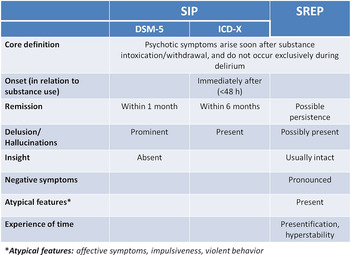
Little is known about potential factors associated specifically with SIP, and the adequacy of current classification systems in appropriately distinguishing between primary and substance-induced disorders is questionable.Reference Mathias, Lubman and Hides 35 , Reference Rounsaville 36 The phenomenon of substances causing transient psychotic states was first mentioned in studies from the 1960s,Reference Angrist and Gershon 37 with several experimental studies demonstrating drug effects mimicking the positive (eg, hallucinations, delusions, paranoia, and disorganized thinking) and negative (eg, affective flattening, anhedonia, and attentional and cognitive impairment) symptoms of schizophrenia.Reference Mathias, Lubman and Hides 35 Current major neurobiological theories of schizophrenia have their origin in the effects of substances: the effects of lysergic acid diethylamide (LSD) gave rise to the serotonergic model, amphetamines to the dopamine (DA) hypothesis, PCP and ketamine to the glutamatergic model and, more recently, the effects of cannabis have provoked interest in the role of endocannabinoids. Numerous substances are linked to the development of psychosis, and diagnoses of SIP have been included in both the International Classification of Diseases–10 (ICD-10) (World Health Organization) and the DSM-5. 32 , Reference Schanzer, First, Dominguez, Hasin and Caton 39 The fourth edition of the DSM first introduced the term SIP in 1994. In the DSM-5, the diagnostic criteria for SIP remain essentially unchanged. SIP is defined as a condition in which psychotic symptoms (hallucinations and/or delusions) arise during or soon after substance intoxication/withdrawal and resolve within a set time period. Psychotic symptoms cannot occur exclusively during the course of a delirium. According to the DSM-5, symptoms should be more severe than those expected to occur with intoxication or withdrawal, and they should warrant the need for health care. There should be a lack of insight into hallucinations and delusions, and symptoms should resolve within the somewhat loosely defined timeframe of “about a month.” 32 Interestingly, this definition does not consider negative symptoms, probably excluding a relevant area of clinical manifestations. ICD-10 has a slightly different and more stringent time criterion in that it requires partial resolution within 1 month and full resolution of symptoms within 6 months (Figure 1). In clinical practice, distinguishing between SIP and PPD with concurrent substance use remains a diagnostic difficulty.Reference Schanzer, First, Dominguez, Hasin and Caton 39 Misdiagnoses have major implications in terms of clinical management resulting in suboptimal follow-up and inappropriate treatment, with a potentially poorer prognosis.Reference Mathias, Lubman and Hides 35 In the DSM, a diagnosis of SIP is based on the assumption that symptoms are transient and disappear after sustained abstinence (Figure 1). Literature suggests that diagnostic change over time is common: rate of change from SIP to PPD ranges from 25% to 50%,Reference Caton, Hasin and Shrout 40 , Reference Crebbin, Mitford, Paxton and Turkington 41 as are high rates of transition to mood disorders. A recent meta-analysis reports that SIP is associated with a substantial risk for transition to schizophrenia, particularly following cannabis-induced psychosis.Reference Murrie, Lappin, Large and Sara 42 High transition rates are partly related to progression of the psychotic disorder (ie, SIP develops into PPD), and partly a result of the narrowed definition of SIP that may favor misdiagnosis (ie, SIP diagnosed as Schizophreniform Disorder or Psychosis NOS when criteria for schizophrenia are not fulfilled).Reference Mathias, Lubman and Hides 35 Neither the ICD-10 nor the DSM-5 allows for coding of “persistent states” of SIP, in spite of growing literature suggesting that in some chronic users psychotic symptoms can last substantially longer than the indicated timeframes.Reference Murrie, Lappin, Large and Sara 42 , Reference Weibell, Johannessen and Auestad 44 The diagnosis should then be changed from SIP to PPD. But even then, the question of whether chronic substance use induces a long-lasting, clinically distinct psychotic syndrome or whether it precipitates a PPD (ie, schizophrenia) remains unanswered. The problem of differential diagnosis has hampered research on the specific psychopathology and the prospective outcomes of individuals with psychoses following substance use.Reference Wilson, Szigeti, Kearney and Clarke 45 These psychotic disorders may be a separate diagnostic entity from PPD that is stable over time and has distinctive psychopathological features.
SIP and SREP: clinical and psychopathological characteristics. Abbreviations: DSM-5, Diagnostic and Statistical Manual of Mental Disorders–5; ICD-10, International Classification of Diseases–10; SIP, substance-induced psychosis; SREP, substance-related exogenous psychosis.

In the present contribution, we aim to outline a novel and separate clinical entity, which we describe as substance-related exogenous psychosis (SREP). As previously stated, the narrowed definition of SIP does not consider the issue of persistent psychoses that are clinically distinct from PPD. Within this novel diagnostic category, we refer to both transient and persistent forms of psychoses induced by substances (ie, with onset following substance use). SREP can be considered a schizophrenia spectrum disorder but displays specific characteristics that clearly differentiate it from Schizophrenia/PPD, in terms of clinical presentation, epidemiology, etiological models, and treatment response.
SREP: Epidemiology and Etiopathological Models
Epidemiology
Epidemiological data regarding prevalence and distribution of SREP have highlighted relevant differences compared to primary psychoses. In 2013, the American Psychiatric Association reported that prevalence rates of schizophrenia were similar around the world, 32 with higher incidence rates in racial/ethnic minorities and in urban areas with lower levels of owner-occupied housing, and in subjects using high-potency cannabis daily, as recently showed by the EU-GEI group.Reference Hannah, Jongsma and Gayer-Anderson 46 , Reference Di Forti, Quattrone and Freeman 47 SREP typically emerges in the modern and developed world and has been mostly described in urban areas with high population density and rapid economic growth, where substance use represents a possible way to cope with “social acceleration” and high levels of environmental stressors.Reference Kienast, Stoffers, Bermpohl and Lieb 48 Our hypothesis is that the higher incidence rates in some areas is a result of the presence of SREP cases erroneously classified as schizophrenia. However, we should also consider that substance misuse is still pervasive among patients with schizophrenia, with reported rates varying from 35% to 61%. Clear diagnostic criteria, currently not available, and longitudinal studies are required to clarify the role of SREP in terms of prevalence.
Etiopathological models
Significant differences have also been hypothesized from a psychopathological perspective.
Phenomenologically oriented researchers propose that a disturbance of the basic self is a phenotypic trait marker of psychotic vulnerability.Reference Sass and Parnas 49 This hypothesis is based on a combination of empirical research and philosophical considerations. The type of self-disturbance proposed as being a core abnormality in schizophrenia concerns the pre-reflective level of selfhood (ipseity). Self-disorders become progressively more articulated and thematized as psychotic symptoms develop, crystallizing in the form of delusions, hallucinations, and passivity phenomena. When substance use becomes a relevant factor in the development of a psychotic experience, this model needs to be integrated by a wider perspective. As previously discussed, a substantial number of substance users (especially if use is continuous and heavy) present persistent psychotic symptoms, opening questions regarding substance use and the development of a full, atypical chronic psychosis. In this context, the hexogen model of psychosis and its toxic subtype, defined lysergic psychoma, may be helpful in the understanding of substance-induced phenomena. The term “lysergic psychoma” was first used by Cargnello and Callieri in 1963, though it has its roots in Hellpach’s definition and in Karl Bonhoeffer’s hexogen model.Reference Bonhoeffer 50 It describes a syndrome characterized by a clear egodystonic experience in which the subject perceives the presence of a “foreign body” in his mind. The thinking Ego can feel and observe it as an uncommon experience, out of control, enriched by hallucinations (mainly visual and kinesthetic), delusional perceptions and, in some cases, structured but confined delusional thoughts. The Ego is still aware and “in charge,” and usually tries to suppress the psychoma. This experience is usually transient and self-limiting, strictly connected to the pharmacodynamic effects exerted by the substance. However, repeated and heavy exposure as well as the long-lasting pharmacokinetic properties of some NPS opens up a possible new scenario. When the thinking Ego has to face a recurring and intense abnormal experience (ie, unusual thoughts or perceptions), its resilience weakens and its capacity to contain the experience fails. If the psychoma becomes stable, the capacity to offset it is progressively reduced and it invades the functioning part of the Ego. The lysergic psychoma is an exogenous clinical expression that almost all substance users experience, regardless of the substance type. Clearly, the pharmacodynamics of the drug taken is responsible for the specificity of the induced phenomena. The dopaminergic psychoma is most frequently reported as long-lasting and has the worst prognosis, as described for shaboo and methamphetamine users in southeastern Asia. Methamphetamine-induced psychosisReference Wearne and Cornish 51 is, in fact, a severe form of paranoid schizophrenia, in which the psychoma has become fully pervasive.Reference Wearne and Cornish 51
SREP: Clinical and Psychopathological Characteristics
In terms of clinical presentation, SREP exhibits specific features (Figure 1). Descriptive studies found specific clinical characteristics that distinguish psychoses associated with substance use from schizophrenia and that may drive differential diagnosis. Caton et al identified key demographic, family, and clinical differences between SIP and PPD in 400 participants with at least one psychotic symptom, use of alcohol and/or other drugs in the previous 30 days, and no psychiatric inpatient history in the previous 6 months.Reference Caton, Drake and Hasin 52 Patients with SIP had more visual hallucinations, a higher prevalence of suicidal thoughts during the previous year, more violent behavior, family history of substance use, and higher levels of insight.Reference Beckmann, Lowman, Nargiso, McKowen, Watt and Yule 33 Other systematic studies aiming to characterize SIP as defined by DSM-5 and persistent, atypical psychotic disorders associated with substance use (ie, SREP) are lacking, and descriptions are mostly anecdotal. We briefly discuss possible distinctive clinical and psychopathological features associated with SREP (Figure 1), as reported in existing descriptive studies.
The intersection between drug intoxication and psychosis is an altered state of consciousness, with a dramatic reduction in the field of consciousness (twilight state or crepuscular consciousness). The field of consciousness is restricted to a few or even a single content. Depersonalization and derealization are typical and reversible experiences that characterize the twilight state. The latter is often also accompanied by illusions and hallucinosis and may represent a transitory state between the transient substance-induced psychotic experience and a full-blown, persistent psychosis. Psychosis emerging from crepuscular consciousness is marked by cognitive alterations, perceptual and thought disorders, and affective symptoms. When normal consciousness is restored (ie, the field of consciousness widens again), it sometimes opens up to new meaning in the context of a transformed, delusional reality experience. Both quantitative and qualitative alterations of consciousness should be routinely assessed in patients with a probable alcohol/substance use. These alterations are unusual in psychiatric disorders, with the exception of dissociative disorders, frequently described in literature as substance-induced symptomsReference Vik, Cellucci, Jarchow and Hedt 53 and may help guide early differential diagnosis.
Modification of affectivity accompanied by depersonalization and derealization has been widely described.Reference Messas, Tamelini, Mancini and Stanghellini 54 , Reference Di Petta 55 Several studies report affective symptoms (eg, depressed mood, self-neglect, and hostility) and suicidal ideation.Reference Akiyama, Saito and Shimoda 56 – Reference Hides, Dawe and McKetin 58 Affective symptoms are possibly a core clinical feature of SREP and are not recognized in current diagnostic criteria.Reference Voce, Burns, Castle, Calabria and McKetin 59
Delusions, mostly persecutory/paranoid, are usually secondary to abnormal perception resulting from a characteristic “sensorialization” of the world and of experience.Reference Di Petta 55 , Reference Messas 60 Messas observed these features in a population of crack users in San Paolo (Brazil) and described several fundamental elements of these psychoses, partly related to cultural and social postmodern determinants: (1) hyperstability, a form of existence based on the experience of the present, cut off from the past and future; (2) freezing of the sense of time, with inability to wait and invest in the future; (3) hyper-materiality, where the sense of space and time are condensed in the present experience; and (4) nonevolving, crystallized delusions, which remain condensed inside the experience of present time. These psychopathological correlates emphasize the role of substances as mediators of social drifts. These delusional experiences are unstable, in a rapid-changing on-off state, and insight is fluctuating.
Typically, intact insight has been reported as a common feature among patients with SREP.Reference Di Petta 55 , Reference Matsumoto, Kamijo and Miyakawa 61 , Reference Martinotti, Lupi and Carlucci 62 DSM-5 criteria consider hallucinations/delusions as symptoms of SIP only when they occur in the absence of insight and suggest that a substance user with hallucinations/delusions and insight into these should be coded as having “perceptual disturbances.” However, patients with SREP appear more likely to interpret symptoms as a result of substance use compared to PPD patients.
Hallucinations and other perception disorders are frequently reported in SREP. Visual and cenesthetic hallucinations are more common. This is probably related to the potent interaction exerted on the 5HT receptors by modern hallucinogens, like MDMA and other similar compounds. In SREP, perceptual alterations probably pave the way to thought disorders. Drastic substance-induced changes of the perception-movement cycle may influence judgment. Therefore, substance-induced delusions are not primary, but secondary to intense changes and distortions of perception. Substance-induced delusions are characterized by confirmation and interpretation, not by revelation, and by fantastic contents. In line with the lysergic psychoma model, SREP delusions are similar to paraphrenic delusions, with a feeling of unreality, while the ability to analyze the feeling is preserved.Reference Martinotti, Lupi and Carlucci 62
Aggressiveness appears to be transnosographic, probably representing an intrinsic element correlated with substance use. Patients with SREP generally have high levels of impulsivity and often display violent behavior and severe psychomotor agitation (eg, bizarre/disorganized behavior and motor hyperactivity).Reference Caton, Drake and Hasin 52 Polysubstance use has also demonstrated a strong correlation with aggression in emergency departments, together with higher risks of unprotected sex, car accidents, violence, and victimization.Reference Goldstick, Stoddard, Carter, Zimmerman, Walton and Cunningham 63 Positive urine drug screen results for cannabis have been associated to a higher incidence of inpatient agitation among patients admitted to a psychiatric inpatient unit with a diagnosis of schizophrenia, schizoaffective disorder, or bipolar disorder.Reference Johnson, Wu, Winder, Casher, Marshall and Bostwick 64
SREP: Pharmacological Models of Clinical Presentation
SREP can be differentiated into specific syndromes, associated with the use of different compounds. Substances may precipitate the imbalance of a wide range of neurotransmitters, pathways, and receptors: DA (mostly associated with psychedelic phenethylamines/synthetic cathinones), CB-1R activation (synthetic cannabimimetics), 5-HT2A receptor activation (tryptamine derivatives/hallucinogenic plants), antagonist activities at both NMDA and mGlu2/3 receptors (PCP-like derivatives), and k opioid receptor activation (Salvia divinorum).
Substances mainly acting on dopaminergic pathways are primarily associated with paranoid thoughts and auditory hallucinations. Delusions of reference, persecution, grandeur, and jealousy, as well as hypomanic states, are frequently reported. Aggressiveness and irritability are common, often with dysphoria, anxiety, and panic episodes. With mephedrone, low mood, loss of appetite, difficulty sleeping, paranoid ideation, cognitive impairment, changes in perception, agitation, hallucinations, amnesia, confusion, violence, and suicidal thoughts have been reported.Reference Homman, Seglert and Morgan 65 – Reference Lovrecic, Lovrecic and Gabrovec 69 Users also reported positive effects (eg, euphoria, improved psychomotor speed, alertness, and talkativeness).Reference Deruiter, Cheng, Gehrs, Langley and Dewa 70 – Reference Mdege, Meader, Lloyd, Parrott and McCambridge 72 Cathinone-induced acute intoxication may include symptoms of the serotonin syndrome, such as aggression and hyperthermia, psychotic symptoms, catatonia, and hyperactive delirium.Reference Warrick, Hill and Hekman 73 – Reference Penders, Gestring and Vilensky 80 Mood disturbances and paranoid ideation have been observed in chronic users of cathinones. Rasmon Kalayasiri’s studyReference Kalayasiri, Kraijak, Maes and Mutirangura 81 reports that up to 40% of individuals who use methamphetamine may experience psychotic symptoms or paranoia.
In line with their pharmacological profile, molecules that have high serotonin/DA ratios are similar to entactogenic substances, such as MDMA. Conversely, high DA/serotonin ratios predict a strong stimulant experience. Furthermore, high or low affinity to noradrenergic systems may be associated with varying sympathetic nervous system activation, whereas activation of 5-HT2A/1A receptors is likely to predict hallucinogenic effects.Reference Baumeister, Tojo and Tracy 82
Substances acting predominantly on serotonergic pathways are most commonly implicated in the development of visual hallucinations with vivid colors, frequently associated with intense positive or negative emotional experiences. Hallucinogens are also called “psychedelics” (eg, LSD and psilocybin), “psychotomimetics” (as their effects mimic psychotic symptoms), and “entheogens” (due to the mystical-type experiences these drugs may induce). Hallucinogens may induce hallucinations, illusions, and “pseudo-hallucinations” (hallucinations the patient recognizes as not resulting from external stimuli), as well as intense emotional responses.Reference Schifano, Papanti, Orsolini and Corkery 83 In order of frequency, the other possible disordered perceptions are kinesthetic and tactile. The presence of auditory, olfactory, and gustatory hallucinations is uncommon. Paranoid delusions, particularly with religious content, are possible, but full-blown systematic delusions are rare. Hypomanic states are frequently reported, although suicidal thoughts and depressive states may also occur. The predominant clinical effects of tryptamines include visual hallucinations, alterations in sensory perception, distortion of body image, depersonalization, marked mood lability, and anxiety/panic.
Substances mainly acting on glutamatergic pathways usually determine dissociative reactions, such as derealization and somatopsychic depersonalization. Visual abnormal perception may be reported, mainly in the form of distortions and illusions. Bodily and kinesthetic hallucinations are frequent, as is the occurrence of near-death experiences. Auditory, olfactory, and gustatory hallucinations are less common. Delusions with somatic themes are frequent: Ekbow, Capgras, and Cotard syndromes have been reported, as well as episodes of demoniac possession and vexation. Negative symptoms are common. Mood is mainly flat, accompanied by affective blunting, anhedonia, and a general sense of anesthesia and detachment from the surrounding environment. Irritability and aggressiveness may be noted. The “K-hole” is an out-of-body/near-death experience, with the user becoming trapped in a state of detachment from physical presence. Residual symptoms, such as flashbacks and perceptual distortions, may follow.
Cannabis intoxication is associated with anxiety and transient psychosis-like or psychotomimetic effects that include depersonalization, derealization, psychomotor agitation, disorganized behavior, ideas of reference, grandiose and paranoid delusions, flight of ideas, disorganized thinking, and auditory and visual hallucinations. Such effects have been increasingly reported with high THC-containing strains of cannabis and SCs (“spice,” “K2,” and “kush”), generally CB1R and CB2R full agonists. Literature describes cases of new-onset psychosis named “Mojo Psychosis” following the intake of SC mixtures.Reference Orsolini, Chiappini, Papanti, De Berardis, Corkery and Schifano 84
While low doses of SCs produce similar psychoactive effects to cannabis/THC, higher doses often lead to auditory/visual hallucinations, anxiety, and intense feelings of paranoia.Reference Bonaccorso, Metastasio and Ricciardi 85 , Reference Winstock and Barratt 86 Other psychiatric and neurological effects include behavioral dyscontrol and agitationReference Brakoulias 87 ; mood swings Reference Celofiga, Koprivsek and Klavz 88 ; suicidal ideation and suicide attempts; panic attacks; thought disorganization; and hyperactive delirium.Reference Schifano, Orsolini, Papanti and Corkery 89 A florid/acute transient psychosis, relapse/worsening of a pre-existing psychosis or bipolar disorder,Reference Oluwabusi, Lobach, Akhtar, Youngman and Ambrosini 90 , Reference Ustundag, Ozhan Ibis, Yucel and Ozcan 91 and persistent psychotic disorder/“Spiceophrenia”Reference Schifano, Papanti, Orsolini and Corkery 83 , Reference Papanti D, Schifano and Botteon 92 have all been described. Intoxication/acute toxic effects of SCs appear to be more akin to those experienced with sympathomimetic/stimulant drug use.Reference Wood and Dargan 93 , Reference Naviglio, Papanti, Moressa and Ventura 94 It is interesting to note that some SCs exhibit pharmacologically relevant affinity for psychosis-associated receptors, including D2, 5-HT2A, and NMDA. Skryabin et alReference Skryabin, Vinnikova, Nenastieva and Alekseyuk 95 highlighted four clinical variants of SC-induced psychoses: (1) psychosis with predominant delirium symptoms, (2) psychosis with predominant hallucinatory symptoms, (3) psychosis with predominant affective-delusional symptoms, and (4) psychosis with predominant mental automatism.
Substances acting on the opiate system do not usually determine clear psychotic syndromes. NSOs toxicity includes drowsiness, sedation, disorientation, slurred speech, confusion, dizziness, nausea, miosis, slowed breathing, and respiratory depression.Reference Suzuki and El-Haddad 96 Conversely, NSOs psychotropic effects include anxiolysis, euphoria, feeling of relaxation, and mood lift, dysphoric, and dissociating effects.Reference Solimini, Pichini, Pacifici, Busardò and Giorgetti 97 Other compounds classified among NSOs are desomorphine (“krokodil”), mitragynine and 7-hydroxymitragynine (alkaloids found in “kratom”/Mitragyna speciose),Reference Rech, Donahey, Cappiello Dziedzic, Oh and Greenhalgh 98 and salvinorin A, with its analogue herkinorin, which are the main components of Salvia divinorum. Salvinorin A’s psychoactive effects include perceptual disturbances, psychosis, irritability, and anxiety.
A range of experiences may be associated with use of high doses of gabapentinoids, including euphoria, improved sociability, opiate-like sedation, entactogenic feelings/dissociation, and psychedelic effects.Reference Schifano, Papanti, Orsolini and Corkery 83
These phenomena (serotonergic, dopaminergic, and glutamatergic psychoma) cannot be considered as different syndromes, given the frequent overlap of symptoms. This is due to the fact that some NPS exert their effect on different pathways, and that the occurrence of polyabuse is the norm rather than the exception. However, the ability to differentiate and characterize clinical presentation may be useful to plan an appropriate therapeutic approach.
Conclusion
There is a clear need for a new diagnostic framework that provides reliable, unambiguous clinical criteria to differentiate between comorbid conditions (ie, schizophrenia patients with SUD) and clinically distinct psychoses associated with substance use, given that 1/3 of individuals with SIP develop a severe mental illness, schizophrenia spectrum disorders, or bipolar disorders, within 2 to 3 years.Reference Beckmann, Lowman, Nargiso, McKowen, Watt and Yule 33 , Reference Schifano, Napolitano and Chiappini 99 Moreover, psychotic phenomena following substance use in patients with a primary diagnosis of mood disorder or borderline personality disorder need to be recognized and clearly distinguished from other forms of psychoses, with relevant consequences in terms of treatment. Also, early differential diagnosis and staging between persistent psychoses associated with substance use (ie, SREP) and transient psychotic states occurring during substance intoxication/withdrawal is necessary.
In this paper, we address these issues and make a first attempt to bridge this gap by discussing current literature on psychoses associated with substance use and proposing a new clinical and diagnostic entity, SREP. SREP is conceived as a distinct psychotic disorder with psychopathological specificities that develops following mostly chronic substance use and persists well beyond use. This distinction may have important implications for choice of treatment interventions (ie, the contentious issue of long-term antipsychotic medication in substance-related phenomena). Potent and highly rewarding NPS are frequently associated with SREP and will likely challenge and shape substance-related psychopathology for years to come. SREP is highly represented in our postmodern liquid society, marked by instantaneity and rapid transformation, where substance use is often an adaptive trait. Elements of postmodernity (ie, instability of self-identity) dominate contemporary social contexts and possibly operate as existential background conditions that contribute to the emergence of psychotic phenomena following substance use. Longitudinal studies are needed in order to confirm our hypothesis giving strength and clinical validity to the diagnostic category of SREP.
Disclosure
The authors ensure the absence of conflict of interest.