1. Introduction
Dating dinosaurs proves in many cases to be problematic, on account of the scarcity of bio- and chronostratigraphic data in the continental formations of the Mesozoic. There are significant examples of changes in the age attributed to dinosaurs as a result of improvements in stratigraphic knowledge (see Wilson & Upchurch, Reference Wilson and Upchurch2009). On occasions, discoveries have been made prior to precise stratigraphic studies, as occurred with the exceptionally well-preserved sites of the Jehol Formation, which were originally considered to be Late Jurassic in age, but which are in fact Early Cretaceous (see Chang et al. Reference Chang, Zhang, Renne and Fang2009). This has resulted in constant changes being made to the chronostratigraphic position of certain dinosaurs. Such uncertainty has proved a handicap in recognizing palaeobiogeographical relationships, producing palaeoecological reconstructions and proposing time-calibrated phylogenies (Carballido et al. Reference Carballido, Garrido, Canudo and Salgado2010).
A good example of these difficulties is provided by the Spanish sauropod Aragosaurus ischiaticus Sanz, Buscalioni, Casanovas & Santafé, Reference Sanz, Buscalioni, Casanovas and Santafé1987, the fossil remains of which have been attributed both to the El Castellar Formation (Díaz-Molina & Yébenes, Reference Díaz-Molina and Yébenes1987; Sanz et al. Reference Sanz, Buscalioni, Casanovas and Santafé1987; Ruiz-Omeñaca et al. Reference Ruiz-Omeñaca, Canudo, Aurell, Badenas, Cuenca-Bescós and Ipas2004) and the Villar del Arzobispo Formation (Royo-Torres et al. Reference Royo-Torres, Cobos, Luque, Aberasturi, Espílez, Fierro, González, Mampel and Alcalá2009). The differences between the two attributions are significant, since the two units in question belong to two well-differentiated stages in the evolution of the northeastern Iberian basins: the Villar del Arzobispo Formation represents the end of the sedimentation of the ‘Jurassic cycle’, whereas the El Castellar Formation is the first stratigraphic unit deposited during what is known as the ‘Early Cretaceous rifting phase’ in this part of the Iberian Basin (Liesa et al. Reference Liesa, Soria, Meléndez and Meléndez2006). Between the units deposited in these two stages there exists an unconformity associated with a stratigraphic gap of variable amplitude over the different sedimentation domains of the basin (e.g. Salas & Casas, Reference Salas and Casas1993; Salas et al. Reference Salas, Guimerà, Más, Martín-Closas, Meléndez and Alonso2001; Aurell et al. Reference Aurell, Robles, Bádenas, Quesada, Rosales, Meléndez and García-Ramos2003). For this reason, the attribution of Las Zabacheras, the type-locality of Aragosaurus, to one stratigraphic unit or another is of significant consequence for its age, which may vary from the end of the late Tithonian–early Berriasian (Royo-Torres et al. Reference Royo-Torres, Cobos, Luque, Aberasturi, Espílez, Fierro, González, Mampel and Alcalá2009) to the Hauterivian (Sanz et al. Reference Sanz, Buscalioni, Casanovas and Santafé1987; Ruiz-Omeñaca et al. Reference Ruiz-Omeñaca, Canudo, Aurell, Badenas, Cuenca-Bescós and Ipas2004).
The aim of this paper is twofold. In the first place it is to put the type-locality of Aragosaurus in its stratigraphic context, providing new cartographic and stratigraphic data. Second, it is to locate the El Castellar Formation chronologically on the basis of all the biostratigraphic and geological information now available.
2. Geological setting: the Galve syncline
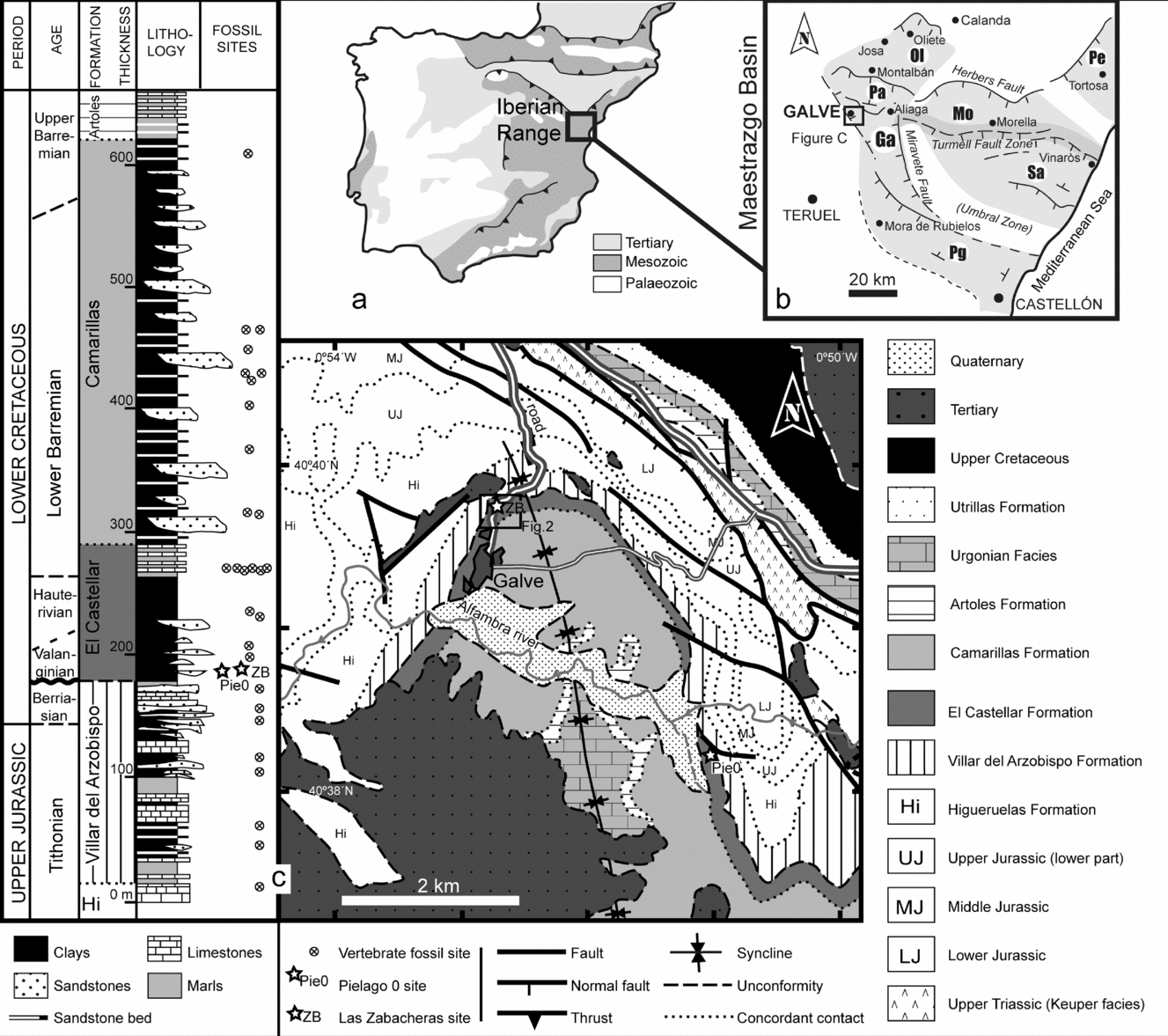
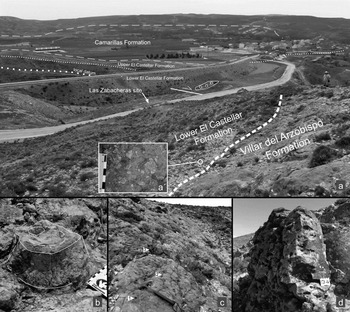
Las Zabacheras, the type-locality of Aragosaurus, is located 500 m north of Galve (Teruel province) in NE Spain (Fig. 1). It is placed in the western limb of the so-called Galve syncline, which is in turn located in the Central Iberian Range. The fossil level crops out on the embankment of what used to be a road, which is now partially covered with landfill and rubble (Fig. 2a).
Geographical and geological location of Galve (Teruel, Spain). (a) Simplified geological map of the Iberian Peninsula. (b) Palaeogeographic sub-basins (Ol – Oliete, Pa – Las Parras, Ga – Galve, Mo – Morella, Pe – Perelló, Sa – Salzedella, Pg – Peñagolosa) within the Maestrazgo basin and active faults during Early Cretaceous sedimentation, modified from Salas et al. (Reference Salas, Guimerà, Más, Martín-Closas, Meléndez and Alonso2001). (c) Stratigraphy of the Wealden facies and geological mapping of the Galve syncline (modified from Díaz-Molina & Yébenes, Reference Díaz-Molina and Yébenes1987).

Photographs of outcrops of the Galve syncline. (a) Panoramic view of the area around the site of Las Zabacheras, with the village of Galve in the background, with the main stratigraphic horizons marked. (a′) Detail view of the basal conglomerates of the lower El Castellar Formation. (b) Dinosaur caudal vertebra cropping out in the karstified surface located in the uppermost part of the Villar del Arzobispo Formation in the Las Cerradicas section. (c) Karstified surface of the carbonated top part of the Villar del Arzobispo Formation near the site of Las Zabacheras, indicating various structures generated in the discontinuity: small perforations (1), ferruginization (2) and broad depressions (3). (d) The karstified top of the Villar del Arzobispo Formation on the other flank (east) of the Galve syncline.

The Lower Cretaceous of the Iberian Range in the eastern part of the province of Teruel is part of the Maestrazgo Basin, which is further divided into seven sub-basins, one of which is the Galve sub-basin (Salas et al. Reference Salas, Guimerà, Más, Martín-Closas, Meléndez and Alonso2001). The Galve sub-basin is oriented NNW–SSE, and is 40 km long and 20 km wide (Fig. 1b). It was formed as a consequence of the Latest Jurassic–Early Cretaceous extensional deformation of the Iberian rift (Liesa et al. Reference Liesa, Soria, Meléndez and Meléndez2006). The Galve syncline is located in the northwestern part of the Galve sub-basin (Fig. 1). Marine, continental and transitional sediments of Tithonian (Late Jurassic) to the early Aptian age crop out in this syncline (Díaz-Molina & Yébenes, Reference Díaz-Molina and Yébenes1987). The lithostratigraphic units that are richest in fossil vertebrates are the Villar del Arzobispo Formation, the El Castellar Formation and the Camarillas Formation (Sanz et al. Reference Sanz, Buscalioni, Casanovas and Santafé1987; Canudo & Cuenca, Reference Canudo and Cuenca1996; Ruiz-Omeñaca et al. Reference Ruiz-Omeñaca, Canudo, Aurell, Badenas, Cuenca-Bescós and Ipas2004; Canudo et al. Reference Canudo, Ruiz-Omeñaca, Aurell, Barco and Cuenca-Bescós2006), ranging from late Tithonian to Barremian in age (Fig. 1).
During the Late Jurassic–Early Cretaceous rifting stage, differential subsidence in the Galve sub-basin was caused by the reactivation of structural grain and the formation of NW–SE and NE–SW normal faults (Soria de Miguel, Reference Soria de Miguel1997; Liesa et al. Reference Liesa, Soria, Meléndez and Meléndez2006). This normal fault activity was non-continuous, leading to the formation of a widespread angular unconformity between the Villar del Arzobispo and El Castellar formations. Associated with this unconformity is a stratigraphic gap, traditionally dated as Berriasian–Hauterivian, in the Galve sub-basin (Liesa et al. Reference Liesa, Soria, Meléndez and Meléndez2006).
The Villar del Arzobispo Formation represents the last stage of development of the Jurassic marine platform, with its record of shallow-marine to coastline environments that mark the transition between marine and continental units. Near Galve, the unit consists of a 160 m thick clastic-dominated succession (i.e. cross-bedded and rippled sandstones and red clays) including interbedded bioclastic-rich carbonate levels (benthic forams, bivalves, echinoderms, peloids), formed after successive marine incursions over the coastal plain. In the middle and upper parts of the Villar del Arzobispo Formation, there are levels with dinosaur tracks (Pérez-Lorente et al. Reference Pérez-Lorente, Cuenca-Bescós, Aurell, Canudo, Soria and Ruiz-Omeñaca1997), sauropods such as Galvesaurus (Barco et al. Reference Barco, Canudo, Cuenca-Bescós and Ruiz-Omeñaca2005) and theropods (Canudo et al. Reference Canudo, Ruiz-Omeñaca, Aurell, Barco and Cuenca-Bescós2006). The age of the unit is constrained by the first appearance of the benthic foraminifer Anchispirocyclina lusitanica in the upper part of the previous marine unit (i.e. the lower–middle Tithonian Higueruelas Formation; see Aurell et al. Reference Aurell, Robles, Bádenas, Quesada, Rosales, Meléndez and García-Ramos2003, Reference Aurell, Bádenas, Ipas, Ramajo, van Buchem, Gerdes and Esteban2010). On the other hand, the Jurassic–Cretaceous boundary is assumed to be located near the top of the unit in the light of the correlation with the more open, eastern domains of the basin (Bádenas, Salas & Aurell, Reference Bádenas, Salas and Aurell2004). Accordingly, the most probable age traditionally considered for the Villar del Arzobispo Formation in Galve is middle Tithonian–upper part of the early Berriasian (Díaz-Molina et al. Reference Díaz-Molina, Yébenes, Goy and Sanz1985; Canudo et al. Reference Canudo, Ruiz-Omeñaca, Aurell, Barco and Cuenca-Bescós2006, Aurell et al. Reference Aurell, Bádenas, Ipas, Ramajo, van Buchem, Gerdes and Esteban2010, and this work). In a sampling taken from a carbonate level situated close to the top of the formation near the site of Las Zabacheras, the charophyte Globator maillardii incrassatus was recovered. This characterizes a charophyte biochronozone that is from the upper part of the early Berriasian or middle Berriasian in age (sensu Riveline et al. Reference Riveline, Berger, Feist, Martín-Closas, Schudack and Soulié-Märsche1996). The Villar del Arzobispo Formation is overlain by a low-angle unconformity, which will be described in detail in Section 5.b. The unconformity is also marked by an important lithological and environmental change, represented by the setting of the continental red clays of the bottom of the El Castellar Formation (Soria de Miguel, Reference Soria de Miguel1997; Pérez-Lorente et al. Reference Pérez-Lorente, Cuenca-Bescós, Aurell, Canudo, Soria and Ruiz-Omeñaca1997). This unit represents the first syn-rift unit included in the Wealden facies of the Galve sub-basin. This formation has two clearly differentiated parts (Fig. 2a). The lower El Castellar Formation is an alluvial unit (50–90 m thick) with great lithological heterogeneity, mainly consisting of lutites, sandstones and conglomerates. The upper El Castellar Formation comprises burrowed palustrine–lacustrine marly limestones (35–50 m thick) typical of a lacustrine system in phases of expansion and retraction (Meléndez et al. Reference Meléndez, Liesa, Soria and Meléndez2009). As further justified in Section 5, the locality of Las Zabacheras is located in yellow-grey shales of the lower El Castellar Formation (Fig. 2a). Laterally these become silts within a section that is predominantly lutitic and red in colour.
The Camarillas Formation conformably overlies the El Castellar Formation. This represents a significant lithological change, being composed mainly of red clays and white sands at its base, deposited in a fluvial environment with a certain marine influence (Schudack & Schudack, Reference Schudack and Schudack2009). This formation is Barremian in age, according to the recorded charophyte association (Díaz-Molina & Yébenes, Reference Díaz-Molina and Yébenes1987).
3. On the discoveries of Aragosaurus and its systematic position
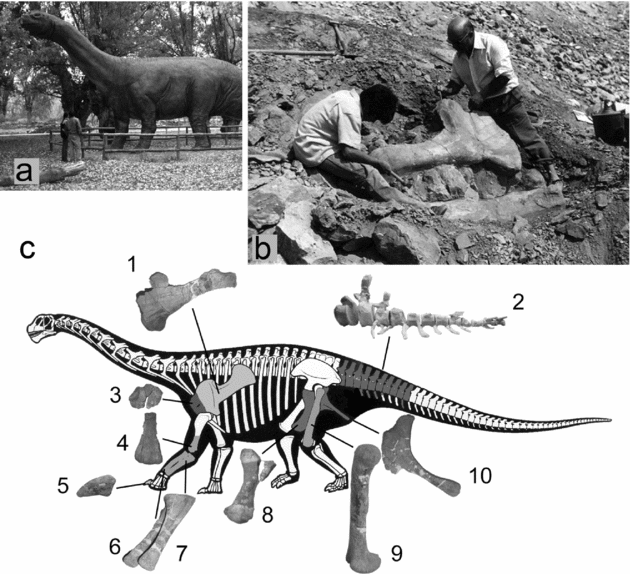
The first fossil remains from Las Zabacheras were found in 1958 by a local amateur palaeontologist from Galve by the name of José María Herrero Marzo (Fig. 3b). Lapparent (Reference Lapparent1960) published a first study, in which he referred to a new camarasaurid sauropod, though he did not go so far as to name it formally. Sanz et al. (Reference Sanz, Buscalioni, Casanovas and Santafé1987) defined it under the name Aragosaurus ischiaticus, this being the first dinosaur to be described in Spain (Fig. 3). These authors included it in the family Camarasauridae, in conformity with the ideas of Lapparent (Reference Lapparent1960). The Camarasauridae family also included Brachiosaurinae (Sanz et al. Reference Sanz, Buscalioni, Casanovas and Santafé1987), and accordingly they noted the resemblance it bore to Brachiosaurus, which is currently regarded as the most primitive taxon in the clade Titanosauriformes (Salgado, Coria & Calvo, Reference Salgado, Coria and Calvo1997).
The sauropod Aragosaurus ischiaticus. (a) Life-size model of Aragosaurus located on the Alfambra riverbank, near the village of Galve. (b) The extraction of the right scapula in the site of Las Zabacheras by José María Herrero. (c) Preserved postcranial elements of Aragosaurus and their location over the skeletal silhouette of the related sauropod dinosaur Camarasaurus (from Wilson & Sereno, Reference Wilson and Sereno1998): scapula (1), caudal vertebrae and haemal arches (2), coracoid (3), humerus (4), ungual phalanx (5), radius (6), ulna (7), pubis (8), femur (9), ischium (10).

Aragosaurus is a ‘forgotten’ sauropod in modern phylogenetic proposals (Wilson, Reference Wilson2002; Upchurch, Barrett & Dodson, Reference Upchurch, Barrett, Dodson, Weishampel, Dodson and Osmólska2004; Harris, Reference Harris2006), even though a broad range of postcranial elements are preserved. Cervical and dorsal ribs, caudal vertebrae, haemal arches, two scapulae, coracoid, two ischia, pubis, humerus, radius, ulna, femur, carpal bones, metapods and phalanges are known from Aragosaurus (Fig. 3c). Furthermore, Sanz et al. (Reference Sanz, Buscalioni, Casanovas and Santafé1987) assigned to Aragosaurus an isolated tooth found in the vicinity of Las Zabacheras (previously described in Sanz, Reference Sanz1982). Upchurch, Barrett & Dodson (Reference Upchurch, Barrett, Dodson, Weishampel, Dodson and Osmólska2004) regard Aragosaurus as lacking the diagnostic characters necessary to be able to locate it in the main clades, classifying it as Eusauropoda indet. Nonetheless, Aragosaurus presents derived characters that allow greater precision in pinpointing its phylogenetic position. The pubis and ischium have been figured and described by Sanz et al. (Reference Sanz, Buscalioni, Casanovas and Santafé1987) and Royo-Torres, Canudo & Ruiz-Omeñaca (Reference Royo-Torres, Canudo, Ruiz-Omeñaca and Rábano1999). The great development of the pubo-ischiatic symphysis allows it to be included in the clade Camarasauromorpha of Salgado, Coria & Calvo (Reference Salgado, Coria and Calvo1997) or in the clade Camarasaurus + Titanosauriformes of Wilson & Sereno (Reference Wilson and Sereno1998). In these terms, it is a macronarian neosauropod. The pubis and the ischium of Aragosaurus are of virtually the same length, which excludes it from Titanosauria (Salgado, Coria & Calvo Reference Salgado, Coria and Calvo1997; Royo-Torres, Canudo & Ruiz-Omeñaca, Reference Royo-Torres, Canudo, Ruiz-Omeñaca and Rábano1999). The femur presents a well-developed lateral bulge in a proximolateral position (Sanz et al. Reference Sanz, Buscalioni, Casanovas and Santafé1987) and a lateromedially displaced articular head (Canudo et al. Reference Canudo, Barco, Royo-Torres, Ruiz-Omeñaca, Meléndez, Herrera, Delvene and Azanza2001). These characters of the proximal part of the femur are diagnostic of Titanosauriformes and suggest that Aragosaurus should be included in this clade (Salgado, Coria & Calvo, Reference Salgado, Coria and Calvo1997; Wilson & Carrano, Reference Wilson and Carrano1999; Canudo et al. Reference Canudo, Barco, Castanera and Torcida Fernández-Baldor2010).
Recently, Royo-Torres (Reference Royo-Torres, Huerta Hurtado and Torcida Fernández-Baldor2009b) has suggested that Aragosaurus, together with Lourinhasaurus and Tastavinsaurus, should be included in Laurasiformes, a clade of non-titanosauriform macronarians. Lourinhasaurus and Tastavinsaurus are two Iberian sauropods from the Late Jurassic and the Early Cretaceous, respectively (Antunes & Mateus, Reference Antunes and Mateus2003; Canudo, Royo-Torres & Cuenca-Bescós, Reference Canudo, Royo-Torres and Cuenca-Bescós2008). The drawback of this proposal is that the character matrix used does not include the cranium or the cervical vertebrae. It would thus be necessary to include these characters to demonstrate the existence of this clade.
Regardless of these discussions of detail, it is important to stress that Aragosaurus is an exceedingly interesting taxon for resolving such a little-known part of the sauropod cladogram as that of the basal macronarians and non-titanosaurian titanosauriforms. Its uniqueness makes the correct dating of the type-locality of Aragosaurus a question of fundamental importance, with direct repercussions upon the construction of evolutionary and palaeobiogeographical hypotheses for this group.
4. On the stratigraphic and chronological position of Aragosaurus
The Aragosaurus holotype has been situated in the Wealden facies ever since the first cartographical work on the Galve syncline. Lapparent (Reference Lapparent1960) located Las Zabacheras at the base of the Wealden sequence, dating it to the Neocomian. Gautier (Reference Gautier1980) published the first detailed stratigraphical work. For Gautier, the Cretaceous begins with an essentially detritic complex ‘of Wealden facies’, within which he distinguishes two units. The first unit is the ‘dark formation’, comprising a detritic lower level with conglomerate at its base (lower El Castellar Formation) and an upper level of limestones and blackish marls with a great quantity of charophytes (upper El Castellar Formation). The charophyte and ostracod associations allowed these carbonate levels to be dated as Hauterivian–basal Barremian. The second unit is the ‘red detritic series’, consisting of generally reddish quartz-micaceous clays, with intercalations of sandstones and sands, which Gautier (Reference Gautier1980) dated as early Barremian on the basis of its stratigraphic position. This ‘red series’ is the Camarillas Formation.
Díaz-Molina et al. (Reference Díaz-Molina, Yébenes, Goy and Sanz1985) and Díaz-Molina & Yébenes (Reference Díaz-Molina and Yébenes1987) differentiated six units in their study of the facies of the Upper Jurassic and Lower Cretaceous of the Galve syncline. Units 1 and 2 correspond to the Higueruelas Formation and the Villar del Arzobispo Formation, respectively. Unit 3 is the lower El Castellar Formation (i.e. stage 1 of Liesa et al. Reference Liesa, Soria, Meléndez and Meléndez2006). Díaz-Molina et al. (Reference Díaz-Molina, Yébenes, Goy and Sanz1985) considered this unit (and Aragosaurus) to be Hauterivian? in age. Unit 4 is equivalent to the upper El Castellar Formation (i.e. stage 2 of Liesa et al. Reference Liesa, Soria, Meléndez and Meléndez2006). In Unit 4, Díaz-Molina & Yébenes (Reference Díaz-Molina and Yébenes1987) described a charophyte association of the early Barremian. Unit 5, which is fundamentally detritic, corresponds to the Camarillas Formation. Above these, Unit 6 marks the start of the Urgon facies represented by the Artoles Formation. This is the chronostratigraphic scenario that has been followed by the authors that have studied the fossil fauna and geology of Galve over the last years (e.g. Sanz et al. Reference Sanz, Buscalioni, Casanovas and Santafé1987; Ruiz-Omeñaca et al. Reference Ruiz-Omeñaca, Canudo, Aurell, Badenas, Cuenca-Bescós and Ipas2004).
The interpretation by Royo-Torres et al. (Reference Royo-Torres, Cobos, Luque, Aberasturi, Espílez, Fierro, González, Mampel and Alcalá2009) of the stratigraphic position of Las Zabacheras is significantly different. These authors attribute what has traditionally been regarded as the lower El Castellar Formation at Galve (and the locality of Las Zabacheras) to the upper part of the Villar del Arzobispo Formation. They do not provide any new cartographical or stratigraphic data, but base their conclusion on the criterion of the lithological similarity between the red clays and sandstones of the Villar del Arzobispo Formation in the area of Riodeva (Teruel) and those of the lower levels of the El Castellar Formation at Galve. Royo-Torres et al. (Reference Royo-Torres, Cobos, Luque, Aberasturi, Espílez, Fierro, González, Mampel and Alcalá2009) locate the boundary between these two formations in a detritic level situated at the base of the upper El Castellar Formation. In these terms, the locality of Las Zabacheras would be late Tithonian–early Berriasian in age.
5. New data on the stratigraphic and geological mapping around Las Zabacheras
The boundary between the marine facies of the end of the Jurassic cycle and the alluvial and palustrine facies deposited at the onset of the Early Cretaceous cycle is recognized over broad areas of the Iberian Range as a significant unconformity. It generally consists of a karstification surface associated with a stratigraphic gap of variable amplitude, at many points a marked angular unconformity (Liesa et al. Reference Liesa, Soria, Meléndez and Meléndez2006; Aurell et al. Reference Aurell, Robles, Bádenas, Quesada, Rosales, Meléndez and García-Ramos2003; Meléndez et al. Reference Meléndez, Liesa, Soria and Meléndez2009). Bearing in mind that the Jurassic cycle ends at Galve with mixed siliciclastic-carbonate facies partly similar to the lithology recorded at the lower El Castellar Formation, the above mentioned unconformity between the Jurassic and Early Cretaceous cycles may go unnoticed. For this reason, a detailed field study and photogeological study have been carried out to characterize this unconformity in the vicinity of the site of Las Zabacheras (Figs 2, 4, 5).
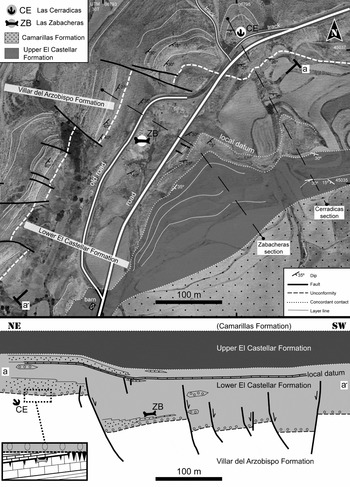
Photogeological sketch map based on 1:3000 aerial photograph of the outcrops in the vicinity of the site of Las Zabacheras, the type-location of the sauropod Aragosaurus ischiaticus; and geological section for the Barremian Stage, including the system of faults identified in the aerial photograph and in field work.

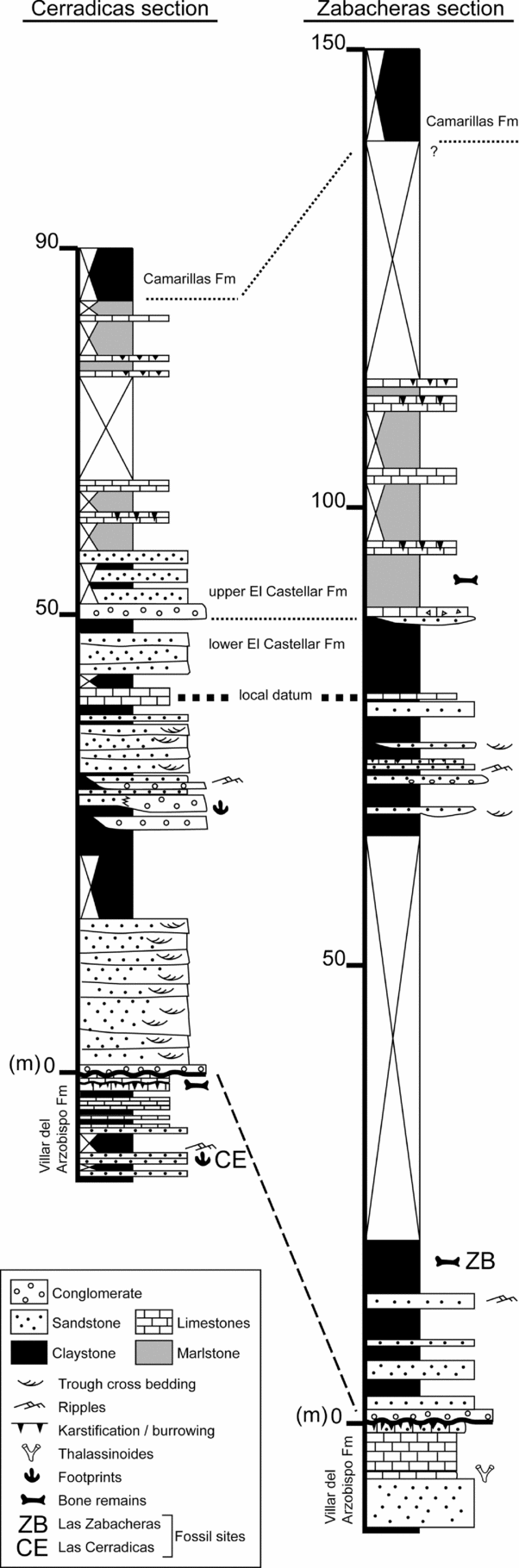
Detailed stratigraphic sections of the El Castellar Formation in the area of the sites of Las Zabacheras and Las Cerradicas; localization of the sections indicated in Figure 4.

The work area is a sector of approximately 500 × 500 m (see location within Fig. 1c). This corresponds to the west flank of the Galve syncline in transition towards the periclinal closure. The oldest material (Jurassic) crops out from west to east towards the most modern (Barremian). A series of measurements of direction and dip were taken over the whole study area (Fig. 4), in particular in the areas where stratigraphic profiles have been drawn. The series dips towards the SE at an average inclination of some 30–35°. Geological mapping was based on field work and analysis of aerial photos (1:3000 scale). Some of the reference stratigraphic horizons used in the geological mapping were identified and used for correlation within the two logged sedimentary successions (Figs 4, 5). These reference horizons were the discontinuity at the top of the Villar del Arzobispo Formation, a continuous carbonate level within the lower El Castellar Formation, which we used as a local guide level (local datum), the boundary between the lower and the upper El Castellar Formation, and the boundary between the El Castellar Formation and the Camarillas Formation. This boundary is generally covered in the work area, yet its trace can be deduced on the basis of the grey–red colour contrast between the units lying below and above it, respectively (Fig. 4).
5.a. Synsedimentary faults
Geological mapping shows the presence of synsedimentary faults trending ENE–WSW, which affected the deposition of the El Castellar Formation (see Figs 2, 4, 5). These faults shifted the discontinuity of the Villar del Arzobispo Formation, and their traces were fossilized by the upper part of the El Castellar Formation. In the outcrops they are observed as mechanical contact with red lutitic facies, sandstones and ochre and grey carbonates. The upper part of the lower El Castellar Formation includes a carbonated bed that is continuous at outcrop scale. This bed is not affected by the synsedimentary faults, and for this reason it was used as a local datum. This system of normal faults is represented in the geological section of the lower El Castellar Formation (Fig. 4). They may be interpreted as intrabasinal faults, which are mainly synthetic faults with the hangingwall to the south, as well as some antithetic faults.
The Villar del Arzobispo Formation is the pre-rift series, whereas the unconformity between the Villar del Arzobispo Formation and the El Castellar Formation is the pre-rift unconformity. This model implies that the activity of the synsedimentary faults could have produced appreciable lateral changes in thickness to both sides of the same fault. However, these changes in thickness should not be present below the pre-rift unconformity. In order to verify this, we studied two detailed local stratigraphic sections separated by tens of metres on either side of the most important normal fault (see location in Fig. 4). The Las Cerradicas section represents the deposits in the footwall block, and the Las Zabacheras section represents the deposits in the hangingwall block. The thickness in the upper two parts of the Villar del Arzobispo Formation is the same in both sections (Fig. 5). Nevertheless, the difference of thickness in the lower El Castellar Formation is almost 40 m. The local datum is situated 41 m from the base of the unit in the Las Cerradicas section and 79 m from it in the Las Zabacheras section (Fig. 5). The syn-rift deposits of the upper El Castellar Formation also show differences of 20 m depth, so these faults were still active during the deposition of this unit.
At basin-scale, the general movement of the fault system continued in the upper El Castellar Formation. The fault traces do not affect the local datum in the area of Las Zabacheras, yet the fault activity continued to produce selective subsidence, which was greater in the semi-graben depression formed by the local system of normal faults.
The tectonic and sedimentary features of the model proposed by Liesa et al. (Reference Liesa, Soria, Meléndez and Meléndez2006) for the Galve sub-basin (Fig. 6) can be seen at outcrop level in the area mapped around the site of Las Zabacheras. Characterizing the series that includes the site of Las Zabacheras (lower El Castellar Formation) as a syn-rift unit affected by a system of local faults provides a sound basis for locating Aragosaurus ischiaticus within the lower El Castellar Formation (i.e. at the onset of the Early Cretaceous cycle).
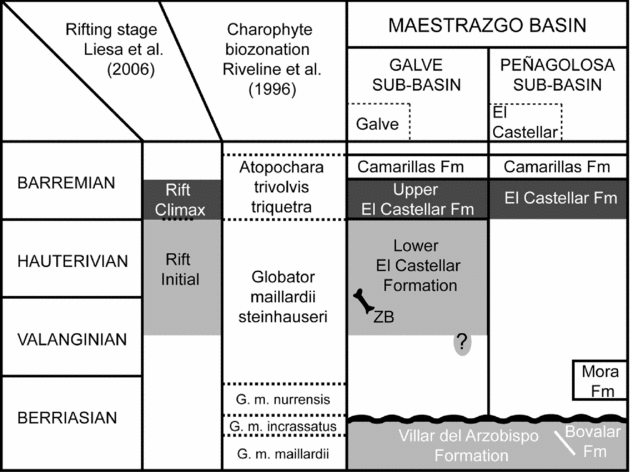
Chronostratigraphic framework for the western Maestrazgo Basin during the deposition of the Wealden facies, Early Cretaceous rifting stage; the chronolithostratigraphic diagram is integrated with available data for the depositional sequences, the rifting model for the Galve sub-basin and the charophyte biozonation.

5.b. On the discontinuity between the Villar del Arzobispo and El Castellar formations
The contact between the Villar del Arzobispo Formation and the El Castellar Formation at Galve is a low-angle unconformity, formed after block tilting and erosion at the onset of the Early Cretaceous cycle (see detail view of section a–a′ in Fig. 4). The top of the Villar del Arzobispo Formation presents variations from NE to SW in the vicinity of Las Zabacheras. Towards the NW, the top comprises grey limestones with a karstification surface in which vertebrate remains have been found (Fig. 2b). Above this, laminated grey limestones crop out, which do not appear laterally further south. Towards the SW, the top part of the Villar del Arzobispo Formation presents different lithologies and facies that change within just a few metres. Detritic limestones, limestones with poorly-preserved dinosaur tracks and limestones with Thalassinoides have thus been identified. The top parts of these carbonate levels are karstified (Fig. 2c). In some cases this karstification is intense, exploiting the organic bioturbation or generating decimetre-sized depressions. Karstified surfaces tend to show processes of ferruginization, so reddish surfaces are abundant (Fig. 2c). This karstified surface can be recognized regionally. It has been identified on the other side of the Galve syncline (Fig. 2d) and even in other outcrops in the Galve sub-basin (e.g. outcrops close to Aguilar de Alfambra). This we interpret as evidence of the tilting of the pre-rift series, with erosion, karstification and ferruginization in elevated areas as opposed to the sedimentation of other parts that are better protected from weathering.
The irregularity in the topography of the top part of the Villar del Arzobispo Formation produces lateral variation in the basal conglomerate of the El Castellar Formation (Fig. 2a). This conglomerate shows a certain degree of continuity, though in some areas it laterally becomes sandstones and lutites. The matrix-supported conglomerate is formed by heterometric and sub-angular limestone pebbles. It presents oxidized fossil wood fragments and isolated unidentifiable bony remains. Above the conglomerate lies the typical Wealden facies comprising clays and sandstones in alluvial facies with no marine fossils. It is some 10 m above the basal conglomerate that Las Zabacheras is located (Fig. 5).
6. On the age of the El Castellar Formation at Galve
6.a. Charophytes
The type-section of the El Castellar Formation is located in the sub-basin of Peñagolosa, 30 km to the south of Galve. Martín-Closas (unpub. Ph.D. thesis, Universitat de Barcelona, 1989) described several charophyte associations in this section, the oldest of which were found in a level located immediately above the conglomerates and sandstones of the base of the formation. He studied two samples from the upper, marly-calcareous section and complemented this with two further samples taken from nearby outcrops, situated stratigraphically beneath the marl–limestone alternations. In the type section he recognized two biozones: the lower part he assigned to the Ancora–Trochiliscoides Zone, which is Hauterivian? in age; the upper part he included in the Triquetra–Neimongolensis Biozone (Triquetra Subzone), of early Barremian age. The division between these two biozones represents the transition from associations where Atopochara trivolvis triquetra is accessory (basalmost sample) to associations where Atopochara trivolvis triquetra is dominant. Accordingly, Martín-Closas (unpub. Ph.D. thesis, Universitat de Barcelona, 1989) did not make use of first appearances in these biozones.
Riveline et al. (Reference Riveline, Berger, Feist, Martín-Closas, Schudack and Soulié-Märsche1996) proposed a charophyte biozonation for the Oxfordian–Turonian time interval. The Atopochara trivolvis triquetra Zone was first formally defined in this paper as the interval from the first occurrence of Atopochara trivolvis triquetra to the first occurrence of Ascidiella cruciata. The age assigned is early Barremian and the lower part of the late Barremian. Nevertheless, Combes, Glacon & Grambast (Reference Combes, Glacon and Grambast1966) found the taxa characteristic of this biozone with the foraminifer ‘Palaeodictyoconus’ cuvillieri, which is late Hauterivian to middle late Barremian in age. Taking this into account, Riveline et al. (Reference Riveline, Berger, Feist, Martín-Closas, Schudack and Soulié-Märsche1996) argued that the first appearance of Atopochara trivolvis triquetra would have been in the late Hauterivian. This constitutes a contradiction with respect to the age proposed by these authors in the same paper for the lower boundary of the biozone (early Barremian). In a recent paper, Martín-Closas et al. (Reference Martín-Closas, Clavel, Schroeder, Charollais and Conrad2009) have regarded the Atopochara trivolvis triquetra Zone as early Barremian.
Atopochara trivolvis triquetra is present in all the samples from the series of the type area, even the most basal. Accordingly, the type-series of El Castellar is included in the Atopochara trivolvis triquetra Zone. As such, in this locality and possibly in the whole of the Peñagolosa sub-basin, the El Castellar Formation would be early Barremian in age (Fig. 6). The Camarillas Formation lying above it has charophytes from the Triquetra Zone (Martín-Closas, unpub. Ph.D. thesis, Universitat de Barcelona, 1989). This author dated the El Castellar Formation at Galve to the late Hauterivian–early Barremian, on finding a fossil association from the Triquetra Subzone. In accordance with these data, the abundant vertebrate fauna that is found in the formation has been regarded as late Hauterivian–early Barremian (Ruiz-Omeñaca et al. Reference Ruiz-Omeñaca, Canudo, Aurell, Badenas, Cuenca-Bescós and Ipas2004; Badiola, Canudo & Cuenca-Bescós, Reference Badiola, Canudo and Cuenca-Bescós2011). However, Martín-Closas only studied the charophytes gathered by Gautier (Reference Gautier1980) in the upper part of the formation, and so the Atopochara trivolvis triquetra Biozone has only been recognized in the upper El Castellar Formation (Fig. 6). The correlation of the lower El Castellar Formation at Galve (which includes the locality of Las Zabacheras) with the type-locality of the El Castellar Formation is still an open question. The detritic nature of the lower El Castellar Formation does not favour the presence of charophytes as a way of dating this unit. However, a sample of grey clays located immediately above the local datum (90 m level of the Las Zabacheras section) has produced the charophyte Globator maillardii steinhauseri, characteristic of the Globator maillardii steinhauseri Zone, which is latest Berriasian–late Hauterivian in age.
6.b. Palynological data
The only biostratigraphic information available to date regarding the detritic interval of the lower El Castellar Formation at Galve is the pollen study of Piélago 0 (Díez et al. Reference Díez, Pons, Canudo, Cuenca and Ferrer1995). This site is located in a carbonated detritic level some 10 m above the base of the formation, in a stratigraphic position very close to Las Zabacheras. However, the location of the sites of Las Zabacheras and Piélago 0 on different flanks of the Galve syncline (Fig. 1), as well as the lateral thickness and facies variation displayed in the lower part of the unit, rule out a level-to-level correlation.
The fossil spore association at Piélago 0 consists of the genera Cyathidites, Deltoidospora, Concavissimisporites, Leptolepidites, Impardecispora, Trilobosporites, Cicatricosisporites, Cingulatisporites and Contignisporites. The pollens are represented by Speripollenites, Podacarpides and Classopollis. Particularly abundant is the pollen of the gymnosperm Classopollis, which represents more than 85% of the association. The abundance of Classopollis, the good representation of Trilobosporites, the presence of Impardecispora and the absence of angiosperms allow this level to be dated to Valanginian–Hauterivian (Díez et al. Reference Díez, Pons, Canudo, Cuenca and Ferrer1995).
6.c. Dinosaur fossil record
The presence of ‘Jurassic-like faunas’ in the lower part of the El Castellar Formation at Galve is one of the arguments drawn upon in order to include Las Zabacheras in the Villar del Arzobispo Formation (Royo-Torres et al. Reference Royo-Torres, Cobos, Luque, Aberasturi, Espílez, Fierro, González, Mampel and Alcalá2009). The lines of argument are twofold: first, the morphological similarity between the sauropods Aragosaurus and Lourinhasaurus (Antunes & Mateus, Reference Antunes and Mateus2003); second, the presence of stegosaurids in the lower part of the El Castellar Formation at Galve (Pereda Suberbiola et al. Reference Pereda Suberbiola, Galton, Ruiz-Omeñaca and Canudo2005). Continental vertebrates are good biostratigraphic indicators of continental sediments, particularly for the Cenozoic and Quaternary. Their value decreases for the Mesozoic on account of the scarcity of more or less continuous records that would allow first and last appearances to be clearly identified. A good example of this is the dinosaur fossil record of the Iberian Range, which is too fragmentary to be used for biostratigraphical purposes at present.
Royo-Torres et al. (Reference Royo-Torres, Cobos, Luque, Aberasturi, Espílez, Fierro, González, Mampel and Alcalá2009) defend the Jurassic affinity of Aragosaurus on the basis of a cladistic analysis published by Royo-Torres (Reference Royo-Torres2009a, Reference Royo-Torres, Huerta Hurtado and Torcida Fernández-Baldorb). In this analysis, Aragosaurus forms a clade together with Lourinhasaurus, a sauropod from the Kimmeridgian of Portugal (Antunes & Mateus, Reference Antunes and Mateus2003). This claim is based on an analysis of a clade of non-titanosauriform macronarians designated Laurasiformes by Royo-Torres (Reference Royo-Torres2009a, Reference Royo-Torres, Huerta Hurtado and Torcida Fernández-Baldorb). This clade in turn consists of the clade Aragosaurus + Lourinhasaurus and the clade Cedarosaurus + (Tastavinsaurus + Venenosaurus). Royo-Torres thus notes a dichotomy between a group of sauropods of an age ranging from Barremian (Cedarosaurus) to Aptian (Tastavinsaurus and Venenosaurus), which he considers to be an exclusively Cretaceous group, and another group with ‘Jurassic affinities’, in which he includes Lourinhasaurus (Kimmeridgian) and Aragosaurus (Tithonian–Berriasian, for Royo-Torres et al. Reference Royo-Torres, Cobos, Luque, Aberasturi, Espílez, Fierro, González, Mampel and Alcalá2009). However, morphological similarity and phylogenetic relationships are not sufficient criteria for establishing chronological relationships, especially taking into account the scarce record of the clade of Laurasiformes. On the one hand, Laurasiformes are present well into Early Cretaceous time. On the other hand, the common ancestor of all Laurasiformes has to be Kimmeridgian in age or older. Neither of these facts implies the possibility that Aragosaurus is anything other than Valanginian–Hauterivian in age, having preserved certain primitive features characteristic of the ancestors of its clade.
Together with sauropods, the stegosaurids are the most abundant dinosaur remains in the Villar del Arzobispo Formation (Cobos et al. Reference Cobos, Royo-Torres, Luque, Alcalá and Mampel2010), yet this does not mean that they are exclusive to this formation. Indeed, they have been cited at various localities of the European Lower Cretaceous since last century (Galton & Upchurch, Reference Galton, Upchurch, Weishampel, Dodson and Osmólska2004; Billon-Bruyat, Mazin & Pouech, Reference Billon-Bruyat, Mazin and Pouech2010). The presence of an isolated dermal spine at the site of La Canaleta in the lower part of the El Castellar Formation at Galve (Pereda Suberbiola et al. Reference Pereda Suberbiola, Galton, Ruiz-Omeñaca and Canudo2005) is thus not an argument indicating the ‘Jurassic’ affinity of this part of the formation. Rather, it should be emphasized that stegosaurids are found at Galve until the early Barremian of the Camarillas Formation (Pereda Suberbiola et al. Reference Pereda Suberbiola, Galton, Ruiz-Omeñaca and Canudo2005).
7. Discussion and conclusions
Stratigraphic and geological mapping analysis on the western limb of the Galve syncline (Central Iberian Ranges, NE Spain) has made it possible to precisely locate the type-locality of the sauropod Aragosaurus ischiaticus in the lower part of the El Castellar Formation. The type-locality is located 20 m above the regional unconformity developed between the Jurassic and Early Cretaceous cycles. This discontinuity surface is developed in Galve above the last levels with a marine influence that characterizes the Villar del Arzobispo Formation (late Tithonian–upper part of the early Berriasian). The presence of a karstification surface associated with a basal conglomeratic level and a low-angle unconformity produced after block tilting and erosion at the onset of the Early Cretaceous cycle, are the main arguments used to differentiate the top of the Villar del Arzobispo Formation from the base of the El Castellar Formation at Galve.
The El Castellar Formation at Galve presents two clearly differentiated parts: the ‘lower El Castellar Formation’ represents an initial rift phase, with compartmentalization of the deposition area and a variable sedimentation rate; the ‘upper El Castellar Formation’ constitutes the transition to the rift climax phase, with homogenization of the sedimentation rate, which increases notably. As such, the El Castellar Formation at Galve, as it has traditionally been considered, represents a sedimentary unit without major unconformities.
Taking into account its palaeopalynological content and the criterion of stratigraphic continuity, the lower El Castellar Formation in the Galve sub-basin is Valanginian p.p.–Hauterivian in age (Fig. 6). Dating by charophytes allows the upper El Castellar Formation to be considered early Barremian in age and the Camarillas Formation Barremian in age (early Barremian and lower part of the late Barremian). These two formations, the upper El Castellar Formation and the Camarillas Formation, are included in the Atopochara trivolvis triquetra Zone (Fig. 6).
Accordingly, the most parsimonious dating for the holotype of Aragosaurus ischiaticus is Valanginian p.p.–Hauterivian, making it the only dinosaur of this age described on the Iberian Peninsula.
Acknowledgements
This paper forms part of the projects CGL2007-62469 and CGL2010-16447 and is subsidized by the Spanish Ministry of Science and Innovation, the European Regional Development Fund and the Government of Aragón (‘Grupos Consolidados’ and ‘Dirección General de Patrimonio Cultural’). M.M.A is supported by an FPI grant (BES-2008–005538) from the Spanish Ministry of Science and Innovation; J.M.G. is supported by an FPI grant (B064/08B) from the Government of Aragón. Rupert Glasgow translated to the text into English. The comments of Xabier Pereda Suberbiola and an anonymous reviewer improved the original manuscript.