Introduction
This article’s central premise is that discourses in their construction of policy ‘problems’ ultimately then shape the ‘solutions’ – in this case, policy and practice related to care and support for older adults and their carers. ‘Adult social care’ (ASC) is a specific policy field in England, focused on support to older and disabled people with ‘eligible needs’ and with assets below a certain threshold (Hall et al. Reference Hall, Needham, Hamblin, Ellison and Haux2020). Support for older adults accounts for more than half of all spending on social care in England (NHS Digital 2023),Footnote 1 with population ageing and the gap between life expectancy and healthy/disability-free life expectancy increasing the demand for statutory care provision (Hamblin Reference Hamblin2020). It is a sector that is in a seemingly perpetual state of ‘crisis’, chaos and neglect – evident in rising unmet care needs, lack of capacity in the workforce, and poor working conditions and low pay (Glasby Reference Glasby2021; Turnpenny and Hussein Reference Turnpenny and Hussein2021). The crisis in part reflects trends across the globe (Keating et al. Reference Keating, McGregor and Yeandle2021), but is also exacerbated by political decision-making (Glasby et al. Reference Glasby, Zhang, Bennett and Hall2021). Public spending on the care sector has not kept pace with demand: prior to the 2020 Covid-19 pandemic, spending in real terms per person in England was lower than in 2010/11 (Bottery and Ward Reference Bottery and Ward2021).
Policy makers and sector stakeholders in England (Eccles Reference Eccles2021) and across Europe (Nilsson et al. Reference Nilsson, Andersson, Magnusson and Hanson2022; Pols and Willems Reference Pols and Willems2011), seeking solutions other than increasing spending, have emphasised the potential of technology as part of a solution to care crises. Early use of technology in care provision in the 1960s focused on the remote monitoring of older adults to mitigate risks via ‘telecare’ and support independence via assistive devices. An increasingly wide range of devices and systems is now being used to meet a broader range of outcomes, including to organise care delivery; to record, share and analyse care data; and to facilitate connection and communication with other people (Hamblin Reference Hamblin2022). This evolution is partly due to technological advancement, but also necessitated by the planned ‘digital switchover’, impacting telecare devices that have only analogue capabilities (Hamblin Reference Hamblin2020). Changes in the types of technology used are also driven by policy. National investment in a range of funding programmes open to technology developers, local authorities, care providers and academics supported the development, piloting and implementation of technologies including artificial intelligence (AI), robotics and digital care records (Hamblin Reference Hamblin2022; Wright Reference Wright2021).
This article examines discursive promises made regarding these technologies. We centre our analysis on ASC as a policy area at a national level that has been neglected in terms of concrete reform. The most recent, and long-awaited, white paper (DHSC 2022b) ‘People at the Heart of Social Care’ was widely viewed as an insufficient response to challenges in the sector (Bottery et al. Reference Bottery, Wellings, Varrow and Thorlby2018; Glasby et al. Reference Glasby, Zhang, Bennett and Hall2021; Social Care Leaders 2021). Taking this neglect, uncertainty and delay into account, we approach the English ASC sector as an area ripe for the hopeful, transformative discursive promises offered in discursive technological ‘imaginaries’ – or vulnerable to being ‘shaped’ by interest groups, that is, technology developers. Some of these imaginaries are under-evidenced (Baig et al. Reference Baig, Afifi, GholamHosseini and Mirza2019; Dada et al. Reference Dada, Van der Walt, May and Murray2021; Krick et al. Reference Krick, Huter, Domhoff, Schmidt, Rothgang and Wolf-Ostermann2019; Peetoom et al. Reference Peetoom, Lexis, Joore, Dirksen and De Witte2015; Pu et al. Reference Pu, Moyle, Jones and Todorovic2019; Zigante Reference Zigante2021) or seem at odds with the aspirations and experiences of people receiving and providing care who in practice combine ‘hi-’ and ‘lo-tech’ devices (Gibson et al. Reference Gibson, Dickinson, Brittain and Robinson2015, Reference Gibson, Dickinson, Brittain and Robinson2019; Lariviere et al. Reference Lariviere, Poland, Woolham, Newman and Fox2021; Lynch et al. Reference Lynch, Glasby and Robinson2019; Rolfe et al. Reference Rolfe, McCall, Gibson, Pusram and Robertson2023).Footnote 2
The article opens by emphasising how discourse is ideological. We situate literature on discourse analysis within overarching constructions of power relations under capitalism, and consider how the approach has been applied to the study of care and technology. We then outline the method used here – critical discourse analysis (Fairclough Reference Fairclough2003). The findings sections highlight the solutions and problems emphasised, the means and ends of achieving technology ‘fixes’, and the barriers and alternative solutions omitted. We discuss how discourse delineates technology use in care, precluding other options, and creates limits around the role of the state. The main contribution of the article to social gerontology is thus to illustrate how discourses construct and circumscribe social relations and critically analyse political perspectives on, and promises about, care provision for an ageing population.
Context
Discourse, power and hegemony
This article contains two fundamental assumptions: that discourses (1) shape the way we view our social world and shape the world itself; and (2) are open to manipulation by those with the power and resources to do so. Discursive practices are therefore ‘sites of struggle in that they show traces of differing discourses and ideologies contending and struggling for dominance’ (Wodak Reference Wodak, Wodak and Meyer2002: 10). In what Hajer (Reference Hajer and Metze2006: 70) terms discourse structuration and institutionalisation, particular discourses become dominant in how actors view the world, and discourse thus ‘solidifies into institutions and organisational practices’. Negotiation and capitulation are required between actors, and in such struggles certain discourses are naturalised (Torfing Reference Torfing, Howarth and Torfing2005). Narratives become seen as ‘common sense’ despite being formed by interest groups who benefit from their creation and maintenance, and whose interests are hidden through ‘inculcation’ (Fairclough Reference Fairclough1989).
In this way, discourse forecloses and constrains by activating certain social actors and actions while rendering others passive. Perspectives of interest groups are legitimised as universal, with certain experiences presented as indicative of those of a wider population. This gives the appearance of debate, but only allows weaker counter-arguments to surface. The naturalisation of particular discourses as universal can be understood using conceptualisations of power. Lukes (Reference Lukes1974) describes how the power to act, as well as the power not to act, is possible when the most damaging alternative arguments are ‘organised out’ of debates via discourse. This analysis has been used by Dant (Reference Dant1988) to understand the unequal power relationship and dynamics of dependency between older people and the state, which play out in state policies. We explore these dynamics further by considering how technology alters these power relations and dependencies.
Our approach to discourse also draws upon ideas of ideological hegemony (Gramsci Reference Gramsci, Hoare and Nowell Smith1971), which has been applied to ageing. Salter and Salter (Reference Salter and Salter2018) analyse how descriptions about, and values related to, ageing are hegemonically constructed and ordered through health care, the pharmaceutical industry and nation states. Developing these ideas, Higgs and Gilleard (Reference Higgs and Gilleard2020: 1623) refer to the ‘social imaginary’ of ageing, highlighting an othering of old age that connects to consumer markets and a neoliberal ‘valorisation of choice’. Discourse analysis provides a useful tool for understanding such an imaginary. Fairclough (Reference Fairclough2003: 207) describes how the ‘universal’ interacts with these ‘imaginaries’ of possible social relations and events. The state and the political economy within which it is situated shape these imaginaries: as Fisher’s theory of ‘capitalist realism’ emphasises, ‘what counts as “realistic”, what seems possible at any point in the social field, is defined by a series of political determinations’ (Fisher Reference Fisher2009: 16). The particular political determinations analysed in this article are policy discourses that create and contribute to a hegemony of care ‘crisis’, ageing ‘burden’ and technology solution.
Technology, ageing and care
Technology and the care ‘crisis’ is, we suggest, an interesting illustrative example of how discourse functions to construct and prescribe what is possible. We see the same kinds of argument made in relation to technology as those outlined earlier regarding discourse – both are created and creative, constructing objects, subjects and institutions while at the same time being constructed by them (Hastings Reference Hastings1998; Wodak Reference Wodak, Wodak and Meyer2002). The field of science and technology studies (STS) broadly conceptualises technology as a site of struggle or an ‘ongoing encounter’ (Matthewman Reference Matthewman2017: 8) that is in flux. This literature conceptualises technologies as impacted by and impacting on factors external to their materiality. In the technology encounter, ‘socio-technical imaginaries’ (Jasanoff and Kim Reference Jasanoff and Kim2009) are formed, whereby alternatives and criticisms are excluded in favour of a seemingly ‘collectively held’ normative vision of the role of technology in society. These imaginaries can be emergent from, or reinforced by, discourses.
Technology has been conceptualised as co-constituted with ageing. Preconceived ideas about ageing inform the design of technologies, and in turn the way technologies are developed and configured shapes the experience of ageing (Peine and Neven Reference Peine and Neven2021). The presentation of care as a site of crisis necessarily entails implicitly and/or explicitly defining what care should be. Similarly, the inclusion of technology as a solution is bound up with particular imaginaries of both care and technology itself. Care is itself also a site of contestation (Daly Reference Daly2021), conceptualised as both a universal need (Tronto Reference Tronto1993) and a policy domain or service for which people’s needs and means are assessed prior to access. Even as purely the latter, there is more than one way to ‘do care’ as policy or provision. However, it has been argued that ASC is increasingly dominated by neoliberal agendas (within broader dynamics of neoliberalism [Harvey Reference Harvey2007]) with its hallmarks of marketisation, individualisation and personal responsibility (Simmonds Reference Simmonds and Simmonds2021). In this context, we see contradictions between care and capital made manifest (Fraser Reference Fraser2023).
The way that technology relates to ageing and care, and the aligned imaginaries, has changed with technological advancement. As noted in the introduction, early telecare had served primarily to manage risks related to ‘ageing in place’ whereby ‘button and box’ solutions enabled users of care services to press a button on, for example, a pendant alarm to summon help. Increasingly the input of the user is unnecessary as monitoring devices can communicate automatically when they detect issues and can gather and intelligently analyse data, feeding into imaginaries of preventive as opposed to reactive care for ageing people. Other imaginaries relate to workforce efficiency in the way that data is recorded (and staff are monitored [Hayes and Moore Reference Hayes and Moore2017]) and through implementation of ‘entertainment’ or communication robotics. Such technologies – when afforded by people requiring care, local authorities or care providers – fulfil the purpose of seeming innovative, but can end up altering labour and creating new tasks, rather than alleviating pressures on carers or the workforce (Hamblin Reference Hamblin2022; Oung et al. Reference Oung, Rolewicz, Crellin and Kumpunen2021; Wright Reference Wright2023). In the findings here, we track how policy interest in technology has shifted and increased despite a lack of clarity over its efficacy.
Methods
Discursive analyses
Discursive analysis has been applied to contexts of technology and health, care and ageing. A recent study focused on Sweden (Nilsson et al. Reference Nilsson, Andersson, Magnusson and Hanson2022) examined how discourses construct both older people and health in relation to ‘e-health’ technologies. Using the ‘What’s the Problem Represented to Be’ method (WPR, Bacchi Reference Bacchi2009), Nilsson et al. argue that discourses and how they construct policy ‘problems’ ultimately then shape the ‘solutions’ or services for older adults and their carers. While WPR usefully identifies problems, aims, solutions and assumptions in policy, another approach is to focus on the arguments made by particular groups within discursive contexts. Lynch et al. (Reference Lynch, Glasby and Robinson2019) take a similar approach, using the argumentative discourse analysis (ADA) developed by Hajer (Reference Hajer1995, Reference Hajer and Metze2006) to carry out discourse analysis of an organisational case study (a telecare service run by a local authority). The authors focus on aspirations for the technology, who benefits from interventions and how benefits are ‘realised’, highlighting how complex ‘interpretations’ underlie the misleadingly simple narrative, forming a ‘discourse-coalition’ around the technology. We see a similar method applied by Greenhalgh et al. (Reference Greenhalgh, Procter, Wherton, Sugarhood and Shaw2012) to perspectives on health and care technologies in England. The authors use ADA to look at the ‘organising vision’ (Swanson and Ramiller Reference Swanson and Ramiller1997) across stakeholders and highlight how interest groups exist in an ‘uncomfortable truce with one another’ (Greenhalgh et al. Reference Greenhalgh, Procter, Wherton, Sugarhood and Shaw2012: 11).
We build upon these studies, adopting critical discourse analysis (CDA) as outlined by Fairclough across various texts (Fairclough Reference Fairclough1993, Reference Fairclough2003; Fairclough and Fairclough Reference Fairclough and Fairclough2013), and as utilised by Fealy et al. (Reference Fealy, McNamara, Treacy and Lyons2012) and Lessard et al. (Reference Lessard, Oyinlola and Sussman2024) in this journal to uncover competing discursive constructions of age and ageing. While CDA has similarities with methods described so far in the analyses of problems and coalitions of perspectives, it is focused more on the production and reproduction of political structures and power dynamics through discourse. Fairclough (Reference Fairclough1993) emphasises that CDA goes beyond linguistics to include factors external and internal to the text: he blends ‘interdiscursive analysis’ focused on genres,Footnote 3 discourses and styles with ‘language analysis’ concerned with the lexical, grammatical and semantic construction of texts. Thus, CDA enables us to critically understand the role of discourse in political decision-making surrounding technology and care provision. Fairclough and Fairclough (Reference Fairclough and Fairclough2013: 86–7) also underscore the importance of exploring ‘representation’ within texts and discourse, as ‘premises into reasoning for what we should do’. Applying CDA thus allows us to go beyond grouping perspectives into coalitions and exploring the presentation of problems and their solutions. Instead, we critically analyse the hidden faces of power that construct certain things as ‘common sense’ – and approach all policy discourse as inherently political but as often striving to appear otherwise. Part of the criticality of CDA is that it also focuses on what is missing, or whose perspectives are omitted and how. To further strengthen the analysis of omissions and imaginaries in CDA, we incorporate power not to act (Lukes Reference Lukes1974) and analyse the hegemonic terrain of the ‘real’ (Fisher Reference Fisher2009).
Data selection and analysis
The main form of discourse we examine is policy papers, which frame certain problems as natural and others as political (Hajer Reference Hajer and Metze2006). Our approach to CDA has been anchored by a ‘focus on the argument for action that is being made, starting from a depiction of the context of action and a desirable goal, informed by values’ (Fairclough and Fairclough Reference Fairclough and Fairclough2013: 87). We analysed 28 texts – eight policy publications, two news reports, six speeches, eight press releases and four web pages – published by the Department of Health and Social Care (DHSC) and NHSXFootnote 4 between 2020 and 2022 and relating to England’s ASC sector. This was a key period when reform of adult social care in England was on the policy agenda amid increasing calls for change (Bottery et al. Reference Bottery, Wellings, Varrow and Thorlby2018; Glasby et al. Reference Glasby, Zhang, Bennett and Hall2021; Social Care Leaders 2021). The time frame also includes the Covid-19 pandemic, when ASC was under considerable pressure, and the ‘commonsensical’ case for change was strengthened. To provide insight into discursive representations of technology and care during this period, we selected documents focused primarily on the topic of ASC in England, with some also centred on health provision as a connected policy domain. The news reports, speeches and press releases were selected using the search function on the UK government website (gov.uk). We searched for ‘social care’ in the topic of ‘health and social care’ and the sub-topic of ‘technology in health and social care’ – within ‘news and communications’ and ‘policy papers or consultations’.
In the first stage, we carried out an analysis using dimensions of discourse based on Fairclough (Reference Fairclough2003), using NVivo as a coding tool. The first dimension is the externalities of texts, analysing the social practices, networks, chains and frameworks within which the text is situated, and the characteristics of genres to which the text belongs. Second are the ‘nuts and bolts’, or the how of the documents: the causal or contrastive claims, forms of statements, metaphors and intertextuality through indirect or direct quotation. Taking an abductive approach, we used these categories as anchoring questions. After reading through the sources selected, as co-authors we independently created open codes within the above categories, then cross-compared and discussed our coding frameworks before finalising them.
We made further refinements at this stage (see Appendix Table 2 for coding frame) by drawing on a worked example of discursive elements in texts by Fairclough and Fairclough (Reference Fairclough and Fairclough2013: 45). The authors describe solutions or claims for action as something an ‘Agent (presumably) ought to do’; goal premises as a ‘future state of affairs’ to be achieved; and circumstantial premises regarding the problem and context. Means-goal premises is then used to describe the presumption that the agent taking a particular action will achieve a particular goal, and value premises refers to what the agent intends (or should intend to) achieve (Fairclough and Fairclough Reference Fairclough and Fairclough2013: 45). Other aspects are alternative options and addressing alternative options, that is, are alternatives ignored or argued against? Combined, these discursive elements provide a critical analysis of power. They provide insight into: normalisation and naturalisation of political perspectives and rejections of alternatives; political assumptions over values, problems and allocation of responsibility; and constructions of imaginaries (as goal premises) and representations of reality (as circumstantial premises) (Fairclough and Fairclough Reference Fairclough and Fairclough2013).
Findings
Genres and context
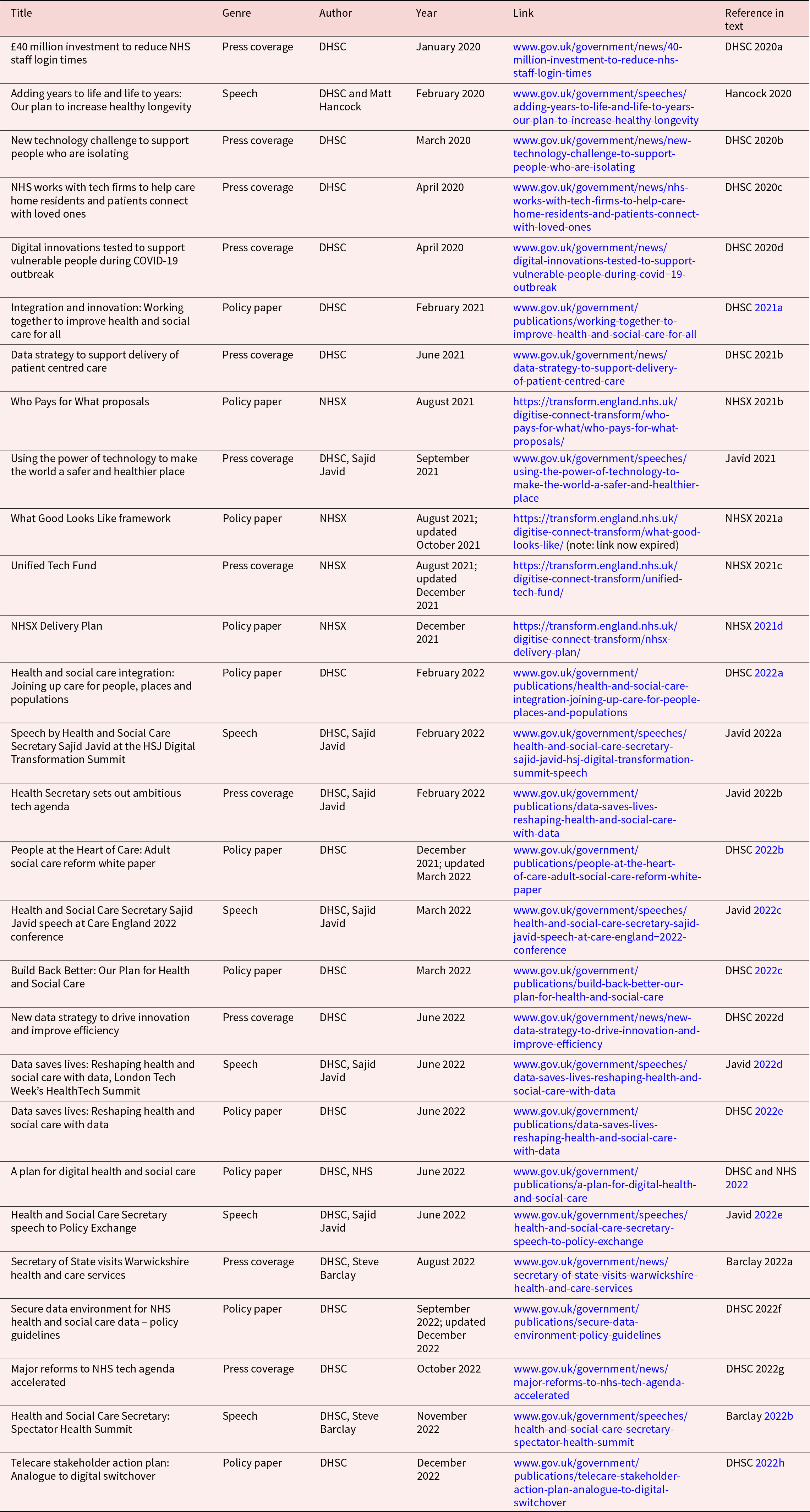
Our analysis began with a focus on the genres of the texts. There are broadly three main genres – policy papers, speeches and press coverage – including releases and news reports published by DHSC (see Table 1). Speeches included here (as texts) are sometimes aligned to the release of a particular policy document and explicitly are or were for a particular audience. Press releases and news reports, too, relate to specific policies or policy documents. The texts we have classified as policy papers are listed variously as white or green papers, (action) plans, strategies or consultations. The difference is, however, nebulous and opaque: white papers are listed in the UK Parliament GlossaryFootnote 5 as being ‘issued by the Government as statements of policy, and often set out proposals for legislative changes’, yet they seemingly overlap with plans and strategies and ‘[s]ome White Papers may invite comments’. The boundary between green papers and consultations is also blurred. The glossary refers to green papers as ‘consultation documents produced by the Government’. The extent to which different policy documents are ‘open’ to the contestation and alternative narratives presented by comments and consultations is therefore legislatively unclear, leaving it open to political interpretation and choice.
Texts analysed and their genres

To turn now to the analysis of the context, social care has been largely neglected in policy making. The Committee of Public AccountsFootnote 6 noted in 2021 that, despite numerous green and white papers and official reviews, ‘care is not properly funded, lacks transparency and urgently needs reform’ (House of Commons Committee of Public Accounts 2021: 3). Former prime minister Boris Johnson pledged in the first speech of his premiership in 2019 that he would ‘fix the crisis in social care once and for all’ (Johnson Reference Johnson2019), yet reform was not immediately forthcoming. The promised green paper included in former chancellor Phillip Hammond’s 2017 spring budget became a white paper and was not launched until December 2021 – to an underwhelmed response from the care sector and academia alike (Oliver Reference Oliver2022; Yeandle Reference Yeandle2021). Other changes announced and then deferredFootnote 7 include a ‘lifetime cap’ of £86,000 on care costs for people in England (DHSC 2022c). September 2021 also saw the announcement of a ‘health and social care levy’ that would raise £5.4bn for social care from increases to National Insurance contributions and dividend tax rates. This, too, was a short-lived policy, repealed a year later before it could come into force in April 2023.
In the absence of wider reform, technology has been an area of investment by central governments in England for over 20 years. The Department of Health report ‘Delivering 21st century IT support for the NHS’ (Department of Health 2002) included the ambitious aim that remote monitoring systems should be in all homes where people needed them by December 2010; the department produced an accompanying strategy in 2005 (‘Building Telecare in England’, Department of Health 2005). This was followed by a significant funding programme – the £80 million Preventative Technology Grant (2006–2008) (Office of the Deputy Prime Minister and Department of Health 2006) which had local authorities ‘bidding’ for an allocation. The fund was not ring-fenced, which resulted in uneven distribution and implementation (Barlow et al. Reference Barlow, Hendy, Chrysanthaki, Glascock and Kutzik2012). Attention then shifted to the creation of an evidence base related to technology and care including large-scale randomised control trials funded by DHSCFootnote 8 (the ‘Whole System Demonstrator Programme’ and ‘Assistive Technology and Telecare to maintain Independent Living At home for people with dementia’). Neither found that ‘telecare’ produced significant cost savings or ‘transformative’ outcomes for those receiving care or carers (Gathercole et al. Reference Gathercole, Bradley, Harper, Davies, Pank, Lam, Davies, Talbot, Hooper, Winson, Scutt, Ordonez Montano, Nunn, Lavelle, Lariviere, Hirani, Brini, Bateman, Bentham, Burns, Dunk, Forsyth, Fox, Henderson, Knapp, Leroi, Newman, O’Brien, Poland, Woolham, Gray and Howard2021; Henderson et al. Reference Henderson, Knapp, Fernandez, Beecham, Hirani, Beynon, Cartwright, Rixon, Doll, Bower, Steventon, Rogers, Fitzpatrick, Barlow, Bardsley and Newman2014; Hirani et al. Reference Hirani, Beynon, Cartwright, Rixon, Doll, Henderson, Bardsley, Steventon, Knapp, Rogers and Bower2014; Steventon et al. Reference Steventon, Bardsley, Billings, Dixon, Doll, Beynon, Hirani, Cartwright, Rixon, Knapp, Henderson, Rogers, Hendy, Fitzpatrick and Newman2013). Indeed, there has been criticism of the policy approach to technology and care in England as ‘ignoring the inconvenience of evidence’ (Eccles Reference Eccles2021: 13; Glasby et al. Reference Glasby, Zhang, Bennett and Hall2021).
More recently, resources have been made available to pilot approaches that include AI, robotics, digital care records and mainstream, consumer technologies (Hamblin Reference Hamblin2022; Wright Reference Wright2020). For example, the Social Care Programme, which ran from 2016 to 2021 with a total investment of £22.8 million and projected benefits of £103.2 million (RSM UK Consulting et al. 2021). However, these programmes are in flux: the implementation of new integrated care systems (ICSs) is leading to changes in the governance and funding for local authority–delivered care technologies. Further complicating the potential of technology across systems, strategy at a national level has seemed disorganised. In 2013 NHS DigitalFootnote 9 was established as a provider of digital services to health and social care; it was joined in 2019 by NHSX, which had a remit of innovating policy related to digital and health and social care. However, NHSX was subject to criticism (Hamblin Reference Hamblin2022) and its tenure was short-lived: it merged with NHS Digital into the NHS England Transformation Directorate in 2022.
Care problems and technology solutions
The central claim identified across the documents relates to technology’s potential to ‘transform’ ASC. Policy papers include statements such as that technology will ‘ultimately transform how care is delivered’ (DHSC 2022a) and that data possesses ‘incredible power’ that ‘can bring the future forward’ (DHSC 2022e). Former secretary of state for health and social care Sajid Javid binds together the benefits for the state, the system and citizens in the foreword to ‘A plan for digital health and social care’ (DHSC and NHS 2022). In a perspective aligned with the notion of a ‘triple win’ discourse (Neven and Peine Reference Neven and Peine2017), Javid states: ‘I am determined to use the power of technology and the skills, leadership and culture that underpins it, to drive a new era of digital transformation. So our health and care system, and our country, will thrive long into the future, delivering vast benefits for patients.’
Speed and progress are also emphasised across the documents, for example in reference to maintaining ‘the pace of adoption’ of technologies during the pandemic (DHSC 2022a). In a speech to the Policy Exchange think tank, Javid states that ‘we must modernise and adapt or we will fall behind, and we will rightly be condemned for our failure to reform when we should have done’ (DHSC and Javid 2022e) and about the ‘Data saves lives’ paper (DHSC and Javid 2022d), he comments that ‘we will keep accelerating’. He approaches this acceleration through an ideological enlightenment lens: ‘technology is something that I’ve always been very excited about because the story of technology is the story of human progress’ (DHSC and Javid 2022d). Some depictions of the movement of technology leave the impression that technology will progress regardless of intervention from stakeholders. In the quote ‘[a] brighter future depends on a stream of transformative technologies being developed and spreading fast through the health and social care system’ (DHSC and NHS 2022), ‘being developed’ acts to exclude agency, and ‘spreading fast’ further shifts agency away from any particular actors. In this way, technology is presented as simply appearing – the factors (resources, funding, processes and people) that cause and enable technology to ‘spread’ are left out.
The texts also include a number of circumstantial premises. These outline not only the need for change in terms of broad reform but also specifically the technological advancement in ASC. Advancement is constructed through the juxtaposing of the outmoded, inefficient, crisis-laden ASC sector – simultaneously drowning in but also lacking necessary data – with technology presented as efficient, fast and ‘smart’. The texts analysed reiterate this overarching problematisation of care: the ‘Integration and innovation’ paper claims that ‘[w]e are living through the greatest challenge our health and care system has ever faced’ (DHSC 2021a). The ‘challenge’ that the health and care system is facing is abstractly or explicitly attributed to the ageing of the population – without acknowledgement of the political and economic decisions within which the challenge is situated. The white paper (DHSC 2022b) ascribes the failure of not planning for the challenge of care needs to society as a whole, as opposed to a specific gap in public policy: ‘as a society, we do not tend to think about or plan for care and support needs that may arise in older age’. In addition, ASC is depicted as a site that is inherently challenging owing to complexity, as are the telecare and telecommunications sectors (DHSC 2022h).
A juxtaposition is made among the circumstantial premises between the NHS and ASC services. Javid (DHSC and Javid 2022c) states that ‘we must be open and honest about the fact that social care lags behind the NHS when it comes to digital transformation’. Texts advocate for the better integration of data between the two (e.g. in DHSC 2021a), despite acknowledging that ‘data flow’ is impeded in practice (DHSC 2022e). Other impediments and challenges around implementing technology relate to workforce skills. The ‘Data saves lives’ paper (DHSC 2022e) emphasises that ‘45% of providers expressed concern that care staff lacked digital skills’. Arguments for the need for change imply various deficits within the care workforce, to be resolved through technology and related ‘new ways of working’. These changes are to be influenced by, but not enacted by, the DHSC: ‘Change of mindset is required to drive and build confidence in information governance as an enabler … We will accomplish the change by: influencing and creating a more dynamic, credible and professional workforce who are committed to driving a transformation of approach and behaviours across the sector.’
The care workforce is thus framed through a circumstantial premise as part of the ‘problem’ and depicted as a site of transformation in order to accommodate the necessary digital technologies, in many instances already implemented in health contexts. Obstacles in terms of data infrastructure in social care are a focus of the paper too: responsibility for resolving infrastructure is allocated to ICSs. Acknowledging another challenge, that of improving public trust in the way that data is used and collected, the paper does outline plans to provide a ‘data pact’ by December 2022. However, as of June 2024, the consultation has taken place (Patients’ Association 2023) but the pact itself remains unpublished.
Positing means and assuming ends
The claim that technology will transform ASC includes various goal, means-goal and value premises thath illustrate what is being transformed and why. Goal premises encompass the provision of better care, comprising ‘greater choice, control, and independence’ (DHSC 2022b). Such premises include the ability of people to ‘age in place’ and to remain in or return to their own homes from hospital. The ‘Data saves lives’ (DHSC 2022e) paper describes how a trial by one local authority focused on ageing in place via assistive technology. Technologies included alarms, sensors and Amazon Echo devices, which were implemented with the aim to ‘help older people live independently in their homes for longer’. The white paper (DHSC 2022b) also focuses on care within the home. In this instance, the voices of others are alluded to: ‘[p]eople who draw on care and support have told us that the core purpose of ASC should be to help them to maintain or gain their independence, allowing them to have control over their lives’. Elsewhere, the paper moves from describing how others favour independence to arguing for independence: ‘[o]ur ambition is to give more people the choice to live independently and healthily in their own homes for longer’. The paper also uses ‘I’ statements to connect this independence (via technology) with empowerment, such as: ‘I can live in my own home, with the necessary adaptations, technology, and personal support as designed by me, to enable me to be as independent as possible.’
Some of the goal premises in the texts are blurred with the means to achieve them, thereby becoming means-goal premises. The goal of ‘better care’ is described in the sources as ‘safer’, ‘personalised’ (DHSC 2022e), more attuned with the needs and preferences of the person and achievable through the means of technology. Technology is seen as allowing the sector to ‘Generate [data]. Store. Analyse … This is a virtuous triangle that unlocks our ability to move to a more personalised form of care’ (DHSC and Barclay, Reference Barclay2022b). Technology and efficiency are synonymised as a means-goal premise to the extent that Javid (DHSC and Javid 2022e) refers to them as ‘two sides of the same coin’. He provides only the occasional concrete example, for example claiming that integrated digital care records can change how long it takes to access somebody’s care record – reducing it from ‘approximately’ 15 minutes to 30 seconds. As ‘means’, these efficient technologies are associated with achieving better-quality care, as well as achieving efficiencies and, potentially, profit: ‘A range of digital technologies working in the background can help health and social care systems to improve the quality of all their care and prevention services, online and otherwise … The opportunities offered by digital transformation are huge, with benefits over the next decade running to billions of pounds in efficiencies, economic growth and private investment.’ This reframes the ageing population as an opportunity, in contrast to aforementioned texts including the circumstantial premise that ageing population is a source of crisis (e.g. DHSC 2021b). Matt Hancock (former secretary of state for health and social care) similarly frames ageing as an ‘opportunity’: ‘Among policy makers – especially in government – our ageing society has traditionally been framed as a problem, a liability. A source of pressure on public services. An unwelcome modern trend, like cybercrime or falling bee numbers. But this is looking at things through the wrong end of the telescope’ (DHSC and Hancock, 2020). The ‘right’ end of the telescope is, according to Hancock, to view longer life as ‘not a problem to be tackled but a goal to be pursued’ (DHSC and Hancock, 2020). Javid (DHSC and Javid 2022e) is more explicit in portraying ageing as an area for economic investment. He comments that ‘our social care system is home to some of our most vulnerable in our society, and so the opportunities on offer are even greater [than in the NHS]’ (DHSC and Javid 2022d). There is, again, a blurring of means and ends in the presentation of social care as an investment area, that is, the financial opportunities are assumed to connect to quality of care. As this connection is not evidenced, the profit potential is made to seem like an end in itself.
Value premises related to these financial opportunities are nationalistic: Javid (DHSC and Javid 2022d) argues that his role is to ensure that the UK is ‘seen as the best-possible place for innovators to come and make their breakthroughs’. In a speech to the Policy Exchange think tank, Javid (DHSC and Javid 2022d) also refers to the need to
make sure that this country is the natural home for the tech pioneers to make their breakthroughs … We cannot afford to be caught on the wrong side of history, and so we must make the most of the huge advances in digital technologies that will deliver vast benefits for everyone involved in health and care. The British state must modernise if it is to deliver now and to face the great challenges of the decades to come. This is not a choice.
Nationalist sentiment is also suggested in the foreword of the ‘Data saves lives’ (DHSC 2022e) paper, where Javid comments again on the UK as a ‘natural home’ for technology development and expresses determination to ‘pursue every single opportunity to give ourselves a competitive advantage’. Patriotism is also evident in documents where politicians compare the Covid-19 pandemic to World War II (DHSC 2022c; DHSC and Javid, 2022a).
Dominant framing of a thriving technology sector aligns with the broader understanding of social care as a ‘vibrant’ market that, when combined with diminished state functions, is in line with neoliberal value premises. The ‘Health and social care integration’ paper (DHSC and NHS 2022) indicates a reluctance to interfere in decisions between technology organisations and ICSs. It states that, ‘[w]here necessary, we will intervene with ICSs and vendors – including by setting conditions of funding, producing guidance, providing support, encouraging disruption and leveraging other allies’. The implementation of technology is thus presented as localised. Similarly, in ‘A plan for digital health and social care’ (DHSC and NHS 2022), ICSs are positioned as responsible for digital transformations. This positioning is achieved through storylines, describing three individuals who will have their lives transformed by the use of care technologies. The paper predicts that ‘by 2025, their local ICS, like all others, had succeeded in digitising and connecting systems, upskilling their workforce and developing a strong data, digital and technical team’.
While neoliberalism is an overall value premise that sets boundaries around particular actions, inequality is framed as an area requiring state intervention. There are references throughout the documents to health inequalities within the population, and also inequalities spatially in terms of access to health and ASC services. As with problems in care more generally, there is a corresponding to a means-goal premise of technology solutionism. For example, inequalities can be tackled by employing ‘machine learning plus easy-to-use data visualisation platforms, … [to]identify … population groups who are not accessing health services as readily as they should be able to and whose outcomes are unusually poor’ (DHSC and NHS 2022).
Omissions and alternative options
The documents reviewed typically espouse the benefits of technology broadly, with occasional examples of specific technologies such as digital social care records, AI, acoustic monitoring and smart devices. When presented as ‘technology’, what is omitted is acknowledgement of the differential impact of these varied devices and systems on care; where examples are used, they are often not evidenced in the discourse. For example, the major efficiency presented is that technology will decrease the workload for the care workforce. ‘A plan for digital health and social care’ (DHSC and NHS 2022) includes the claim that ‘[s]uccess will allow frontline health and social care staff to spend less time on administrative tasks and more time delivering personalised care’. In a speech to the All-Party Parliamentary Group for Longevity, Hancock (DHSC and Hancock 2020) used an example of a care provider in Warwickshire that is ‘doing great things with acoustic monitoring. The tech lets the staff hear crying or breathing problems, sending an alert to a monitoring station staffed by a night manager. It means that staff aren’t knocking on residents’ doors every hour and disturbing people.’ This example assumes that residents are more likely to view being checked on by staff as a ‘disturbance’ than as reassuring, and omits to acknowledge the additional labour created. While the technology allows staff to ‘hear crying or breathing problems’, they then need to alert a night manager at a monitoring station, with the result that labour is shifted elsewhere. There are also tensions between statements that present technology as creating both independence and new interdependencies. Technologies are advocated in the documents as a means to collect and share data to improve choice and personalisation, but in a way that requires coordination: ‘When all the people involved in meeting a person’s health and social care needs – including that person, their family and unpaid carers – can see what each of them has done and is doing, in real time, they can coordinate as one team to meet that person’s needs and preferences’ (DHSC and NHS 2022).
More broadly, categorical assertions regarding the acceleration of technology and its potential to transform adult social care omit necessary structures and processes. For example, the white paper (DHSC 2022b) uses storylines to strengthen its positive discursive representation of technology. One such story describes technology-user ‘Niki’ and her husband ‘Matthew’: ‘Thanks to technology, Niki can continue working while she cares for Matthew. She loves her job: “It gives me a sense of self … But I could not do what I do without WiFi, remote working and the technology that Matthew and I use to support his care – it gives us both independence.”’ In the framing of ‘thanks to technology’, the wider infrastructure of Wi-Fi connection and the changes in employment practices towards remote working are left out despite being cited by Niki as equally important.
Part of this emphasis on innovation is that regulation and bureaucracy are constructed as an impediment to economic and societal progress. The ‘Integration and innovation’ paper notes that ‘we will use legislation to remove much of the transactional bureaucracy that has made sensible decision-making harder … The reforms will help enable us to use technology in a modern way’ (DHSC 2021a). ‘Too much’ bureaucracy thus becomes a rejected alternative option. Regulation is also rejected through reference to what is and is not possible: ‘[w]e will be looking to digital health, innovator and vendor communities to ensure standards are realistic, and help health technologies interoperate consistently’ (DHSC 2022e).
The emphasis on technology in social care also omits to acknowledge particularities of social care in comparison to other industries. For example, Javid (DHSC and Javid 2021) comments: ‘I used to work in finance – an industry that was transformed by technology – and led to the creation of new industries, like mobile banking.’ Another comment from Javid (DHSC and Javid, 2022d) compares the health and care system to defunct video store Blockbuster: ‘This was a company that fell behind the change that was happening around it, and it never fully recovered … Of course, health and care is far more instrumental and important to our lives than a video store, but the message remains the same.’ When critics argued that the message was not the same (DHSC and Javid 2022e; Willems Reference Willems2022) doubled-down on the metaphor, discrediting any alternative options to embracing technology as unwise. Arguing that reform is the ‘responsible’ approach, Javid (DHSC and Javid 2022e) also cautioned against the alternative option of increasing funding. To do so he implies that increasing spending is synonymous with, or will lead to, an ‘ever-expanding state’ with challenges staying ‘unresolved’ (DHSC and Javid 2022e). State expansion in this space is assumed to be negative. Javid’s push for reform through marketisation (including a care technologies market) and efficiency (achieved through technologies) thus justifies its discursive representation of the state using neoliberal argumentation.
Discussion
This article has critically examined the discursive framing of the ‘crisis’ of English ASC related to an ageing population and the corresponding solutions offered by the adoption of technology in the sector. We first identified the different ‘genres’ of discourse and the chaotic contours of care policy, then discussed how discourses promote certain solutions as well as assuming certain problems. The ‘power of technology’ is emphasised – accelerated by investment and the nationalistic notion that the government should promote the UK as a ‘natural home’ for innovative technology developers (there is no similar patriotic sentiment regarding England as a home for ‘good care’). This approach is posited as a solution to problems of workforce supply issues, increased needs, an ageing population, an inefficient sector, an unsustainable market and a structural separation between health and social care services. Technology is presented not only as inherently efficient and innovative but as agentic – in phrases such as ‘thanks to technology’ – and inevitable. In this way, the agency of other actors such as government bodies is obscured (Fairclough and Fairclough Reference Fairclough and Fairclough2013).
We then looked in more detail at the particular means and ends – or goals – put forward in discourses and emphasised the difficulty of demarcating between means and ends. With regard to the ‘means’, often there is insufficient specificity as to the potentially different outcomes of technologies as diverse as AI, digital care records, acoustic monitoring, robotics, mainstream smart devices and remote monitoring. When specific examples of technology are cited, reviews (including those commissioned by the government [Institute of Public Care (IPC) 2021]) have highlighted that their outcomes are under-evidenced, insufficiently independent and/or not straightforwardly positive (Baig et al. Reference Baig, Afifi, GholamHosseini and Mirza2019; Dada et al. Reference Dada, Van der Walt, May and Murray2021; Krick et al. Reference Krick, Huter, Domhoff, Schmidt, Rothgang and Wolf-Ostermann2019; Peetoom et al. Reference Peetoom, Lexis, Joore, Dirksen and De Witte2015; Pu et al. Reference Pu, Moyle, Jones and Todorovic2019; Zigante Reference Zigante2021). Reflecting these reviews, we found that the how of ‘efficient’ technology is kept abstract in policy, while the efficiency effects are asserted emphatically.
There is thus a disconnect between these aspirations for technologies and what they achieve in practice, and it becomes unclear as to whether efficiency is an end in itself or a ‘means’ to improved care. Care and technology are here co-constituted (Neven and Peine Reference Neven and Peine2017) as part of a problem–solution loop: care is in crisis and at risk of being ‘left behind’ while other sectors reap the benefits of technological advances; technology is a solution, creating efficiencies and promoting independence that in turn constitute ‘good care’. ‘Good’ care technology becomes, in this way, narrowly confined to devices and systems that promote these means-goals of efficiency and independence. Yet time savings made using technology do not guarantee quality of care – they could instead enable local authorities to make budget savings and/or translate into profit for care providers. Further, a potential disconnect exists between the ideas of policy makers and people who receive care regarding what constitutes ‘good care’ (Lynch et al. Reference Lynch, Glasby and Robinson2019; Nilsson et al. Reference Nilsson, Andersson, Magnusson and Hanson2022). For example, the emphasis on independence as part of good care can be a slippery slope to loneliness (compare with Plath Reference Plath2008), and in practice less dependence on paid services might mean more dependence on family carers (compare with Twigg Reference Twigg1989). Further, technology involves new forms of dependence, being reliant on infrastructure and human interventions (compare with Hamblin Reference Hamblin2022). This builds on debate over power relations of dependency and interdependency between users of care services and the state. While Dant (Reference Dant1988) contends that an emphasis on dependence can overlook interdependencies and power differentials, we point to the ways that discourses of independence are shaped by neoliberal structures and intentions.
We have also identified an overarching assumption that technology is an innovative solution, becoming part of the way that innovation ‘profoundly shapes the future of ageing’ (Neven and Peine Reference Neven and Peine2017: 9). Yet government discourses also neglect to discuss what innovation might mean in practice. The capacity of local authorities to innovate by adopting new technologies is financially constrained, and innovative development of a finite number of profitable technologies may also be antithetical to the ‘bricolage’ approach to technology (Greenhalgh et al. Reference Greenhalgh, Wherton, Sugarhood, Hinder, Procter and Stones2013). Other solutions to ‘circumstantial premises’ discussed earlier are also ignored; changes to commissioning practices, employment structures or funding arrangements are seen as less innovative. Reasons why there is currently not enough time for carers and care workers to provide quality or ‘good’ care are overlooked, as are shifts in employment practices and the broader infrastructure and wraparound services. Power not to act (Lukes Reference Lukes1974) regarding particular (e.g. workforce and infrastructure) issues thus plays out in the governance of social care and in the posing of the technology ‘solution’. Discourse ‘organises out’ counter-arguments from debate, and prevents them from coming into existence. De-naturalising, de-objectivising and de-universalising discursive claims enables us to critically examine certain perspectives that dominate, who their dominance benefits and what alternatives are omitted, for example alternative conceptualisations of ageing and care, including those that conceive of the latter as antithetical to a profit motive (Fraser Reference Fraser2023).
The documents not only describe the strategies of government (to promote the market for technologies alongside the existing quasi-marketisation of care) but also contain assumptions regarding what government should be. The role of the state is presented, hegemonically, along neoliberal lines, intervening in certain aspects of technology – by shaping or encouraging markets – while disengaging from other aspects, such as regulation. The state uses technology to gather data and insights on inequalities, but the sources then stop short of exploring how the causes or impacts of these inequalities will be addressed. Lightly regulated technology is also discursively constructed as part of a broader marketisation and financialisation solution. Rather than simply depleting public funds and being a hindrance to capital accumulation, the care sector and, relatedly, ageing are become part of the neoliberal project ‘to open up new fields for capital accumulation in domains hitherto regarded off-limits to the calculus of profitability’ (Harvey Reference Harvey2007: 160). State provision of care for (primarily) older adults is ‘opened up’ to capital accumulation through technologies. The discursively constructed imaginary is that ageing and care are not just problems to be solved; they are also profit domains to be pursued.
Strengths and limitations
In utilising CDA to unpack how policy descriptions of technology in the context of social care in England serve a variety of functions, this article is open to various critiques of focusing on discourses. One is that interpretation of linguistics is subjective: for example, Widdowson (Reference Widdowson2000) questions the basis of inferences made in analyses and the assumption that others will read the same intention into texts, the implication being that discourse analysis is less objective than other methods. In response, Fairclough (Reference Fairclough1989, 32) highlighted the subjectivity of all forms of analysis – other methods similarly contain ideological motivations and ‘political commitments’. Subjective interpretations are thus one limitation of this article, but, like Fairclough, we do not aim to justify our analysis on the basis of objectivity (although, as described in the ‘Methods’ section, we coded the data independently of each other then cross-checked to mitigate the subjectivity of the findings).Footnote 10 We also acknowledge that our focus on publicly available policy documents provides insight into only a fragment of the realities of government.
Another qualification is that we have not set out to counter constructions of realities or disprove claims. Instead, we contribute to debate over government representations of what is happening in relation to care and technologies, and what might happen. For example, we have considered when realism is invoked – that is, in reference to applying ‘realistic’ standards to care technologies – and when it is disregarded, such as in descriptions of the potential of technology. With regard to the article’s strengths, therefore, the article operationalises an approach to CDA that explores not only what is said in texts but the ways in which alternative arguments are ‘organised out’ to create commonsensical ‘solutions’ to the policy problem of care provision in an ageing society. In doing this, it provides a ‘worked example’ of CDA in practice – a methodology noted for its varied approaches and analytical guidelines, and used in a growing corpus of papers published in this journal (Lessard et al. Reference Lessard, Oyinlola and Sussman2024; Nilsson et al. Reference Nilsson, Andersson, Magnusson and Hanson2022).
Conclusion
The findings of this article demonstrate how technology as a ‘solution’ (Eccles Reference Eccles2021; Higgs and Gilleard Reference Higgs and Gilleard2022; Nilsson et al. Reference Nilsson, Andersson, Magnusson and Hanson2022) to the social care ‘problem’ permeates political discourses. We have gone beyond exploring representations of ageing to focus on the role of discourse as part of a process of co-constitution between technology and care, examining how both are framed within policy documents. Using CDA, we have emphasised the building blocks of this discursive construction: the values, goals and assumed means and ends. The overall goal of achieving better care for a population that is ageing is, we have argued, obscured and diverted. Our methodological approach could be applied in other policy contexts – applying CDA systematically presents a way for future research to situate documents within a political context and relations of power. Our findings also have implications in terms of policy making: we have emphasised that under-evidenced efficiencies via technology are posited in policy as ways of achieving quality of care but, under the auspices of neoliberal policy making, become ends in themselves. Within this focus, issues of ethics and equity, particularly in the growing use of intelligent systems, are elided (Whitfield et al. Reference Whitfield, Wright, Hamblin, Paul, Carmel and Cobbe2024), as are effects like shifts of labour towards family and/or monitoring centres. Political discourse also omits alternatives like increased funding, regulation and improvements to working conditions and wages. While it is unclear where policy will go next in terms of social care in the aftermath of the July 2024 election and change to a Labour government, technology will undoubtedly play a role in future policy approaches to social care. As such, we hope that strategies acknowledge that technology is not a sufficient or simple ‘fix’ for a sector that has faced decades of underfunding and, increasingly, resource extraction through marketisation.
Acknowledgements
The authors would like to thank colleagues in the Centre for Care Professor Catherine Needham and Dr Emily Burn for their insightful comments on an earlier draft of this paper.
Author contributions
The idea for the paper was a joint endeavour by the authors, with KH providing the conceptual direction and research focus, GW leading on the theoretical framework and contribution, and the authors jointly developing the methodological approach. Amendments were made on initial drafts following the comments of Centre for Care colleagues. Both authors contributed to the analysis of the data and the refinement of the paper prior to submission.
Financial support
The Centre for Care is funded by the Economic and Social Research Council (ESRC), award ES/W002302/1, with contribution from the National Institute for Health and Care Research (NIHR) (Department of Health and Social Care). The views expressed are those of the author(s) and not necessarily those of the ESRC, UKRI, th eNHS, the NIHR or the Department of Health and Social Care.
Appendix. Table 2 Coding framework