Introduction
Rice is an important crop in the Everglades Agriculture Area (EAA) and surrounding region of southern Florida where it has been cultivated for more than 70 yr (Anonymous 2022; Bhadha et al. Reference Bhadha, Trotta and VanWeelden2016). The EAA, located south of Lake Okeechobee, is dominated by organic or muck soils (Histosols) covering approximately 280,000 ha (Daroub et al. Reference Daroub, Horn, Lang and Diaz2011) and planted mainly with sugarcane (Saccharum spp. hybrids). Rice cultivated in approximately 10,000 ha (Anonymous 2022) is one of the rotational crops in the region’s sugarcane cropping system. In Florida, rice is direct-seeded into dry seedbeds followed by initiation of permanent flooding a few weeks after planting. Several weed species emerge simultaneously with or prior to rice (DCO, personal observation). These weeds become a major cost of rice production and reduce yield when they are not effectively controlled. Rice planting density, water availability, fertility management, cultivar, and weed species composition and abundance are factors that can reduce yield in rice (Odero and VanWeelden Reference Odero and VanWeelden2018). Of the 350 species of weeds reported in rice, weeds in the Poaceae family are the most common (Singh et al. Reference Singh, Singh, Dhyani, Banga, Kumar, Satyawali and Bisht2016). The most dominant and problematic weed species in Florida rice crops are grasses, although sedges and broadleaf weeds also occur (Odero and VanWeelden Reference Odero and VanWeelden2018; Van Wychen Reference Van Wychen2021). Fall panicum is the most prevalent and problematic grass weed in Florida rice fields (Cherry and Bennett Reference Cherry and Bennett2005; Odero and VanWeelden Reference Odero and VanWeelden2018).
Fall panicum is an erect, summer annual grass commonly found in cultivated fields and ruderal habitats (Bryson and DeFelice Reference Bryson and DeFelice2009). In southern Florida’s subtropical climate, fall panicum occurs year-round. Fall panicum can grow up to 200 cm tall and produce leaves that are 12 to 50 cm long by 3 to 12 mm wide (Bhandari et al. Reference Bhandari, Ebina, Saha, Bouton, Rudrabhatla, Goldman and Kole2011). It can germinate and tolerate temperatures up to 30 C and complete its life cycle within 60 to 90 d (Fausey and Renner Reference Fausey and Renner1997; Sandell Reference Sandell1998). Fall panicum is also a prolific seed producer that can produce 10,000 to 100,000 seeds per plant-− depending on plant size (Govinthasamy and Cavers Reference Govinthasamy and Cavers1995). The optimum emergence depth for fall panicum is 1 to 2.5 cm, although emergence can also occur at depths of 7.5 cm (Fausey and Renner Reference Fausey and Renner1997).
To mitigate yield loss fall panicum must be controlled soon after emergence in a rice field before the establishment of permanent flood (Odero and VanWeelden Reference Odero and VanWeelden2018). Establishment of permanent flood after rice emergence has a profound effect on germination of several weed species (Sahid and Hossain Reference Sahid and Hossain1995; Scott et al. Reference Scott, Norsworthy, Barber, Hardke and Hardke2021). Similar to grasses such as Leptochloa species (Scott et al. Reference Scott, Norsworthy, Barber, Hardke and Hardke2021), fall panicum will usually not germinate and emerge after establishment of permanent flooding (DCO, personal observation). Reduction of emergence and growth of variable flatsedge (Cyperus difformis L.), rice flatsedge (C. iria L.), and grasslike fimbry [Fimbristylis miliacea (L.) Vahl] have also been reported in flooded rice fields (Chauhan and Johnson Reference Chauhan and Johnson2009). Because rice is tolerant to hypoxic conditions, flooding is an important cultural practice used to control several weeds in this crop such as palmleaf morningglory (Ipomoea wrightii Gray; Chauhan and Johnson Reference Chauhan and Johnson2010; Gealy Reference Gealy1998; Scott et al. Reference Scott, Norsworthy, Barber, Hardke and Hardke2021). Flooding as a cultural weed management practice is particularly important in organic rice production systems where conventional herbicides are not used for weed management. Effective weed control by flooding requires fields to remain flooded at optimal depths for extended periods throughout rice establishment and growth (Rodenburg et al. Reference Rodenburg, Meinke and Johnson2011).
Sensitivity of weedy grasses and herbaceous plants to depth of flooding varies depending on species. Barnyardgrass [Echinochloa crus-galli (L.) P. Beauv.] is less tolerant to a flooding depth of 20 cm compared to watergrass [E. oryzoides (Ard.) Fritsch.; Williams et al. Reference Williams, Roberts, Hill, Cardiac and Tibbits1990). Sahid and Hossain (Reference Sahid and Hossain1995) also reported that barnyardgrass was most affected by flooding depth with no seedling surviving at a depth of 15 cm. The number of junglerice [E. colona (L.) Link] and gulf cockspur [E. crus-pavonis (Kunth) Schult.] plants were reduced by 8 cm of flooding (Kent and Johnson Reference Kent and Johnson2001). In contrast, a flooding depth of 8 cm had no effect on redstem (Ammannia prieriana Guill. & Perr.), gooseweed (Sphenoclea zeylanica Gaertn.), mud plantain (Heteranthera callifolia Rchb. ex Kunth), and globe fringerush (F. littoralis Gaudich.; Kent and Johnson Reference Kent and Johnson2001). Also, the survival of matamat [Rhynchospora corymbosa (L.) Britt.] and water primrose [Ludwigia hyssopifolia (G. Don) Exell] were not affected by a flooding depth of 15 cm (Sahid and Hossain Reference Sahid and Hossain1995). For effective weed control in direct-seeded rice using flooding, it is important to flood fields at depths and duration that rice and not weeds will tolerate. Fall panicum has been shown to be tolerant to intermittent flooding and drainage over short durations of time (Hoveland and Buchanan Reference Hoveland and Buchanan1972). However, limited information exists on the effect of deep, permanent flooding on fall panicum growth and survival for an extended duration of time. Therefore, the objective of this study was to determine the effect of flooding on growth and the ability of fall panicum to produce panicles.
Materials and Methods
Outdoor experiments were conducted at the Everglades Research and Education Center (EREC) in Belle Glade, FL, from April to July 2021, to evaluate the effect of flooding depth on fall panicum growth and its ability to produce panicles. Fall panicum seeds were collected from mature plants in EREC fields in 2019 and stored in the dark at 2 C before use. Fall panicum seeds were planted in 53- by 28-cm plant growing trays filled with a commercial potting medium (Fafard®; Sun Gro Horticulture, Agawam, MA). The trays were kept in a greenhouse maintained at a maximum of 30 C under natural light before being transplanted into round 2.36-L (17 cm top diameter and 16 cm height) pots filled with Dania muck (Euic, hyperthermic, shallow Lithic Haplosaprists) soil, pH 7.3, with 74% organic matter from fields used for rice production at the EREC. Soil pH and organic matter content were determined using the method described by Fernandez et al. (Reference Fernandez, Odero, MacDonald, Ferrell, Sellers and Wilson2019).
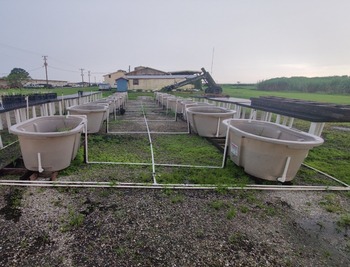
After emergence, two fall panicum seedlings were transplanted per pot and placed outdoor on benches to simulate field conditions. The plants were then thinned to one plant per pot after 2 wk. Planting was staggered to provide plants at two- to four-leaf and four- to six-leaf stages at the time of flood establishment. These development stages coincide with fall panicum size at establishment of permanent flooding in rice depending on whether they emerge simultaneously with rice (two- to four-leaf) or prior to rice emergence (four- to six-leaf). The potted plants were placed in 0.6-m by 0.6-m by 1.2-m round-end granite tan stock tanks (224 Poly Round End; Behlen® Country, Columbus, NE) maintained at flooding depths of 0, 10, 15, 20, and 30 cm using drainage pipes of applicable heights attached permanently to the tanks to siphon excess water for each flooding depth (Figure 1). Water was automatically added to the troughs twice a day to maintain each desired depth. No nutrition was provided to fall panicum plants in the troughs.
Layout of round-end stock tanks maintained at flooding depths of 0, 10, 15, 20, and 30 cm with drainage pipes permanently fixed to the tanks to siphon excess water.

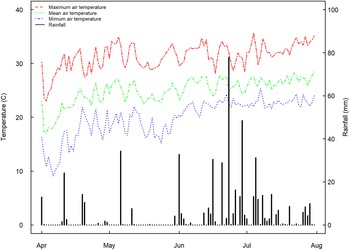
The experiment was a two-factor factorial in a completely randomized design with a split-plot arrangement and four replications of each experimental unit. The main plot was flooding depth (0, 10, 15, 20, and 30 cm). Plants at the 0-cm flooding depth were watered as needed to ensure that moisture was not limiting. The subplot was growth stage of fall panicum (two- to four-leaf and four- to six-leaf-stage plants) at flooding initiation. The daily temperature (maximum, minimum, mean) and rainfall received during the experiments is presented in Figure 2. The experiments were initiated on April 15, 2021, and June 1, 2021, for the first and second experimental runs, respectively.
Daily air temperatures (maximum, minimum, mean) and rainfall during the experiments in April to July 2021 (Source: Florida Automated Weather Network. https://fawn.ifas.ufl.edu/data/fawnpub/daily_summaries/BY_STATION/).

At 14, 28, 42, and 56 d after flooding (DAF), destructive samples to determine the number of tillers, plant height, leaf area, and shoot and root biomass were recorded from one plant per replication for each experimental unit (i.e., a total of four plants, one from each replication for each experimental unit). Plant height was measured for each plant from the base of the plant to the flag leaf, considered as the last leaf to emerge. Each plant was separated into leaves and stems, and leaf area was measured using a leaf-area meter (LI-3000C Portable Area Meter; LI-COR Biosciences, Lincoln, NE). The leaves and stems from each plant were dried at 60 C for 72 h to determine shoot biomass. Roots from each plant were harvested and dried to determine root biomass in a manner similar to shoot biomass. Reproduction data were recorded at the last evaluation timing (56 DAF). Data for fall panicum reproductive ability was based on the number of panicle branches produced per plant because estimation of seed number was very difficult to determine due to shattering of fall panicum seeds soon after ripening (Govinthasamy and Cavers Reference Govinthasamy and Cavers1995). The binomial response of the ability of fall panicum to survive flooding and develop panicles was recorded as 1, whereas the inability to survive flooding and develop panicles was recorded as 0.
Statistical Analysis
All data were subjected to ANOVA (P < 0.05) using the lme4 package (Lenth Reference Lenth2021) of the R statistical language (version 4.1.0; https://cran.r-project.org/bin/windows/base/). Fall panicum growth stage at flood initiation, flooding depth, and their interactions were considered fixed effects, whereas experimental run and replication nested within experimental run were considered random effects for each DAF. Predicted or marginal means at each DAF were calculated where significant effects were detected for fall panicum height, number of leaves, leaf area, number of tillers, and shoot and root biomass using the emmeans package of R (Bates et al. Reference Bates, Maechler, Bolker and Walker2021). The post hoc Tukey test was then performed for all pairwise comparisons (P < 0.05) using the emmeans package of R (Bates et al. Reference Bates, Maechler, Bolker and Walker2021).
The number of fall panicum panicle branches at 56 DAF was modeled as a function of flooding depth using a two-parameter exponential decay model using the drc package of R (Ritz and Streibig Reference Ritz and Streibig2005, Reference Ritz and Streibig2016) as follows:
 $$Y = d({\rm{exp}}^{ - x/e})$$
where Y is the number of panicle branches per plant at flooding depth x (cm), d is the maximum number of panicle branches per plant attained at x = 0, and e is the steepness of the decay or the relative slope. The probability of fall panicum survival and ability to produce panicles was modeled as a function of flooding depth using a two-parameter log-logistic model (Ritz and Streibig Reference Ritz and Streibig2005, Reference Ritz and Streibig2016) as follows:
 $$Y = 1//\left( {1 + {\rm{exp}}\,\{ b\left[ {{\rm{log}}\left( x \right)-{\rm{log}}\,\left( e \right)} \right]\} } \right)$$
where Y is the probability of fall panicum to survive and develop panicles at flooding depth x (cm), b is the relative slope at the inflection point, and e is where the inflection point occurs or the flooding depth that results in 50% probability of fall panicum to survive and develop panicles. A lack-of-fit test at the 95% level comparing the models (Equations 1 and 2) to ANOVA was conducted to determine whether the models appropriately fit the data (Ritz and Streibig Reference Ritz and Streibig2005). Root-mean-square error was calculated using the qpcR package of R (Spiess Reference Spiess2018) to test for goodness of fit of the models.
Results and Discussion
The main effects of fall panicum growth stage at flood initiation and flooding depth were significant for plant height, number of leaves per plant, number of tillers per plant, leaf area, and shoot and root biomass data at all evaluations or DAF; however, the interaction of the main effects was not significant. Therefore, data are presented by the significant main effects.
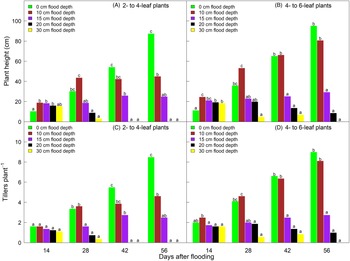
Depth of flooding and fall panicum growth stage (two- to four-leaf and four- to six-leaf plants) influenced plant height. Flooding depth had a significant effect on fall panicum height from 14 to 56 DAF (Figure 3A and B). There were no differences in plant height at 14 DAF at depths of 10 to 30 cm for plants flooded at the two- to four-leaf stage, whereas the height of four- to six-leaf-stage plants flooded at depths of 20 and 30 cm were significantly lower than plants at 10-cm flood depth. The most profound effect of flooding on height was observed from 28 DAF for both growth stages. For both growth stages, the height of plants in 10- and 15-cm flood depths surpassed the level of water in the stock tanks at 14 DAF, whereas the height of plants in flood depths of 20 and 30 cm never exceeded the water level. From 28 DAF, plants flooded at the two- to four-leaf stage in flood depths of 20 and 30 cm did not survive, whereas plants at four- to six-leaf stage did not survive a flood depth of 30 cm by 56 DAF. Although plant height was highest for unflooded plants (0 cm flood depth) at 56 DAF, among flood depths the highest average plant height was observed for both growth stages at the 10-cm flood depth (Figure 3A and B). The results show that fall panicum flooded at the two- to four-leaf stage was able to survive flooding as deep as 15 cm, whereas plants flooded at the four- to six-leaf stage survived and emerged from flood depths of up to 20 cm. Grasses such as dallisgrass (Paspalum dilatatum Poir.) respond to submergence by elongating their shoots to increase the proportion of leaves above water (Manzur et al. Reference Manzur, Grimoldi and Striker2020). In contrast, herbaceous plants such as texasweed [Caperonia palustris (L.) A. St.-Hil.] grow and survive under complete submergence by producing adventitious roots and phellem in the submerged roots and stems (Godara et al. Reference Godara, Williams and Webster2011).
A) Fall panicum height for plants submerged at the two- to four-leaf stage in response to flooding depth. B) Fall panicum height for plants submerged at the four- to six-leaf stage in response to flooding depth. C) Fall panicum tillers for plants submerged at the two- to four-leaf stage in response to flooding depth. D) Fall panicum tillers for plants submerged at the four- to six-leaf stage in response to flooding depth. Means followed by the same letter at each evaluation timing (or days after flooding) are not significantly different according to Tukey’s test at P < 0.05.

The number of fall panicum tillers per plant significantly decreased with increase in flood depth from 28 DAF (Figure 3C and D). For both two- to four-leaf and four- to six-leaf stages, plants exposed to a flood depth of 10 cm produced more tillers than flood depths of 15 to 30 cm at all evaluation timings (Figure 3C and D). The greatest number of tillers per plant were produced at 56 DAF for two- to four-leaf and four- to six-leaf-stage plants at the 10-cm flood depth compared with deeper flood depths. Tiller production at the 10-cm flood depth was not significantly different from that of unflooded plants for plants at the four- to six-leaf stage. Plants at a flood depth of 10 cm produced five and eight tillers for plants at the two- to four-leaf stage and four- to six-leaf stage, respectively, after 56 d of flooding. Flooding significantly reduced fall panicum tillers with the magnitude of reduction proportionately greater with increase in flood depth and duration. Alteration of phenotypic plasticity in tiller dynamics of fall panicum under deep flooding resulting in reduced tiller number was probably attributed to limited allocation of energy resources for tiller development. Tillers produced by fall panicum during its vegetative phase of development provides the plant with the necessary number of stalks for panicle production during the reproductive phase of development. Therefore, it is likely that fall panicum at a flood depth of 10 cm would have the most reproductive capacity compared with deeper flood depths.
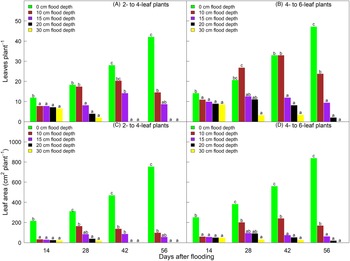
There were significant effects of flood depth and fall panicum growth stage on the number of fall panicum leaves per plant at all evaluation timings (Figure 4A and B). Overall, there was a decline in leaf production for both growth stages as flood depth and duration of flooding increased. Differences in fall panicum leaf production between flood depths of 10 to 30 cm was observed from 28 DAF. The greatest number of leaves per plant for plants flooded at two- to four-leaf and four- to six-leaf stages at flooding depths of 10 to 30 cm was observed at 42 DAF at the 10-cm flood depth (Figure 4A and B). Plants flooded at two- to four-leaf stage at flood depths of 20 and 30 cm were not able to survive and produce leaves after 28 or more days of flooding. Only the plants at the four- to six-leaf stage flooded at 20 cm were able to survive and produce leaves for up to 56 d of flooding. Fall panicum leaves per plant were proportionately more affected as flooding depth and duration increased. The plastic response of fall panicum leaf number was indicative of its inability to tolerate deeper flood depths over longer periods.
A) Fall panicum leaves for plants submerged at the two- to four-leaf stage in response to flooding depth. B) Fall panicum leaves for plants submerged at the four- to six-leaf stage in response to flooding depth. C) Fall panicum leaf area for plants submerged at the two- to four-leaf stage in response to flooding depth. D) Fall panicum leaf area for plants submerged at the four- to six-leaf stage in response to flooding depth. Means followed by the same letter at each evaluation timing (or days after flooding) are not significantly different according to Tukey’s test at P < 0.05.

Flood depth and duration of flooding influenced fall panicum leaf area. There were no differences in fall panicum leaf area between flooding depths for both two- to four-leaf and four- to six-leaf-stage plants at 14 DAF except for nonflooded plants (Figure 4C and D). Differences in leaf area between the different flood depths were observed from 28 DAF. Leaf area decreased with increasing depth of flooding from 28 DAF. Plants at the 10-cm flood depth produced relatively larger leaves compared with flood depths >10 cm at all evaluation timings. Leaf area for flooded plants was significantly lower for plants at both the two- to four-leaf and four- to six- leaf stages compared with nonflooded plants at all evaluation timings. Similarly, leaf area of palisade grass [Brachiaria brizantha (Hochst. ex A. Rich) Stapf], signal grass (B. decumbens Stapf), and koronivia grass [B. humidicola (Rendle) Schweick] were reduced by flooding (Dias-Filho and Carvalho Reference Dias-Filho and Carvalho2000). Godara et al. (Reference Godara, Williams and Webster2011) also reported a reduction in the leaf area of texasweed with increased flooding depth.
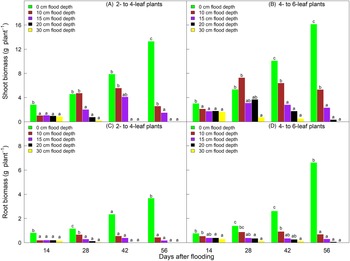
Both shoot (Figure 5A and B) and root biomass (Figure 5C and D) decreased as the depth of flooding increased. Plants at the flood depth of 10 cm accumulated significantly more shoot biomass relative to deeper flood depths at 56 DAF. The 10-cn flood depth resulted in taller plants with more leaves, tillers, and leaf area compared with plants at deeper flood depths. However, root biomass accumulation at 56 DAF was not significantly different between flood depths of 10 to 30 cm for both plant sizes, indicating that biomass allocation to fall panicum roots was reduced by flooding. A similar plastic response of root biomass to flooding occurred in dallisgrass (Vasellati et al. Reference Vasellati, Oesterheld, Medan and Loreti2001). Flooding can also result in complete or near complete loss of roots in flood-intolerant plants (Sauter Reference Sauter2013).
A) Fall panicum shoot biomass for plants submerged at the two- to four-leaf stage in response to flooding depth. B) Fall panicum shoot biomass for plants submerged at the four- to six-leaf stage in response to flooding depth. C) Fall panicum root biomass for plants submerged at the two- to four-leaf stage in response to flooding depth. D) Fall panicum root biomass for plants submerged at the four- to six-leaf stage in response to flooding depth. Means followed by the same letter at each evaluation timing (or days after flooding) are not significantly different according to Tukey’s test at P < 0.05.

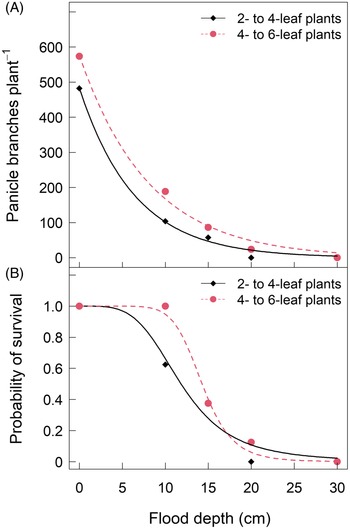
Fall panicum fecundity expressed as number of panicle branches per plant followed an exponential decay (Figure 6A). There was gradual decrease in the number of panicle branches per plant with increase in flood depth. The maximum number of panicle branches with no flooding was 483 and 577 for the two- to four-leaf and four- to six-leaf-stage plants, respectively (Table 1). The flood depth required to reduce panicle branch production by 50% was estimated to be 15 and 20 cm for two- to four-leaf and four- to six-leaf stage plants, respectively. The probability of fall panicum survival and ability to produce panicles decreased as the flood depth increased (Figure 6B). Plants at the four- to six-leaf stage had a greater probability of survival at deeper depths compared with two- to four-leaf-stage plants. Flood depth required for 50% probability of survival and ability to produce panicles for four- to six-leaf-stage plants was estimated to occur at a flood depth of 14 cm, whereas the flood depth of two- to four-leaf-stage plants occurred at 12 cm (Figure 6B). Based on the log-logistic model (Equation 2), to reduce the probability of fall panicum survival by 90%, it was estimated that a field should be flooded at a depth of >19 cm for both plant growth stages. Survival of plants to flooding varies by species. Barnyardgrass was killed by flooding at 15 cm, while junglerice, water primrose, rice flatsedge, and matamat survival at the 15-cm flood depth was 50%, 92%, 86%, and 94%, respectively (Sahid and Hossain Reference Sahid and Hossain1995). Williams et al. (Reference Williams, Roberts, Hill, Cardiac and Tibbits1990) also reported 45% survival of watergrass in 20-cm flood depth.
A) Fall panicum panicle branches for plants submerged at the two- to four-leaf and four- to six-leaf stages in response to flooding depth at 56 d after flooding. B) Probability of fall panicum survival and ability to produce panicles for plants submerged at the two- to four-leaf and four- to six-leaf stages in response to flooding depth at 56 d after flooding. Model parameters are reported in Table 1.

Model parameters for fall panicum panicle branches per plant and the probability of fall panicum survival and ability to produce panicles after 56 d of flooding. a , b

a Abbreviation: RMSE, root mean square error.
b Experiments were conducted outdoors in Belle Glade, FL, in 2021. Data are combined over experimental runs.
c The exponential model is represented by Equation 1: Y = d exp−x/e , where Y is the number of panicle branches plant-1 at flooding depth x, x the flooding depth (cm), d is the maximum number of panicle branches per plant attained at x = 0, and e is the steepness of the decay or the relative slope.
d The log-logistic model is represented by Equation 2: Y = 1/ (1 + exp{b[log(x) − log(e)]}), where Y is the probability of fall panicum survival and ability to develop panicles at flooding depth x, x the flooding depth (cm), b is the relative slope at the inflection point, and e is where the inflection point occurs or the flooding depth which results in 50% probability of fall panicum to survive and develop panicles.
These results show that deep flooding was successful in controlling fall panicum growth and its ability to produce panicle branches. Overall, fall panicum was better controlled when it was flooded at the two- to four-leaf stage compared to the later stage of growth. Therefore, flooding in rice should be applied as early as possible for better control of fall panicum. Flooding early in the growing season is important because once weeds are established and reach later growth stages, they become difficult to control with flooding (Sahid and Hossain Reference Sahid and Hossain1995). Flooding is usually effective as a weed control technique when used for an extended period (Rodenburg et al. Reference Rodenburg, Meinke and Johnson2011). In Florida, rice is permanently flooded at an average depth of 8 to 10 cm from the four-leaf stage of growth until approximately 21 d before harvest. The flooding depth in direct-seeded rice is typically 5 to 10 cm in other production systems, which is maintained throughout the growing season and gradually drained before harvesting (Ismail et al. Reference Ismail, Johnson, Ella, Vergara and Baltazar2012). In this study, a 10-cm flood depth resulted in 81% and 67% reduction of shoot biomass for two- to four-leaf and four- to six-leaf-stage plants, respectively, and 90% reduction of root biomass for both leaf stages compared with nonflooded plants. Although the flood depth of 10 cm was able to reduce fall panicum growth and its ability to reproduce, the plant was still able to survive and produce panicles. Based on the results, a flood depth of >20 cm is required to significantly reduce fall panicum survival. Because flood level in rice is usually maintained at <10 cm, chemical weed control is important to supplement flooding for effective fall panicum control in rice. Williams et al. (Reference Williams, Roberts, Hill, Cardiac and Tibbits1990) reported that without herbicide application, a flood depth of 20 cm was required for barnyardgrass control, whereas control was achieved with herbicide application at a flood depth of 5 cm. Chemical weed control in rice is more efficient when supplemented with flooding (Williams et al. Reference Williams, Roberts, Hill, Cardiac and Tibbits1990). Therefore, an integrated approach is required with the regular flooding depth (≤10 cm) to control fall panicum growth and reproduction in Florida rice.
Acknowledgments
We thank the weed science program staff at the Everglades Research and Education Center for their assistance with the project. This project was partially funded by the Florida Rice Growers, Inc. and supported by the U.S. Department of Agriculture–National Institute of Food and Agriculture, Hatch project FLA-ERC-005755. No conflicts of interest have been declared.