1. IntroductionFootnote 1
Some 50 years ago, the demographer John Hajnal created a problem for medieval historians. Drawing a line through Europe that ran from St Petersburg to Trieste, he stated that people west of that line had long practised a highly distinctive ‘European Marriage Pattern’ (EMP) marked by two characteristics: relatively late ages of marriage (in the mid-twenties) for both women and men, and relatively high proportions of adults – again, women as well as men – who never married at all (10 per cent or more).Footnote 2 Hajnal saw this marriage pattern as unique to north-western Europe and as historic, not contemporary. Yet for him, the EMP, arising first among the prosperous classes of Europe and thereafter driving the remarkable expansion of Europe, had laid critical foundations for Europe's twentieth-century global dominance.
For social historians of Europe, Hajnal's EMP arrived like a thunderbolt thrown across the academic quad. Historians are always eager borrowers from other disciplines, but this salvo was special. It was endowed with the authority of statistics, a field whose truth claims in the 1960s waxed as strong among historians as those of DNA analysis do today. It spoke directly to the central concerns – demography, family, marriage, women – of the ‘new social history’ of the time. And best of all, it presented a question that historians could try to answer: when and why did the EMP emerge? Hajnal speculated that the marriage habits of western Europeans changed from young-and-universal to older-and-limited sometime between 1400 and 1650. This is a huge time range, and historians, particularly medievalists, have been trying ever since to narrow it down.
This article pushes back the presence in England of late marriage and fewer marriages to the thirteenth century. It also puts to one side the statistics at the heart of the concept of an EMP, proposing that medievalists (and the demographers who rely on their findings) accept common-sense alternatives to what has been a Sisyphean search for firm numbers about medieval marriage patterns. And it unravels the positive twists that Hajnal attached to the EMP, particularly its links with economic prosperity and greater opportunities for women. Rather than a happy history of a forward-thinking Europe fuelled by Girl Power, this article offers an unhappy history of wretched girls and wretched boys.Footnote 3
The argument is built in five parts, followed by a conclusion. The first two sections are historiographic, exploring the positive depiction of the EMP in European history generally and then reviewing debates about the presence (or not) of the EMP in medieval England specifically. The third section considers the special challenges of studying rural poverty and landlessness in England between c. 1250 and 1350. And the final two sections examine marriage and not-marriage among peasants during this difficult century – that is, what young women and young men had to accomplish to get married, and what happened to those who never did.
2. The EMP and its historians
Hajnal's first essay on the EMP, published in 1965, defined it by the age and extent of marriage; a second essay in 1982 added two further features – before marriage, young people often circulated among households as live-in servants, and after marriage, a new couple usually established their own, separate household.Footnote 4 Both essays were crispy written and filled with common-sense reasoning, firm opinion, and gentle scolding. Both relied on case studies produced by other scholars, discussed one after the other, rather like pearls loosely strung on the same strand.
Hajnal presented the EMP as a deeply empirical subject, with thousands of firm data points analysed mathematically and summarised in charts and graphs. In a trenchant section of his 1965 article that focused perhaps not coincidentally on the work of medieval historians, Hajnal dismissed ‘non-statistical evidence’ as ‘distorted’ and ‘risky’.Footnote 5 Yet this empiricism masked how Hajnal loaded the EMP with interpretative baggage. He was confident that the EMP reflected the singularity and superiority of Europe: it was unique to Europe; it kick-started Europe's modern pre-eminence; and it was linked to the high status of European women. Hajnal also offered European historians a sort of Holy Grail, suggesting that the EMP likely derived from a common origin and ‘presumably arose only once in human history’.Footnote 6
A big theory born of big data, the EMP has fascinated scholars for the last half-century. Some, especially demographers and economists, have used ever-improving technologies to collect new data, crunch them, and amend the model. Hajnal recognised from the outset that his EMP was really western European; in his 1982 article, he described the pattern as north-western European; and today, most historians assume that late marriage and restricted marriage were especially manifest during the early modern centuries in the Low Countries and England.Footnote 7 The beginnings of the EMP have been pushed back as early as 1350, especially (again) on both sides of the English Channel.Footnote 8 The ebbing and flowing of the EMP is now more obvious than before, so that, for example, we can trace how the proportion of never-married adults in England peaked in the seventeenth century (at about one fourth), with relative troughs in the sixteenth and eighteenth centuries.Footnote 9 The geographical uniqueness of the EMP has also been called into question, for its features have now been found, wholly or in part, in cultures as far distant as Tokugawa Japan and Arab societies today.Footnote 10 And in an argument that anticipated my conclusions here about delayed marriage and non-marriage in thirteenth-century England, Tracy Dennison and Sheilagh Ogilvie have recently shown, based on a multivariate analysis of demographic behaviour in 39 European countries between 1500 and 1900, that the EMP is more associated with economic stagnation and poverty than with economic growth and wealth.Footnote 11
The EMP has grown from these challenges into a more nuanced and subtler model. But on the level of grand theory, it has proven a blunter instrument, particularly in two sorts of history that came of age in the late twentieth century – histories of modernity and histories of women. In the immediate wake of Hajnal's first article on the EMP, some of the most prominent practitioners of the new social history wove the EMP into their stories of how Europeans progressed from medieval to modern. Lawrence Stone, for example, memorably traced the consequences of the EMP by moving, in a few choice sentences, from delayed marriage, to sexually frustrated young men, to rowdy Oxbridge colleges, to European capitalism and violent expansionism.Footnote 12 Assessments of the EMP's role in modernity are more measured today, and they have acquired new focus in discussions about Europe's Great Divergence – that is, how Europe (and Europeans, even if transplanted elsewhere) emerged by the nineteenth century as the dominant world civilisation. In 2013, for example, Nico Voigtländer and Hans-Joachim Voth argued that a shift to pastoralism in England after 1348 enhanced women's employment, extended ages of female marriage, restricted fertility, and thereby laid ‘one of the foundations for Europe's early rise to riches’.Footnote 13 In 2015 a magisterial survey of British economic growth by Stephen Broadberry and colleagues took it as given that the fertility-reducing effects of the EMP kept ‘reproduction rates from swamping the growth of GDP’ and thereby enhanced the economic development of north-west Europe.Footnote 14
For historians of women, the EMP put women right where they needed to be – at the centre of history writing. Hajnal had recognised from the outset that ‘the uniqueness of the European pattern lay primarily in the high age of marriage for women’ and as a result, reduced fertility in EMP regions.Footnote 15 Hajnal did not speculate about what might have encouraged European women to delay or forego marriage, but historians of women soon took up the challenge. In 1992, Jeremy Goldberg suggested that the EMP, although possibly present before the Black Death, came into its own after 1350 because women had more opportunities and better choices. He argued, first, that female employment expanded and improved after 1350, and second, that better-employed women were able to marry later or not at all.Footnote 16 In 2004, Mary S. Hartman offered a ‘subversive history’ that more fully drew out the EMP's feminist implications. She focused on the EMP's positive effects for women: parental investment in girls; female choice in marriage; companionate marriages; and more female agency in both home and work. And she used the EMP to argue that European women's marriage choices solved ‘the continuing puzzle of why western Europe was the site of changes that, from about 1500, gave birth to the modern world’.Footnote 17 And in 2010, Tine de Moor and Jan Luiten van Zanden argued that the EMP, rooted in church teachings about marriage and women's improved employment, arose after 1350 to play ‘a fundamental role in western Europe's economic development’. Their notion of ‘Girl Power’ brought the two strands of EMP grand theory together into a particularly beguiling package that both appreciated women as a force in history and explained Europe's modern dominance on the world stage.Footnote 18
3. The EMP in medieval England
Drawn by rich archives and historiography, Hajnal focused on English evidence when he briefly discussed medieval marriage in 1965.Footnote 19 The pace of work on medieval English demography grew rapidly thereafter. Hajnal's challenge to find the EMP's origin was one incentive; so, too, was the general allure of quantitative methods for historians; and particular inspiration also came from the path-breaking work of David Herlihy and Christiane Klapisch-Zuber with the Florentine catasto of 1427, published in 1978.Footnote 20 They found that Florentine women married young (about 18 years of age) and near universally – that is, that the EMP was not present in fifteenth-century Tuscany.
For Richard Smith, who in the 1980s became the leading voice in medieval English demography, the Tuscan example provided a clear contrast with England where, as he saw it, the EMP emerged much earlier. For the period after 1350, English medievalists possess what Hajnal rightly considered to be the best data for its time: the poll taxes of 1377–1381.Footnote 21 The returns for these taxes suggest that proportions of never-married women (30 per cent) and households with live-in servants (4–5 per cent) might just squeeze into the lower end of Hajnal's ranges for the EMP.Footnote 22 Smith's student Goldberg tracked the EMP in late medieval York and Yorkshire; another student, Larry Poos, did much the same in Essex; and Smith argued the point for England writ large: thanks to labour shortages caused by the Black Death, women's employment improved so much that women delayed or even eschewed marriage.Footnote 23 For Smith, the marriage regimes of northern Europe and southern Europe were so distinct that they created almost two medieval Europes, distinct in terms of family, population, economy, and possibly much more.Footnote 24
The most powerful objections to this model came from Zvi Razi who in 1980 had published a laborious family reconstitution of the manor of Halesowen between 1270 and 1400. Calculating that most people in Halesowen married between the ages of 18 and 22 years, Razi argued against the presence of the EMP.Footnote 25 Other voices joined the chorus of scepticism, particularly those of John Hatcher, Mavis Mate, and Mark Bailey, but Razi's weighty empirical base gave his judgement special heft.Footnote 26 These two sides – yes, the EMP existed in England after 1350, and no, the EMP did not develop until the sixteenth century – were partly created by differences of sources, methods, and local histories. They also spoke to two distinct explanations for England's demographic stagnation in the century after 1350. If the EMP existed at that time, then low fertility slowed population growth; if the EMP was absent, then high mortality was the primary cause.Footnote 27 Yet across these stark lines, English medievalists agreed on several fundamentals – that among the aristocracy and gentry, young ages of marriage were more common; that working women likely married earlier in rural areas than in towns; that towns drew female immigrants in large numbers; that migration, service, and other employments could delay female marriage; and that there was, in fact, a lot of variety – personal, regional, and positional – in marriage practices.
Much less work has been done on the EMP in England before 1350. Despite his general argument against the presence of the EMP, Razi had found late marriage among the rural poor before 1349; 76 per cent of ‘rich’ children in Halesowen (that is, with parents who held 25 acres or more) were settled with land and spouse during their fathers’ lifetimes, but only 42 per cent of middling children (12–15 acres) and a paltry 14 per cent of poor offspring (six acres or less). Poor people predominated in Halesowen, as elsewhere, but Razi, noting that poor fathers died earlier than rich ones and perhaps rightly worrying that under-reporting of the poor had skewed his results, focused his argument against the EMP on the better information available for children of the rich minority.Footnote 28 A few years later, H. E. Hallam estimated that on the Lincolnshire estates of Spalding Priory from 1252 to 1348, women married, on average, between 21–27 years of age and men between 26–37 years.Footnote 29 Hallam's figures are striking but unreliable – derived from flawed sources and undercut by worrying methods.Footnote 30
In a variety of venues, Richard Smith has more persuasively considered that English peasants as early as the thirteenth century might have married late or married not at all.Footnote 31 He has demonstrated that old arguments about the age of marriage overemphasised inheritance customs (especially partible versus impartible male inheritance) and underestimated the countervailing influences of the peasant market in land. He has established as unreliable Razi's calculations of non-EMP marriage ages before the Black Death.Footnote 32 And he has built a positive case for the EMP before 1350 by searching out analogies in social practice between England c. 1300 and c. 1600 (by which time the EMP can be firmly documented). Rates of widow remarriage provide one proxy measure: in many pre-plague villages, widows took new husbands as frequently as widows in early modern English parishes. Exogamous marriage offers another measure, for Smith has shown that in 1300 as in 1600, most marriages were contracted between principals from different villages. Moreover, daughters of poorer tenants seem to have been especially likely to marry outsiders, suggesting that they moved to find work as labourers and servants, another singular feature of EMP societies.Footnote 33 And rates of marriage among women provide Smith's last measure. Working particularly with Spalding Priory's inventories of serf children in Moulton and Weston in 1268–1269, he has suggested that about 40 per cent of women were married, a figure he characterises as ‘very close to comparable estimates … in English seventeenth-century populations when mean ages of first marriage were about twenty-six for females and twenty-nine for males’.Footnote 34
Smith's proxy measures, reworked and revisited over several decades, are broadly convincing, but he has let them rest as little more than intriguing suggestions about a pre-plague period whose demographic trends are ‘ridden with uncertainties’.Footnote 35 Indeed, by the 1990s, confidence in the ability of English medievalists to reach certainty on demographic questions was faltering. The malaise was partly methodological, born of debates that promoted more scepticism than resolution, but the main problem was that extant medieval sources are simply insufficient for modern data analysis.Footnote 36 In 1991, Smith himself complained that the field's ‘thin and uncertain’ knowledge and ‘bleak’ prospects for answers made for ‘depressing reading’.Footnote 37 A few years later, Bailey published a devastating critique of the Smith-Poos-Goldberg model of a post-1350 EMP, arguing that its evidential base was thin and its modelling inadequate.Footnote 38 In the two decades since, progress in medieval English demography has slowed, almost stalled.Footnote 39 Medievalists today do not even agree on the most basic demographic question of all: how many people lived in England at the peak of its population growth c. 1300. Estimates range from about 4.5 to 6 million.Footnote 40
4. The rural poor
Medieval demographers are unlikely to reach any statistical certainty on marriage ages and incidence, but we do not require statistics, for the records extant from the English countryside between 1250 and 1350 clearly tell us that many young people married late or never married at all. They also tell us why: these people were simply too poor to marry. Poverty need not ipso facto preclude marriage, but for peasants in thirteenth-century England, marriage was tied to landholding and householding, and those who could not acquire land and household seldom married. To observe late marriage and celibacy in England before 1350, in other words, we need to adjust our vision socially downwards, away from the fortunate minority of peasants who worked holdings of 20–30 acres, and towards the many more peasants who survived with only a few acres, and even further downwards towards those who held no land at all.
Historians agree on three main points about rural immiseration in the late thirteenth and early fourteenth centuries. First, peasants commonly held very little land. Most manors had a customary size of tenement, often called a ‘virgate’ or ‘yardland’, that contained about 30 acres, but by the mid-thirteenth century, so many of these standard holdings had broken apart that, as E. A. Kosminsky famously showed in his mid-twentieth-century analysis of the Hundred Rolls of 1279, almost one third of villein tenants held less than five acres. Fragmentation was even more acute among free tenants – almost one half held less than five acres – because they were less constrained in how they passed property between generations.Footnote 41 Kosminsky's figures, which drew on a mere handful of counties, have since been much revised, and Bruce Campbell's estimates now provide our best view of the extent of parcellation c. 1290: 38 per cent of rural people, free and unfree, were landless or land-poor, holding less than three acres.Footnote 42
Second, and as also noted by Campbell, these many smallholders and landless people were genuinely poor, often desperately poor.Footnote 43 Historians have long recognised that acreage alone did not make or break peasant budgets, because many households supplemented arable farming with by-industries, market gardening, stock-raising, and wage labour, and in any case, land itself varied so much – in quality, in permitted uses, and in rents due – that acreage is a revealing but not definitive measure of economic status. After much debate about the imponderables of peasant incomings and outgoings, we have reached a rough consensus that a family of five (two parents, three dependants) needed about 15 acres to maintain a basic – not prosperous – standard of living.Footnote 44 Some smallholders managed well with only a few acres, especially those who found the bulk of their support in skilled trades (such as milling and smithing) or steady employment (especially as manorial shepherds, ploughmen, or dairywomen). But most smallholders were in dire straits indeed. They drew some sustenance from the land, but they had to patch together most of their living from elsewhere. Some made ends meet by thatching, spinning, carpentering, or brewing on the side; some profited from specialist regional economies, such as saltmaking and fishing in coastal villages; and most had to survive by makeshifts – by common rights (especially to pasture), by expensive and temporary sub-leases of land from sitting tenants, by casual wage earning, and by charity, theft, and prostitution.Footnote 45 When these stratagems failed, smallholders and their families practised what Edward Miller and John Hatcher have called the ‘peasant art of starvation’.Footnote 46
Third, the circumstances of the rural poor worsened from 1250 when the rural economy began to stall. Towns continued to grow (thanks, in part, to a steady flow of poor migrants from the countryside) and markets proliferated, but the ongoing commercialisation of the economy left the poor behind.Footnote 47 Real wages tumbled; land rents rose (especially free rents, which were less constrained by custom); crop yields grew less predictable; and when harvests failed, people died, whether from outright starvation or mere malnutrition we do not know.Footnote 48 With small respites here and there, the century between 1250 and 1350 was one long tale of agrarian woes, epitomised by the Great Famine of 1315–1322 and concluded, in the most horrid finale imaginable, by the arrival of bubonic plague in England in the early summer of 1348.Footnote 49 Blame for this century-long doldrums and decline is much discussed among historians: rapacious landowners; extortionate royal taxes; overbreeding peasants; monetary policies; underdeveloped markets; climate change; depleted soils; cattle disease; even a volcanic eruption in Indonesia in 1257. Whatever the causes (and all these likely played a part), the hard times were real. A few peasants continued to prosper, but everyone else was caught in a ‘vicious cycle of poverty with remarkably few escape routes’.Footnote 50
Because the rural poor are so poorly documented in medieval archives, they are easy to overlook. Manorial officers relied on well-off tenants to run much of the manorial economy and, indeed, much of rural society. Manorial records focus so much on these elite men that they can throw everyone else into shadow, as they did, for example, in George Homans's still remarkable study of English villagers of the thirteenth century.Footnote 51 The people below this upper crust are not, of course, entirely obscured. Manorial accounts sometimes report on the landless and land-poor, some of whom were estate servants and others of whom were hired ad hoc as wage labourers. Manorial courts enrolled the disputes and misdemeanours of the poor, even though they appeared in court much less often than other villagers (and seldom as jurors, pledges, or local officers). And manorial rentals noted the holdings (sometimes measured down to the inch) of even the least of head tenants.Footnote 52 Yet because sub-leases (especially those for a year or less) were seldom recorded, we know frustratingly little about a temporary resource that might have been especially important to the poor. As best we can tell from the few examples available, most sub-tenants were men (just as were most head tenants); some held no other land but others were expanding their acreage; and most leased small plots or cottages on short terms of a year or so.Footnote 53 If, as we suspect, these sub-leases provided a stopgap for the poor, they were a relatively expensive stopgap, for lessors charged, of course, more than they themselves paid in rent. We know least of all about the landless, who were mostly beneath manorial notice. Landless men are better documented than landless women, and in the records of the Glastonbury estate between 1265 and 1350, they are exceptionally revealed in annual lists of garciones or ‘lads’ aged 12 or more who lived by labour, not land.Footnote 54
I adopt here several strategies to unearth the rural poor from the documents in which they so rarely appear. My perspective is expansive, both geographically and chronologically. Regional differences and local peculiarities are important, and so too is change over time. But the rural poor are such a badly documented group that a single piece of evidence that survives today for just one jurisdiction could have had much wider, albeit undocumented, applicability, much like a single coin hoard that suggests far-flung trade or a single Vindolanda tablet that reveals the quotidian sociability of women in Roman Britain. The Glastonbury lists of garciones are a good example; they allow us to see clearly what we can barely glimpse elsewhere. Also, although I have happily collected data and argued with numbers throughout my career, I have downplayed here the numeracy so critical to most demographic and economic history. Much of what we can know about the medieval peasantry cannot be measured – yet, we still can confidently know it. And because numbers give medievalists, at best, rough measures hedged by uncertainties, I have preferred rounded figures to percentages worked to fractions of tenths or hundreds. Given the state of medieval databases, ‘about one half’ is almost always a fairer statement than ‘48.2 per cent’.
Finally, because broad strokes can be dizzyingly abstract, I ground my discussion of marriage among the rural poor in the experiences of a cohort of young people who came of age in the mid-thirteenth century. I call this group ‘Generation W’ for Weston, the village in south Lincolnshire where they were born. In 1268–1269, the Prior of Spalding ordered his clerks to assemble an inventory of the daughters and sons of his serfs in Weston, and they duly reported on the whereabouts of about 250 offspring – some infants, some adults, and many in between. Surviving today in a fourteenth-century copy, this list is a unique and revealing source.Footnote 55
The daughters and sons of Generation W were born of relatively well-off parents, so they provide a best-case example of how young people settled themselves with land and marriage. Weston was a fortunate place, with sea marsh to the north, fens to the south, and some of the best arable in Europe on the dry silt land between the two. All the parents of Generation W were serfs, but most held 25 acres or more. Some prospered so much that they were able to place sons in ecclesiastical careers, a considerable social leap for boys born into serfdom. Growing up in comfortable households in a village rich with resources of land, sea, and fen, Generation W's prospects outpaced those of most peasant children: better than their free neighbours, whose parents held much smaller tenancies; better than young people elsewhere in eastern England, a region generally crowded with too many people on holdings too small; and better, indeed, than most peasant daughters and sons, free or unfree, in other parts of England. If Generation W struggled to marry, we can confidently bet that others struggled even more.
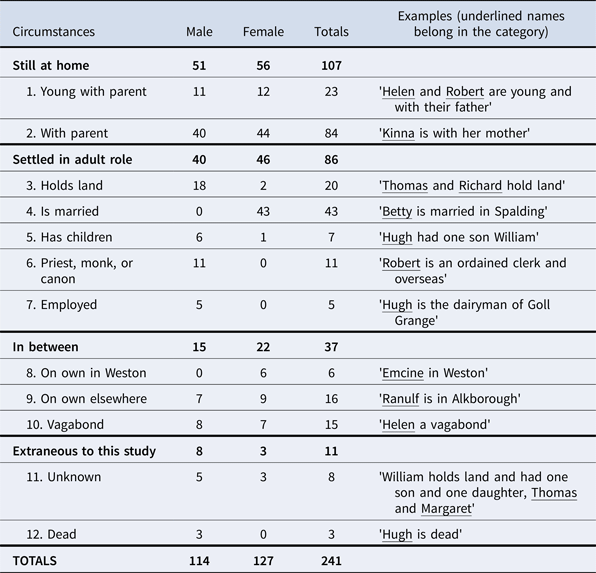
Generation W grew up in Weston and then grew beyond it, with many moving readily within a 20-mile radius of their home and settling, briefly or forever, in nearby towns and villages. More daughters married away from Weston than within it, although they often moved in sets of two or three sisters (either in sequence or together – we cannot know), and they seldom travelled far (most settled in Spalding to the immediate west or Moulton to the immediate east). Other members of Generation W travelled farther afield (including to London), and at least four were reported in 1268–1269 as living overseas. Rather like a photograph, Table 1 – reproduced here from my detailed analysis of the Weston serf list in ‘Married and not: Weston's grown children in 1268–1269’ – catches all this movement at a single moment in time and fixes each person in only one social position, namely, the category that best indicates their marital status.
Generation W in 1268–1269

How many members of Generation W were grown up and old enough to marry? The osteoarchaeological markers of medieval maturity are clear: girls began to menstruate in their mid-teens, and both sexes usually reached full biological maturity at 18–20 years of age.Footnote 56 Marriageability depended on point of view. The church, whose rules governed the marriages of all medieval Christians, set a minimum age of 12 years for girls and 14 years for boys. Some royal and aristocratic children did indeed marry this young (or even younger, with canonical dispensations), but peasants married later. For peasant sons, the minimal age for marriage varied by local customs of land tenure: sons usually waited to marry until they were old enough to hold land - in Weston, 20 years was the minimum age.Footnote 57 For daughters, marriageability might have started a few years earlier, as suggested by canon law, by osteoarchaeological evidence of earlier female maturation, and also by a custom found in some villages (not Weston) that allowed girls to take land at a younger age than boys.Footnote 58 All told, Weston boys were likely seen as marriageable at 20 years and girls perhaps a year or two earlier. The Weston inventory says nothing explicit about individual ages, but home-stayers (category 2 in Table 1) certainly included some offspring in their late teens and twenties, and home-leavers (categories 8–10) likely included some younger people in their early teens. Since we cannot know the exact proportions of these slippages caused by adults-at-home and youngsters-away-from-home, it seems wisest to assume that they balanced out, and if so, 55 sons in Generation W were grown up and marriageable (categories 3–10) and 68 daughters too (categories 3–10).Footnote 59 These grown offspring allow us to think in concrete terms about how one group of young women and young men could (and could not) navigate the distance from childhood to marriage.
5. Getting married in rural England (c. 1250–1350)
Marriage making was a costly business, but most costs were never written down, so we know them only from rare legal disputes about promises unfulfilled. A priest had to be paid for his services (a case in 1294 reported six shillings for this expense); a wedding feast had to be provided for family and neighbours (20 shillings were expended for one couple's convivium die nuptiarum in 1306); and if the bride were unfree, manorial permission had to be obtained through payments that ranged widely but generally fell between one and five shillings.Footnote 60 Even greater costs came from the need to endow the couple with practical goods – house, livestock, clothing, pots, carts, and the like – whose value easily amounted to 20 shillings or more.Footnote 61 And the greatest challenge was land tenure, for without land a new household could not thrive. Land and married life went together so closely that the clerk who compiled the Weston inventory described married offspring differently by gender – if sons, he said they ‘have land’ and if daughters, they ‘are married’. His phrasing shows how young men and young women took different routes to the same destination. Parents aimed to get land for their sons (so that sons could then get wives, who might add goods, cash, and livestock to the conjugal pot) and husbands for their daughters (so that daughters could then acquire land through their husbands).
Let us begin with sons and land. (As is so often the case in medieval history, the archives let us see men more clearly than women.) To get land, a son first had to be of ‘full age’. Although 20 years of age was the minimum for landholding in Weston, the requirement varied by manor and occasionally by gender as well; at Winslow (Bucks), for example, it was 20 years for men and 16 years for women. On at least some manors, it even changed over time, so that men on the Hertfordshire manors of St Albans reached majority at 16 years, but after a rule change in 1337 had to wait until they reached 20 years. ‘Full age’ was more often invoked than specified in manor courts, but it ranged from as low as 15 years to as high as 21 years. Given the tendency of manor courts to adopt practices from the common law (majority at 21 years), older ages were likely becoming more common (as on the St Albans estate).Footnote 62 Once a son reached the full age set by local custom, he had five main ways to acquire a sufficient tenancy to marry.
First, inheritance. Some sons inherited land. Male inheritance was the invariable rule in rural England, and daughters inherited only if they had no brothers (this occurred, in theory, in about one fifth of tenant deaths). Custom varied widely as to which son or how many sons inherited, but usually either one son (oldest or youngest) took his father's tenancy or all sons divided (or shared) the tenancy among themselves. Custom also varied for daughters, but usually the inheritance was divided equally among them.Footnote 63 Second, gift. Sons also received land as outright grants, sometimes from manors installing new tenants, but more often from their parents or other kin; these gifts were sometimes small, just a few acres here or there, but they were often substantial and coherent tenancies. Some gifts were conditional; a son might receive land from his father and then return all or part of it back for the duration of his father's life.Footnote 64 Third, purchase. Some sons bought land, usually just small bits and pieces. Even unfree land could be bought and sold this way, as long as the sales were approved in the manor court.Footnote 65 Fourth, maintenance agreement. Sons also acquired land by agreeing to maintain until death a sitting tenant who was incapacitated by age or illness.Footnote 66 And fifth, marriage. A son could get land by marrying (just as his sisters did). Widows were more plentiful than heiresses, and most held a life interest in a portion of their dead husbands’ lands. After 1348, widows rarely remarried, but before 1348, they often did. Why? In the land-hungry century before the Black Death, widows with land (even just a life-interest in land) were exceptionally marriageable.Footnote 67
These options varied, of course, by region, lordship, economic conditions, and a range of personal and local circumstances. In eastern England, for example, inheritance was often partible among sons, and peasants regularly traded or sold small pieces of land to non-kin; and in the Midlands, inheritance was more often impartible to one son, large holdings trended to remain intact, and the land market was more muted. Freedom and serfdom made a difference, too. Free tenants everywhere tended to prefer inheritance by all sons, and their unfree counterparts might have done the same, except that they sometimes had impartibility imposed on them by manorial administrators (intact holdings were easier to supervise).Footnote 68 Markets also mattered: high grain prices and distressed sales of land could delay marriages for the poor and speed them up for the wealthy.Footnote 69 Sub-leasing adds yet another layer of complexity, although most sub-leases were so small, so short-term, and so expensive that they could not suffice to make a marriage.Footnote 70 Amidst all these varied circumstances, most sons in most places faced the same general challenge if they wished to marry: acquire a head tenancy by inheritance, gift, purchase, maintenance contract, strategic marriage, or some combination of these.
Sons had a lot of flexibility and opportunity in achieving this goal, but some options took longer to achieve than others, and despite their variety, these five options fell far short of providing secure tenure for every son. In a work of painstaking historical reconstruction, Martin Ecclestone has traced the fate of young men in Monkton Deverill and Longbridge Deverill (Wiltshire), two manors of the Glastonbury Abbey estate, in the decades between 1296 and 1345. The median age for those who acquired land by inheritance was about 24 years; those who married widows were aged about 26 years; and those who purchased land waited until they were 29 years. They were the lucky ones, for in Ecclestone's words, men in these two villages had ‘roughly equal chances of eventually acquiring land or dying first’.Footnote 71 Men in Generation W probably fared a little better than this. About one half of the adult sons in Weston had already acquired land in one of these ways by 1268–1269, and although we do not have the records to see it, some others surely acquired land later on.Footnote 72
Most men married as soon as they took a tenancy. Marriage and tenancy were simultaneous, of course, for men who married heiresses or widows, but those who obtained land by other means quickly found wives too. Because the St Albans estate required marriage licences from men as well as women, its court books provide striking examples: dozens and dozens of entries, each reporting that a man simultaneously paid to acquire a tenancy and to take a wife.Footnote 73 These were head tenancies, held directly from the manor, not mere sub-leases. Men certainly married without acquiring what historians today consider to be sufficient acreage to support a family – that is, 15 acres or more – but they married with the benefit of guaranteed tenures, usually not only for themselves but also for their heirs. For example, Gilbert Hendigone of Park married as soon as he acquired a mere one fourth of a yardland in 1325, and at Walsham le Willows (Suffolk) in 1328–1329, as soon as John Typetot was old enough, he simultaneously took possession of four acres of free land and married.Footnote 74 The rough rule seems to have been that a prospective husband needed secure tenure of a substantive, but not necessarily sufficient, property. A cottage and yard was not enough, nor was a sub-lease.
Land tenure enabled marriage, but it also encouraged it – a man needed a wife's labour to help maintain his holding and home. Everyone agreed that land and marriage went together: the new tenant secured his position in the village; the steward rested confident that the holding would be well run; neighbours welcomed a stable, self-supporting family.Footnote 75 Taking a wife even, it seems, made a boy into a man. Only after marriage did men usually take on responsibilities – as tithingmen, jurors, or aletasters – in village governance.Footnote 76 And on Glastonbury Abbey manors and elsewhere as well, never-married men of any age were called ‘lads’ (garciones) – it mattered not whether they were 15 or 50.Footnote 77 Even priests, because they lived without marriage and wives, were viewed as somehow different from other men.Footnote 78
For a son, then, the central challenge of growing up was to acquire a tenancy. If he could get land, a wife would easily follow, and from marriage, he acquired a wife's labour and wealth; he headed a new family and a household; he became a householder in a community of other householders; and he, of course, placed himself in the normative venue for love, sexuality, and reproduction. His household might thrive or it might stumble, but it was founded in landholding.Footnote 79 For a daughter, maturation worked the other way around; her challenge was to get a husband and with him, access to his land and all the other benefits of marriage. Marriage was not solely an economic transaction for women, but practical considerations loomed large. In 1298 Vincent Buncheswell complained to the court of Gressenhall (Norfolk) that he had lost a woman's love and marriage (amor et maritagium) because a rival had slanderously reported that ‘Vincent had not seeded and ploughed his land in a timely fashion and that he was not a good farmer (cultor bonus).’Footnote 80
To find a good farmer, a young woman needed an endowment – that is, she needed assets that she could bring to the marriage, partly her own person, skills, and labour, but also cash, goods, livestock, and possibly even a cottage or a plot of land. We know about women's endowments mostly from agreements-gone-wrong: for example, a widowed mother in Brightwalton (Berkshire) who failed in 1288 to supply the barley, oats, cart, and 20 sheep promised to her new son-in-law; or a father in Belper (Derbyshire) in 1312 who had promised but not delivered a new-built house for his daughter and son-in-law, as well as 20 shillings, a cow, and a dress.Footnote 81 Daughters relied, like their brothers, on parents for help acquiring the material resources to effect a marriage. Parents rarely gave land to daughters, and if they did, they gave small properties, smaller than those given to sons.Footnote 82 But the goods given to daughters in parental endowments – cattle, sheep, clothing, cash, even a new house – were essential for creating a household. Indeed, many communities considered that a daughter's marital endowment was so substantive that it terminated her claims on the family – a not-married daughter had a share in her parents’ estate, but her married sisters did not.Footnote 83 Razi's reconstitution of Halesowen suggested that parents were grudging in settling daughters into marriage; he found that fathers managed, while living, to provide about twice as many sons with land as daughters with husbands.Footnote 84 But this gap is more apparent than real, a creation of courts that reported more often on land transfers than marriages. The parents of Generation W seem to have settled roughly equal numbers of sons in adult careers (categories 3–7 in Table 1) as daughters in marriage (categories 4 and 5); they also kept as many daughters at home as sons (category 2); and they might even have especially tried to keep home-leaving daughters as nearby as possible (category 8).
In any case, most daughters did not rely entirely on their parents for marital endowments. They themselves worked, saved, and made their own contributions to the marital pot. Many likely worked as servants in husbandry, a critical employment for young people that – like sub-leasing – is frustratingly underreported before 1350.Footnote 85 In the early fourteenth-century court rolls of Walsham le Willows, for example, servants appear only sporadically, but often enough for us to know that perhaps as many as one in every ten rural dwellers (women as well as men) found employment in service; that servants were treated as dependants within their employers’ households; that a stint in service could extend over many years and households; and that servants, along with wives and children, were most often cited for minor offences in field or forest (such as illegally taking firewood, setting snares, or collecting grain).Footnote 86 Female servants were usually paid less than males (as in other employments too), and they likely also often endured more mistreatment, but service nevertheless offered singlewomen security, training, and the chance of saving for marriage.Footnote 87 Daughters could also save for marriage by brewing for profit (although brewing was mostly a trade of married women) or by working for wages (although they found fewer jobs than their brothers and earned less money once they did).Footnote 88
We can best observe daughters’ contributions to their marriages indirectly – that is, through the payment of the marriages fines (or ‘merchets’) that most manors required of servile daughters. This burden fell on only a sub-set of marrying women, but it was for them a necessary expense of marriage, just like endowment. Parents and husbands-to-be sometimes paid merchet, but daughters often paid it themselves. Rates of bridal payment of merchet – usually between 20 and 50 per cent – varied by place and time.Footnote 89 They show that it was common for daughters to contribute actively to their own marriages, presumably not just taking responsibility for their own marriage fines but also bringing to their marriages clothing, cash, animals, and other goods that they had earned on their own account.
With sons provided with land (and then, wives) and daughters provided with husbands (and their land), parents established their offspring in new households and families. Getting married, the centre of this settlement for both sons and daughters, was a cumbersome process that involved priests, stewards, parents and neighbours. But final control rested with the principals themselves. Their consent and vows made the marriage, and indeed, in the eyes of church lawyers, their commitment to each other was the essential part of a marriage. This added a wild card to the process, because couples could (and sometimes did) exchange vows in privacy, creating a marriage that was improperly made but legitimate. These ‘clandestine marriages’ efficiently replaced the long marriage process with an instant marriage, but they were risky. They made the principals mutually vulnerable (church courts had the happy task of sorting out ‘he said, she said’ disputes); they created marriages unsupported by family and community; and they could even harm spousal rights (especially on manors where a widow's claims to support depended on public, wedding-day declarations of dower).Footnote 90 Other unions were even less straightforward: they got undone midway through; or were bigamous; or looked like marriages but were not (for example, clerical unions). Rural marriage in the thirteenth century was certainly not a lock-step process. But it is clear that by 1250 a proper marriage gave a couple what no other arrangement could: authorised sexuality; property rights (for a husband during marriage, and for widows or widowers thereafter); legitimacy and inheritance for children; and a public position as a recognised unit, a new household in a community organised by households.Footnote 91 In Weston in 1268–1269, about half of grown sons and about two thirds of grown daughters had accomplished this goal.Footnote 92
6. Singletons in rural England (c. 1250–1348)
Despite the many benefits of marriage, not all peasants wanted to marry, and some never did, even though they had the means. This was certainly true of those who chose church careers; their celibacy might have been more a sacrifice than a preference, but it was clearly a choice. Lay people also sometimes did not marry. Cecilia Penifader had sufficient land in early fourteenth-century Brigstock (Northamptonshire) to marry, but she never took a husband. Her brother Robert, also a well-off landholder, never took a wife.Footnote 93 Leticia Stronde of Walsham died a singlewoman in 1340, possessed of eight acres of land and a bastard son William.Footnote 94 Chelestria of Eywood felt so strongly about not marrying that she paid two shillings in 1238 for the privilege of living ‘without a husband for her whole life’.Footnote 95 In Generation W, Emma and Agnes, daughters and heirs of Ringolf, son of Emma, had not married by 1268–1269 and perhaps never did, even though they jointly controlled more than 25 acres.Footnote 96 And in nearby Spalding, a serf inventory compiled c. 1255 includes 12 not-married adults (nine men and three women), usually described as per se, or singularis.Footnote 97 Sometimes people did not marry because of disability or misfortune, but others made a positive choice to live alone. Their decisions speak powerfully to the viability of single life at this time. These relatively well-off single people lived among neighbours for whom, as Hajnal described it for later EMP societies, the not-married life ‘was accepted as a normal (if perhaps exceptional) alternative to marriage’.Footnote 98 They were able, thanks to a robust labour market to hire servants or wage workers (many of them also single) to fill any labour gaps in their small households. And they even could, if they chose, set up household with a non-spouse, especially a sibling (at the end of their lives, Cecilia and Robert Penifader did just this) or a same-sex friend.Footnote 99 In the English countryside before the plague, then, two sorts of single folk proliferated – those who had the means to marry but did not, and a larger group who could not marry because they lacked secure tenure of land.
For the larger group, the link between landlessness and singleness was so axiomatic that by the thirteenth century (and long after) it was enshrined in everyday words: a lad was an unwed man, often young but also older; a maid was an unwed woman, also of any age; and both lad and maid also described labourers and servants.Footnote 100 These were single people who lived by their labour, not by any landholding. Their landlessness is easier to trace than their singleness, for many manors taxed resident adults who were neither tenants nor still-at-home children of tenants. Usually, these adults-without-tenancies were required to pay an annual fee or to provide free labour at harvest time, thereby acknowledging that although they held no land of a manor they were beholden to it nevertheless. Those subject to these exactions were variously called garciones (especially in the south-west), anilepimen or anilepiwomen (in East Anglia), and selfodes (in the north), and these terms also speak tellingly about the link between lack of secure tenure and lack of spouse: these people were seen as lads, only-men and only-women, and self-holds.Footnote 101 The circumstances of people like these are the linchpin for understanding marriage patterns in the English countryside before 1348. We know from the presence of well-off singletons like the Penifader siblings that singleness was accommodated among landholders in English villages. What about those who were landless and therefore usually spouseless?
Again because of better documentation, we begin with men who were landless and spouseless – and especially the landless boys and men on the 32 manors (most in Wiltshire and Somerset) of the Glastonbury estate, who from age 12 were charged an annual fine called chevagium garcionum (calculated to reflect the value of each man's labour). Extensively studied by Harold Fox and Martin Ecclestone, these lists report the following:
• Garciones were about as numerous as men with tenancies. In 1307–1308, for example, 2,227 garciones were reported for an estate that had just under 2,050 tenants.Footnote 102
• Most worked as servants.Footnote 103
• Their earning power was modest in the teen years, high in the mid-twenties and then declined with age.Footnote 104
• Some were locally born, but most (usually 50–70 per cent) were in-migrants.Footnote 105 Locals and migrants died at roughly similar rates, but migrants more often moved on.Footnote 106
• They usually lived in their employers' homes; even local men lived with employers, not parents.Footnote 107
• They seem not to have sub-leased small properties.Footnote 108
• Each year, less than 3 per cent of these men acquired a landholding (in 1307, for example, only 56 of 2,227 garciones did so).Footnote 109
• Of local men who eventually got tenure of land, the median age was 25 and oldest was 35.Footnote 110
• A man was as likely to die a garcio as he was to acquire land. Some men stayed on the list year after year, decade after decade, until they died.Footnote 111
These are remarkable – and remarkably harsh – facts about male landlessness before the plague, produced by an estate whose records in this regard are without peer. The fine was widespread, although well documented especially in south-western, eastern, and northern counties; it was hard to escape; and it even left men somewhat unmanned – garciones or lads no matter what their age.Footnote 112 Some might have occasionally sub-leased small areas of land, but most lived by their labour, either as live-in servants (which brought them reliable housing and food for the duration) or as day labourers, living from hand to mouth and from village to village. Theirs was not an easy life. When Thomas Cuckoo died in Ditcheat (Somerset) in 1349, he had lived by his wits for more than 40 years, sometimes in Ditcheat and sometimes nearby, and, in his desperate final months, he was reported to have struggled as a ‘pauper, feeble, and blind’.Footnote 113
Generation W lets us see more clearly the choices that faced Thomas Cuckoo and men in his situation, for it included a fair number of men who lived without wives (26 men in categories 6, 8, 9, and 10 in Table 1; possibly some others in category 7; and certainly some older home-stayers in category 2). Some of Weston's landless men tarried at home with their parents (category 2). The inventory does not allow us to count their numbers, but it does show – by counting out birth intervals in large sibling groups – that some stay-at-home sons were fully grown, aged 20 years or more.Footnote 114 Theirs was a passive strategy of hoping for the best, and it placed them in a sort of extended childhood – grown men who laboured on family lands in return for food and shelter. It was so common for sons to linger in this way that Glastonbury Abbey allowed parents to keep one son at home without charge; only extra sons were subject to chevagium garcionum.Footnote 115 Stay-at-home men were usually proscribed from marriage; the unspoken logic was that as dependants of their parents (or their inheriting brothers), they should not themselves take on dependants. The custom in Sevenhampton (Wiltshire) in 1287 held that a non-inheriting brother could claim support from the family holding as long as he was without wife (dum ipse sine uxore) and living locally; on the Cambridgeshire manors of Crowland Abbey in 1323 the same restrictions applied to brothers supported on a holding (quousque promoti vel maritati fuerint).Footnote 116 It might have been even more common for sons to stay locally but live apart from their parents, especially in the homes of their employers. No sons in Generation W were reported as living in this way (category 8), but it was the most common accommodation of local garciones on the Glastonbury estates. Whether living at home or elsewhere, these sons were husbands-in-waiting, biding their time, hoping for a windfall of land, and running the risk that, like Thomas Cuckoo, they would die as they lived – landless and alone.
In Generation W, about one in four adult men tried another strategy: they took to the road (categories 9 and 10 in Table 1).Footnote 117 There is a certain timelessness to young men setting out to make their fortunes, but circumstances between 1250 and 1350 positively encouraged home-leaving. Some were attracted by the expanding opportunities provided by conquest, colonisation, and commercialisation; others were surely pushed out – by hardships at home, by poor prospects for land, and by parents promoting some sons over others (six of the eight reported male vagabonds in Weston left behind landholding brothers).Footnote 118 A migrant's life was often hard: no safety net of friends and family; no ready shelter or food; unsteady employment; suspicious welcomes; and little prospect of land. Migrants were so numerous and mobile that they passed somewhat anonymously among more settled peoples – in the Glastonbury Abbey records, migrating garciones are sometimes casually nicknamed Dustybeard, Skinhead, Draglap, and the like.Footnote 119 Of those migrant garciones who tarried on the Glastonbury Abbey manors of Monkton Deverill and Longbridge Deverill, perhaps only 1 in 20 eventually acquired local land (compared to about half of local garciones); all the other migrant lads either died landless or moved on after a year or so.Footnote 120
Soon after Edward I took the throne in 1272, he provided new opportunities for men like these. He demanded, year after year, unprecedented numbers of foot soldiers: more than 15,000 foot soldiers in his first Welsh campaign in 1277; 11,000 to deal with the rebellion of 1287; 31,000 for the 1294–1295 rebellion; 26,000 men for the Falkirk campaign of 1298. His son did the same, fielding 15,000 foot soldiers at Bannockburn in 1314 and more than 11,000 for his 1322 campaign. Recruitment varied, especially by region and method, but soldiers were more often coerced into service than enticed; they did not have to be well-off as they were equipped, such as it was, at local expense; and young, restless men were surely prime candidates, then as now. Some soldiers returned home after their military terms expired, but they were at high risk of death by illness, accident, or battle, and among those who survived, some never went home, enlisting for further service or settling elsewhere.Footnote 121
The success of Edward I's wars provided further opportunities for landless men on the move. It is breathtaking how quickly English settlers arrived hard on the heels of conquest in Ireland before 1250 and in Wales and Scotland thereafter. Some settlers came as families, as had happened, for example, in Carlisle some two centuries earlier when William Rufus ousted the Scottish lord, built a castle, and according to the Anglo-Saxon Chronicle, sent peasants from southern England ‘with their wives and cattle to live there to cultivate the land’.Footnote 122 Already-formed families were ideal settlers, ensuring both the Englishness of new settlement and its economic viability. But other colonists travelled alone, young men more than young women.Footnote 123 Some were erstwhile soldiers, settling on land they had helped to conquer; others were landless sons eager to take up plentiful tenancies in newly emptied valleys; still others were craftsmen, traders, and labourers willing to try new markets. English lords, anxious to pacify new territories and make them profitable, welcomed young men such as these. If successful, they might eventually marry, but if so, they married later than their stay-at-home brothers and usually married local women – Irish, Welsh and Scots.
Other landless men substituted skill and education for land. Those in lay employments might have married: Generation W produced a dairyman who might reasonably have sought a wife to help with his work; a priory servant who was probably unable to marry; two priory shepherds who might have been similarly constrained; and a carpenter whose employment in London was surely not dependent on marriage (category 7 in Table 1). Marriage was proscribed for those who pursued careers in the church, among them the 11 priests, monks, and canons in Generation W (category 6). Clerical recruitment in Generation W was exceptionally robust (accounting for 20 per cent – 11 out of 55 – adult males); in the realm as a whole, perhaps 5 per cent of adult males chose celibate careers (about 50,000 men in 1300).Footnote 124 Some of these men, especially those among the secular clergy, acquired female lovers or concubines, but they were at best quasi-married, never fully shouldering the socio-economic duties of a husband, householder, and father. For a young woman looking to secure her economic future, a cleric was a poor choice, indeed the epitome of a faithless provider. Late medieval ballads often dwell on foolish maidens charmed by clerics and ruined by out-of-wedlock pregnancy.Footnote 125
Landless men had, then, many ways to cope. They could stay near home, patch together a living primarily by labour (for parents or employers), and hope eventually to get secure tenure of land and a wife. They could head out from home, seeking employment in other villages or towns and in Edwardian armies. They could seek out new lands for cultivation, but unlike previous generations who had reclaimed nearby wasteland, forest, and fen, they had to relocate to regions opened by English conquest. And if they could acquire the necessary training, they could find steady employment as skilled servants or craftsmen, or they could go into the church, the most upwardly mobile option of all. For most of these men, landlessness meant wifelessness too. This was explicit, of course, for clergy, and it was all but explicit for servants, wage labourers, and sub-lessees. Because newlyweds were expected to establish their own, separate, self-supporting, farming households, a man conventionally needed land to effect a marriage. As Simon Piers put it to Alice Pleyneys in 1347, he was eager to marry but had to wait until ‘I am a man in such a position that I can marry.’Footnote 126 A man not in such a position lived by himself – per se or singularis as in the Spalding serf inventory.Footnote 127
These men were surely not without sexuality; many flirted with women and dallied with them, and some partnered with women, perhaps for years.Footnote 128 But they were not landholders and not husbands. ‘No land, no marriage’ – George Homans succinctly described this rule almost a century ago and it is now axiomatic to our understanding of peasants, land, and family before the plague.Footnote 129 But we have not hitherto realised what this meant, in actual practice, for the many landless and land-poor men in the thirteenth-century countryside. In Generation W, about half of grown men were landless in 1268–1269, even though their fathers were part of the landholding elite; slightly less than half of men on the Glastonbury estates were landless garciones; and considerably more than half were non-tenants in early fourteenth-century Walsham.Footnote 130 Many of these landless men – roughly half, if the experiences of the garciones of the Deverills are a good guide – eventually manoeuvred their way into landholding and wife-taking. The rest never did. Roughly half not-married at any moment; of these, roughly half eventually acquired a tenancy and married; if we allow for some slippage and estimate conservatively, then about one in five men never married.
We know much less about never-married women, but if sex ratios were balanced (more likely than not), male landlessness on this scale meant that about one in every five women was unable to find a suitable husband.Footnote 131 Some daughters bypassed the problem of male landlessness by acquiring the land for themselves; they then either lived as single landholders, or more often, married a man eager for land (a daughter who inherited or received land was, like a widow, highly marriageable). But landholding was a rare option for never-married women; only 10 to 15 per cent of tenancies were held by women, most of them widows.Footnote 132 Most singlewomen lived as landless women, and they were particularly vulnerable to poverty because of the highly gendered trickle-down economics of the medieval countryside: in each generation, resources (particularly land, but also skilled crafts and most waged work) went primarily to men and then moved, through men, to their wives. This worked well enough for married women, but it left singlewomen without the resources that usually flowed from husbands to wives.Footnote 133 Some single daughters, like single sons, remained at home, and just like their brothers, they had a claim for support from the family holding. In Over (Cambridgeshire) in 1300, for example, Margery Syward won a court judgement that her brothers Roger and Alan, the heirs of the family tenement, were obliged to lodge and feed her, as long as she remained without a husband (dum vixerit sine marito).Footnote 134
Other single daughters, again like single sons, struck out on their own. In Generation W, women living by their own labour (categories 8, 9, 10 in Table 1) accounted for about a quarter of Weston's grown-up daughters. Sometimes parents gave not-married daughters small pieces of land on which to live independently. For example, in Ingoldmells (Lincolnshire), a coastal village some 40 miles north-east of Weston, Alan Bugge in 1303 gave a half-acre of land with a cottage to his daughters Matilda and Agnes, specifying that they were to hold it as long as they lived or ‘which of them shall live the longer and shall not be married’. Some of his neighbours did the same for their daughters, although most did not stipulate that the land was forfeit on marriage.Footnote 135 A half-acre and a cottage could not support the Bugge sisters, but their father's gift provided shelter, common rights, and a farmyard. It was a small foundation around which to build – with wage work, spinning, market gardening, and other stratagems – an economy of makeshifts, until they married, but not beyond.
Perhaps a few other not-married daughters sub-leased cottages or small crofts, but most likely lived without any land at all, working as live-in servants or day labourers. Many daughters in Generation W left Weston, and this was a common pattern: more daughters than sons left their home villages.Footnote 136 Theirs could be a hard life. A young peasant woman could not pursue a career in the church, for nuns were few and recruited from elite families, and she was unlikely to train for skilled employment or go soldiering.Footnote 137 She could not even borrow money – with which to buy land or set herself up as a brewster – as easily as her brothers.Footnote 138 If a servant, she was at greater risk of sexual abuse and earned less reward. If a day labourer, she found less work and earned lower wages.Footnote 139 Despite these obstacles, some women flourished on their own, and some even found surrogate families. In the 1330s, Agnes Waleys moved about five miles from her home to work as a servant for Hugh and Emma Talbot in Brigstock. They got along so well that she stayed, year after year, and her employers eventually made generous provisions for her long-term support, giving her a garden and arranging for her to inherit a house and yard.Footnote 140
Agnes Waleys's employers provided the resources she needed to survive without marriage, so she had the luxury of deciding whether or not to take a husband. For most daughters on their own, however, marriage was desirable, necessary, and hard to achieve. In Generation W, daughters still at home in 1268–1269 were much more successful at later finding husbands (we can trace the merchets of 17 out of 56) than those who had left home (1 out of 22).Footnote 141 Helen Wiseman was among the unsuccessful ones. She was living away from Weston at the time of the inventory in 1268–1269, but nine years later, she had returned to the village, where she was reported for being sexually active but not married. Helen Wiseman was, by then, in her mid-twenties or older, but she was still not settled with husband and land. The sisters Catherine and Alice Kembald found themselves in similar straits in Walsham in 1320 when they each, after supporting themselves independently of their parents for five long years, bore a child out of wedlock.Footnote 142 The landholder Cecilia Penifader could choose not to marry and still live well, but for women like Helen Wiseman and the Kembald sisters, living well without marriage was hard, if not impossible. Their situation inverted Homans's axiom. For Helen Wiseman, the Kembald sisters, and others like them, the reality usually was, ‘No marriage, no land.’
Because they were so poor, these singlewomen usually fell beneath the attention of the revenue-generating bureaucracies of medieval manors.Footnote 143 Landless men earned enough, it seems, to be squeezed for a small payment like chevagium garcionum once a year; landless women apparently earned so little that few manors bothered to tax them. But landless women did attract attention, albeit more often from irate villagers than grasping manors. They feature prominently in complaints about unwelcomed gleaners at harvest; about ‘strangers’ illegally sheltered by locals; about hedge-burners (that is, those who pilfered fuel from hedges); and about those who were outright expelled from rural communities.Footnote 144 They seem to have headed towards towns even more often than migrant men, accounting, for example, for three fourths of those who illegally tried to settle in urban Halesowen (Worcestershire) and for three fifths of the poor slain in an attack on an alms gathering at St Pauls, London in 1298.Footnote 145 Women on their own also figure large among those who, unable or unwilling to settle, died on the road, a fate that the earliest coroners’ rolls tell us befell more women than men. Emma Hatch who begged door-to-door, until she was ‘seized by the cold’ and died. Beatrice Bone, a ‘poor woman’ begging food, who died ‘weak and infirm’. A nameless ‘poor woman, a stranger’ found dead in a ditch and presumed to have died of the cold.Footnote 146
These women were so numerous in East Anglia that ‘anilepiman’ – a generic term capable of applying to women as well as men – was supplemented in the mid-thirteenth-century with the female-specific ‘anilepiwoman’. Nominal lists of these people include many women, often mostly women, and sometimes all women. In Horsham (Norfolk) in 1286 and 1287, for example, the anilepimen included 19 women, 6 men, and 3 children.Footnote 147 These women (and a few men) made Horsham their home over many years, although a few were expelled and a few left voluntarily. No anilepiwoman was married or widowed, but several had children. About half shared their hard lives with siblings. Agnes Neth and her sister Avice, for example, lived together in lodgings, were expelled from the village together, and eventually returned together. These people possessed no land – or only the tiniest peices of land – to cultivate; they could not afford, because of higher rents, the temporary relief of sub-leased lands; they could not rely much on wage income; they seldom had the resources to support themselves by brewing; they lacked sheep or cattle. They lived mostly beyond the structures of landholding, husbandry, and customary rights that shaped the lives of their better-off neighbours. Their survival often depended on what these neighbours considered to be reprehensible misbehaviours – stealing wood or hay; pilfering grain at harvest; receiving and reselling stolen goods; refusing to contribute to parish fundraising; dodging debts. These activities might seem anti-social, but they were primarily economic. When not patching together an economy of makeshift in these ways, Horsham's anilepiwomen (and men) were no more given to quarrels or insults than anyone else. In the northern counties, people like these were called ‘selfodes’ – a ‘floating population’ of people of the ‘lowest grade’ among whom women also sometimes predominated.Footnote 148
These not-married women struggled, but they also made their own lives. They were not poor and nothing else: they were daughters, sisters, and friends; harvest workers, lodgers, and sub-leasers; ale sellers, parishioners, and thieves. They also might be mothers and prostitutes. Some women supported themselves through prostitution, finding lodging, as did a few anilepiwomen in Horsham, in houses notorious for attracting men at night. Other women partnered with men for love, for pleasure, or, indeed, for the economic support even a landless man might offer. Some couplings were brief, but other women considered themselves married, by fact if not by law. This is what Alice Pleyneys had thought when Simon Piers vowed to marry her as soon as he had sufficient wealth, and it was only after they had a child together that their marriage fell into dispute. Leyrwite (a fine for fornication) and in East Anglia the similar ‘childwite’ (a fine for extramarital childbirth) testify to the frequency of sex outside of marriage and the consequences for women: these fines were levied on women, not men; they fell most frequently on poor women; and they were punitively expensive. In Horsham, 11 out of 15 childwites were paid by anilepiwomen.Footnote 149 Maligned, fined, expelled, and simply judged ‘not useful’ to their neighbours, pregnant singlewomen took to the road so often that, in a time when births were home-based, some medieval hospitals made special provisions to care for homeless women in childbirth, and other hospitals specifically excluded them.Footnote 150 These women were marrying late or not at all, just as the EMP describes, but their lives were shaped by poverty, not ‘Girl Power’.
7. Conclusion
For more than 50 years, historians have cast admiring eyes at the EMP. We have accepted that this pattern of later marriage and less marriage was born of prosperity and encouraged still more prosperity. We have characterised it as forward-thinking and industrious. We have assumed it was born in modernising cities, not backward villages. And we have credited English and Dutch burghers with a sort of enlightened progressivism: they treated their children (especially their daughters) better than others did, and they reaped the rewards. These are pleasant ideas, but they have often caused us to see prosperity where there was, in fact, poverty.Footnote 151
Poverty does not itself prevent marriage, but poverty combined with expectations of a certain sort of marital union – the sort that creates a separate, self-sustaining household – limits marriage to those who can afford it. When poor couples can reside with parents, or share households with married siblings, or partake of the resources of a sustaining network of wider kin, poor women and poor men can marry. In the mid-thirteenth-century English countryside, however, these alternatives were rare, and most weddings created not only a new conjugal couple but also a new, freestanding economic unit and household. I doubt that we will ever have more than a remote, elite-based view – from ecclesiastical, royal, and seigneurial sources – of the emergence of neolocal marriage in the English countryside. It is clear that manorial policies could favour nuclear households (for example, by insisting on primogeniture and taxing landless adults), and it is possible that the extensive cooperation required by open fields and common rights generated a similar pressure from neighbours. Other causes and precise chronology await further research, but we can be confident that, if this sort of marriage was already common in rural England at any time between 1086 and 1250, it was then much easier for people to achieve, simply because these were decades of rural expansion and land reclamation.Footnote 152 After 1250, English peasants had to adapt their marital expectations to a contracting and, indeed, collapsing rural economy. Rather than changing their marital practices, they seem to have changed who could marry and when.
Historians value context and specificity, but we also seek out commonalties and generalities. This article paints in broader strokes than most, and it necessarily leaves unexplored how the experiences of poor, never-married people varied by person (not just gender but also such factors as age and social standing), by legal status (free and unfree), by region (upland or lowland, coastal or inland), by manorialism (strong or weak), and by changing times (especially the economic slump of the 1290s, the famine of 1315–1322, and the slowing down of demographic growth from c. 1300 onwards). I expect that factors such as these will introduce more variations than substantive differences to what I have outlined here. In the century between 1250 and 1350, practices of late marriage and non-marriage were, for most people in the English countryside, about poverty, not prosperity; about wretched girls and boys, not children being nurtured towards well-paid work and prudent marriage; about people unable to marry, not those like the Penifader siblings who had the resources to marry and did not. The EMP might have existed in much of English rural society before 1250; it might have waxed or waned or disappeared altogether after 1350. What we have demonstrated here is that in the hard century between these dates, many people simply lacked the necessary means to marry. These are circumstances that, in line with Dennison's and Ogilvie's strong association of the EMP with the poor economies of central and Nordic Europe, dethrone the EMP as a positive marker: it grew from poverty, not prosperity, and it was not associated with an improving status of women.Footnote 153
These circumstances do not, of course, mean that the EMP was always and everywhere negative, but they do push us towards a more nuanced view. In providing a preventive check on population growth, the EMP could be both good for economic stability, as Malthus thought, and inhumane in its effects on disadvantaged populations, as anti-Malthusians protested. The EMP also relied on a rough balance, for better and for worse, between the insularity of neolocal households and the social support needed for those who lived outside them, those in circumstances of what Peter Laslett has usefully called ‘nuclear family hardship’.Footnote 154 These difficulties could touch anyone – a father could be disabled in an accident, a wife could be widowed, and as in this article, women and men could find themselves unable to marry, either temporarily or forever. English villagers had many institutions that aided the not-married: land markets facilitated their acquisition of cottages and small plots; common rights gave them access to forest and pasture; local custom ensured their maintenance by inheriting brothers; labour markets provided their employment as servants-in-husbandry and wage labourers; even religious practices embraced their celibacy, at least in theory. But English villagers also sometimes did not pause before the vulnerability of landless singletons – they expelled unwelcome strangers; they frowned on sex outside of marriage; and as Fox in particular has argued, they even sometimes calculatingly sent off their own children in order to replace them with cheaper servants.Footnote 155
Standardised data, statistics and models have been the working currency of the EMP ever since Hajnal inaugurated its historical investigation in 1965. Medievalists have tried, with limited success, to wring reliable data out of medieval sources; economists have tried, also with limited success, to model their way through medieval marriage practices. In the case of the EMP in the English countryside between 1250 and 1350, we do not need to rely on these strategies alone. Yes, it is good to know, as we do for 145 locally born garciones taxed in Longbridge Deverill between 1296 and 1345, that 59 (41 per cent) were living with their parents when they were first liable for the tax at 12 years of age, but only 15 (10 per cent) at 17 years of age: these numbers speak powerfully about adolescents leaving home to live in the households of local employers.Footnote 156 It is also good to know that of 170 local lads on the same manor (the larger total includes some whose ages are unknown), 65 (38 per cent) died as garciones, 63 (37 per cent) acquired land and married, and the rest (42 or 25 per cent) either left the village or disappeared for reasons unknown: these numbers tell us that, at best, a garcio was as likely to die single as married.Footnote 157 And it is good to know, as we have already seen, that those garciones lucky enough to acquire land usually had to wait until age 24 (to get family land), age 26 (to marry a widow), and age 29 (to buy land): these numbers show men waiting many years to get land and wives.Footnote 158 But we simply cannot deduce similar numbers for the critical matters of female home-leaving and age of marriage, and even the estimate given above of adults never-married (about 20 per cent) is very rough indeed. Yet if we mingle our quantitative and qualitative sources, we can see something very like the EMP. Smith has already traced how proxy measures – migration-to-marry, widow remarriage, and proportions married – suggest the presence of the EMP. By excavating the landless from land-focused sources, the material presented here shows that young people often left home and supported themselves before they married; that garciones and other landless people were thick on the ground; and that landlessness either delayed marriage or prevented it altogether. If the EMP was not fully present in the English countryside before 1350, it was certainly well on its way.
In the early years of the fourteenth century, a young boy named William was coming of age in a village to the south-west of London; he would, like many other young men in his generation, decide to opt out of marriage and enter the church; he became a Franciscan and a teacher and a philosopher; and he regularly argued that simpler explanations were better than complex ones – today, in his honour, we call this principle Ockham's razor. We should apply his logic to the question of marriage in the crowded, poor, land-hungry countryside in which William of Ockham grew up. Was it easy to get land and marry in this world? No. Is it likely therefore that many people married late or not at all? Yes. Can we see this, even if we cannot measure it precisely? Yes. When we look back to England in the century before 1348, we find abounding, indeed, uncountable numbers of garciones, selfodes, anilepimen and anilepiwomen. These were people for whom marriage was an elusive goal – achieved late, if at all.
Acknowledgements
For their careful readings and good advice, I thank Sandy Bardsley, Chris Briggs, Bruce Campbell, Cynthia Herrup, Maryanne Kowaleski, Sheilagh Ogilvie and Christopher Whittick, as well as the four anonymous readers for Continuity and Change. I am also grateful for suggestions received from audiences at the Centre for Medieval Studies at the University of Toronto (2016) and at the Medieval Economic and Social History Seminar at the University of Oxford (2019).