“Worries About Microwaves Have Set off Reverberations in Cooking, Diplomacy and Health” an article in the November 7, 1976, issue of the New York Times Magazine announced. With characteristic clarity, science writer Marion Steinmann enumerated concerns regarding the safety of the low-level radiation that powered Soviet eavesdropping equipment, long-distance telephone conversations, airport control towers—and consumer-grade microwave ovens.Footnote 1 By linking the diplomatic and the domestic, Steinmann implicitly, if unwittingly, evoked an event that had taken place only seventeen years before, the famous “Kitchen Debate” at the 1959 American Exhibition in Moscow. There, during a brief thaw in the Cold War, U.S. vice president Richard Nixon and Soviet premier Nikita Khrushchev argued over which nation manufactured the better refrigerators and washing machines and debated the relative merits of capitalist and communist “attitudes toward women.” To Nixon, the trade show’s corporate sponsors, and many Americans back home, the exhibition’s four demonstration kitchens represented potent symbols of the superiority of the American way of life—scientific and technological progress, consumer abundance, postwar domesticity and its attendant gender roles.Footnote 2
Steinmann’s essay reveals the outlines of another kitchen debate, one we can trace through the late twentieth-century history of the microwave oven. If this history lacks the drama of confrontation between world leaders—or even a single inflection point—it nevertheless suggests ways in which the Cold War continued to shape domestic life well into the 1980s. If, as the historians Ruth Oldenziel and Karin Zachmann suggest, modern kitchens served to domesticate technological innovation “in an era in which most people felt that novel technologies such as the atomic bomb threatened the routines of their daily lives or could even be lethal,” what of the new appliances that beamed radiation into American kitchens?Footnote 3 How did politicians, government regulators, industry representatives, advertisers, home economists, media, and consumers navigate the politics of gender in an era that witnessed both the rise of second wave feminism and the expansion of women’s paid employment?
In the 1970s and 1980s, these various constituencies confronted two related issues, both rooted in Cold War politics: the hazards of microwave radiation and the gradual, if uneven, demise of the postwar domestic ideal that anchored the American way of life. It would be claiming too much to say that the Cold War represented the only factor that shaped perceptions of microwave oven safety. Yet Cold War contexts rendered microwaves’ potential dangers most visible, even as policy makers and scientists embraced increasingly outdated visions of gender. By the late eighties and early nineties, as East–West tensions waned, American media perceived fewer distinctions between the risks posed by microwave ovens and those presented by their conventional counterparts. Despite a dramatic rise in the numbers of gainfully employed wives and mothers and newly affordable machines that promised to make cooking fast and effortless, household divisions of labor remained largely intact. Once the housewife’s miracle assistant, the microwave was now the superwoman’s not altogether reliable helpmeet. It was just like any other kitchen appliance, only (sometimes) a little speedier.
The Military Origins and Cold War Heritage of the Microwave Oven
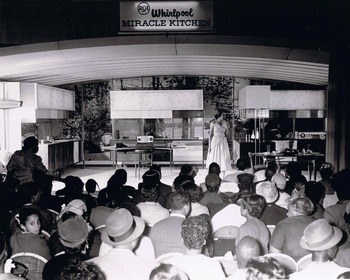
Microwave ovens figured in the Kitchen Debate, if only tangentially. Portions of Nixon and Khrushchev’s iconic confrontation took place in RCA Whirlpool’s Miracle Kitchen, which debuted at (racially segregated) U.S. home shows in 1957 and 1958 and had come to Moscow by way of the 1958 Milan Trade Fair (Figure 1). RCA Whirlpool’s “kitchen of the future” featured a “mechanical maid” floor cleaner, a self-propelled cart that delivered clean dishes to the table and dirty ones to an automatic dishwasher, and an “electronic [microwave] oven” that “bakes a cake in 3 minutes.”Footnote 4 The microwave oven presumably numbered among the “gadgets” Khrushchev famously scorned, although he apparently singled out the automatic floor cleaner for particular derision.Footnote 5
The Chicago Defender, the nation’s preeminent African American newspaper, sponsored home shows (this one in 1959) that demonstrated the RCA Whirlpool Miracle Kitchen to Black audiences. The “electronic [microwave] oven,” concealed in one of the upper cabinets, could be lowered with a wave of the hand.
Courtesy of the Obsidian Collection Archives (item number 930429703), Chicago, Illinois.

If the ostensible purpose of the American Exhibition was to elevate peaceful competition over global—and nuclear—war, the cursory attention given to microwave ovens was only fitting. For the technology that powered them originated in less than peaceful purposes. Defined by science writer Paul Brodeur as “those frequencies lying just below the infrared region of the electromagnetic spectrum and ranging in wavelength for about 100 centimeters … down to a millimeter,” microwaves were first deployed during World War II for military radar. Eventually they found applications in missile guidance systems, and as Brodeur presciently observed in 1977, “the highly classified … eavesdropping operations of the National Security Agency.” By the late twentieth century they had acquired various civilian uses—communications satellites, radio and television broadcasting, shoplifting detection devices, and, of course, ovens. Still, the origins of microwave technology lay in the military. Tellingly, weapons manufacturer Raytheon produced the first commercially available microwave oven, the Radarange, in 1947.Footnote 6
Newspaper and magazine articles published in the immediate postwar period celebrated the wartime heritage of “electronic ovens,” as microwaves initially were called. “Radar—the same thing they located submarines with during the war—had broiled a filet mignon,” a 1947 Washington Post article declared.Footnote 7 The broiling took place in the kitchen of a hotel restaurant; the size, installation requirements, and cost of early microwaves rendered them unsuitable for home use. By the time household models made their first appearances in 1955, media reports rarely noted their military origins.Footnote 8 Why is not clear. Perhaps a war that ended a decade earlier had lost its relevance; perhaps microwave manufacturers feared references to radar might alarm atomic age consumers. Sales at any rate stalled, primarily because most Americans had neither the space nor the money for an appliance approximating the dimensions of a conventional range that retailed for $1300 (more than $11,000 in 2020 dollars).Footnote 9 Until more affordable countertop versions premiered in the late 1960s and early 1970s, and for nearly a decade thereafter, microwaves designed for commercial use in restaurants, hospitals, and schools outnumbered home models. By then, few traces of the military-industrial complex remained. Raytheon marketed its 17.25 by 22.75 by 14.5 inch Radarange (1967) under the Amana brand, which it acquired in 1965. By the same token, Litton Industries gave consumers little reason to suspect that it made both MinuteMasters (1971) and missile guidance systems.Footnote 10
The increasing popularity and affordability of microwave ovens nevertheless coincided with fears about their safety. Concerns about radiation in daily life, especially as it pertained to color TVs (which emitted X-rays) and diagnostic X-rays, surfaced in the late 1960s, culminating in the passage of the Radiation Control for Health and Safety Act in 1968. The new law empowered the Department of Health, Education, and Welfare (HEW), through its subagency, the Food and Drug Administration (FDA), to establish and enforce safety standards and oversee relevant research.Footnote 11 Microwaves, unlike X-rays or nuclear weapons, are a form of nonionizing radiation—or as the FDA puts it, one that “does not have enough energy to knock electrons out of atoms.”Footnote 12 Hence, many believed them harmless. Nevertheless, microwave ovens soon joined the list of potentially hazardous appliances. First, there were reports of radiation leakage from commercial ovens, many of them with faulty door locks, purchased by the U.S. military for the Walter Reed Army Medical Center. A year later, in 1969, scientists at HEW found that about a third of the microwave ovens they tested as part of a random survey leaked radiation in excess of the agency’s proposed standards, set to go into effect in 1971, and the industry’s laxer, voluntary guidelines.Footnote 13 (The new federal standard, still in use today, “limits the amount of microwaves that can leak from an oven throughout its lifetime to 5 milliwatts (mW) of microwave radiation per square centimeter at approximately 2 inches from the oven surface.”Footnote 14) Early in 1970, investigative columnist Jack Anderson, famed for his exposés of organized crime and CIA assassination plots, accused HEW’s director of caving to industry pressure by deleting details of the specific effects of excessive exposure from its report. By December of that year, further testing by the Bureau of Radiological Health (BRH), the FDA division charged with administering the Radiation Control for Health and Safety Act, had “cleared” most models, blaming the problem not on the ovens themselves, but on inadequate maintenance.Footnote 15
Cold War espionage would raise further questions about the safety of the revolutionary new appliances that were beginning to populate American kitchens. In 1972, Anderson revealed the existence of a hitherto secret CIA file labeled “Operation Pandora.” According to its contents, the CIA and other government agencies had known for years that the Soviets had been beaming microwaves at the U.S. Embassy in Moscow, perhaps to spy on U.S. envoys, perhaps to “brainwash” them. These revelations, according to Anderson, generated a series of bizarre American scientific experiments on the impact of microwave radiation. Some of these endeavors reportedly substituted monkeys for diplomats; others used U.S. Navy personnel as “human guinea pigs.”Footnote 16
Anderson’s allegations gained little immediate traction; “Anderson caused a flurry, but only a flurry,” Washington Post columnist Stephen S. Rosenfeld wrote four years later.Footnote 17 Subsequent developments brought the Cold War home—to American kitchens. Only a year after Anderson revealed the existence of Operation Pandora, Consumer Reports magazine pronounced microwave ovens “not recommended.” Citing evidence that prolonged exposure to microwaves caused “irreversible cataracts” in humans and reduced “testicular function” in laboratory animals, CR’s April 1973 issue concluded, “We are unable to uncover data to establish to our satisfaction what level of microwave radiation emission can unequivocally be called safe.” The problem, as Consumer Reports saw it, was not an absence of standards. The problem was whether the standards had any meaning.Footnote 18
Consumer Reports forged no explicit link between Anderson’s revelations and its own recommendations. Nevertheless, by referencing the work of Soviet and Eastern European scientists, who had conducted most of the publicly available research on nonionizing radiation, it implicitly placed its findings within a Cold War framework. “not recommended” linked Moscow and Middle America by claiming that the exposure levels permitted by the BRH in American homes was 500 times higher than the Soviet bloc’s established protocols (though it noted that the two sets of standards were not strictly comparable). Equally disturbing, CR testers found significant variation between the ideal usage patterns that underpinned manufacturers’ safety ratings and the circumstances of real-life kitchens. All of the models Consumer Reports evaluated, each carrying a sticker attesting compliance with the BRH’s standards, allowed at least some microwave radiation to escape through their door seals. Various experiments—trapping paper towels in doorframes, spilling food, running an oven while empty or with small amounts of food—resulted in further leakage.Footnote 19
While the timing was coincidental, hearings on radiation and public safety convened by the Senate Committee on Commerce began just a day after Consumers Union announced that the next issue of Consumer Reports would label microwave ovens “not recommended.” The committee cast a wide net, summoning witnesses who testified on topics as diverse as nuclear radiation, diagnostic X-rays, and communications systems. Microwaves in general and microwave ovens in particular commanded considerable attention; as presiding officer John V. Tunney (D-California) explained, their rapidly rising popularity rendered them a “major source of concern.”Footnote 20
Testimony from a predictable mix of experts, bureaucrats, and industry representatives yielded no discernible conclusions and few concrete results. BRH director John C. Villforth defended his agency’s testing record, though he acknowledged that factory inspections depended on the voluntary compliance of microwave manufacturers. Even as he asserted confidence in FDA’s standards, he was forced to admit that “the long-term bio-effects of chronic, low-level microwave radiation have not been investigated in this country, and that effects of such radiation on biological structures are unknown and not reasonably postulated.” Milton M. Zaret, an ophthalmologist whose research contracts with the Army, Navy, and Air Force had been terminated, allegedly because his studies revealed the inadequacy of military safety standards, pronounced “a clear, present and ever-increasing danger to the entire population of our country from exposure to the entire non-ionizing portion of the electromagnetic spectrum.” These dangers, he claimed, included cataracts, “testicular malignancy, mental illness, cardiovascular disease, hormonal imbalance, [and] arthritis.” Raytheon research scientist John Osepchuk, testifying on behalf of the Association of Home Appliance Manufacturers, responded by paraphrasing astrophysicist James Van Allen (“The hazard from microwave ovens is about the same as getting a skin tan from moonlight”) and assailing “misinformation and nonsense based on observations and experiments by individuals of questionable competence.”Footnote 21
Witnesses made no mention of Soviet espionage, but devoted abundant attention to the merits and deficiencies of Soviet research, as well as to the validity of CR’s findings. Villforth downplayed differences between Soviet and U.S. standards and claimed—correctly, it seems—that Consumer Reports had conflated emission leakages and exposure standards. At the same time, he, like many others, cast doubt on the validity and methods of Eastern bloc research. So, too, did Osepchuk’s associate, University of Rochester biophysicist Sol Michaelson, who dismissed “questionable literature from the U.S.S.R.” characterized by “limited statistical analysis of data, inadequate controls, and lack of quantification of the results.”Footnote 22 In short, assessments of microwave safety hinged in part on the willingness of American experts to accept communist science.
To a certain extent they did. Partly in response to petitions by Consumer Reports’ parent organization, Consumers Union, the BRH required warning labels on ovens manufactured after September 29, 1975, that cautioned consumers against operating any model with faulty or damaged doors and interlock switches that prevented ovens from running with their doors open. (Nevertheless BRH standards for allowable leakage remained unchanged.) In fall 1973 and winter 1974, scientists from the United States joined their Eastern bloc counterparts at international conferences on microwave radiation.Footnote 23
Early in 1976, however, when news leaks forced the U.S. government to acknowledge the truth of Anderson’s claims, scientific détente collided with diplomatic crisis. Both U.S. and Soviet officials insisted that the “Moscow Signal”—the term intelligence officials and, later, news media used to describe the irradiation of the U.S. Embassy—was intended to jam the Americans’ own spying equipment rather than eavesdrop or threaten diplomats’ mental health. Evidence, however, suggested that intentionally or not, microwave exposure constituted a threat to physical health; American media outlets reported an alarming incidence of cancer and blood disorders among embassy personnel and developmental disabilities in their children. Rumors regarding the health of American ambassador Walter Stoessel, the evacuation of two American children for medical treatment in the United States, the federal government’s decision to compensate a former embassy staffer for his wife’s death from cancer, and the Ford administration’s bungled public messaging bolstered Zaret’s claim that microwaves posed “a clear, present and ever-increasing danger.”Footnote 24 Indeed, the State Department’s decision to install aluminum screens on the embassy’s windows and investigate possible health effects of the Moscow Signal on embassy staff suggested that the federal government believed nonionizing radiation unsafe.Footnote 25
The embassy incident raised a troubling question: If microwave emissions caused cancer in diplomats, what of the microwave radiation Americans encountered at home? “What about microwave ovens, the instrument that would probably concern American homeowners most?” Boston Globe reporter Jonathan Winer asked as part of a wide-ranging discussion of Soviet transmissions, TV and radio towers, and the health problems of radar operators. Or as Steinmann’s New York Times Magazine piece put it, “Worries About Microwaves Have Set off Reverberations in Cooking, Diplomacy and Health.” Accounts like these took their cue from Consumer Reports by contrasting apparently lax U.S. regulations for oven radiation leakage with stringent Soviet safety standards. Steinmann explained the apples-and-oranges nature of the relevant measurements; Winer opted for direct—and consequently more alarming—comparisons. Yet even Steinmann remained wary. After quoting a BRH scientist who pronounced “the exposure level possible to consumers using microwave ovens in the home … probably less than is permissible under the Russian occupational standard,” she reached a sobering conclusion. “Is this level safe, especially when you’re exposed to it repeatedly—day after day—in the kitchen? No one can say for sure.”Footnote 26
Microwave ovens sales nevertheless continued to rise, surpassing purchases of gas stoves. Sales figures did not necessarily connote ignorance or complacency. People knew about microwaves’ potential risks, a 1976 Consumers Union survey suggested, but bought them anyway. How many respondents referenced the U.S. Embassy is unknown. Many reports of microwave radiation abroad, moreover, made no mention of microwaves at home; some small-city newspapers ran Mother’s Day ads for microwave ovens alongside stories of events unfolding in Moscow.Footnote 27 Still, articles such as “Radiation Fears Fail to Slow Growth of Microwave Sales” and “Microwave Ovens Are Hot-selling Items Despite Continuing Questions on Safety,” which discussed microwave safety in light of the embassy affair, conveyed a disturbing implication: The hazards that menaced Tchaikovsky Street potentially imperiled American suburbia.Footnote 28
The members of the Senate Committee on Commerce, Science, and Transportation had the Moscow Signal on their minds when they reconvened in June 1977 for another set of hearings on radiation health and safety, this time with Senator Wendell Ford (D-Kentucky) presiding. Ford’s opening remarks referenced “the present public concern over many reports concerning radiation effects which have appeared in the media—for example, the controversy surrounding mammography, the microwave irradiation of the Moscow embassy, the Navy’s proposed project Seafarer” (a never implemented communications system). Herbert Pollack of the State Department’s Office of Medical Services reported “that to date there have not been established any radiation-related health problems in the personnel who have served in the U.S. Embassy in Moscow.” FDA and BRH administrators assured the committee that government standards for diagnostic X-rays, televisions, baggage inspections, and microwave ovens, among myriad other usages, protected public health. “Mr. Chairman, there is virtually no aspect of life in these United States that is untouched by any one or combination of the standards developed and administered by the FDA,” deputy commissioner Sherwin Gardner proclaimed, even as BRH head John Villforth, who accompanied him, acknowledged the need for further research.Footnote 29 The president of the Association of Home Appliance Manufacturers lamented the “many charges and implications pointed toward microwave ovens.” John Osepchuk, this time representing both the Institute of Electrical and Electronics Engineers and Raytheon, dismissed warnings about the radiation broadcast from communications towers and leaking from kitchen ovens: “This is science fiction… . Unfortunately, the Moscow Embassy incident has caused problems in this regard.”Footnote 30 Still, there were disquieting moments. Charles Hardin of the Conference of Radiation Control Program Directors testified to “a need for standards on microwave exposure limits for people, in addition to source emission standards.” “There is no easy way of checking up on such ovens once they have been installed in the home and used for an appreciable period of time,” Richard Setlow, senior scientist at Brookhaven National Laboratory, cautioned. “We have no good notion as to precisely how dangerous such things are.”Footnote 31
Osepchuk once again took Consumers Union to task for “confus[ing] emission and exposure.” He also pronounced two essays authored by New Yorker science writer Paul Brodeur “a disservice to the general public.” Brodeur had previously taken on laundry detergent manufacturers and the asbestos industry, in both cases castigating government regulators for failing to keep workers and consumers safe.Footnote 32 His articles on microwaves, it turned out, were merely a prelude to his full-length book, The Zapping of America, which appeared in print five months after the 1977 hearings. Though much of what he had to say was already public knowledge, Brodeur neatly tied together disparate threads—Project Pandora, the U.S. Embassy, Consumer Reports—into a persuasive whole, connecting radar operators and home cooks afflicted with cataracts to embassy personnel diagnosed disproportionately with cancer. In Brodeur’s telling, microwaves—emanating from radar systems, power lines, television and radio transmitters, telephones, CB radios, garage-door openers, color televisions, and ovens—continuously zapped unsuspecting Americans as they went about their daily lives. Equally unsettling, Brodeur charged an unholy alliance of government officials and weapons manufacturers with perpetrating a massive cover-up that kept ordinary people ignorant of the dangers that surrounded them.Footnote 33
Published at a time of heightened environmental consciousness, when hitherto oblivious Americans learned that asbestos floor tiles, formaldehyde insulation, and toxic waste posed serious threats to their health, Brodeur’s “rather shrill” (New York Times) albeit “popular and alarming book” (Time) found a ready audience. Its particular genius, however, was to suggest that no place was safe; the American kitchen, in Brodeur’s rendition, was merely a subdivision of the military-industrial complex, or as he put it, “the military-electronics industry complex.”Footnote 34 As The Zapping of America underscored, those who worried about the radiation emanating from microwave ovens knew they had reason to worry because of the afflictions that bedeviled diplomatic personnel and former soldiers. One of the latter, Raymond V. Krabbenhoft, attributed his numerous health problems—three heart attacks, two strokes, severe cataracts, and sterility— to his stint as a radar repairman on Iwo Jima. “I was cooked,” Krabbenhoft told Time in 1978.Footnote 35
Microwave ovens, then, occupied ambiguous cultural terrain. Situated physically alongside refrigerators, dishwashers, and gas or electric ranges, they now appeared in the same sentences as police radar, communication towers, espionage, and satellites. They were, indeed, what their proponents proclaimed: space age appliances. Some Americans, especially after the 1979 accident at the Three Mile Island Nuclear Generating Station, feared they were atomic appliances. “One of the biggest problems we have had in the microwave industry,” a Litton executive complained, “is the public’s not distinguishing between nuclear radiation and X-rays, and microwave radiation.”Footnote 36
During the seventies, newspaper headlines like “Are Microwave Ovens Safe?” and “The Invisible Dangers of MWOs” competed with “Microwave Oven Defended” and “The Magic of Microwave.”Footnote 37 Claims of danger and safety corresponded closely, although not always exactly, with whether they appeared in the “news” section or the “women’s” pages. A veritable army of home economists and cooking instructors—many of them employed by appliance manufacturers—assured consumers that microwave ovens were both magical and safe.Footnote 38 If the magic eventually won out, Brodeur’s book, at least temporarily, hit its mark; a July 1978 issue of Business Week attributed a slump in microwave oven sales in part to the impact of The Zapping of America. Footnote 39
Gendering the Space Age: Cold War Kitchens in the 1970s
The view from the women’s pages, for the most part, looked different. Promoters of microwave cookery, unsurprisingly, steered clear of the military-industrial complex. The major women’s magazines—Ladies’ Home Journal, Redbook, Good Housekeeping—assured their readers that government standards kept microwave ovens safe, but made no mention of Consumer Reports, the embassy incident, or Brodeur’s book.Footnote 40
Yet the Cold War continued to echo in the world of domestic media, albeit in seemingly innocuous ways. The microwave revolution belonged to the space age, one more Jetsons than Sputnik.Footnote 41 The future, as popular culture imagined it, bore a distinct resemblance to an idealized, culturally conservative present. Cooking, for instance, was women’s work, even if it required little more than pushing buttons. The home of the future depicted in Philco-Ford’s short 1967 film, 1999 A.D., featured individualized hot lunches ready in two minutes—but nevertheless the wife and “part-time homemaker” prepared them. She was “part-time,” it is worth underscoring, not because she worked outside the home, but because space age appliances promised her a “life of beauty and leisure.” In Philco-Ford’s vision, the future—at least of home cooking—was female. In a period marked by considerable turmoil (civil rights and antiwar protests, liberal feminist demands for workplace equality, and the beginnings of the women’s liberation movement—which emerged about the same time 1999 A.D. premiered in American theaters), the world depicted in 1999 A.D. offered a reassuring vision of space age domesticity.Footnote 42
By the time the future arrived in American kitchens, the United States could claim victory in both the space race and the contest over consumer goods (one reporter observed in 1972 that Soviet citizens now had access to “crude Western-style appliances,” including microwave ovens).Footnote 43 In a decade beset by inflation, unemployment, gasoline shortages, and rising energy prices, however, the space age looked less than bright. It was in this context that NASA, a key Cold War player, literally domesticated the space race and unveiled solutions—not especially practical ones—to the current energy crisis. Its Technology Utilization House, “a ‘house of the future’ ready today” (1977) incorporated solar energy and other “energy conservation techniques.” One of these was a microwave oven; it is not clear whether the model tech house even included a conventional stove. According to a pamphlet issued by NASA, “The use of a microwave is especially recommended as an energy-saving appliance, because foods cooked in a microwave oven require less time for cooking, thereby using less electricity.”Footnote 44
The house as it appeared in the technical support pamphlet was oddly or perhaps admirably genderless—and also people-less—although its Popular Mechanics–style format skewed masculine. NASA’s annual Spinoff report, on the other hand, offered subtle gender cues. While publicity stills failed to picture anyone cooking in the Tech House, they suggested a household division of labor that differed little from 1999 A.D. They positioned women, but no men, inside the Tech House performing mundane tasks—opening the door, closing window blinds, operating a home security system, sewing while sitting on a couch upholstered in flame-retardant fabric. NASA’s recommendations for maximum energy efficiency, moreover, assumed the presence of a stay-at-home wife and mother who could do laundry in the morning. Alas, the real-life family who lived in the Tech House for a year as part of the agency’s energy-saving experiment subverted this plan; both spouses worked full-time outside the home.Footnote 45
In an era of rising divorce rates, newspaper and magazine articles occasionally referenced the utility of microwaves for bachelors. Most, however, continued to envision women as the primary users. One consulting home economist acknowledged that her husband and teenage children “use the microwave oven almost as frequently as I do, mainly to reheat foods on paper plates.” As retailers recognized, the “real” cooking fell to women, a distinction the British sociologists Cynthia Cockburn and Susan Ormrod would later term the difference between “cooking” and “zapping.”Footnote 46 A microwave oven, the proprietors of a California appliance store suggested, was “the ideal gift for the woman in your life for Valentine’s Day.”Footnote 47 In a similar vein, the president of Litton’s microwave division waxed rhapsodic over the potential of microwaves to liberate women. Ms. editor Lettie Cottin Pogrebin offered a pointed rejoinder: “As long as it is going to be viewed as a labor saving device for women, forget it. We are still in the kitchen.”Footnote 48
Just how much liberation microwaves had to offer was open to question. Advertisements and women’s magazines touted their labor-saving potential; as Ladies’ Home Journal announced in 1970, they were “breaking the time barrier in thousands of U.S. kitchens.”Footnote 49 In the early seventies, commentary assumed consumers would use microwaves to prepare meals, rather than heat or reheat pre-prepared foods. Actual recipes cast doubt on the notion that microwaves saved time or even energy; from-scratch microwave cooking typically required more work than pushing a button. Because the meat that emerged from microwaves had an unappetizing gray color, cooks were advised to brown it under their conventional broilers, hide it under a sauce, or concoct a mixture from food coloring to make it look brown.Footnote 50 Consumer Reports took a dim view of such advice. Browning under the broiler after cooking “created the nuisance of having to use and clean two appliances.” The magazine’s “careful check of one claim showed the ‘hours’ saved in cooking the complete meal described in the ad to be only a few minutes.” Indeed, only 28 of the 410 microwave owners CR surveyed in 1973 said that microwave ovens saved them time. Ten even said they required more time than using conventional ovens.Footnote 51
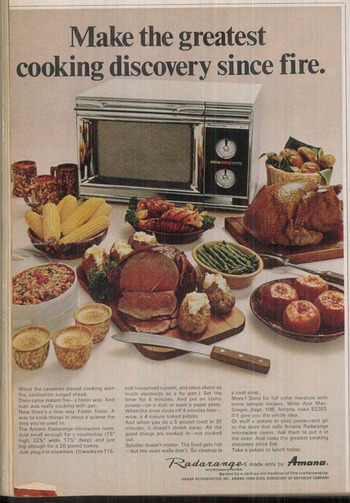
Perhaps this was because users initially believed you could make anything in a microwave, a fallacy magazine advertisements eagerly promoted (Figure 2). Who could resist “the greatest cooking discovery since fire” (Amana) or “old-fashioned slow-cooked goodness at microwave speeds” (Litton)?Footnote 52 Much as advertisers and assorted futurists seemed unable to imagine anyone but women in the space age kitchen, the food that emerged from space age ovens remained reassuringly traditional. Ads routinely pictured the results of microwave magic: roasts, breads, and assorted attractively garnished vegetable dishes, and, inevitably, turkeys (somehow always beautifully browned).Footnote 53
This 1970 advertisement for Amana’s Radarange was one of many that exaggerated the cooking capabilities of microwave ovens.
Ladies’ Home Journal, May 1970, 78. Courtesy of the Herman B Wells Library, Indiana University, Bloomington, Indiana.

Those who believed the hype were in for a rude awakening. CR test cooks reported that microwave ovens did a “dreadful job of baking brownies.” When they tried painting brown coloring on a microwaved chicken, they “hesitate[d] to call the blotchy bird appetizing.” Similar complaints trickled in from other quarters: “dry, tough food, uneven cooking, and lack of browning”; “you can just destroy a roast on high power”; “everything seems steamed.”Footnote 54 Asked what they liked best about their microwave ovens, respondents to a Good Housekeeping survey ranked “cooking results” second to last.Footnote 55 A Los Angeles Times article titled “Microwave Oven Defended” acknowledged that “some foods cook well with microwave energy and others do not.” Of course, the piece continued, “You may use conventional ranges in combination with microwave,” an assertion that undercut claims that microwave cookery necessarily saved time. Careful readers might have noticed that the defense was full of holes: “Pork chops frozen in the store package and thawed in the microwave oven may be browned on the range-top, macaroni may be cooked on the range top while the sauce is prepared in the oven.”Footnote 56 Some manufacturers obliged by marketing “cooking centers” that combined microwave and conventional ovens; Litton and General Electric experimented with “combination” and “superstove” ranges that toggled between conventional and microwave heating.Footnote 57 “New, improved” features such as browning elements, temperature probes, and an ever-multiplying choice of power levels generated considerable confusion among consumers—“You have to be Thomas Edison to know how to use it”—and a proliferation of microwave cooking classes and “schools.”Footnote 58 One headline summed it up: “It’s Great If You Know What You’re Doing.”Footnote 59 Every add-on, moreover, reduced the time gap between space age cooking and its old-fashioned counterpart.
Space age cooking, as the Tech House engineers belatedly learned, coincided with a massive uptick in women’s paid employment. Many analysts were quick to connect the two. In 1976, for instance, the New York Times attributed “sizzling” sales to “the changing role of women.”Footnote 60 The truth behind such claims is murkier; while several surveys suggested a majority of women who owned microwaves worked outside the home, at least one academic study concluded that wives’ employment status had little impact on ownership or use.Footnote 61 As mainstream magazines increasingly featured “the working woman”—the title of a regular column in Ladies’ Home Journal that ran from 1971 to 1980—a smattering of articles emphasized microwaves’ utility for women employed outside the home. Others simply recommended them to “busy” women. Advertisers embraced a similar degree of ambiguity, hedging their bets by appealing to multiple constituencies: self-identified career women, working women who still considered themselves “housewives,” and full-time homemakers. If, as historian Beth Bailey persuasively argues, “changes in gender roles were negotiated and reconciled in the American consumer marketplace as much as in the realm of politics or ideas,” gesturing to all women’s work, paid and unpaid, eagerly sought and reluctantly undertaken, was a savvy marketing strategy.Footnote 62
Whatever their relationship to the marketplace, seventies microwavers, who accounted for fewer than a tenth of American households, were an elite group. If the newer compact ovens no longer retailed at the exorbitant prices of their refrigerator-sized predecessors, they were still expensive; at mid-decade an average model cost the equivalent of $1800 to $2100 in 2020 dollars.Footnote 63 The likeliest users, according to a 1980 government survey, were families whose annual income exceeded $35,000 (approximately $118,000 today).Footnote 64 African American newspapers were some of the first publications to recommend microwaves to working wives and mothers—not surprising given Black women’s proportionally greater labor force participation. Evidence nevertheless indicates that the vast majority of microwave owners were white.Footnote 65 If microwaves saved time—a debatable assumption—it appears that the cooks who might have benefited the most were the least likely to have one. After all, as Consumer Reports reminded its readers, microwaves oven were a “luxury.”Footnote 66
Gendering Radiation Safety: Senators, Scientists, and “Housewives” in the 1970s
During the 1970s, Redbook, Woman’s Day, Ladies’ Home Journal, and their ilk gradually incorporated the insights of second wave feminism, tackling such subjects as sexuality, domestic violence, and abortion as well as work outside the home.Footnote 67 Deliberations at the heart of the military-electronics industry complex remained oblivious—or perhaps resistant—to social change. As scientists, industry reps, government officials, and members of Congress gathered to debate the safety of microwave technology, domestic and diplomatic, in the home and on the battlefield, they conjured up a world that more closely resembled 1999 A.D. (itself on the verge of gender obsolescence) than LHJ’s “Working Woman.” In an era marked by the women’s liberation movement and women’s widespread entrance into the paid labor force, both representatives of the military-electronics complex and their critics seemed unable to conceive of microwave oven users as anything but full-time homemakers. Take University of Pennsylvania scientist Lawrence Sher, who took part in a then-secret government project investigating the health impacts of the Moscow signals. At the 1969 Richmond Symposium on the Biological Effects and Health Implications of Microwave Radiation, Sher argued that microwaves were safer than conventional ovens because “my wife burns herself regularly.” “It is certainly not unusual,” he quipped, “for ovens, gas operated, to generate clinically significant problems such as the house catching on fire or other untoward results of cooking.”Footnote 68 Or “maverick” scientist Milton Zaret, who testified before the Senate Committee on Commerce in 1973 that the same sorts of cataracts that afflicted soldiers repeatedly exposed to radar could be observed in the eyes of a “housewife” whose only known exposure to nonionizing radiation was from using a microwave oven. “Photograph of the pupil in the housewife having been exposed to a leaky microwave oven, depicting microwave cataract,” read the caption for an image he submitted. “Are you satisfied that there is adequate protection that is being given to consumers in this country, particularly housewives who use microwave ovens?” Senator John Tunney asked Clay T. Whitehead, director of the Office of Telecommunications Policy.Footnote 69 Four years later, Kentucky senator Wendell Ford combined skepticism with folksiness when he asked a Litton representative if current regulations “require that you tell the consumer what to do in case the oven is damaged? For example, if the housewife hits it with a heavy cast iron skillet that we use to make cornbread out of or something of that nature?”Footnote 70
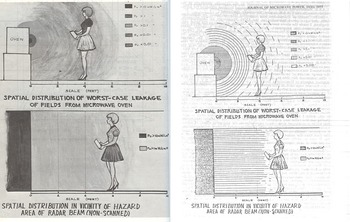
Perhaps most revealing is a slide Raytheon rep John Osepchuk presented during his testimony before the Senate Committee on Commerce. Demonstrating the “spatial distribution of worst-case leakage of fields from microwave oven” was an illustration of “a person.” “A person” scored a point for gender neutrality. The accompanying illustration did not. It depicted a cartoon woman with shapely legs, attired in a tightly bodiced, very short dress and high heels, an odd cross between June Cleaver and Barbie. Women wore miniskirts in 1973, but they also wore pants, maxiskirts—both featured in magazine microwave ads published the same year—and the occasional midi.Footnote 71 By 1977, when Osepchuk showed the members of that year’s Senate subcommittee a slightly modified version of the same image—this time reproduced from a 1975 article in the Journal of Microwave Power—the fashion it depicted definitely was outmoded (Figure 3). Footnote 72
“Spatial Distribution of Worst-Case Leakage of Fields from Microwave Oven” 1973 (left) and 1977 (reproduced from the Journal of Microwave Power, right), a diagram a Raytheon representative presented at successive Senate hearings on radiation safety, depicted a mini-skirted “housewife”—an increasingly outdated image, both economically and sartorially.
Radiation Control for Health and Safety Act of 1968, Hearings on Public Law 90-602 before the Committee on Commerce, United States Senate, 93rd Congress (1973), 118; and Radiation Health and Safety Hearings Before the Committee on Commerce, Science, and Transportation, United States Senate, 95th Congress (1977), 236. Courtesy of the Herman B Wells Library, Indiana University, Bloomington, Indiana.

So was the world the Senate hearings collectively portrayed. Women’s labor force participation was already climbing when Nixon debated Khrushchev, an upward trend that continued through the end of the century. A decade and a half later, neither senators nor witnesses acknowledged the nearly 45 percent of adult women who were gainfully employed in 1973 or the 48 percent in 1977, more than two-fifths of whom were mothers of children under six years of age. No one suggested that anyone other than a housewife push the buttons, although Osepchuk did opine that his children would think “it is fun to be able to do their own warming up of their hamburger in the microwave oven.”Footnote 73
Like the testimony before the two commerce committees, Osepchuk’s diagram conjured up an increasingly bygone era of male breadwinners and female homemakers, even if this particular homemaker wore a miniskirt instead of a New Look dress. Domestic containment, a vision of life under attack on many fronts by the 1970s, was alive and well in Osepchuk’s world; little besides fashion had changed since 1959, when Nixon famously conflated American women, imagined as universally white and generically middle class, with “housewives.”Footnote 74 But if Nixon had valorized American women, by the late 1960s and 1970s at least some scientific experts seemingly considered “housewife” a synonym for “halfwit.” The illustration of a childlike, but strangely sexualized, housewife, like Sher’s “my wife burns herself regularly,” trivialized both women and household labor. It also trivialized the issue of safety.Footnote 75
Superwomen and Second Shifts: “Nuking” in the 1980s
By the 1980s, the space age was mostly in the past. Despite a brief resurgence of Soviet radiation directed at U.S. diplomats, a combination of interagency conflict, industry pressure, bureaucratic inertia, and Reagan-era budget cuts stymied further attempts to regulate microwave radiation in general and microwave ovens in particular.Footnote 76 Given the State Department’s finding that microwaves had nothing to do with high white blood cells counts among embassy employees (a Johns Hopkins study blamed an unidentified “microbe”) and given that exposure during a 1983 incident was well below hazardous levels, at least as U.S. standards defined them, the current U.S. ambassador protested merely as a “matter of principle.”Footnote 77 As the Moscow Signal faded from the headlines, American media devoted less attention to the perceived dangers of microwave radiation. “Burning Issue of Microwave Safety Has Cooled Down,” a Chicago Tribune article announced in 1983. “Ten years ago, when my husband wanted to give me a microwave oven for our anniversary, I asked if he was trying to get rid of me,” New York Times health columnist Jane Brody wrote in 1986. “Last Christmas, however, I bought one myself.” Footnote 78
Doubts persisted. Brody touted microwaves’ improved safety and energy-saving potential. She praised the nutritional benefits of microwave cookery. Yet she conveyed a mixed message. The ubiquitous presence of microwaves—“military and police radar, long-distance telephone communications, UHF broadcasts, deep-heat treatments, computer terminals and many manufacturing processes,” she explained, exposed many Americans to “already substantial” levels of radiation. These circumstances warranted vigilance in the kitchen: “The best defense against escaping microwaves is to remain a foot or more away from the oven when it is in use.” Close to half of the microwave owners who responded to a survey commissioned by Campbell Soup Company a year later expressed concerns about safety. If the Moscow Signal had receded from view, the larger fears the Cold War engendered had not. The now commonplace slang for microwaving (“nuking”) first appeared in 1984, a time of intense anxiety about nuclear warfare.Footnote 79
Nevertheless, sales soared. According to the Department of Energy’s Residential Energy Consumption Survey, 14 percent of American households owned a microwave oven in 1980, 34 percent in 1984, and 79 percent in 1990.Footnote 80 Some commentators credited a steep decline in prices—by the late 1980s, some smaller models cost less than $100. “Coinciding with the price drop has been an erosion in the safety fears about microwave use,” the Chicago Tribune explained in 1987. Footnote 81 Others pointed to the widespread movement of women into the paid labor force. “Housewares Lighten the Load of Working Women,” the African American Chicago Defender noted in 1978. That same year, the president of Litton’s microwave products division predicted the tripling of the market by 1985 “mainly because of the growing spending power of working women.”Footnote 82
In the era of the mythic “superwoman” who effortlessly combined work and family, women’s magazines catered more aggressively to readers who worked outside the home and presented them with meals that could be “fixed in a flash.” Newer publications such as Working Mother explicitly sought out career women, but filled page after page with childcare, housekeeping, and cooking tips—and time-saving recipes for home-cooked microwaved meals, including an entire Thanksgiving dinner.Footnote 83 Just how much time these superwoman cooks saved is unclear; much like 1970s home economists, Working Mother’s regular “Microwave Mastery” column acknowledged that “what the microwave is best at is working as a partner with your conventional oven, broiler, range and barbecue grill.”Footnote 84
Despite the advent of browning dishes, combination ranges, specialized cookbooks, corporate-sponsored cooking contests, and advice on home appliance partnership, many users gave up on “old-fashioned slow-cooked goodness at microwave speeds.”Footnote 85 Surveys showed that people used microwaves mainly for defrosting and reheating. Encouraged by the microwave industry and grocery chains—who hoped to counteract busy Americans’ growing dependence on fast food restaurants—food corporations rushed to fill the gap between increasing microwave ownership and decreasing use. Campbell Soup, Stouffer’s, Oscar Mayer, and Green Giant (an early adopter), among others, added microwaving directions to their labels.Footnote 86 Kraft rebranded Cheez Whiz as “the marvelous microwave in-a-minute cheese sauce.”Footnote 87 Pillsbury pioneered products manufactured specifically for microwaves—popcorn, cake mixes, and pancakes. Other makers of prepared foods followed suit; as a product manager for Amana’s Radarange explained in 1979, “virtually all the major food companies have issued what amounts to an edict that no new products will be developed unless they provide good results in a microwave oven.”Footnote 88 New products necessarily came in new packages—microwave-friendly paper or plastic replaced metal trays.Footnote 89
These innovations built on decades of industrial food production and marketing campaigns that persuaded consumers to buy canned soups, frozen vegetables, instant oatmeal, and other “convenience” foods. Making a product microwavable promised to cook an already convenient food faster. In some cases, this meant simply changing the packaging, in others, such as microwave cake and brownie mixes, the formula.Footnote 90 In 1973, an LA Times food writer had predicted, “The time may come when whole sections of supermarkets will be devoted to prepared foods you can pop in your microwave oven.”Footnote 91 By the late eighties, that vision had come to pass.
As Ruth Schwartz Cowan brilliantly argued almost forty years ago, domestic labor-saving devices tended only to increase women’s workload. Yet in an era of gender upheaval, microwaves theoretically had the potential to shift household division of labor. One 1980s television commercial for the Whirlpool TimeMaster implied as much, by showing a husband preparing dinner in advance of his power-suited wife’s arrival. The ad reflected a certain reality; a Working Mother survey revealed that husbands were more likely to use microwave ovens than other sorts of appliances, including dishwashers, washing machines, dryers, and vacuum cleaners. Still, wives used them more. Whirlpool’s ad, too, undercut any claims to gender equality; the couple’s tween-aged daughter, standing alarmingly near the oven door, had to show dad the TimeMaster ropes.Footnote 92
Housework remained stubbornly gendered, even if microwaving moved the needle just a bit. Study after study showed that in dual-career heterosexual families, women did the bulk of the housework, including the cooking. In this milieu, the marriage of convenience between microwave technology and a burgeoning frozen foods industry offered women who worked outside the home one privatized solution to what the sociologist Arlie Russell Hochschild in 1989 termed “the second shift.” Certainly, as Hochschild noted, advertisers marketed microwaves that way: “her husband may not be helping her at home, but her machine is.” At least one reader of Working Mother, “whose husband does nothing around the house except run the vacuum cleaner occasionally,” agreed: “Cooking on weekends and owning a microwave are all that stand between myself and insanity.”Footnote 93
Yet microwave ovens and microwavable meals failed to live up to their revolutionary potential, allowing for some corner-cutting, but saving little time overall. “Microwaves, self-cleaning ovens, and no-frost refrigerators have helped compress some household work,” a Washington Post article concluded, “but most working women are still swamped.” Even as late as 1990, only 23 percent of the households surveyed by the U.S. Department of Energy used microwave ovens to cook more than half their food. Five years later, a New York Times article proclaimed microwave cooking “the revolution that never happened.”Footnote 94
Safety remained an issue. Over the course of the 1980s, however, newspapers and magazines gradually shifted their focus from the imperceptible impact of nonionizing radiation to tangible dangers—the hazards of hot liquids, plastic wrap, and undercooked pork.Footnote 95 The hottest microwave safety topic of the late eighties and early nineties concerned the question of whether—and at what ages—parents should allow their children to use them. Articles such as “Can Your Child Use a Microwave Safely?” and “Is it Safe for Children to Use a Microwave?” made no mention of radiation. Rather, they enumerated the injuries and accidents that might result when unsupervised kids failed to use oven mitts or microwave-safe cookware, swallowed microwaved food before testing its temperature, or carelessly exposed themselves to steam (microwave popcorn bags were a major culprit here). Although text and accompanying photographs showed parents and children microwaving together, magazines and the advice they proffered acknowledged changes in family life wrought by middle-class women’s entry into the paid labor force: more children were home alone with convenience foods—many of which targeted school-age audiences—and microwave ovens.Footnote 96 The problem was not that juvenile users exposed themselves to electromagnetic waves. The hazards were far more conventional, the dangers domesticated and preventable. New definitions of safety put the microwave oven back into the kitchen, leaving questions about the potential dangers of low-level radiation unresolved. Despite its allegiance to tradition, the military-electronics industry complex had triumphed, in large part because the majority of American women no longer were “housewives.”
Coda: Havana Syndrome
By the 1990s, few Americans perceived any relationship between foreign policy and the appliances on their kitchen countertops. The Cold War was over. So, too, for the most part was the war on countertop radiation. But microwaves and espionage are once again in the news. In late 2016, barely a year after the United States and Cuba restored diplomatic relations, staff at the U.S. Embassy in Havana began to experience mysterious health problems—hearing loss, headaches, nausea, dizziness, cognitive impairment. Over the next five years, “Havana Syndrome,” as the media dubbed it, spread across the globe, afflicting U.S. diplomats in China, Russia, Austria, India, and Vietnam, among other places. While its origins continue to be debated, the National Academies of Sciences, Engineering, and Medicine, in a report commissioned by the State Department and released in December 2020, cited “radiofrequency energy, a type of radiation that includes microwaves” as Havana Syndrome’s “most probable cause.”Footnote 97 The finding, which seemed to confirm a good deal of previous speculation, conjured up memories of the Moscow Signal and speculation that Russia was behind the more recent attacks.Footnote 98 With few exceptions, it did not conjure up references to microwave ovens; the media marriage between espionage, military weaponry, and microwave ovens evidently had ended in divorce. One exception seemingly proved the rule: New York Times science journalist William J. Broad contrasted the probable effects of the “concentrated beams” directed at diplomats with “such everyday uses as microwaving foods.” In the latter instance, “They’re seen as harmless.” Broad’s particular turn of phrase—“seen as harmless” recalls Marion Steinmann’s concluding words more than forty years before: “If my tiny Manhattan kitchen were large enough, I would probably keep and use a microwave oven there. But I would be careful about following manufacturer’s safety instructions and, to be doubly safe, I would stay well away from the thing while it was on.”Footnote 99
Acknowledgement
I presented an earlier version of this essay at the 2019 Gender, Labour, and Consumption in Historical Perspective conference at the University of Essex. I thank the organizers and participants, especially Sarah Elvins, Vicki Howard, and Katherine Parkin, for their helpful comments. I am also grateful to Enterprise & Society editor Andrew Popp and the anonymous reviewers for close and careful readings. Finally, my thanks to Thomas Pegram for suggesting the title and Nazareth A. Pantaloni III, head of the Copyright Program at the Indiana University Libraries, for help with images.