During the 2009 influenza A (H1N1) pandemic, the World Health Organization issued considerations for assessing pandemic severity: “Assessment of the severity of a pandemic is complex. Experience has shown that past influenza pandemics have varied in terms of severity, and that the associated health impacts may vary significantly based on a variety of factors.”Reference Chan12 Health care preparedness and hospital management are among these key factors.34
In early 2009, amid much unpredictability about lethality and spread of the pandemic virus, health care systems assumed the challenge of preparing to respond to potential increased strains on hospitals.56 An essential tool in doing so was integrated data management, which enabled up-to-date strategic decision making regarding hospital resources.78
To achieve routine monitoring of critical hospital events, it is necessary to select and monitor key hospital processes that may require rapid changes, reinforcements, or reassessments.9Reference Buckle and Barrabino10 Daily monitoring is preferable because resource needs may change within hours and rapid strategic decision making may be necessary. Ideally, integrated information about key hospital processes should be easily available and visible. To allow strategic decision making, an integrated information management system should compile information from key hospital sectors in a timely fashion to provide a comprehensive overview. In this manner, hospital management may continuously modify and adapt to changing needs by maintaining and optimizing response levels.Reference Villalbí, Villalbí and Guix11Reference Kaplan and Norton12
Hospital Nacional Profesor Alejandro Posadas (Hospital Posadas) is the largest national hospital in Argentina, a tertiary care, multispecialty referral center in the capital province of Buenos Aires having more than 400 beds. During the peak of the 2009 H1N1 influenza pandemic, the hospital successfully treated a large urban patient population. Integral to the hospital's success was the integrated information management system created by the pandemic planning committee the authors formed in April 2009, after severe influenza had been reported in North America but before any suspected cases of H1N1 influenza had been reported in Argentina. In this article, we describe our successful pandemic planning strategy with the hope that it may serve as a template for other hospitals.13
Hospital Posadas treats approximately 20 000 inpatients and 500 000 outpatients each year and has a staff of approximately 3000. Hospital physical resources before pandemic planning began included 26 adult intensive care beds and 16 pediatric intensive care beds; 198 general adult beds, including 80 with central oxygen; 100 general pediatric beds, including 80 with central oxygen; and 4 pediatric chronic care beds. Outpatient physical resources included for adult ambulatory care 17 single rooms, 2 clinics, a separate area for patient triage, 2 nurses rooms, a physicians' lounge, and an administrative reception area; and for pediatric ambulatory care 9 offices, 12 observation rooms, a resuscitation room, a nurses' station, a physicians' lounge, a waiting room, a patient triage area, and an administrative reception area.
METHODS
During the peak H1N1 pandemic period in Argentina in late June and early July 2009, the Hospital Posadas pandemic planning committee met daily to compile and review information from multiple key institutional sectors.14 We describe in this section the data sources and methodology for integrating all of the information and demonstrate sample integrated information tables.
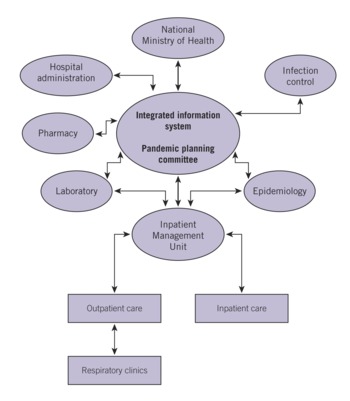
Daily during this period, our pandemic planning committee reviewed data provided by our hospital's inpatient management unit, including numbers of inpatient admissions and ambulatory care visits. Our epidemiology office provided data on consultations involving notifiable diseases, including influenza-like illness. Our laboratory office provided the numbers of samples that tested positive for influenza A by immunofluorescence, and after June 26, 2009, when the Hospital Posadas laboratory acquired materials for performing real-time polymerase chain reaction on site, the number of samples that tested positive for 2009 H1N1 influenza. Our pharmacy department provided amounts of available critical pharmaceutical resources, including antiviral stores. Our central supply warehouse provided data on available personal protective equipment, including quantities of disposable gloves, gowns, respirators, and surgical masks. The personnel department monitored staff with influenza symptoms and provided daily counts. Data flow is illustrated in Figure 1.
Data flow within the integrated information system.

The data produced by each of these sectors were reported daily either manually or electronically (by e-mail or short message service text message) to be entered into a database for integrated information management. Data were then incorporated into automatically updated detailed reports. Reports could be sorted by hospital specialty area, patient age (adult vs pediatric), or level of care. Summaries could be viewed at a single point in time or longitudinally. Daily summary reports were immediately available to the pandemic planning committee and hospital leadership, who maintained communication with all of the hospital services as well as the regional and national ministries of health through e-mail. System revisions were ongoing as resource targets and management strategies were refined.
The resource requirements to initiate and maintain the integrated information system were not insignificant. The largest cost was to assign 3 full-time data managers and 1 data entry coordinator the tasks of data collection and analysis. Other resources required were dedicated computers and a workroom. We used readily available database software (Excel, Microsoft, Seattle, WA) for a minimal initial outlay of expenditures.
One notable difficulty in the interpretation of these data was identifying suitable baselines for comparison. Comparable daily data from past years did not always exist in an easily accessible format, or at all. To avoid this obstacle, we focused on continuous daily monitoring of hospital admissions for respiratory diagnoses, using trends in these data as a guide to interpreting resource needs in other key hospital sectors.Reference Raffo15
In the initial version of our integrated information management system, as of June 16, 2009, the measures collected were date, epidemiologic week (standardized week number according to the annual calendar), numbers of hospital admissions, numbers of patients with respiratory vs nonrespiratory symptoms, ratio of respiratory to nonrespiratory hospitalized patients, numbers of suspected and confirmed H1N1 influenza cases, general vs critical care hospitalized patients, and intubated patients receiving mechanical ventilation. All of these data were collected and tracked separately for adult and pediatric patients.
In the second version of our system, as of July 1, 2009, additional measures collected were the numbers of outpatient ambulatory consultations for adult and pediatric patients, peak daily respiratory patients, general vs critical care hospitalized patients with respiratory symptoms, confirmed and pending laboratory results, seasonal impact, and sufficient information to create epidemiologic curves for ambulatory and hospitalized patients. These measures were chosen based on demand from leaders of clinical services.
Finally, on July 20, 2009, to the measures collected were added information regarding quantity of available personal protective equipment and pharmaceutical supplies and levels of daily staff absenteeism. These measures were chosen based on demand from leaders of resource management systems.
RESULTS
During the peak pandemic period, we learned the following from our integrated information management system. During epidemiological weeks 24 to 31 (June 14–August 8, 2009), our hospital had 582 inpatients with respiratory symptoms who were tested for influenza. Of these, 282 (48%) tested positive for 2009 influenza A (H1N1), 164 (28%) tested negative, 125 (21%) had specimens that could not be processed, and 11 (1%) had test results that were consistent with seasonal influenza.
Among the 282 hospitalized patients with confirmed H1N1 influenza, 137 (48%) were male and 144 (51%) were female patients, with a median age of 26.4 years. Among all of the hospitalized patients with confirmed H1N1 influenza, 80 (37%) were younger than 15 years, 82 (38%) were 15 to 45 years old, and 55 (25%) were older than 45 years. During this period, 90 patients were admitted to the intensive care unit with respiratory symptoms and 43 (48%) were confirmed as being positive for H1N1 influenza, for an intensive care admission rate of 15% among all of the hospitalized patients with confirmed H1N1 influenza. Among 33 patients who died from severe respiratory disease at the hospital during this period, 19 were confirmed to have H1N1 influenza, for a mortality rate of 6.7% among hospitalized patients with confirmed H1N1. Among the fatalities with confirmed H1N1 influenza, 6 (32%) were younger than 15 years and hospitalized in the pediatric intensive care unit at the time; of the older patients, who were housed in the adult intensive care unit at the time, 10 (53%) were 15 to 45 years old, and 3 (16%) were older than 45 years.Reference Estenssoro, Ríos and Apezteguía16Reference Libster, Bugna and Coviello17 Compared with averages from prior years, these numbers represent an increase in the number of respiratory patients at this hospital, especially in intensive care areas.Reference Aguilar, Rios and Raffo18Reference Rios, Valentini and Estenssoro19Reference Aguilar, Rios and Pezzola20
Our integrated information system permitted daily aggregation and analysis of data to address ongoing needs at the hospital. Although Hospital Posadas is a referral center, no patients were turned away during the peak of the pandemic.
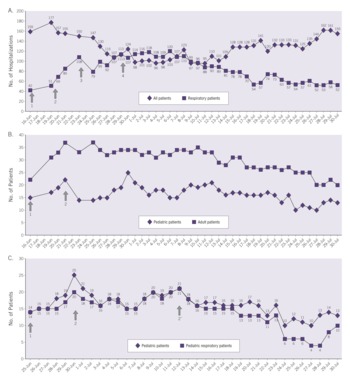
Examples of the summary data displayed by our integrated information management system are included in Figure 2, where the arrows represent the dates of significant decisions. We present 3 examples of strategic decision making applied to daily pandemic data: respiratory admissions, intubated patients receiving mechanical ventilation, and pediatric critical care patients.
Pandemic planning data in the integrated information management system. A, Respiratory vs nonrespiratory hospital admissions; B, adult and pediatric intubated patients receiving mechanical ventilation; C, respiratory vs nonrespiratory pediatric critical care patients. Arrows represent decision points (see text).

Example 1: Respiratory Admissions
A summary graph of overall hospital admissions for respiratory vs nonrespiratory diagnoses is displayed in Figure 2A, with key decision points marked by arrows. On June 16, 2009, the total number of respiratory patients admitted exceeded our historical baseline; with this information, we decided to dedicate 2 new hospital areas to the care of patients with suspected H1N1 influenza. These areas included 17 dedicated clinic isolation rooms for outpatients and 16 dedicated beds with central oxygen for inpatients with suspected influenza.
On June 20, 2009, in response to a rapid increase in the number of hospitalized patients with respiratory symptoms, we dedicated a floor of 32 beds with central oxygen, compressed air, and suction for noninvasive monitoring care of patients with suspected H1N1 influenza. Some existing staff members were reassigned to this area, and temporary nursing, administrative, supervisory, and cleaning staff were also hired.
On June 23, 2009, our information management system showed a 57% increase in hospitalized respiratory patients during a 72–hour period, from 69 patients on June 20, 2009 to 108 patients on June 23, 2009. At this point, another similar 32-bed floor was dedicated to the care of patients with suspected influenza. Within 1 week, we had readapted 72 beds for intermediate care and a total of 188 inpatient beds overall. After our absenteeism information system was activated, we were able to direct containment teams to patients, families, and staff.
On June 28, 2009, our integrated information system demonstrated a 155% cumulative increase in hospitalized respiratory patients during the first 12 days of monitoring, from 42 patients on June 16, 2009 to 107 patients on June 28, 2009. At this time, we increased our adult intermediate care beds from 72 to 89 (a 24% increase) and again shifted dedicated staff to these areas.
Example 2: Intubated Patients
A summary graph of adult and pediatric intubated patients receiving mechanical ventilation is displayed in Figure 2B. This graph aided daily decision making as follows: On June 23, 2009, our integrated information system demonstrated that intubated patients requiring mechanical ventilation had increased by 59% during a 7-day period, from 37 patients on June 16, 2009, to 59 patients on June 23, 2009. In response, we purchased supplies including 40 ventilators and 30 oximeters and 25 multiparametric monitors. These additions increased our hospital ventilator capacity from 53 to a total of 93 ventilators, a 75% increase. We also hired 70 additional temporary nurses and offered overtime shifts to existing staff in critical areas.
Example 3: Pediatric Critical Care
A summary graph of respiratory vs nonrespiratory pediatric critical care patients is displayed in Figure 2C. There were 2 peaks in pediatric critical care demand, compared with a baseline of 14 patients receiving mechanical ventilation on June 25, 2009. The first peak of 25 patients receiving mechanical ventilation occurred on June 30, 2009. The second peak of 21 patients occurred on July 12, 2009. Based on these data from the integrated information system, we decided to reallocate our 4 pediatric chronic care beds to pediatric critical care beds. This increased our total pediatric critical care beds from 16 to 20 beds, a 25% increase.
The challenges we faced in collecting these data included the inability to link data together at the patient level, making analysis of individual risk factors or treatment effectiveness difficult. Nevertheless, hospital management and ward teams were pleased with the timeliness and accuracy of the reports for making decisions about resource use at the hospital level.
DISCUSSION
In many health care institutions, various informatics subsystems coexist among hospital services, diagnostic areas, and administrative centers, all producing performance summary reports at different intervals. In our experience at Hospital Posadas during the peak of the H1N1 influenza pandemic, there were increased demands on multiple hospital sectors, including facilities, resources, administration, and staff. Our key recommendation is the integration of information about increased demands on different hospital sectors for the purpose of strategic decision making based on current data.
Although the hospital-wide approach is useful for resource management, this approach may be of limited utility when analyzing individual patient-level data. Furthermore, establishing baselines for comparison in advance of the pandemic event would be preferable to relying on relative increases in need, as we did. Furthermore, these efforts would not be possible without commitments of infrastructure, including information technology support and communications networks that allowed rapid data transmission between hospital sectors. Periodic reevaluation is necessary to ensure that the information measures collected accurately reflect the strategic needs of the local institution.
We plan to continue the use of this system as our hospital continues to work to be prepared for future pandemics. The next steps include improving automatic data entry from each hospital sector for ongoing monitoring by hospital leadership. We suggest that a comprehensive integrated information management system can help hospital management use data for making decisions that are tailored to the strategic needs of the local institution, especially during a pandemic crisis.
CONCLUSIONS
We successfully revised the measures collected by the information management system as the pandemic continued. Daily information processing and reporting improved monitoring and timely decision making, including reallocation of hospital resources and staff as the need arose. Based on this foundation, our pandemic planning committee was able to adapt to ongoing challenges and successfully guide our hospital through the peak pandemic period. Throughout the 2009 H1N1 influenza pandemic, Hospital Posadas did not turn away any patients.
Author Disclosures: The author reports no conflicts of interest.
Acknowledgements The authors thank their colleagues at the National Ministry of Health in Argentina, the Pan American Health Organization, and the Centers for Disease Control and Prevention, particularly Dr Marc-Alain Widdowson, for encouraging this collaboration.